
2. Does Valeria need any disability income coverage? Explain.
If Valeria became disable, the only disability income would be from Social Security of $700 per
they need to examine the disability insurance available to them and the cost of that insurance.
3. What specific recommendations regarding disability income insurance would you give
Valeria and Matias to provide adequate protection for themselves and their child?
Matias needs additional disability insurance. First he should check with his employer to see if he

Test Yourself
9-1 Why should health insurance planning be included in your personal financial plan?
9-2 What factors have contributed to today’s high costs of health care and health
insurance?
It is commonly stated that the demand for health services is a function of supply. If the service is
9-3 What are the two main sources of health insurance coverage in the United States?
Health insurance coverage is available from two main sources: private and government-
9-4 What is group health insurance? Differentiate between group and individual health
insurance.
Group health insurance refers to health insurance contracts written between a group (such as an
employer, union, credit union, or other organization) and the health care provider: a private
9-5 Describe the features of traditional indemnity (fee-for-service) plans and explain the
differences between them and managed care plans.
Most private health insurance plans fall into one of two categories: traditional indemnity (fee-for-
service) plans and managed care plans, which include health maintenance organizations

9-6 Briefly explain how an HMO works. Compare and contrast group HMOs, IPAs, and
PPOs.
A health maintenance organization (HMO) is an organization of hospitals, physicians, and
other health care providers who have joined to provide comprehensive health care services to its
9-7 Discuss the basics of the Blue Cross/Blue Shield plans.
Blue Cross/Blue Shield plans historically were not insurance policies, but rather are prepaid
9-8 Who is eligible for Medicare and Medicaid benefits? What do those benefits
encompass?
Medicare is a federally funded and operated plan that provides health insurance to all who are 65
and older or receiving disability from Social Security. The doctors and other providers agree to
9-9 What is the objective of workers’ compensation insurance? Explain its benefits for
employees who are injured on the job or become ill through work-related causes.
Workers’ compensation insurance is designed to compensate workers who are injured on the
job or become ill through work-related causes. Although mandated by the federal government,
9-10 What are the key provisions of the ACA? How is it likely to affect your health care
insurance?
The ACA has two key goals:
• Reduce the number of uninsured citizens in the country. All citizens not covered by
Medicare or Medicaid are required to purchase insurance. Low income citizens may qualify
for a tax credit to help pay for the insurance.

9-11 Explain four methods for controlling the risks associated with health care expenses.
Recall from Chapter 8 that you can deal with risk in four ways: risk avoidance, loss prevention
and control, risk assumption, and insurance.
9-12 Explain what factors should be considered in evaluating available employer-sponsored
health insurance plans.
Group plans are less expensive than individual plans. So, the factors to examine are the
alternatives that are offered. For example, a single person would not opt for family coverage.
Vision and hearing options may not apply at this time and may be added at a later date.
9-13 Discuss possible sources of health insurance available to supplement employer
sponsored health insurance plans.
9-14 Answer the key questions posed to help you choose a plan, based on your current
situation. What type of plan do you think will best suit your needs?
The financial road sign, “Choosing a Health Insurance Plan” gives a list of questions to answer
in selecting a plan. They are:
Ask the following questions when choosing among health care insurance plans:
• Can I choose to use any doctor, hospital, clinic, or pharmacy?
9-15 Explain the differences between hospitalization insurance and surgical expense
insurance.
Hospitalization policies usually pay for a portion of:
(1) the hospital’s daily semiprivate room rate, which typically includes meals, nursing care, and
other routine services; and

9-16 What are the features of a major medical plan? Compare major medical to
comprehensive major medical insurance.
Major medical coverage is designed to finance medical costs of a more catastrophic nature and
provides benefits for nearly all types of medical expenses resulting from either illnesses or
accidents. The amounts that can be collected under this coverage are relatively large. Major
9-17 Describe these policy provisions commonly found in medical expense plans: (a)
deductibles, (b) co-insurance, and (c) coordination of benefits.
A deductible is a fixed amount that the patient must pay before any insurance benefits will be
available. The deductible may apply to the total charges or to a class of charges.
9-18 What are the key provisions of COBRA? How do they relate to continuation of group
coverage when an employee voluntarily or involuntarily leaves the insured group?
When employees voluntarily or involuntarily (except in the case of gross misconduct) leave their

9-19 Explain the cost containment provisions commonly found in medical expense plans.
How might the provision for second surgical opinions help an insurer contain its costs?
Typical cost containment provisions include the following:
Pre-admission certification: Insurance company must approve scheduled hospitalization and an
estimated length of stay.
9-20 Why should a consumer consider purchasing a long-term care insurance policy?
Most regular health care policies do not cover the cost of long-term care. As more of the
population lives longer, there is a greater likelihood that many people will at some point in their
lives be unable to care for themselves for an extended time period. Long-term care insurance
9-21 Describe the differences among long-term-care policies regarding (a) type of care, (b)
eligibility requirements, and (c) services covered. List and discuss some other important
policy provisions.
a. Type of care: Policies will cover care in either a nursing home or in the home of the
insured, or both. Obviously, a better policy will cover both situations.
Other long-term care policy provisions include:
Daily benefits—sets a daily maximum for reimbursement.
Benefit duration—how long the benefits will be paid; ranges from one year to the insured’s
lifetime. However, most common policy limits coverage to three years.
Waiting period—period after eligibility begins during which no benefit payments are made; the
longer the waiting period, the lower the premium.
Renewability—guaranteed renewability assures continued coverage as long as premiums are
9-22 Discuss some of the questions one should ask before buying long-term-care insurance.
What guidelines can be used to choose the right policy?
The Financial Planning Tips covers buying long-term care insurance. The major points are:
Buy the right amount and the right kind of coverage.
Buy at the right time.
9-23 What is disability income insurance? Explain the waiting-period provisions found in
such policies.
Disability income insurance provides families with weekly or monthly payments to replace
income when the insured is unable to work because of a covered illness, injury, or disease.
9-24 Describe both the liberal and strict definitions used to establish whether an insured is
disabled.
Disability policies vary in the standards you must meet to receive benefits. Some pay benefits if
you’re unable to perform the duties of your customary occupation—the own occupation (or
“Own Occ”) definition—whereas others pay only if you can engage in no gainful employment at
9-25 Why is it important to consider benefit duration when shopping for disability income
coverage?
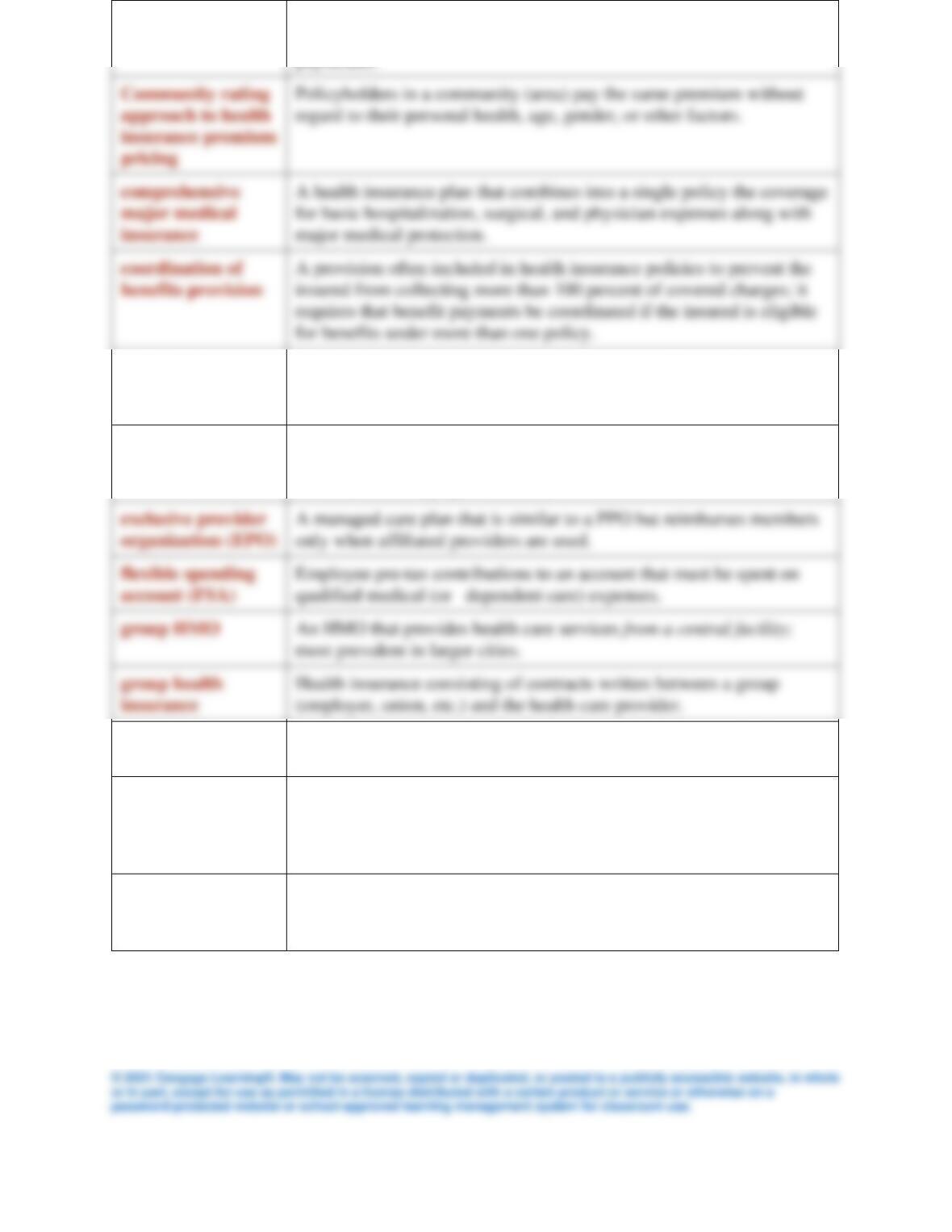
Blue Cross/Blue
Shield plans
Prepaid hospital and medical expense plans under which health care
services are provided to plan participants by member hospitals and
physicians.
comprehensive
major medical
insurance
A health insurance plan that combines into a single policy the coverage
for basic hospitalization, surgical, and physician expenses along with
major medical protection.
coordination of
benefits provision
insured from collecting more than 100 percent of covered charges; it
requires that benefit payments be coordinated if the insured is eligible
for benefits under more than one policy.
deductible
The initial amount not covered by an insurance policy and thus the
insured’s responsibility; it’s usually determined on a calendar-year
basis or on a per-illness or per-accident basis.
disability income
insurance
Insurance that provides families with weekly or monthly payments to
replace income when the insured is unable to work because of a
covered illness, injury, or disease.
exclusive provider
organization (EPO)
A managed care plan that is similar to a PPO but reimburses members
only when affiliated providers are used.
flexible spending
account (FSA)
Employee pre-tax contributions to an account that must be spent on
qualified medical (or dependent care) expenses.
group health
insurance
Health insurance consisting of contracts written between a group
(employer, union, etc.) and the health care provider.
guaranteed
renewability
A policy provision ensuring continued insurance coverage for the
insured’s lifetime, so long as the premiums continue to be paid.
Health Insurance
Portability and
Accountability Act
(HIPAA)
A federal law that protects people’s ability to obtain continued health
insurance after they leave a job or retire, even if they have a serious
health problem.
health maintenance
organization
(HMO)
An organization of hospitals, physicians, and other health care
providers that have joined to provide comprehensive health care
services to its members, who pay a monthly fee.
health
reimbursement
account (HRA)
An account into which employers place contributions that employees
can use to pay for medical expenses. Usually combined with a high
deductible health insurance policy.
health savings
account (HSA)
A tax-free savings account—funded by employees, employer, or
both—to spend on routine medical costs. Usually combined with a
high deductible policy to pay for catastrophic care.
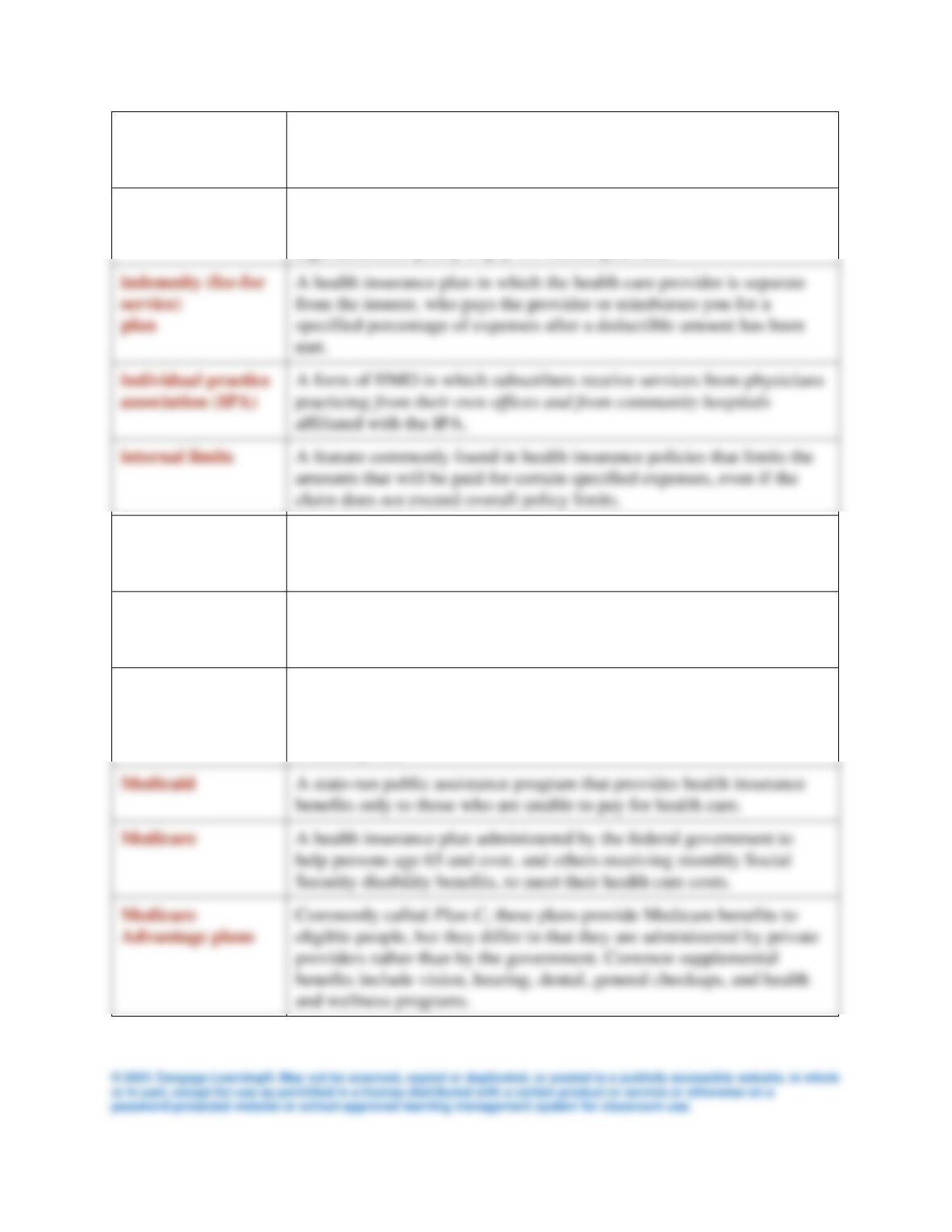
indemnity (fee-for
service)
plan
A health insurance plan in which the health care provider is separate
from the insurer, who pays the provider or reimburses you for a
specified percentage of expenses after a deductible amount has been
met.
internal limits
A feature commonly found in health insurance policies that limits the
amounts that will be paid for certain specified expenses, even if the
claim does not exceed overall policy limits.
long-term care
The delivery of medical and personal care, other than hospital care, to
persons with chronic medical conditions resulting from either illness or
frailty.
major medical plan
An insurance plan designed to supplement the basic coverage of
hospitalization, surgical, and physician expenses; used to finance more
catastrophic medical costs.
managed care plan
A health care plan in which subscribers/users contract with the
provider organization, which uses a designated group of providers
meeting specific selection standards to furnish health care services for
a monthly fee.
Medicaid
A state-run public assistance program that provides health insurance
benefits only to those who are unable to pay for health care.
Medicare
A health insurance plan administered by the federal government to
help persons age 65 and over, and others receiving monthly Social
Security disability benefits, to meet their health care costs.
optional
renewability
A contractual clause allowing the insured to continue insurance only at
the insurer’s option.
participation
(co-insurance)
clause
A provision in many health insurance policies stipulating that the
insurer will pay some portion— say, 80 or 90 percent—of the amount
of the covered loss in excess of the deductible
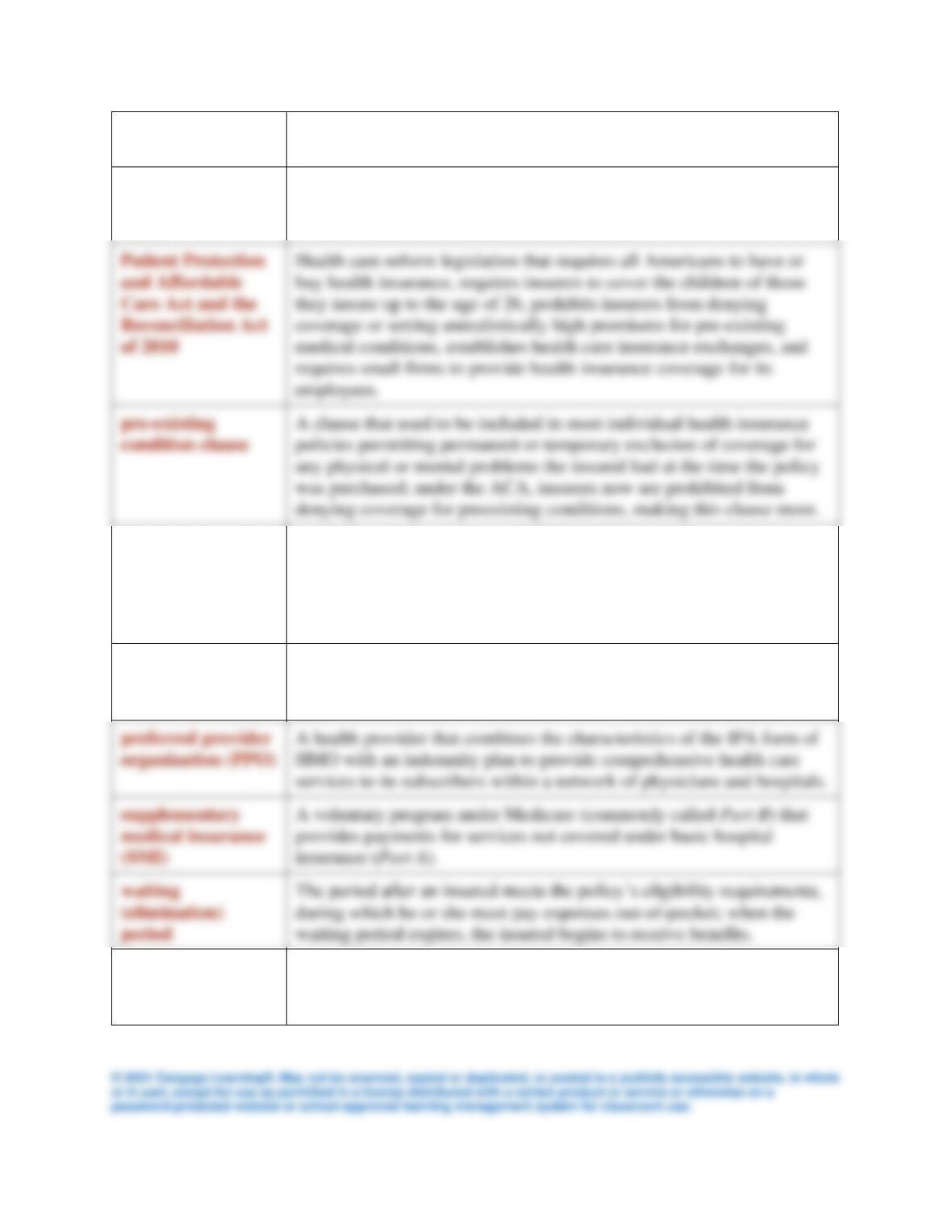
pre-existing
condition clause
A clause that used to be included in most individual health insurance
policies permitting permanent or temporary exclusion of coverage for
any physical or mental problems the insured had at the time the policy
was purchased; under the ACA, insurers now are prohibited from
denying coverage for preexisting conditions, making this clause moot.
prescription drug
coverage
A voluntary program under Medicare (commonly called Part D),
insurance that covers both brand-name and generic prescription drugs
at participating pharmacies. Participants pay a monthly fee and a yearly
deductible and must also pay part of the cost of prescriptions, including
a copayment or co-insurance.
point-of-service
(POS) plan
A hybrid form of HMO that allows members to go outside the HMO
network for care and reimburses them at a specified percentage of the
cost.
preferred provider
organization (PPO)
A health provider that combines the characteristics of the IPA form of
HMO with an indemnity plan to provide comprehensive health care
services to its subscribers within a network of physicians and hospitals.
supplementary
medical insurance
(SMI)
A voluntary program under Medicare (commonly called Part B) that
provides payments for services not covered under basic hospital
insurance (Part A).
workers’
compensation
insurance
Health insurance required by state and federal governments and paid
nearly in full by employers in most states; it compensates workers for
job-related illness or injury.

Insuring Your Health
Chapter Outline
Learning Goals
I. The Importance of Health Insurance Coverage
*Test Yourself*
II. Health Insurance Plans
A. Private Health Insurance Plans
1. Traditional Indemnity (Fee-for-Service) Plans
B. Government Health Insurance Plans
1. Medicare
2. Medicaid
3. Workers’ Compensation Insurance
C. Rationale for Health Care Reform
D. The Patient Protection and Affordable Care Act of 2010
*Test Yourself*
IV. Medical Expense Coverage and Policy Provisions
A. Types of Medical Expense Coverage
1. Hospitalization
2. Surgical Expenses
3. Physician Expenses

7. Limited Protection Services
B. Policy Provisions of Medical Expense Plans
1. Terms of Payment
2. Terms of Coverage
a. Persons and Places Covered
b. Cancellation
c. Pre-existing Conditions
C. Cost Containment Provisions for Medical Expense Plans
*Test Yourself*
V. Long-Term Care Insurance
A. Do You Need Long-Term Care Insurance?
B. Long-Term Care Insurance Provisions and Costs
C. How to Buy Long-Term Care Insurance
*Test Yourself*
VI. Disability Income Insurance
A. Estimating Your Disability Insurance Needs
B. Disability Income Insurance Provisions and Costs
*Test Yourself*
Summary
Financial Planning Exercises
Applying Personal Finance
Insure Your Health!