Chapter 9
The Cost of Capital
ANSWERS TO END-OF-CHAPTER QUESTIONS
9-1 a. The weighted average cost of capital, WACC, is the weighted average of the after-tax
component costs of capital—-debt, preferred stock, and common equity. Each
weighting factor is the proportion of that type of capital in the optimal, or target, capital
structure. The after-tax cost of debt, rd(1 – T), is the relevant cost to the firm of new
debt financing. Since interest is deductible from taxable income, the after-tax cost of
debt to the firm is less than the before-tax cost. Thus, rd(1 – T) is the appropriate
component cost of debt (in the weighted average cost of capital). If a company has
short-term debt with a cost of rstd, then its after-tax cost is rstd(1 – T) is the appropriate
component cost of debt (in the weighted average cost of capital).
c. The target capital structure is the relative amount of debt, preferred stock, and common
equity that the firm desires. The WACC should be based on these target weights.
9-2 The WACC is an average cost because it is a weighted average of the firm’s component
costs of capital. However, each component cost is a marginal cost; that is, the cost of new
capital. Thus, the WACC is the weighted average marginal cost of capital.
9-3 Probable Effect on
rd(1 – T) rs WACC
a. The corporate tax rate is lowered. + 0 +
b. The Federal Reserve tightens credit. + + +
c. The firm uses more debt; that is, it
increases its debt/assets ratio. + + 0
9-4 Stand-alone risk views a project’s risk in isolation, hence without regard to portfolio
effects; within-firm risk, also called corporate risk, views project risk within the context of
the firm’s portfolio of assets; and market risk (beta) recognizes that the firm’s stockholders
hold diversified portfolios of stocks. In theory, market risk should be most relevant
because of its direct effect on stock prices.
SOLUTIONS TO END-OF-CHAPTER PROBLEMS
9-1 a. rd(1 – T) = 13%(1 – 0) = 13.00%.
b. rd(1 – T) = 13%(0.80) = 10.40%.
c. rd(1 – T) = 13%(0.65) = 8.45%.
9-2 rd(1 – T) = 0.084(0.75) = 6.3%.
9-4 rps =
)05.01(00.70$
)06.0(60$
−
=
50.66$
60.3$
= 5.41%.
9-5 P0 = $36; D1 = $3.00; g = 5%; rs = ?
rs =
0
1
P
D
+ g = ($3.00/$36.00) + 0.05 = 13.33%.
9-9 Enter these values: N = 60, PV = -515.16, PMT = 30, and FV = 1000, to get I = 6% =
periodic rate. The nominal rate is 6%(2) = 12%, and the after-tax component cost of debt
is 12%(0.75) = 9%.
9-10 a. rs =
0
1
P
D
+ g =
23$
14.2$
+ 7% = 9.3% + 7% = 16.3%.
b. rs = rRF + (rM – rRF)b
= 9% + (13% – 9%)1.6 = 9% + (4%)1.6 = 9% + 6.4% = 15.4%.
c. rs = Bond rate + Risk premium = 12% + 4% = 16%.
d. The bond-yield-plus-judgmental-risk-premium approach and the CAPM method both
resulted in lower cost of equity values than the dividend growth approach. The firm’s
cost of equity should be estimated to be about 15.9%, which is the average of the three
methods.
9-12 a. rs =
0
1
P
D
+ g
0.09 =
00.60$
60.3$
+ g
0.09 = 0.06 + g
g = 3%.
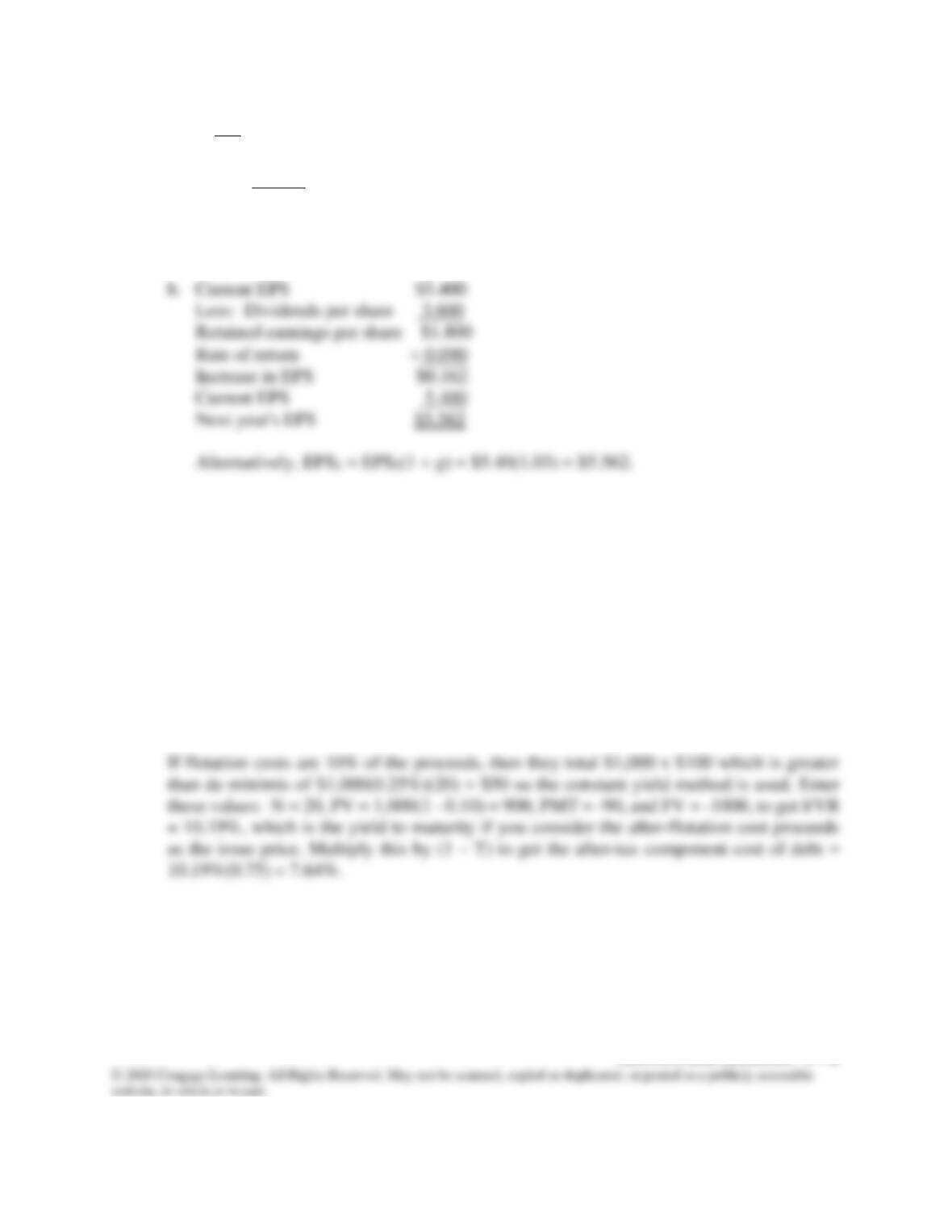
b. Current EPS $5.400
9-13 P0 = $30; D1 = $3.00; g = 5%; F = 10%; rs = ?
rs = [D1/(1 – F) P0] + g = [$3/(1 – 0.10)($30)] + 0.05 = 16.1%.
9-14 If flotation costs are 2% of the issue price, then they total $1,000(2%) = $20. This is less
than de minimis of $1,000(0.25%)(20) = $50 so the costs are amortized linearly. The annual
amortized cost is $20/20 = $1 per year. The tax benefit from this amortized cost is $1(0.25)
= $0.25 per year. This is the amount by which you reduce the after-tax coupon payment to
calculate the after-tax cost of debt. Enter these values: N = 20, PV = $1,000(1 – 2%) =
$980, PMT = -90(1 – 0.25) + $0.25 = -$67.25, and FV = -1000 to get I/YR = 6.91%. This
is the after-tax component cost of debt if flotation costs are 2%.
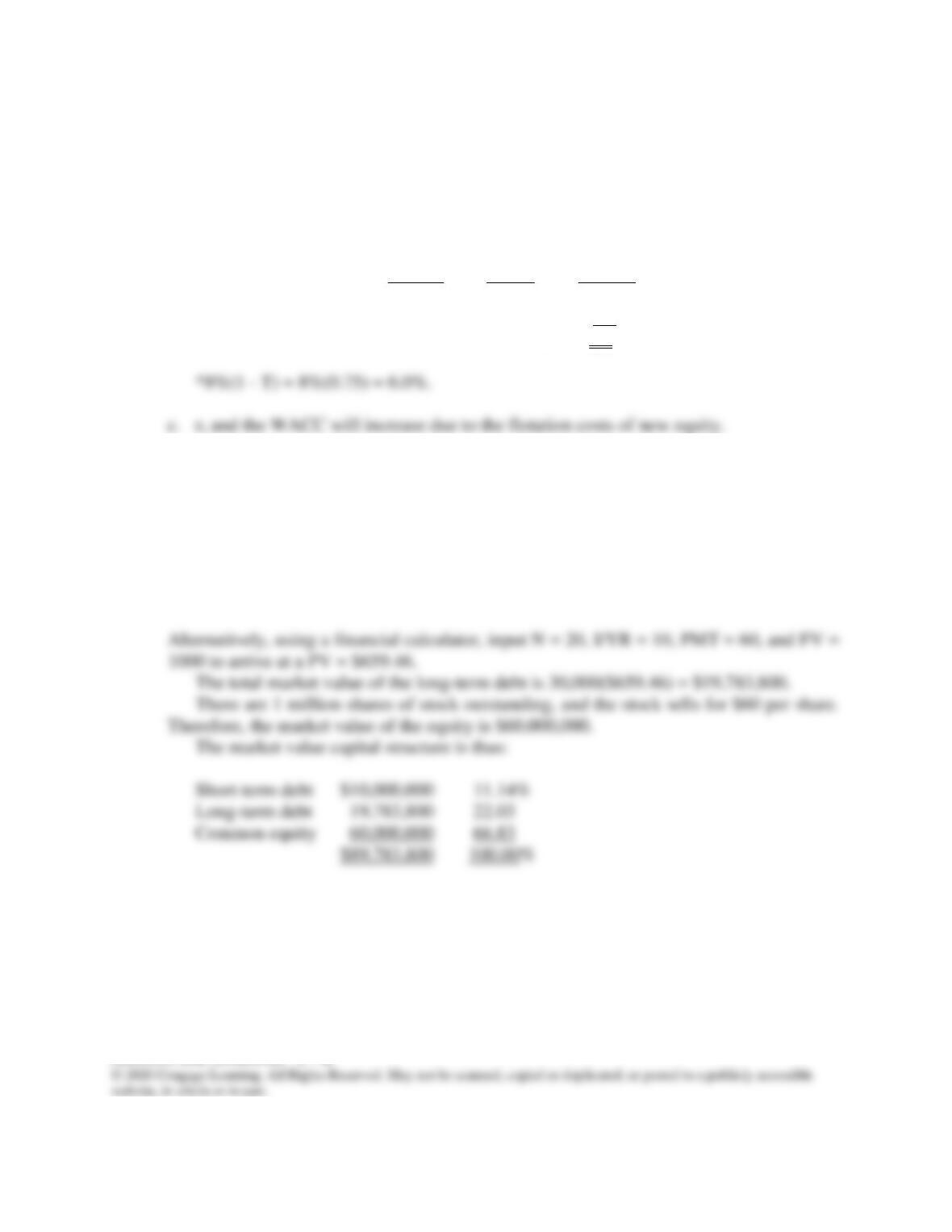
9-15 a. Common equity needed:
0.5($30,000,000) = $15,000,000.
b. Cost using rs:
After-Tax
Percent Cost = Product
Debt 0.50 6.0%* 3.0%
Common equity 0.50 12.0 6.0
WACC = 9.0%
9-16 The book and market value of the notes payable are $10,000,000.
The bonds have a value of
V = $60([1/0.10]-[1/(0.1*(1+0.10)20)]) + $1,000((1+0.10)–20)
= $60(8.5136) + $1,000(0.1486)
= $510.82 + $148.60 = $659.42.
9-17 Several steps are involved in the solution of this problem. Our solution follows:
a. In this case, A/P and accruals should be disregarded because they are not sources of
financing from investors—they are not capital components.
Debt:
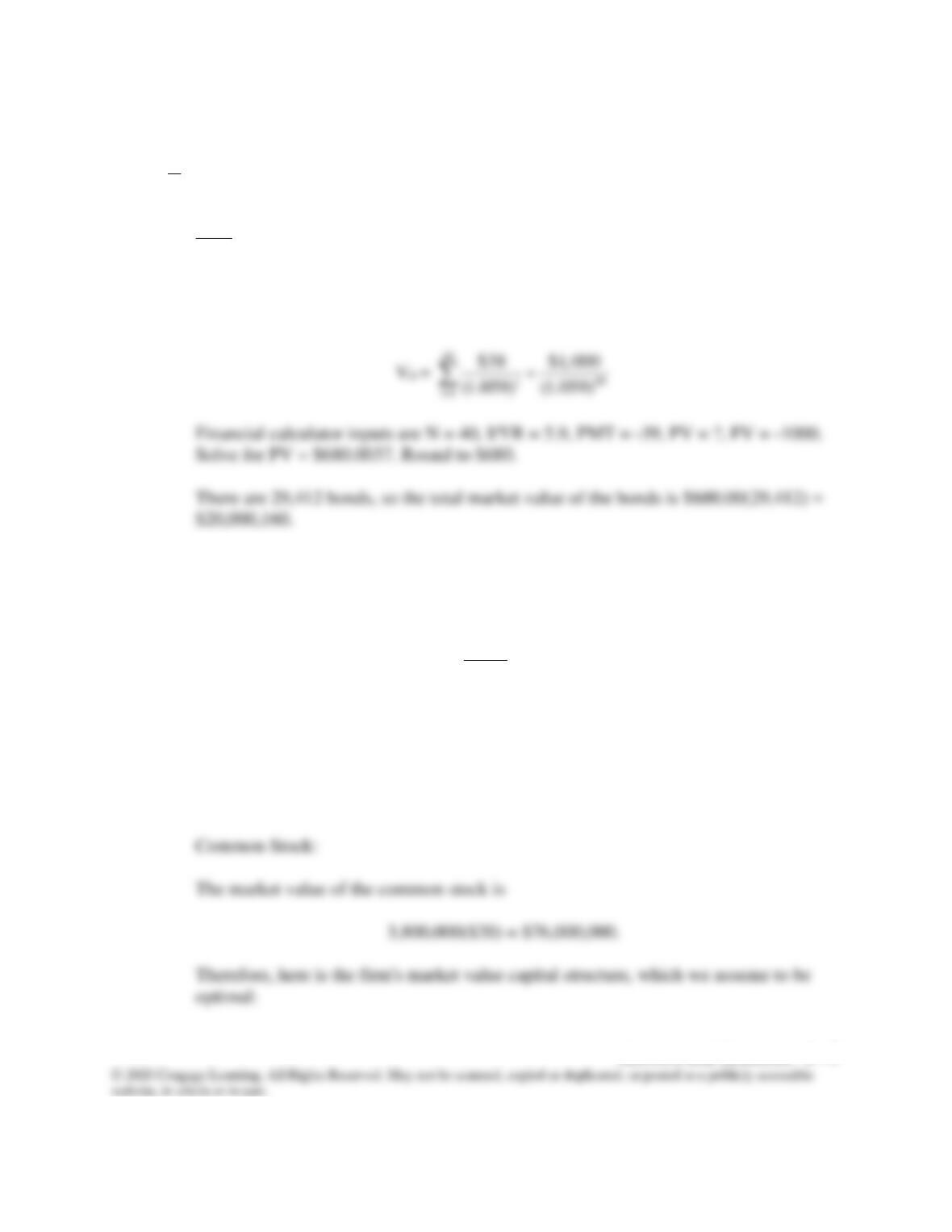
The annual yield to maturity is 11.8%, so the semiannual YTM is 11.8%/2 = 5.9%.
The semiannual coupon payment is 7.6%($1,000)/2 = $38. Each bond has a market
value found as follows:
Preferred Stock:
The preferred has a value of
Pps =
$2(4)
0.10
= $80.00.
There are 50,000 shares of preferred outstanding, so the total market value of the
preferred is
50,000($80.00) = $4,000,000.

Long-term debt $ 20,000,160 20.00%
Preferred stock 4,000,000 4.00
Common equity 80,000,000 76.00
$100,000,000 100.00%
We would round these weights to 20% debt, 4% preferred, and 76% common equity.
c. What is the cost of preferred stock?
Annual dividend on new preferred = 10%($100) = $10. Therefore,
rps = $10/]$100(1 – 0.0385)] = $10.4%.
e. Use the retention growth equation to estimate the expected growth rate. Then use the
expected growth rate and the dividend growth model to estimate the required return
on common stock.
Payout ratio = DPS/EPS = $1/$5 =20%.
g = ROE(1 – Payout ratio) = 10%(1 – 20%) = 8%.
rs =
0
0
D (1 g) g
P
++
=
$1(1 0.08) 0.08
$20
++
= 0.134 = 13.4%

g. Use the required return on stock from the CAPM model and calculate the WACC.
WACC = rd(1 − T)wd + rpswps + rsws
= 8.85%(0.20) + 10.4%(0.04) + 14%(0.76) = 12.826%.

SPREADSHEET PROBLEM
9-18 The detailed solution for the problem is available in the file Ch09 P18 Build a Model
Solution.xlsx at the textbook’s web site.
MINI CASE
During the last few years, Jana Industries has been too constrained by the high cost of capital
to make many capital investments. Recently, though, capital costs have been declining, and
the company has decided to look seriously at a major expansion program that has been
proposed by the marketing department. Assume that you are an assistant to Leigh Jones,
the financial vice-president. Your first task is to estimate Jana’s cost of capital. Jones has
provided you with the following data, which she believes may be relevant to your task:
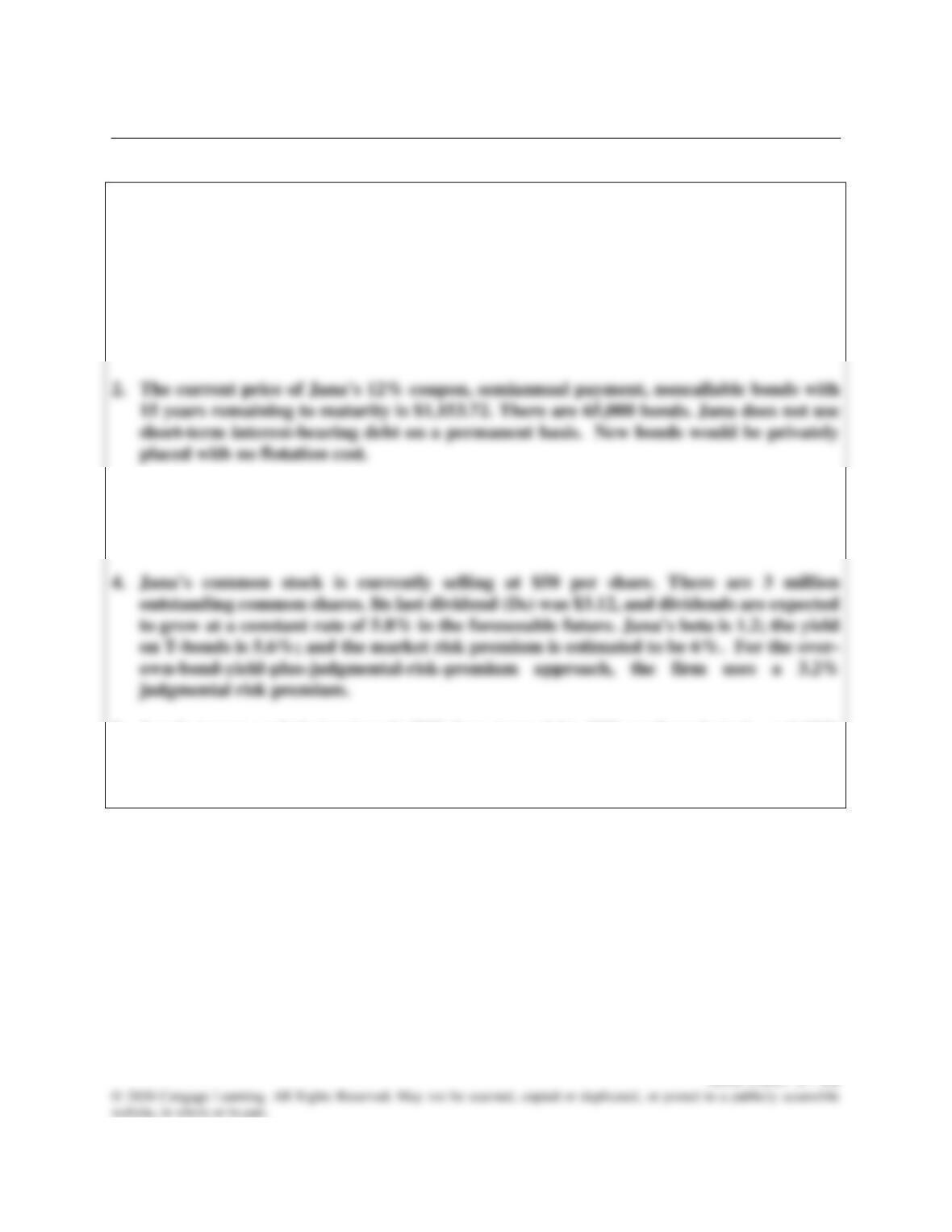
1. The firm’s tax rate is 25%.
3. The current price of the firm’s 10%, $100 par value, quarterly dividend, perpetual
preferred stock is $116.95. There are 200,000 outstanding shares. Jana would incur
flotation costs equal to 5% of the proceeds on a new issue.
5. Jana’s target capital structure is 30% long-term debt, 10% preferred stock, and 60%
common equity.
To help you structure the task, Leigh Jones has asked you to answer the following questions.
a. 1. What sources of capital should be included when you estimate Jana’s weighted
average cost of capital (WACC)?
Answer: The WACC is used primarily for making long-term capital investment decisions, i.e.,
for capital budgeting. Thus, the WACC should include the types of capital used to pay
for long-term assets, and this is typically long-term debt, preferred stock (if used), and
a. 2. Should the component costs be figured on a before-tax or an after-tax basis?
Answer: Stockholders are concerned primarily with those corporate cash flows that are available
a. 3. Should the costs be historical (embedded) costs or new (marginal) costs?
b. What is the market interest rate on Jana’s debt, and what is the component cost
of this debt for WACC purposes?
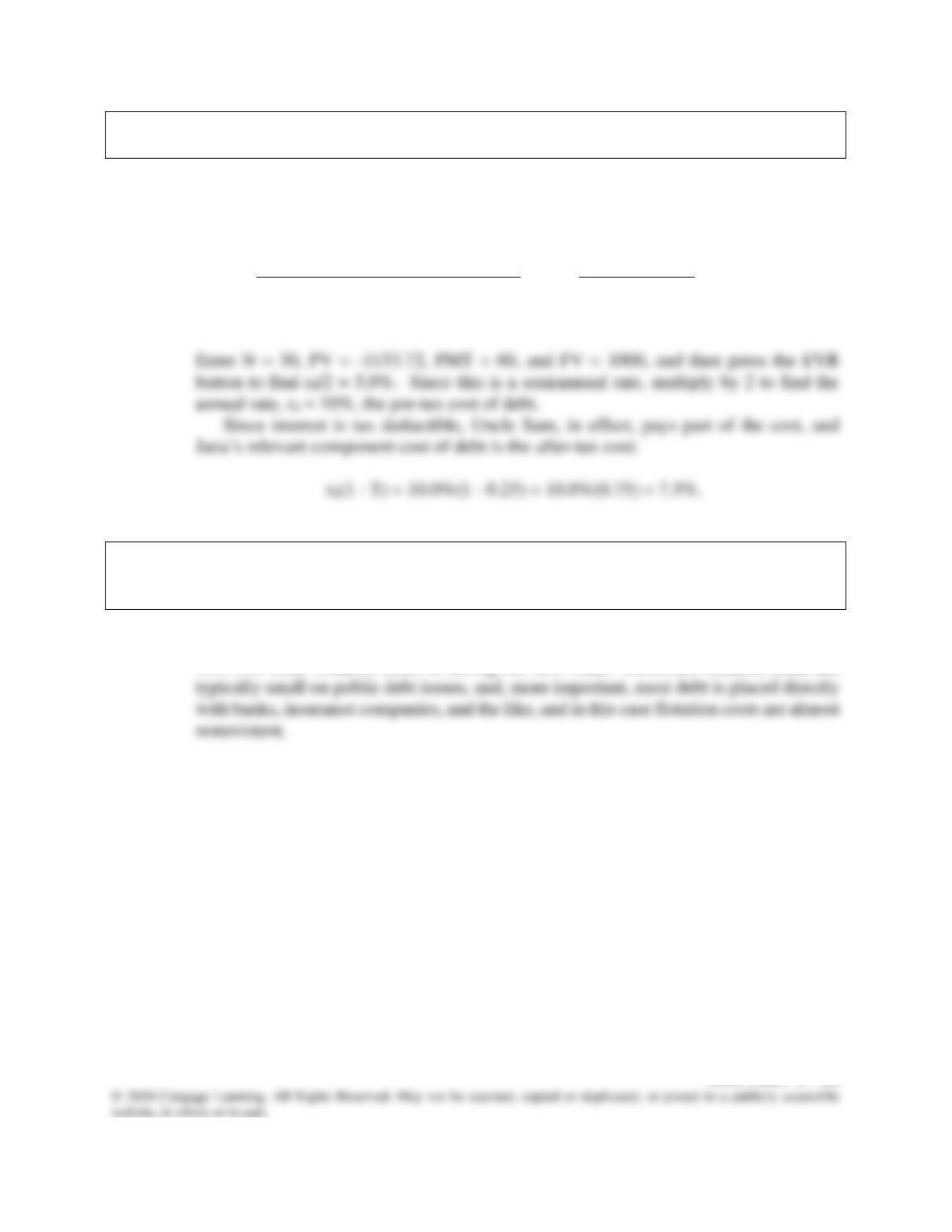
Answer: Jana’s 12% bond with 15 years to maturity is currently selling for $1,153.72. Thus, its
yield to maturity is 10%:
0 1 2 3 29 30
| | | | • • • | |
-1,153.72 60 60 60 60 60
1,000
Optional Question
Should flotation costs be included in the estimate?
Answer: The actual component cost of new debt will be somewhat higher than 6% because the
Optional Question
Should you use the nominal cost of debt or the effective annual cost?
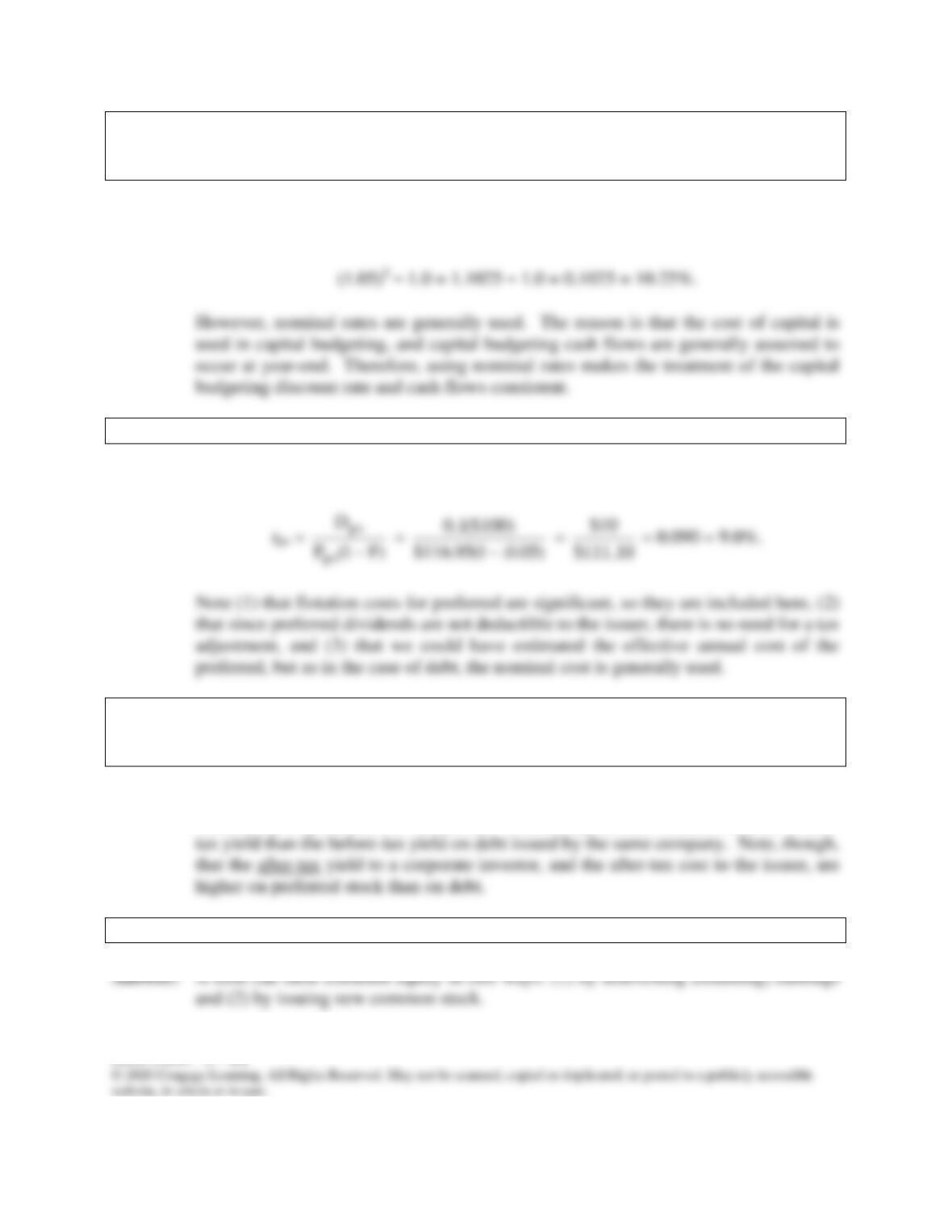
Answer: Our 10% pre-tax estimate is the nominal cost of debt. Since the firm’s debt has
semiannual coupons, its effective annual rate is 10.25%:
c. 1. What is the firm’s cost of preferred stock?
Answer: Since the preferred issue is perpetual, its cost is estimated as follows:
c. 2. Jana’s preferred stock is riskier to investors than its debt, yet the preferred’s yield
to investors is lower than the yield to maturity on the debt. Does this suggest that
you have made a mistake? (Hint: Think about taxes.)
Answer: Corporate investors own most preferred stock, because 50% of preferred dividends
received by corporations are nontaxable. Therefore, preferred often has a lower before-
d. 1. What are the two primary ways companies raise common equity?

d. 2. Why is there a cost associated with reinvested earnings?
Answer: Management may either pay out earnings in the form of dividends or else retain
d. 3. Jana doesn’t plan to issue new shares of common stock. Using the CAPM
approach, what is Jana’s estimated cost of equity?
Answer: rs = 0.056 + (0.06)1.2 = 12.8%.
e. 1. What is the estimated cost of equity using the dividend growth approach?
e. 2. Suppose the firm has historically earned 15% on equity (ROE) and retained 62%
of earnings, and investors expect this situation to continue in the future. How
could you use this information to estimate the future dividend growth rate, and
what growth rate would you get? Is this consistent with the 5.8% growth rate
given earlier?
Answer: Another method for estimating the growth rate is to use the retention growth model:
e. 3. Could the dividend growth approach be applied if the growth rate was not
constant? How?
Answer: Yes, you could use the dividend growth approach using nonconstant growth. You
f. What is the cost of equity based on the bond-yield-plus-judgmental-risk-premium
method?
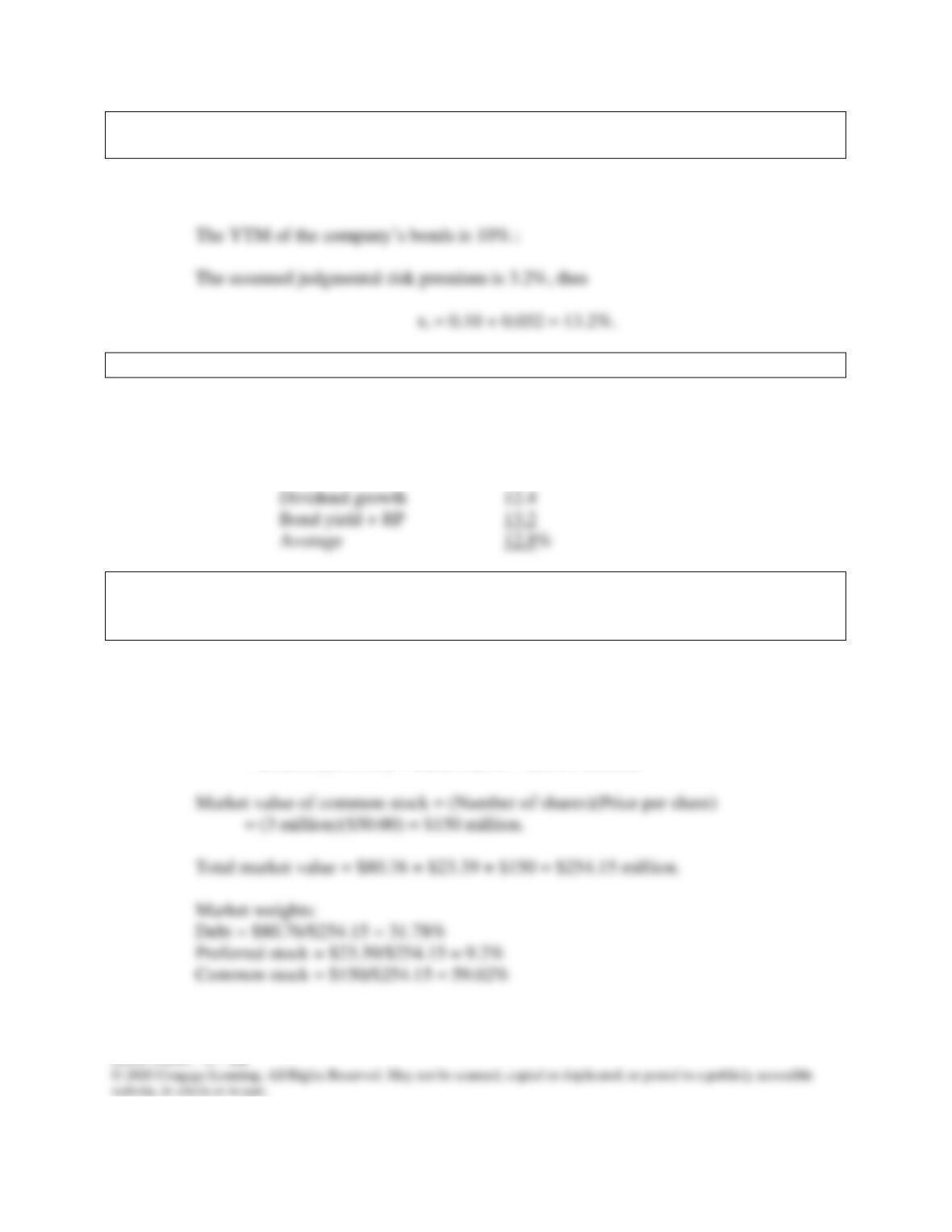
Answer: rs = Company’s own bond yield + judgmental risk premium.
g. What is your final estimate for the cost of equity, rs?
Answer: The final estimate for the cost of equity would simply be the average of the values
found using the above three methods.
CAPM 12.8%
h. What is Jana’s current market value capital structure? How does this compare
with Jana’s target capital structure of 30% long-term debt, 10% preferred stock,
and 60% common equity?
Answer: Market value of debt = (Number of bonds)(Price per bond)
= 70,000($1,153.72) = $80,760,400 ≈ $80.76 million.
Market value of preferred stock = (Number of shares)(Price per share)
= 200,000($116.95) = $23,390,000 = $23.39 million.
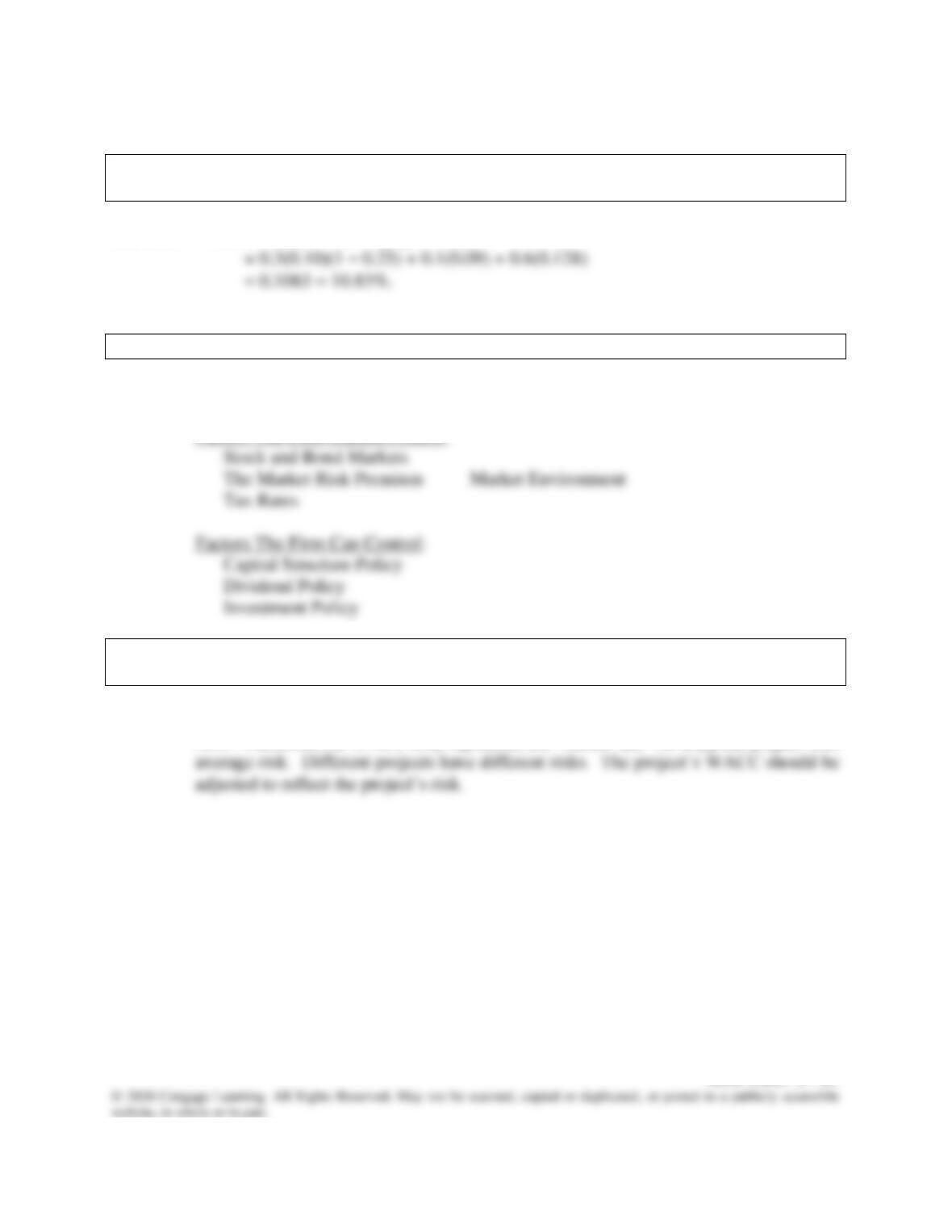
The current market value weights are very close to the target weights.
i. Use Jana’s target weights to calculated the weighted average cost of capital
(WACC).
Answer: WACC= wdrd(1 – T) + wpsrps + ws(rs)
j. What factors influence a company’s WACC?
Answer: There are factors that the firm cannot control and those that they can control that
influence WACC.
k. Should the company use the overall, or composite, WACC as the hurdle rate for
each of its divisions?
Answer: No. The composite WACC reflects the risk of an average project undertaken by the
l. What procedures can be used to estimate the risk-adjusted cost of capital for a
particular division? What approaches are used to measure a division’s beta?
Answer: The following procedures can be used to determine a division’s risk-adjusted cost of
capital:
(1) Subjective adjustments to the firm’s composite WACC.
(2) Attempt to estimate what the cost of capital would be if the division were a stand-
alone firm. This requires estimating the division’s beta.
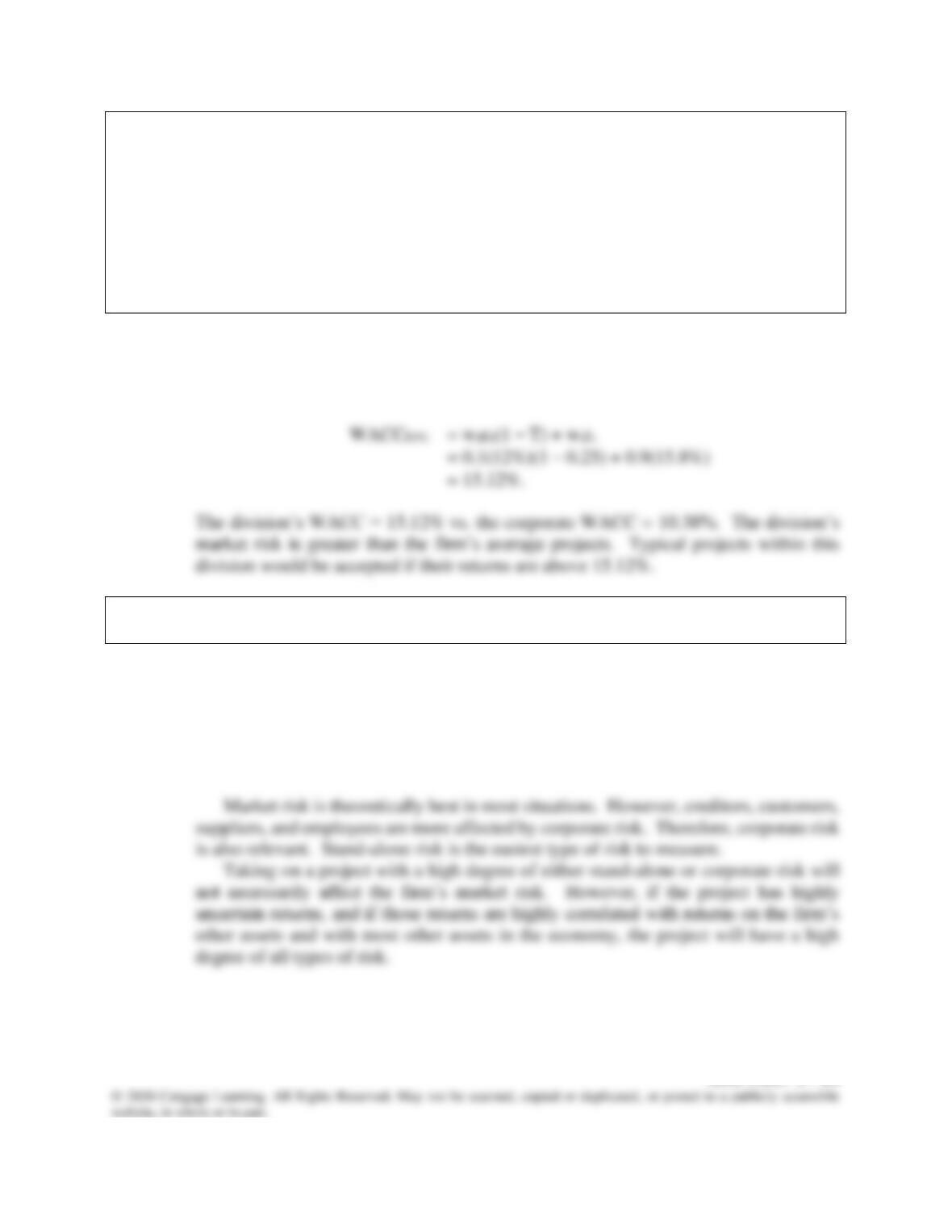
The following approaches can be used to measure a division’s beta:
m. Jana is interested in establishing a new division that will focus primarily on
developing new Internet-based projects. In trying to determine the cost of capital
for this new division, you discover that specialized firms involved in similar
projects have on average the following characteristics:
• Their capital structure is 10% debt and 90% common equity.
• Their cost of debt is typically 12%.
• The beta is 1.7.
Given this information, what would your estimate be for the division’s cost of
capital?
Answer:
rs DIV. = rRF + (rM – rRF)bDIV.
= 5.6% + (6%)1.7 = 15.8%.
n. What are three types of project risk? How can each type of risk be considered
when thinking about the new division’s cost of capital?
Answer: The three types of project risk are:
Stand-Alone Risk
Corporate Risk
Market Risk
o. Explain in words why new common stock that is raised externally has a higher
percentage cost than equity that is raised internally as retained earnings.
Answer: The company is raising money in order to make an investment. The money has a cost,
and this cost is based primarily on the investors’ required rate of return, considering
risk and alternative investment opportunities. So, the new investment must provide a
p. What four common mistakes in estimating the WACC should Jana avoid?
Answer: 1. Don’t use the coupon rate on a firm’s existing debt as the pre-tax cost of debt. Use
the current cost of debt.
2. When estimating the risk premium for the CAPM approach, don’t subtract the
current long-term T-bond rate from the historical average return on stocks.
For example, the historical average return on stocks has been about 12.7%. If
inflation has driven the current risk-free rate up to 10%, it would be wrong to