3.c. Zapata can borrow an additional Mex$15,000. How will this affect its translation exposure if
it uses the funds to pay a dividend to its parent? If it uses the funds to increase its cash
position?
4. Walt Disney expects to receive a Mex$16 million theatrical fee from Mexico in 90 days. The
current spot rate is $0.0915/Mex$ and the 90-day forward rate is $0.0903/Mex$.
4.a. What is Disney’s peso transaction exposure associated with this fee?
4.b. If the expected spot rate in 90 days is $0.0908, what is the expected U.S. dollar value of the fee?
4.c. What is the hedged dollar value of the fee?
5. A foreign exchange trader assesses the euro exchange rate three months hence as follows:
$1.31 with probability 0.25
5.a. Will the trader buy or sell euros forward against the dollar if she is concerned solely with
expected values? In what volume?
5.b. In reality, what is likely to limit the trader’s speculative activities?
5.c. Suppose the trader revises her probability assessment as follows:
$1.29 with probability 0.33
$1.33 with probability 0.33
$1.37 with probability 0.33
Assuming the forward rate remains at $1.32, do you think this new assessment will affect the
trader’s decision?
6. An investment manager hedges a portfolio of Bunds (German government bonds) with a 6–
month forward contract. The current spot rate is €0.75:$1 and the 180-day forward rate is
€0.72:$1. At the end of the 6-month period, the Bunds have risen in value by 3.75 percent (in
euro terms), and the spot rate is now €0.66:$1.
6.a. If the Bunds earn interest at the annual rate of 5 percent, paid semi-annually, what is the
investment manager’s total dollar return on the hedged Bunds?
ANSWER. Ignoring hedging for the time being, for each $100 invested in Bunds at a spot rate of €0.75
per dollar, the investment manager would have at the end of six months an amount of euros equal to
6.b. What would the return on the Bunds have been without hedging?
6.c. What was the true cost of the forward contract?
7. Magnetronics, Inc., a U.S. company, owes its Taiwanese supplier NT$205 million in three
months. The company wishes to hedge its NT$ payable. The current spot rate is NT$1 =
U.S.$0.03987, and the three-month forward rate is NT$1 = U.S.$0.04051. Magnetronics can
also borrow/lend U.S. dollars at an annualized interest rate of 12% and Taiwanese dollars at
an annualized interest rate of 8%.
7.a. What is the U.S. dollar accounting entry for this payable?
7.b. What is the minimum U.S. dollar cost that Magnetronics can lock in for this payable?
Describe the procedure it would use to get this price.
ANSWER. Magnetronics can use either a forward market hedge or a money market hedge. The forward
7.c. At what forward rate would interest rate parity hold given the interest rates?
8. Cooper Inc., a U.S. firm, has just invested £500,000 in a note that will come due in 90 days and
is yielding 9.5% annualized. The current spot value of the pound is $1.9612 and the 90-day
forward rate is $1.9467.
8.a. What is the hedged dollar value of this note at maturity?
8.b. What is the annualized dollar yield on the hedged note?
8.c. Cooper anticipates that the value of the pound in 90 days will be $1.9550. Should it hedge?
Why or why not?
8.d. Suppose that Cooper has a payable of £980,000 coming due in 180 days. Should this affect its
decision of whether to hedge its sterling note? How and why?
9. American Airlines is trying to decide how to go about hedging $70 million in ticket sales
receivable in 180 days. Suppose it faces the following exchange and interest rates.
Spot rate: $0.6433-42/SFr
Forward rate (180 days): $0.6578-99/SFr
DM 180-day interest rate (annualized): 4.01%-3.97%
U.S. dollar 180-day interest rate (annualized): 8.01%-7.98%
9.a. What is the hedged value of American’s ticket sales using a forward market hedge?
9.b. What is the hedged value of American’s ticket sales using a money market hedge? Assume
the first interest rate is the rate at which money can be borrowed and the second one the rate
at which it can be lent.
9.c. Which hedge is less expensive?
9.d. Is there an arbitrage opportunity here?
ANSWER. Yes. By borrowing dollars at a semiannual rate of 4.005% (8.01%/2), converting them to
9.e. Suppose the expected spot rate in 180 days is $0.67/SFr with a most likely range of $0.64-
$0.70/SFr. Should American hedge? What factors should enter into its decision?
ANSWER. Based on the expected 180-day spot rate and its expected range, it would appear that
10. Madison Inc. imports olive oil from Chilean firms and the invoices are always denominated in
drachma (Dr). It currently has a payable in the amount of Dr 250 million that it would like to
hedge. Unfortunately, there are no drachma futures contracts available and Madison is having
difficulty arranging a Dr forward contract. Its treasurer, who recently received her MBA,
suggests using Italian lira to cross-hedge the drachma exposure. She recently ran the following
regression of the change in the exchange rate for the drachma against the change in the lira
exchange rate:
ΔDr/$ = 1.6(ΔLit/$)
10.a. There is an active market in forward lira. To cross-hedge Madison’s drachma exposure,
should the treasurer buy or sell lira forward?
10.b. What is the risk-minimizing amount of lira that the treasurer would have to buy or sell
forward to hedge Madison’s Dr exposure?
ADDITIONAL CHAPTER 9 PROBLEMS AND SOLUTIONS
1. Paragon U.S.’s Japanese subsidiary, Paragon Japan, has exposed assets of ¥8 billion and
exposed liabilities of ¥6 billion. During the year, the yen appreciates from ¥125/$ to ¥95/$.
1.a. What is Paragon Japan’s net translation exposure at the beginning of the year in yen? In
dollars?
1.b. What is Paragon Japan’s translation gain or loss from the change in the yen’s value?
CHAPTER 10: MEASURING AND MANAGING ACCOUNTING EXPOSURE
21
1.c. At the start of the next year, Paragon Japan adds exposed assets of ¥1.5 billion and exposed
liabilities of ¥2 billion. During the year, the yen depreciates from ¥95/$ to ¥130/$. What is
Paragon Japan’s translation gain or loss for this year? What is its total translation gain or
loss for the two years?
2. Suppose that on January 1, American Golf’s French subsidiary, Golf du France, had a balance
sheet that showed current assets of FF1 million; current liabilities of FF300,000; total assets of
FF2.5 million; and total liabilities of FF900,000. On December 31, Golf du France’s balance
sheet in francs was unchanged from the figures given above, but the franc had declined in
value from $0.1270 at the start of the year to $0.1180 at the end of the year. Under FASB 52,
what is the translation amount to be shown on American Golf’s equity account for the year if
the franc is the functional currency? How would your answer change if the dollar were the
functional currency?
ANSWER. According to FASB 52, balance sheets must be translated using the current rate method; that
3. Halon France, the French subsidiary of a U.S. company, Halon, Inc., has the following balance
sheet:
Assets (FF thousands)
Liabilities (FF thousands)
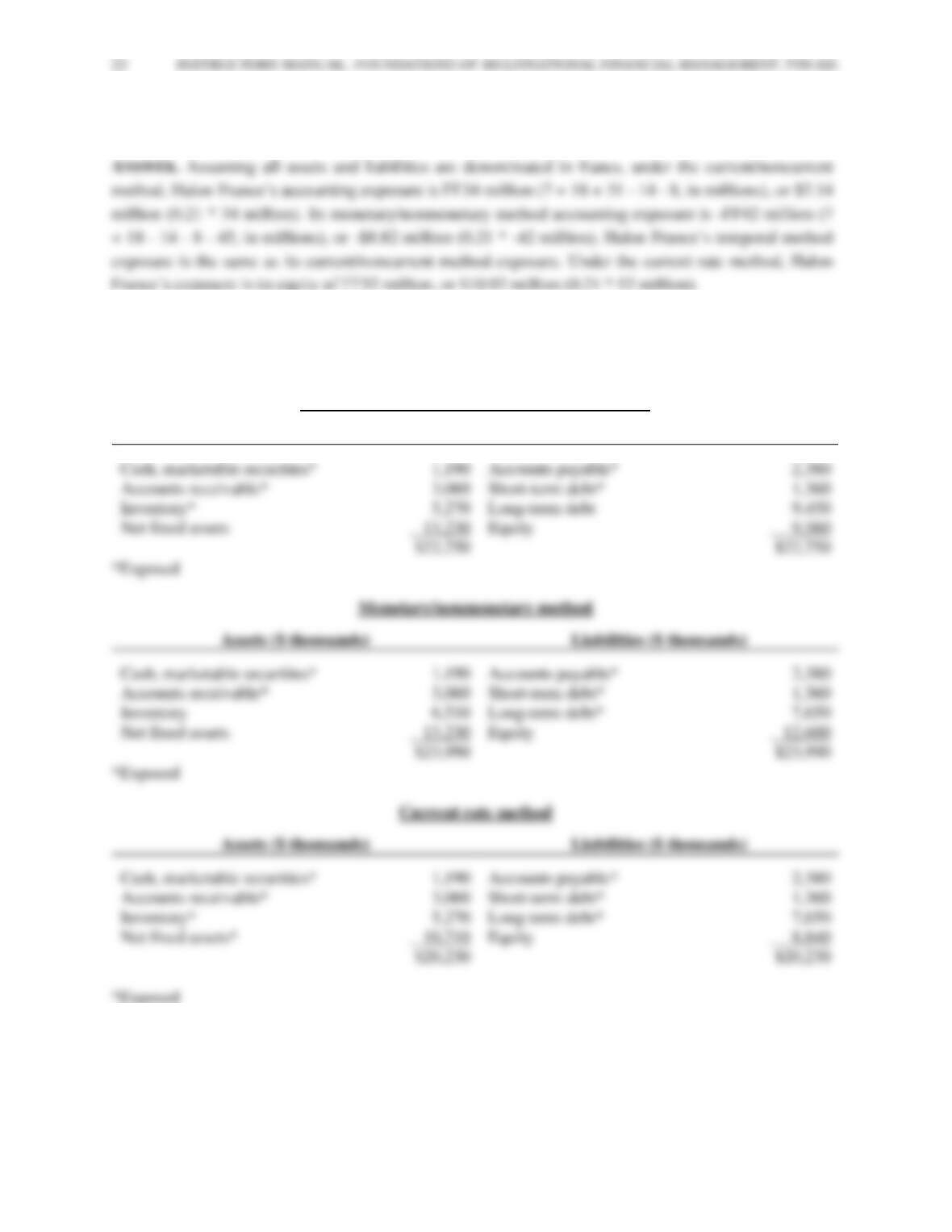
3.a. At the current spot rate of $0.21/FF, calculate Halon France’s accounting exposure under the
current/noncurrent, monetary/nonmonetary, temporal, and current rate methods.
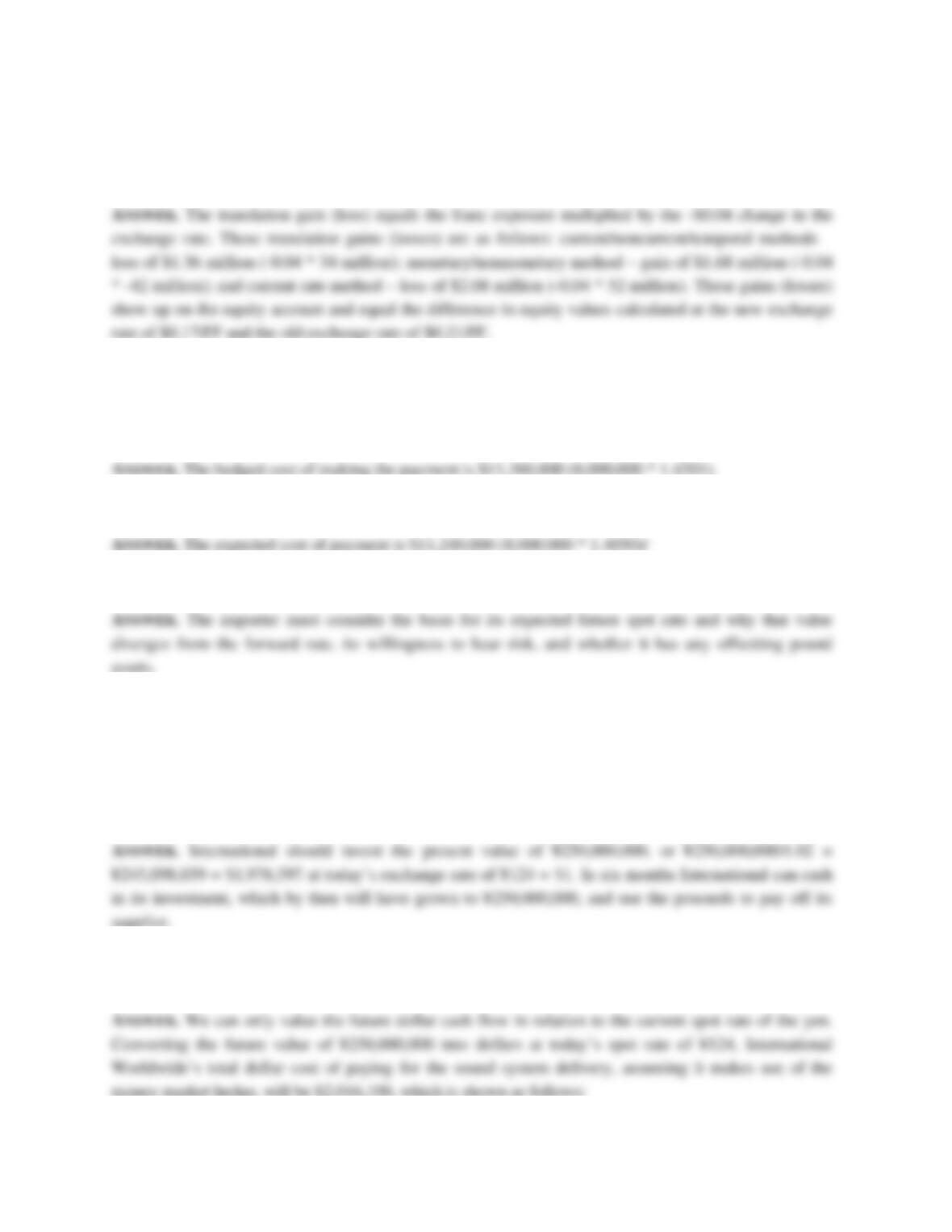
3.b. Suppose the French franc depreciates to $0.17. Produce balance sheets for Halon France at
the new exchange rate under each of the four alternative translation methods.
ANSWER.
Current/noncurrent rate and temporal methods
Assets ($ thousands)
Liabilities ($ thousands)
CHAPTER 10: MEASURING AND MANAGING ACCOUNTING EXPOSURE
23
3.c. Calculate the translation gains or losses associated with the FF depreciation for each of the
four methods. Relate these gains and losses to the exposure calculations performed in part a
combined with the exchange rate change. Where would these translation gains or losses show
up in the balance sheets prepared for part b?
4. An importer has a payment of £8 million due in 90 days.
4.a. If the 90-day pound forward rate is $1.4201, what is the hedged cost of making that
payment?
4.b. If the spot rate expected in 90 days is $1.4050, what is the expected cost of payment?
4.c. What factors will influence the hedging decision?
5. International Worldwide would like to execute a money market hedge to cover a ¥250,000,000
shipment from Japan of sound systems it will receive in six months. The current exchange rate
is ¥124 = $1.
5.a. How would International structure the hedge? What would it do to hedge the Japanese yen it
must pay in six months? The annual yen interest rate is 4%.
5.b. The yen may rise to as much as ¥140 = $1 or fall to ¥115 = $1. What will the total dollar cash
flow be in six months in either case?
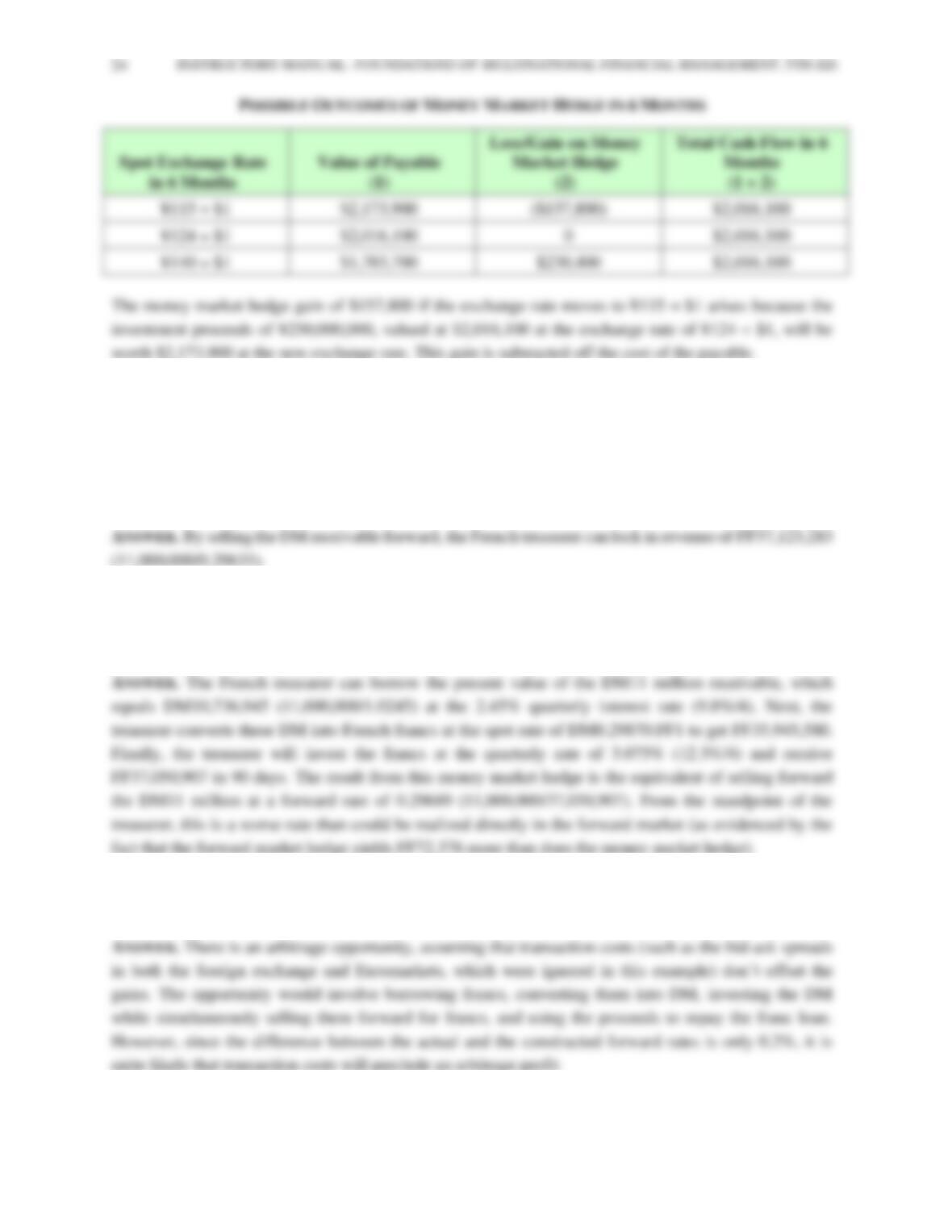
6. A French corporate treasurer expects to receive a DM11 million payment in 90 days from a
German customer. The current spot rate is DM0.29870:FF1 and the 90-day forward rate is
DM0.29631:FF1. In addition, the annualized three-month EuroDM and Eurofranc (French)
rates are 9.8% and 12.3%, respectively.
6.a. What is the hedged value of the DM receivable using the forward contract?
6.b. Describe how the French treasurer could use a money market hedge to lock in the franc
value of the DM receivable. What is the hedged value of the DM receivable? What is the
effective forward rate that the treasurer can obtain using this money market hedge?
6.c. Given your answers in parts a and b, is there an arbitrage opportunity? How could the
treasurer take advantage of it?
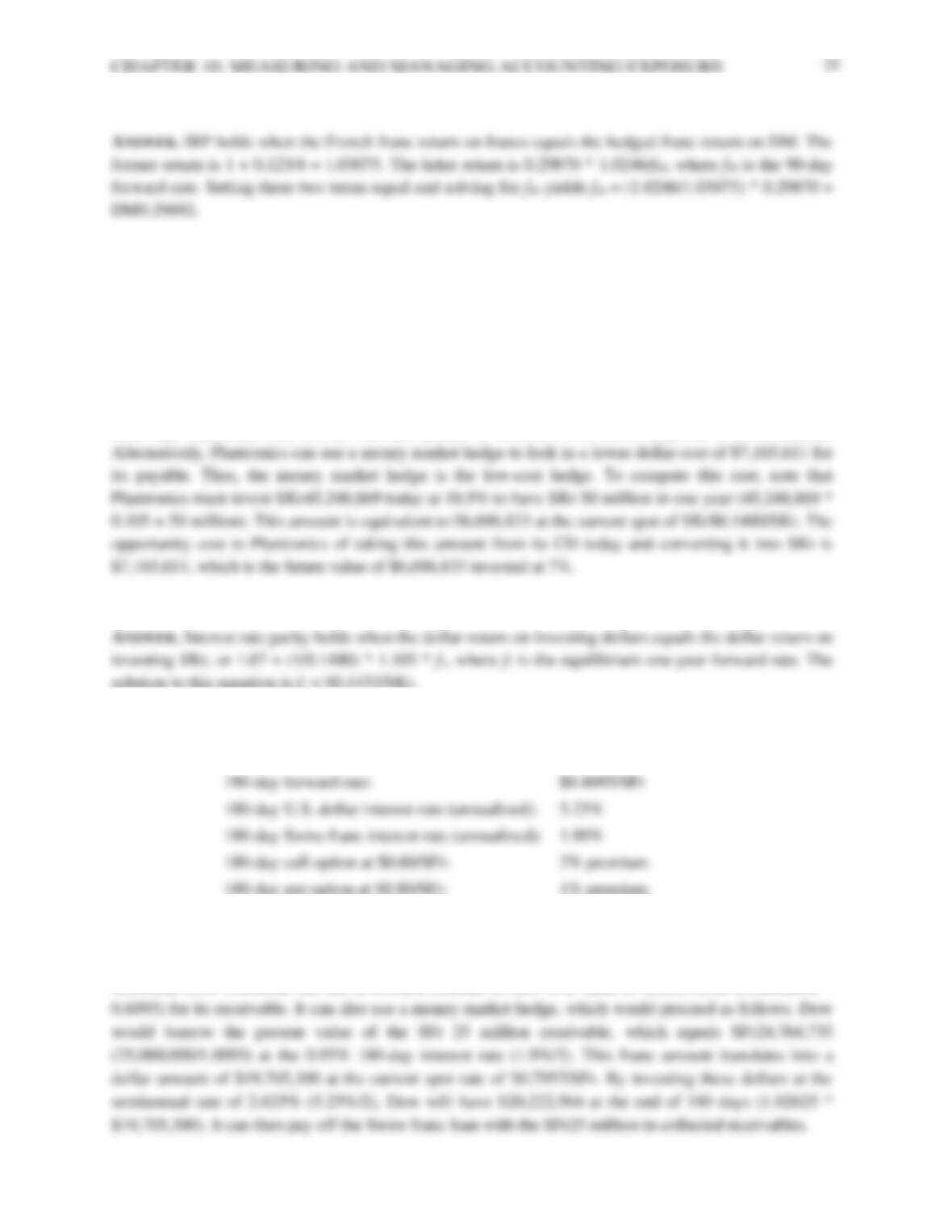
6.d At what 90-day forward rate would IRP hold?
7. Plantronics owes SKr50 million, due in one year, for some electrical equipment it recently
bought from ABB Asea Brown Boveri. At the current spot rate of $0.1480/SKr, this payable is
$7.4 million. It wishes to hedge this payable but is undecided how to do it. The one-year
forward rate is currently $0.1436. Plantronics’ treasurer notes that the company has $10 million
in a marketable U.S. dollar CD yielding 7% per annum. At the same time, SE Banken in
Stockholm is offering a one-year time deposit rate of 10.5%.
7.a. What is the low-cost hedging alternative for Plantronics? What is the cost?
ANSWER. Plantronics can use the forward market to lock in a cost for its payable of $7.18 million.
7.b. Suppose interest rate parity held. What would the one-year forward rate be?
8. Dow Chemical has sold SFr 25 million in chemicals to Ciba-Geigy. Payment is due in 180 days.
Spot rate: $0.7957/SFr
8.a. What is the hedged value of Dow’s receivable using the forward market hedge? The money
market hedge?
ANSWER. Dow Chemical can use a forward contract to lock in a value of $20,237,500 (25,000,000 *
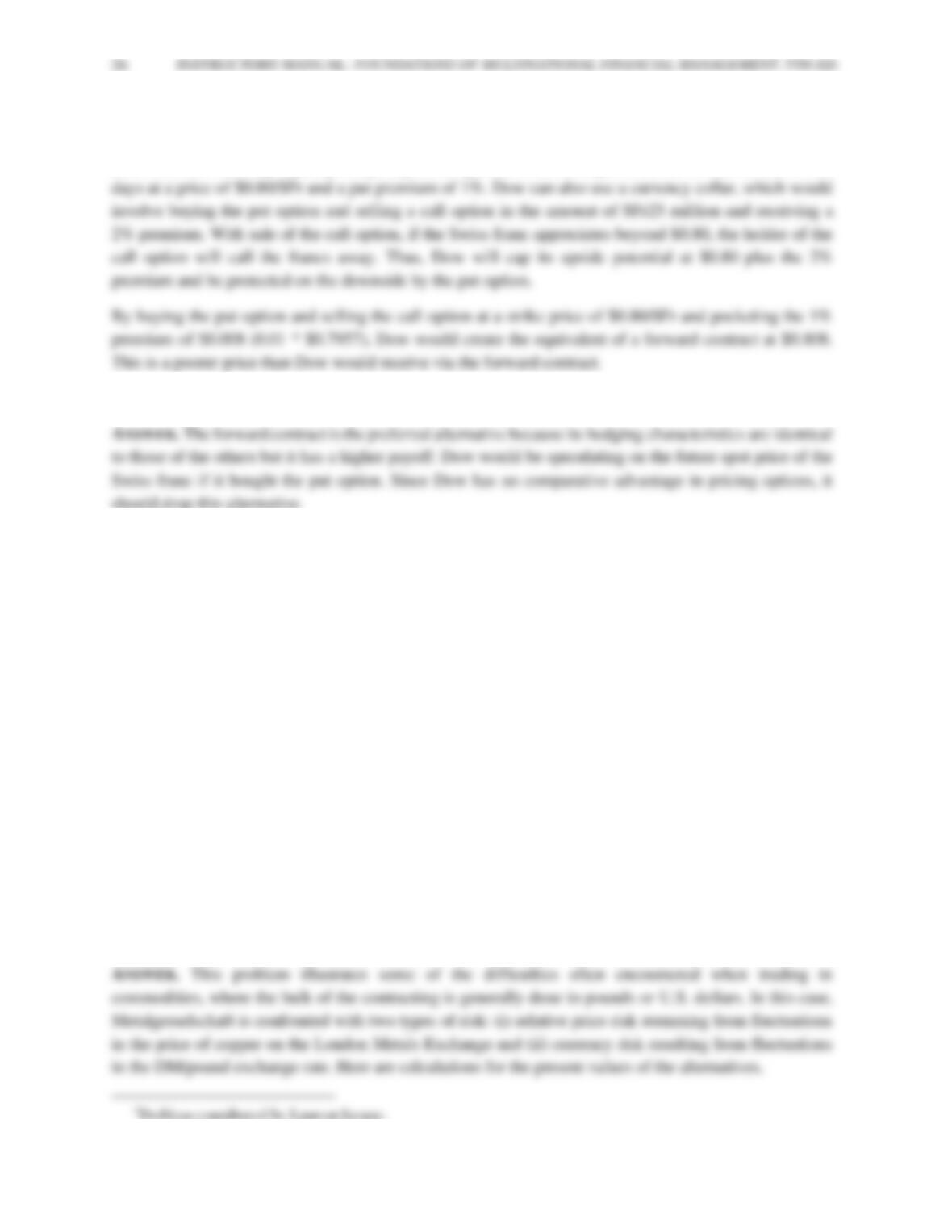
8.b. What alternatives are available to Dow to use currency options to hedge its receivable?
Which option hedging strategy would you recommend?
ANSWER. Dow can buy a put option giving it the right but not the obligation to sell SFr25 million in 180
8.c. Which hedging alternative analyzed in parts a and b would you recommend to Dow? Why?
9.* Metalgesselschaft, a leading German metal processor, has scheduled a supply of 20,000 metric
tons of copper for October 1. On April 1, copper is quoted on the London Metals Exchange at
£562 per metric ton for immediate delivery and £605 per metric ton for delivery on October 1.
Monthly storage costs are £10 for a metric ton in London and DM 30 in Hamburg, payable on
the first day of storage.
Exchange rate quotations are as follows: The pound is worth DM 3.61 on April 1 and is selling
at a 6.3% annual discount. The opportunity cost of capital for Metalgesselschaft is estimated at
8% annually, and the pound sterling is expected to depreciate at a yearly rate of 6.3% over the
next 12 months.
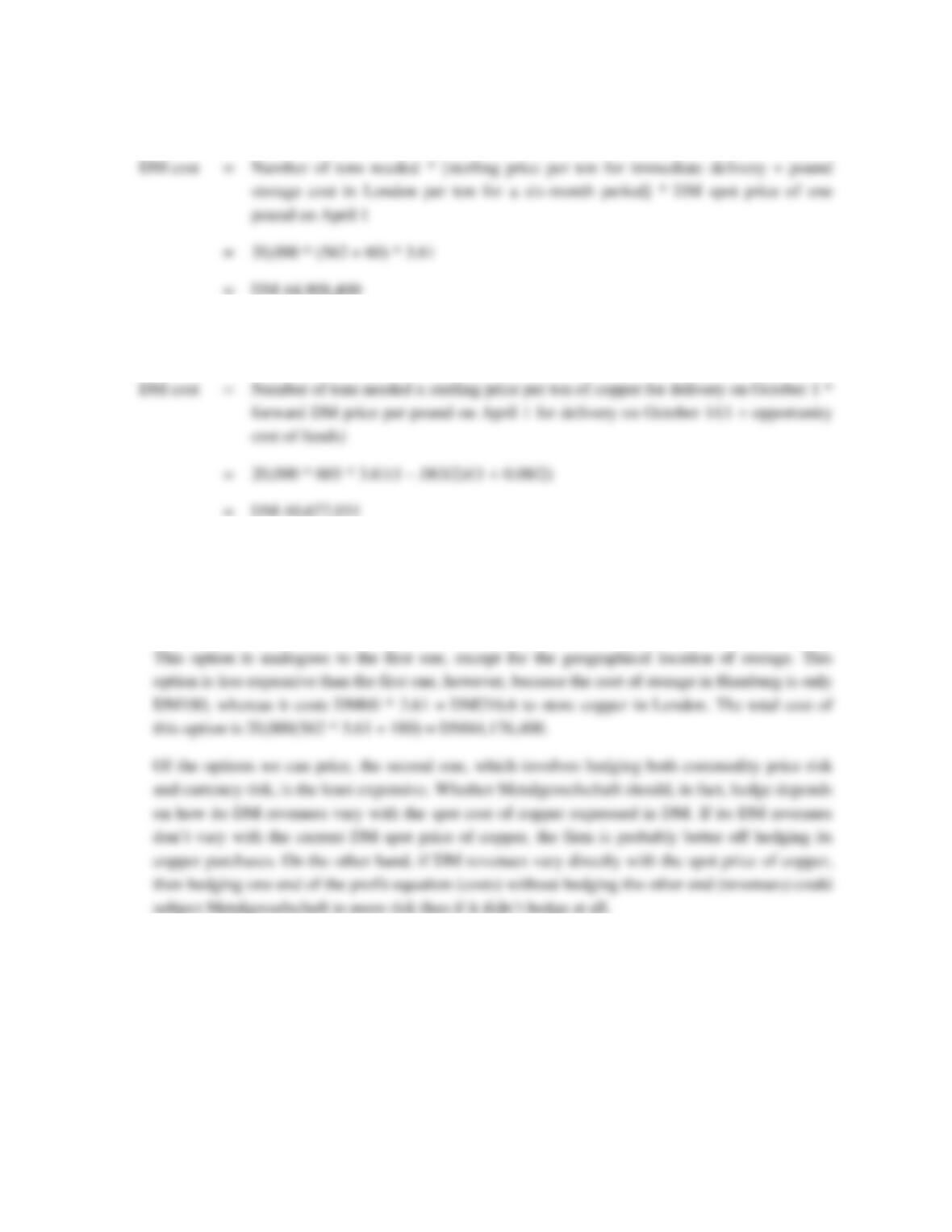
Compute the DM cost for Metalgesselschaft on April 1 of the following options:
9.a. Buy 20,000 metric tons of copper on April 1 and store it in London until October 1.
9.b. Buy a forward contract of 20,000 metric tons on April 1, for delivery in six months. Cover
sterling debt by purchasing forward pounds on April 1.
9.c. Buy 20,000 metric tons of copper on October 1.
Identify other options available to Metalgesselschaft. Which one would you recommend?
CHAPTER 10: MEASURING AND MANAGING ACCOUNTING EXPOSURE
27
9.a. Buy the required 20,000 metric tons of copper and incur storage costs in London. Payment
occurs on April 1, so the present value of the cost is the same as the actual cost.
9.b. Cover both commodity and currency risks through forward contracts of matching maturities in
the respective markets. Payment doesn’t take place until October 1.
9.c. Leave both commodity and currency positions uncovered. The DM cost of this option cannot
be computed since no information is given as to the projected price of copper or the
projected DM value of the pound six months hence.
An additional option would consist of buying the copper on April 1 and storing it in Hamburg.
INSTRUCTORS MANUAL: FOUNDATIONS OF MULTINATIONAL FINANCIAL MANAGEMENT, 5TH ED.
28
10. Cosmo, a Japanese exporter, wishes to hedge its $15 million in dollar receivables coming due
in 60 days. To reduce its net cost of hedging to zero, however, Cosmo sells a 60-day dollar call
option for $15 million with a strike price of ¥98/$ and uses the premium of $314,000 to buy a
60-day $15 million put option at a strike price of ¥90/$.
10.a. Graph the payoff on Cosmo’s hedged position over the range ¥80/$-¥110/$. What risk is
Cosmo subjecting itself to with this option hedge?
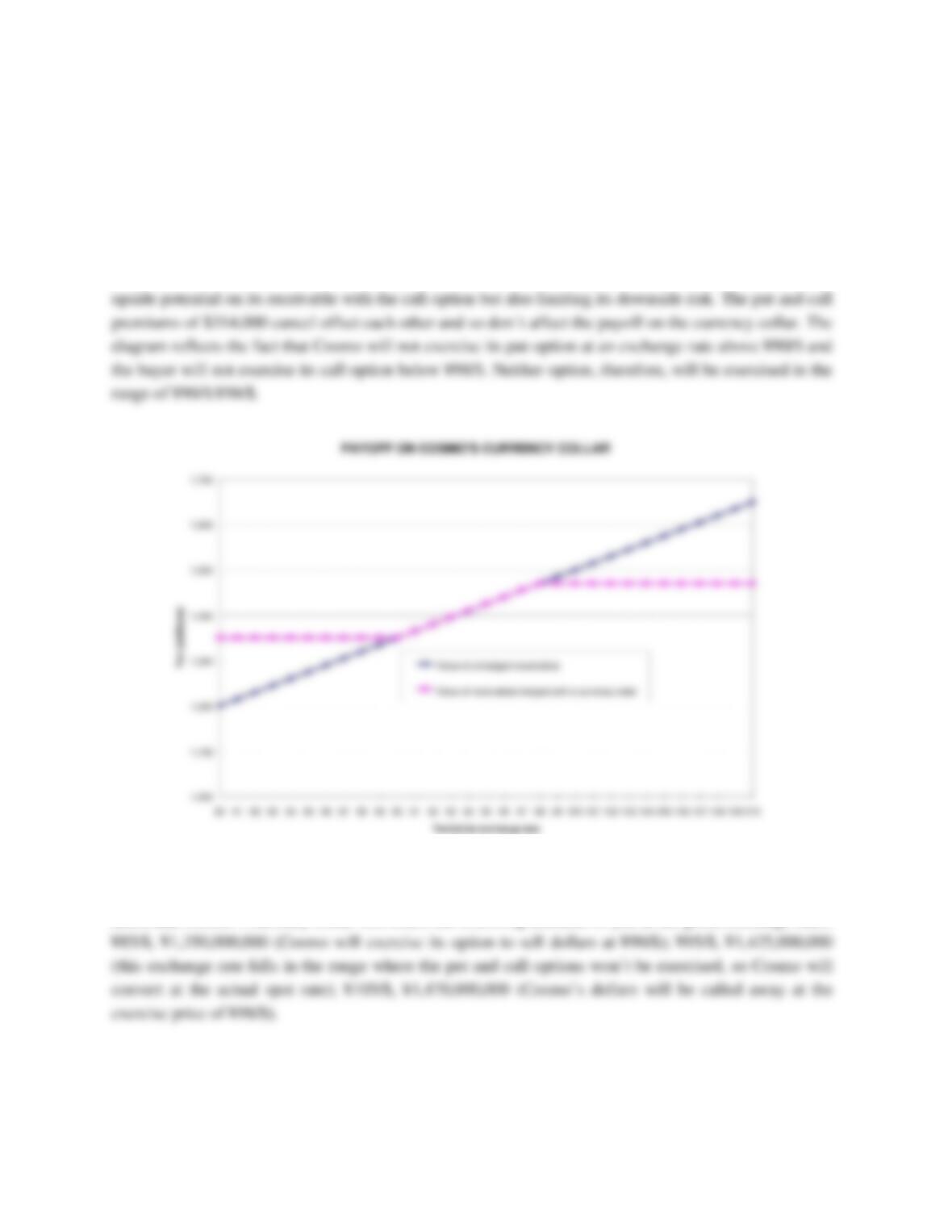
ANSWER. As can be seen from the payoff diagram on Cosmo’s currency collar, Cosmo is limiting the
10.b. What is the net yen value of Cosmo’s option hedged position at the following future spot
rates: ¥85/$, ¥95/$, and ¥105/$?
ANSWER. Cosmo’s currency collar will return the following amounts of yen at the given exchange rates:
10.c. As an alternative to using options, Cosmo could have hedged with a 60-day forward contract
at a price of ¥97/$. What would be the yen value of Cosmo’s hedged receivable if it had used
a forward contract to hedge?
10.d. At what exchange rate will the hedged value of Cosmo’s dollar receivables be the same
whether it used the option hedge or forward hedge?