Insuring Your Health
Chapter 9
How Will This Affect Me?
Having adequate health insurance is critically important to your financial plan. Health care costs
have grown dramatically in recent decades, and a major illness or accident could wipe you and
your family out financially if you are uninsured. Yet health insurance policies are complicated to
price and to compare. This chapter explains the importance of health insurance and the key
determinants of its costs. The various types of public and private health insurance are described
and a framework for decision making is provided. This includes discussions of how to analyze
LEARNING GOALS
LG1 Discuss why having adequate health insurance is important and identify the factors
contributing to the growing cost of health insurance.
LG2 Differentiate among the major types of health insurance plans and identify major private
and public health insurance providers and their programs.
throughout life.
LG3 Analyze your own health insurance needs and explain how to shop for appropriate
coverage.
LG4 Explain the basic types of medical expenses covered by and the policy provisions of health
insurance plans.
The text discusses the types of medical expenses and I would use the class time otherwise. You
LG5 Assess the need for and features of long-term-care insurance.
The need for long-term-care insurance and the cost are the issues. Generally, long-term care
insurance covers nursing home care which is expensive, but the amount the insurance pays may
LG6 Discuss the features of disability income insurance and how to determine your need for it.
Students probably identify disability insurance with the duck on the Aflac commercials. But
Financial Facts or Fantasies?
These may be used as “teasers” to get the students on the right page with you. Also, they may be
used as quizzes after you covered the material or as “pre–test questions” to get their attention.
Health care insurance coverage should be viewed as an essential component of your personal
financial plans.
Fact: Health care insurance not only helps you meet the costs of illness or injury, but it also
The difference between a health maintenance organization (HMO) and a preferred provider
organization (PPO) is that the HMO offers a wider range of choices of physicians, hospitals, and
so forth.
Fantasy: One of the drawbacks of an HMO is that it is common to be treated at its central
With health care insurance that covers the whole family, children may be included up to age 26
as long as they are full-time students.
Fantasy: Under the Affordable Care Act a child may be covered in a family insurance plan so
Health reimbursement accounts (HRAs) and health savings accounts (HSAs) are both funded by
employers to help their employees cover health-related costs – and any unused money is the
employee’s to keep.
Fantasy: While both accounts are consumer-directed plans, HRAs are funded solely by
Hospital insurance is the most comprehensive type of medical insurance you can buy. Fantasy:
Major medical or comprehensive major medical provides the most complete coverage, whereas
hospital insurance covers only the costs incurred while confined to a hospital.
The covered services, quality of the insurance company, and the advice of an agent are
important variables to consider when shopping for health care insurance.
Fact: When shopping for health care insurance, it’s important to know what services are
Disability insurance is helpful only if you make a lot of money – and then only if you are out of
work for a long period of time (at least six months to a year).
Fantasy: Disability income insurance replaces some or all of the weekly earnings lost in case

Financial Facts or Fantasies?
These may be used as a quiz or as a pre-test to get the students interested.
1. True False Health care insurance coverage should be viewed as an essential
component of your personal financial plans.
2. True False The difference between a health maintenance organization (HMO) and a
preferred provider organization (PPO) is that the HMO offers a wider
range of choices of physicians, hospitals, and so forth.
3. True False With health care insurance that covers the whole family, children may be
included up to age 26 as long as they are full-time students.
4. True False Health reimbursement accounts (HRAs) and health savings accounts
(HSAs) are both funded by employers to help their employees cover
health-related costs – and any unused money is the employees to keep.
5. True False Hospital insurance is the most comprehensive type of medical insurance
you can buy.
6. True False The covered services, quality of the insurance company, and the advice of
an agent are important variables to consider when shopping for health care
insurance.
7. True False Disability insurance is helpful only if you make a lot of money – and then
only if you are out of work for a long period of time (at least six months to
a year).
YOU CAN DO IT NOW
The “You Can Do It Now” cases may be assigned to the students as short cases or problems.
They will help make the topic more real or relevant to the students. In most cases, it will only
take about ten minutes to do, that is, until the student starts looking around at the web site. But
they will learn by doing so.
Compare Policies on an ACA Health Insurance Exchange
Financial Impact of Personal Choices
Read and think about the choices being made. Do you agree or not? Ask the students to discuss
the choices being made.
Wyatt Expands His Health Insurance Coverage
Wyatt Phillips is 28 years old. He works for a company with a good comprehensive major
medical health insurance plan. Indeed, Wyatt has heard it’s priced better than most plans and has
consequently taken out the optional expanded dental and vision plans. While he doesn’t currently
wear glasses or contact lenses, he does go for an annual eye exam and wants the extra vision plan
What do you think about Wyatt’s decision to purchase the vision insurance?
Applying Personal Finance
Insure Your Health!
Health care costs have increased dramatically in recent years, and many insurance providers have
reduced their coverage, leaving the individual to foot more of the bill. In this project, you’ll
examine your health insurance needs and determine the coverage that’s appropriate for you.
Solutions to Financial Planning Exercises
1. Evaluating current health insurance. Assess your current health insurance situation.
What does your policy cover? What is excluded? Are there any gaps that you think need to
be filled? Are there any risks in your current lifestyle or situation that might make
additional coverage necessary? If you were to purchase health insurance for yourself in the
near future, what type of plan would you select, and why? What steps can you take to keep
your health costs down?
Worksheet 9.1 provides a list of typical benefits. You can use it to examine what your policy
covers and if there are any gaps.
An honest examine of your lifestyle is difficult. You can start by listing how you spent your
time over the last week. Then ask yourself what impact the listed activities have on your health.
2. Choosing a health insurance plan. Silas and Camila Sims have two children, with ages of
6 years and 5 months. Their younger child, Julian, was born with a congenital heart defect
that will require several major surgeries in the next few years to correct fully. Silas is
employed as a salesperson for a major pharmaceutical firm, and Camila does not work
outside the home. Silas’ employer offers employees a choice between two health benefit
plans:
• A plan that allows the Sims to choose health services from a wide range of doctors and
hospitals. The plan pays 80 percent of all medical costs, and the Sims are responsible for
the other 20 percent. There’s a deductible of $500 per person. Silas’ employer will pay 100
percent of the cost of this plan for Silas, but the Sims will be responsible for paying $380 a
month to cover Camila and the children under this plan.
• A group HMO. If the Sims family choose this plan, the company still pays 100 percent of
the plan’s cost for Silas, but insurance for Camila and the children will cost $295 a month.
They’ll also have to make a $20 co-payment for any doctor’s office visits and prescription
drugs. They will be restricted to using the HMO’s doctors and hospital for medical
services.
Which plan would you recommend that the Sims family choose? Why? What other health
coverage options should the Sims family consider?
The Sims have a specific concern—their son’s heart problems. The choice of health plans will
be determined by which plan has the doctors and hospital that they need for Julian’s surgery and
recovery. If the HMO has the doctors and hospital that they need, then that is the better plan for
3. Out-of-pocket indemnity plans costs. Oscar Wang was seriously injured in a
snowboarding accident that broke both his legs and an arm. His medical expenses included
five days of hospitalization at $900 a day, $6,200 in surgical fees, $4,300 in physician’s fees
(including time in the hospital and eight follow-up office visits), $520 in prescription
medications, and $2,100 for physical therapy treatments. All of these charges fall within
customary and reasonable payment amounts.
a. If Oscar had an indemnity plan that pays 80 percent of his charges with a $500
deductible and a $5,000 stop-loss provision, how much would he have to pay out of pocket?
Oscar’s total expenses are [$900 * 5] + 6,200 + 4,300 + 520 + 2,100 = $17,620
b. What would Oscar’s out-of-pocket expenses be if he belonged to an HMO with a $20 co-
pay for office visits?
Oscar’s costs would be $20 per office visit, that is $20 * 8 = $160.
c. Monthly premiums are $155 for the indemnity plan and $250 for the HMO. If he had no
other medical expenses this year, which plan would have provided more cost-effective
coverage for Oscar? What other factors should be considered when deciding between the
two plans?
4. Comparing health insurance policies. Use Worksheet 9.1. Thea Morris, a recent college
graduate, has decided to accept a job offer from a nonprofit organization. She’ll earn
$45,000 a year but will receive no employee health benefits. Thea estimates that her
monthly living expenses will be about $2,000 a month, including rent, food, transportation,
and clothing. She has no health problems and expects to remain in good health in the near
future.
Using the Internet or other resources, gather information about three health insurance
policies that Thea could purchase on her own. Use Worksheet 9.1 to compare the policies’
features. Which of the three policies would you recommend Thea buy, and why?
I suggest a high deductible policy that will provide protection for catastrophic medical event and
5. Pros and cons of long-term care insurance. Discuss the pros and cons of long-term-care
insurance. Does it make sense for anyone in your family right now? Why or why not? What
factors might change this assessment in the future?
Pros of long-term care insurance include: protection of assets should a covered family member
need lengthy nursing home care [an unlikely event, average length of stay is about 16 months)
6. Calculating need for disability income insurance. Use Worksheet 9.2. Asher Perkins, a 35-
year-old computer programmer, earns $96,000 a year. His monthly take-home pay is
$4,800. His wife, Ellie, works part-time at their children’s elementary school but receives
no benefits. Under state law, Asher’s employer contributes to a workers’ compensation
insurance fund that would provide $2,250 per month for six months if Asher were disabled
and unable to work.
a. Use Worksheet 9.2 to calculate Asher’s disability insurance needs, assuming that he
won’t qualify for Medicare under his Social Security benefits.
Worksheet 9.2, Chapter 9 Exercise 6
DISABILITY BENEFIT NEEDS
Name(s):
Asher Perkins
1.
Estimate current monthly take-home pay
$ 4,800
b. Based on your answer in part a, what would you advise Asher about his need for
additional disability income insurance? Discuss the type and size of disability income
insurance coverage he should consider, including possible provisions he might want to
include. What other factors should he take into account if he decides to purchase a policy?
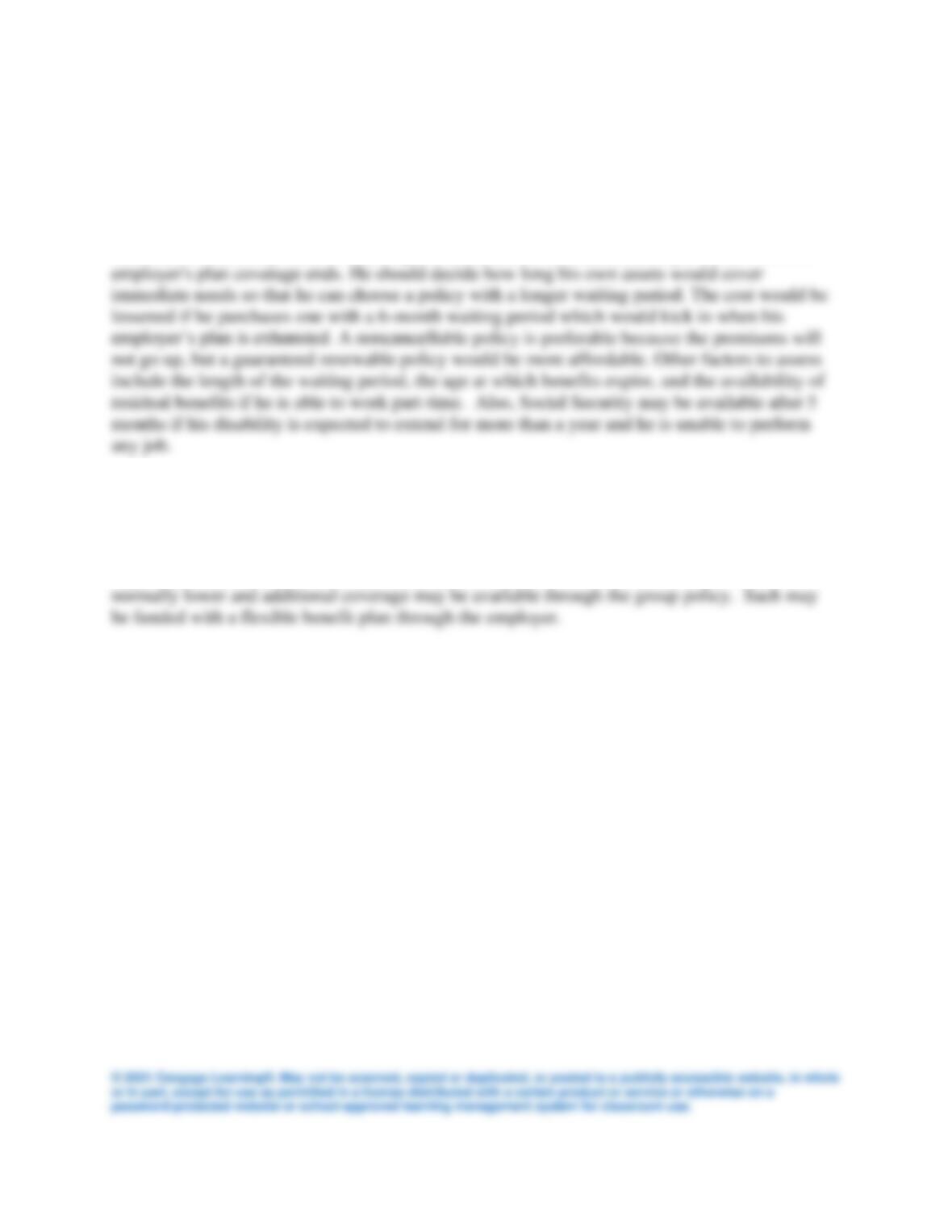
Asher needs to supplement his employer’s disability insurance with an individual policy. The
minimum he currently needs is $2,550 per month, and he will need $4,800 per month once his
7. Calculating your need for disability income insurance. Use Worksheet 9.2. Do you need
disability income insurance? Calculate your need using Worksheet 9.2. Discuss how you’d
go about purchasing this coverage.
Typically disability insurance is not very expensive, thus it is affordable. Group rates are
Critical Thinking Cases
9.1 Evaluating Jasper’s Health Care Coverage
Jasper Bell was a self-employed window washer earning approximately $700 per week.
One day, while cleaning windows on the eighth floor of the Third National Bank Building,
he tripped and fell from the scaffolding to the pavement below. He sustained severe
multiple injuries but miraculously survived the accident. He was immediately rushed to the
Critical Thinking Questions
1. Explain the policy provisions as they relate to deductibles, co-insurance, and internal
limits.
$3,000 deductible: He must incur $3,000 in costs before the policy will pay anything,
80% co-insurance: After the deductible is met, the policy will pay 80% of the costs. He is
responsible for the other 20% until he the stop-loss amount is reached.
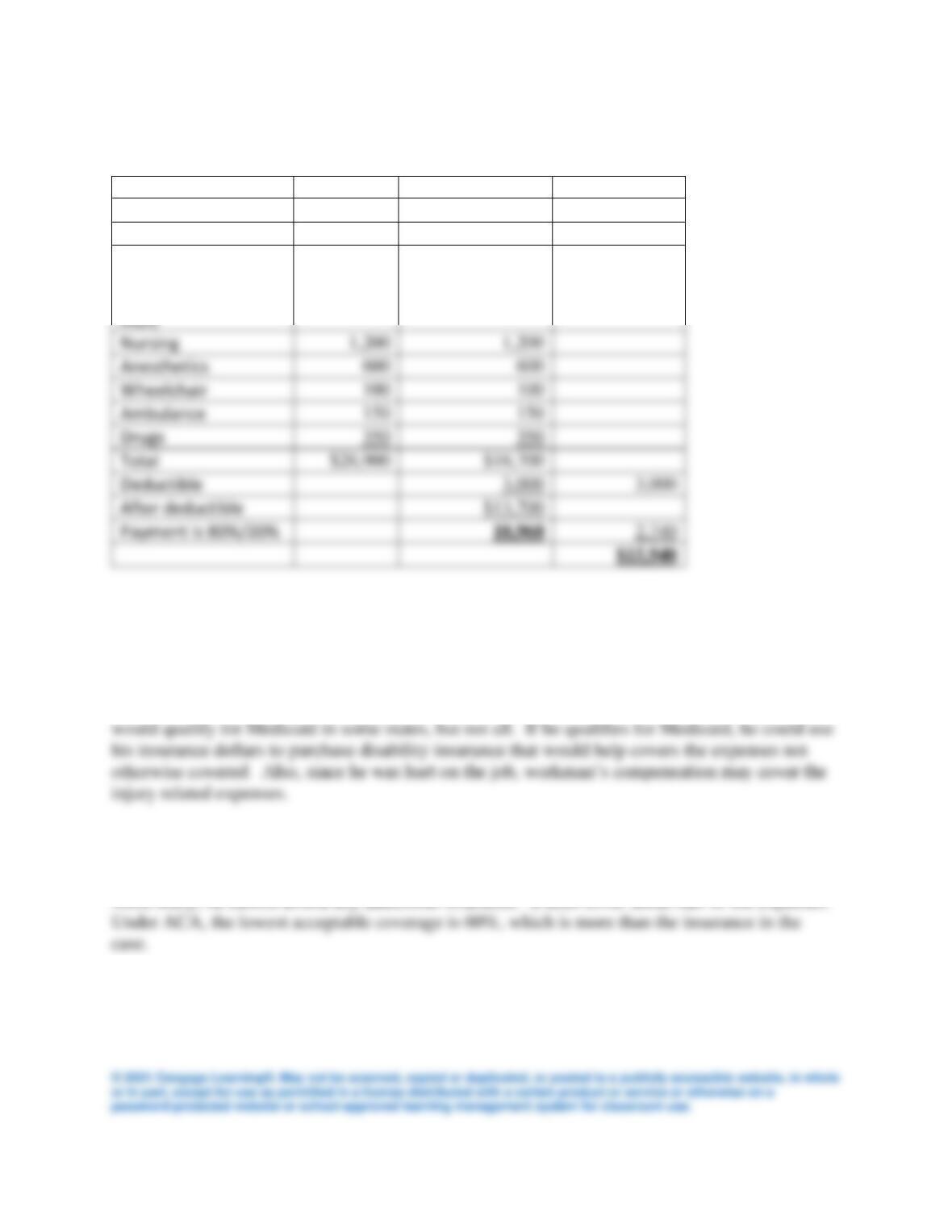
2. How much should Jasper recover from the insurance company? How much must he pay
out of his own pocket?
Expense Item
Charge
Paid by Insurance
Paid by Jasper
Surgeon
$7,500
1,500
6,000
Physician
2,000
2,000
0
Hospital room, board
(Charged $250 x 60
days; limit $180 x 60
Nursing
1,200
1,200
Anesthetics
Wheelchair
Ambulance
Drugs
Total
Deductible
3,000
3,000
After deductible
Payment is 80%/20%
2,740
15,000
10,800
4,200
3. Would any other policies have offered Jasper additional protection? What about his
inability to work while recovering from his injury?
He would qualify for disability benefits if he had disability insurance. With his income level, he
4. Based on the information presented, how would you assess Jasper’s health care
insurance coverage? Explain.
9.2 Valeria and Matias Evaluate Their Disability Income Needs
Valeria and Matias Rivera have been married for two years and have a 1-year-old son.
They live in Richmond, Virginia, where Matias works for Software Solutions. He earns
$6,000 per month, of which he takes home $4,200. Matias and his family are entitled to
per month.
Valeria is also employed. She earns $1,400 per month after taxes by working part-time at a
nearby grocery store. As a part-time employee, the store gives her no benefits. Should
Critical Thinking Questions
1. How much, if any, additional disability income insurance does the Rivera family require
to ensure adequate protection against Matias becoming completely disabled? Use
Worksheet 9.2 to assess his needs.
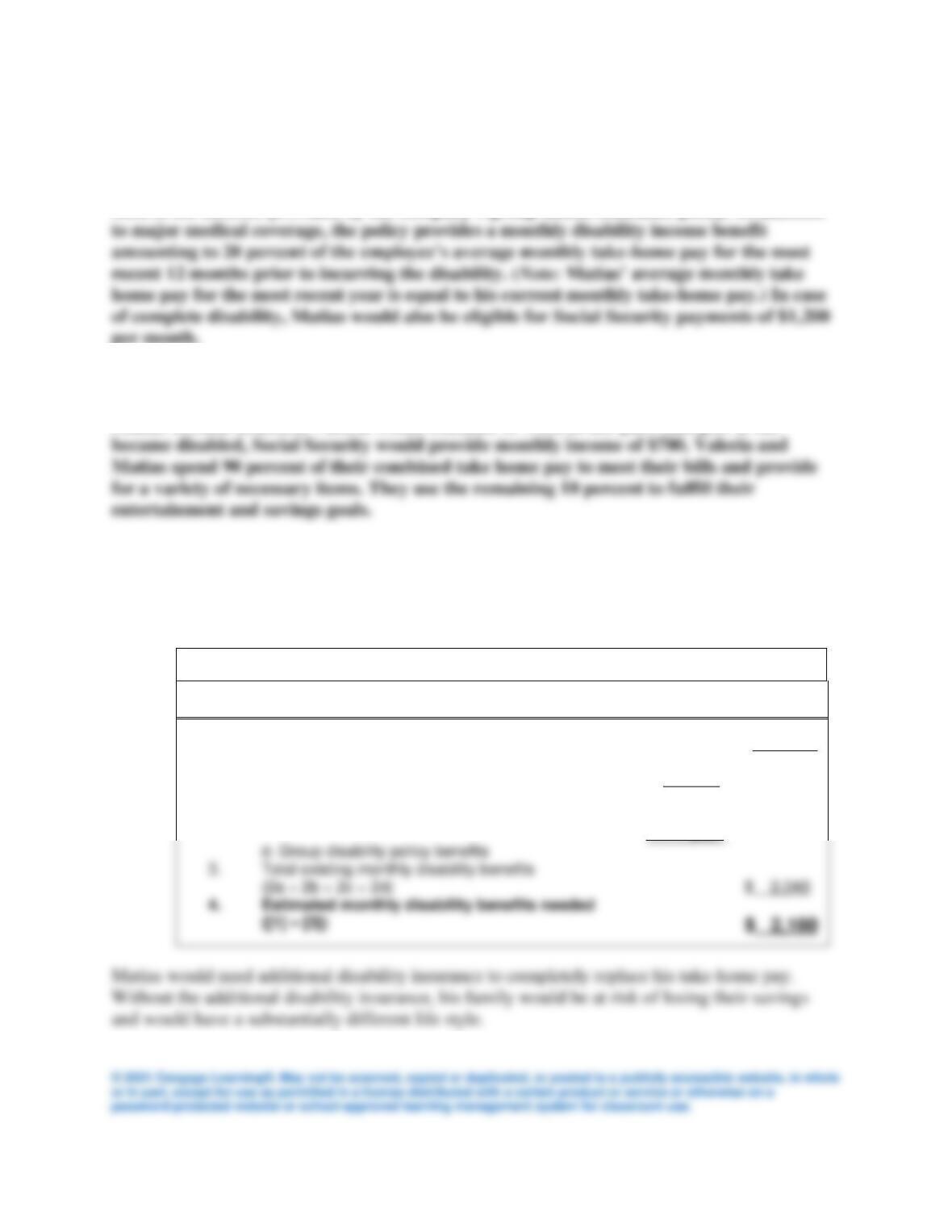
DISABILITY BENEFIT NEEDS
Name(s):
Matias Rivera
1.
Estimate current monthly take-home pay
$ 4,200
2.
Estimate existing monthly disability benefits:
a. Social security benefits
$__1,200_
b. Other government benefits
________
c. Company benefits
d. Group disability policy benefits
Total existing monthly disability benefits