
COUNTY OF SACRAMENTO
NOTES TO BASIC FINANCIAL STATEMENTS
FOR THE YEAR ENDED JUNE 30, 2009
(amounts expressed in thousands)
NOTE 15 – COMMITMENTS
The County has entered into several agreements related to the construction of capital projects, the expansion of the airport and other activities.
Governmental Funds – The County’s governmental funds has entered into contracts for the construction of certain projects totaling $198,563 at June 30, 2009.
Airport – Airport Systems had approximately $143,834 in outstanding construction contract commitments at June 30, 2009.
Solid Waste Enterprise Fund – Waste Management and Recycling Department has entered into equipment and construction agreements totaling $7,621 at
June 30, 2009.
The Fund operates one active landfill (Kiefer) and maintains postclosure care for two closed landfills (Elk Grove and Grand Island).
In accordance with GASB Statement No. 18, management of the Fund has deemed the capacity of the Kiefer Landfill will be the basis of recognizing its closure
and postclosure care costs. The Fund reported Kiefer Landfill closure and postclosure care liabilities of $12,844 and $11,364 at June 30, 2009 and 2008,
respectively. The Fund will recognize costs of $31,415 as the remaining capacity in the Kiefer Landfill is used in future years. At June 30, 2009, the capacity of the
portion of the postclosure costs expected to be paid during the next year is $24.
Future closure and postclosure costs are based on what it would cost to perform all closure and postclosure care in 2009. Actual costs may be different due to
inflation, changes in technology, changes in permitted capacity and/or changes in regulations.
92

COUNTY OF SACRAMENTO
NOTES TO BASIC FINANCIAL STATEMENTS
FOR THE YEAR ENDED JUNE 30, 2009
(amounts expressed in thousands)
The Fund is required by state and federal laws and regulations to provide financial assurance that appropriate resources will be available to finance closure and
postclosure care costs in the future. Management has accumulated sufficient assets to finance Kiefer Landfill closure costs as required by applicable laws at June 30,
2009 and 2008. The Board of Supervisors has approved pledges of revenues to provide financial assurance for the postclosure maintenance costs of the Kiefer Landfill.
93
COUNTY OF SACRAMENTO
NOTES TO BASIC FINANCIAL STATEMENTS
FOR THE YEAR ENDED JUNE 30, 2009
(amounts expressed in thousands)
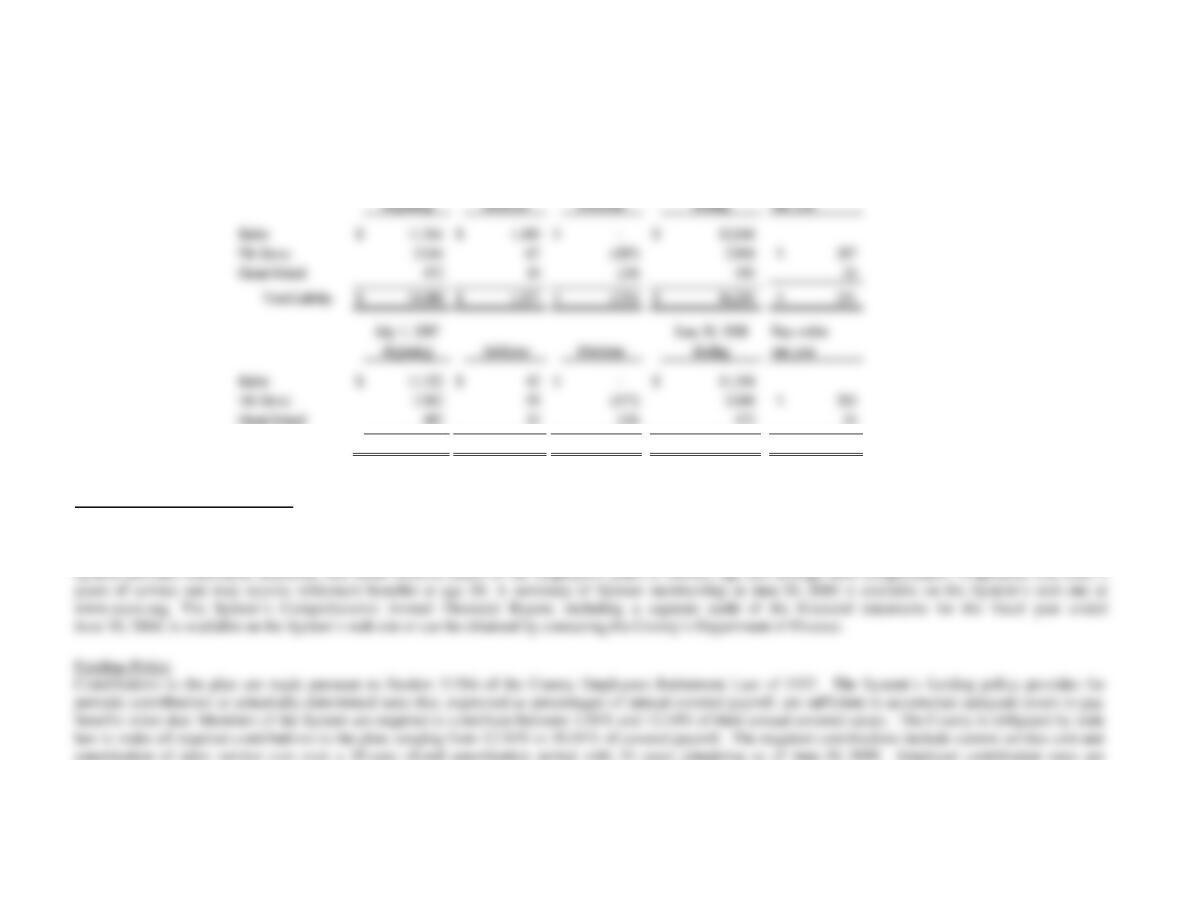
Changes in accrued landfill closure and postclosure care liability for the fiscal years ended June 30, 2009 and 2008 were as follows:
July 1, 2008 June 30, 2009 Due within
Total Liability $ 14,967 $ 114 $ (201) $ 14,880 $ 227
NOTE 17 – RETIREMENT PLAN
All County full-time and part-time employees participate in the Sacramento County Employees’ Retirement System (“SCERS” or the “System”), a multiple-
employer, cost-sharing, public employee retirement system. For purposes of County financial statements, SCERS is considered a sole employer plan because the
County’s contributions substantially make up the total contributions of the plan. Membership in the System primarily consists of employees of the County. The
determined using the entry age normal funding method based on a level percentage of payroll. The System also uses this actuarial method to amortize the unfunded
liability, if applicable.
94

COUNTY OF SACRAMENTO
NOTES TO BASIC FINANCIAL STATEMENTS
FOR THE YEAR ENDED JUNE 30, 2009
(amounts expressed in thousands)
Contributions for the year ending June 30, 2009 totaled $204,844. Included in this total are employer contributions of $160,406 and member contributions of
$44,438. All contributions were made in accordance with actuarially determined contribution requirements based on the actuarial valuation performed at
June 30, 2009.
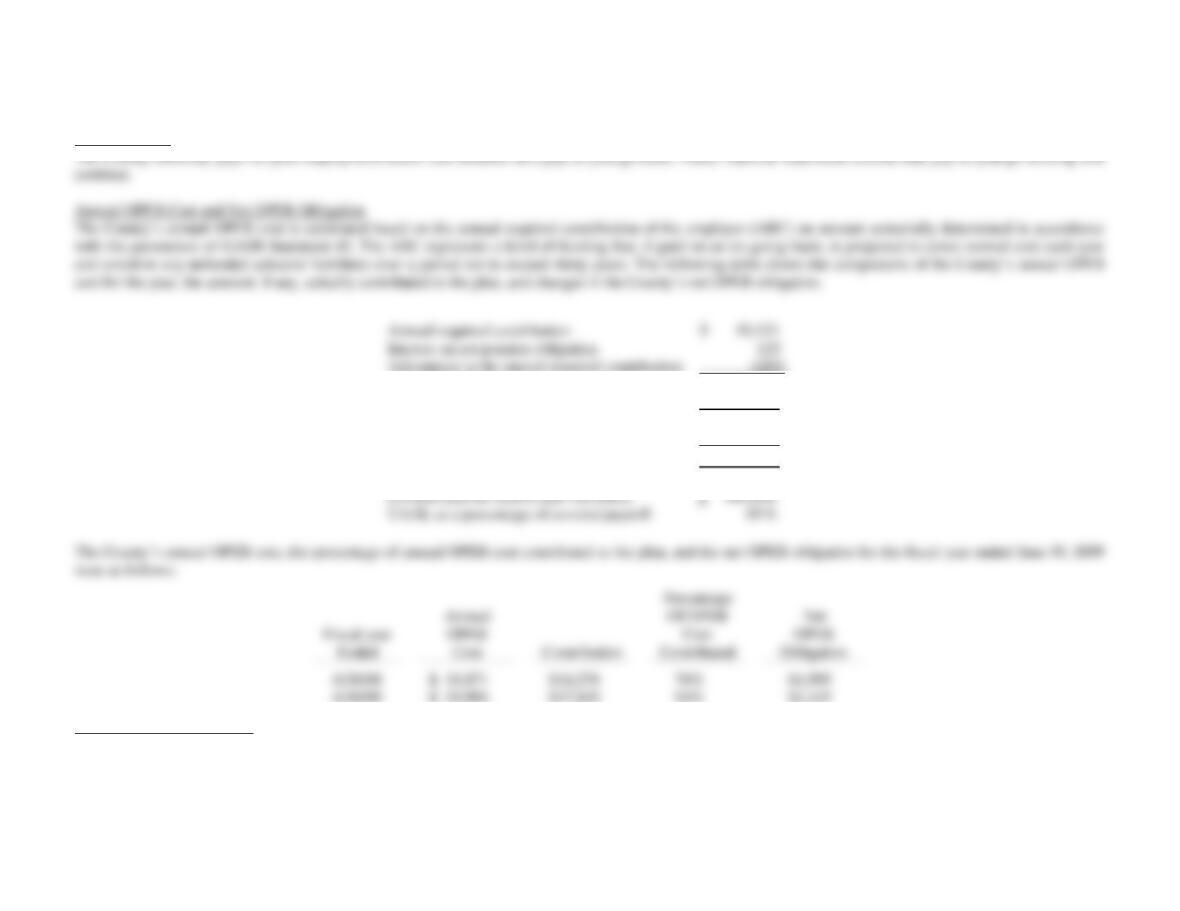
Annual Pension Cost, Actuarial Methods and Assumptions, and Net Pension Asset
The County’s annual pension cost and required and actual contributions were determined as part of the June 30, 2007 actuarial valuation using the entry age normal
actuarial cost method. The actuarial assumptions included (a) 3.50 % annual general inflation, (b) 7.875% investment rate of return (net of administrative expenses),
and (c) Projected salary increases of 5.14% to 11.55% for miscellaneous; 3.75% to 9.76% for safety (includes inflation at 3.4%, plus real across the board salary
increase of 0.25% plus merit and longevity increases). The actuarial value of SCERS assets was determined using techniques that smooth the effects of short-term
volatility in the market value of investments over a five-year period (smoothed fair value). SCERS’ unfunded actuarial accrued liability is being amortized as a
level percentage of projected payroll over 30 years, with 24 years remaining on a closed basis. The County’s annual pension cost and pension assets for the year
ended June 30, 2009, were as follows:
Annual required contribution $ 160,406
Interest on beginning net pension asset (79,603)
6/30/07
6/30/08
6/30/09
$140,089
145,767
161,340
$145,432
148,163
160,406
104%
102%
99%
$1,035,174
1,037,569
1,036,635
Funding Status and Progress
As of June 30, 2009, the most recent actuarial valuation date, the plan was 86.0 percent funded. The actuarial accrued liability for benefits was $6,661,993, and the
COUNTY OF SACRAMENTO
NOTES TO BASIC FINANCIAL STATEMENTS
FOR THE YEAR ENDED JUNE 30, 2009
(amounts expressed in thousands)
NOTE 18 – POST EMPLOYMENT HEALTH CARE BENEFITS
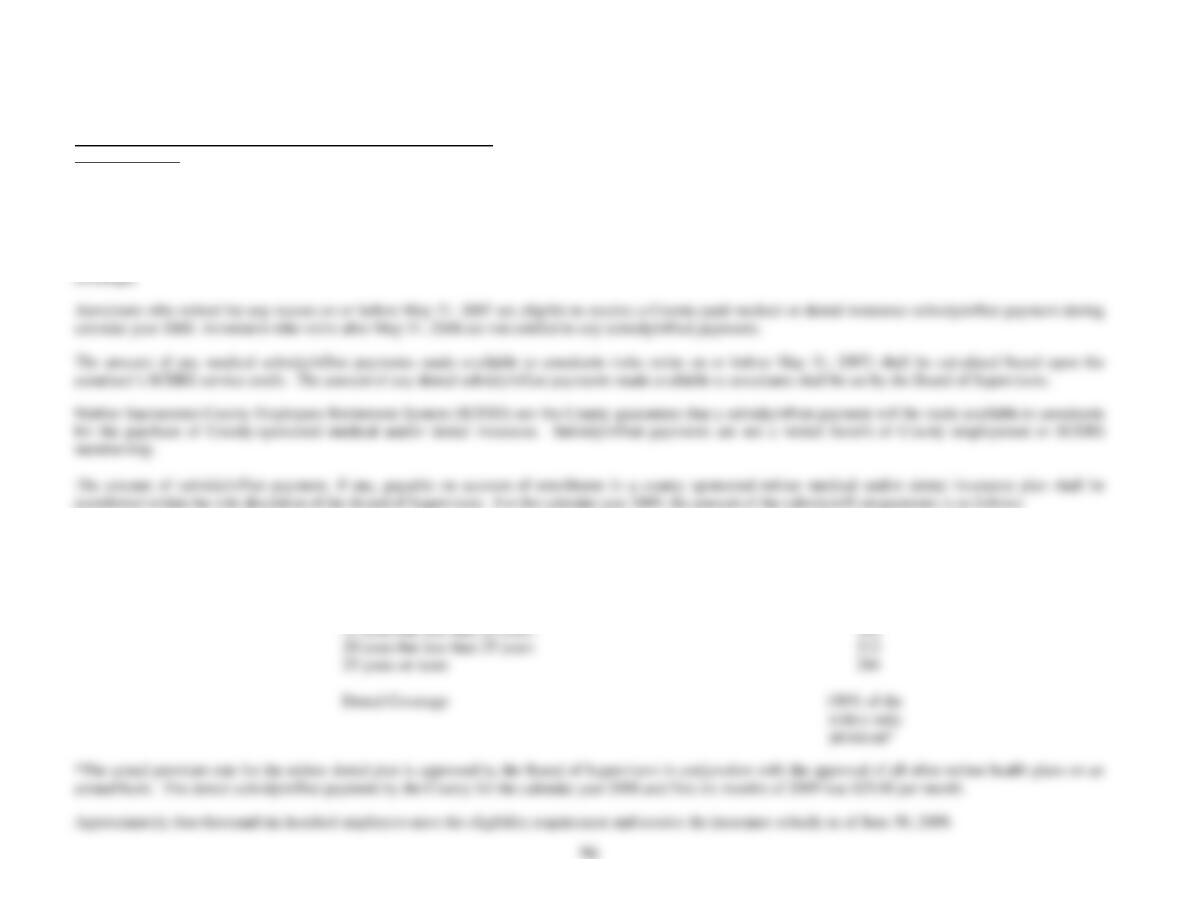
Plan Description The County provides medical insurance and dental insurance, and subsidy/offset payments as authorized by the Board of Supervisors on an annual
basis. The Board of Supervisors must approve the benefit annually or it is terminated
All annuitants are eligible to enroll in a retiree medical and/or dental insurance plan in a given calendar year if (1) they began receiving a continuing retirement
allowance from SCERS during that calendar year, or (2) they were enrolled in the annual plan previously approved by the County, or (3) they previously waived
coverage but elected to enroll during the County authorized enrollment period with a coverage date effective January of the given calendar year. (continuous
Amount of
subsidy/offset
Years of SCERS service credit payment
Less than 10 years $122
10 years but less than 15 years 152
COUNTY OF SACRAMENTO
NOTES TO BASIC FINANCIAL STATEMENTS
FOR THE YEAR ENDED JUNE 30, 2009
(amounts expressed in thousands)
Funding Policy
Annual OPEB cost 18,994
Contributions made 17,849
Increase in OPEB obligation 1,145
Net OPEB Obligation, beginning of year 4,595
Net OPEB Obligation, end of year $ 5,740
Funding Status and Progress
As of June 30, 2007, the most recent actuarial valuation date the plan was 0% funded. The actuarial accrued liability was $245,592 and the actuarial value of assets
was $0 resulting in an unfunded actuarial accrued liability (UAAL) of $245,592. The schedule of funding progress is presented as RSI following the notes to the
financial statements.
97

COUNTY OF SACRAMENTO
NOTES TO BASIC FINANCIAL STATEMENTS
FOR THE YEAR ENDED JUNE 30, 2009
(amounts expressed in thousands)
Actuarial valuations of an ongoing plan involve estimates of the value of reported amounts and assumptions about the probability of occurrence of events far into
the future, examples include assumptions made about future employment, mortality and the healthcare cost trend. Amounts are determined regarding the funded
status of the plan, and the annual required contribution of the employer are subject to continual revision as actual results are compared with past expectations and
new estimates are made about the future. The June 30, 2007 actuarial report is the most recent actuarial valuation, consequently there is no historical information
provided in the Schedule of Funding Progress. The Schedule will, in subsequent fiscal years, present multi-year trend information that shows whether the actuarial
value of plan assets is increasing or decreasing over time relative to the AAL for benefits.
Actuarial Methods and Assumptions:
Projections of benefits for financial reporting purposes are based on the substantive plan (the plan as understood by the employer and the plan members) and
include the types of benefits provided at the time of each valuation and the historical pattern of sharing benefit costs between the employer and plan members to
that point. The actuarial methods and assumptions used include techniques that are designed to reduce the effects of short-term volatility in actuarial accrued
liabilities and the actuarial value of assets, consistent with the long-term perspective of the calculations.
funds’ liability for premium charges by making provisions in budgets of succeeding years. The self-insurance internal service funds recognize revenue and the
owing funds expense/expenditure when the owing funds are charged by the self-insurance internal service funds.
The Liability/Property and the Workers’ Compensation Self-Insurance funds’ estimated claim liabilities are actuarially based and include claims incurred but not
reported. The estimated liabilities include provisions for allocated claims adjustment expenses, including administrative, attorney, and other associated expenses.
Proceeds received for salvage and subrogation are recognized as revenue in the year of receipt, and therefore are not included in the estimated liabilities.

COUNTY OF SACRAMENTO
NOTES TO BASIC FINANCIAL STATEMENTS
FOR THE YEAR ENDED JUNE 30, 2009
(amounts expressed in thousands)
Reconciliation of Claims Liabilities
2009 2008
Liability/Property
2009 2008
Compens ation
Worker‘s
2009 2008
Dental &
Unemployment
2009
Total
2008
Current portion
Noncurrent
Total beginning balance
Unpaid claims and claim adjustment expenses at beginning
of the fiscal year
$ 11,100
22,208
33,308
12,097
23,527
35,624
24,821
87,695
112,516
23,277
80,763
104,040
35,921
109,903
145,824
35,374
104,290
139,664
to ins ured events of prior fiscal years
Total payments
Total unpaid claims and claim adjustment expenses
at end of the fiscal year June 30, 2009.
19,672
20,319
33,629
13,077
13,807
33,308
26,184
29,164
118,148
27,406
30,269
112,516
1,880
1,291
45,856
51,363
151,777
40,483
45,367
145,824
Current portion of unpaid claims and claim adjustments 11,276
11,100
26,391
24,821
37,667
35,921
COUNTY OF SACRAMENTO
NOTES TO BASIC FINANCIAL STATEMENTS
FOR THE YEAR ENDED JUNE 30, 2009
(amounts expressed in thousands)
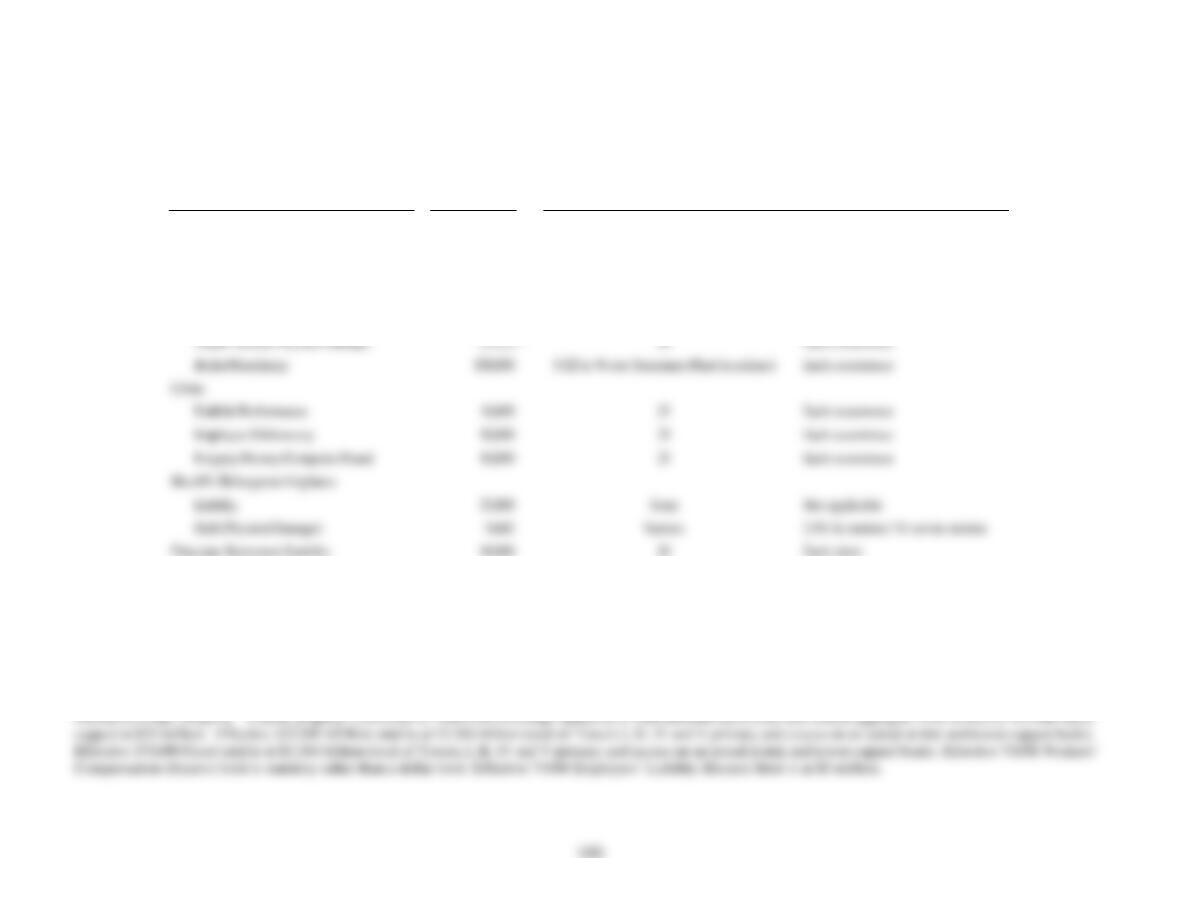
Coverage for specific perils required under the terms of certain debt issues and County policies obtained from outside carriers is as follows:
Coverage Amount Deductible Provision
Airport Liability & Hanger keepers $ 500,000 $25 Each occurrence
Property Program:
Property Insurance (All Risk) 2,264,000 * 50 Each occurrence
Flood 2,264,000 * 2% / 100 minimum Per Building / Each occurrence
Earthquake (EQ) 25,000 * 5% / 100 minimum Per building / Each occurrence
General Liability (Exces s ) 25,000 2,000 Self–ins ured retention
Pollution Liability 10,000 500 Each occurrence
Workers’ Compensation (Excess) Statutory* 2,000 Self–insured retention
Employers ’ Liability 5,000 2,000 Self–ins ured retention
*Airport Liability and Hangerkeepers – Coverage is subject to War & Terrorism exclusion. The County has not purchased the buy-back coverage due to the expense and

COUNTY OF SACRAMENTO
NOTES TO BASIC FINANCIAL STATEMENTS
FOR THE YEAR ENDED JUNE 30, 2009
(amounts expressed in thousands)
NOTE 20– RESTRICTED NET ASSETS
Restricted Net Assets are assets that are subject to constraints either 1) externally imposed by creditors, grantors, contributors, or laws or regulations of other
governments or 2) imposed by law through constitutional provision or enabling legislation. Restricted net assets as of June 30, 2009 are as follows:
Business-
Go v e rn me n t a l type
Activities Activities Total
$
8,279 8,279
Community facilities 4,601 4,601
Fis h and game 30 30
Net assets restricted by enabling legislation are comprised of $103,733 (passenger facility charges), $3,178 (lighting and landscape maintenance) and $4,601
(community facilities) in the Statement of Net Assets at June 30, 2009.
Restricted Net Assets include:
•
COUNTY OF SACRAMENTO
NOTES TO BASIC FINANCIAL STATEMENTS
FOR THE YEAR ENDED JUNE 30, 2009
(amounts expressed in thousands)
•
Fire protection – accounts for property taxes used to fund the provision of fire protection services provided by the Natomas Fire District to approximately 40
square miles of the unincorporated area.
•
Health programs – health programs are comprised of the following:
¾
First five Commission – accounts for funds received from State Proposition 10 which are used to support healthy development of children prenatal to age
space.
•
Community facilities – accounts for service charges collected from direct levies on property tax bills for various community facilities districts.
•
Fish and game – used to account for fines collected for violations of the fish and game code and deposited to the Fish and Game Propagation Program to
support activities related to fish and game, including education.
NOTE 21 – NET ASSETS/FUND BALANCES
COUNTY OF SACRAMENTO
NOTES TO BASIC FINANCIAL STATEMENTS
FOR THE YEAR ENDED JUNE 30, 2009
(amounts expressed in thousands)
•
Restricted Net Assets – This category presents external restrictions imposed by creditors, grantors, contributors or laws or regulations of other governments and
restrictions imposed by law through constitutional provisions or enabling legislation.
•
Unrestricted Net Assets – This category represents net assets of the County, not restricted for any project or other purpose.
In the fund financial statements, reserves and designations segregate portions of fund balance that are either not available or have been earmarked for specific
purposes. The various reserves and designations are established by actions of the Board and management and can be increased, reduced or eliminated by similar
¾
Long term receivables and advances to other funds – to reflect the amount due from other funds and receivables that are long-term in nature. Such
amounts do not represent available spendable resources.
¾
Special deposits – to reflect the advances to employees for travel purposes.
•
Debt service – to reflect the funds held by trustees or fiscal agents for future payment of bond principal and interest. These funds are not available for general
operations.
COUNTY OF SACRAMENTO
NOTES TO BASIC FINANCIAL STATEMENTS
FOR THE YEAR ENDED JUNE 30, 2009
(amounts expressed in thousands)
•
Teeter plan notes – to reflect an amount equal to the amount of the final payment on the Teeter note.
•
Future services – to reflect management’s intent to provide funding for unspecified services and capital projects.
•
Future pension obligations –to reflect management’s intent to improve cash reserves to pay for the incremental increase in future pension obligation bond
payments over the next 13 years.
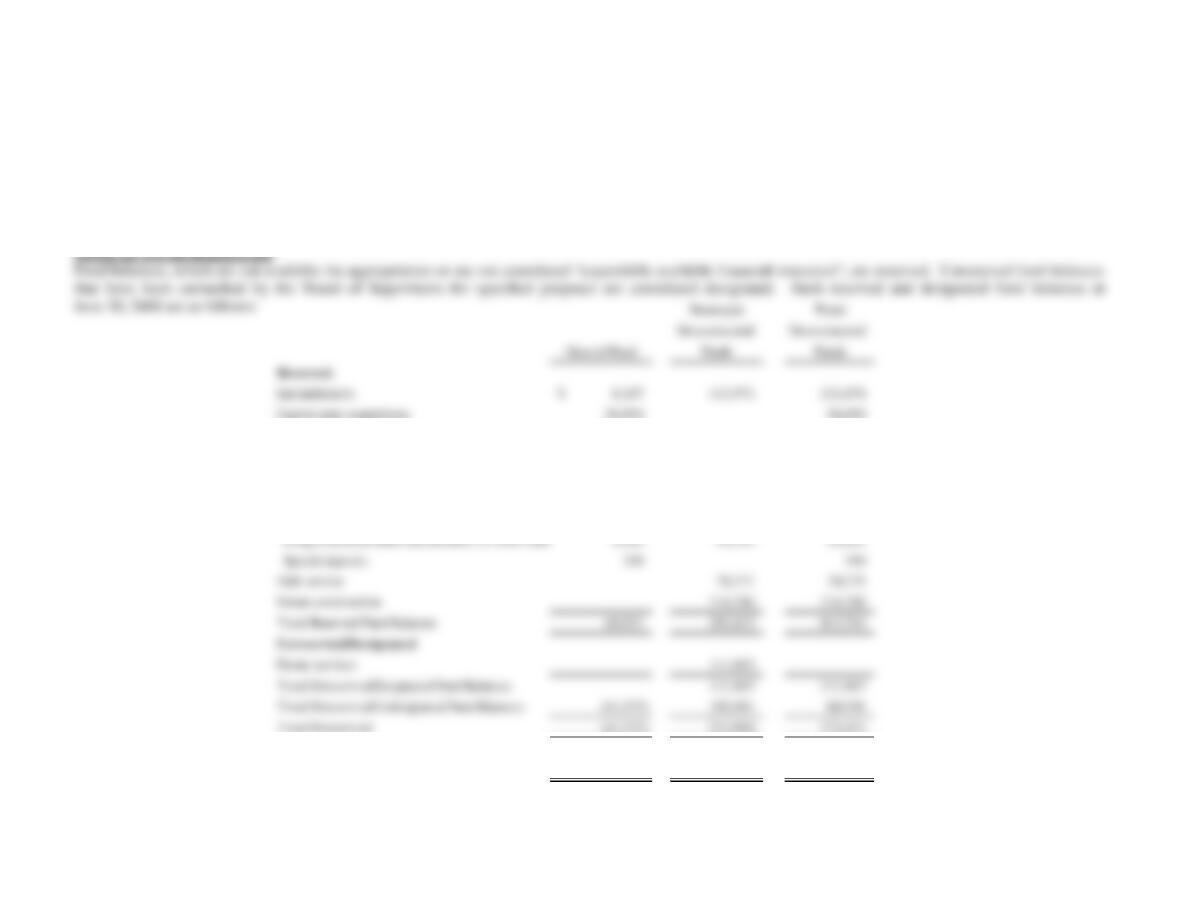
Assets not available:
Teeter plan tax loss
TRANS interest
Teeter plan delinquencies
Imprest cash
s
19,541
1,137
665
255
4,260
149
54,145
Total Fund Balances $ 19,388 566,786
19,541
1,137
665
404
58,405
586,174
As not all long-term assets are reserved, see Note 5 for the allocation between reserved fund balance and deferred revenue as Note 1 discloses as being the policy of the
County.
104

COUNTY OF SACRAMENTO
NOTES TO BASIC FINANCIAL STATEMENTS
FOR THE YEAR ENDED JUNE 30, 2009
(amounts expressed in thousands)
NOTE 23 – CONTINGENCIES
The County is a defendant in various lawsuits related to self-insurance programs and for other claims, including construction, property tax assessments, and claims
arising from audits of federal- and state-funded programs. Anticipated costs related to such claims and litigation are accrued in the Self-Insurance funds where
appropriate. Although the final outcome of these matters cannot be predicted, the County believes that these accruals are adequate to provide for its estimated future
obligations in these matters, and that any amounts in excess of such accruals will not be significant to the County.
Financial Stress
The County is currently experiencing significant financial stress. As a result of continuing weakness in the national, State and local economy, various revenue sources
of the County, including revenues from or based on property taxes and sales taxes, have declined significantly since fiscal year 2007-08. In addition, County pension
costs and debt service costs relating to pension obligation bonds are significantly increasing.
Housing Declines
The housing market slump and related negative impact of economic conditions has continued through 2009 to date. In the County, Notices of Default increased from
approximately 7,000 in calendar year 2006 to approximately 18,000 in calendar year 2007, to approximately 24,000 in 2008. Notices of Default filings typically
The County Assessor’s Office projects, on a preliminary basis, that assessed values for Fiscal Year 2010-11 will decrease from Fiscal Year 2009-10 levels by
approximately 2%, translating into a property tax revenue decrease for the County General Fund of approximately $8 million between the Fiscal Year 2009-10
currently estimated actual amount and the Fiscal Year 2010-11 projected amount.
105

COUNTY OF SACRAMENTO
NOTES TO BASIC FINANCIAL STATEMENTS
FOR THE YEAR ENDED JUNE 30, 2009
(amounts expressed in thousands)
Sales Tax Declines
In addition to declines in property tax revenues described above, in the adopted 2009-10 budget, revenues of the County from or related to sales taxes were projected to
decline by approximately 14% from Fiscal Year 2008-09 levels. The County now expects that sales tax revenues will decline by an additional $3.2 million below
2009-10 budget projections due to overestimating the Fiscal Year 2008-09 year-end accrual and a portion received from the State in-lieu property tax payments. In
addition, the 2009-10 budget projected decreases in “realignment” revenues that consist of the County’s share of State sales tax and vehicle license fees of
approximately $21 million and declines in the ½ cent Public Safety Sales Tax (dedicated to law enforcement services) of approximately $8.9 million. Based on
allocation information recently received from the State, the County projects a further decline (below 2009-10 budget projections) of approximately $1.8 million in
“realignment” revenues, and expects the ½ cent Public Safety Sales Tax to be received at budgeted levels.
Changes in Personnel Expenditures
The 2009-10 budget included decreases in General Fund labor expenditures of approximately $41 million (as compared to Fiscal Year 2008-09 actual expenditures),
due to reductions in County staff levels. Labor expenses at current staffing levels are projected to increase by $44.3 million in Fiscal Year 2010-11 due to current labor
contractual commitments.
Fiscal Year 2009-10 mid-year budget hearings are scheduled for February 2010, to make adjustments in revenue and expenditure projections as needed to ensure the
current year’s budget remains in balance. The County currently projects that property taxes, sales taxes and certain other revenues for Fiscal Year 2009-10 will be
approximately $10 million less than assumed in the 2009-10 budget resulting in a projected budget shortfall for the current fiscal year (2009-10) equal to that amount.
The County Executive’s Office has directed departments to submit ongoing expenditure reduction plans and currently expects to request the Board of Supervisors
during mid-year budget hearings to approve expenditure reductions of approximately $15.3 million for the remainder of Fiscal Year 2009-10 that addresses the $9.9
COUNTY OF SACRAMENTO
NOTES TO BASIC FINANCIAL STATEMENTS
FOR THE YEAR ENDED JUNE 30, 2009
(amounts expressed in thousands)
Fiscal Year 2010-11 General Fund Budget Outlook
The County currently has identified a Fiscal Year 2010-11 budget shortfall of approximately $149 million. If the Board of Supervisors approves the mid-year reduction
of $5.4 million reflected above, and if that reduction is carried forward by Board action during the Fiscal Year 2010-11 Proposed Budget hearings in June for the entire
four quarters of the fiscal year resulting in a $21.6 million reduction, then the remaining shortfall identified would be approximately $122.1 million. This $122.1
million reflects the following: $53.3 million in one-time funding sources used in Fiscal Year 2009-10 that is no longer available; $11.9 million due to beginning
scheduled transfers-back of interfund transfers made to the General Fund in Fiscal Year 2008-09; $8.0 million property tax revenue decrease; $4.6 million due to
increases in pension obligation bond debt service; and, approximately $44.3 million in anticipated labor cost increases at current staffing levels.
employees and not to retirees. Unfair labor practice charges were filed by a number of unions, claiming that the County had violated the MMBA by failing to meet and
confer prior to changing the eligibility requirements. UPE also claimed that the zipper clause in its contract permits UPE to refuse to negotiate a mid-contract change in
retiree health benefits.
Ultimately, the PERB Board held that the County had committed unfair labor practices because the retiree health program is an established past practice that provides a
future benefit for current employees, and a subject within the scope of bargaining. As to UPE, PERB also found that the zipper clause applied and UPE could refuse to
107

COUNTY OF SACRAMENTO
NOTES TO BASIC FINANCIAL STATEMENTS
FOR THE YEAR ENDED JUNE 30, 2009
(amounts expressed in thousands)
GASB Statement No. 53 establishes standards for accounting and financial reporting for Derivative Instruments. This Statement addresses the recognition,
measurement and disclosure of information regarding derivative instruments entered into by state and local governments. A key provision in this Statement is that
derivative instruments covered in its scope, with the exception of synthetic guaranteed investment contracts (SGICs) that are fully benefit-responsive are reported at
fair value. Much of this Statement describes the methods of evaluating effectiveness. The disclosures required by Technical Bulletin No. 2003-1, Disclosure
Requirements for Derivatives Not Reported at Fair Value on the Statement of Net Assets, have been incorporated into this Statement. The County has not
timing of measurements are effective for actuarial valuations first used to report funded status information in OPEB plan financial statements for periods beginning
after June 15, 2011. Statement No. 57 addresses issues related to the measurement of OPEB obligations by certain employers participating in agent multiple-employer
OPEB plans. (In agent multiple-employer plans, separate liabilities are calculated and separate asset accounts are kept for each participating government, rather than
being administered and accounted for as a single plan as is done in a cost sharing plan.) Statement No. 57 amends Statement No. 43, Financial Reporting for
Postemployment Benefit Plans other than Pension Plans and State No. 45, Accounting and Financial Reporting by Employers for Postemployment Benefits other than
COUNTY OF SACRAMENTO
NOTES TO BASIC FINANCIAL STATEMENTS
FOR THE YEAR ENDED JUNE 30, 2009
(amounts expressed in thousands)
On December 31, 2009, GASB issued Statement No. 58, Accounting and financial Reporting for Chapter 9 Bankruptcies effective for periods beginning after June 15,
2009. Retroactive application is required for all prior periods presented during which a government was in bankruptcy. GASB Statement No 58 provides guidance for
governments that have petitioned for protection from creditors by filing for bankruptcy under Chapter 9 of the United States Bankruptcy Code. It establishes
requirements for recognizing and measuring the effects of the bankruptcy process on assets and liabilities, and for classifying changes in those items and related costs.
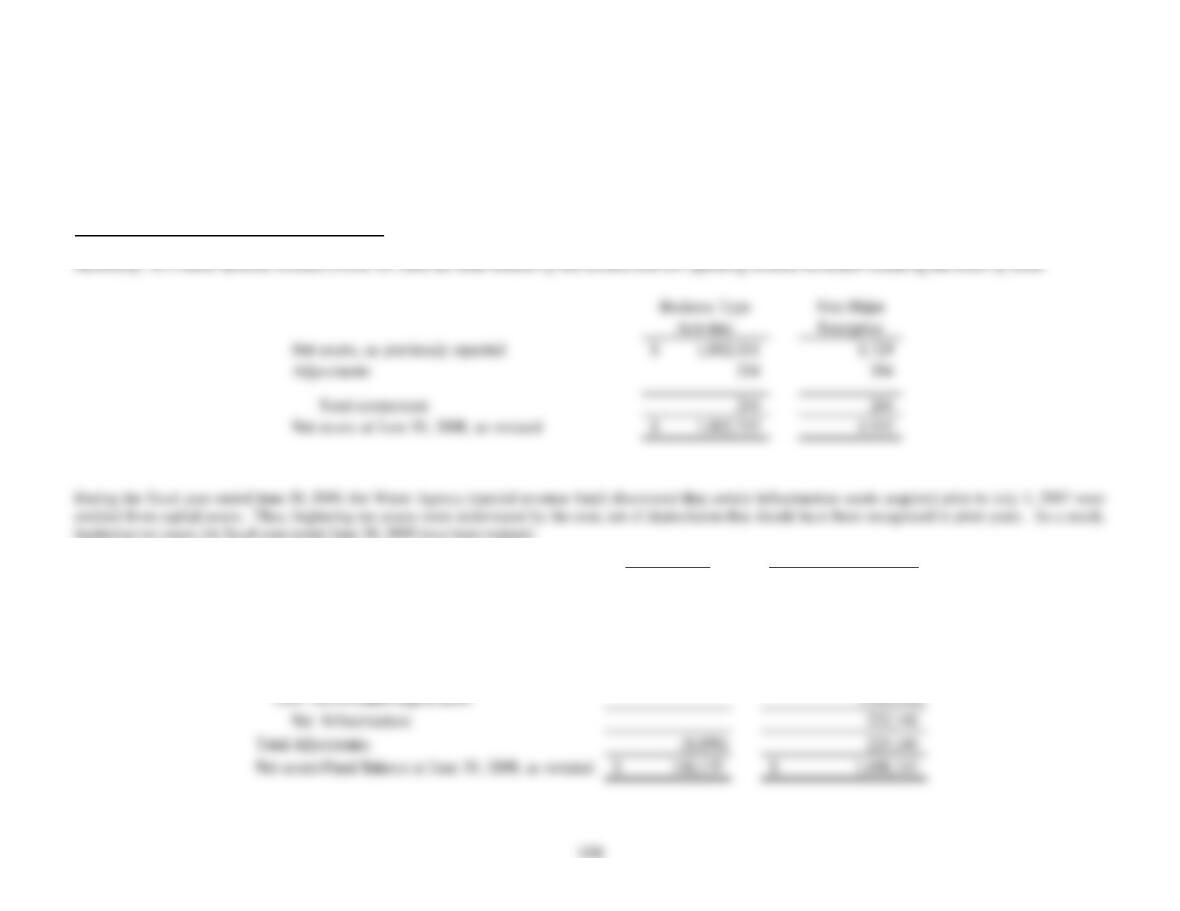
NOTE 25 – RESTATEMENT OF NET ASSETS
During the fiscal year ended June 30, 2009, Transit (enterprise fund) determined that there were adjustments needed in prior periods, TDA revenues were deferred
General Fund Governmental Activities
.
Net assets\Fund Balance, as previously reported $ 157,033 $ 1,472,997
Adjus t ments :
Deferred revenue (8,898)
Infrastructure Gross 410,464

COUNTY OF SACRAMENTO
NOTES TO BASIC FINANCIAL STATEMENTS
FOR THE YEAR ENDED JUNE 30, 2009
(amounts expressed in thousands)
NOTE 26 – SUBSEQUENT EVENTS
In July 2009, the California State Legislature passed a series of bills affecting counties, cities, redevelopment agencies and special districts. This legislation
authorized the State of California to borrow from or defer revenues to local governments for fiscal year 2009-10. The revenues affected include:
•
Property Taxes – County auditors are directed to reduce 2009-10 property tax allocations by an amount equal to 8%, except in limited circumstances,
•
Redevelopment Agency Property Taxes – $1.7 billion in redevelopment revenues will be shifted to the Supplemental Educational Revenue Augmentation
Fund in 2009-10, thereby benefiting the State General Fund. An additional $350 million is shifted in 2010-11. For just 2009-10, the 20% set-aside to the
obligation, with interest, by June 30, 2013.
To mitigate the impact on the County’s cash flow, the County is participating in the Proposition 1A Securitization Program administered by the California
Statewide Communities Development Authority which will enable the County to sell the Proposition 1A Receivable and neutralize the affect of the State
borrowing. All cost of issuance will be paid by the State. The County is expected to receive proceeds of $16,357,727 and $16,357,727 on January 15, 2010 and
May 3, 2010, respectively.
COUNTY OF SACRAMENTO
NOTES TO BASIC FINANCIAL STATEMENTS
FOR THE YEAR ENDED JUNE 30, 2009
(amounts expressed in thousands)
Terms: The bonds and the related swap agreement mature on July 10, 2031, and the swap’s original notional amount of $49,225 matched the $49,225 accreted value
on the variable-rate bonds. The swap’s current notional amount is $49,225. The swap was entered into on June 22, 2006, with an effective date of July 10, 2009.
do not have a corresponding fair value increase.
Credit risk: If the swap was in effect, the County would not be exposed to credit risk resulting from a failure of the counterparty to perform because the swap had a
negative fair value. The swap counterparty was rated A+ by Standard & Poor’s and Aa3 by Moody’s Investors Services.
Basis risk: If the swap were in place, it would be exposed to basis risk. The basis risk is the difference between the rate paid on the variable rate bonds and the
floating amount received from the interest rate swap of the 5 year USD-ISDA. If the variable rate was 2.6% (current rate of interest on bonds), and the 5 year USD-
ISDA SWAP minus 50 basis points was 2.47%, there would be a difference of 1.633%. As of June 30, 2009, the intended synthetic fixed rate would then be
4.233%, or 2.6% plus 1.633%.
Termination risk: The County or the counterparty may terminate the swap if the other party fails to perform under the terms of the contract. If the swap is
terminated, the variable-rate certificates would no longer carry a synthetic interest rate. If the swap is terminated, other than by the counterparty exercising its option
under the agreement, and at the time of termination, the swap has a negative fair value, the County would be liable to the counterparty for a payment equal to the