FY2009/10 Approved Budget
2009/10
Proposed
2010/11 2011/12 2012/13 2013/14
Budget Estimate Estimate Estimate Estimate
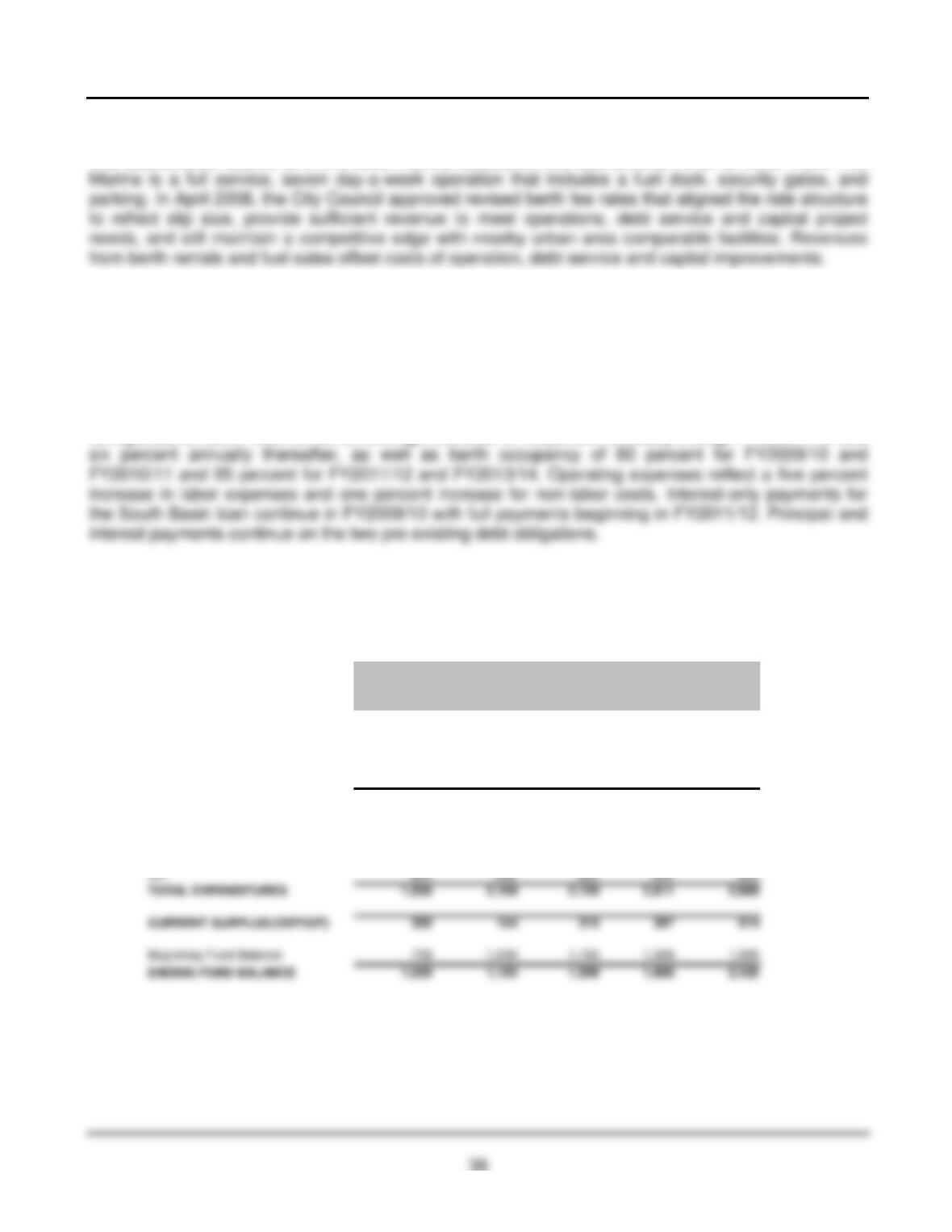
REVENUE
Berth Rentals 1,810 2,027 2,696 2,858 3,029
Interest 18 20 23 24 25
Gas and Oil Sales 250 250 300 300 300
Miscellaneous 78 26 26 26 26
TOTAL REVENUES 2,156 2,323 3,045 3,208 3,380
EXPENDITURES
Operating 1,052 1,218 1,364 1,446 1,501
Debt Service 604 751 1,165 1,165 1,165
Marina Fund (6009)
Revenue and Expenditure Five-Year Forecast
Dollars in Thousands
Marina Fund (6009)
The Sacramento Marina is a 475-berth marina located on the Sacramento River at Miller Park. The
The Sacramento Marina completed a $10.5 million renovation in FY2008/09 that included replacement
of the 45-year old deteriorating South Basin docks, providing covered berths for nearly all slips,
complete replacement of the fuel dock, and reconfiguring the berth sizes to reflect market demand and
ensure higher annual occupancy rates. The project was primarily financed through a loan from the
State Department of Boating and Waterways.
The five-year expense and revenue forecast reflects the financial analysis prepared for the new berth
configurations. Berth fees reflect an average increase of 12 percent annually through FY20011/12 and

FY2009/10 Approved Budget
39
THIS PAGE LEFT INTENTIONALLY BLANK
FY2009/10 Approved Budget
Community Center Fund (6010)
The Community Center Fund funds the operation, debt service, and capital improvement program for the
Sacramento Convention Center, Memorial Auditorium, and Community Center Theater. The Center’s goals
include maintaining successful financial performance as an enterprise fund, optimizing facility utilization
through aggressive marketing, exceeding industry standards for service and facility maintenance,
increase to the full amount of $3.00 per ticket in FY2009/10.
Labor costs are budgeted to grow by four percent during this time and non-labor costs by one percent.
Cost savings are being pursued and implemented due to uncertainty in the overall economy and the
potential negative impact on revenues. The Community Center is also establishing an operational
reserve beginning in FY2012/13 to address unanticipated or emergency needs.
FY2009/10 Approved Budget
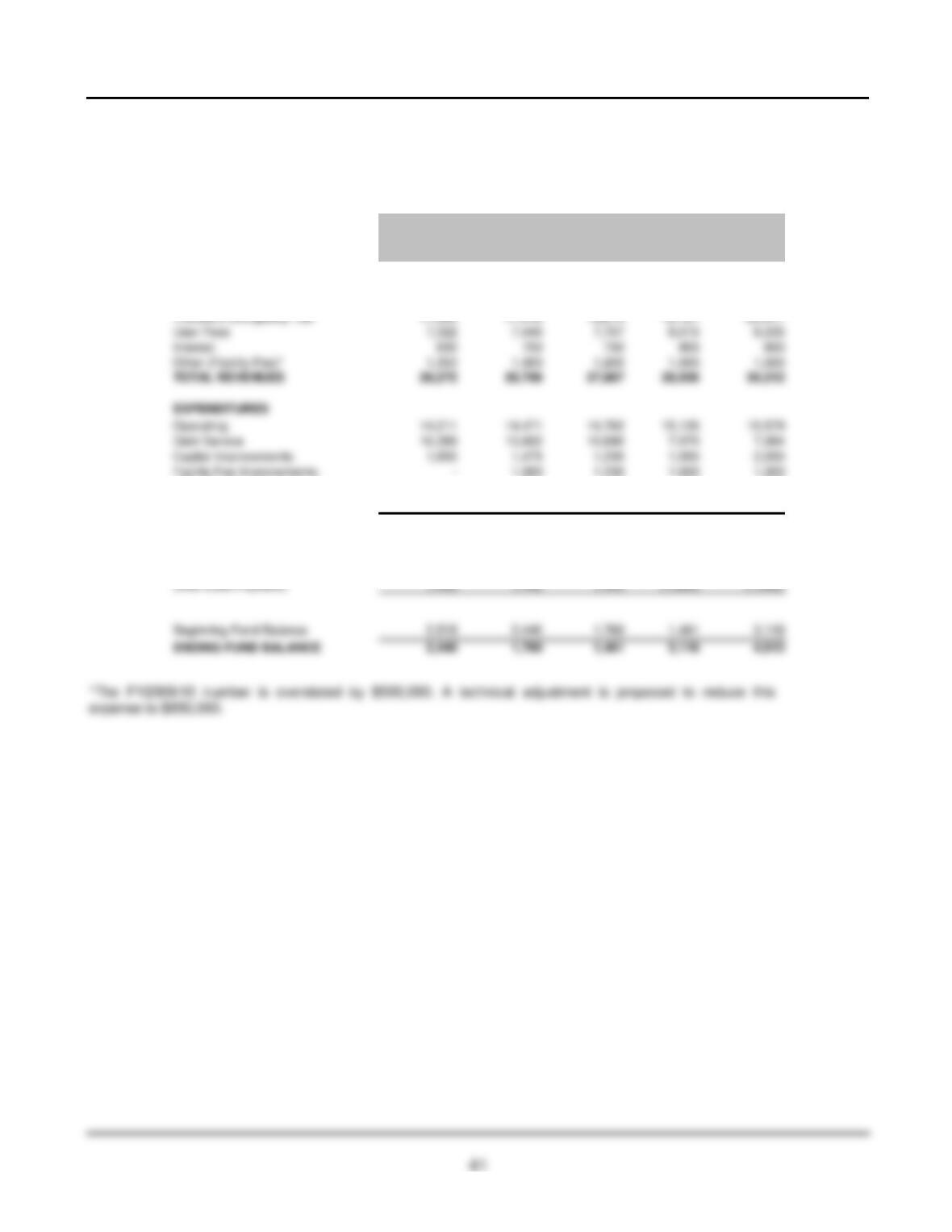
2009/10
Proposed
2010/11 2011/12 2012/13 2013/14
Budget Estimate Estimate Estimate Estimate
REVENUE
Other Fund Uses – 224 224 224 224
TOTAL EXPENDITURES 26,250 27,862 28,066 26,279 27,717
SURPLUS/(DEFICIT) 22 (580) (199) 2,656 2,496
Operational Reserve – – – (50) (50)
Other Fund Uses
Revenue and Expenditure Five Year Forecast
Dollars in Thousands
Community Center Fund (6010)
FY2009/10 Approved Budget
42
Storm Drainage Fund (6011)
Revenue generated by the City for the purpose of providing storm drainage service to its customers is
deposited in the Storm Drainage Fund. Revenues are derived primarily from customer service charges
and interest earnings. Storm Drainage Fund revenues cover the cost of storm drainage operations at
103 pumping stations, wet weather treatment and storage, collection system maintenance, related
engineering services, flood plain management, customer service and billing, education programs,
water quality monitoring and other regulatory compliance issues, and a capital improvement program.
Fund expenditures are divided among operating costs, debt service, and capital improvements.
Challenges facing the Storm Drainage Fund include:
Upgrading drainage service to areas outside of the City’s combined sewer and storm drainage
system (CSS) to meet citywide standards.
Supporting regional flood control efforts.
Improving drainage system reliability.
The following chart provides a five-year budget and rate forecast including the following assumptions:
No rate increases and continued use of fund reserves. Expenditures continue to exceed
revenues and the fund is projected to be in a deficit position in the near-term. Per Proposition
218, a voter approved ballot measure is required to increase Storm Drainage rates. The
department intends to recommend moving forward with the ballot measure process.
Increase in Sacramento Area Flood Control Agency (SAFCA) costs: The City of Sacramento
provides support and assistance to SAFCA by providing a salary and benefit framework for
SAFCA staff. City positions are filled with SAFCA staff and are fully reimbursed by SAFCA for
all associated salary and benefit costs. There are 5.0 FTE SAFCA staff positions currently
funded within the City’s budget in Utilities. SAFCA has requested an additional 11.0 FTE
positions costing approximately $1.6 million in FY2009/10. These costs will be fully offset by
reimbursement from SAFCA.

FY2009/10 Approved Budget
43
2009/10 2009/10 2009/10 2010/11 2011/12 2012/13 2013/14
Base
Budget
Proposed
A
ugmentations
Proposed
Budget Estimate Estimate Estimate Estimate
Projected Rate Increase* 0% 0% 0% 0% 0%
REVENUE
Charges, Fees and Services 33,117 – 33,117 33,117 33,117 33,117 33,117
Interest 387 – 387 387 387 387 387
Other 3,502 2,712 2,796 2,886 2,977 3,074
Additional SAFCA Positions – Fully
Offset – 11.0 11.0 FTE
Storm Drainage Fund (6011)
Revenue and Expenditure Five Year Forecast
Dollars in Thousands
*Voter approval is required for rate adjustments to the Storm Drainage Fund. This forecast assumes no rate increases for FY10-14.
FY2009/10 Approved Budget
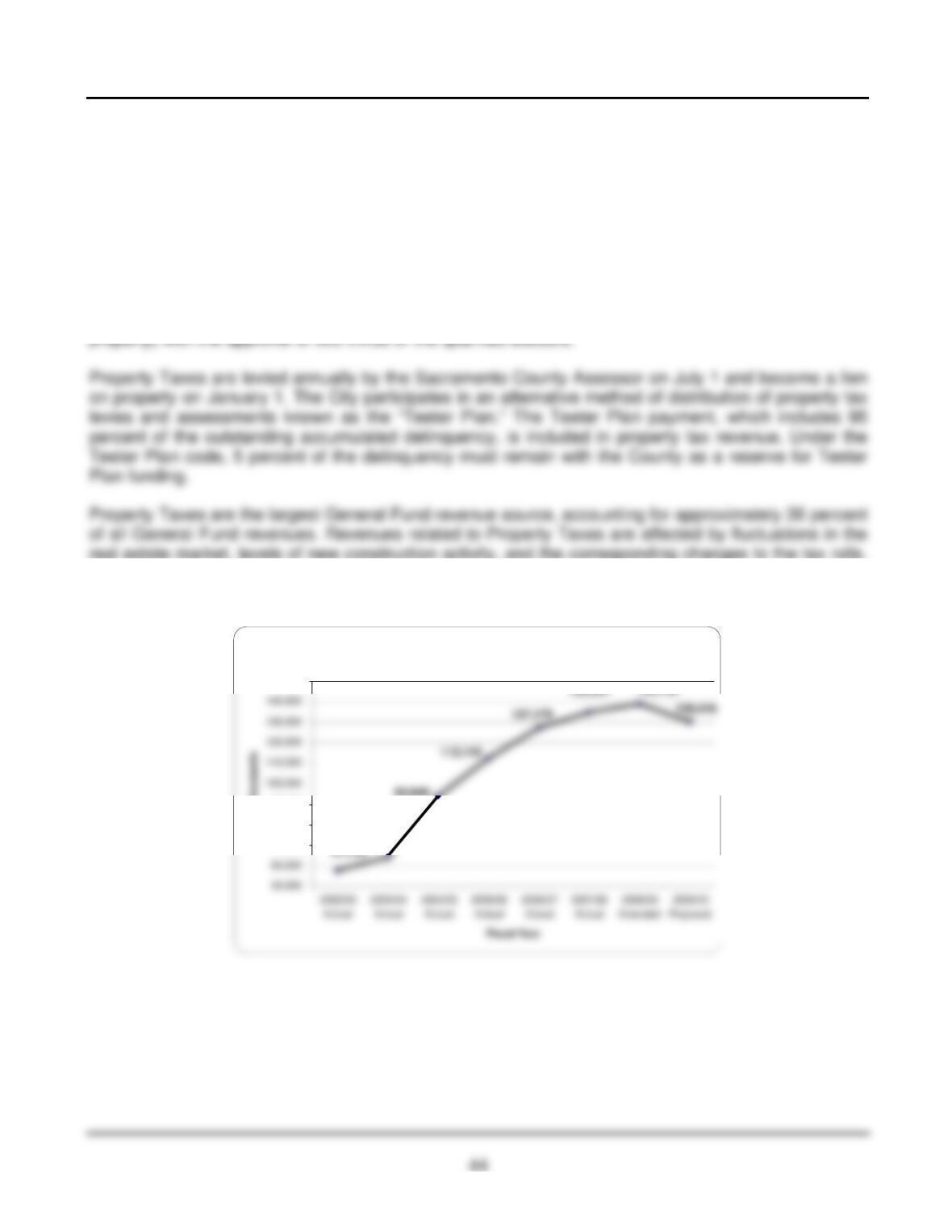
Property Taxes
In Thousands
138,738
64,379
70,000
80,000
90,000
150,000
$ Thousands
Revenue Overview
Property Taxes
Article XIII of the California Constitution (Proposition 13) limits ad valorem taxes on real property to
one percent of value plus taxes necessary to pay indebtedness approved by voters prior to July 1,
1978. The Article also established the 1975/76 assessed valuation as the base and limits annual
increases to the cost of living, not to exceed two percent, for each year thereafter. Property may also
be reassessed to full market value after a sale, transfer of ownership, or completion of new
construction. The State is prohibited under the Article from imposing new ad valorem, sales, or
transactions taxes on real property. Local government may impose special taxes (except on real
Not included in the graphic below is the property transfer tax, imposed on all transactions when
property located in the City is sold.
FY2009/10 Approved Budget
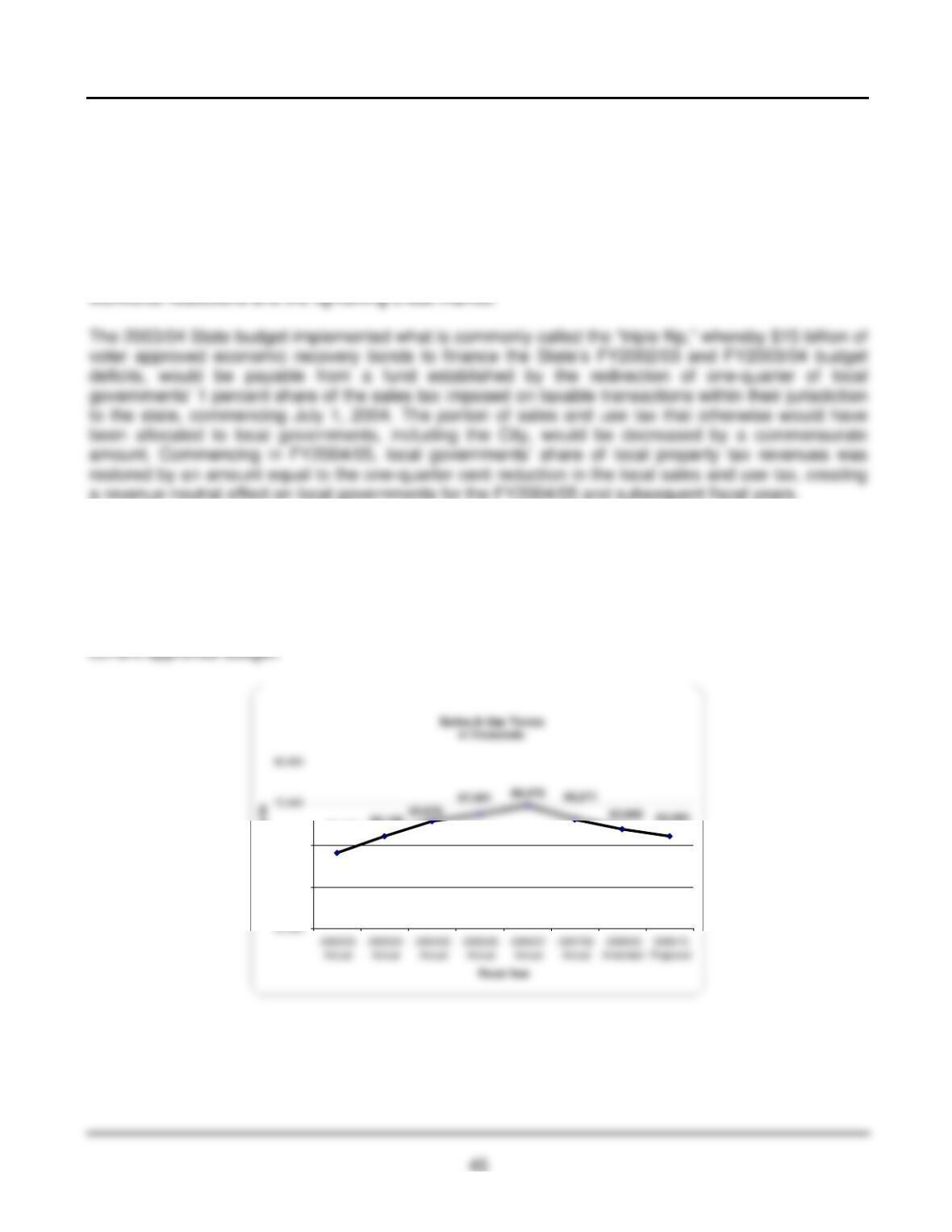
58,194
50,000
60,000
$ Thousands
Sales and Use Tax
The City of Sacramento has adopted a Bradley-Burns Sales Tax Ordinance, which allows the City to
receive one cent of the overall sales tax imposed in the City. The State Board of Equalization
collects and distributes sales and use tax for the state, cities, counties, and other entities receiving
sales tax revenue.
Sales and Use Taxes make up approximately 16 percent of General Fund revenues and are expected
to decrease by approximately 2.5 percent as a result of the effects of the slowing real estate market,
Since FY2004/05, this revenue exchange has been implemented with the City receiving less sales tax
and greater property tax allocations. This will remain in effect until such time as the state’s economic
recovery bonds have been retired.
The City’s sales tax receipts peaked at $69.5 million in FY2007/08. For FY2009/10 sales tax is
estimated to be $62.2 million, or 10.5 percent less than the peak and a 2.5 percent reduction from the
FY2009/10 Approved Budget
46
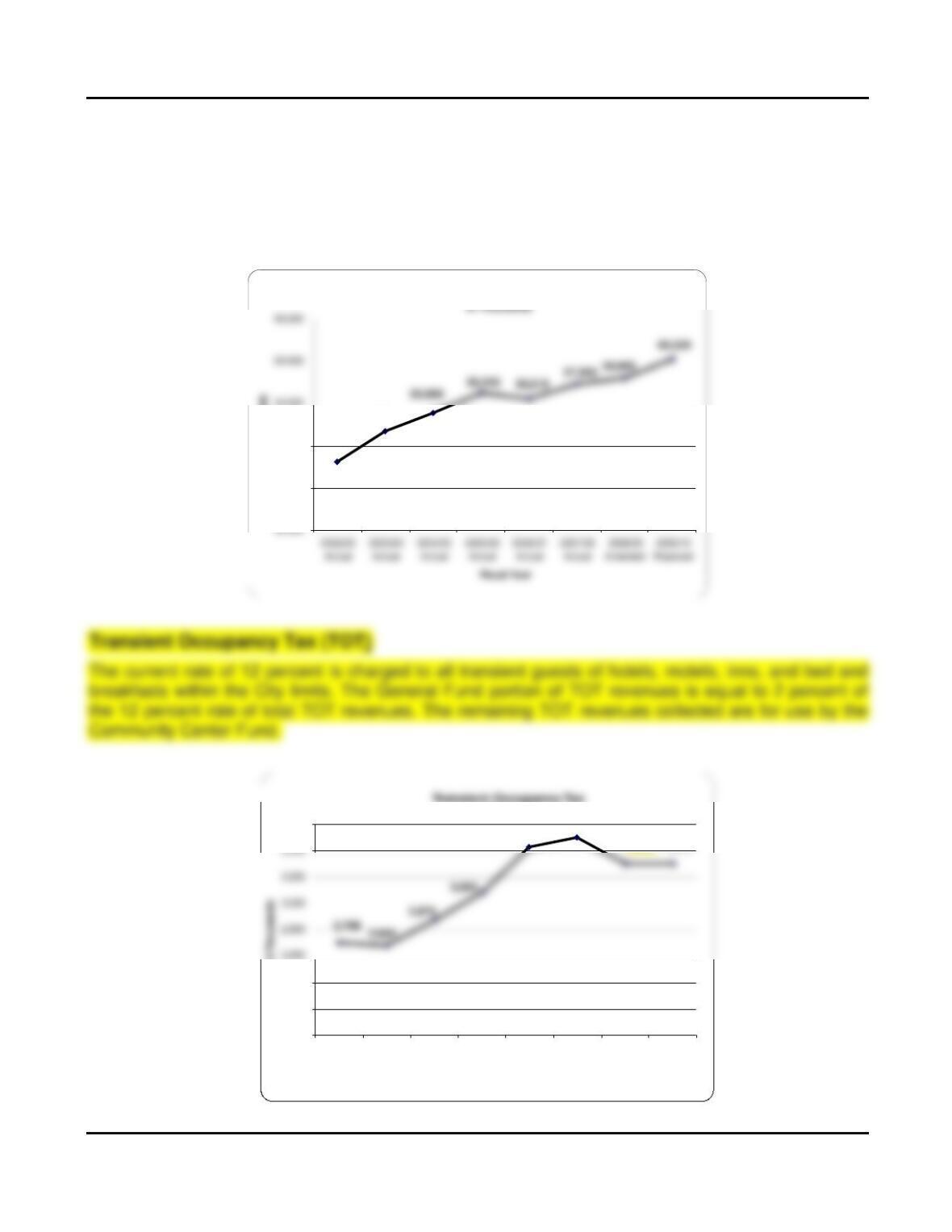
Utility Users’ Tax
51,739
48,069
45,000
50,000
$ Thousands
In Thousands
3,3003,300
3,504
3,431
2,000
2,200
2,400
3,600
2002/03
Actual
2003/04
Actual
2004/05
Actual
2005/06
Actual
2006/07
Actual
2007/08
Actual
2008/09
Amended
2009/10
Proposed
Fiscal Year
Utility Users Tax (UUT)
Measure O was approved by the voters on November 4, 2008, and reduced the 7.5 percent tax rate
to 7.0 percent on telecommunication services but expanded to include Voice over Internet Protocol
(VoIP), text messaging and many other previously excluded technologies. The 7.5 percent tax rate
continues to be in effect for gas, electric, and cable services. Current UUT revenue is approximately 16
percent of General Fund revenues and is expected to increase by 4 percent.
FY2009/10 Approved Budget
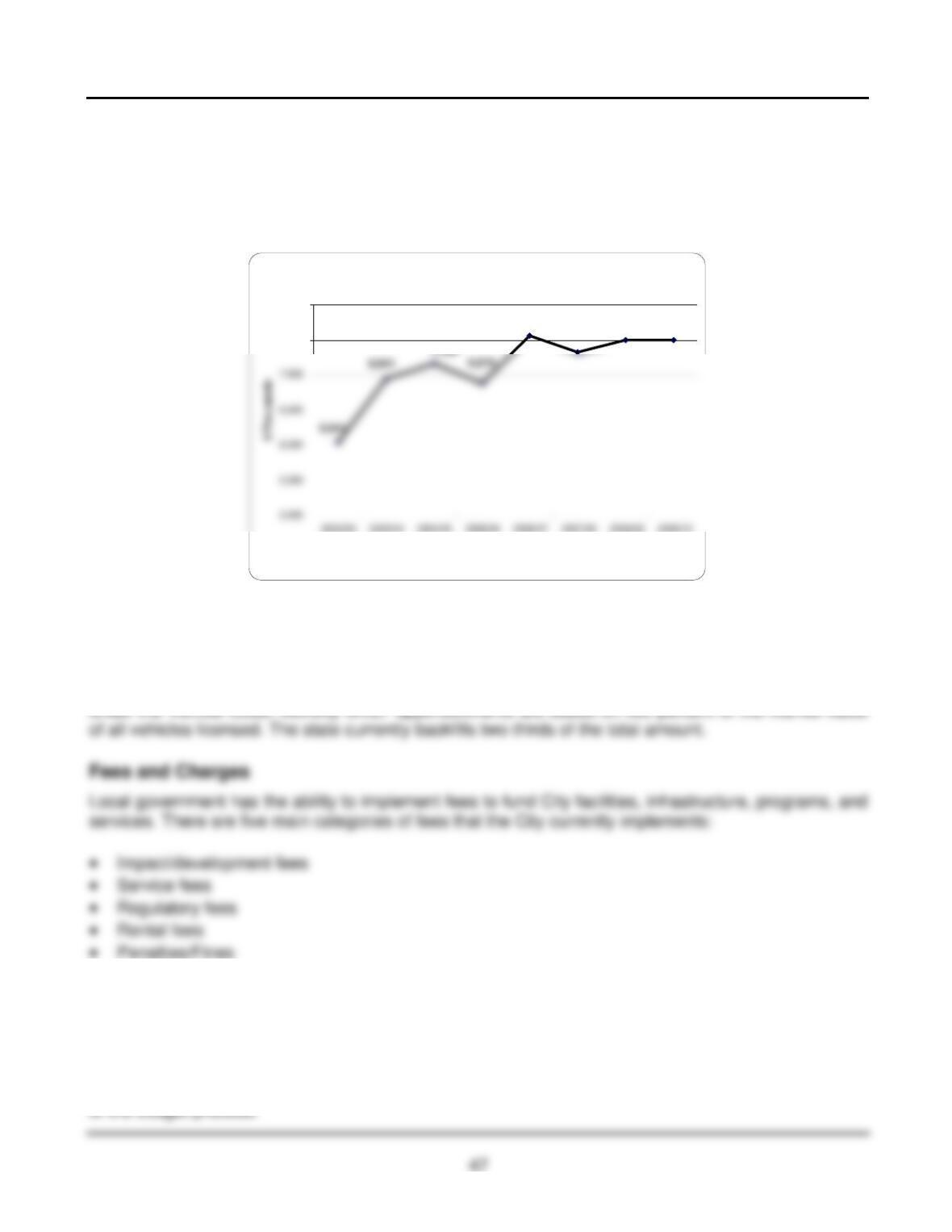
Business Operations Tax
In Thousands
7,500
7,500
7,319
7,558
7,500
8,000
Actual
Actual
Actual
Actual
Actual
Actual
Amended
Proposed
Fiscal Year
Business Operations Tax
Business Operations Taxes are remitted annually by individuals and businesses that commence,
transact, engage in or carry on any business, trade, profession, calling, occupation or gainful activity in
the City. Business Operations Taxes make up approximately 2 percent of General Fund revenues and
are expected to remain at a stagnant level for FY2009/10.
Motor Vehicle License Fee (MVLF)
An annual license fee equal to 2 percent of the market value of the vehicle as determined by the
Department of Motor Vehicles is imposed on any vehicle, of a type which is subject to registration
The Council has an adopted fee policy which sets forth guidelines for establishing cost recovery goals
determining the categories of cost recovery levels in which to categorize/organize fees, methods for
determining which category a fee falls under, and establishment and modification of fees and charges.
Fees and Charges make up approximately 10 percent of General Fund revenues and are expected to
grow approximately 10 percent. Annually, Council considers adjustments to fees and charges as part
FY2009/10 Approved Budget
48
Note: Property, sales, use, and utility user taxes related to the current fiscal year are accrued as
revenue and accounts receivable and are considered available if received within 60 days of year end.
Employee Retirement Benefits
The City of Sacramento provides defined benefit retirement benefits through PERS and the SCERS.
PERS is an agent multiple-employer public employee defined benefit pension plan. SCERS, a closed
system, is a single-employer defined benefit pension plan. There are approximately 1,150 retirees
covered by SCERS and 120 active employees covered by the plan. All other retirees and active
employees are covered under PERS.
PERS – Miscellaneous 7%
PERS – Safety 9%
SCERS – (varies with entry age) 3-10%
The City makes the following participant contributions on their behalf and for their account (percent of
annual covered payroll):
equal to the City’s required and actual contributions. The required contribution was determined as part
FY2009/10 Approved Budget
of the June 30, 2006, actuarial valuation, using the entry age normal actuarial cost method. The
actuarial assumptions included (a) 7.75 percent investment rate of return (net of administrative
which results in an amortization of 6 percent of unamortized gains and losses each year.
For the fiscal year ended June 30, 2008, the City’s annual SCERS pension cost of $3.5 million was
equal to the City’s required and actual contributions. The required contribution was determined as part
of the June 30, 2006 actuarial valuation using the entry age normal actuarial cost method. The
Proposed FY2009/10 budget contains a $3.4 million contribution to SCERS from both the General
open system such as CalPERS.
Other Post Employment Benefits (OPEB)
Recent changes to State and Local Government employers reporting requirements related to the cost
of retiree medical benefits represent a very serious fiscal challenge to the City. The City currently
provides a medical insurance subsidy to retirees who meet certain longevity standards. The City has
FY2009/10 Approved Budget
$31.5 million. The current pay-as-you-go cost in the Budget is approximately $10 million. The
difference between the ARC and the pay-as-you-go amount of $21.5 million will be recorded as a
liability on the City’s financial statements. This information was communicated to City Council as part
of the Midyear FY2007/08 Budget Council Report dated January 22, 2008.
A City working group has been formed to gather facts and explore the City’s options for dealing with
ratings, particularly if a significant number of local governments in California do fully fund the benefit on
an actuarial basis. This is only one of several risks to the City’s credit ratings. In the short run, the
City’s deteriorating budgetary situation and the likely development restrictions in the Natomas Basin
are a more significant risk to our credit rating. We see continuing pressure on state and local agencies
to reduce benefits, raise employee contributions or close benefits to new employees to fund the
FY2009/10 Approved Budget
51
BUDGET STATEMENT
General Information
The City of Sacramento was established in 1849 and in 1854 became the capital for the State of
California. Sacramento also serves as the seat of Sacramento County government. It is the seventh
Sacramento is a charter city and operates under a Council-Manager form of government that currently
provides for a nine-member elected City Council, including an elected Mayor. There are no other
elected City officials. The City Council appoints the City Manager, City Attorney, City Clerk and the City
Treasurer to carry out its adopted policies. Members of the City Council serve alternating terms of four
Budget Presentation
The presentation of the FY2009/10 Proposed Budget is included in three documents: Proposed
Operating Budget, Proposed Capital Improvement Program (CIP), and the Blueprint for Strategic
Budgeting. The Blueprint is designed to provide highlights and general information relative to the
Proposed Operating and CIP Budgets. The Proposed budget documents are available on the City’s Web
City Council Budget Hearings
Starting on May 19, 2009 the City Council will hold hearings on the FY2009/10 Proposed Budget.
These hearings provide the public the opportunity to provide their input on the budget. The preliminary
hearing schedule is provided on the following page:

FY2009/10 Approved Budget
Date What When
Week of April 27 Budget Briefings (Mayor/Council and
Unions)
Friday May 1 Release Proposed Budget
Tuesday, May 26 Budget Update
Hold for Hearing if Necessary
2-4 p.m. Hold for Budget as Needed
6-9 p.m. Council Business
Tuesday, June 2 CIP
Budget Update
Hold for Hearing if Necessary
Evening 1 hour
Financial Policies
The City of Sacramento operates under the following financial policies:
1) Budgetary Practices
a) Approved Budget Resolution
2) Investment Policy
3) Debt Management
1) Budgetary Practices
a) Budget Resolution
The Budget Resolution is the primary financial policy document for the City of Sacramento. These
policies are reviewed annually during the budget process and are shared with the City Council
during the review of the proposed budget.
FY2009/10 Approved Budget
53
The FY2009/10 Budget Resolution can be found in Section 30 of this document.
The budget resolution governs the following financial management areas:
Section 1. Scope
Section 2. Definitions
Section 8. Unspent Appropriations and Encumbrances
Section 9. Revenue Budget
Section 10. Capital Improvements
Section 11. Operating Grants and Externally Funded Programs
Section 12. Multi-Year Operating Projects
Section 13. In-Lieu Property Taxes and In-Lieu Franchise Fee
Section 14. Appropriation Limits
Section 15. Midyear Financial Reporting
Section 16. Miscellaneous Controls/Considerations
b) Financial Planning Policy
The City of Sacramento develops its annual budget according to Council-adopted sustainable
budget policies. These policies call for one-time funding sources to be used for only one-time
operating and capital expenditures. Ongoing expenditures are to be matched with ongoing financing
The ongoing core of the Mayor and Council’s budget philosophy continues to be sustainability. The
City Council has adopted the following objectives and principles to support this philosophy:
Budget Objectives
Develop a fiscally sustainable spending plan by July 1st
Budget Principles
Maintain a fiscally sustainable, balanced budget
Use one-time resources strategically
Identify return on investment and impacts; fiscal and social benefits
FY2009/10 Approved Budget
54
The Mayor and City Council adopted specific guidelines for the development of the FY2009/10
budget:
Preserve the delivery of City services to residents and businesses to the extent
possible
Use a mix of reserves, new revenues and citywide departmental reductions
consistent with a sustainable budget approach
c) Budget Development Policy
The Mayor and City Council formally adopted the Strategic Planning – Strategic Budgeting
process in June 2006, which allows the Mayor and City Council to incorporate priorities as
identified in their strategic plan into the budget process. Strategic Planning – Strategic
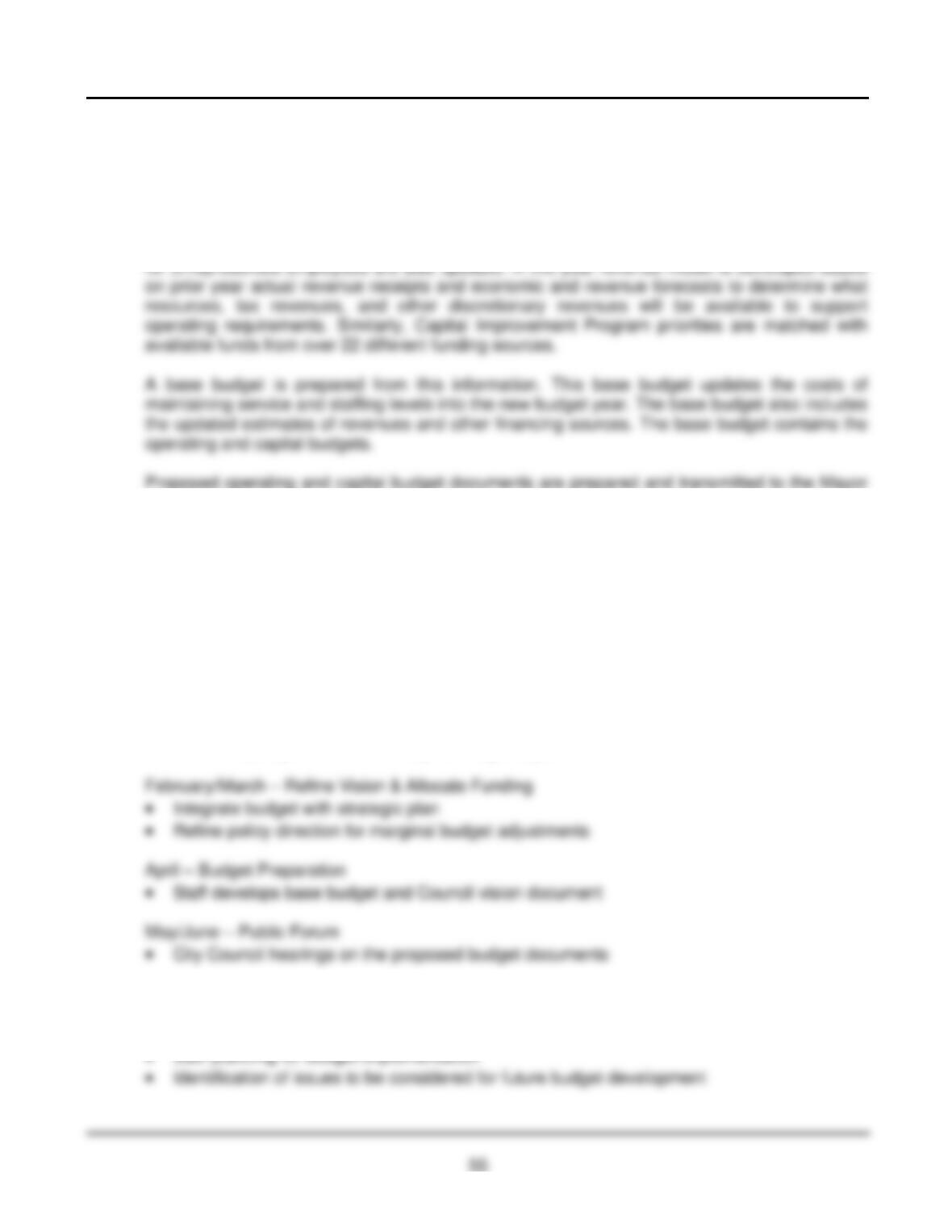
The following figure represents the City’s budget/program planning cycle:
FY2009/10 Approved Budget
The City’s fiscal year is July 1 through June 30. As such, the City Council annually adopts the
City’s operating and capital budgets for a single fiscal year beginning July 1 and ending June
30 in the subsequent calendar year.
To establish the annual budget, the Budget Division of the Finance Department develops a
plan for expenditure of projected available resources for the coming Fiscal Year. Labor costs
are updated to reflect salary and benefit changes called for in union contracts, and estimates
and City Council as required by City Charter on or before May 1 of each year. The Mayor and
Council review the proposed operating and capital improvement budget in public hearings. The
budget is formally adopted by a vote of the City Council on or before June 30 of each year. Any
changes to the proposed budget, as considered and approved by the City Council during
budget hearings, are included in the Approved Budget document.
The Council adopted Strategic Planning – Strategic Budgeting process is reflected in the
following timeline:
January – Council Planning Session
Establish budget objectives and principles
Provide policy direction for year-end results
Consider policy direction for marginal budget adjustments
July 1st – New Fiscal Year
August/September – Executive Team Planning
FY2009/10 Approved Budget
October/November – Department Reviews and Recommendations
Administrative work related to close of prior fiscal year
Staff briefs Council on critical fiscal issues for future budget development
d) Budget Basis
Annual budgets are adopted for the General Fund, Enterprise Funds, Internal Service Funds,
and a variety of other Governmental Funds. In all funds, appropriations for expenditures are
established using the modified accrual basis of accounting, adjusted for the following:
‐ Purchase order encumbrances are budgeted as expenditures in the year of commitment.
the revenues are collected within sixty days of fiscal year-end. Payments in lieu of taxes in the
General Fund are budgeted as revenue instead of interfund transfers. The City budgets for
revenue in Proprietary Funds using the accrual basis of accounting.
The City Manager is authorized to administratively amend the budget during the year for
transactions up to $100,000 without City Council approval. All other appropriation adjustments
during the year require City Council approval.
2) Investment Policy
The investment policy of the City of Sacramento is established in the Sacramento City Code and
3) Debt Management
The City currently operates under the State of California debt requirements. The California Constitution
requires that long-term debt pledged by the full faith and credit of the City can only be approved by
FY2009/10 Approved Budget
57
The City also carries debt secured by specific revenue sources, and Certificates of Participation
secured by interests in City assets.
4) Risk Management
The City is exposed to various risks of loss related to torts; theft of, damage to, and destruction of
5) General Fund Reserves
6) Fees and Charges
The City Council evaluates all City fees on an annual basis to determine the manner in which fees and
charges are set and the extent to which they cover the cost of the service provided.
Fund Structure
Overview
The General Fund is the City’s primary operating fund and accounts for all financial resources of the
general government, except those required to be accounted for in another fund.
The City budget includes the following major Enterprise Funds:
The Water Fund accounts for the operation and maintenance of the City’s water treatment, water
transmission, and distribution systems.
The Sewer Fund accounts for the operation and maintenance of the City’s sewer system.