
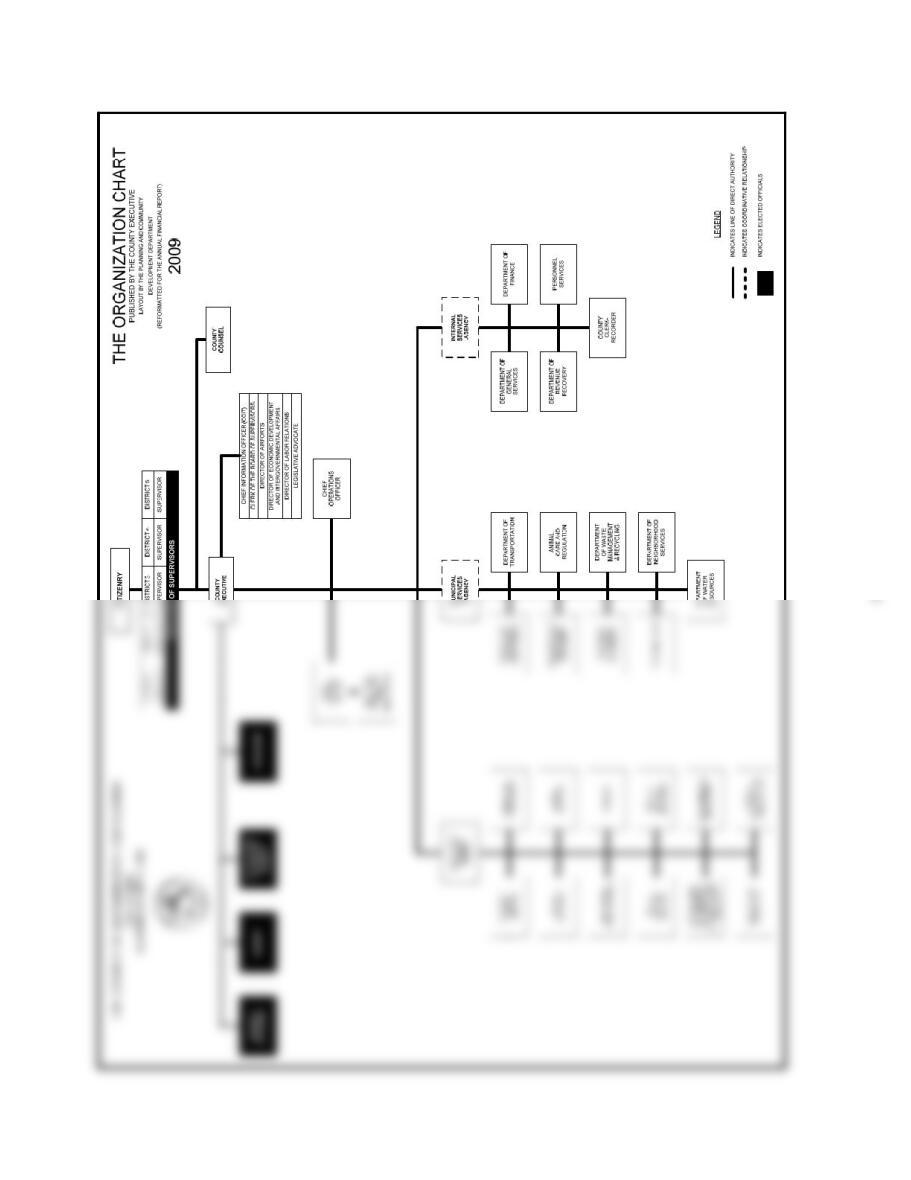

COUNTY OF SACRAMENTO
LIST OF PUBLIC OFFICIALS
JUNE 30, 2009
ELECTED:
Board of Supervisors:
Roger Dickinson District 1
Jimmie Yee District 2
Susan Peters District 3
Roberta MacGlashan District 4
Don Nottoli District 5
APPOINTED:
Terry Schutten (Retired December 31, 2009) County Executive
Navdeep Gill Chief Operations Officer
Mark Norris Agency Administrator, Internal Services Agency
Dave Irish Director of Finance
THE COMPREHENSIVE ANNUAL FINANCIAL REPORT
FOR THE
COUNTY OF SACRAMENTO
For the fiscal year ended June 30, 2009
ACKNOWLEDGEMENT
Prepared by the County of Sacramento
Department of Finance
Intentionally Blank
xxii

INDEPENDENT AUDITORS’ REPORT
To the Honorable Board of Supervisors
County of Sacramento, California
We have audited the accompanying financial statements of the governmental activities, the business-type activities, each major fund, and the aggregate
remaining fund information of County of Sacramento, California (the County) as of and for the year ended June 30, 2009, which collectively comprise the
County’s basic financial statements as listed in the table of contents. These financial statements are the responsibility of the County’s management. Our
responsibility is to express opinions on these financial statements based on our audit.
In our opinion, the financial statements referred to above present fairly, in all material respects, the respective financial position of the governmental
activities, the business-type activities, each major fund, and the aggregate remaining fund information of the County of Sacramento, California, as of
June 30, 2009, and the respective changes in financial position, and cash flows, where applicable, thereof, and the respective budgetary comparison for the
General Fund for the year then ended in conformity with accounting principles generally accepted in the United States of America.
1
control over financial reporting and on our tests of its compliance with certain provisions of laws, regulations, contracts, and grant agreements and other
matters. The purpose of that report is to describe the scope of our testing of internal control over financial reporting and compliance and the results of that
testing, and not to provide an opinion on the internal control over financial reporting or on compliance. That report is an integral part of an audit
performed in accordance with Government Auditing Standards and important for assessing the results of our audit.
Rancho Cucamonga, California
January 27, 2010
2
MANAGEMENT’S DISCUSSION AND ANALYSIS
This section of the County of Sacramento’s (County) comprehensive annual financial report presents a discussion and analysis of the County’s
financial performance during the fiscal year ended June 30, 2009. Please read it in conjunction with the transmittal letter at the front of this
report and the County’s basic financial statements following this section. All dollar amounts are expressed in thousands unless otherwise
indicated.
FINANCIAL HIGHLIGHTS
•
The assets of the County exceeded liabilities at the close of the 2008-09 fiscal year by $2,547,254 (net assets), of this amount, $697,307 is
restricted for specific purposes (restricted net assets), and $1,997,771 is invested in capital assets, net of related debt. The County’s total
net assets decreased by $153,604.
3
OVERVIEW OF THE FINANCIAL STATEMENTS
This discussion and analysis are intended to serve as an introduction to the County’s basic financial statements. The County’s basic financial
statements comprise three components 1) Government-wide financial statements; 2) Fund financial statements and 3) Notes to basic financial
statements.
Government-wide Financial Statements are designed to provide readers with a broad overview of County finances, in a manner similar to a
private-sector business.
The statement of activities presents information showing how net assets changed during the most recent fiscal year. All changes in net assets
are reported as soon as the underlying event giving rise to the change occurs, regardless of the timing of related cash flows. Thus, revenues and
expenses are reported in this statement for some items that will result in cash flows in future fiscal periods (e.g., uncollected taxes and earned
but unused vacation leave).
Both of these government-wide financial statements distinguish functions of the County that are principally supported by taxes and
intergovernmental revenues (governmental activities) from other functions that are intended to recover all or in part a portion of their costs
through user fees and charges (business-type activities). The governmental activities of the County include general government, public
protection, public ways and facilities, health and sanitation, public assistance, education, and recreation and culture. The business-type
activities of the County include the Airport, Solid Waste, Water Agency, Parking Enterprise and the County Transit.
4
Fund Financial Statements are groupings of related accounts that are used to maintain control over resources that have been segregated for
specific activities or objectives. The County, like other state and local governments, uses fund accounting to ensure and demonstrate finance-
related legal compliance. All of the funds of the County can be divided into three categories: governmental funds, proprietary funds and
fiduciary funds.
Governmental funds are used to account for essentially the same functions reported as governmental activities in the government-wide
financial statements. However, unlike the government-wide financial statements, governmental funds financial statements focus on near-term
inflows and outflows of spendable resources, as well as on balances of spendable resources available at the end of the fiscal year. Such
information may be useful in evaluating a county’s near-term financing requirements.
Proprietary funds are maintained two ways. Enterprise funds are used to report the same functions presented as business-type activities in the
government-wide financial statements. The County uses enterprise funds to account for the Airport, Solid Waste, Water Agency, Parking
Enterprise, and the County Transit operations. Internal service funds are an accounting device used to accumulate and allocate costs internally
among the County’s various functions. The County uses internal service funds to account for its liability/property self-insurance;
telecommunication and information technology support; worker’s compensation self-insurance; self-insurance for dental and unemployment
claims (Self-Insurance – Other); regional communications; special services provided by the Public Works Agency; Facility Planning,
Architecture and Real Estate; and centralized services provided by the Department of General Services. Because these services predominantly
benefit governmental rather than business-type functions, they have been included within governmental activities in the government-wide
financial statements.
5
Fiduciary funds are used to account for resources held for the benefit of parties outside the government. Fiduciary funds are not reflected in the
government-wide financial statements because the resources of those funds are not available to support the County’s own programs. The
accounting used for fiduciary funds is much like that used for proprietary funds except for agency funds.
The combining and individual fund statements and schedules referred to earlier provide information for non-major governmental funds,
enterprise and internal service funds, and can be found on pages 115-211 of this report.
6
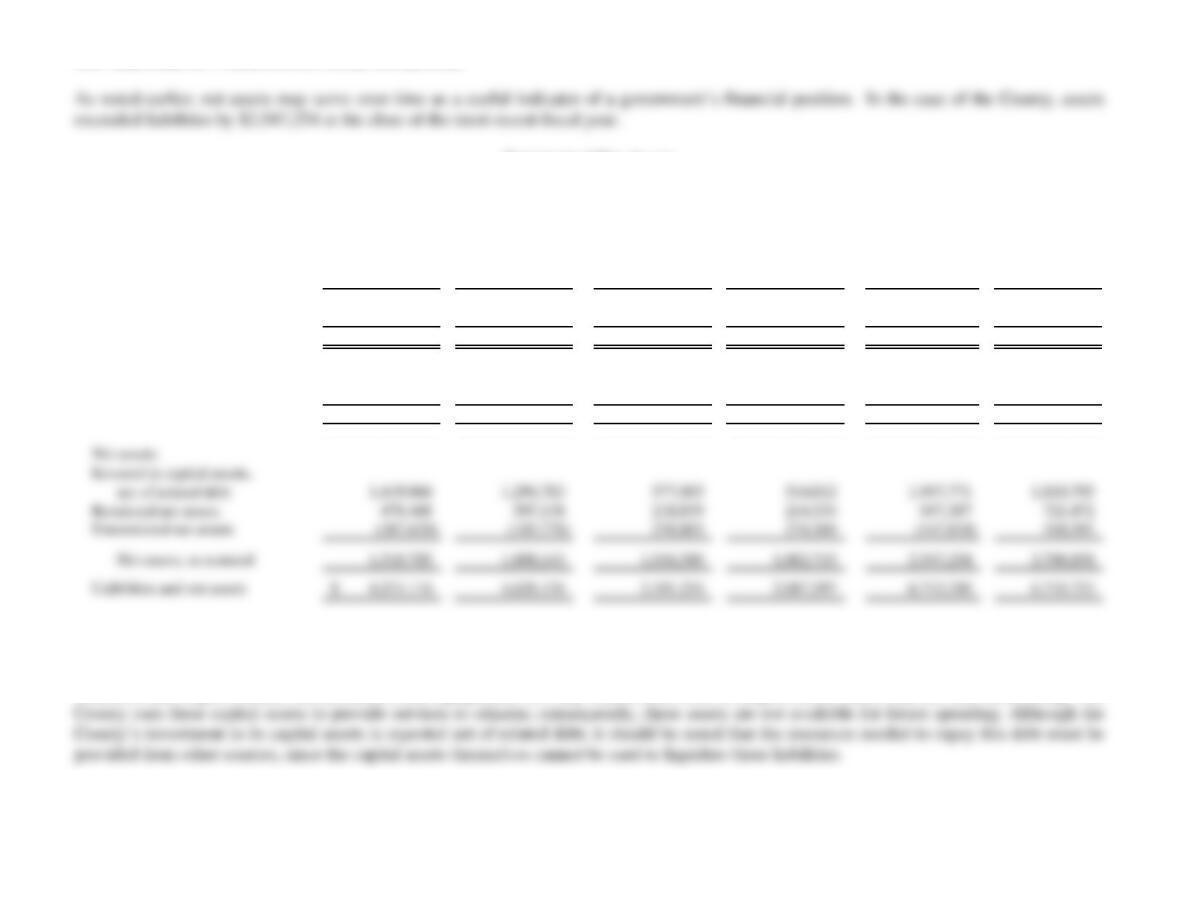
GOVERNMENT-WIDE FINANCIAL ANALYSIS
Statement of Net Assets
For the Year Ended June 30, 2009
(amounts expressed in thousands)
Other assets
Capital assets
Total assets
2009
2,708,288 $
1,812,828
4,521,116 $
Governmental
Activities
2008
2,867,156
1,760,980
4,628,136
2009
814,455
1,376,779
2,191,234
Business-type
Activities
2008
1,091,157
996,440
2,087,597
2009
3,522,743
3,189,607
6,712,350
Total
2008
3,958,313
2,757,420
6,715,733
Other liabilities
Long-term debt obligations
Total liabilities
1,413,611 $
1,596,800
3,010,411
1,192,773
1,737,220
2,929,993
140,828
1,013,857
1,154,685
64,130
1,020,752
1,084,882
1,554,439
2,610,657
4,165,096
1,256,903
2,757,972
4,014,875
The largest portion of the County’s net assets of $1,997,771 (78 percent) reflects its investment in capital assets (e.g. land and easements,
structures and improvements, infrastructure, and equipment), less any related debt used to acquire those assets that are still outstanding. The
7
The remaining balance of total net assets, negative $147,824 is unrestricted and will result in a reduction to the County’s ongoing obligations to
citizens and creditors. Unrestricted net assets decreased by $316,415 from the prior year. The decrease in unrestricted net assets is a result of
reclassifying unrestricted net assets to restricted from governmental fund balances that have declined over the last several years due to financial
stresses related to increasing costs combined with decreasing ongoing revenue streams.
The County’s net assets decreased by $153,604 during the current fiscal year, which results in a decrease of 6% of total net assets from prior
year. The decrease takes into consideration a $204 restatement of prior year net assets for County Transit enterprise fund and a $225,146
restatement of prior net assets to governmental activities. Total prior year net asset amount of $2,475,508 was restated to $2,700,858. At the
end of the current fiscal year the County reported an increase of 10.3% in net assets invested in capital assets, net of related debt. The increase
in net assets invested in capital assets, net of related debt of $186,976 represents capital purchases net of depreciation plus the retirement of
related long-term debt. The County’s restricted net assets decreased by 3% while unrestricted net assets decreased by 188%. During the 2008-
09 fiscal year, the County as a whole, reported positive balances in two out of the three categories of net assets. Governmental activities
reported a negative balance in unrestricted net assets of $387,629 which is primarily due to recognition of long term debt from a declining fund
balance, a result of the economic recession.
8
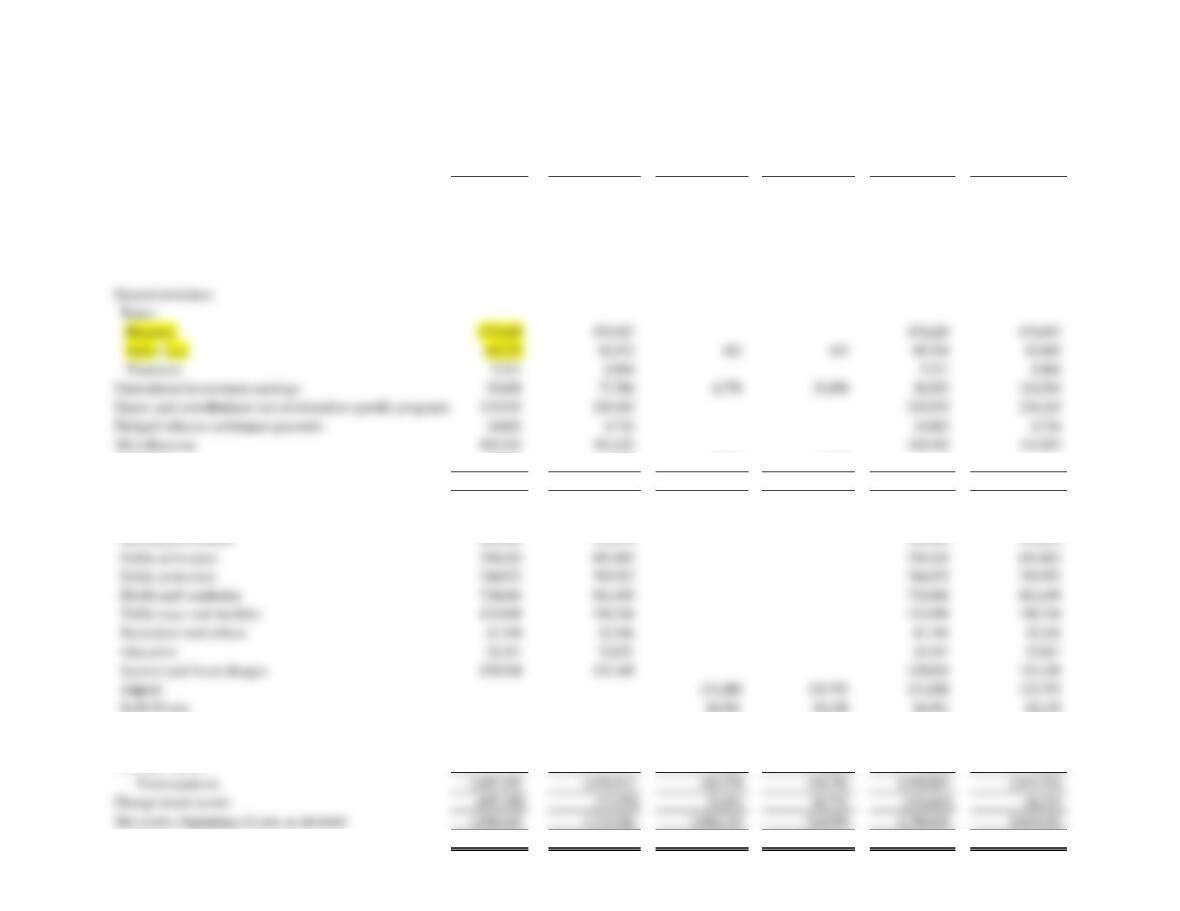
Statement of Activities
For the Year Ended June 30, 2009
(amounts expressed in thousands)
Governmental Business-type
Activities Activities Total
2009 2008 2009 2008 2009 2008
Revenues:
Program revenues:
Charges for services 343,401 $ 363,957 239,336 231,621 582,737 595,578
Operating grants and contributions 1,177,843 1,223,424 25,031 29,922 1,202,874 1,253,346
Capital grants and contributions 34,808 95,231 12,290 28,635 47,098 123,866
Transfers 7,514 1,988 (7,514) (1,988)
Total revenues 2,499,857 2,659,533 276,404 320,513 2,776,261 2,980,046
Exp en s es :
Water Agency 29,277 45,992 29,277 45,992
Parking Enterprise 12,459 2,904 12,459 2,904
County Trans it 1,955 1,954 1,955 1,954
Net as s ets , end of year $ 1,510,705 1,698,143 $ 1,036,549 1,002,715 2,547,254 2,700,858
9
Total revenues for the County’s governmental activities decreased by $159,676 from the prior year. This decrease is primarily due to reduced
internal service charge allocations to County Departments and an overall reduction in intergovernmental revenue for program costs.
Total expenses for governmental activities were $2,687,295, an increase of $10,383 or less than 1% from the prior year. As a service delivery
entity the County’s major cost component is salaries and benefits, which accounted for approximately 48.8% of total County expenses. The
Business-type activities. Business-type activities increased the County’s net assets by $33,834. The increase is primarily related to increased
activity for Airport and Water Agency. See page 14 for additional comments on changes to net assets.
FINANCIAL ANALYSIS OF THE COUNTY’S FUNDS
Governmental funds. The general government functions are contained in the general, special revenue, debt service, and capital projects funds.
Included in these funds are the special districts governed by the Board of Supervisors. The focus of the County’s governmental funds is to
provide information on near-term inflows, outflows, and balances of spendable resources. Such information is useful in assessing the County’s
financing requirements. In particular, unreserved fund balance may serve as a useful measure of a government’s net resources available for
spending at the end of the fiscal year.
The decrease of $211,140 in the governmental funds combined fund balances was attributable to the economic recession. The County
experienced a sharp drop in property tax, exacerbated by the devaluation of homes, loss of sales tax revenue, no opportunity to restructure debt,
inability to use one-time funds and interfund transfers, and the State of California’s lack of carry through on obligation to pay counties for their
cost of doing business.
The General Fund is the chief operating fund of the County. At June 30, 2009, unreserved fund balance of the general fund was a negative
$41,533 while total fund balance reached $19,388. As a measure of the general fund’s liquidity, it may be useful to compare both unreserved
10
Revenues for governmental functions totaled $2,412,030 in fiscal year 2008-09, which represents a decrease of 4.6% from fiscal year 2007-08.
The following table presents the amount of revenues from various sources as well as increases or decreases from the prior year.
Revenues Classified by Source
Governmental Funds
(amounts expressed in thousands)
FY 2009
FY 2008 Increase/(Decrease)
Percent of
Percent of Percent of
Revenues by Source
Amount Total Amount Total Amount Change
Taxes
$ 550,165 22.81% 564,383 22.33% (14,218) (2.52%)
Use of money and property
49,108 2.04% 72,908 2.88% (23,800) (32.64%)
Licenses and permits
•
Use of money and property decrease is due to a lower pooled interest rate during 2008-09. Lower federal fund rates resulted from high
unemployment rates and joblessness due to the economic recession and was a direct impact on the County’s Pooled Investment Fund.
•
Licenses and permits decreased due to the economic recession which resulted in a less applications and business license program activity
during 2008-09.
•
Fines, forfeitures, and penalties decreased due to less revenue collection for Teeter.
2007-08.
11

The following table presents expenditures by function compared to prior year amounts.
Expenditures by Function
Governmental Funds
(amounts expressed in thousands)
FY 2009 FY 2008 Increas e/(Decreas e)
Percent of Percent of Percent of
Expenditures by Function Amount Total Amount Total Amount Change
Current:
G
enera
l
government
$
171
,
945
6
.
32%
175
,
593
6
.
62%
(3
,
648)
(2
.
08%)
Public ass is tance 689,891 25.34% 673,098 25.39% 16,793 2.49%
Public protection 683,099 25.10% 666,706 25.15% 16,393 2.46%
Health and sanitation 681,774 25.05% 644,595 24.32% 37,179 5.77%
The following provides an explanation of the expenditures by function that changed significantly over the prior year.
General government – Decrease is primarily due to the combination of increases in retirement expenditures ($10 million), decreases related to
reduced interest expenditures for TRAN ($7 million), decreases in election costs ($1 million) and decreases in planning costs ($6 million).
Bond principal and interest costs – Increase is due to increased debt service for Pension Obligation Bonds and Teeter.
Bond issuance costs – Decrease is due to lesser amount refunded for 2004 Pension Obligation Bond in the current year.
12
Other financing sources and uses are presented below to illustrate changes from the prior year:
Increase/(Decrease)
FY 2009 FY 2008 Amount Percent
Transfers in
174,740 184,870 (10,130) (5.48%)
Transfers out
(156,475) (171,783) 15,308 (8.91%)
Capital leases obligations
8,413 (8,413) (100.00%)
Issuance of debt
80,006 160,241 (80,235) (50.07%)
Swap, premium short term 2,950
2,950 100.00%
Swap, premium long term 20,069
20,069 100.00%
Payment to refunded bonds escrow agent
(49,225) (350,037) 300,812 (85.94%)
Total other financing sources (uses) $ 98,806 146,310 (47,504) (32.47%)
•
Transfers in/out – Decrease transfers between 2007 Public Facilities Debt Service and Capital Projects funds from prior year, combined
with increased transfers in Pension Obligation Bond debt service and increased transfers for debt service reimbursement from Departments.
13