Chapter 9 CFIN6
Chapter 9 Solutions
9-1
6
1
1(1.10)
Value PV of CFs 36,950 36,950(4.355261) 160,926.88
0.10
−
= = = =
Calculator solution: N = 6, I/Y = 10, PMT = 36,950, FV = 0; PV = ? = -160,926.88
b.
4
1
1(1.12)
Value PV of CFs 104,000 104,400(3.037349) 317,099.27
0.12
−
= = = =
Calculator solution: N = 4, I/Y = 12, PMT = 104,400, FV = 0; PV = ? = -317,099.27
9-3
10
1
1(1.11)
NPV 3,600,000 600,000 0.11
−
=− +
Chapter 9 CFIN6
9-4
5
1
1(1.09)
NPV 42,000 11,000 0.09
−
=− +
9-5
3
1
1(1 IRR)
20,070 8,500 IRR
−
+
=
Calculator solution: CF0 = -20,070, CF1 – CF3 = 8,500; compute IRR = 13.0%
Alternative calculator solution using TVM keys: N = 3, PV = -20,070, PMT = 8,500, FV = 0; compute I/Y
= 13.0% = IRR
9-7 a.
4
1
1(1.14)
NPV 75,000 26,000 0.14
−
=− +
=-75,000+26,000(2.9137123) = -75,000 + 75,756.52 = 756.52
Calculator solution: CF0 = -75,000, CF1 – CF4 = 26,000, I = 14; compute NPV = 756.52
b.
4
1
1(1 IRR)
75,000 26,000 IRR
−
+
=
Chapter 9 CFIN6
Calculator solution: CF0 = –75,000, CF1 – CF4 = 26,000; compute IRR = 14.49%
9-8 a.
3
1
1(1.12)
NPV 34,000 14,150 0.12
−
=− +
=-34,000+14,150(2.401831) = -34,000 + 33,985.91 = -14.09
Calculator solution: CF0 = -34,000, CF1 – CF3 = 14,150, I = 12; compute NPV = -14.09
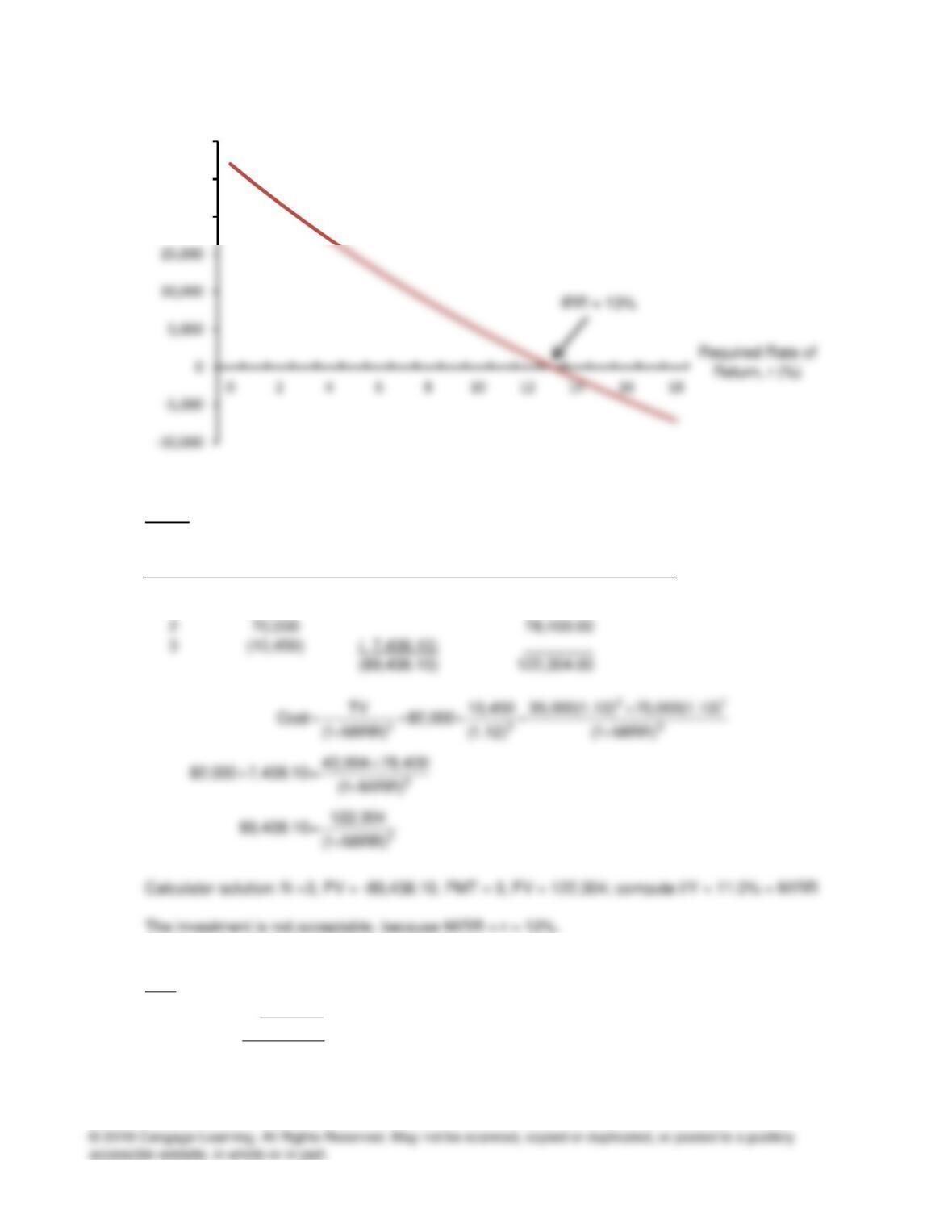
9-9 Data for NPV profile: Cost = 64,000, CF = 18,200 for five years
r NPV
0.00 $27,000.00
0.01 24,332.45
0.02 21,784.96
0.06 12,665.02
0.07 10,623.59
0.08 8,667.32
0.09 6,791.65
0.10 4,992.32
0.11 3,265.33
0.12 1,606.93
Chapter 9 CFIN6
9-10. MIRR:
PV of Cash FV in Year 3 of
Year CF Outflows @ 12% Cash Inflows @ 12%
0 (82,000) (82,000.00)
1 35,000 43,904.00
9-11 IRR:
4
1
1(1 IRR)
5,500 1,800 IRR
−
+
=
NPV ($)
20,000
25,000
30,000
Chapter 9 CFIN6
Calculator solution: CF0 = -5,500, CF1 – CF4 = 1,800; compute IRR = 11.72%
Alternative calculator solution: N = 4, PV = -5,500, PMT = 1,800, FV = 0; compute I/Y = 11.72%
MIRR:
4
(1.08) 1
1,800 0.08
−
9-12 IRR:
2
1
1(1 IRR)
90,000 54,000 IRR
−
+
=
Calculator solution: CF0 = -90,000, CF1 – CF2 = 54,000; compute IRR = 13.07%
Alternative calculator solution: N = 2, PV = -90,000, PMT = 54,000, FV = 0; compute I/Y = 13.07%
MIRR:
9-13 Traditional payback:
Year CF CF
0 -270,000 -270,000
1 75,000 -195,000
2 75,000 -120,000
Chapter 9 CFIN6
45,000
PB 3 3.6 years
75,000
= + =
Discounted payback:
Year CF PV of CF @ 11% PV of CF
0 (270,000) (270,000.00) (270,000.00)
1 75,000 67,567.57 (202,432.43)
2 75,000 60,871.68 (141,560.75)
9-14 Traditional payback:
Year CF CF
0 -64,000 -64,000
1 16,000 -48,000
2 16,000 -32,000
3 16,000 -16,000
Chapter 9 CFIN6
Discounted payback:
Year CF PV of CF @ 12% PV of C
0 (64,000) (64,000.00) (64,000.00)
1 16,000 14,285.71 (49,714.29)
6,323.58
DPB 5 5.78 years
8,106.10
= + =
Because DPB < 6, the project should be purchased.
9-15 a.
12
260,000 175,000
NPV 365,000 (1.13) (1.13)
=− + +
= -365,000 + 260,000(0.884956) + 175,000(0.783147)
c. MIRR:
10
n 2 2
TV 260,000(1.13) 175,000(1.13) 293,800 175,000
Cost 365,000
(1 MIRR) (1 MIRR) (1 MIRR)
++
= = = =
+ + +
Chapter 9 CFIN6
9-16 Project Alpha:
a. NPV:
13
(1.14)
1
NPV 270,000 120,000 270,000 120,000(2.321632) 8,595.84
0.14
−
=− + =− + =
Calculator solution: CF0 = -270,000, CF1-3 = 120,000, I = 14; compute NPV = 8,595.84
c. Discounted payback:
Year CF PV of CF @ 12% PV of C
0 (270,000) (270,000.00) (270,000.00)
1 120,000 105,263.16 (164,736.84)
2 120,000 92,336.10 (72,400.74)
3 120,000 80,996.58 8,595.84 = NPV
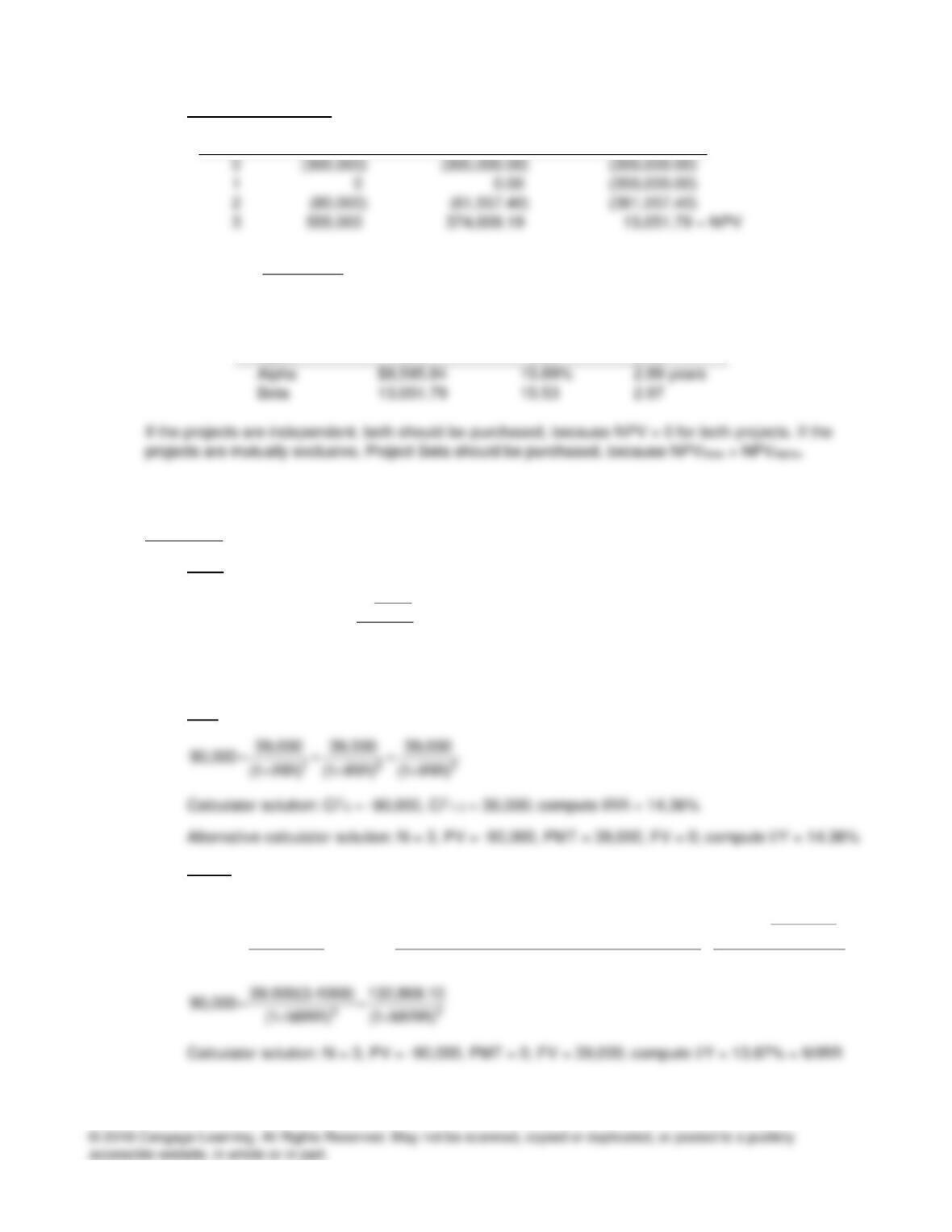
300,000 0(0.877193) 80,000(0.769468) 555,000(0.674972)
300,000 0 61,557.40 374,609.19 13,051.79
=− + − +
=− + − + =
Calculator solution: CF0 = -300,000, CF1 = 0, CF2 = -80,000, CF3 = 555,000, I = 14; compute
NPV = 13,051.79
b. IRR:
Chapter 9 CFIN6
c. Discounted payback:
Year CF PV of CF @ 12% PV of C
361,557.40
DPB 2 2.97 years
374,609.19
= + =
Summary of computations:
Project NPV IRR DPB
9-17 Project AB:
a. NPV:
−
=− + =− + =
13
(1.13)
1
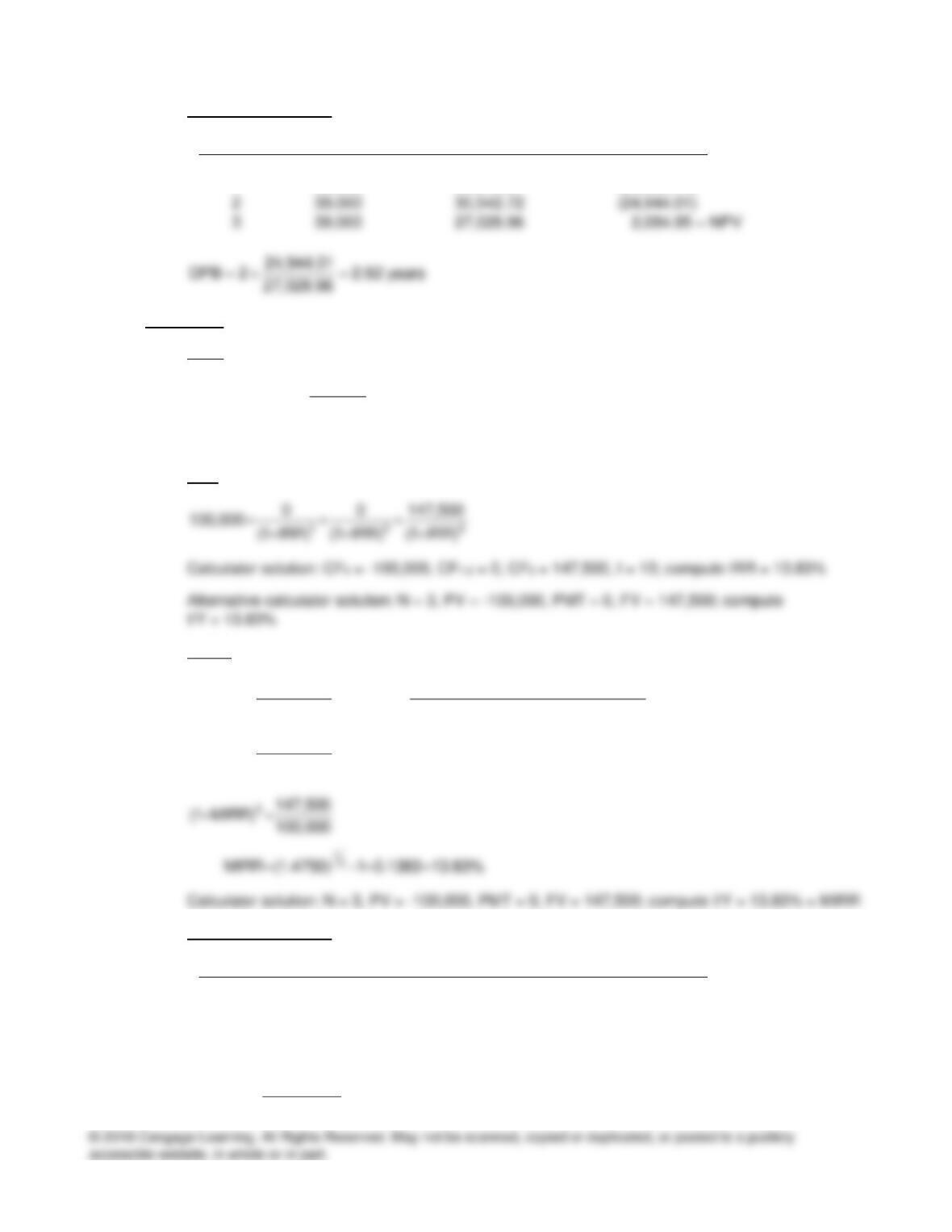
NPV 90,000 39,000 90,000 39,000(2.361153) 2,084.95
0.13
Calculator solution: CF0 = -90,000, CF1-3 = 39,000, I = 13; compute NPV = 2,084.95
b. IRR:
c. MIRR:
−
++
= = = =
+ + +
3
2 1 0
n 3 3
(1.13) 1
39,000 0.13
TV 39,000(1.13) 39,000(1.13) 39,000(1.13)
Cost 90,000
(1 MIRR) (1 MIRR) (1 MIRR)
Chapter 9 CFIN6
d. Discounted payback:
Year CF PV of CF @ 13% PV of C
0 (90,000) (90,000.00) (90,000.00)
1 39,000 34,513.27 (55,486.73)
Project LM:
a. NPV:
=− + =− + =
3
147,500
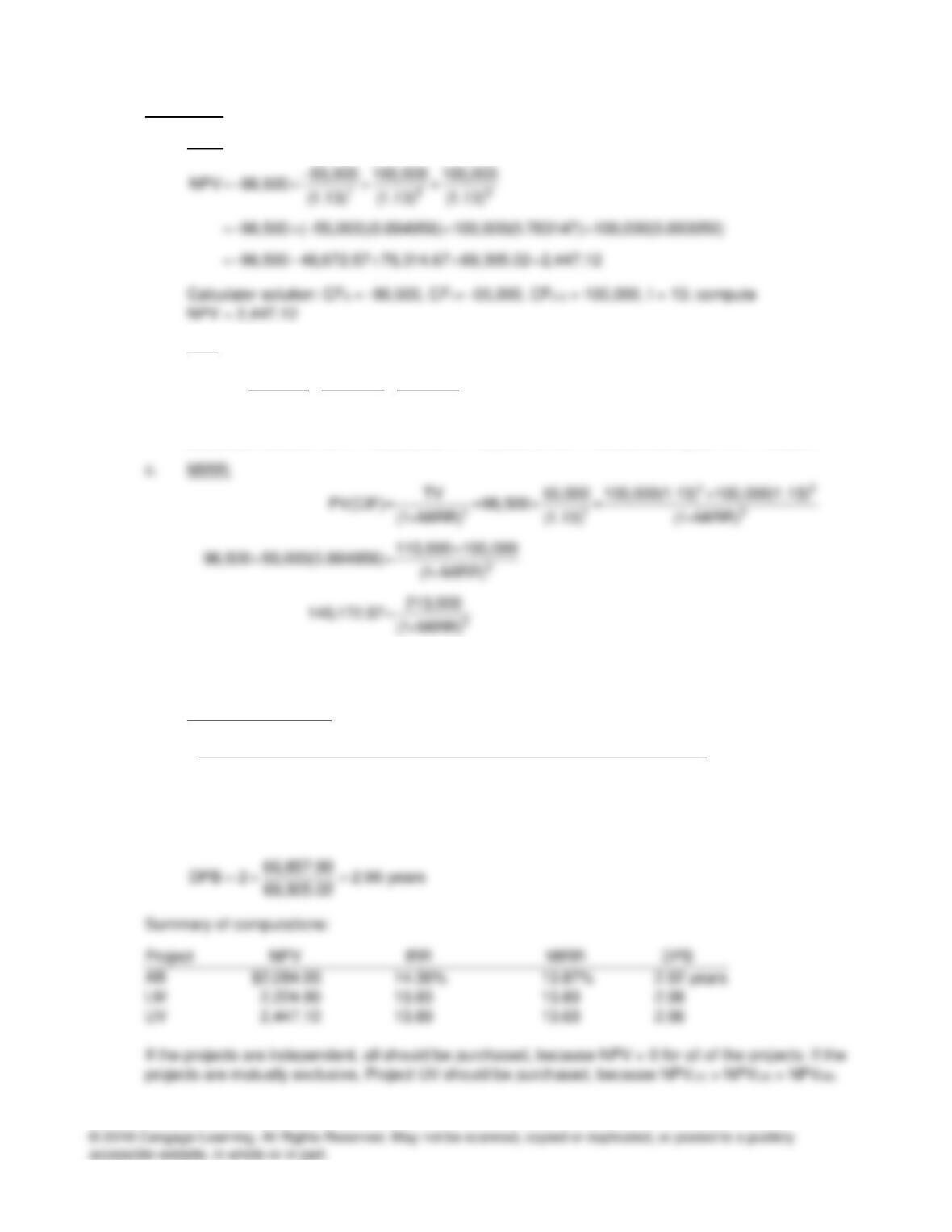
NPV 100,000 100,000 147,500(0.693050) 2,224.90
(1.13)
Calculator solution: CF0 = –100,000, CF1-2 = 0, CF3 = 147,500, I = 13; compute NPV = 2,224.90
b. IRR:
c. MIRR:
++
= = =
++
=+
2 1 0
n3
3
TV 0(1.13) 0(1.13) 147,500(1.13)
Cost 100,000
(1 MIRR) (1 MIRR)
147,500
100,000 (1 MIRR)
d. Discounted payback:
Year CF PV of CF @ 13% PV of C
0 (100,000) (100,000.00) (100,000.00)
1 0 0.00 (100,000.00)
2 0 0.00 (100,000.00)
3 147,500 102,224.90 2,224.90 = NPV
= + =
100,000.00
DPB 2 2.98 years
102,224.90
Chapter 9 CFIN6
Project UV:
a. NPV:
b. IRR:
−
= + +
+ + +
1 2 3
55,000 100,000 100,000
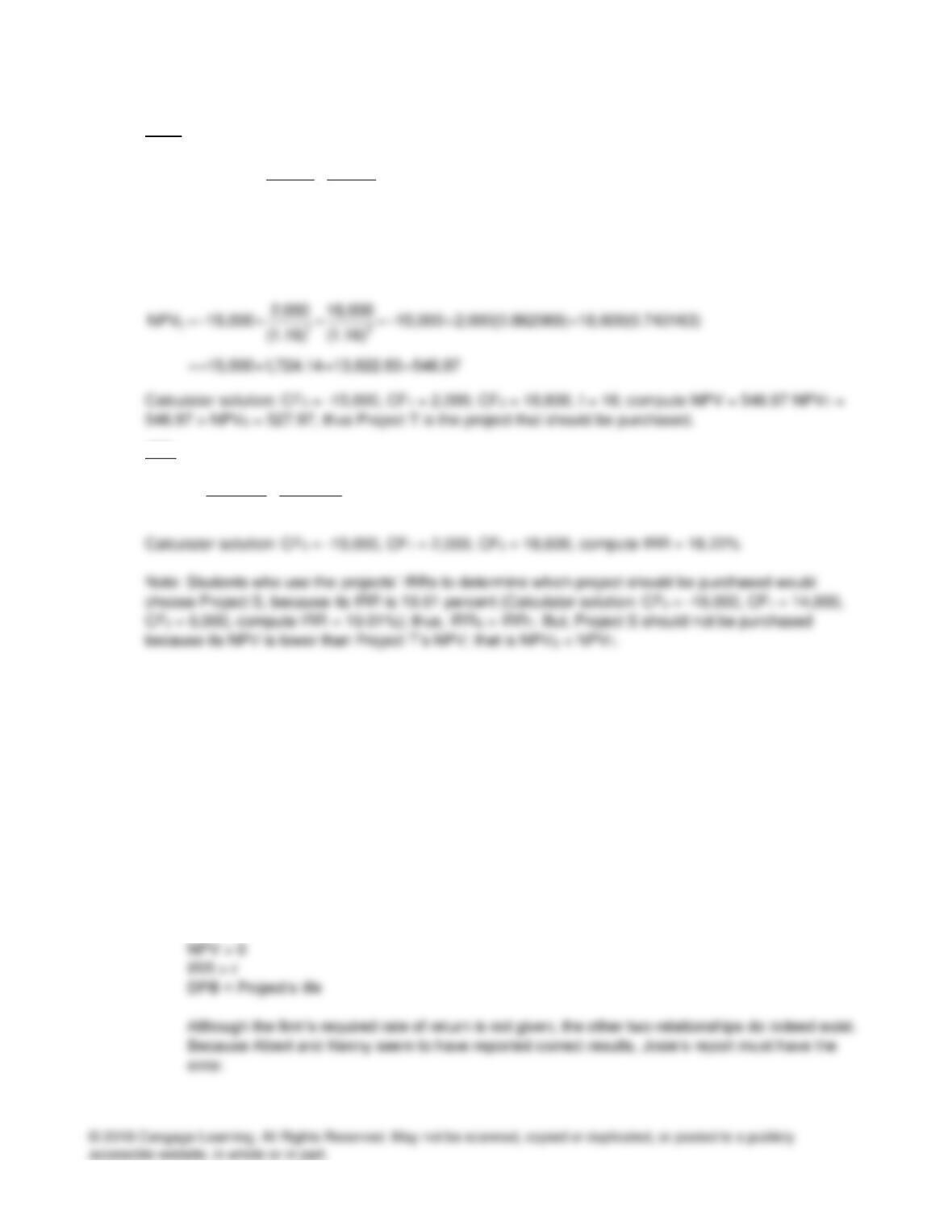
96,500 (1 IRR) (1 IRR) (1 IRR)
Calculator solution: CF0 = –96,500, CF1 = -55,000, CF2-3 = 100,000; compute IRR = 13.89%
Calculator solution: N = 3, PV = –145,172.57, PMT = 0, FV = 213,000; compute I/Y = 13.63% =
MIRR
d. Discounted payback:
Year CF PV of CF @ 13% PV of C
0 (96,500) (96,500.00) (96,500.00)
1 (55,000) (48,672.57) (145,172.57)
2 100,000 78,314.67 (66,857.90)
3 100,000 69,305.02 2,447.12 = NPV
Chapter 9 CFIN6
9-18 NPV:
=− + + =− + +
=− + + =
S12
14,000 6,000
NPV 16,000 16,000 14,000(0.862069) 6,000(0.743163)
(1.16) (1.16)
16,000 12,068.97 4,458.98 527.95
Calculator solution: CF0 = -16,000, CF1 = 14,000, CF2 = 6,000, I = 16; compute NPV = 527.94
IRR:
=+
++
12
2,000 18,600
15,000 (1 IRR) (1 IRR)
9-19 a. Because they are independent and both projects have positive NPVs, both projects are
acceptable.
b. When a project has a positive NPV, we know that it is acceptable using both the NPV technique
and the IRR technique. Thus, IRR > r for both projects, which means that we can conclude the
firm’s required rate of return, r, is less than 15.5 percent (the lower IRR).
9-20 a. Because all of the capital budgeting techniques listed in the table are based on time value of
money (TVM) concepts, they all must agree with respect to the accept/reject decision. The
projects Albert and Kenny evaluated are acceptable, and therefore should be purchased. As a
result, for both projects, the following must exist:

Chapter 9 CFIN6
If a project is not acceptable, then NPV < 0 and DPB > Project’s life. For her project, Josie reports
that NPV < 0, which is correct; but the number that she reports for the project’s discounted