Chapter 9 Cash Flow and Capital Budgeting 251
2016. With the marketing campaign, sales are expected to rise to the levels shown in the
sales forecast table for each of the next five years. The cost of goods sold is expected to
remain at 75 % of sales; general and administrative expense (exclusive of any marketing
campaign outlays) is expected to remain at 15 % of sales; and annual depreciation expense
is expected to remain at $2 million. Assuming a 40 % tax rate, find the cash flows over the
next five years associated with Premium Wines’ proposed marketing campaign.
Premium Wines Income Statement
for the Year ended
December 31, 2011
___________________________________________________________
Sales revenue $80,000,000
Less: Cost of goods sold (75%) 60,000,000
Gross profit $20,000,000
Premium Wines
Sales Forecast .
Year Sales Revenue
2012 $82,000,000
A9-7. Incremental operating cash flows:
Year
2012
2013
2014
2015
2016
Change in sales
$ 2,000,000
$ 4,000,000
$ 6,000,000
$10,000,000
$14,000,000
252 Instructor’s Manual
Incremental Cash Flows
P9-8. Identify each of the following situations as involving sunk costs, opportunity costs, and/or
cannibalization. Indicate what amount, if any, of these items would be relevant to the given
investment decision.
a. The investment requires use of additional computer storage capacity to create a data
d. Subleasing 100 parking spaces in your firm’s parking lot to the tenants in an adjacent
building that has inadequate off-street parking. You pay $20 per month for each space
under a non-cancelable 50-year lease. The sublessee will pay you $15 per month for
A9-8. a. $37,000 per year until the lease would have expired by itself is the opportunity cost to
the investment and it is relevant to the investment decision
e. Cannibalization of the existing products by the new one, even though they are not re-
lated, because the sales force will be overburdened and therefore invest less time in
P9-9. Barans Manufacturing is developing the incremental cash flows associated with the pro-
posed replacement of an existing stamping machine with a new, technologically advanced
Chapter 9 Cash Flow and Capital Budgeting 253
a. Barans could use the same dies and other tools (with a book value of $40,000) on the
new stamping machine that it used on the old one.
d. Barans can use a small storage facility, built by Barans at a cost of $120,000 three
years earlier, to store the increased output of the new stamping machine. Because of its
unique configuration and location, it is currently of no use to either Barans or any other
firm.
A9-9. a. Using the same dies and tools is not an incremental expense. This is a sunk cost and
not relevant to the project cash flows.
b. The $17,000 is an opportunity cost and is relevant. If the firm accepts the project, it
P9-10. Blueberry Electronics is exploring the possibility of producing a new handheld device that
will serve both as a basic PC with Internet access and as a cell phone. Which of the follow-
ing items are incremental costs for the project’s analysis?
a. Research and development funds that the company has spent while working on a pro-
A9-10. Sunk costs include:
a. Research and development funds already spent
Incremental costs include:
b. The impact on other products produced by the company. However, since it is expected
254 Instructor’s Manual
P9-11. New York Pizza is considering replacing an existing oven with a new, more sophisticated
oven. The old oven was purchased three years ago at a cost of $20,000, and this amount
was being depreciated under MACRS using a 5-year recovery period. The oven has five
years of usable life remaining. The new oven being considered costs $30,500, requires
New Oven .
Old Oven .
Year
Revenue
Expenses
(excluding
depreciation)
Revenue
Expenses
(excluding
depreciation)
a. Calculate the initial cash outflow associated with replacement of the old oven with a
new one.
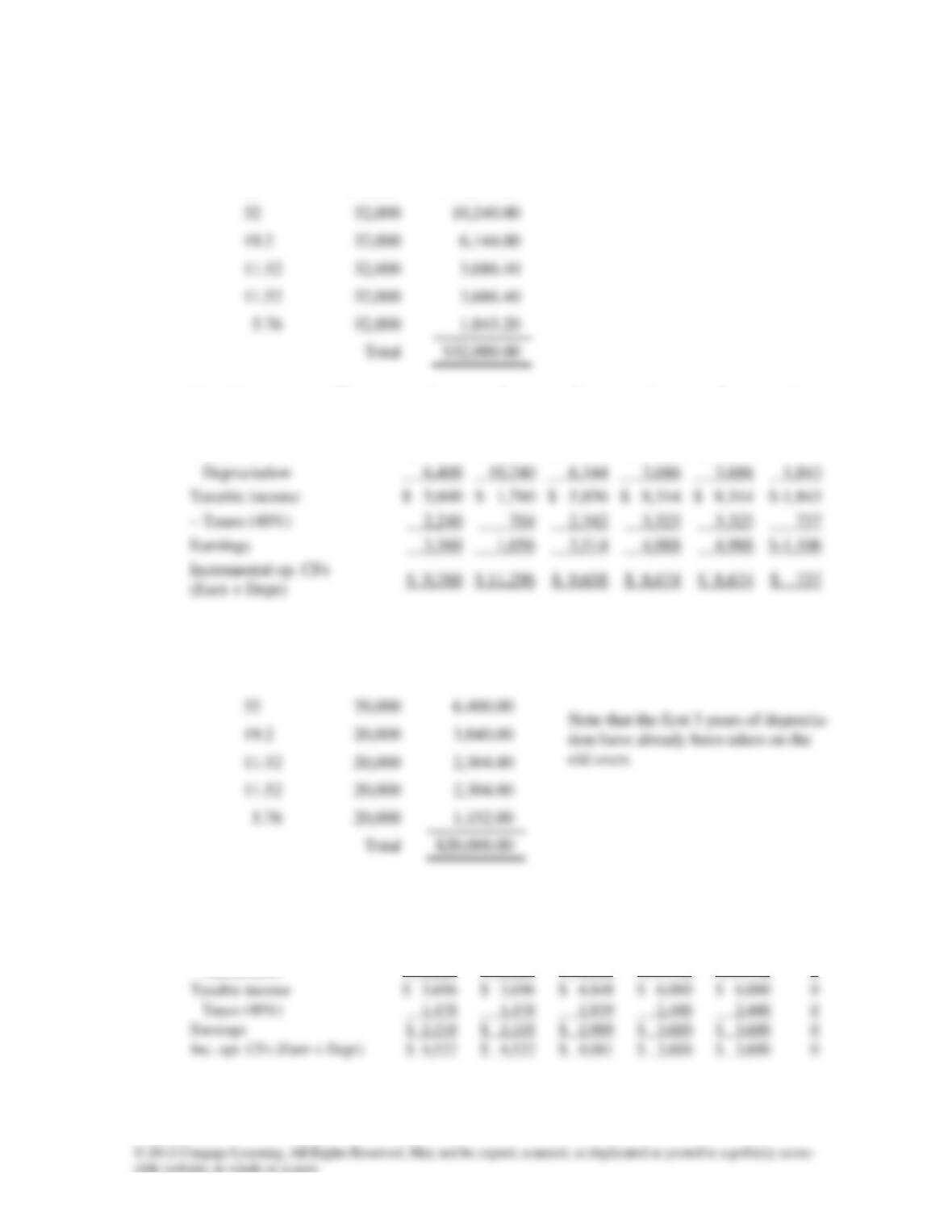
A9-11. a.
Cost of new oven
$30,500
+ Installation costs
1,500
Total installed cost
$32,000
Proceeds from Sale of old oven
$22,000
Less tax on sale of old oven:
Sale price
$22,000
Book value (1 – .20 – .32 – .192) $20,000
Gain on sale of old oven
$16,240
Tax rate
Tax on sale of old oven
After tax proceeds from sale of old oven
Chapter 9 Cash Flow and Capital Budgeting 255
5-Year
MACRS %
Installed
Cost
Depreciation
20
$32,000
$ 6,400.00
32
11.52
11.52
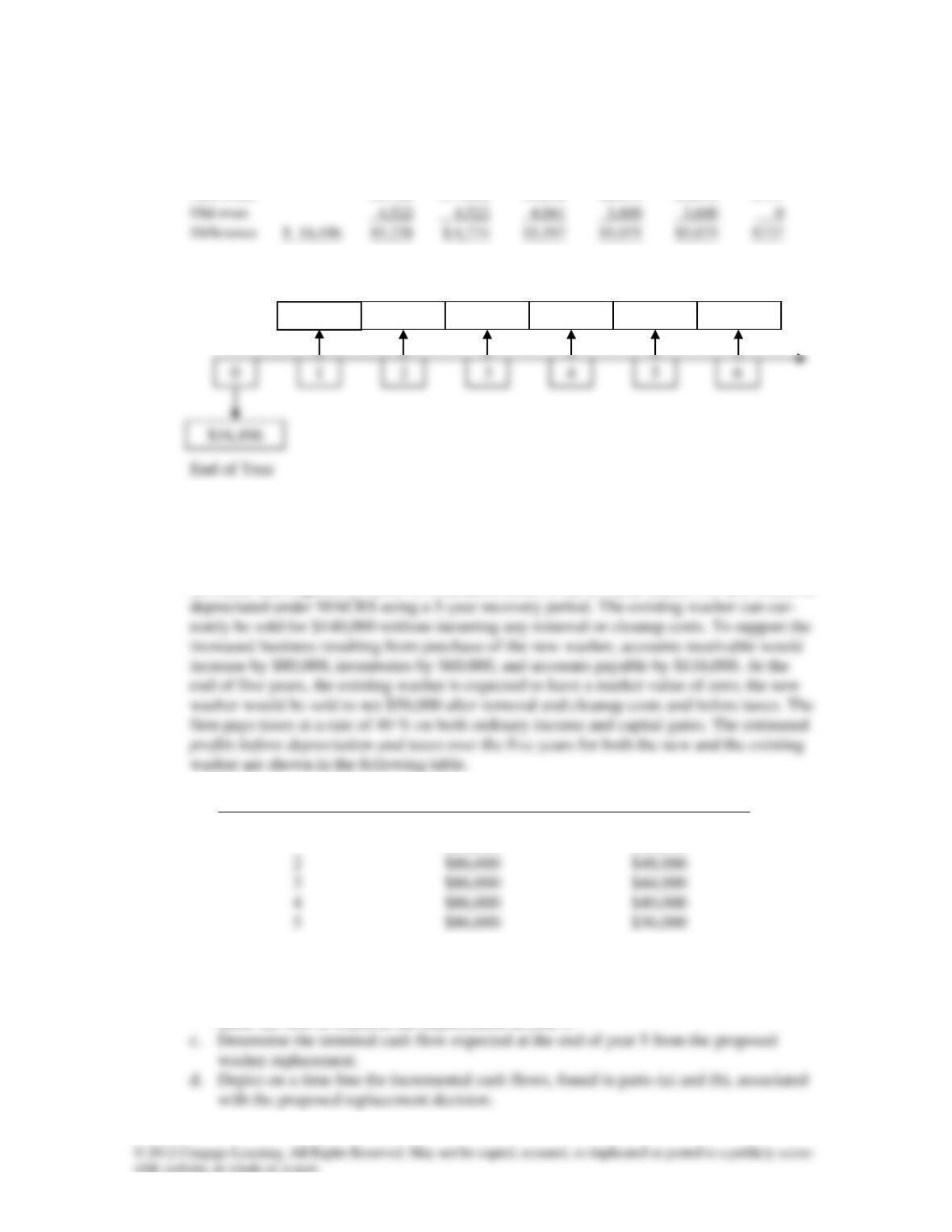
New Oven: Year:
1
2
3
4
5
6
Sales
$300,000
$300,000
$300,000
$300,000
$300,000
$ 0
– Expenses
288,000
288,000
288,000
288,000
288,000
0
– Depreciation
Taxable income
Earnings
(Earn + Depr)
5-Year
MACRS %
Installed
Cost
Depreciation
19.2
11.52
11.52
20
$20,000
$4,000.00
Old Oven: Year:
1
2
3
4
5
6
Sales
$270,000
$270,000
$270,000
$270,000
$270,000
0
– Expenses
264,000
264,000
264,000
264,000
264,000
0
– Depreciation
2,304
2,304
1,152
0
0
0
Taxable income
0
– Taxes (40%)
0
Earnings
$ 2,218
0
0
256 Instructor’s Manual
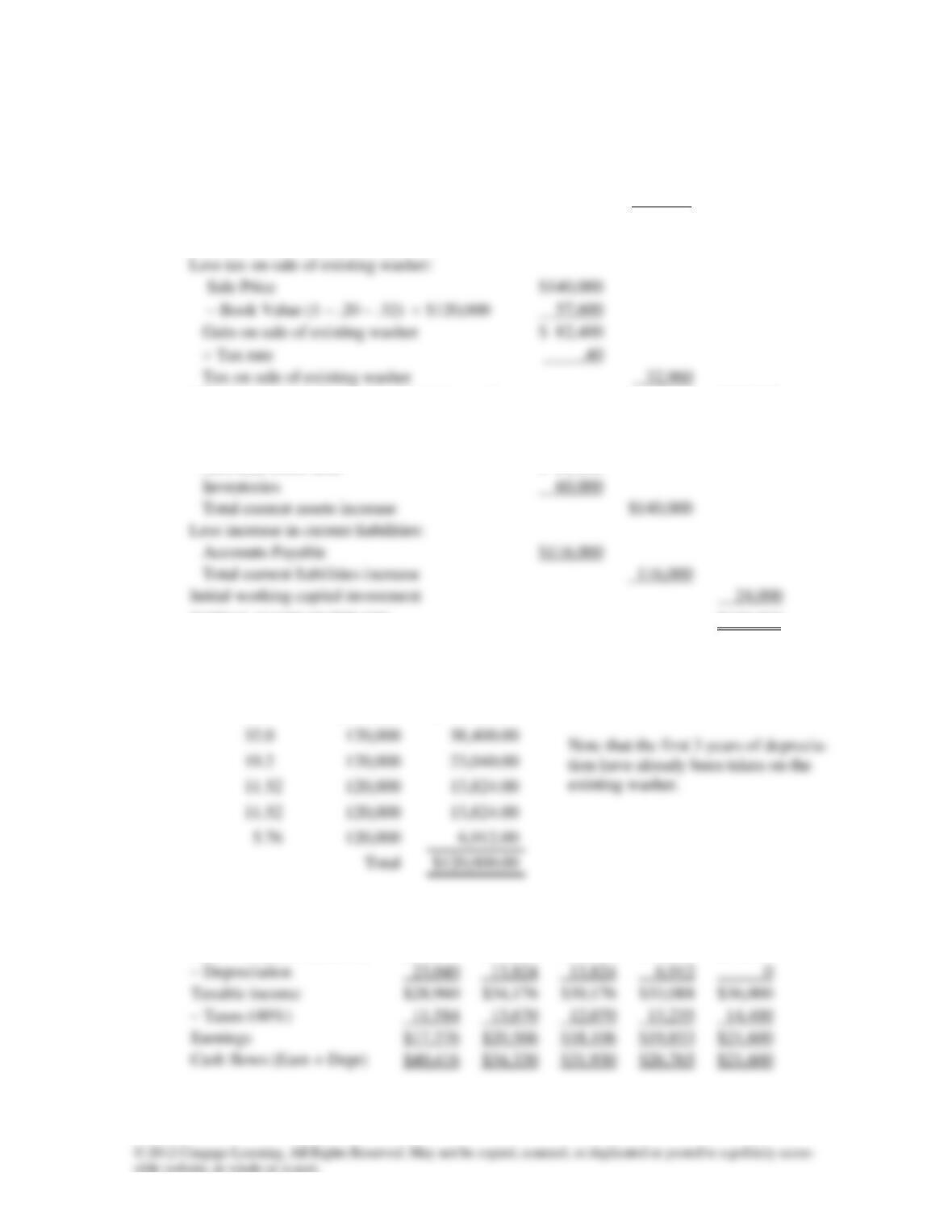
Incremental cash flows:
Year:
0
1
2
3
4
5
6
New oven
$9,760
$11,296
$9,658
$8,675
$8,675
$737
Difference
$5,238
$5,597
$5,075
$5,075
$737
c.
P9-12. Speedy Auto Wash is contemplating the purchase of a new high-speed washer to replace
the existing washer. The existing washer was purchased two years ago at an installed cost
of $120,000; it was being depreciated under MACRS using a 5-year recovery period. The
existing washer is expected to have a usable life of five more years. The new washer costs
$210,000 and requires $10,000 in installation costs; it has a 5-year usable life and would be
Profits before Depreciation and Taxes
Year
New Washer
Existing Washer
1
$86,000
$52,000
3
$86,000
$44,000
a. Calculate the initial cash outflow associated with the replacement of the existing wash-
er with the new one.
b. Determine the incremental cash flows associated with the proposed washer replace-
ment. Be sure to consider the depreciation in year 6.
$5,238
$6,774
$5,597
$4,474
$5,074
$737
Chapter 9 Cash Flow and Capital Budgeting 257
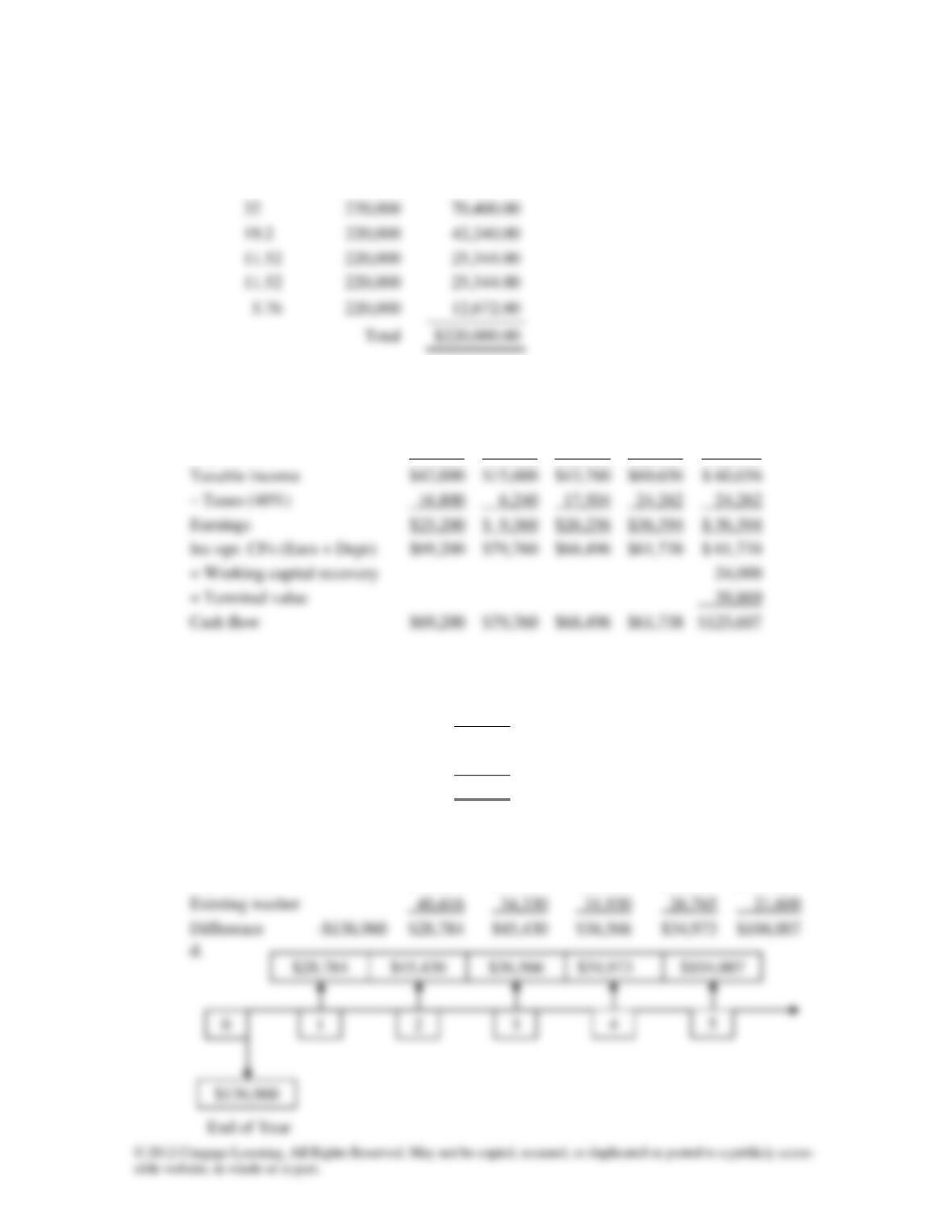
A9-12. a.
Cost of new washer
$210,000
+ Installation cost
10,000
Total installed cost
$220,000
Proceeds from sale of existing washer
$140,000
Less tax on sale of existing washer:
Sale Price
$140,000
– Book Value (1 – .20 – .32) $120,000
Gain on sale of existing washer
$ 82,400
Tax on sale of existing washer
After tax proceeds from sale of existing washer
(107,040)
+ Initial working capital investment
Increase in current assets:
Accounts receivable
$ 80,000
Inventories
60,000
Total current assets increase
$140,000
Less increase in current liabilities:
Accounts Payable
$116,000
Total current liabilities increase
116,000
Initial working capital investment
24,000
INITIAL CASH OUTFLOW
$136,960
b.
5-Year
MACRS %
Installed
Cost
Depreciation
11.52
20.0
$120,000
$ 24,000.00
Existing Washer: Year:
1
2
3
4
5
Sales – Expenses (PBOT)
$52,000
$48,000
$44,000
$40,000
$36,000
23,040
13,824
13,824
6,912
0
Taxable income
$28,960
$34,176
$30,176
$33,088
$36,000
11,584
13,670
12,070
13,235
14,400
Earnings
$17,376
$20,506
$18,106
$19,853
$21,600
Cash flows (Earn + Depr)
$40,416
$34,330
$31,930
$26,765
$21,600
258 Instructor’s Manual
5-Year
MACRS %
Installed
Cost
Depreciation
20
$220,000
$ 44,000.00
New Washer: Year:
1
2
3
4
5
Machine cost
– Sales-Expenses (PBDT)
$86,000
$86,000
$86,000
$86,000
$ 86,000
Depreciation
44,000
70,400
42,240
25,344
25,344
Taxable income
$42,000
$15,600
$43,760
$60,656
$ 60,656
16,800
6,240
17,504
24,262
24,262
Earnings
$25,200
$ 9,360
$26,256
$36,394
$ 36,394
Inc opr. CFs (Earn + Depr)
$69,200
$79,760
$68,496
$61,738
$ 61,738
+ Working capital recovery
+ Terminal value
39,869
Cash flow
$69,200
$79,760
$68,496
$61,738
$125,607
c. Terminal value of new washer in year 5
Sale price
$58,000
– Book value (0.0576 x 220,000)
12,672
(year 6 depr)
Gain on sale
$45,328
– Taxes (40%)
18,131
Terminal value (sale price – taxes)
$39,869
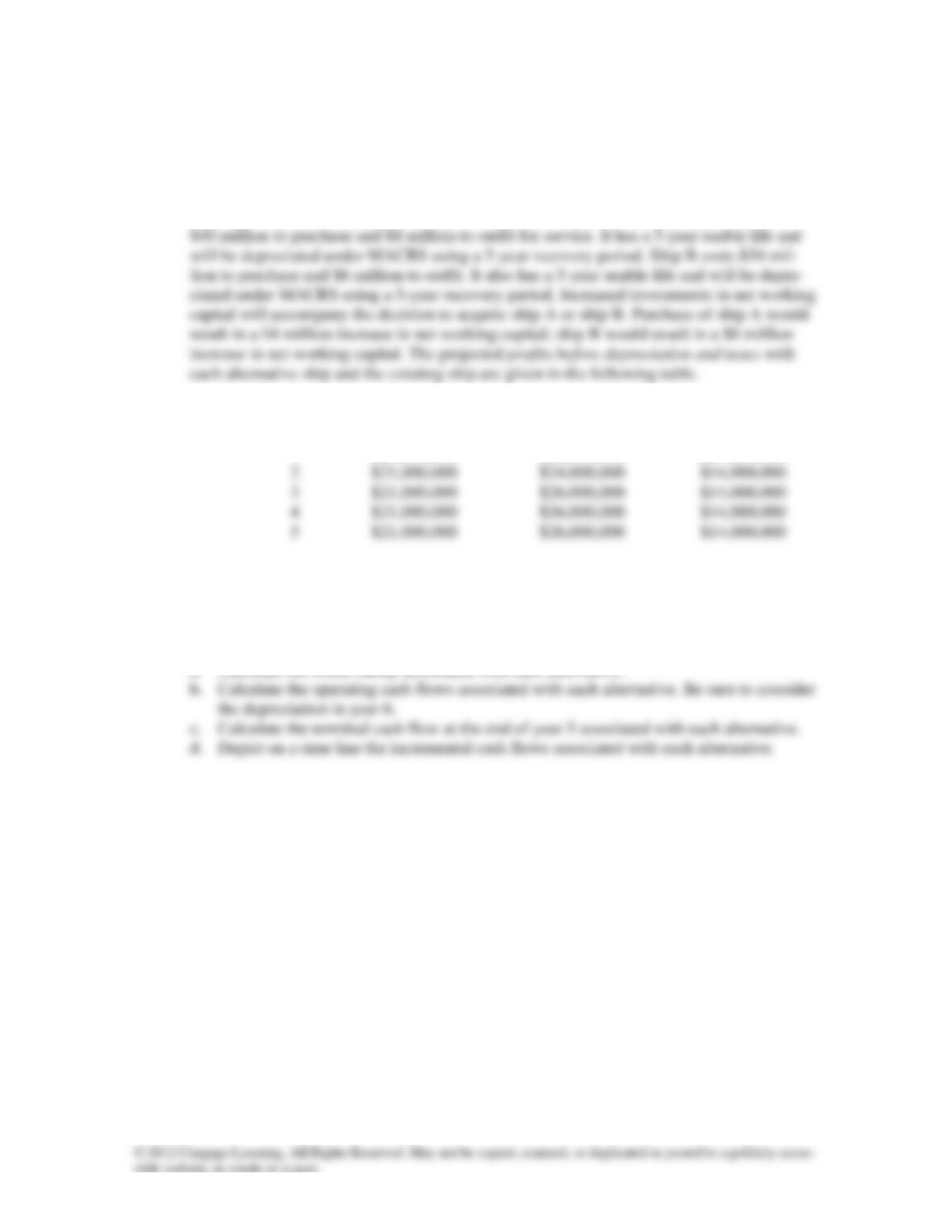
Incremental cash flows:
Year:
0
1
2
3
4
5
New washer
$69,200
$79,760
$68,496
$61,738
$125,607
Existing washer
40,416
34,330
31,930
26,765
21,600
Difference
Chapter 9 Cash Flow and Capital Budgeting 259
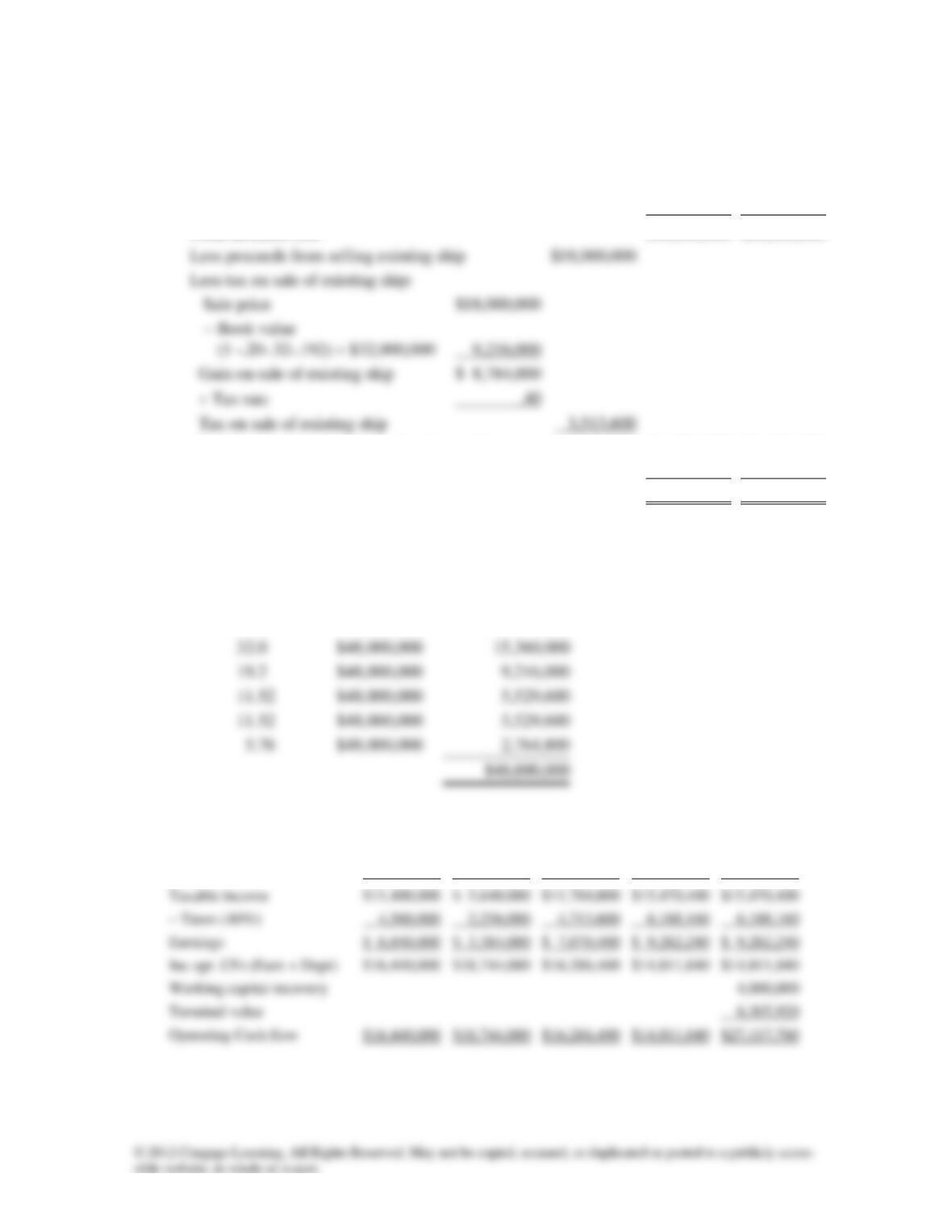
P9-13. TransPacific Shipping is considering replacing an existing ship with one of two newer,
more efficient ones. The existing ship is three years old, cost $32 million, and is being de-
preciated under MACRS using a 5-year recovery period. Although the existing ship has
only three years (years 4, 5, and 6) of depreciation remaining under MACRS, it has a re-
maining usable life of five years. Ship A, one of the two possible replacement ships, costs
Profits before Depreciation and Taxes
Year
Ship A
Ship B
Existing Ship
1
$21,000,000
$22,000,000
$14,000,000
3
$21,000,000
$26,000,000
$14,000,000
5
$21,000,000
$26,000,000
$14,000,000
The existing ship can currently be sold for $18 million and will not incur any removal or
cleanup costs. At the end of five years, the existing ship can be sold to net $1 million be-
fore taxes. Ships A and B can be sold to net $12 million and $20 million before taxes, re-
spectively, at the end of the 5-year period. The firm is subject to a 40 % tax rate on both
ordinary income and capital gains.
260 Instructor’s Manual
A9-13. a.
Ship A
Ship B
Cost of new ship
$40,000,000
$54,000,000
Installation
8,000,000
6,000,000
Total installed cost
$48,000,000
$60,000,000
Less proceeds from selling existing ship
$18,000,000
Less tax on sale of existing ship:
Sale price
$18,000,000
9,216,000
Tax on sale of existing ship
After-tax proceeds from sale of existing ship
(14,486,400)
(14,486,400)
+ Initial working capital investment
4,000,000
6,000,000
INITIAL CASH OUTFLOW
$37,513,600
$51,513,600
b and c.
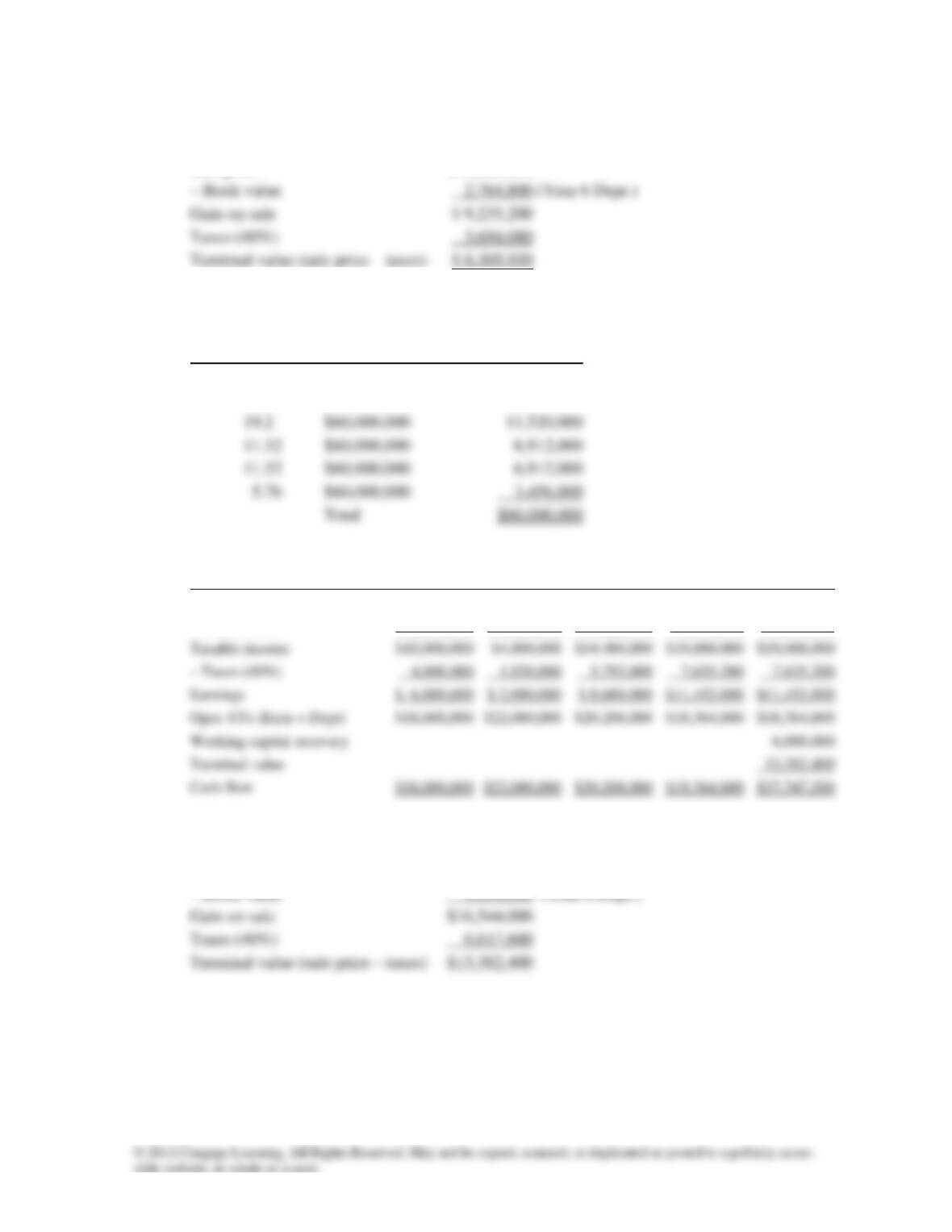
Ship A:
5-Year
MACRS %
Installed
Cost
Depreciation
20.0
$48,000,000
$ 9,600,000
$48,000,000
Year:
1
2
3
4
5
Sales – Expenses (PBDT)
$21,000,000
$21,000,000
$21,000,000
$21,000,000
$21,000,000
– Depreciation
9,600,000
15,360,000
9,216,000
5,529,600
5,529,600
– Taxes (40%)
4,560,000
2,256,000
4,713,600
6,188,160
6,188,160
Working capital recovery
8,305,920
Chapter 9 Cash Flow and Capital Budgeting 261
Terminal value of Ship A in year 5:
Sale price
$12,000,000
(Year 6 Depr.)
Gain on sale
Taxes (40%)
Ship B:
5-Year
MACRS %
Installed
Cost
Depreciation
20.0
$60,000,000
$12,000,000
32.0
$60,000,000
19,200,000
19.2
$60,000,000
11,520,000
11.52
$60,000,000
11.52
$60,000,000
$60,000,000
Year:
1
2
3
4
5
Sales–Expenses
$22,000,000
$24,000,000
$26,000,000
$26,000,000
$26,000,000
– Depreciation
12,000,000
19,200,000
11,520,000
6,912,000
6,912,000
Taxable income
$10,000,000
$14,480,000
$19,088,000
$19,088,000
– Taxes (40%)
5,792,000
7,635,200
7,635,200
Earnings
$ 6,000,000
$ 2,880,000
$11,452,800
$11,452,800
Working capital recovery
Terminal value
13,382,400
Cash flow
$18,000,000
$22,080,000
$20,208,000
$18,364,800
$37,747,200
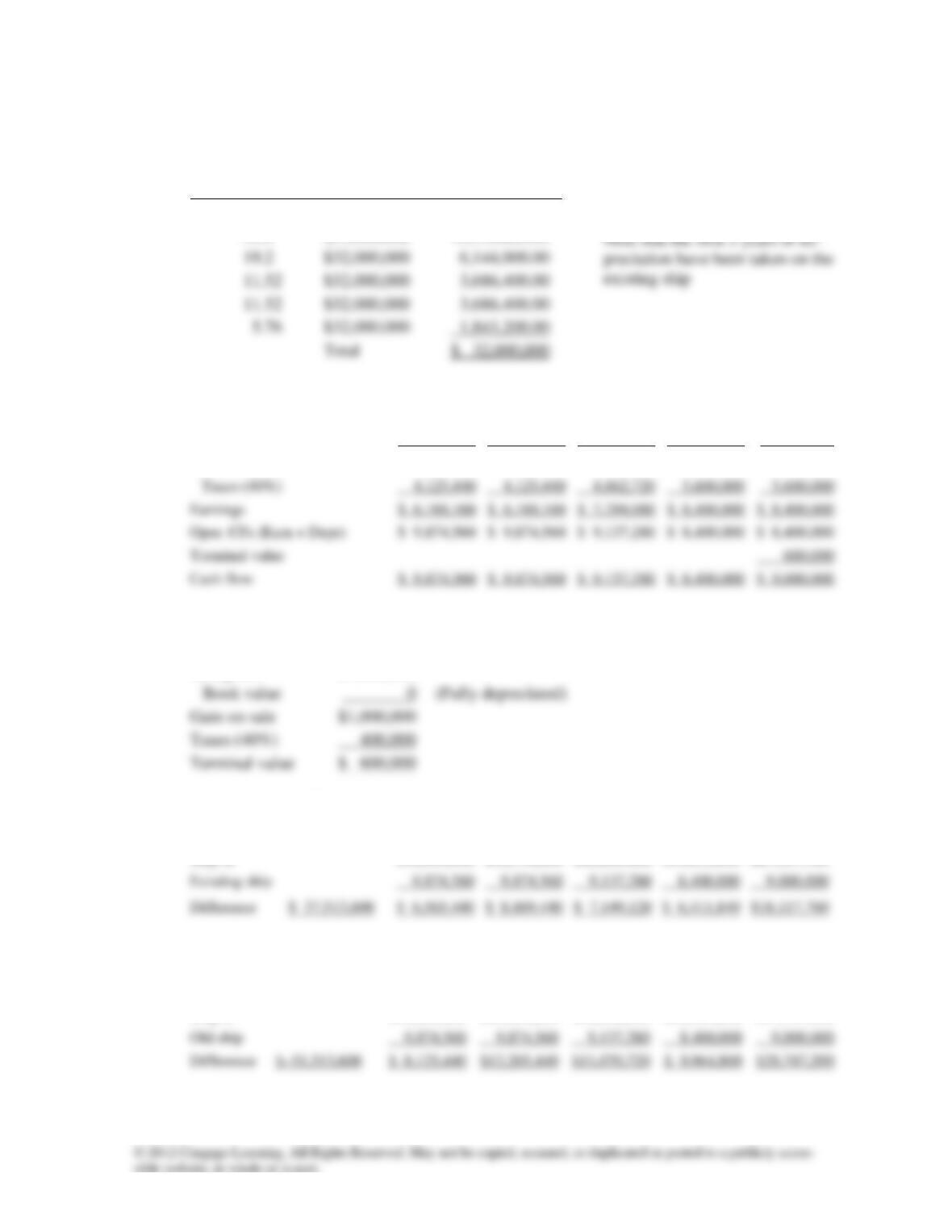
Terminal value of Ship B in year 5:
Sale price
$20,000,000
Gain on sale
$16,544,000
Taxes (40%)
6,617,600
Terminal value (sale price – taxes)
$13,382,400
262 Instructor’s Manual
Existing Ship:
5-Year
MACRS %
Installed
Cost
Depreciation
19.2
$32,000,000
11.52
$32,000,000
$32,000,000
1,843,200.00
Total
$ 32,000,000
20.0
$32,000,000
$ 6,400,000.00
32.0
$32,000,000
10,240,000.00
Year:
1
2
3
4
5
Sales – Expenses (PBDT)
$14,000,000
$14,000,000
$14,000,000
$14,000,000
$14,000,000
– Depreciation
3,686,400
3,686,400
1,843,200
0
0
Taxable income
$10,313,600
$10,313,600
$12,156,800
$14,000,000
$14,000,000
Earnings
$ 6,188,160
$ 6,188,160
$ 7,294,080
$ 8,400,000
$ 8,400,000
Oper. CFs (Earn + Depr)
$ 9,874,560
$ 9,874,560
$ 9,137,280
$ 8,400,000
$ 8,400,000
Terminal value
Cash flow
Terminal value of existing ship in year 5:
Sale price
$1,000,000
(Fully depreciated)
Gain on sale
$1,000,000
Terminal value
$ 600,000
Incremental cash flows:
Year:
0
1
2
3
4
5
Ship A
$16,440,000
$18,744,000
$16,286,400
$14,811,840
$27,117,760
Existing ship
Incremental cash flows:
Year:
0
1
2
3
4
5
Ship B
$18,000,000
$22,080,000
$20,208,000
$18,364,800
$37,747,200
Old ship
Difference
Chapter 9 Cash Flow and Capital Budgeting 263
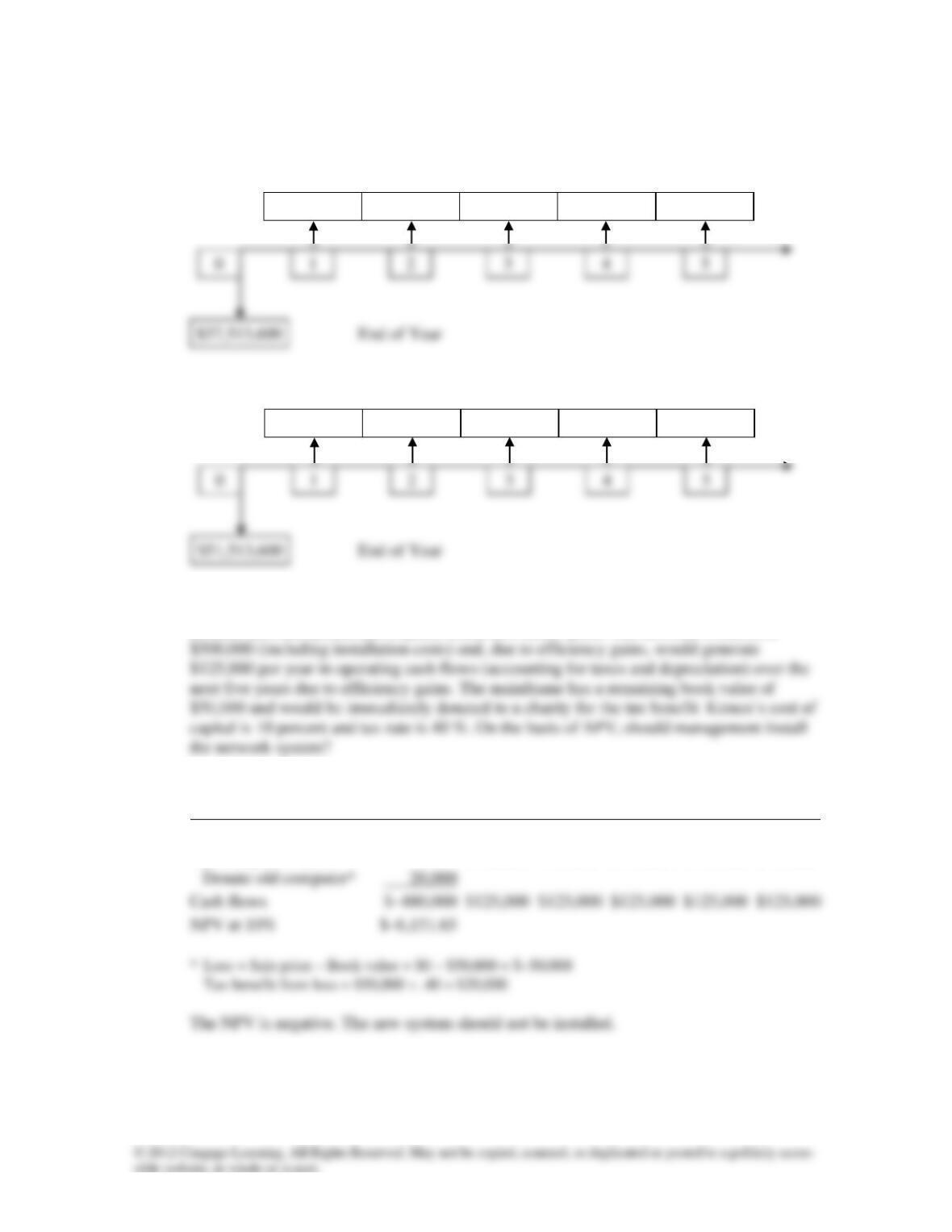
d. The time lines
Ship A:
$37,513,600
Ship B:
$51,513,600
P9-14. The management of Kimco is evaluating replacing their large mainframe computer with a
modern network system that requires much less office space. The network would cost
A9-14.
Year:
0
1
2
3
4
5
Network cost
$–500,000
Operating cash flows
$125,000
$125,000
$125,000
$125,000
$125,000
Cash flows
$–480,000
$125,000
$125,000
$125,000
$125,000
$125,000
NPV at 10%
P9-15. Pointless Luxuries Inc. (PLI) produces unusual gifts targeted at wealthy consumers. The
company is analyzing the possibility of introducing a new device designed to attach to the
collar of a cat or dog. This device emits sonic waves that neutralize airplane engine noise,
so that pets traveling with their owners can enjoy a more peaceful ride. PLI estimates that
$6,565,440
$8,869,440
$7,149,120
$6,411,840
$18,117,600
$8,125,440
$12,205,440
$11,070,720
$9,964,800
$28,747,200
264 Instructor’s Manual
developing this product will require up-front capital expenditures of $10 million. These
costs will be depreciated on a straight-line basis for five years. PLI believes that it can sell
the product initially for $250. The selling price will increase to $260 in years 2 and 3 be-
Year 0
Year 1
Year 2
Year 3
Year 4
Year 5
Accounts receivable
$0
$200,000
$250,000
$300,000
$150,000
$0
Inventory
0
500,000
650,000
780,000
600,000
0
The firm faces a tax rate of 34 percent. Assume that cash flows arrive at the end of each
year, except for the initial $10 million outlay.
a. Calculate the project’s contribution to net income each year.
b. Calculate the project’s cash flows each year.
c. Calculate two NPVs, one using a 10 percent discount rate and one using a 15 percent
discount rate.
d. A PLI financial analyst reasons as follows: “With the exception of the initial outlay,
A9-15. a and b.
Year:
1
2
3
4
5
Units sales
20,000
25,000
30,000
36,000
41,400
Price/Unit
$250
$260
$260
$245
$240
Revenue
$5,000,000
$6,500,000
$7,800,000
$8,820,000
$9,936,000
Net income
$ 300,000
$1,125,000
$1,750,000
$1,960,000
$2,347,000
+ Depreciation
2,000,000
2,000,000
2,000,000
2,000,000
2,000,000
Operating CF
$2,198,000
$2,742,500
$3,155,000
$3,293,600
$3,549,020
Working capital*
–700,000
–200,000
–180,000
330,000
750,000
Cash flow
$1,498,000
$2,542,500
$3,623,600
$4,299,020
* Year-to-year change in investment in A/R and inventories