Chapter 8 Capital Budgeting Process and Decision Criteria 217
Accounting-Based Methods
P8-3. Kenneth Gould is the general manager at a small-town newspaper that is part of a national
media chain. He is seeking approval from corporate headquarters (HQ) to spend $20,000 to
buy some Macintosh computers and a laser printer to use in designing the layout of his
daily paper. This equipment will be depreciated using the straight line method over four
years. These computers will replace outmoded equipment that will be kept on hand for
emergency use.
HQ requires Kenneth to estimate the cash flows associated with the purchase of new
Year 1
Year 2
Year 3
Year 4
Cost savings
$7,500
$9,100
$9,100
$9,100
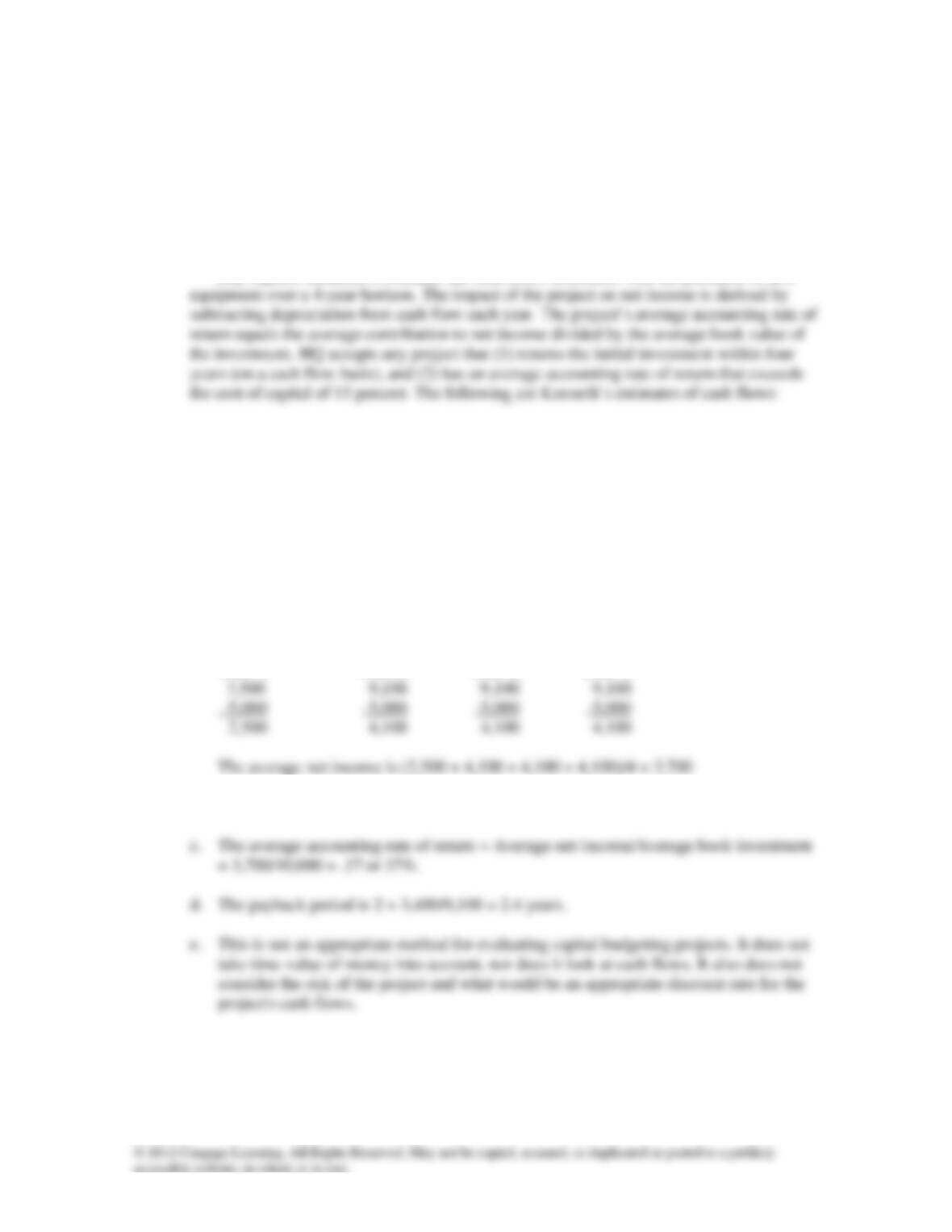
a. What is the average contribution to net income across all four years?
b. What is the average book value of the investment?
c. What is the average accounting rate of return?
d. What is the payback period of this investment?
e. Critique the company’s method for evaluating investment proposals.
A8-3. a. If the computers are depreciated on a straight-line basis, depreciation will be $5,000
per year for 4 years. Contribution to net income will be:
Year 1 Year 2 Year 3 Year 4
b. The average book value of the investment is (20,000 + 0)/2 = $10,000.
Net Present Value
P8-4. Calculate the net present value (NPV) for the following 20-year projects. Comment on the
acceptability of each. Assume that the firm has an opportunity cost of 14%.
a. Initial cash outlay is $15,000; cash inflows are $13,000 per year.
b. Initial cash outlay is $32,000; cash inflows are $4,000 per year.
218 Instructor’s Manual
c. Initial cash outlay is $50,000; cash inflows are $8,500 per year.
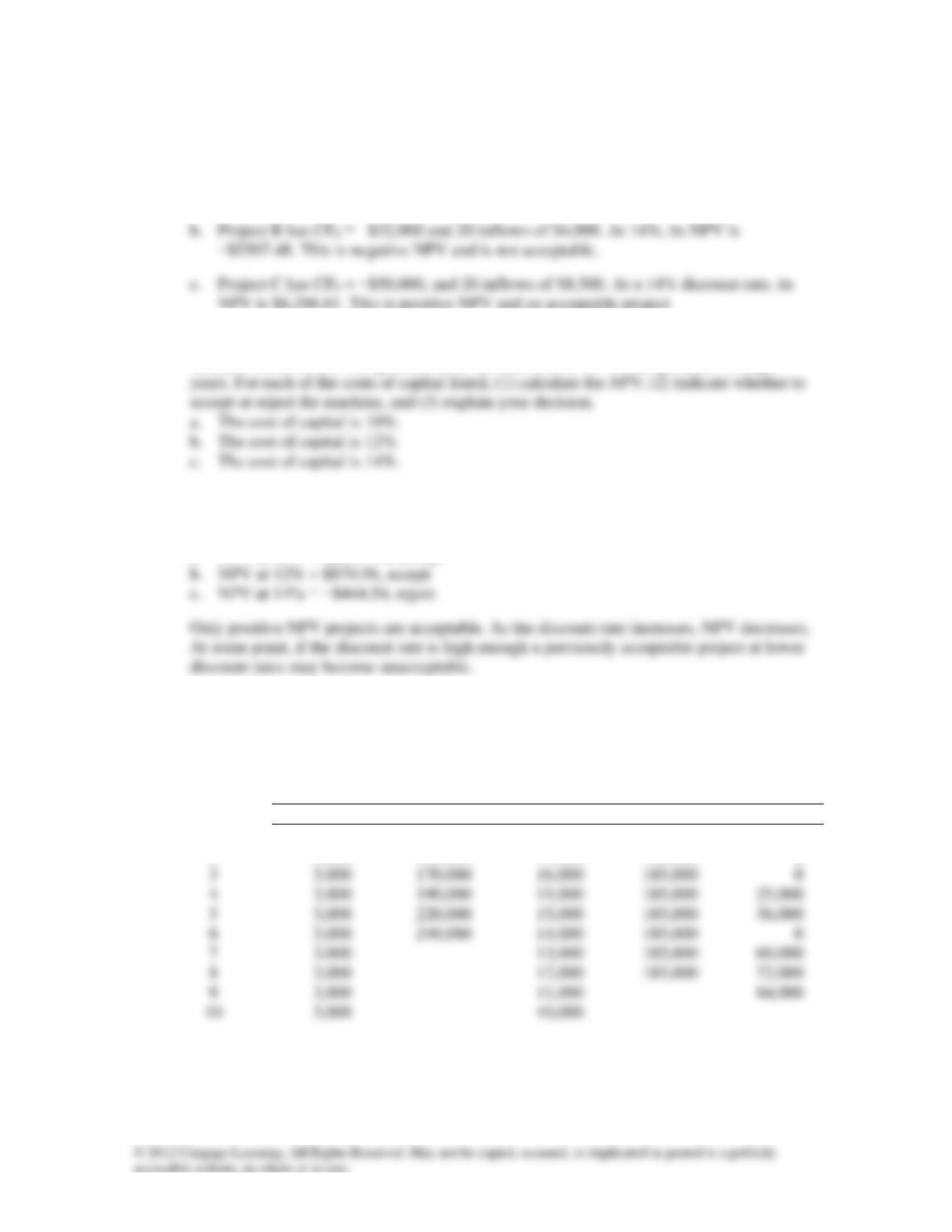
A8-4. a. Project A has CF0 = −$15,000, and 20 inflows of $13,000. At a 14% discount rate, its
NPV is $71,100.70. This is positive NPV and an acceptable project.
P8-5. Michael’s Bakery is evaluating a new electronic oven. The oven requires an initial cash
outlay of $19,000 and will generate after-tax cash inflows of $4,000 per year for eight
A8-5. CF0 = -$19,000
Cash flows of $4,000/Year for 8 years.
a. NPV at 10% = $2,339.70, accept
P8-6. Using a 14% cost of capital, calculate the NPV for each of the projects shown in the
following table and indicate whether or not each is acceptable.
Project A
Project B
Project C
Project D
Project E
Year
Cash Flows
0
-$20,000
-$600,000
-$150,000
-$760,000
-$100,000
1
$3,000
$120,000
$18,000
$185,000
$ 0
2
3,000
145,000
17,000
185,000
0
3
3,000
170,000
16,000
185,000
0
5
3,000
220,000
15,000
185,000
6
240,000
7
3,000
13,000
185,000
8
9
3,000
11,000
3,000
10,000
Chapter 8 Capital Budgeting Process and Decision Criteria 219
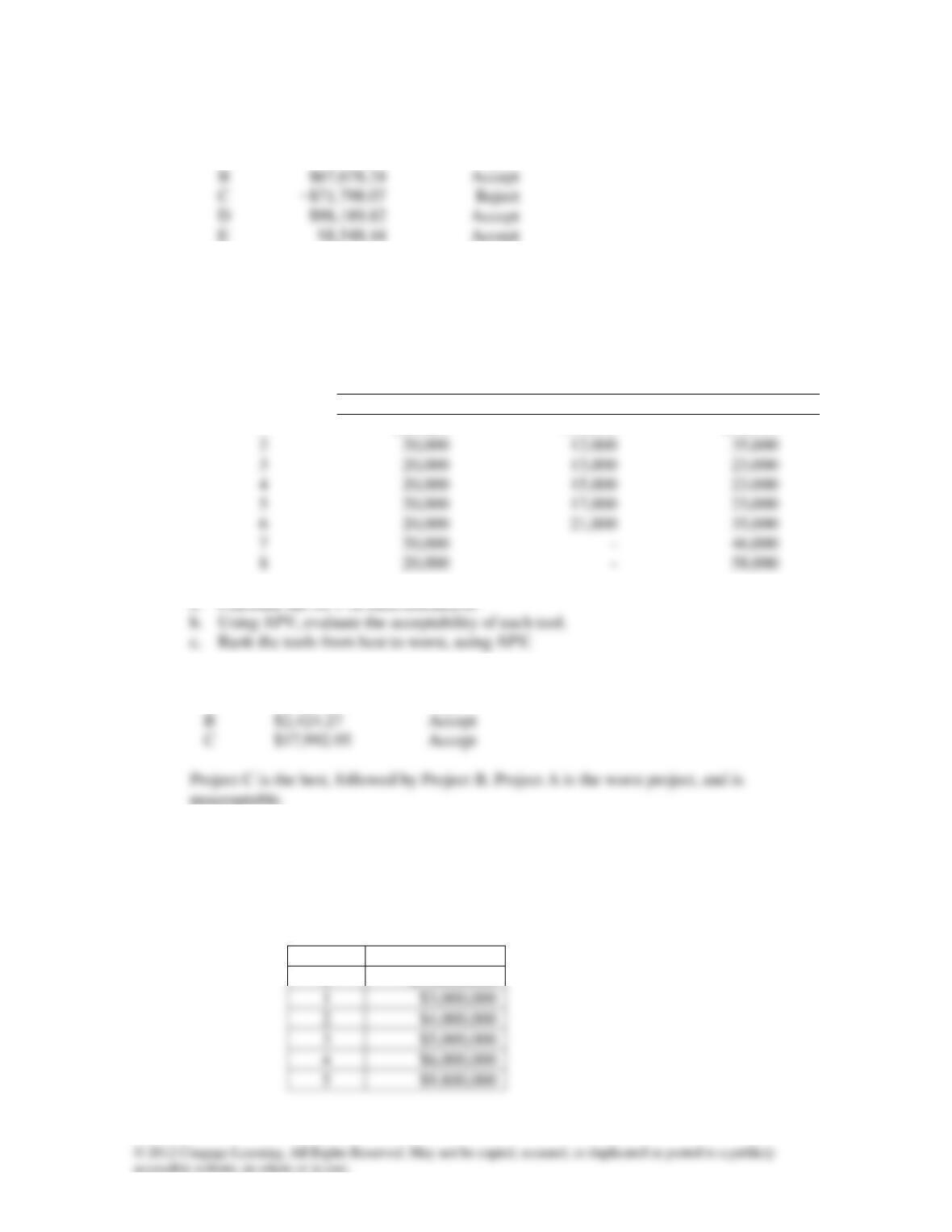
A8-6. Project NPV Decision
A −$4,351.65 Reject
P8-7. Scotty Manufacturing is considering the replacement of one of its machine tools. Three
alternative replacement tools—A, B, and C—are under consideration. The cash flows
associated with each are shown in the following table. The firm’s cost of capital is 15%.
A
B
C
Year
Cash Flows
0
-$95,000
-$50,000
-$150,000
1
$20,000
$10,000
$58,000
2
3
4
5
6
7
8
A8-7. Project NPV Decision
A −$5,253.57 Reject
P8-8. Erwin Enterprises has 10 million shares outstanding with a current market price of $10 per
share. There is one investment available to Erwin, and its cash flows are provided below.
Erwin has a cost of capital of 10%. Given this information, determine the impact on
Erwin’s stock price and firm value if capital markets fully reflect the value of undertaking
the project.
Year
Cash Flow
0
-$10,000,000
2
4
220 Instructor’s Manual
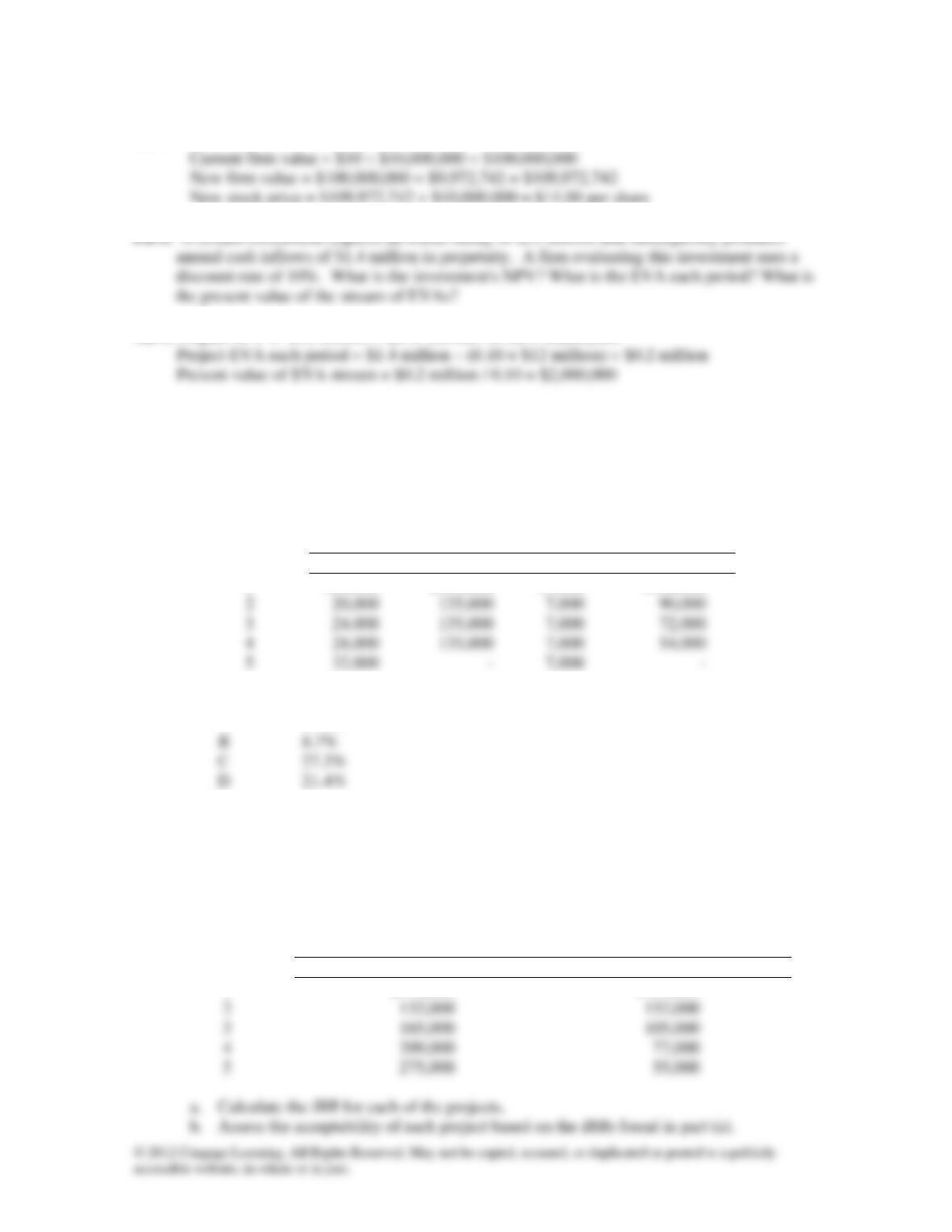
A8-8. NPV of project = $9,972,742
A8-9. Project NPV = -$12 million + ($1.4 million / 0.10) = $2,000,000
Internal Rate of Return
P8-10. For each of the projects shown in the following table, calculate the internal rate of return
(IRR).
Project A
Project B
Project C
Project D
Year
Cash Flows
0
-$72,000
-$440,000
-$18,000
-$215,000
1
$16,000
$135,000
$7,000
$108,000
2
3
24,000
4
5
32,000
A8-10. Project IRR
A 17.4%
P8-11. William Industries is attempting to choose the better of two mutually exclusive projects for
expanding the firm’s production capacity. The relevant cash flows for the projects are
shown in the following table. The firm’s cost of capital is 15%.
Project A
Project B
Year
Cash Flows
0
-$550,000
-$358,000
1
$110,000
$154,000
2
3
4
Chapter 8 Capital Budgeting Process and Decision Criteria 221
c. Which project is preferred, based on the IRRs found in part (a)?
A8-11. a. Project IRR
A 15.7%
P8-12. Contract Manufacturing, Inc. is considering two alternative investment proposals. The first
proposal calls for a major renovation of the company’s manufacturing facility. The second
Year
Renovate
Replace
0
−$9,000,000
−$1,000,000
1
3,500,000
600,000
2
3,000,000
500,000
3
3,000,000
400,000
4
2,800,000
300,000
5
2,500,000
200,000
a. Rank these investments based on their NPVs.
b. Rank these investments based on their IRRs.
c. Why do these rankings yield mixed signals?
A8-12. Project NPV IRR
Renovate $1,128,309 20.5%
P8-13. Consider a project with the following cash flows and a firm with a 15% cost of capital.
Year Cash Flow
0 −$20,000
1 50,000
2 −10,000
a. What are the two IRRs associated with this cash flow stream?
b. If the firm’s cost of capital falls between the two IRR values calculated in part (a),
should it accept or reject the project?
222 Instructor’s Manual
A8-13. a.
000,20$
)IRR1(
000,10$
)IRR1(
000,50$
0$ 21 −
+
−
+
=
Using the quadratic formula
b. Because the undiscounted NPV of the project is positive (i.e; −$20,000 + $50,000 −
P8-14. A certain project has the following stream of cash flows:
Year
Cash Flow
0
$ 17,500
1
−80,500
2
138,425
3
−105,455
4
30,030
Chapter 8 Capital Budgeting Process and Decision Criteria 223
a. Fill in the following table:
Cost of
Capital (%)
Project
NPV
0
______
5
______
10
______
15
______
20
______
25
______
30
______
35
______
50
______
b. Use the values developed in part a to draw a NPV profile for the project.
c. What is this project’s IRR?
d. Describe the conditions under which the firm should accept this project.
A8-14. a.
Cost of Project
Capital (%) NPV
b.
$0
$5
$10
$15
$20
$25
0%
10%
20%
30%
40%
50%
$30
$35
$40
$45
Project NPV
224 Instructor’s Manual
Profitability Index
P8-15. Evaluate the following three projects, using the profitability index. Assume a cost of
capital of 15%.
Project
Liquidate
Recondition
Replace
Initial cash outflow
-$100,000
-$500,000
-$1,000,000
Year 1 cash inflow
50,000
100,000
500,000
Year 2 cash inflow
60,000
200,000
500,000
Year 3 cash inflow
75,000
250,000
500,000
a. Rank these projects by their PIs.
b. If the projects are independent, which would you accept according to the PI criterion?
c. If these projects are mutually exclusive, which would you accept according to the PI
criterion?
d. Apply the NPV criterion to the projects, rank them according to their NPVs, and
indicate which project you would accept if they are independent and if they are
mutually exclusive.
e. Compare and contrast your answer to part (c) to your answer to part (d) for the
mutually exclusive case. Explain this result.
A8-15. a. PI (Liquidate) = $138,161 / $100,000 = 1.38
b. Accept both Liquidate and Replace because both have a PI > 1.0
e. The answers do not match. Liquidate has the higher PI, but Replace is a larger scale
P8-16. You have a $10 million capital budget and must make the decision about which
investments your firm should accept for the coming year. Use the following information on
three mutually exclusive projects to determine which investment your firm should accept.
The firm’s cost of capital is 12%.
Chapter 8 Capital Budgeting Process and Decision Criteria 225
Project 1
Project 2
Project 3
Initial cash outflow
-$4,000,000
-$5,000,000
-$10,000,000
Year 1 cash inflow
1,000,000
2,000,000
4,000,000
Year 2 cash inflow
2,000,000
3,000,000
6,000,000
Year 3 cash inflow
3,000,000
3,000,000
5,000,000
a. Which project do you accept on the basis of NPV?
b. Which project do you accept on the basis of PI?
c. If these are the only investments available, which one do you select?
P8-17. Both Old Line Industries and New Tech, Inc., use the IRR to make investment decisions.
Both firms are considering investing in a more efficient $4.5 million mail-order processor.
This machine could generate after-tax savings of $2 million per year over the next three
years for both firms. However, due to the risky nature of its business, New Tech has a
much higher cost of capital (20%) than does Old Line (10%). Given this information,
answer parts (a)–(c).
a. Should Old Line invest in this processor?
b. Should New Tech invest in this processor?
c. Based on your answers in parts (a) and (b), what can you infer about the acceptability
of projects across firms with different costs of capital?
A8-17. Project Cash Flows:
Year 0 1 2 3
Cash Flow −$4.5 2 2 2
226 Instructor’s Manual
P8-18. Butler Products has prepared the following estimates for an investment it is considering.
The initial cash outflow is $20,000, and the project is expected to yield cash inflows of
$4,400 per year for seven years. The firm has a 10% cost of capital.
a. Determine the NPV for the project.
b. Determine the IRR for the project.
c. Would you recommend that the firm accept or reject the project? Explain your answer.
A8-18. Year 0 1 2 3 4 5 6 7
Cash Flow −$20,000 4,400 4,400 4,400 4,400 4,400 4,400 4,400
P8-19. Reynolds Enterprises is attempting to evaluate the feasibility of investing $85,000, CF0, in
a machine having a 5-year life. The firm has estimated the cash inflows associated with the
proposal as shown below. The firm has a 12% cost of capital.
Year Cash Flows
1 $18,000
2 $22,500
3 $27,000
4 $31,500
5 $36,000
a. Calculate the payback period for the proposed investment.
b. Calculate the NPV for the proposed investment.
c. Calculate the IRR for the proposed investment.
d. Evaluate the acceptability of the proposed investment using NPV and IRR. What
recommendation would you make relative to implementation of the project? Why?
A8-19. a. The payback period is 3.56 years
P8-20. Sharpe Manufacturing is attempting to select the best of three mutually exclusive projects.
The initial cash outflow and after-tax cash inflows associated with each project are shown
in the following table.
Cash Flows
Project X
Project Y
Project Z
Initial cash outflow
$80,000
$130,000
$145,000
Cash inflows years 1-5
27,000
41,000
43,000
a. Calculate the payback period for each project.
b. Calculate the NPV of each project, assuming that the firm has a cost of capital equal to
13%.
c. Calculate the IRR for each project.
d. Summarize the preferences dictated by each measure, and indicate which project you
would recommend. Explain why.
Chapter 8 Capital Budgeting Process and Decision Criteria 227
A8-20. Project Payback NPV IRR
X 2.96 years $14,965.24 20.4%
P8-21. Wilkes, Inc. must invest in a pollution-control program in order to meet federal regulations
to stay in business. There are two programs available to Wilkes: an all-at-once program
that will be immediately funded and implemented, and a gradual program that will be
phased in over the next three years. The immediate program costs $5 million, whereas the
phase-in program will cost $1 million today and $2 million per year for the following three
years. If the cost of capital for Wilkes is 15%, which pollution-control program should
Wilkes select?
A8-21. Year All at Once Gradual
0 -$5 -$1
P8-22. A consumer product firm finds that its brand of laundry detergent is losing market share, so
it decides that it needs to “freshen” the product. One strategy is to maintain the current
Year
Repackage
Reformulate
0
-$3,000,000
-$25,000,000
1
2,000,000
10,000,000
2
1,250,000
9,000,000
3
500,000
7,000,000
4
250,000
4,000,000
5
250,000
3,500,000
a. Rank these investments based on their NPVs.
228 Instructor’s Manual
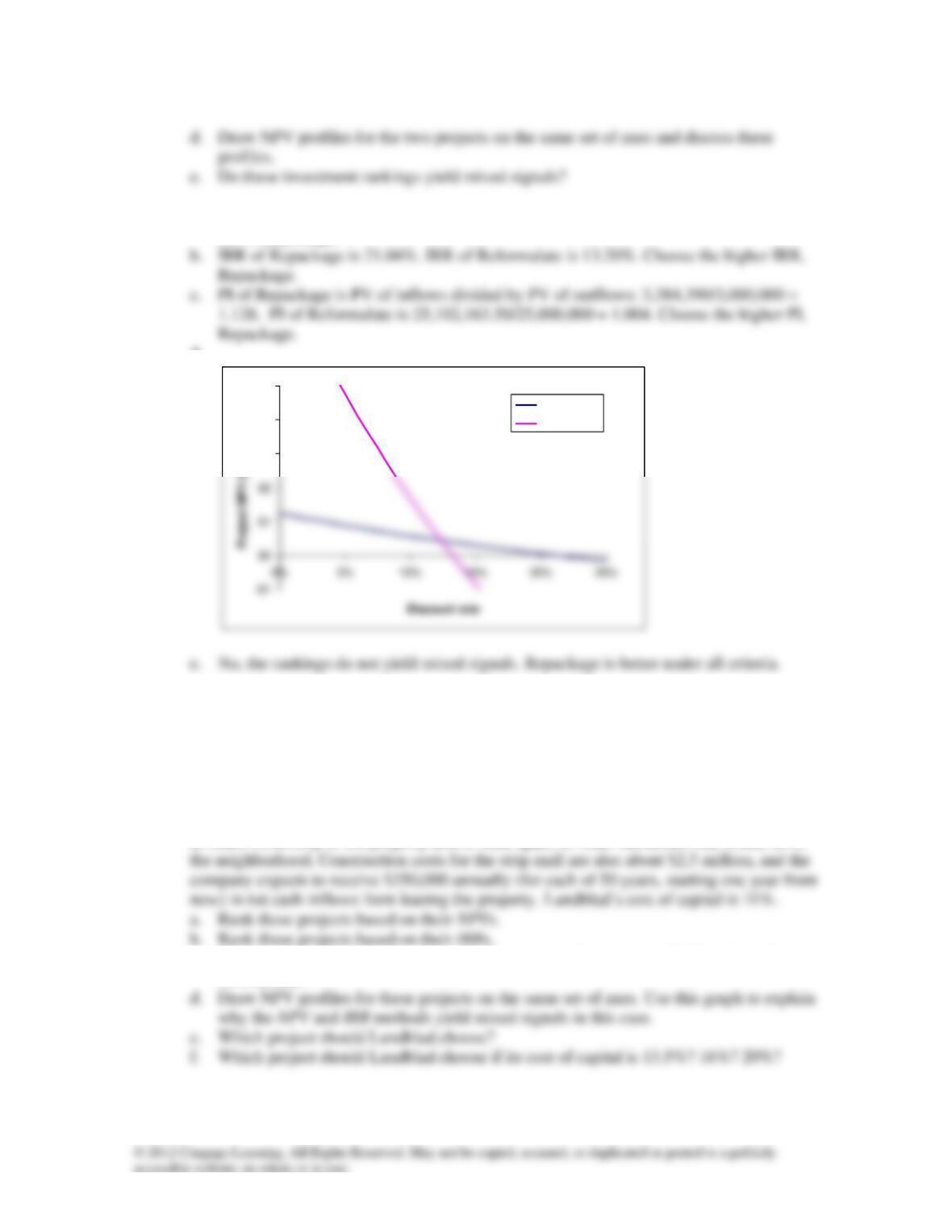
A8-22. a. NPV of Repackage is $384,390. NPV of Reformulate is $102,163. Choose the higher
NPV, Repackage.
d.
$3
$4
$5
Repackage
Reformulate
P8-23. Lundblad Construction Co. recently acquired ten acres of land and is weighing two options
for developing the land. The first proposal is to build ten single-family homes on the site.
This project would generate a quick cash payoff as the homes are sold over the next two
years. Specifically, Lundblad estimates that it would spend $2.5 million on construction
costs immediately, and it would receive $1.6 million as cash inflows in each of the next
two years.
The second proposal is to build a strip shopping mall. This project calls for Lundblad
to retain ownership of the property and to lease space to retail businesses that would serve
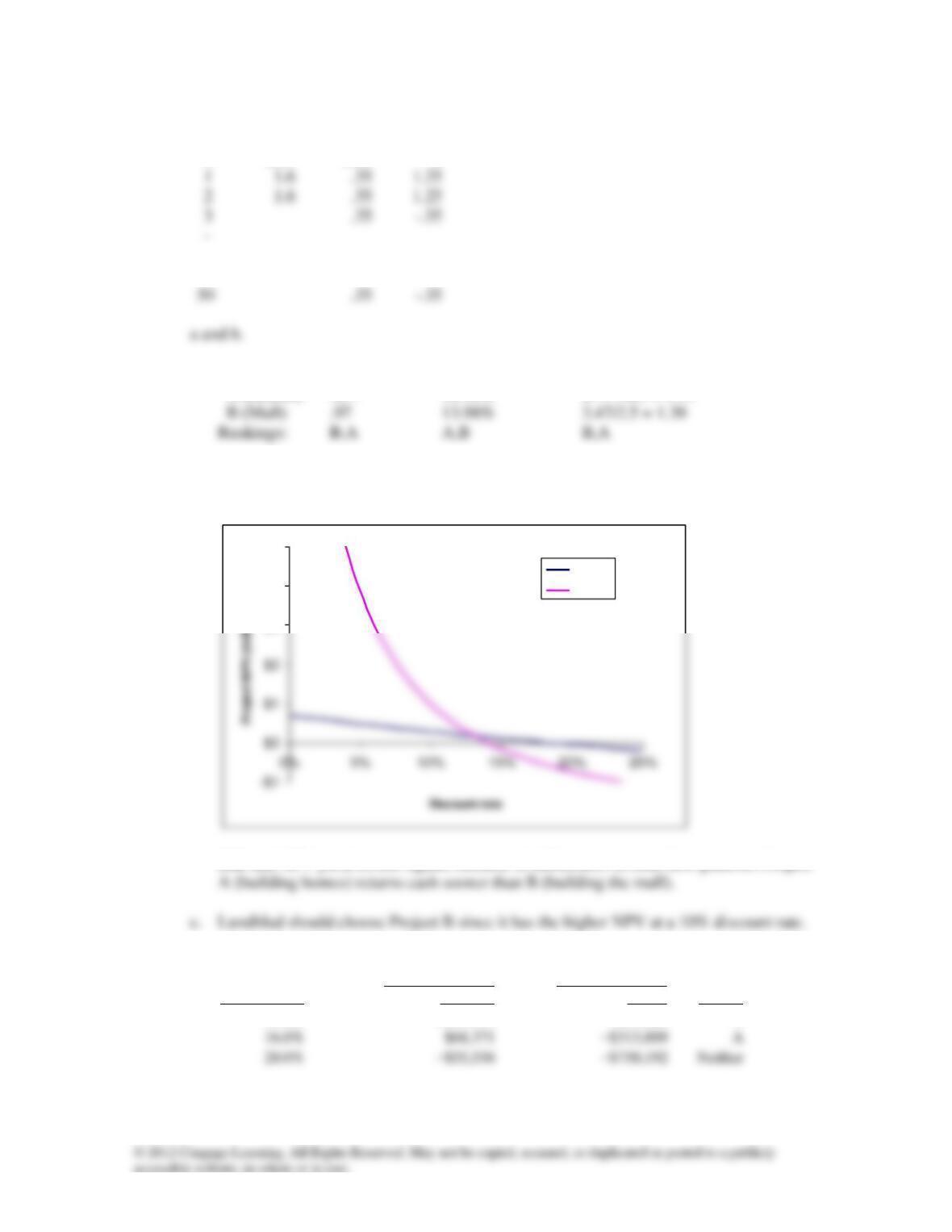
c. Rank these projects based on their PIs. Do these rankings agree with those based on
NPV or IRR?
Chapter 8 Capital Budgeting Process and Decision Criteria 229
A8-23. Year A B A-B
0 -$2.5 -$2.5 0
–
–
Project NPV IRR PI
A (Homes) .277 18.16% 2.777/2.5 = 1.11
c. The PI rankings agree with the NPV rankings, but not with the IRR rankings.
d.
$3
$4
$5
Homes
Mall
IRR and NPV yield mixed signals because of differences in cash flow patterns. Project
f.
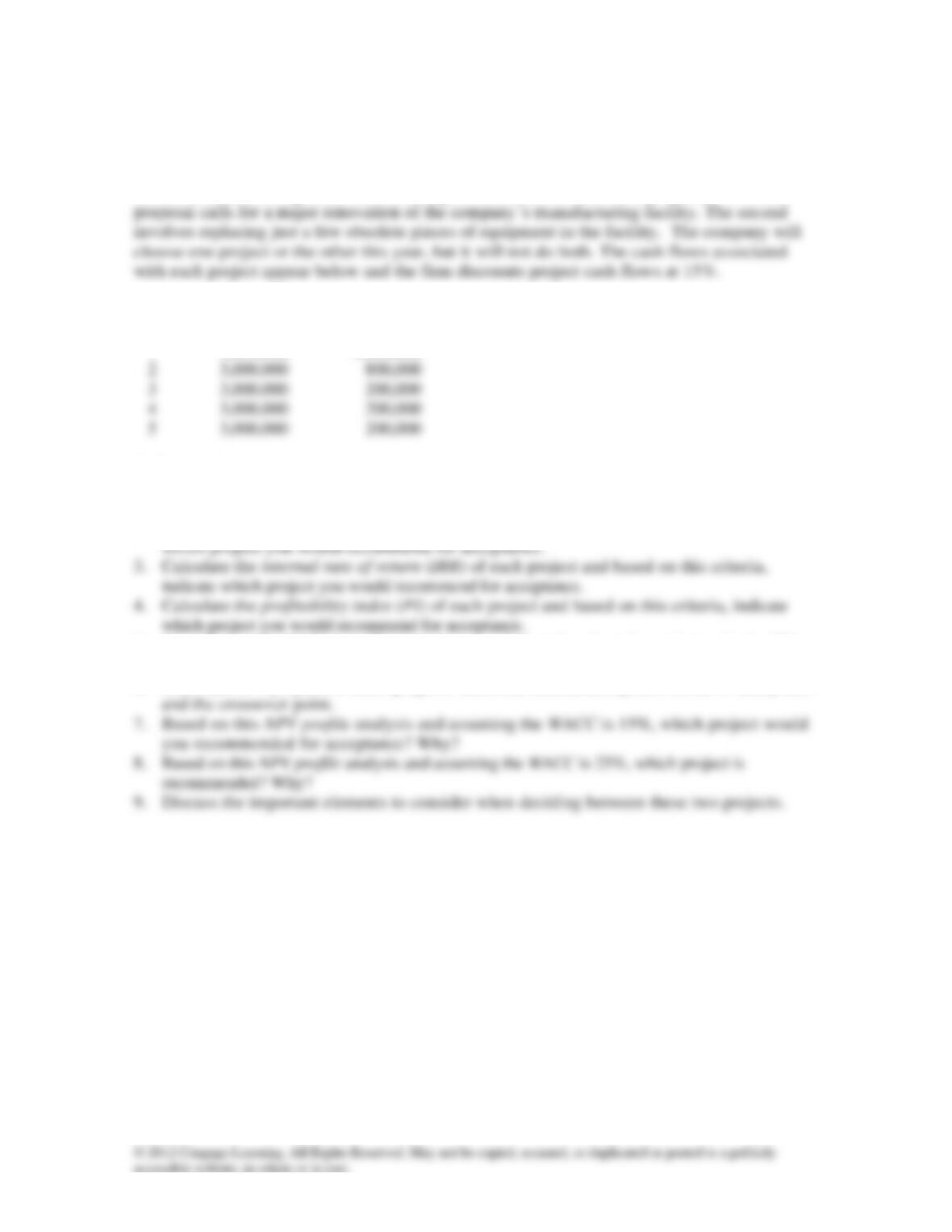
Discount rate
NPV of Project A
(Homes)
NPV of Project B
(Mall)
Choice
13.5%
$151,711
$87,980
A
16.0%
A
20.0%
230 Instructor’s Manual
Answer to MiniCase
Capital Budgeting Process and Techniques
Contact Manufacturing, Inc., is considering two alternative investment proposals. The first
Year Renovate Replace
0 –$9,000,000 –$2,400,000
1 3,000,000 2,000,000
Assignment
1. Calculate the payback period of each project and based on this criteria, indicate which project
you would recommend for acceptance.
2. Calculate the net present value (NPV) of each project and based on this criteria, indicate
5. Overall, you should find conflicting recommendations based on the various criteria. Why
is this occurring?
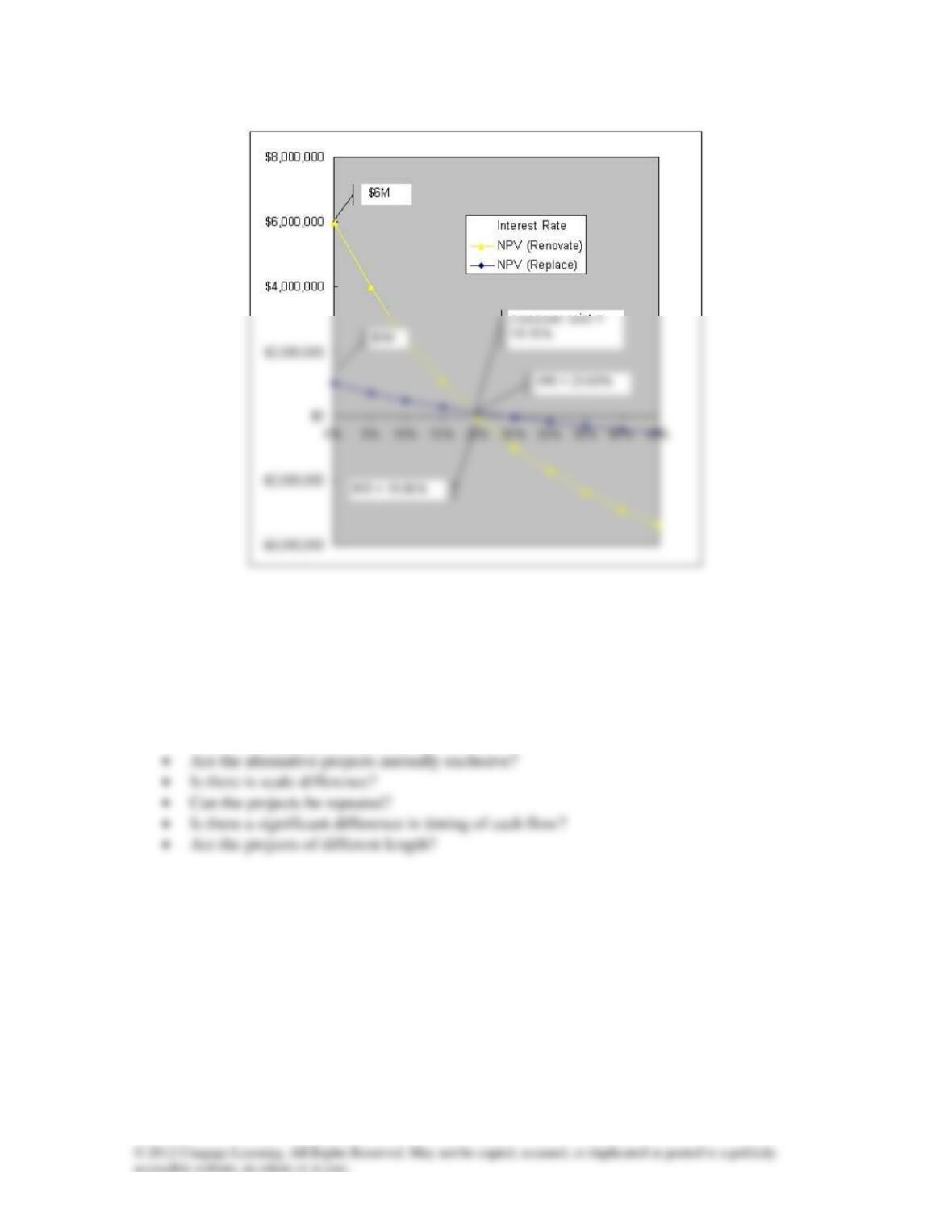
6. Chart the NPV profiles of these projects. Label the intersection points on the x– and y-axis
Chapter 8 Capital Budgeting Process and Decision Criteria 231
Answers
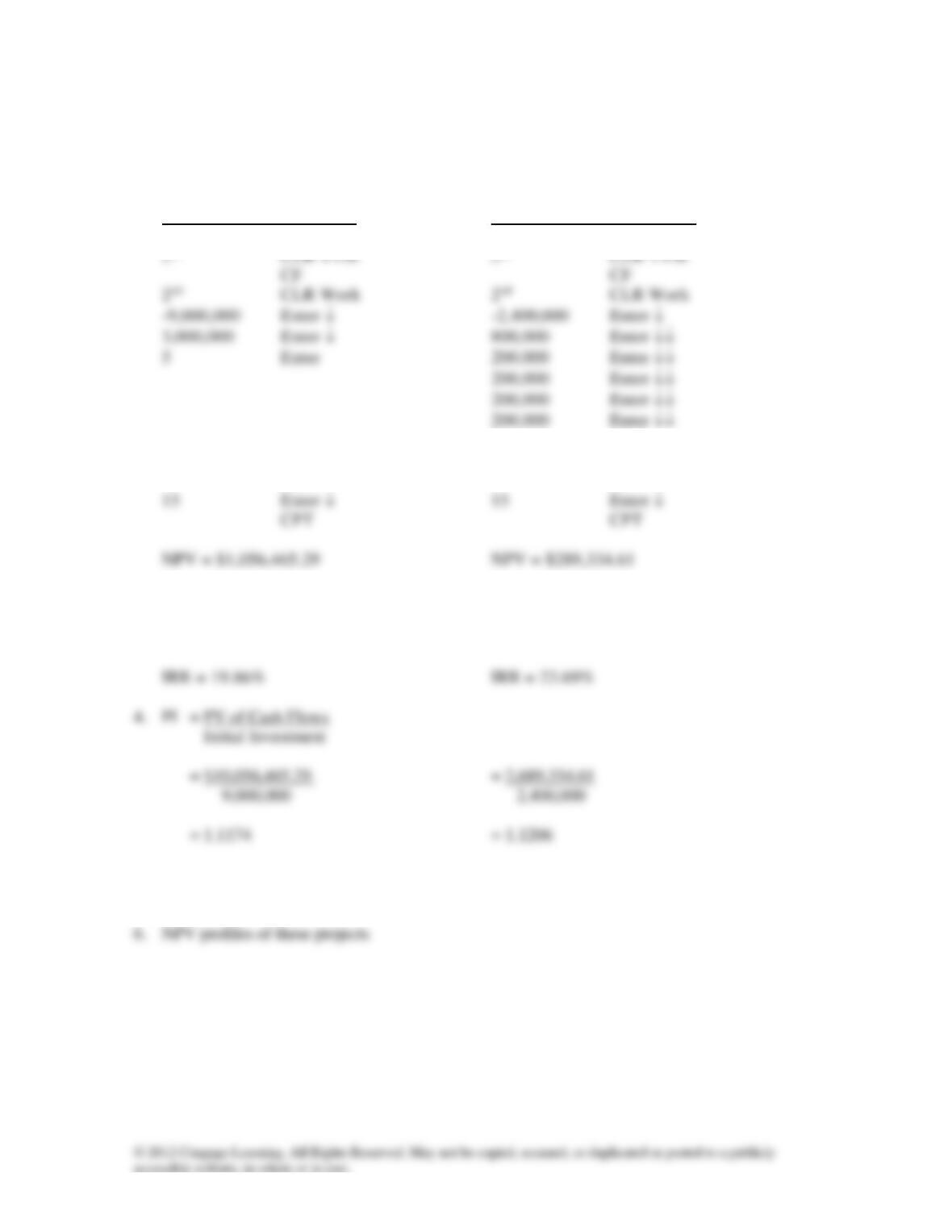
1. Renovate project: Payback = 3 years
Replace project: Payback = 1 + (400,000/800,000) = 1.5 years
Renovation Project Replace Project .
Input Function Input Function
2. Input Function Input Function
NPV NPV
3. Input Function Input Function
IRR IRR
CPT CPT
5. Conflict occurs primarily because of the difference in the size of the initial investment (scale
difference).
232 Instructor’s Manual
7. Based on the NPV profiles, you would choose to renovate since the NPV is greater at a
discount rate of 15%.
8. Based on the NPV profiles, you would choose to replace since the NPV is greater at a discount
rate of 25%.
9. The following things should be considered when evaluating projects.
• What is the appropriate discount rate?