5Chapter 8 CFIN6
Chapter 8 Solutions
8-1 a.
r
ˆ
= (0.2)(19%) + (0.7)(9%) + (0.1)(4%) = 10.5%
8-2 a.
r
ˆ
= (0.45)(32%) + (0.35)(-4%) + (0.2)(–20%) = 9.0%
8-3 a.
A
ˆ
r
= (0.3)(30%) + (0.2)(10%) + (0.5)(-2%) = 10%
B
ˆ
r
= (0.3)(5%) + (0.2)(15%) + (0.5)(25%) = 17%
b.
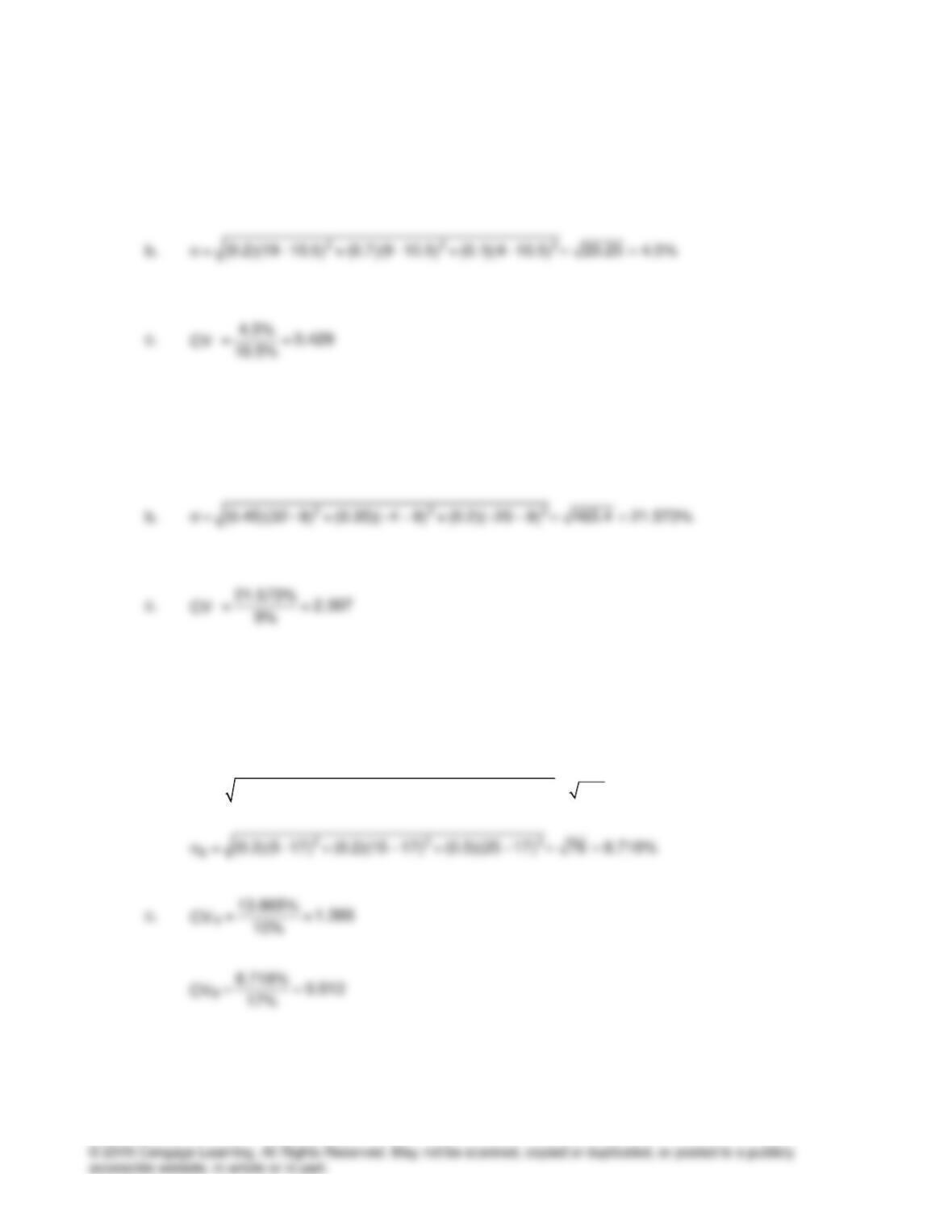
2 2 2
A = (0.3)(30 –10 + (0.2)(10 10 + (0.5)( 2 10 192 13.856%
) ) )
− − − = =
Chapter 8 CFIN6
8-4 To answer the question, the coefficient of variation for each investment must be computed.
Investment
ˆ
r
CV
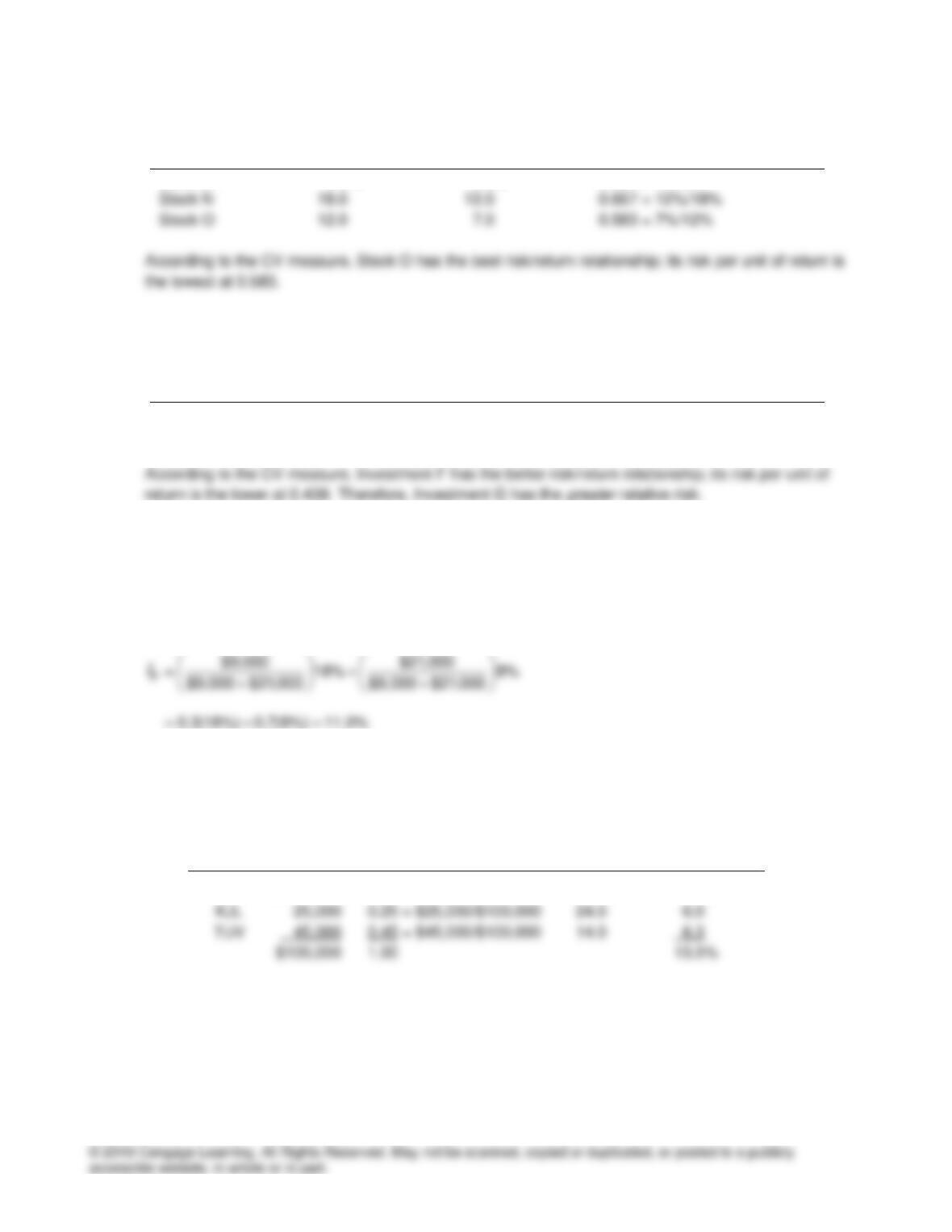
Stock M 6.0% 4.0% 0.667 = 4%/6%
8-5 To answer the question, the coefficient of variation for each investment must be computed.
Investment
ˆ
r
CV
F 16.0% 7.0% 0.438 = 7%/16%
G 27.0 13.0 0.481 = 13%/27%
8-6 $9,000 invested in one stock with an 18 percent expected return
$21,000 invested in a second stock with an 8 percent expected return
8-7 Portfolio return:
Amount Weight Return Portfolio Return
Investment (1) (2) (3) (4) = (2) x (3)
DEF $ 30,000 0.30 = $30,000/$100,000 4.0% 1.2%
Chapter 8 CFIN6
8-8 Portfolio beta:
Investment Weight Beta Portfolio beta
(1) (2) (3) (4) = (2) x (3)
$ 350,000 0.35 = $350,000/$1,000,000 1.0 0.35
250,000 0.25 = $250,000/$1,000,000 0.2 0.05
rj = rRF + (rM – rRF)βj
Investment Beta = 3% + (9% – 3%)βj Weight rP
(1) (2) (3) (4) (5) = (3) x (4)
$ 350,000 1.0 9.0% 0.35 3.15%
8-9 a.
ABC
ˆ
r
= (0.1)(22%) + (0.6)(12%) + (0.3)(2%) = 10.0%
RST
ˆ
r
= (0.1)(-2%) + (0.6)(12%) + (0.3)(30%) = 16.0%
c. Compute the expected return of the portfolio
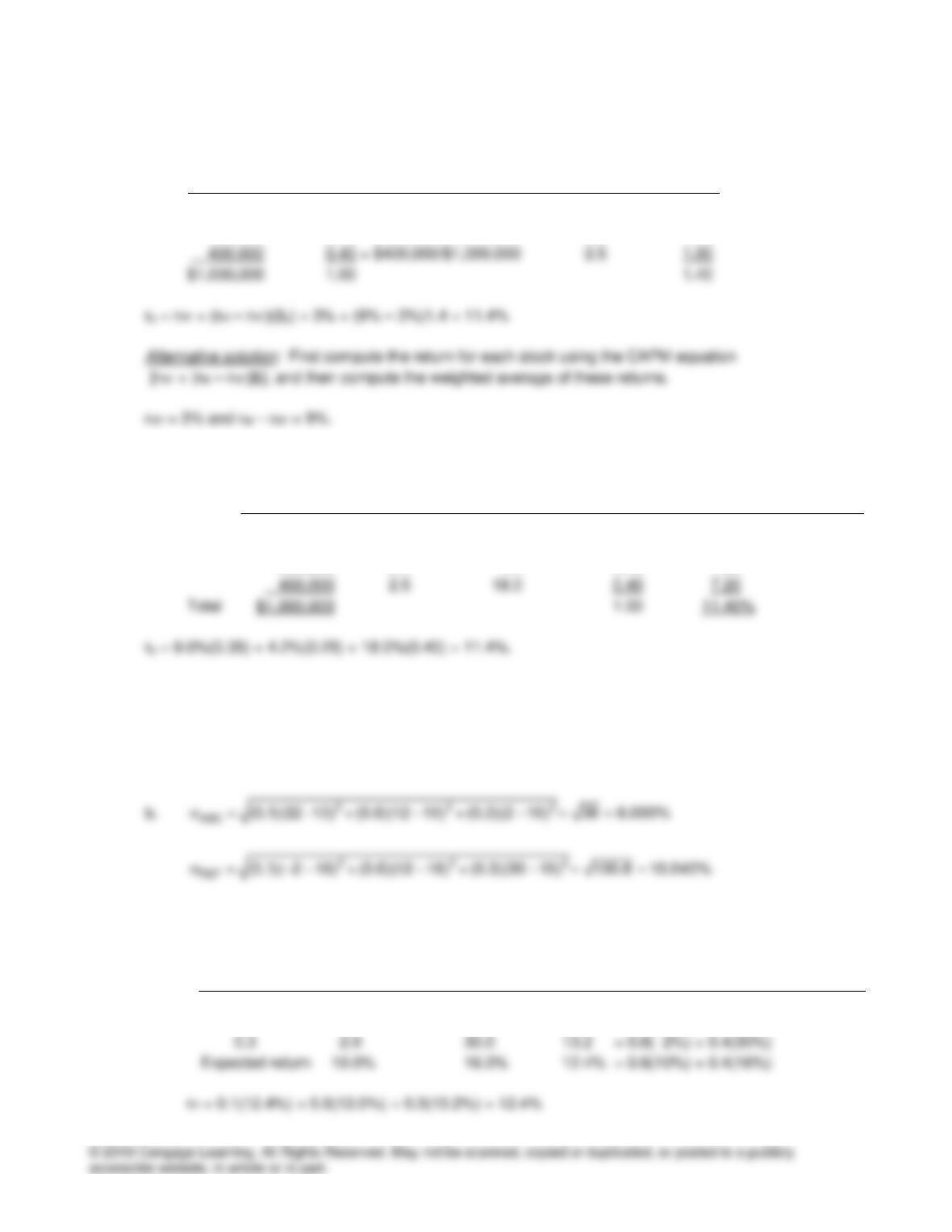
Probability rABC rRST Portfolio Return: 60% ABC; 40% RST
0.1 22.0% –2.0% 12.4% = 0.6(22%) + 0.4(–2%)
0.6 12.0 12.0 12.0 = 0.6(12%) + 0.4(12%)
Chapter 8 CFIN6
2 2 2
P = (0.1)(12.4 –12.4 + (0.6)(12 12.4 + (0.3)(13.2 12.4 0.288 0.537%
) ) )
− − = =
8-10 Total investment = $60,000
ws = 0.40
wX = 0.60
βs = 1.5
βP = 2.1
8-11
new $40,000 $10,000
1.2 2.2 1.2(0.8) 2.2(0.2) 1.4
$40,000 $10,000 $40,000 $10,000
= + = + =
++
8-12 Information that is given:
Total current value $120,000
Number of stocks (current portfolio) 4
Beta coefficient, βCurrent 0.8
Chapter 8 CFIN6
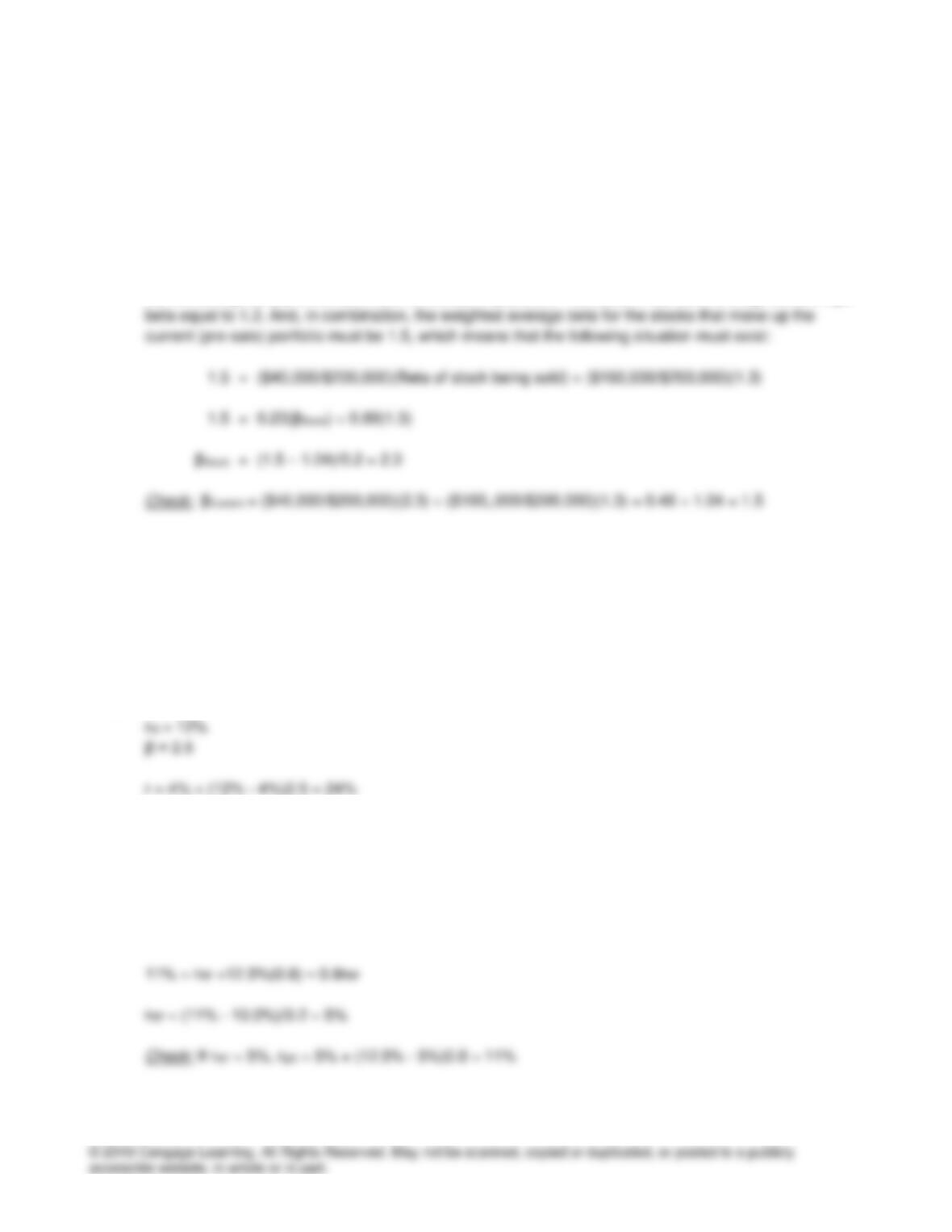
8-13 Information that is given:
Total current value $200,000
Number of stocks (current portfolio) 6
Beta coefficient, βCurrent 1.5
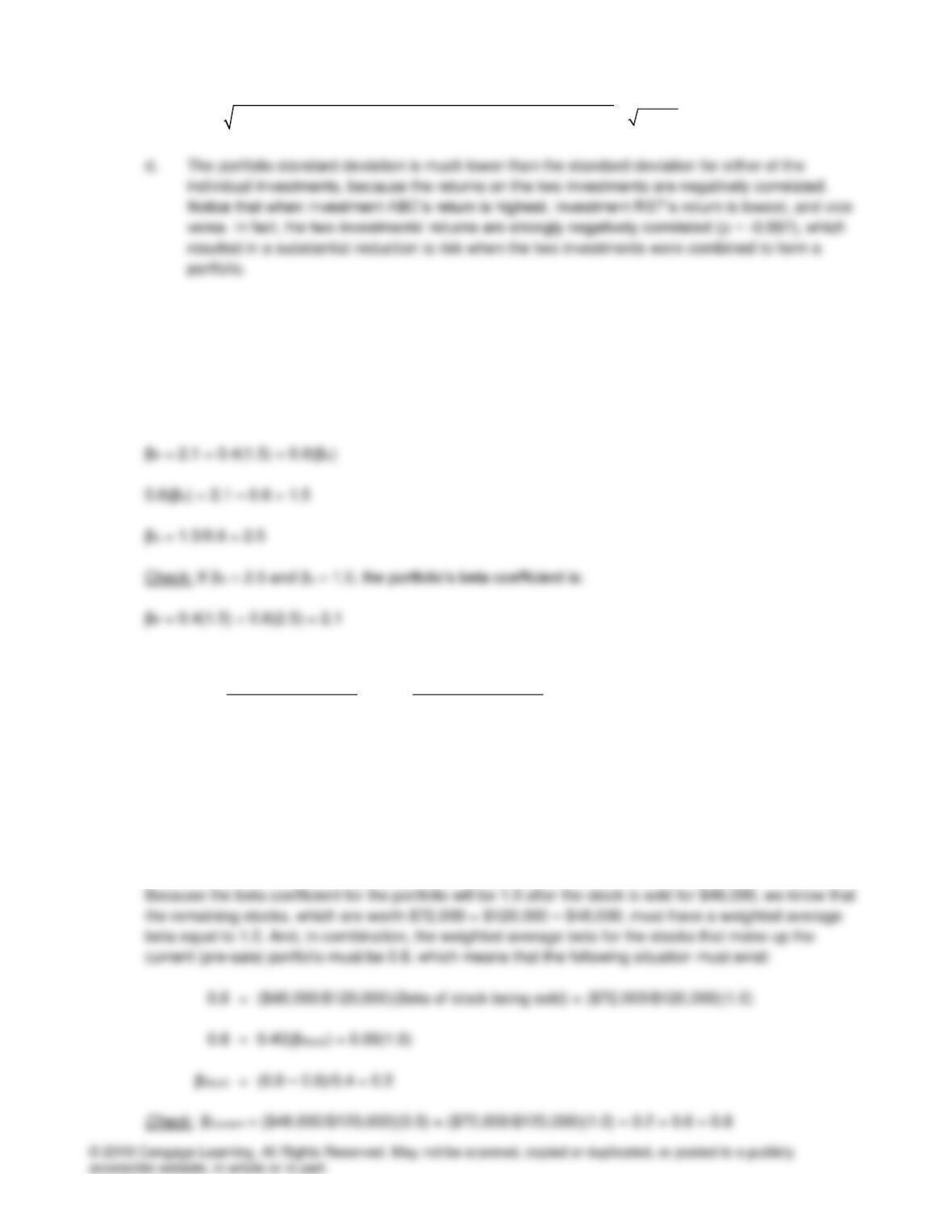
Because the beta coefficient for the portfolio will be 1.3 after the stock is sold for $40,000, we know that
the remaining stocks, which are worth $160,000 = $200,000 – $40,000, must have a weighted average
8-14 rRF = 3%
RRM = 6%
β = 1.5
r = 3% + (6%)1.5 = 12%
8-15 rRF = 4%
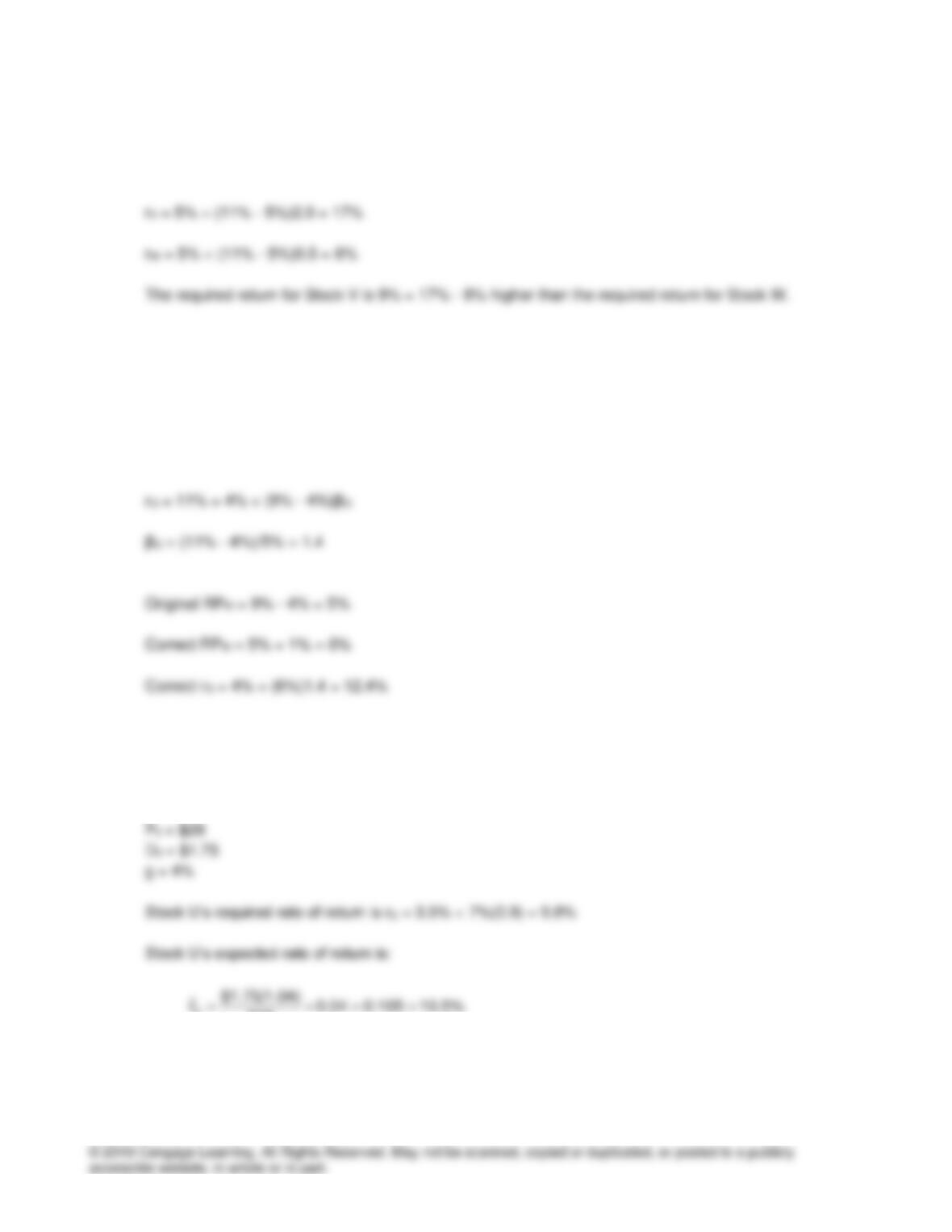
8-16 rRF = ?
rM = 12.5%
β = 0.8
rZR = 11%
11% = rRF + (12.5% – rRF)0.8
Chapter 8 CFIN6
8-17 rRF = 5%
rM = 11%
βV = 2.0
βW = 0.5
8-18 Original information:
rQ = 11%
rRF = 4%
rM = 9%
Based on this information, we can compute the stock’s beta coefficient:
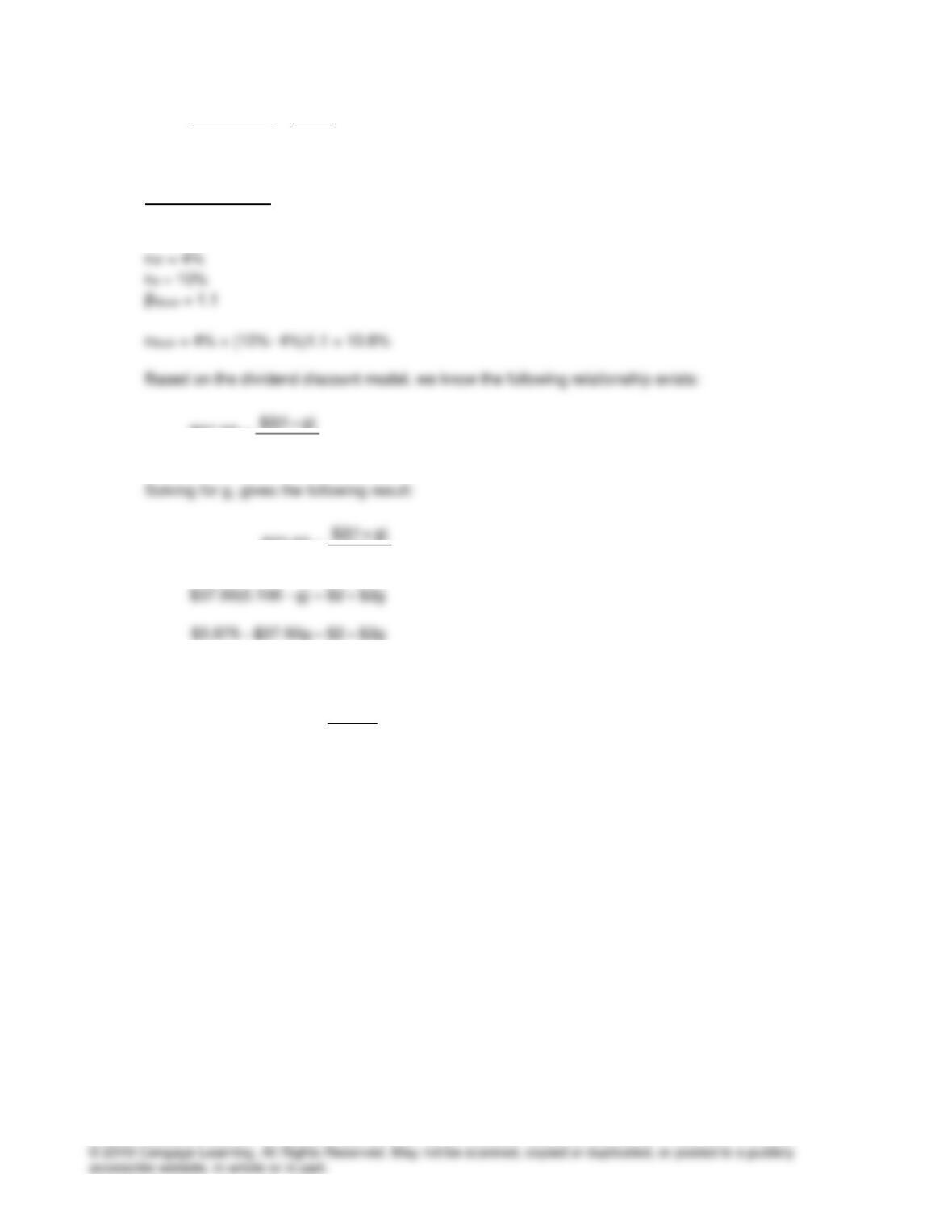
8-19 Given information:
rRF = 3.5%
RPM = 7%
βU = 0.9
U$1.75(1.04)
$28
In this case, the expected rate of return,
U
ˆ
r
, is greater than the required rate of return, rU, which means
the $28 selling price is too low. Investors should want to buy the stock, which will increase the price of
the stock to its equilibrium value of $31.38:
Chapter 8 CFIN6
0$1.75(1.04) $1.82
ˆ
P $31.38
0.098 0.04 0.058
= = =
−
8-20 Given information:
P0 = $37.50
D0 = $2
$37.50 0.106 g
=−
=−
=
= = =
$37.50 0.106 g
$39.50g $1.975
$1.975
g 0.05 5.0%
$39.50