11/21/2018
SITUATION
LOOKING AT EXERCISE AND MARKET VALUE OF AN OPTION
Strike) price = $25
Price of Strike Exercise
the stock Price Value
$0 $20.00 $0.00
$5 $20.00 $0.00
$10 $20.00 $0.00
$15 $20.00 $0.00
$20 $20.00 $0.00
$25 $20.00 $5.00
$25
Chapter 8. Mini Case for Financial Options and Applications in Corporate Finance
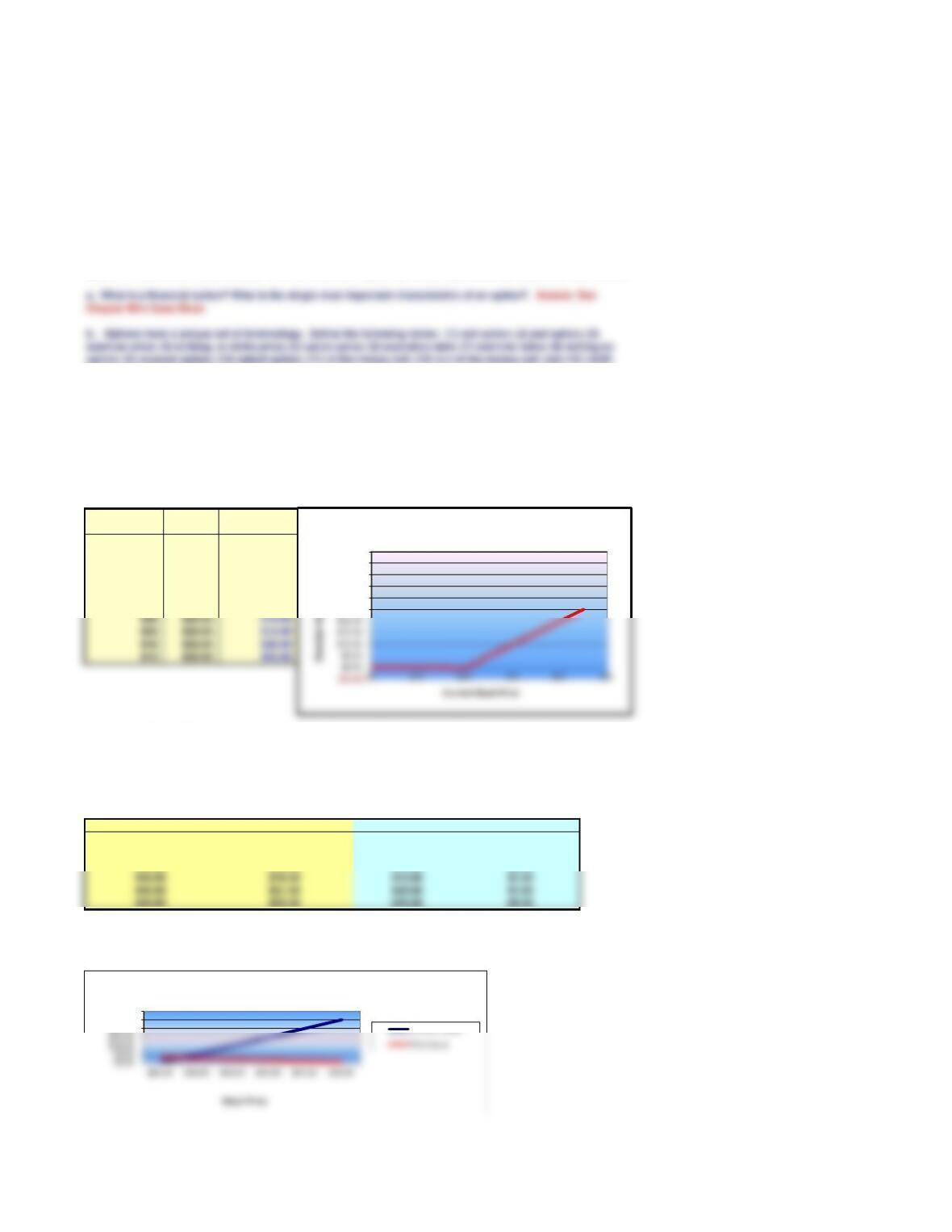
(2.) What happens to the option’s time value (the difference between the option price and its exercise value) as the
stock price rises? The time value falls as the stock price increases; see the graph below. Why? Answer: See
Chapter Mini Case Show
$1.00
$12.00
$16.50
$21.00
$35.00
$40.00
$45.00
$2.00
$1.50
$3.00
To begin, you gathered some outside materials on the subject and used these materials to draft a list of pertinent
questions that need to be answered. In fact, one possible approach to the paper is to use a question-and-answer
Assume that you have just been hired as a financial analyst by Triple Play Inc., a mid-sized California company
that specializes in creating high-fashion clothing. Since no one at Triple Play is familiar with the basics of
financial options, you have been asked to prepare a brief report that the firm’s executives could use to gain at
least a cursory understanding of the topics.
$0.00
$3.00
$7.50
(1.) What are the corresponding exercise values and option time values?
Exercise Values
Option Time Values
Strike Price=
a. What is a financial option? What is the single most important characteristic of an option? Answer: See
Chapter Mini Case Show
Answer: See Chapter Mini Case Show
c. Consider Triple Play’s call option with a $25 strike price. The following table contains historical values for this
option at different stock prices:
Suppose a stock has the strike price shown below. The Exercise Value is the profit if you choose to exercise the
stock. If the current price of the stock is greater than the strike price, then the Exercise Value is the current stock
price minus the strike price; otherwise, it is zero (you would never exercise the option if the stock price is less
than the strike price.)
Stock Price
Option Price
$25.00
$30.00
$5.00
$2.50
$25.00
$30.00
$35.00
$40.00
$45.00
$50.00
Exercise Value vs. Stock Price
$25.00
$30.00
Exercise Values and Option Time Values vs. Stock Price
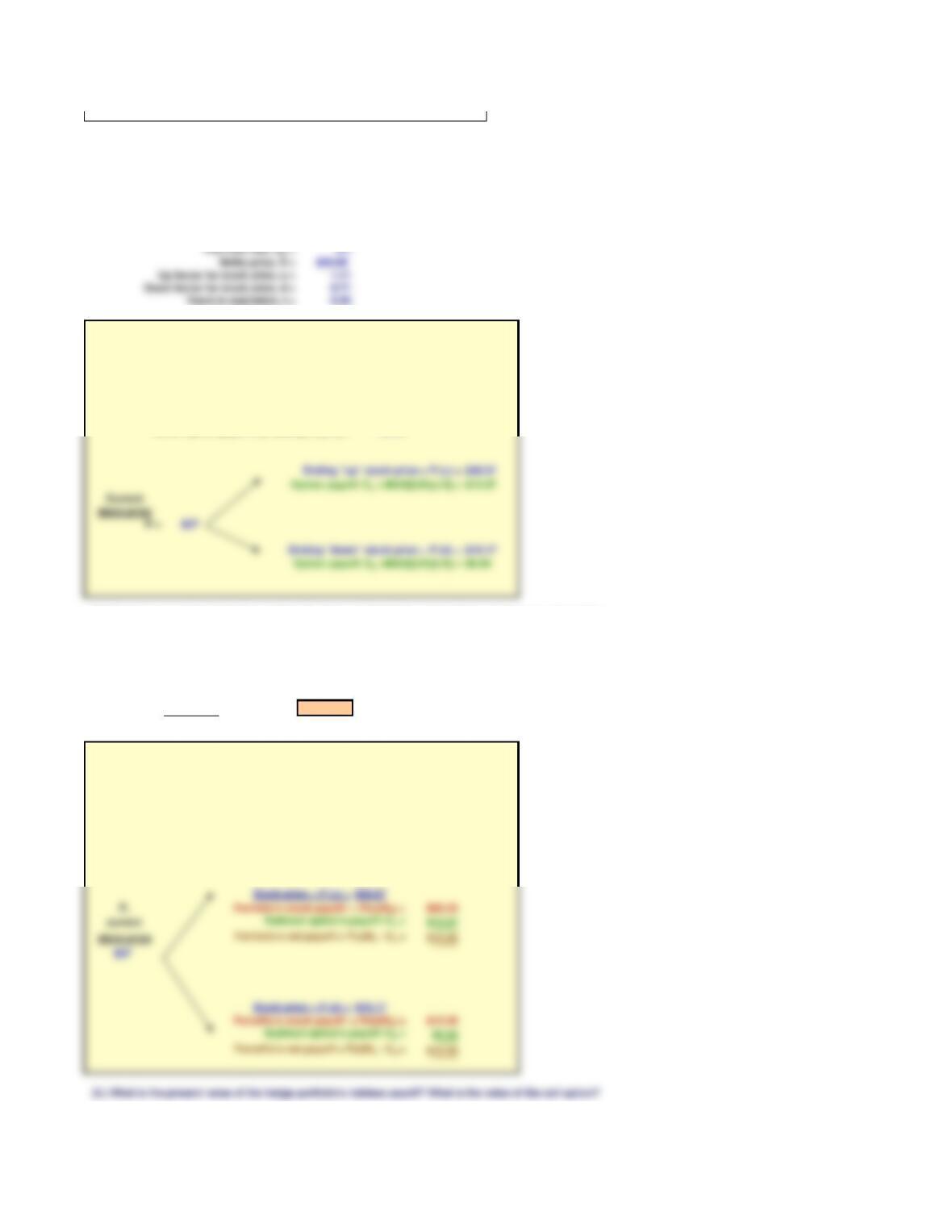
Current stock price, P = $27.00
Binomial Payoffs
Strike price: X = $25.00
Current stock price: P = $27.00
Up factor for stock price: u = 1.41
Down factor for stock price: d = 0.71
Up option payoff: Cu = MAX[0,P(u)-X] = $13.07
Down option payoff: Cd =MAX[0,P(d)-X] = $0.00
Ns = Cu – Cd=0.69153
P(u – d)
The Hedge Portfolio with Riskless Payoffs
Strike price: X = $25.00
Current stock price: P = $27.00
Up factor for stock price: u = 1.41
Down factor for stock price: d = 0.71
Up option payoff: Cu = MAX[0,P(u)-X] = $13.07
Down option payoff: Cd =MAX[0,P(d)-X] = $0.00
Number of shares of stock in portfolio: Ns = (Cu – Cd) / P(u-d) = 0.69153
We can form a portfolio by writing 1 call option and purchasing Ns shares of stock. We want to choose
Ns such that the payoff of the portfolio if the stock price goes up is the same as if the stock price goes
down. This is a hedge portfolio because it has a riskless payoff.
d. Consider a stock with a current price of P = $27. Suppose that over the next 6 months the stock price will
either go up by a factor of 1.41 or down by a factor of 0.71. Consider a call option on the stock with a strike price
of $25 which expires in 6 months. The risk-free rate is 6%.
(1.) Using the binomial model, what are the ending values of the stock price? What are the payoffs of the call
option?
(2.) Suppose you write 1 call option and buy Ns shares of stock. How many shares must you buy to create a
portfolio with a riskless payoff (which is called a hedge portfolio)? What is the payoff of the portfolio?