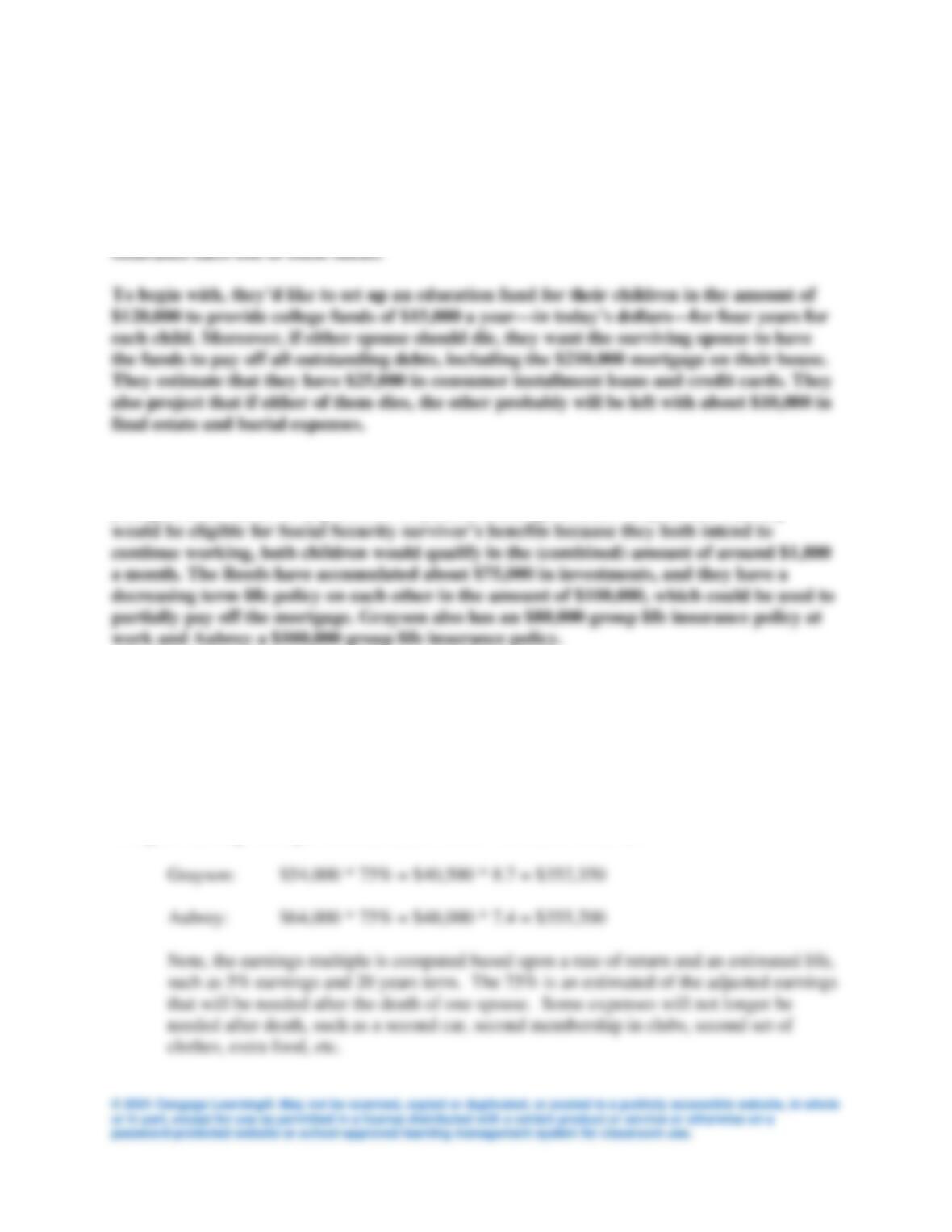
8.2 The Reeds Want to Know: How Much Is Enough?
Grayson and Aubrey Reed are a two-income couple in their early 30s. They have two
children, ages 6 and 3. Grayson’s monthly take–home pay is $3,600, and Aubrey’s is $4,200.
The Reeds feel that, because they’re a two-income family, they both should have adequate
life insurance coverage. Accordingly, they are now trying to decide how much life
Regarding their annual income needs, Grayson and Aubrey both feel strongly that each
should have enough insurance to replace her or his respective current income level until the
youngest child turns 18 (a period of 15 years). Although neither Grayson nor Aubrey
Critical Thinking Questions
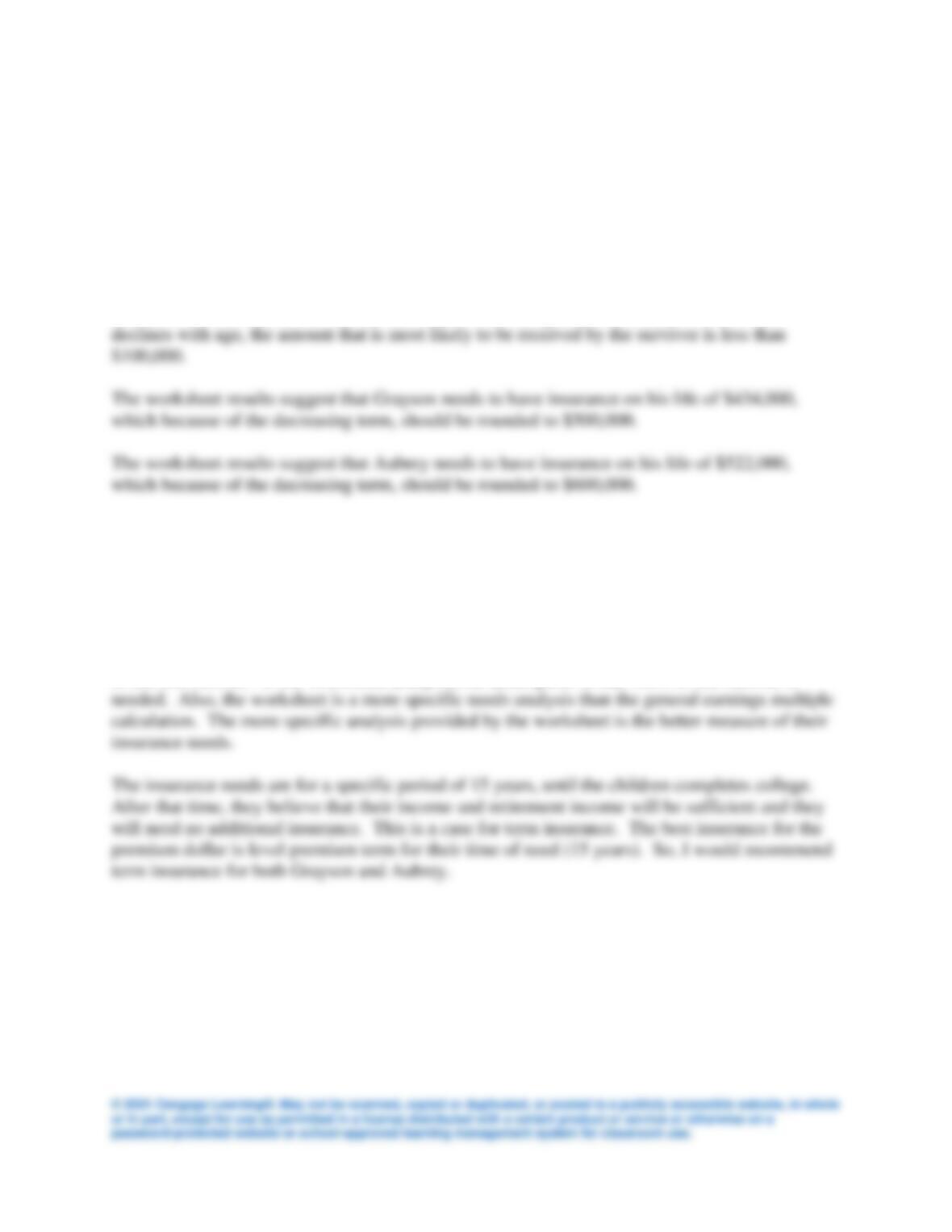
1. Assume that Grayson’s gross annual income is $54,000 and Aubrey’s is $64,000. Their
insurance agent has given them a multiple earnings table showing that the earnings
multiple to replace 75 percent of their lost earnings is 8.7 for Grayson and 7.4 for Aubrey.
Use this approach to find the amount of life insurance each should have if they want to
replace 75 percent of their lost earnings.
Using the earnings multiple calculation, the Reeds’ insurance needs are:
2. Use Worksheet 8.1 to find the additional insurance needed on both Grayson’s and
Aubrey’s lives. (Because Grayson and Aubrey hold secure, well-paying jobs, both agree
that they won’t need any additional help once the kids are grown; both also agree that
they’ll have plenty of income from Social Security and company pension benefits to take
care of themselves in retirement. Thus, when preparing the worksheet, assume “funding
needs” of zero in Periods 2 and 3.)
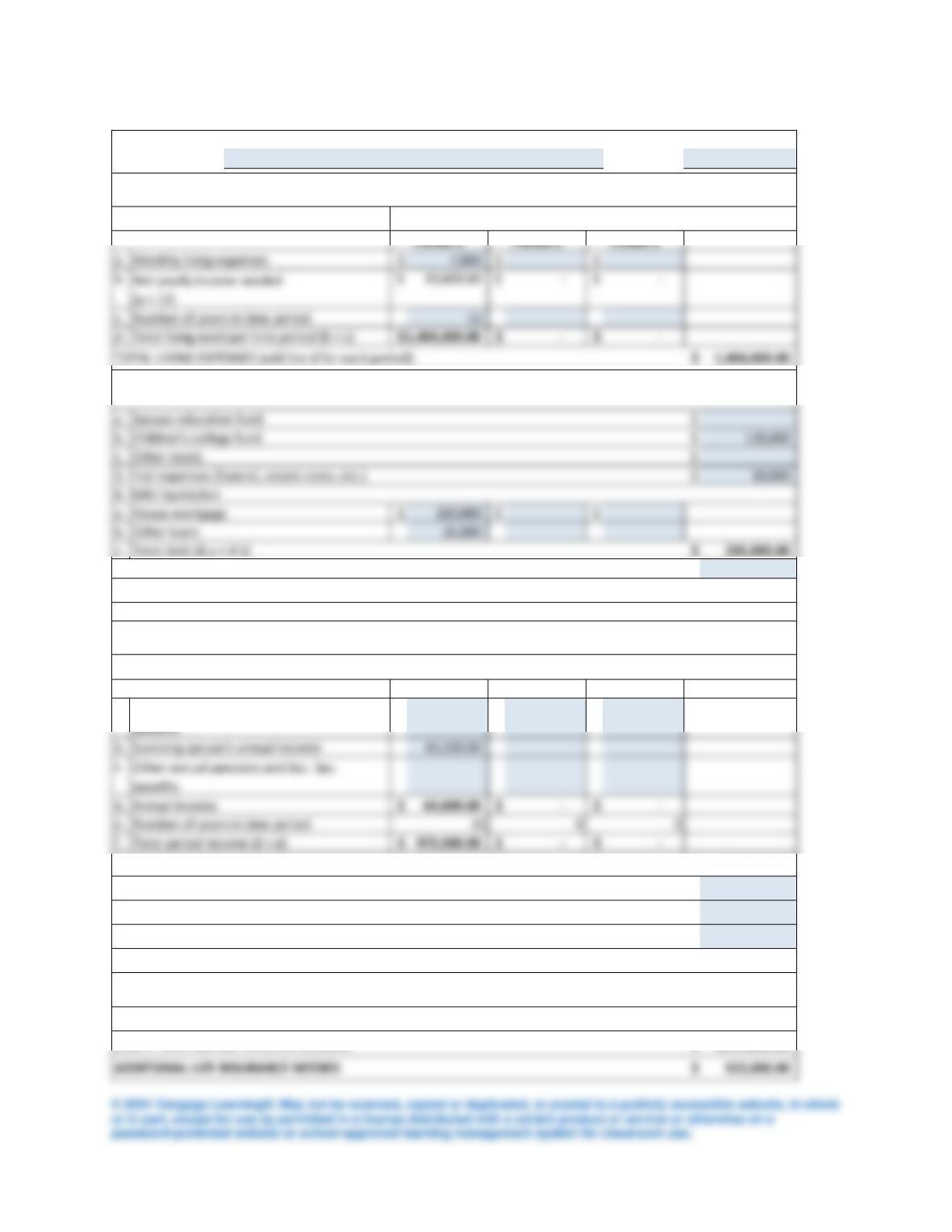
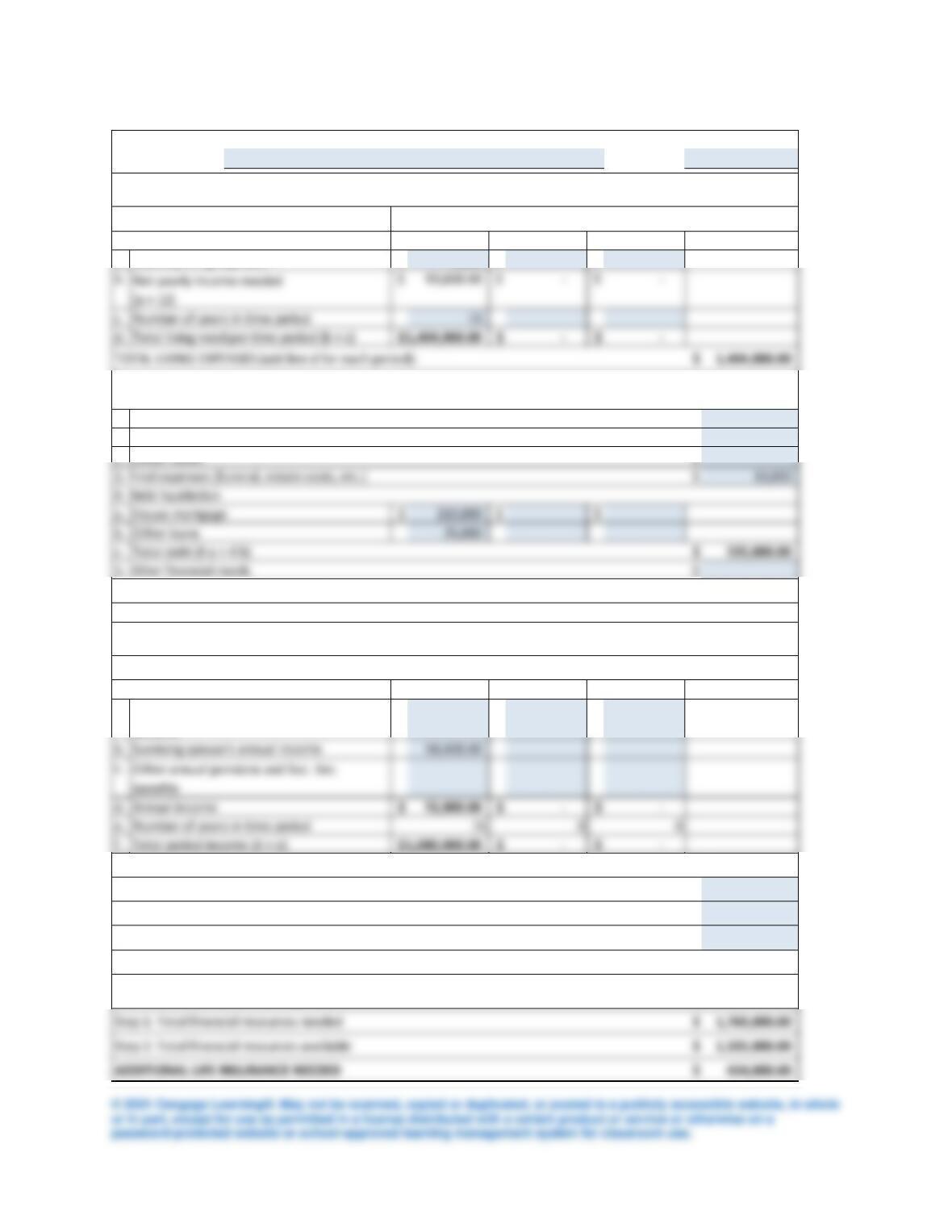
The worksheets are below. One assumption is that the decreasing term that they each have pays
$100,000 at the death of the insured. Since it is decreasing term, the amount of insurance
3. Is there a difference in your answers to Questions 1 and 2? If so, why? Which number do
you think is more indicative of the Jennings’ life insurance needs? Using the amounts
computed in Question 2 (employing the needs approach), what kind of life insurance policy
would you recommend for Grayson? For Aubrey? Briefly explain your answers.
One difference is that the earnings multiple calculation [question 1] is designed to replace 75%
of the lost income. In the Worksheet analysis, the assumption is that 100% of the income is
Worksheet 8.1
Date
Period 3
Period 1
Period 2
Number of years in time period
Monthly living expenses
TOTAL LIVING EXPENSES (add line d for each period):
1,404,000.00$
Spouse education fund
Children’s college fund
Other needs
3. Final expenses (funeral, estate costs, etc.)
House mortgage
Other loans
Total debt (4 a + 4 b)
$
a. $ 21,600.00 $
Surviving spouse’s annual income
Total period income (d × e)
2. $ 75,000.00
3. $ 100,000.00
4. $ 100,000.00
Period 1
Period 2
Period 3
LIFE INSURANCE NEEDS ANALYSIS METHOD
Insured’s Name
Step 1: Financial resources needed after death
1. Annual living expenses and other needs:
10-Dec
Aubrey Reed
2. Special needs
5. Other financial needs
Step 2: Financial resources available after death
1. Income
TOTAL FINANCIAL RESOURCES NEEDED (add right column)
1,769,000.00$
Annual Social Security survivor’s
Step 1: Total financial resources needed
g. TOTAL INCOME
Savings and investments
Other life insurance
Other resources
Step 3: Additional Life Insurance needed
1,247,000.00$
1,769,000.00$
972,000.00$
TOTAL FINANCIAL RESOURCES AVAILABLE (1g + 2 + 3 + 4)
Step 2: Total financial resources available
1,247,000.00$
Worksheet 8.1
Date
Number of years in time period
Monthly living expenses
Total living need per time period (b × c)
TOTAL LIVING EXPENSES (add line d for each period):
1,404,000.00$
a. $
b. $ 120,000
Other needs
3. Final expenses (funeral, estate costs, etc.)
House mortgage
Other loans
5. Other financial needs
a. $ 21,600.00 $
Surviving spouse’s annual income
Total period income (d × e)
2. $ 75,000.00
3. $ 100,000.00
4. $ 80,000.00
Period 1
Period 2
Period 3
Period 3
LIFE INSURANCE NEEDS ANALYSIS METHOD
Insured’s Name
Step 1: Financial resources needed after death
1. Annual living expenses and other needs:
10-Dec
Grayson Reed
Period 1
Period 2
2. Special needs
Spouse education fund
Children’s college fund
Step 2: Financial resources available after death
1. Income
TOTAL FINANCIAL RESOURCES NEEDED (add right column)
1,769,000.00$
Annual Social Security survivor’s
Step 1: Total financial resources needed
Step 2: Total financial resources available
1,769,000.00$
1,335,000.00$
g. TOTAL INCOME
Savings and investments
Other life insurance
Other resources
Step 3: Additional Life Insurance needed
1,335,000.00$
1,080,000.00$
TOTAL FINANCIAL RESOURCES AVAILABLE (1g + 2 + 3 + 4)
Test Yourself Questions
8-1 Discuss the role that insurance plays in the financial planning process. Why is it
important to have enough life insurance?
Insurance is intended to protect you and your family from the financial consequences of losing
8-2 Define (a) risk avoidance, (b) loss prevention, (c) loss control, (d) risk assumption, and (e)
an insurance policy. Explain their interrelationships.
a. risk avoidance — Avoiding an act that would create a risk. Risk avoidance is an attractive
way to deal with risk only when the estimated cost of avoidance is less than the estimated cost of
handling it in some other way, like insuring it.
b. loss prevention — Any activity that reduces the probability that a loss will occur.
8-3 Explain the purpose of underwriting. What are some factors that underwriters consider
when evaluating a life insurance application?
Underwriting — The process used by insurers to decide who can be insured and to determine
applicable rates that will be charged for premiums. Insurers are always trying to improve their
they the statistically analyze to determine the appropriate premiums.
8-4 Discuss some benefits of life insurance in addition to protecting family members
financially after the primary wage earner’s death.
The major benefits are financial protection for dependents, protection from creditors [with proper
8-5 Explain the circumstances under which a single college graduate would or would not
need life insurance. What life-cycle events would change this initial evaluation, and how
might they affect the graduate’s life insurance needs?
Life insurance should be considered if you have dependents counting on you for financial
8-6 Discuss the two most commonly used ways to determine a person’s life insurance needs.
You can use one of two methods to estimate how much insurance is necessary: the multiple-of-
earnings method and the needs analysis method. The multiple-of-earnings method takes your
gross annual earnings and multiplies it by some selected (often arbitrary) number to arrive at an
8-7 Name and explain the most common financial resources needed after the death of a
family breadwinner.
From Exhibit 8.1: Total economic needs include:
• Income needed to maintain an adequate lifestyle
• Extra expenses if the income producer dies: Included here would be the end of life
8-8 What are some factors that underwriters consider when evaluating a life insurance
application? Which, if any, apply to you or your family members?
Life insurance underwriting begins by asking potential insureds to complete an application
8-9 What is term life insurance? Describe some common types of term life insurance
policies.
Term life insurance is the simplest type of insurance policy. You purchase a specified amount
of insurance protection for a set period. If you die during that time, your beneficiaries will
receive the full amount specified in your policy. Types of term life insurance policies include:
8-10 What are the advantages and disadvantages of term life insurance?
Advantages are the cost and options like renewability and convertibility.
Disadvantages include the requirement that you are insurable when the policy expires which is
8-11 Explain how whole life insurance offers financial protection to an individual
throughout his or her life.
In addition to death protection, whole life insurance has a savings feature (called cash value) that
8-12 Explain how the “paid–up insurance” component of a whole life insurance policy
works.
Paid-up insurance is a single premium whole life policy that is purchased with one cash premium
payment at the inception of the contract, thus buying life insurance coverage for the rest of your
8-13 Describe the different types of whole life policies. What are the advantages and
disadvantages of whole life insurance?
Three major types of whole life policies are available: continuous premium, limited payment,
and single premium.
Under a continuous premium whole life policy—or straight life, as it’s more commonly called—
individuals pay a level premium each year until they either die or exercise a nonforfeiture right.
8-14 What is universal life insurance? Explain how it differs from whole life and variable
life insurance.
Universal life insurance is another form of permanent cash-value insurance that combines term
insurance, which provides death benefits, with a tax-sheltered savings/investment account that
8-15 Explain how group life insurance differs from standard term life insurance. What do
employees stand to gain from group life?
Under group life insurance, one master policy is issued, and each eligible group member
8-16 Why should the following types of life insurance contracts be avoided? (a) credit life
insurance, (b) mortgage life insurance, (c) industrial life insurance (home service life
insurance).
8-17 Briefly describe the steps to take when you shop for and buy life insurance.
Several factors should be considered when making the final purchase decision:
(1) comparing the costs and features of competitive products, [Exhibit 8.8 gives major
advantages and disadvantages of the most popular types of life insurance. Exhibit 8.9 lists the
key feature of the various types of life insurance.]
8-18 Briefly describe the insurance company ratings assigned by A. M. Best, Moody’s,
Fitch, and Standard & Poor’s. Why is it important to know how a company is rated? What
ratings would you look for when selecting a life insurance company? Explain.
These agencies use publicly available financial data from insurance companies to analyze their
debt structure, pricing practices, and management strategies in an effort to assess their financial
8-19 What characteristics would be most important to you when choosing an insurance
agent?
Competent, as indicated by the agent’s education and certifications. Also, you want an agent who
8-20 What is a beneficiary? A contingent beneficiary? Explain why it’s essential to designate
a beneficiary for your policy.
The beneficiary is the person who will receive the death benefits of the policy on the insured’s
8-21 Explain the basic settlement options available for the payment of life insurance
proceeds upon a person’s death.
• Lump sum: This is the most common settlement option, chosen by more than 95 percent of
policyholders. The entire death benefit is paid in a single amount, allowing beneficiaries to use
or invest the proceeds soon after death occurs.
• Fixed period: The face amount of the policy, along with interest earned, is paid to the
beneficiary over a fixed time period. For example, a 55-year-old beneficiary may need additional
income until Social Security benefits start.
8-22 What do nonforfeiture options accomplish? Differentiate between paid-up insurance
and extended term insurance.
A nonforfeiture option gives a cash value life insurance policyholder some benefits even when a
policy is terminated before its maturity. Insurance companies usually offer the two options—
paid-up insurance and extended term insurance.
8-23 Explain the following clauses often found in life insurance policies: (a) multiple
indemnity clause, (b) disability clause, and (c) suicide clause. Give some examples of
common exclusions.
a. Multiple indemnity clause: Multiple indemnity clauses increase the face amount of the
policy, most often doubling or tripling it, if the insured dies in an accident.
8-24 Describe what is meant by a participating policy and explain the role of policy dividends
in these policies.
In a participating policy, the policyholder is entitled to receive policy dividends reflecting the
8-25 Describe the key elements of an insurance policy illustration and explain what a
prospective client should focus on in evaluating an illustration.
A life insurance policy illustration is a hypothetical representation of a policy’s performance
that reflects the most important assumptions that the company relies on when presenting the
policy results to a prospective client. Insurance illustrations are complicated and often contain
more than 20 pages of numbers and legal disclaimers.
Key Terms
beneficiary
A person who receives the death benefits of a life insurance policy
after the insured’s death.
cash value
the investment earnings on paid-in insurance premiums.
convertibility
A term life policy provision allowing the insured to convert the policy
to a comparable whole life policy.
credit life
insurance
Life insurance sold in conjunction with installment loans.
decreasing term
policy
A term insurance policy that maintains a level premium throughout all
disability clause
A clause in a life insurance contract containing a waiver-of-premium
The accumulated refundable value of an insurance policy; results from
guaranteed
purchase option
An option in a life insurance contract giving the policyholder the right
to purchase additional coverage at stipulated intervals without
providing evidence of insurability.
group life
insurance
Life insurance that provides a master policy for a group; each eligible
group member receives a certificate of insurance.
industrial life
insurance (home
service life
insurance)
Whole life insurance issued in policies with relatively small face
amounts, often $1,000 or less.
insurance policy
A contract between the insured and the insurer under which the insurer
agrees to reimburse the insured for any losses suffered according to
life insurance
policy
illustration
A hypothetical representation of a life insurance policy’s performance
that reflects the most important assumptions that the insurance
company relies on when presenting the policy results to a prospective
client.
loss control
Any activity that lessens the severity of loss once it occurs.
loss prevention
Any activity that reduces the probability that a loss will occur.
mortgage life
insurance
A term policy designed to pay off the mortgage balance in the event of
the borrower’s death.
multiple indemnity
A clause in a life insurance policy that typically doubles or triples the
clause
policy’s face amount if the insured dies in an accident.
multiple-of-
earnings
method
A method of determining the amount of life insurance coverage needed
by multiplying gross annual earnings by some selected number.
needs analysis
method
A method of determining the amount of life insurance coverage needed
by considering a person’s financial obligations and available financial
resources in addition to life insurance.
nonforfeiture right
A life insurance feature giving the whole life policyholder, upon policy
cancellation, the portion of those assets that were set aside to provide
premium necessary to fund the actual mortality experience of the
company.
portability
An option to convert a group life insurance policy to an individually
issued life policy.
renewability
A term life policy provision allowing the insured to renew the policy at
the end of its term without having to show evidence of insurability.
risk assumption
The choice to accept and bear the risk of loss.
risk avoidance
Avoiding an act that would create a risk.
Social Security
Benefits under Social Security intended to provide basic, minimum
straight term policy
A term insurance policy written for a given number of years, with
coverage remaining unchanged throughout the effective period.
term life insurance
.
Insurance that provides only death benefits, for a specified period, and
does not provide for the accumulation of cash value
insurance
benefits) with a tax-sheltered savings/ investment account that pays
interest, usually at competitive money market rates.
variable life
insurance
Life insurance in which the benefits are a function of the returns being
generated on the investments selected by the policyholder.
whole life
insurance
Life insurance designed to offer ongoing insurance coverage over the
course of an insured’s entire life.
Chapter Outline
Learning Goals
I. Basic Insurance Concepts
A. The Concept of Risk
1. Risk Avoidance
II. Why Buy Life Insurance?
A. Benefits of Life Insurance
B. Do You Need Life Insurance?
*Test Yourself*
III. How Much Life Insurance is Right for You?
A. Step 1: Assess Your Family’s Total Economic Needs
B. Step 2: Determine What Financial Resources Will Be Available After Death
IV. What Kind of Policy is Right for You?
A. Term Life Insurance
1. Types of Term Insurance
a. Straight Term
B. Whole Life Insurance
1. Types of Whole Life Policies
a. Continuous Premium
2. Advantages and Disadvantages of Whole Life
3. Who Should Buy Whole Life Insurance?
C. Universal Life Insurance
1. Advantages and Disadvantages of Universal Life
V. Buying Life Insurance
A. Compare Costs and Features
B. Select an Insurance Company
VI. Key Features of Life Insurance Policies
A. Life Insurance Contract Features
1. Beneficiary Clause
2. Settlement Options
B. Other Policy Features
C. Understanding Life Insurance Policy Illustrations
*Test Yourself*
Summary
Financial Impact of Personal Choices
Financial Planning Exercises
Critical Thinking Cases