CHAPTER 8: SWAPS AND INTEREST RATE DERIVATIVES
1
CHAPTER 8
SWAPS AND INTEREST RATE DERIVATIVES
This chapter examines several special financing vehicles that MNCs can use to fund their foreign
investments. These vehicles include interest rate and currency swaps, structured notes, interest rate
forward and futures contracts, international leasing, and LDC debt-equity swaps. Each of these vehicles
presents opportunities to the MNC to achieve one or more of the following goals: reduce the cost of
funds, cut taxes, and reduce political and/or foreign exchange risk. These opportunities to create value
arise from various market imperfections, which I discuss.
Interest and currency swaps are financial transactions in which two counterparties agree to
exchange streams of payments over time. In effect, a swap is a package of forward contracts. For swaps
to provide a real economic benefit to both parties, a barrier generally must exist to prevent arbitrage from
functioning fully. This impediment must take the form of legal restrictions on spot and forward foreign
exchange transactions, different perceptions by investors of risk and creditworthiness of the two parties,
appeal or acceptability of one borrower to a certain class of investor, tax differentials, and so forth.
Structured notes are interest-bearing securities whose interest payments are determined by
reference to a formula set in advance and adjusted on specified reset dates. The formula can be tied to a
variety of different factors, such as LIBOR, exchange rates, or commodity prices. Sometimes the
formula includes multiple factors, such as the difference between three-month dollar LIBOR and three-
month Swiss franc LIBOR. The common characteristic is one or more embedded derivative elements,
INSTRUCTORS MANUAL: FOUNDATIONS OF MULTNATIONAL FINANCIAL MANAGEMENT, 6TH ED.
2
A Eurodollar future is a cash-settled futures contract on a three-month, $1,000,000 Eurodollar
deposit that pays LIBOR. Eurodollar futures contracts are traded on various organized exchanges for
March, June, September, and December delivery. Contracts are traded out to three years, with a high
degree of liquidity out to two years. Eurodollar futures act like FRAs in that they help lock in a future
interest rate and are settled in cash. But unlike FRAs, they are marked to market daily (as in currency
futures, this means that gains and losses are settled in cash each day).
Cross-border or international leasing can be used to both defer and avoid tax. It can also be used to
safeguard the assets of an MNC’s foreign affiliates and avoid currency controls.
Under a debt-equity program, a firm buys a country’s dollar debt on the secondary loan market at a
discount and swaps it into local equity. Such swaps create the possibility of cheap financing for
expanding plant and retiring local debt in hard-pressed LDCs.
SUGGESTED ANSWERS TO CHAPTER 8 QUESTIONS
1. What is an interest rate swap? What is the difference between a basis swap and a coupon
swap?
ANSWER. An interest rate swap is an agreement between two parties to exchange interest payments in
2. What is a currency swap?
3. Comment on the following statement. “For one party to a swap to benefit, the other party must
lose.”
4. The Swiss Central Bank bans the use of Swiss francs for Eurobond issues. Explain how
currency swaps can be used to enable foreign borrowers who want to raise Swiss francs
5. Explain how IBM can use a forward rate agreement to lock in the cost of a one-year, $25
million loan to be taken out in six months. Alternatively, explain how IBM can lock in the
interest rate on this loan by using Eurodollar futures contracts. What is the major difference
between using the FRA and the futures contract to hedge IBM’s interest rate risk?
ANSWER. To lock in the rate on a one-year, $25 million loan to be taken out in six months, IBM could
ADDITIONAL CHAPTER 8 QUESTIONS AND ANSWERS
1. What factors underlie the economic benefits of swaps?
2. Comment on the following statement. “During the period 1987-1989, Japanese companies
issued some $115 billion of bonds with warrants attached. Nearly all were issued in dollars.
The dollar bonds usually carried coupons of 4% or less; by the time the Japanese companies
swapped that exposure into yen (whose interest rate was as much as five percentage points
lower than the dollar’s), their cost of capital was zero or negative.”
3. Explain how Cisco Systems can use arbitrage to create a forward forward to fix the interest
rate on a three-month $10 million loan to be taken out in nine months. The loan will be priced
off LIBOR.
4. Why do governments provide subsidized financing for some investments?
SUGGESTED SOLUTIONS TO CHAPTER 8 PROBLEMS
1. Dell Inc. wants to borrow pounds, and Virgin Airlines wants to borrow dollars. Because Dell is
better known in the U.S., it can borrow on its own dollars at 7% and pounds at 9%, whereas
Virgin can borrow dollars at 8% and pounds at 8.5%
1.a. Suppose Dell wants to borrow £10 million for two years, Virgin wants to borrow $16 million
for two years, and the current ($/£) exchange rate is $1.60. What swap transaction would
accomplish this objective? Assume the counterparties would exchange principal and interest
payments with no rate adjustments.
1.b. What savings are realized by Dell and Virgin?
1.c. Suppose, in fact, that Dell can borrow dollars at 7% and pounds at 9% , whereas Virgin can
borrow dollars at 8.75% and pounds at 9.5%. What range of interest rates would make this
swap attractive to both parties?
1.d. Based on the scenario in 1.c, suppose Dell borrows dollars at 7% and Virgin borrows pounds
at 9.5%. If the parties swap their current proceeds, with Dell paying 8.75% to Virgin for
pounds and Virgin paying 7.75% to Dell for dollars, what are the cost savings to each party?
2. In May 1988, Walt Disney Productions sold to Japanese investors a 20-year stream of
projected yen royalties from Tokyo Disneyland. The present value of that stream of royalties,
discounted at 6% (the return required by the Japanese investors), was ¥93 billion. Disney took
the yen proceeds, converted them to dollars, and invested the dollars in bonds yielding 10%.
According to Disney’s CFO, “In effect, we got money at a 6% discount rate, reinvested it at
10%, and hedged our royalty stream against yen fluctuations – all in one transaction.”
2.a. At the time of the sale, the exchange rate was ¥124 = $1. What dollar amount did Disney
realize from the sale of its yen proceeds?
2.b. Demonstrate the equivalence between Disney’s transaction and a currency swap. (Hint:
a diagram would help)
2.c. Did Disney achieve the equivalent of a free lunch through its transaction?
3. Suppose IBM would like to borrow fixed-rate yen, whereas Korea Development Bank (KDB)
would like to borrow floating-rate dollars. IBM can borrow fixed-rate yen at 4.5% or floating-
rate dollars at LIBOR + 0.25%. KDB can borrow fixed-rate yen at 4.9% or floating-rate
dollars at LIBOR + 0.8%.
3.a. What is the range of possible cost savings that IBM can realize through an interest
rate/currency swap with KDB?
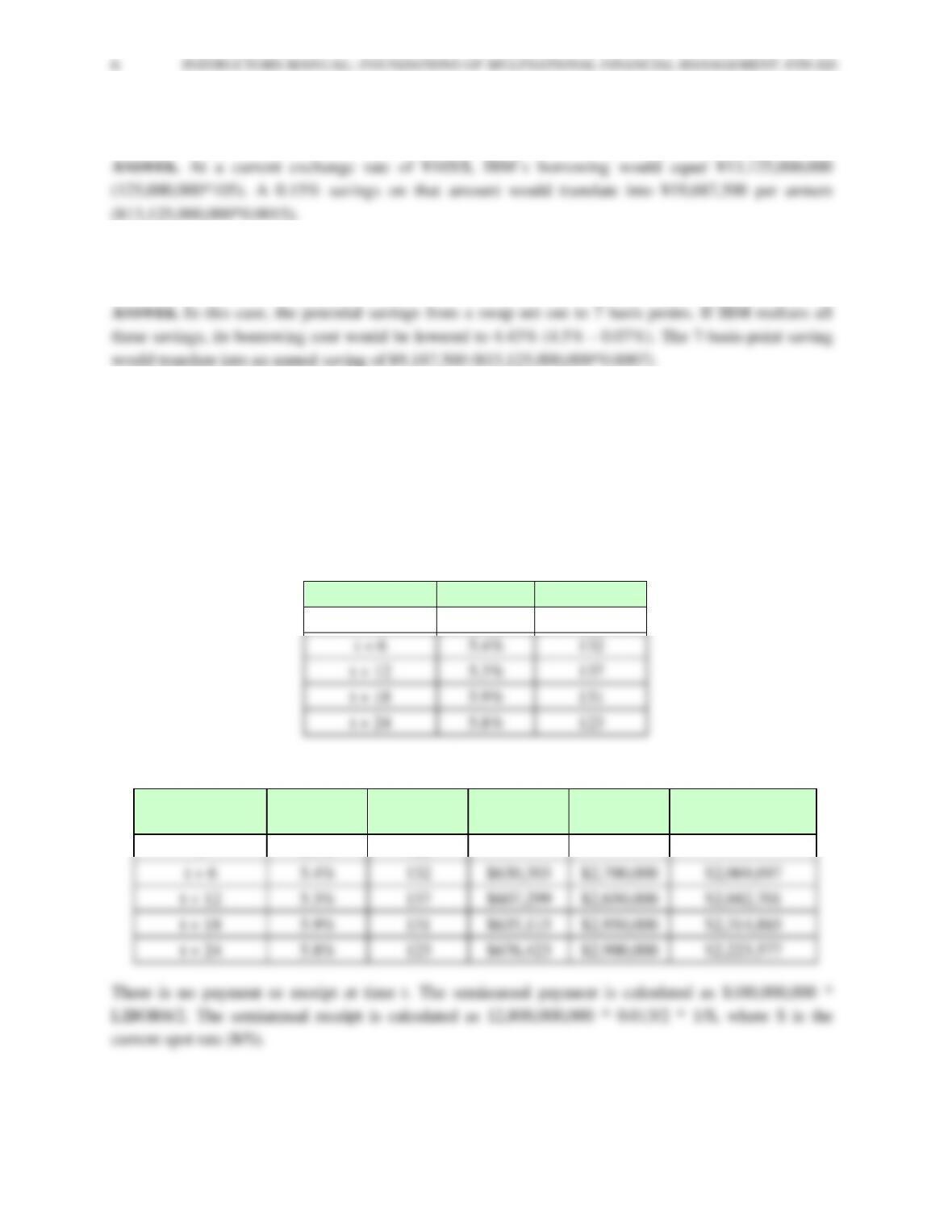
ANSWER. The cost to each party of accessing either the fixed-rate yen or the floating-rate dollar market
for a new debt issue is as follows:
Borrower Fixed-Rate Yen Available Floating-Rate Dollars Available
3.b. Assuming a notional principal equivalent to $125 million and a current exchange rate of
¥105/$, what do these possible cost savings translate into in yen terms?
3.c. Redo parts a and b assuming the parties use Bank of America, which charges 8 basis points
to arrange the swap.
4. At time t, 3M borrows ¥12.8 billion at an interest rate of 1.2%, paid semiannually, for a period
of two years. It then enters into a two-year yen/dollar swap with Bankers Trust (BT) on a
notional principal amount of $100 million (¥12.8 billion at the current spot rate). Every six
months, 3M pays BT U.S. dollar LIBOR6, while BT makes payments to 3M of 1.3% annually in
yen. At maturity, BT and 3M reverse the notional principals.
4.a. Assume that LIBOR6 (annualized) and the ¥/$ exchange rate evolve as follows. Calculate the
net dollar amount that 3M pays to BT (-) or receives from BT (+) each six-month period.
Time (months)
LIBOR6
¥/$ (spot)
t
5.7%
128
5.3%
137
5.8%
123
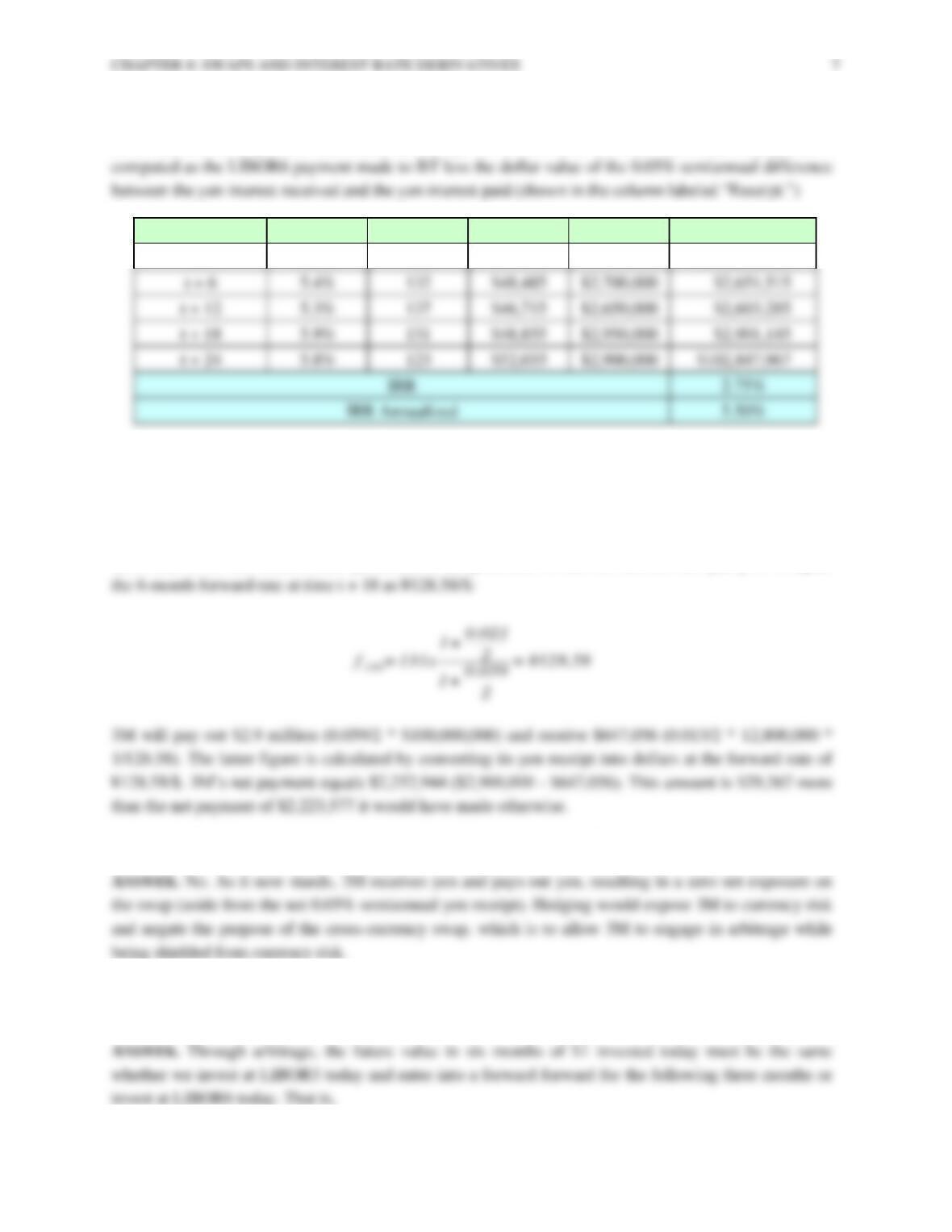
ANSWER. The semiannual receipts, payments, and net receipts (payments) are computed as follows:
Time (months)
LIBOR6
¥/$ (spot)
Receipt
Payment
Net $ Receipt (+)/
Payment (-)
t
5.7%
128
5.3%
137
5.8%
123
4.b. What is the all-in dollar cost of 3M’s loan?
ANSWER. The net payments made semiannually by 3M are shown in the table below. The net payment is
Time (months)
LIBOR6
¥/$ (spot)
Receipt
Payment
Net $ Payment
t
5.7%
128
-$100,000,000
5.4%
132
5.3%
137
5.9%
131
5.8%
123
4.c. Suppose 3M decides at t + 18 to use a six-month forward contract to hedge the t + 24 receipt
of yen from BT. Six-month interest rates (annualized) at t + 18 are 5.9% in dollars and 2.1%
in yen. With this hedge in place, what fixed dollar amount would 3M have paid (received) at
time t + 24? How does this amount compare to the t + 24 net payment computed in part a?
ANSWER. Given the interest rates presented in the problem, we can use interest rate parity to compute
4.d. Does it make sense for 3M to hedge its receipt of yen from BT? Explain.
5. Suppose LIBOR3 is 7.93% and LIBOR6 is 8.11% . What is the forward forward rate for a
LIBOR3 deposit to be placed in three months?
6. Suppose that Skandinaviska Ensilden Banken (SEB), the Swedish bank, funds itself with
three-month Eurodollar time deposits at LIBOR. Assume that Alfa Laval comes to SEB
seeking a one-year, fixed-rate loan of $10 million, with interest to be paid quarterly. At the
time of the loan disbursement, SEB raises three-month funds at 5.75%, but has to roll over this
funding in three successive quarters. If it does not lock in a funding rate and interest rates rise,
the loan could prove to be unprofitable. The three quarterly re-funding dates fall shortly
before the next three Eurodollar futures contract expirations in March, June, and September.
6.a. At the time the loan is made, the price of each contract is 94.12, 93.95, and 93.80. Show how
SEB can use Eurodollar futures contracts to lock in its cost of funds for the year. What is
SEB’s hedged cost of funds for the year?
6.b. Suppose that the settlement prices of the March, June, and September contracts are,
respectively, 92.98, 92.80, and 92.66. What would have been SEB’s unhedged cost of funding
the loan to Alfa Laval?
ADDITIONAL CHAPTER 8 PROBLEMS AND SOLUTIONS
1. Company A, a low-rated firm, desires a fixed-rate, long-term loan. Company A currently has
access to floating-rate funds at a margin of 1.5% over LIBOR. Its direct borrowing cost is 13%
in the fixed-rate bond market. In contrast, Company B, which prefers a floating-rate loan, has
access to fixed-rate funds in the Eurodollar bond market at 11% and floating-rate funds at
LIBOR + 0.50%.
6.a. How can A and B use a swap to advantage?
6.b. Suppose they split the cost savings. How much would A pay for its fixed-rate funds? How
much would B pay for its floating-rate funds?
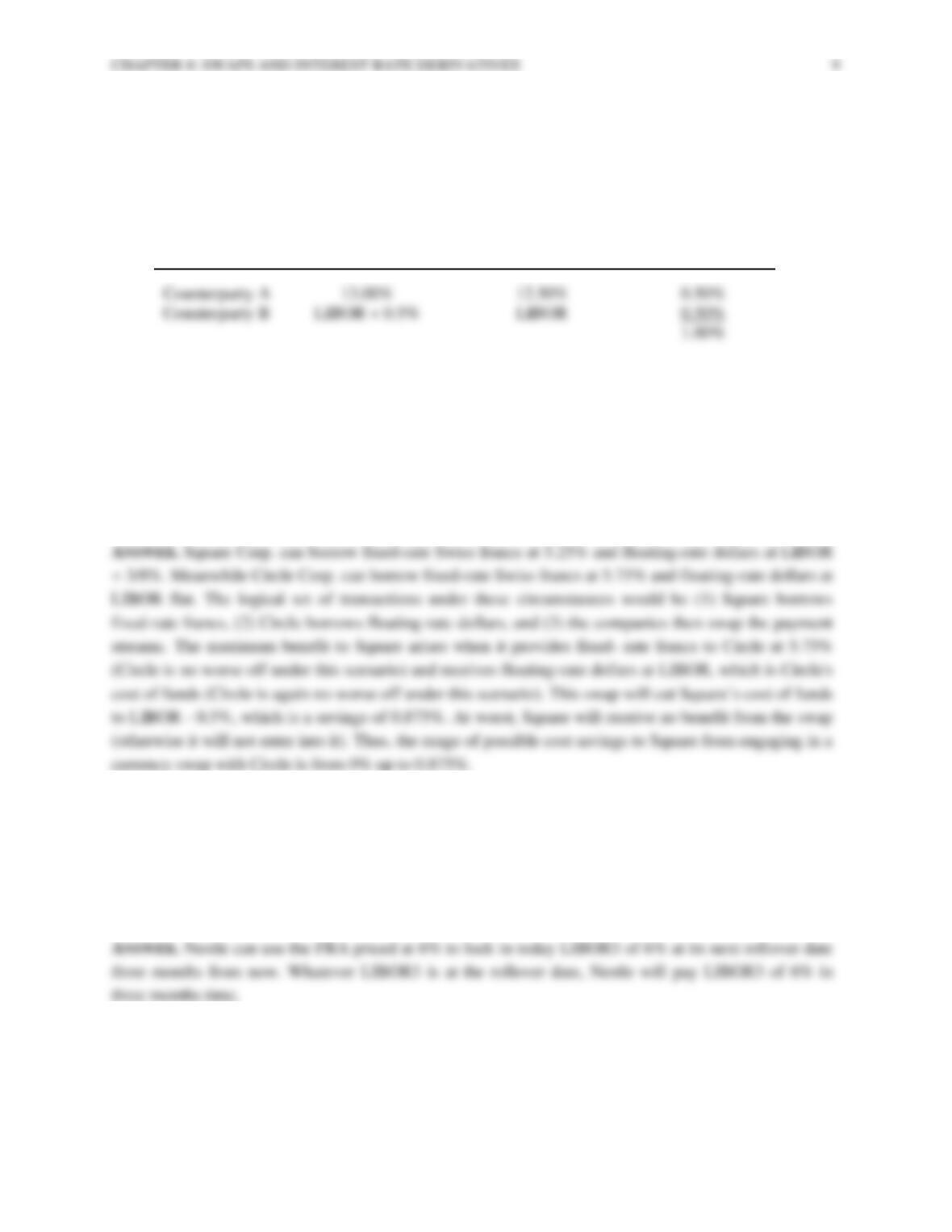
ANSWER. If they split the cost savings, the resulting costs to the two parties would be 12.5% for A and
LIBOR for B, calculated as follows:
Party
Normal Funding
Cost
Cost After Swap
Difference
13.00%
12.50%
0.50%
2. Square Corp. has not tapped the Swiss-franc public debt market because of concern about a
likely appreciation of that currency and only wishes to be a floating-rate dollar borrower,
which it can be at LIBOR + 3/8%. Circle Corp. has a strong preference for fixed-rate
Swiss-franc debt, but it must pay 0.5% more than the 5 1/4% coupon that Square Corp.’s
notes would carry. Circle Corp., however, can obtain Eurodollars at LIBOR flat (a zero
margin). What is the range of possible cost savings to Square from engaging in a currency
swap with Circle?
3. Nestle rolls over a $25 million loan priced at LIBOR3 on a three-month basis. The company
feels that interest rates are rising and that rates will be higher at the next roll-over date in
three months. Suppose the current LIBOR3 is 5.4375%.
3.a. Explain how Nestle can use an FRA at 6% from Credit Suisse to reduce its interest rate risk
on this loan.
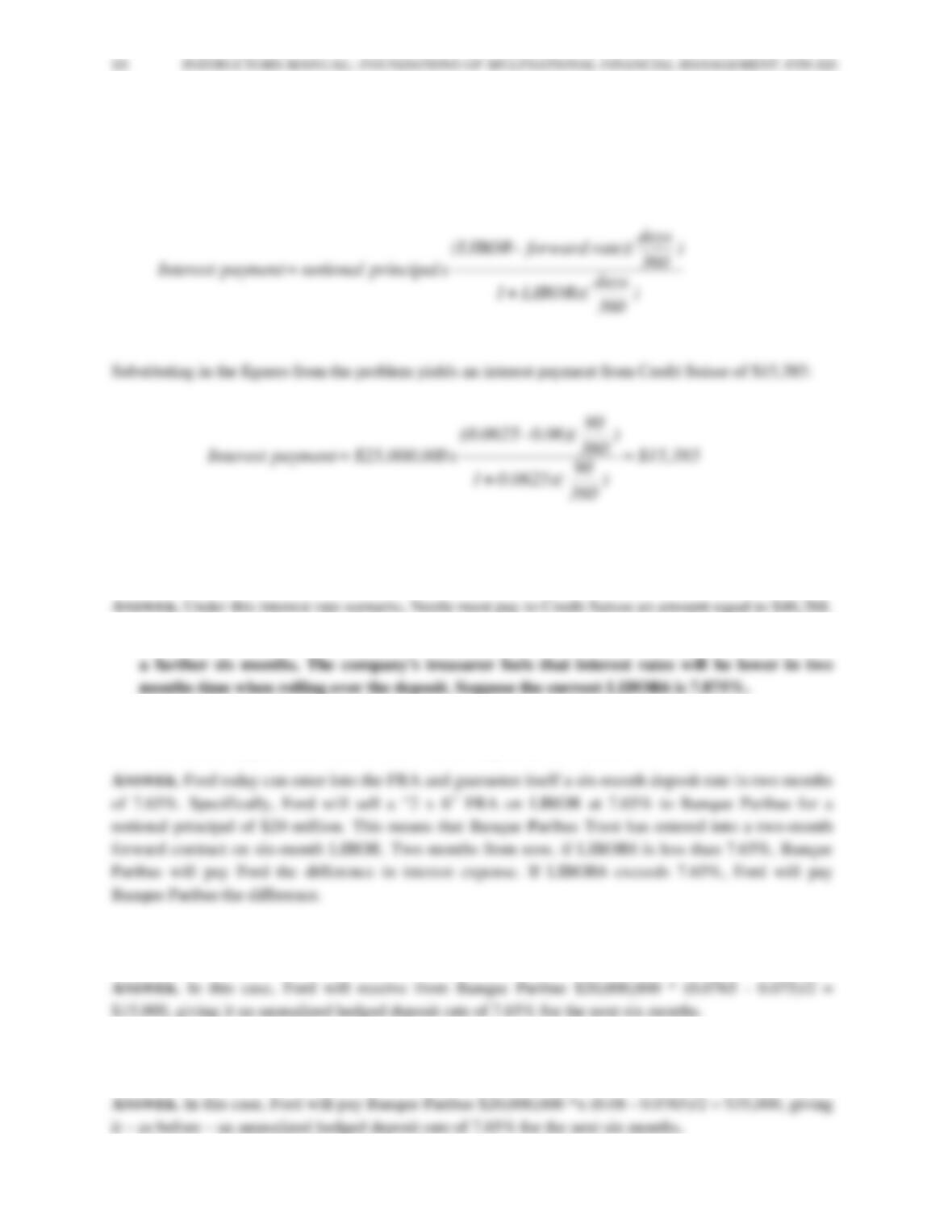
3.b. In three months, interest rates have risen to 6.25%. How much will Nestle receive/pay on its
FRA? What will be Nestle‘s hedged interest expense for the upcoming three-month period?
ANSWER. According to Equation 9.1 in the chapter, Nestle will receive an amount of interest (it will be a
recipient because LIBOR3 on the rollover date exceeds the rate agreed to on its FRA) computed as:
3.c. After three months, interest rates have fallen to 5.25%. How much will Nestle receive/pay on
its FRA? What will be Nestle’s hedged interest expense for the next three-month period?
4. Ford has a $20 million Eurodollar deposit maturing in two months that it plans to roll over for
4.a. Explain how Ford can use an FRA at 7.65% from Banque Paribas to lock in a guaranteed
six-month deposit rate when it rolls over its deposit in two months.
4.b. After two months, LIBOR6 has fallen to 7.5%. How much will Ford receive/pay on its FRA?
What will be Ford‘s hedged deposit rate for the next six-month period?
4.c. In two months, LIBOR6 has risen to 8%. How much will Ford receive/pay on its FRA? What
will be Ford’s hedged deposit rate for the next six months?