Insuring Your Life
Chapter 8
How Will This Affect Me?
Insurance should be used only to protect against potentially catastrophic losses, not for small-risk
exposures. It should cover losses that could derail your family’s future. Insurance balances the
relatively small, certain loss of ongoing premiums against low-probability, high-cost risks. This
chapter focuses on how to buy life insurance. Premature death is a catastrophic loss that could
LEARNING GOALS
LG1 Explain the concept of risk and the basics of insurance underwriting.
Risk and underwriting is the focus of insurance. It will be useful to give some examples of
events that you definitely would insure v events that you would not insure. The first include
major fire in your house, major car accident, premature death of wage earner, and a major
Key terms are:
Risk avoidance is an attractive way to deal with risk only when the estimated cost of avoidance
is less than the estimated cost of managing it in some other way.
Loss prevention is any activity that reduces the probability that a loss will occur
LG2 Discuss the primary reasons for life insurance and identify those who need coverage.
The primary purpose of life insurance is to protect your dependents from financial loss in the
LG3 Calculate how much life insurance you need.
Need for life insurance is the first primary topic for this chapter. Worksheet 8.1 and Exhibit
8.1organize the information to be considered in the insurance or not decision. The multiple of
LG4 Distinguish among the various types of life insurance policies and describe their advantages
and disadvantages.
LG5 Choose the best life insurance policy for your needs at the lowest cost.
Choosing the best life insurance to fulfill the need is the second primary topic for this chapter.
LG6 Become familiar with the key features of life insurance policies.
Exhibit 8.9 lists the key features of various types of life insurance. Exhibit 8.10 lists the various
Financial Facts or Fantasies?
These may be used as “teasers” to get the students on the right page with you. Also, they may be
used as quizzes after you covered the material or as “pre–test questions” to get their attention.
• The best way to figure out how much life insurance you need is to use a multiple of your
earnings.
Fantasy: While the multiple earnings approach is probably the simplest procedure, it suffers
from a number of serious shortcomings. A better choice is the needs approach.
• Selecting an insurance company is the first thing you should do when buying life insurance.
Fantasy: The first thing you should do is determine the amount of life insurance you need and
then select the type of policy that is best for you. Only after you have taken these steps should
you address where you will buy the insurance.

Financial Facts or Fantasies?
These may be used as a quiz or as a pre-test to get the students interested.
1. True False The best way to figure out how much life insurance you need is to
use a multiple of your earnings.
2. True False Social security survivor’s benefits should be factored into your life
insurance plans if you have a dependent spouse and/or minor
children.
3. True False Term insurance provides nothing more than a stipulated amount of
death benefits and, as a result, is considered the purest form of life
insurance.
4. True False Selecting an insurance company is the first thing you should do
when buying life insurance.
5. True False Because most life insurance policies are largely the same, you need
not concern yourself with differences in specific contract provisions.

YOU CAN DO IT NOW
The “You Can Do It Now” cases may be assigned to the students as short cases or problems.
They will help make the topic more real or relevant to the students. In most cases, it will only
take about ten minutes to do, that is, until the student starts looking around at the web site. But
they will learn by doing so.
Shop for a Customized Life Insurance Policy
Let’s make life insurance more concrete and personal. You can easily get an insurance quote
Check Out the Best Life Insurance Companies

Financial Impact of Personal Choices
Ella and Thomas Consider “Buying Term and Investing the Rest”
Ella and Thomas Collins have two young children and believe it’s time to buy a life insurance
policy to protect their family. They’ve both heard the life insurance advice to “buy term and
invest the rest.” In order to evaluate this advice they’ve collected quotes for 20-year term and
whole life policies on Thomas, both with a payoff of $250,000. The whole life policy premium
is $347 a month while the term policy premium is only $23 a month. In 20 years the whole life
policy will have a guaranteed cash value of $70,018 but at current rates would be worth
$105,721. The death benefit will have grown to $326,352. If the Collins buy the term policy and
invest the $324 difference in monthly premiums at 8% for 20 years, they could have a portfolio
worth about $190,843! The Collins wonder about the financial consequences of their decision.
The personal financial consequences of “buy term and invest the rest” suggest the advice may
well work for the Collins. But the best decision depends on their objectives, discipline, and
attitude toward the risks of “investing the rest.”

Applying Personal Finance
Insure Your Life!
Providing for our loved ones in the event of our death is a serious concern for most of us. The
problem is that planning for such an event is not pleasant, and most of us would just as soon put
off thinking about it. This project will help you determine your current and future life insurance
needs.
Solutions to Financial Planning Exercises
Planning Exercises
1. Estimating life insurance needs. Use Worksheet 8.1. Aurora Bell is a 72-year-old widow
who has recently been diagnosed with Alzheimer’s disease. She has limited financial assets
of her own and has been living with her daughter Skylar for two years. Her only income is
$850 a month in Social Security survivor’s benefits. Skylar wants to make sure her mother
will be taken care of if Skylar should die. Skylar, 40, is single and earns $55,000 a year as a
human resources manager for a small manufacturing firm. She owns a condo with a
expectancy but indicates that with proper care some Alzheimer’s patients can live 10 or
more years after diagnosis. Skylar also estimates that her personal final expenses would be
around $5,000, and she’d like to provide a $25,000 contingency fund that would be used to
pay a trusted friend to supervise her mother’s care if Skylar were no longer alive. Use
Worksheet 8.1 to calculate Skylar’s total life insurance requirements and recommend the
type of policy that she should buy.
Skylar is concerned that she should die and leave her mother unable to get the care she needs.
While it is difficult to estimate lives, Skylar believes that her mother will live no more than 13
additional years. At Skylar’s death, Aurora [Mother] will only have her social security which
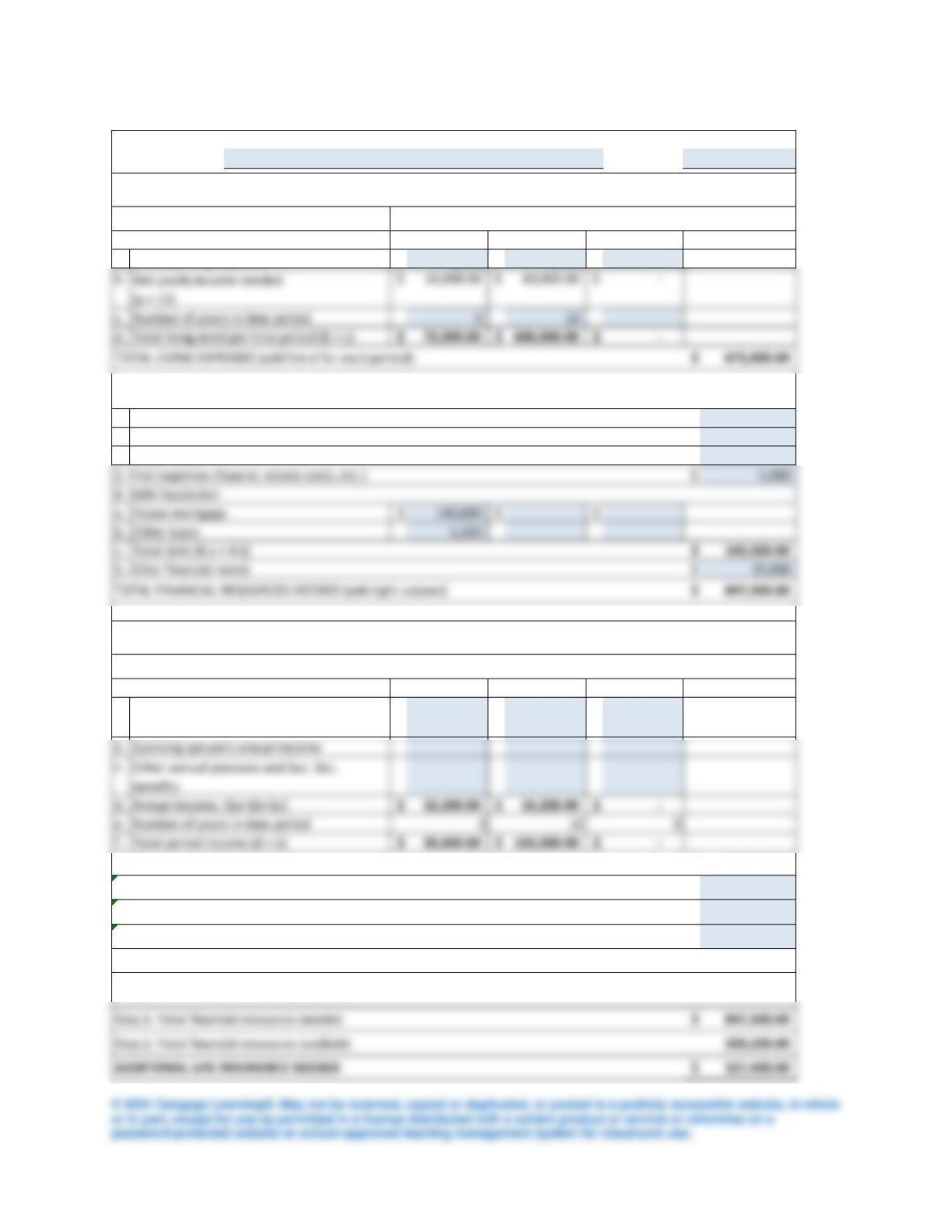
Step 1: Total financial resources needed
Step 2: Total financial resources available
Worksheet 8.1, Chapter 8, Exercise 1
Date
a. $ 2,000
$
5,000 $
Number of years in time period
Total living need per time period (b × c)
TOTAL LIVING EXPENSES (add line d for each period):
672,000.00$
a. $
b. $
c. $
3. Final expenses (funeral, estate costs, etc.)
House mortgage
Other loans
Total debt (4 a + 4 b)
5. Other financial needs
TOTAL FINANCIAL RESOURCES NEEDED (add right column)
847,500.00$
a. $ 10,200.00
$
10,200.00
Surviving spouse’s annual income
Annual income, (1a+1b+1c)
Total period income (d × e)
2. $ 77,500.00
3. $
4. $ 110,000.00
Period 1
Period 2
Period 3
Period 3
LIFE INSURANCE NEEDS ANALYSIS METHOD
Insured’s Name
Step 1: Financial resources needed after death
1. Annual living expenses and other needs:
February 6,2020
Skylar
Period 1
Period 2
Monthly living expenses
2. Special needs
Spouse education fund
Children’s college fund
Other needs
Step 2: Financial resources available after death
1. Income
Annual Social Security survivor’s
benefits
g. TOTAL INCOME
Savings and investments
Other life insurance
Other resources sale of condo
Step 3: Additional Life Insurance needed
320,100.00$
132,600.00$
TOTAL FINANCIAL RESOURCES AVAILABLE (1g + 2 + 3 + 4)
2. Deciding if life insurance is needed. Use Worksheet 8.1. Given your current personal
financial situation, do you feel you need life insurance coverage? Why or why not? Use
Worksheet 8.1 to confirm your answer and calculate how much additional insurance (if
any) you might need to purchase.
3. Deciding if additional life insurance is needed and, if so, appropriate type. Use Worksheet
8.1. Michael Edwards, 43, is a recently divorced father of two children, ages 9 and 7. He
currently earns $95,000 a year as an operations manager for a utility company. The divorce
settlement requires him to pay $1,500 a month in child support and $400 a month in
alimony to his ex-wife. Michael is now renting an apartment, and the divorce settlement
left him with about $100,000 in savings and retirement benefits. His employer provides a
$75,000 life insurance policy. Michael’s ex-wife is currently the beneficiary listed on the
policy. What advice would you give to Michael? What factors should he consider in
deciding whether to buy additional life insurance at this point in his life? If he does need
additional life insurance, what type of policy or policies should he buy? Help answer these
questions for Michael.
Divorce is always a difficult situation, especially with children involved. Michael has to decide
the level of support he wishes to give his children. If he wants to provide a college fund for his
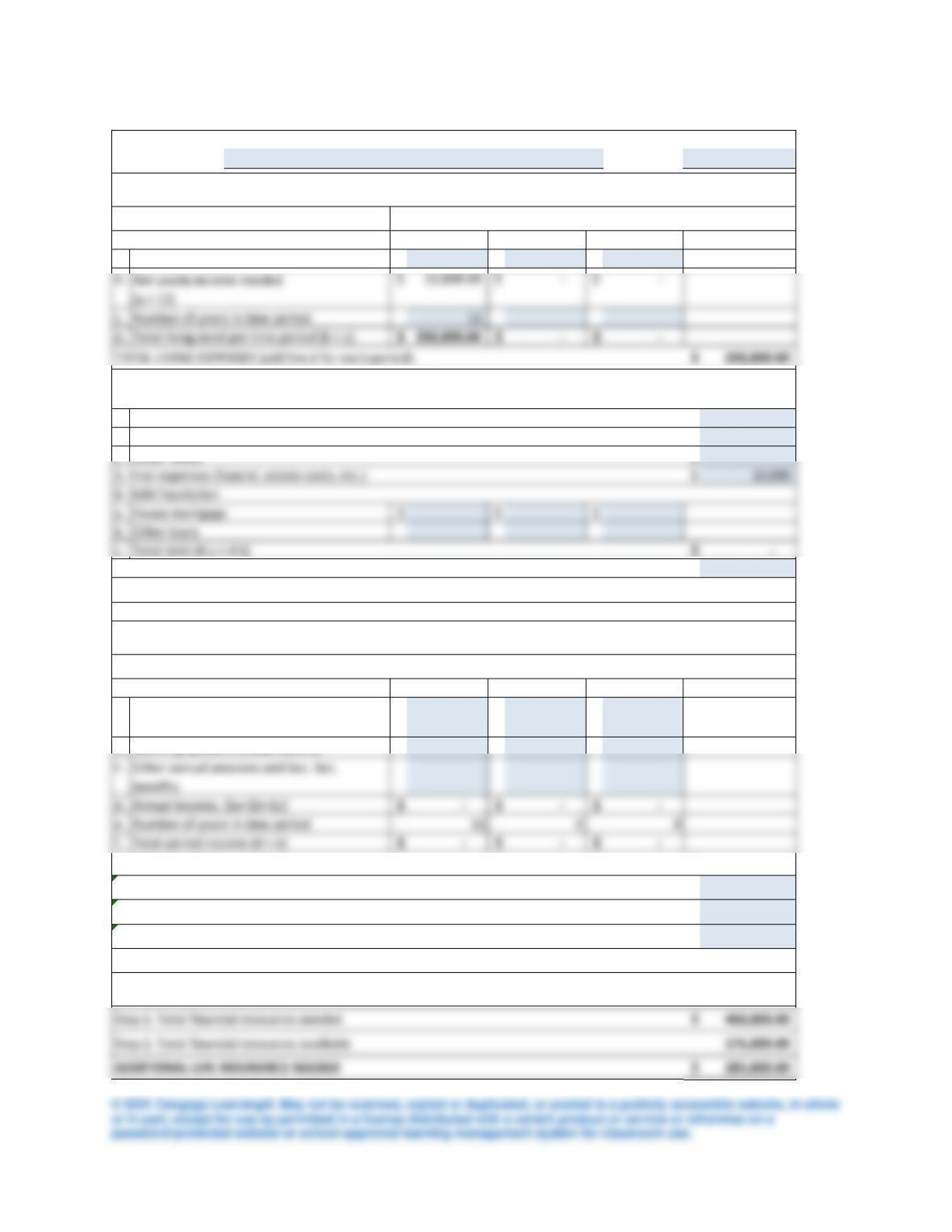
Worksheet 8.1, Chapter 8, Exercise 3
Date
a. $ 1,900 $ $
250,800.00$
Number of years in time period
Total living need per time period (b × c)
TOTAL LIVING EXPENSES (add line d for each period):
a. $
b. $ 200,000
House mortgage
Other loans
Total debt (4 a + 4 b)
Other needs
3. Final expenses (funeral, estate costs, etc.)
$
a. $ $
Total period income (d × e)
Surviving spouse’s annual income
Annual income, (1a+1b+1c)
2. $ 100,000.00
3. $ 75,000.00
4. $
Step 1: Total financial resources needed
Step 2: Total financial resources available
g. TOTAL INCOME
Savings and investments
Other life insurance
Other resources sale of condo
Step 3: Additional Life Insurance needed
175,000.00$
–$
TOTAL FINANCIAL RESOURCES AVAILABLE (1g + 2 + 3 + 4)
Annual Social Security survivor’s
benefits
1. Income
TOTAL FINANCIAL RESOURCES NEEDED (add right column)
460,800.00$
5. Other financial needs
Step 2: Financial resources available after death
Spouse education fund
Children’s college fund
2. Special needs
LIFE INSURANCE NEEDS ANALYSIS METHOD
Insured’s Name
Step 1: Financial resources needed after death
1. Annual living expenses and other needs:
February 6,2020
Michael Edwards
Period 1
Period 2
Monthly living expenses
Period 3
Period 1
Period 2
Period 3
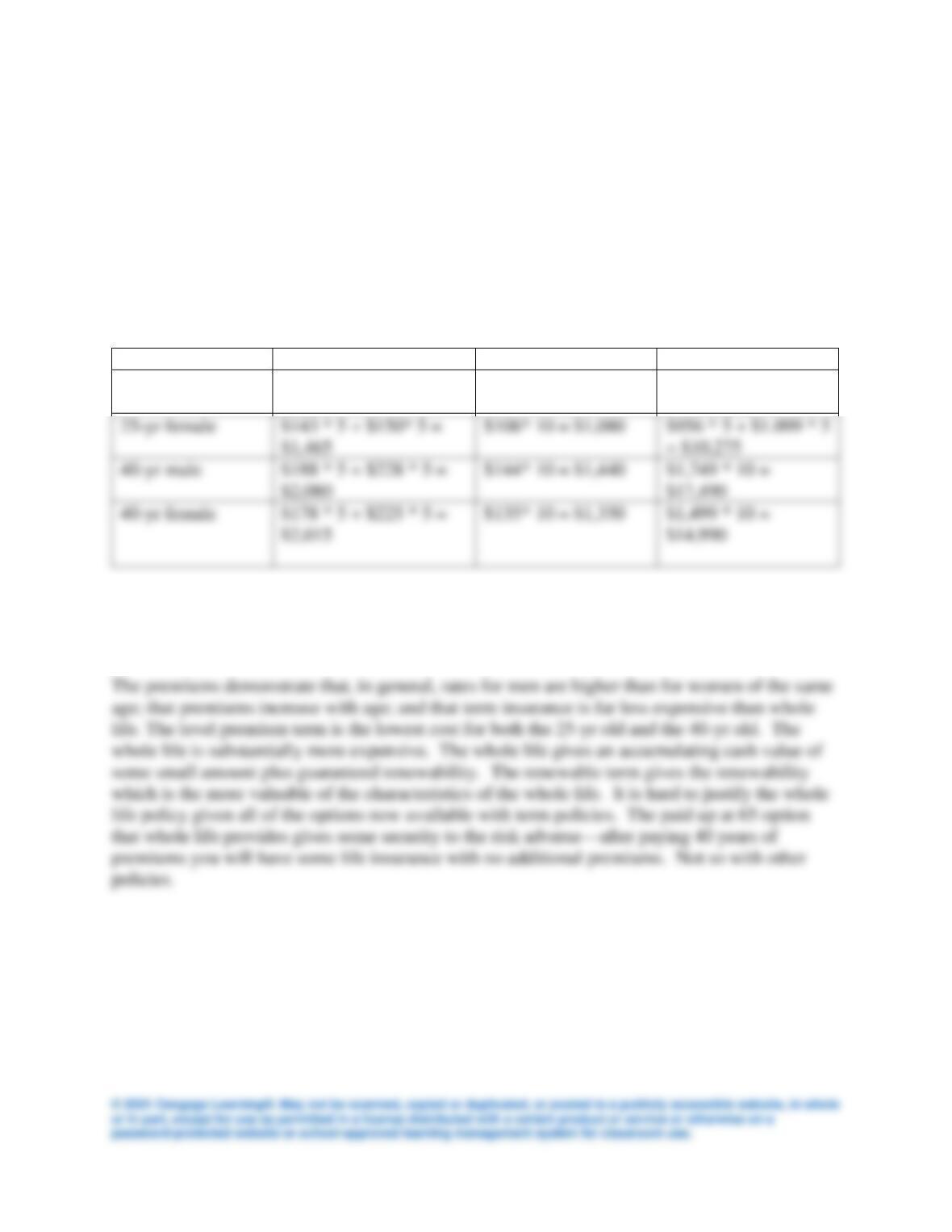
4. Life insurance premiums and comparison of types. Using the premium schedules
provided in Exhibits 8.2, 8.3, and 8.5, how much in annual premiums would a 25-year-old
male have to pay for $100,000 of annual renewable term, level premium term, and whole
life insurance? (Assume a five-year term or period of coverage.) How much would a 25–
year-old woman have to pay for the same coverage? Consider a 40-year-old male (or
female): Using annual premiums, compare the cost of 10 years of coverage under annual
renewable and level premium term options and whole life insurance coverage. Relate the
advantages and disadvantages of each policy type to their price differences.
Policy is $100,000, for 10 years
Insured
Annual renewable term
Level premium term
Whole life insurance
25-yr male
$164 * 5 + $167 * 5 =
$1,655
$120* 10 = $1,200
$1,057 * 5 + $1,218 *
5 = $11,375
$1,465
= $10,275
$2,080
$17,490
I did not interpolate to estimate the yearly premium for the annual renewable term or the whole
life insurance. I just used the 5-year and the 10-year premiums. The comparison will be similar
for the policies.
5. Appropriateness of whole life insurance. Estella and Hugo Sanchez are a dual-career
couple who just had their first child. Hugo age 31, already has a group life insurance
policy, but Estella’s employer does not offer life insurance. A financial planner is
recommending that the 25-year-old Estella buy a $250,000 whole life policy with an annual
premium of $1,670 (the policy has an assumed rate of earnings of 5 percent a year). Help
Estella evaluate this advice and decide on an appropriate course of action.
Issues are the need for insurance and then what type of insurance best meet that need. We do not
know the amount of Hugo’s insurance. Frequently employer provided group life insurance is
term insurance for twice the employee’s annual salary. The need for insurance centers around
the care for her child. The amount of $250,000 could be correct, but a needs analysis should be
performed.
Note the Financial Impact of Personal Choices, Ella and Thomas Consider “Buying Term
and Investing the Rest” that is at the end of the chapter. [Above in these materials.]
6. Appropriateness of variable life insurance. While at lunch with a group of coworkers,
one of your friends mentions that he plans to buy a variable life insurance policy because it
provides a good annual return and is a good way to build savings for his 5-year-old’s
college education. Another colleague says that she’s adding coverage through the group
plan’s additional insurance option. What advice would you give them?
A variable life insurance policy goes further than whole and universal life policies in
combining death benefits and savings. The policyholder decides how to invest the money in the
7. Using insurance policy illustrations. Describe the key elements of an insurance policy
illustration and explain what a prospective client should focus on in evaluating an
illustration.
Some important contract features of life insurance policies you should become familiar with are
the beneficiary clause, settlement options, policy loans, premium payments, grace period,
nonforfeiture options, policy reinstatement, and change of policy. Other policy features include
multiple indemnity and disability clauses, guaranteed purchase options, a suicide clause,
Critical Thinking Cases
8.1 Li Huang’s Insurance Decision: Whole Life, Variable Life, or Term Life?
Li Huang, a 38-year-old widowed mother of three children (ages 12, 10, and 4), works as an
analyst for an advertising firm. Although she’s covered by a group life insurance policy at
work, she feels, based on some rough calculations, that she needs additional protection.
Critical Thinking Questions
1. Explain to Li the differences between (a) a whole life policy, (b) a variable life policy, and
(c) a term life policy.
a. Three major types of whole life policies are available: continuous premium, limited payment,
and single premium.
Under a continuous premium whole life policy—or straight life, as it’s more commonly called—
individuals pay a level premium each year until they either die or exercise a nonforfeiture right.
b. A variable life insurance policy goes further than whole and universal life policies in
combining death benefits and savings. The policyholder decides how to invest the money in the
savings (cash-value) component. The investment accounts are set up just like mutual funds, and
2. What are the major advantages and disadvantages of each type of policy?
Whole life: Advantages include the ability to have insurance protection your entire life
regardless of your insurability in later years, Ability to borrow against the cash value of the
policy with repayment deferred until death, and Ability to purchase “paid–up at year 20” policies
gives high protection for a time, with paid-up insurance at the end of the stated term. One
disadvantage of whole life insurance is its cost. It provides less death protection per premium
dollar than term insurance does.
3. In what way is a whole life policy superior to either a variable life or term life policy? In
what way is a variable life policy superior? How about term life insurance?
Whole life gives a set amount of insurance that will not be cancelled as long as premiums are
paid. It will build some cash value and you may be able to borrow that cash value. With
4. Given the limited information in the case, which type of policy would you recommend for
Li? Defend and explain your recommendations.
In 25 years, Li will have no one depending on her for resources. The youngest child will be 29