Chapter 8
Basic Stock Valuation
ANSWERS TO BEGINNING-OF–CHAPTER QUESTIONS
5-2 Again, see the model or the model printout. We show some alternative conditions, or
scenarios, and the stock price under those scenarios.
5-3 Again, see the model or the model printout. We show how to use Excel to find the stock
5-4 Again, see the model or the model printout. Everything up to this point could be found
5-5 The dividend growth model is only appropriate for companies that pay dividends and are
expected to grow at a predictable rate, with this rate leveling off to a constant rate
sometime in the future. It can also be applied to companies that do not pay dividends but
are expected to do so in the forecastable future, but here the analysis becomes more
speculative.
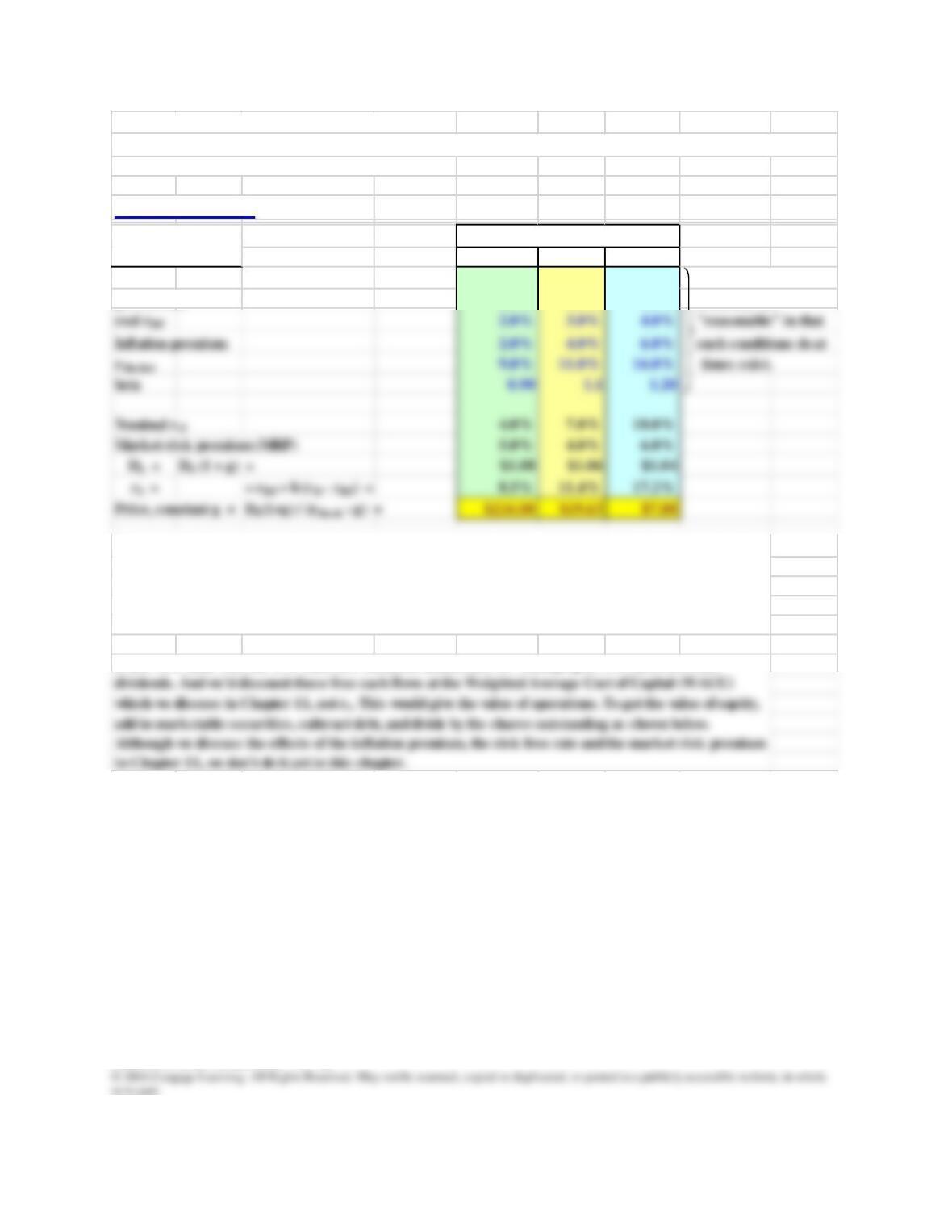
Workshee t for Chapter 8 BOC Que stions 10/21/2014
We like to go through an Excel exercise both to get students more familiar with Excel and also because Excel
is useful for showing sensitivity analysis.
Ques tions 1 and 2.
Good Base Bad
D0$1.00 $1.00 $1.00 These inputs are
growth rate 8.0% 6.0% 4.0% arbitrary but
Data for Different Scenarios:
Constant Growth
Input Data
This example demonstrates that stock prices can experience huge changes as a result of changes in the
basic parameters. Note too that the stock price gets extremely high if g approaches r. For example, if we
changed g in the good scenario from 8% to 8.4% , the price would “explode” to $1,080. One must be very
careful when using the constant growth model to avoid getting nonsense results. If one is not confident
that the constant growth model is appropriate, then us e the nonconstant model as set forth below.
If this were done with the free cash flow valuation model, then we would project free cash flows, not
Answers and Solutions: 8 – 2
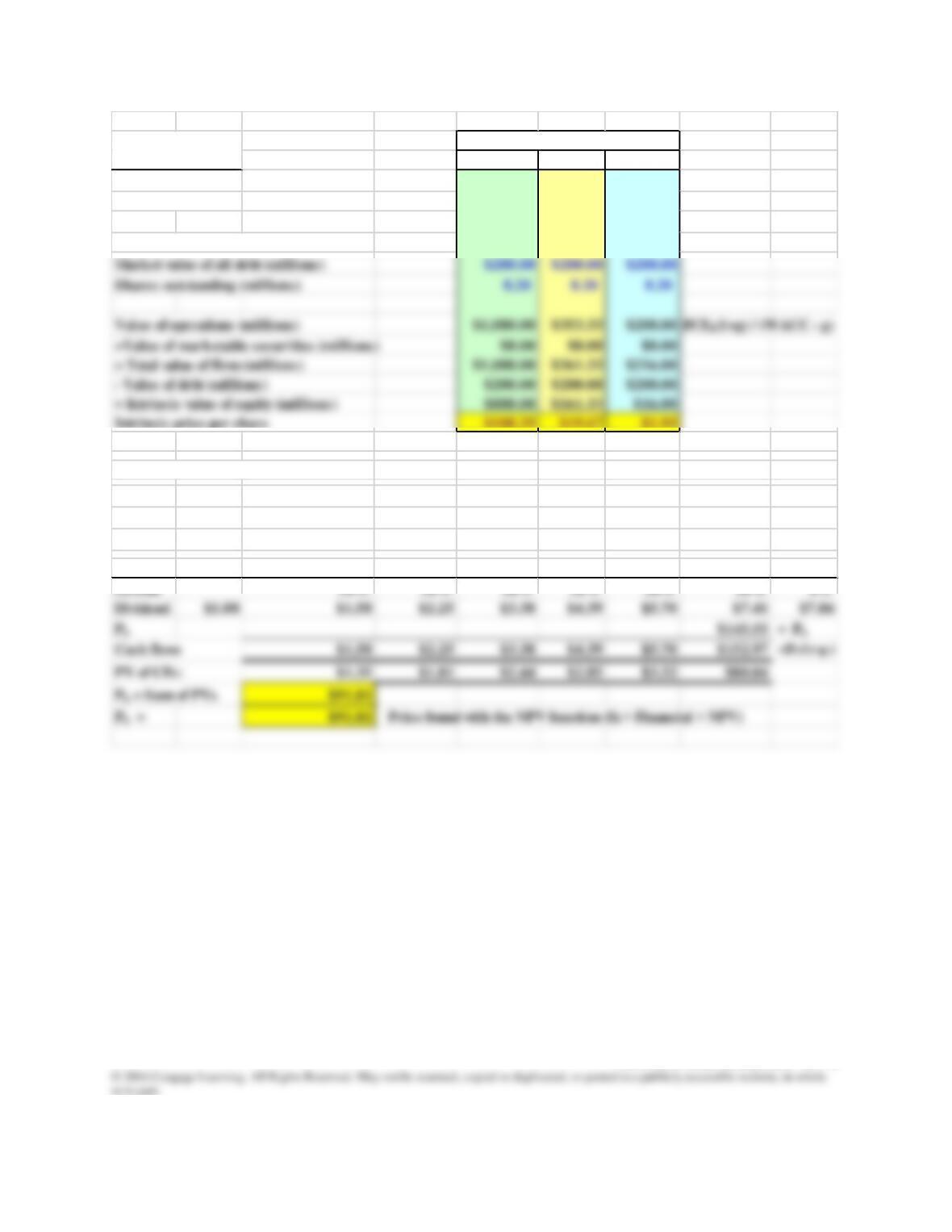
Good Base Bad
FCF
0
(millions) $10.00 $10.00 $10.00
growth rate 8.0% 6.0% 4.0%
WACC 9.0% 9.0% 9.0%
Value of marketable securities (millions) $8.00 $8.00 $8.00
Intrinsic price per share $108.29 $19.67 $1.95
Question 3. Nonconstant growth
g
(1-3)
= 50%
g
(4-6)
= 30%
g
LR
= 6%
Ye ar 0 1 2 3 4 5 6 7
Constant Growth
Input Data
Data for Different Scenarios:
Answers and Solutions: 8 – 3
P
P
P
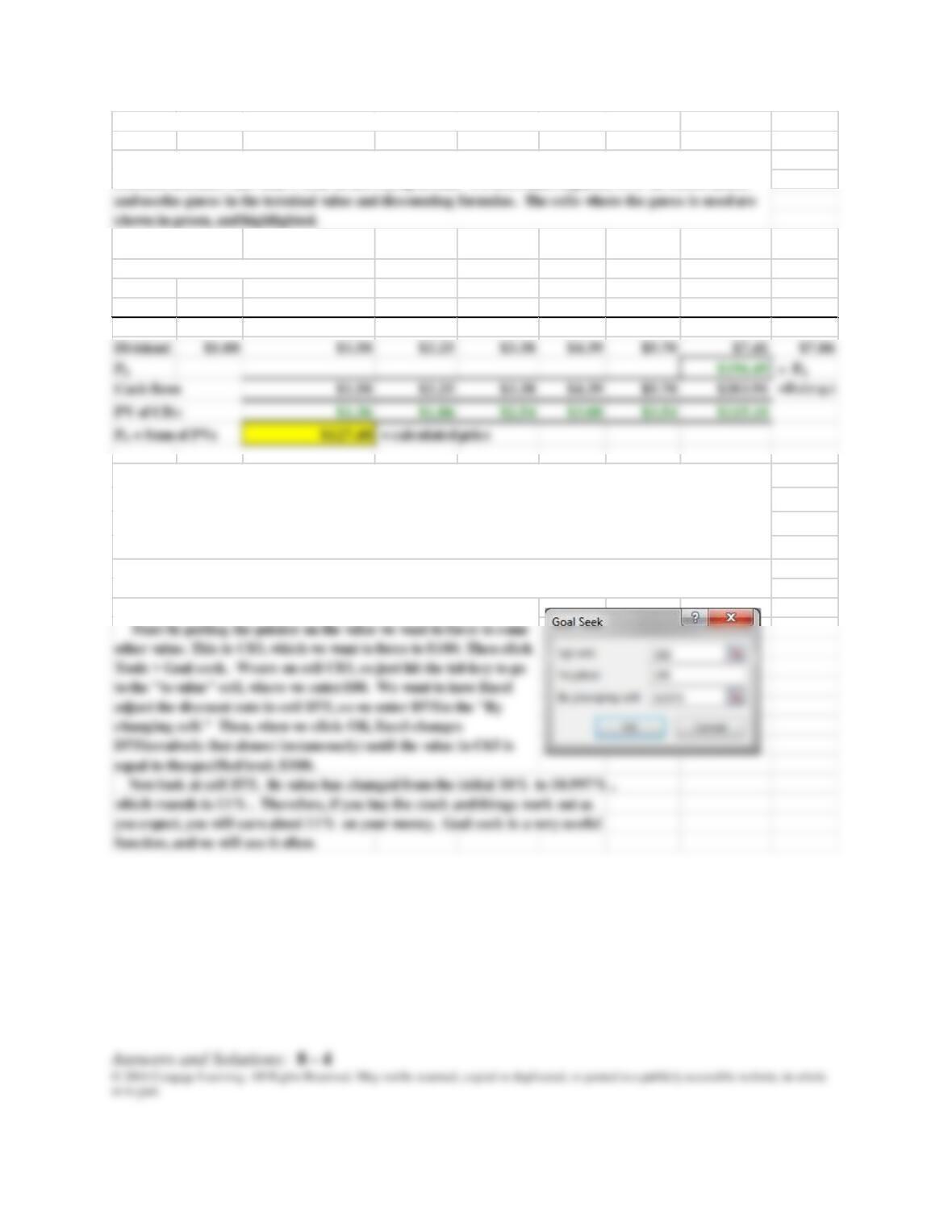
Question 4. Finding the expected rate of return on a non-constant growth stock.
Stock price: $100.00
Guess as to discount rate, r: 10.000%
Ye ar 0 1 2 3 4 5 6 7
Gr owt h 50% 50% 50% 30% 30% 30% 6%
and usethe guess in the terminal value and discounting formulas. The cells where the guess is used are
The dividends are as shown above, so we can copy thos e values as shown below. However, we do not
knowthe discount rate—that’s what we are trying to find. We first make a gues s , 10% as s hown below,
The calculated price, based on the 10% discount rate, is greater than the $100 offer price. This
meansthat the expected rate of return is greater than 10% . So, we could raise the 10% to higher and
highervalues until we found one that “works“ in the sense of making the calculated price equal the given
$100price. The discount rate that causes the calculated stock price to equal $100 is the expected rate of
return.
We could proceed on a trial and error basis, but we could also use Excel‘s “Goal Seek” function. The
goal we seek is the discount rate that forces the calculated stock price to equal the market price, $100.
ANSWERS TO END-OF-CHAPTER QUESTIONS
8-1 a. A proxy is a document giving one person the authority to act for another, typically the
power to vote shares of common stock. If earnings are poor and stockholders are
dissatisfied, an outside group may solicit the proxies in an effort to overthrow
management and take control of the business, known as a proxy fight. The
preemptive right gives the current shareholders the right to purchase any new shares
b. Estimated value (
0
P
ˆ
) is the present value of the expected future cash flows. The
market price (P0) is the price at which an asset can be sold.
c. The required rate of return on common stock, denoted by rs, is the minimum
acceptable rate of return considering both its riskiness and the returns available on
other investments. The expected rate of return, denoted by ^
rs, is the rate of return
Answers and Solutions: 8 – 5
d. The capital gains yield results from changing prices and is calculated as (P1 – P0)/P0,
where P0 is the beginning-of–period price and P1 is the end-of-period price. For a
e. Constant, growth occurs when a firm’s earnings and dividends grow at some constant
long-term rate. One category of nonconstant growth stock is a “nonconstant” growth
stock which has one or more years of growth above that of the economy as a whole,
but at some point the growth rate will fall to the “normal” rate. This occurs,
generally, as part of a firm’s normal life cycle. A zero growth stock has constant
earnings and dividends; thus, the expected dividend payment is fixed, just as a bond’s
coupon payment. A preferred stock has zero growth.
f. Preferred stock is a hybrid—it is similar to bonds in some respects and to common
stock in other respects. Preferred dividends are similar to interest payments on bonds
Answers and Solutions: 8 – 6
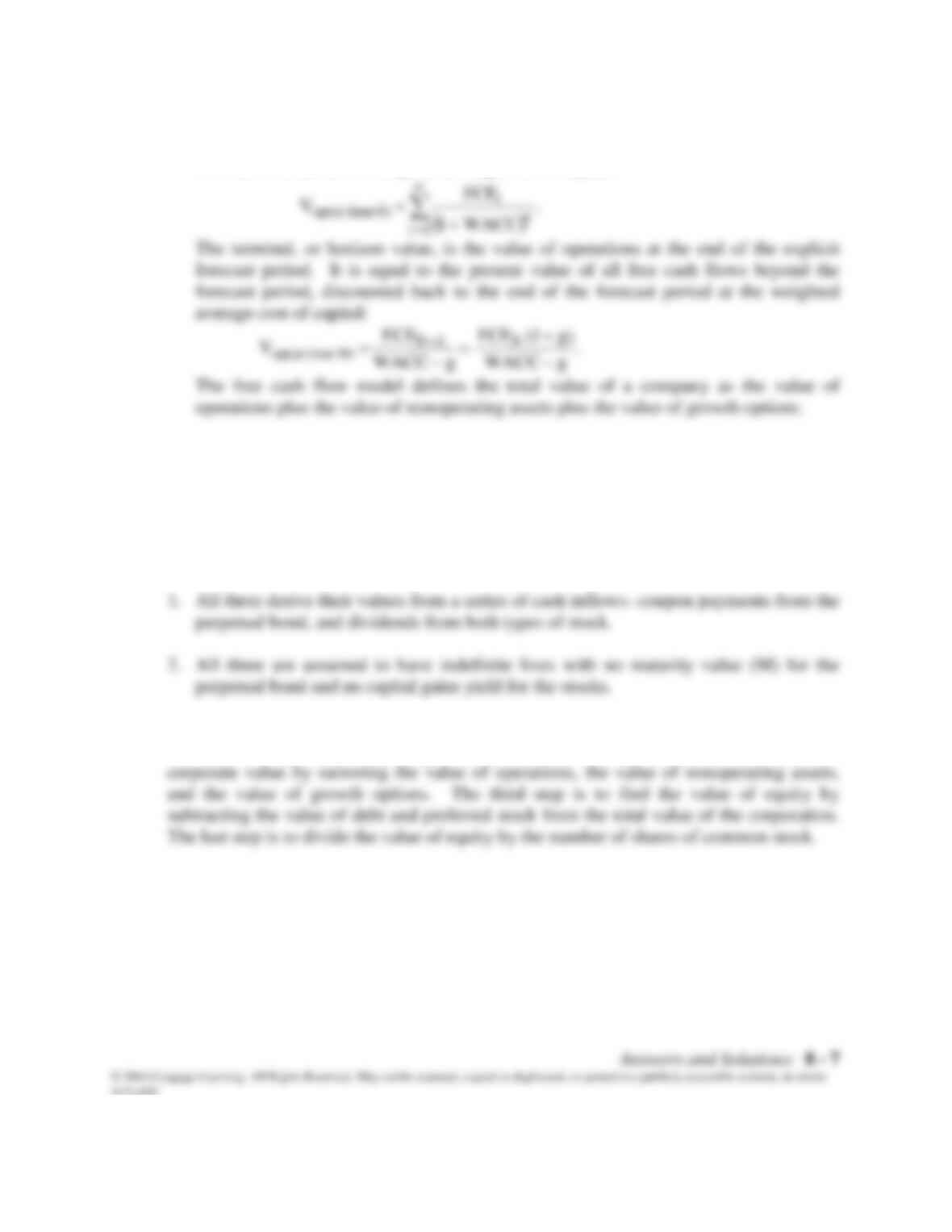
h. The value of operations is the present value of all the future free cash flows that are
expected from current assets–in–place and the expected growth of assets–in–place
when discounted at the weighted average cost of capital:
8-2 True. The value of a share of stock is the PV of its expected future dividends. If the two
investors expect the same future dividend stream, and they agree on the stock’s riskiness,
then they should reach similar conclusions as to the stock’s value.
8-3 A perpetual bond is similar to a no-growth stock and to a share of preferred stock in the
following ways:
8-4 The first step is to find the value of operations by discounting all expected future free
cash flows at the weighted average cost of capital. The second step is to find the total
SOLUTIONS TO END-OF-CHAPTER PROBLEMS
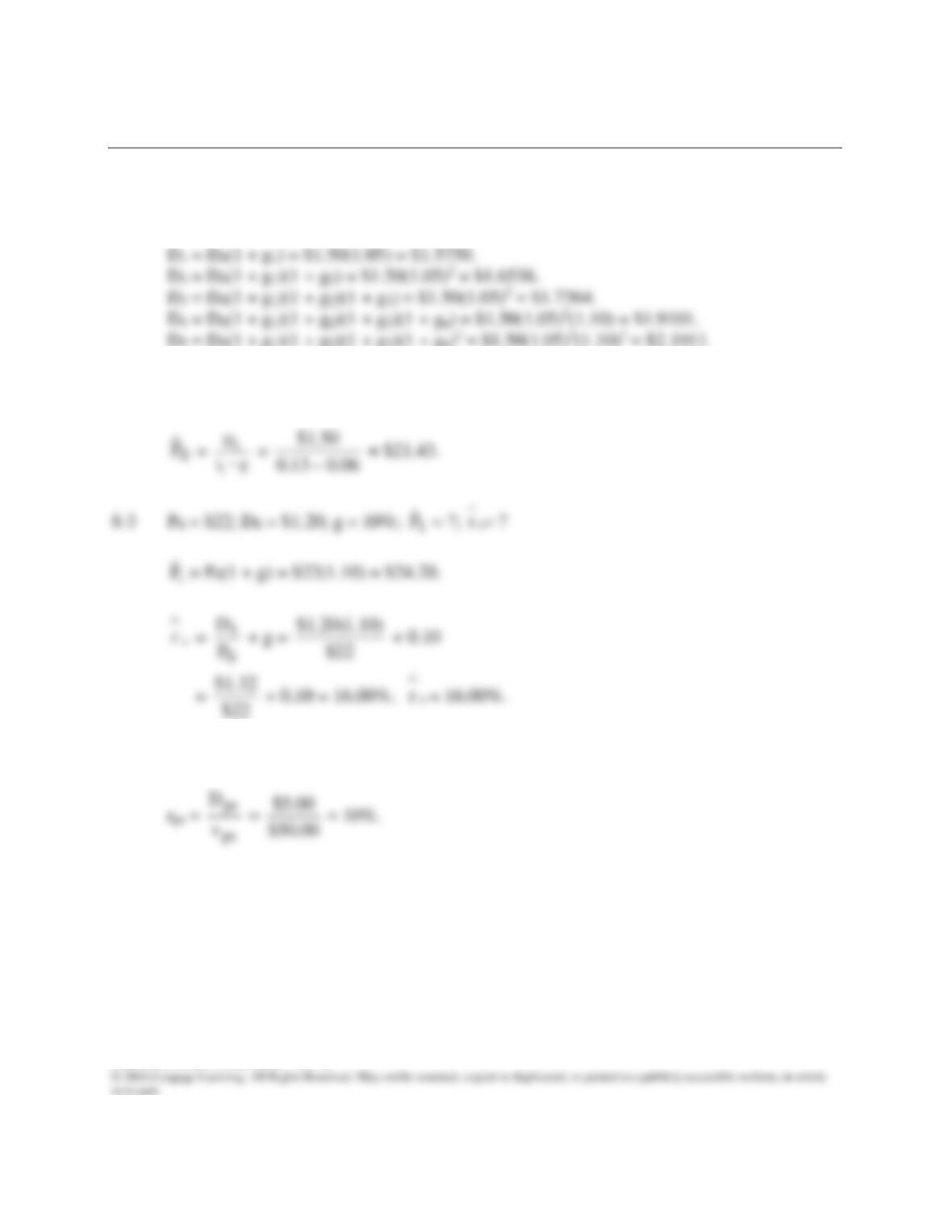
8-1 D0 = $1.50; g1-3 = 5%; gn = 10%; D1 through D5 = ?
8-2 D1 = $1.50; g = 6%; rs = 13%;
0
P
ˆ
= ?
8-4 Dps = $5.00; Vps = $50; rps = ?
Answers and Solutions: 8 – 8
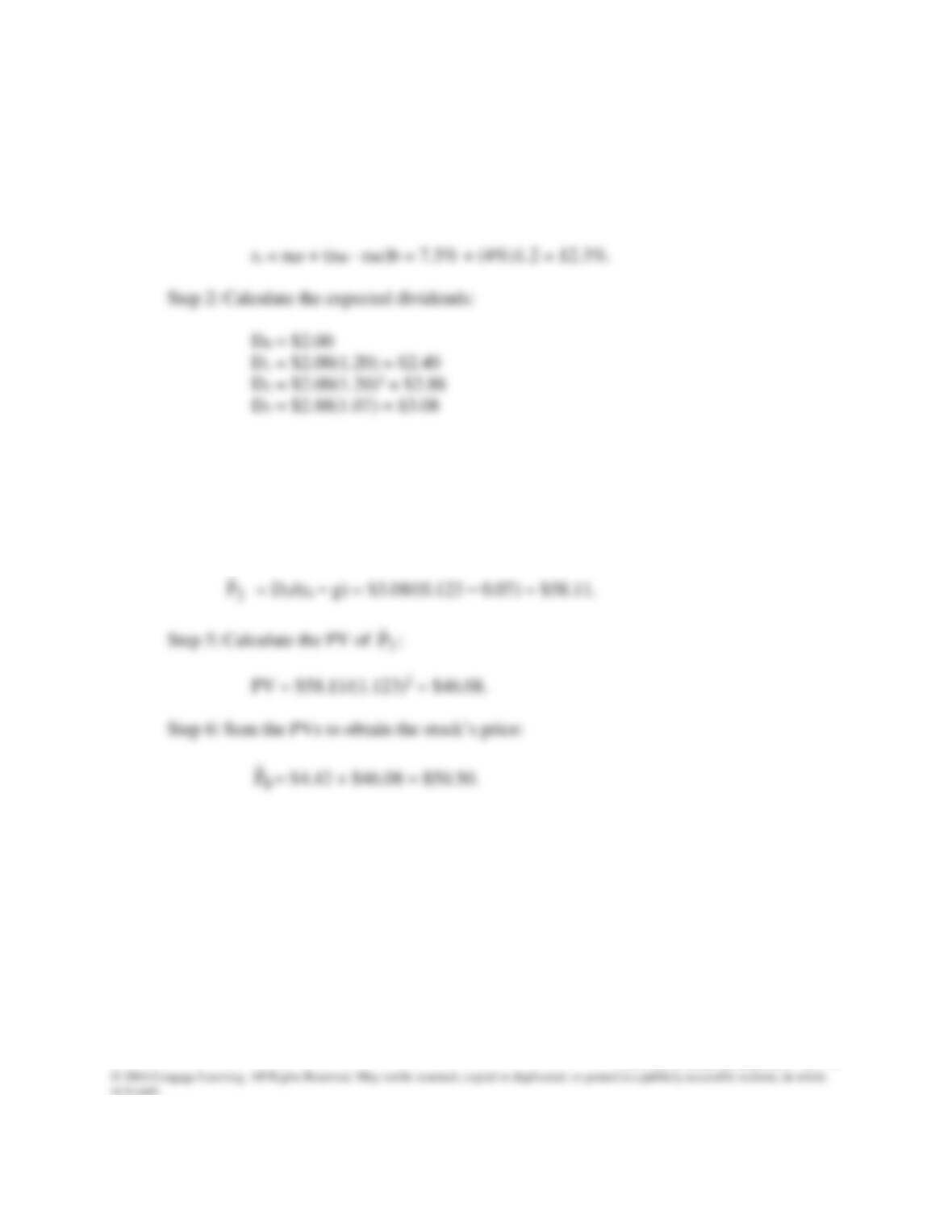
8-5 0 1 2 3
| | | |
D0 = 2.00 D1 D2 D3
2
P
ˆ
Step 1: Calculate the required rate of return on the stock:
Step 3: Calculate the PV of the expected dividends:
PVDiv = $2.40/(1.123) + $2.88/(1.123)2 = $2.14 + $2.28 = $4.42.
Step 4: Calculate
2
P
ˆ
:
2
P
ˆ
Alternatively, using a financial calculator, input the following:
CF0 = 0, CF1 = 2.40, and CF2 = 60.99 (2.88 + 58.11) and then enter I/YR = 12.3 to solve
for NPV = $50.50.
Answers and Solutions: 8 – 9
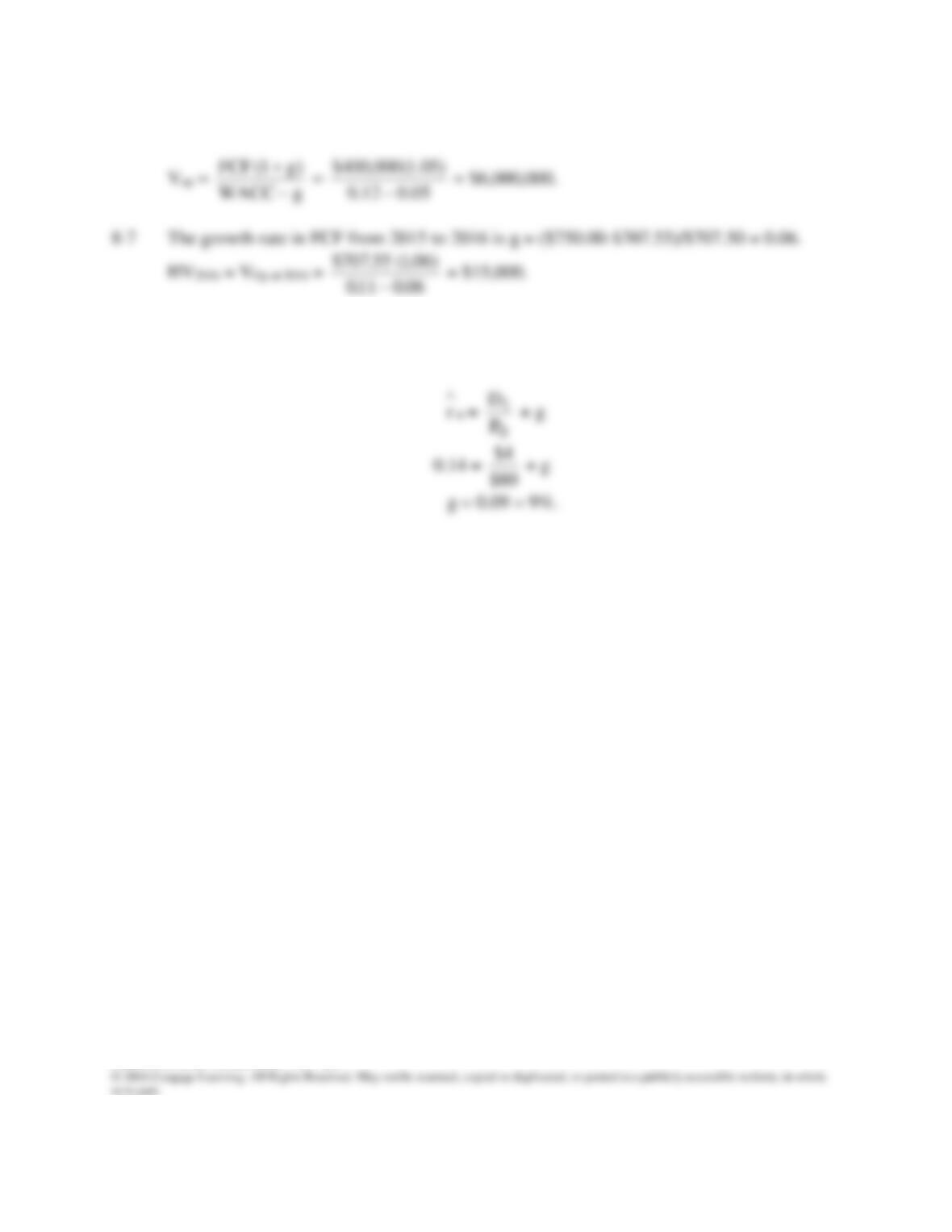
8-6 Value of operations = Vop = PV of expected future free cash flow
8-8 The problem asks you to determine the constant growth rate, given the following facts:
P0 = $80, D1 = $4, and rs = 14%. Use the constant growth rate formula to calculate g:
Answers and Solutions: 8 – 10
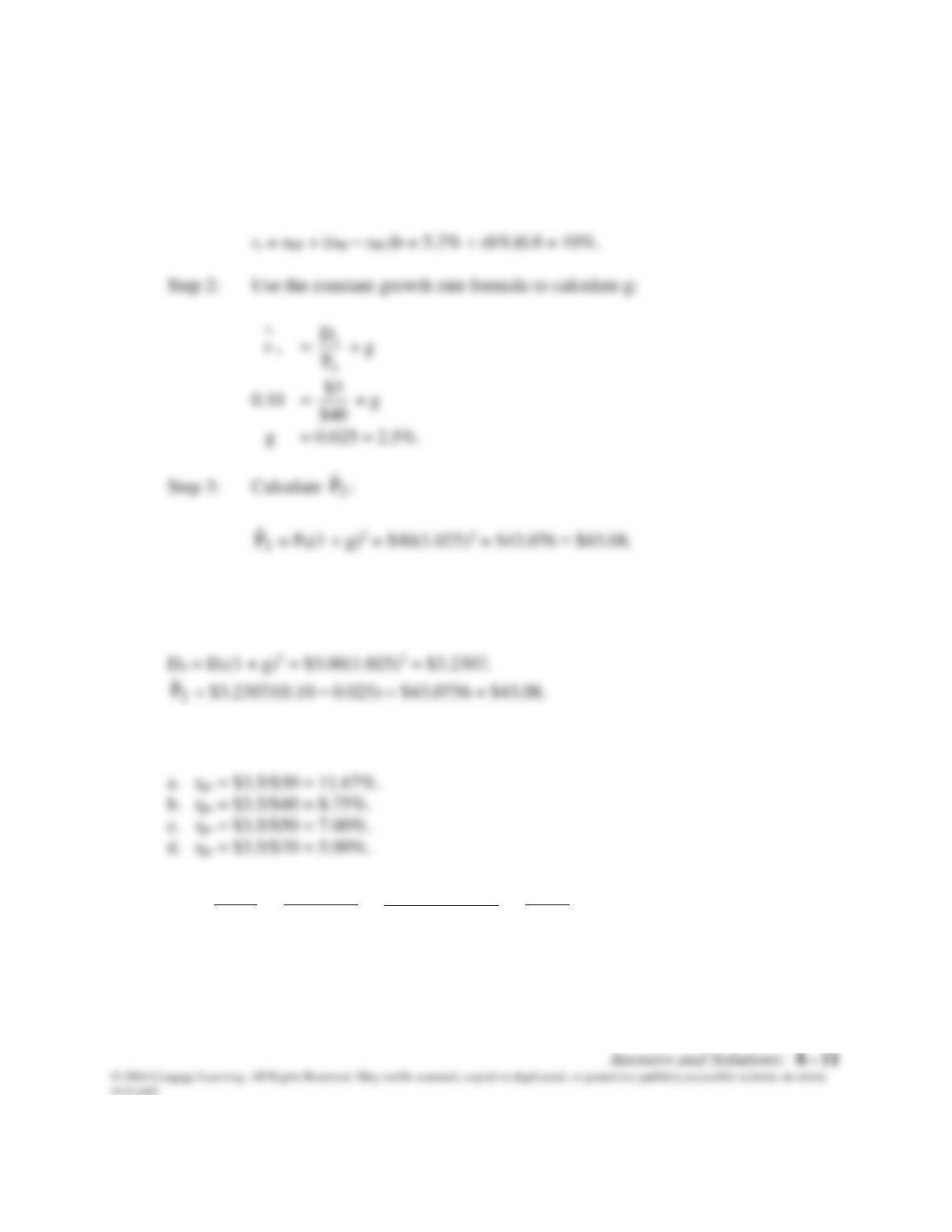
8-9 The problem asks you to determine the value of
3
P
ˆ
, given the following facts: D1 = $3, b
= 0.8, rRF = 5.2%, RPM = 6%, and P0 = $40. Proceed as follows:
Step 1: Calculate the required rate of return:
Alternatively, you could calculate D4 and then use the constant growth rate formula to
solve for
3
P
ˆ
:
3
P
8-10 Vps = Dps/rps; therefore, rps = Dps/Vps.
8-11
0
P
ˆ
=
gr
D
s
1
−
=
gr
)g1(D
s
0
−
+
=
)]04.0(14.0
)]04.0(1[6$
−−
−+
=
18.0
76.5$
= $32.00.
3
P
ˆ
3
P
ˆ
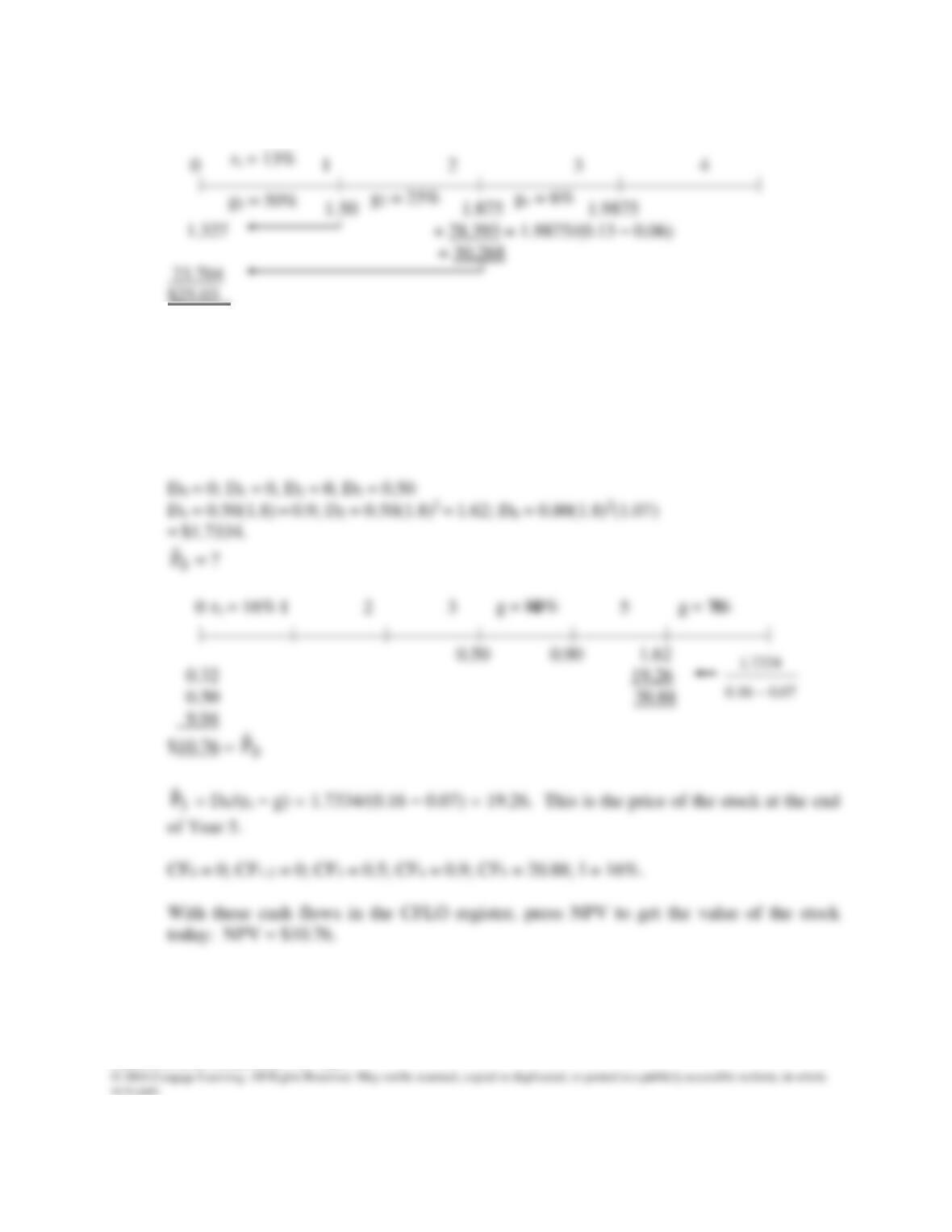
8-12 D0 = $1, rS = 7% + 6% = 13%, g1 = 50%, g2 = 25%, gn = 6%.
8-13 Calculate the dividend stream and place them on a time line. Also, calculate the price of
the stock at the end of the nonconstant growth period, and include it, along with the
dividend to be paid at t = 5, as CF5. Then, enter the cash flows as shown on the time line
into the cash flow register, enter the required rate of return as I = 15, and then find the
value of the stock using the NPV calculation. Be sure to enter CF0 = 0, or else your
answer will be incorrect.
Answers and Solutions: 8 – 12
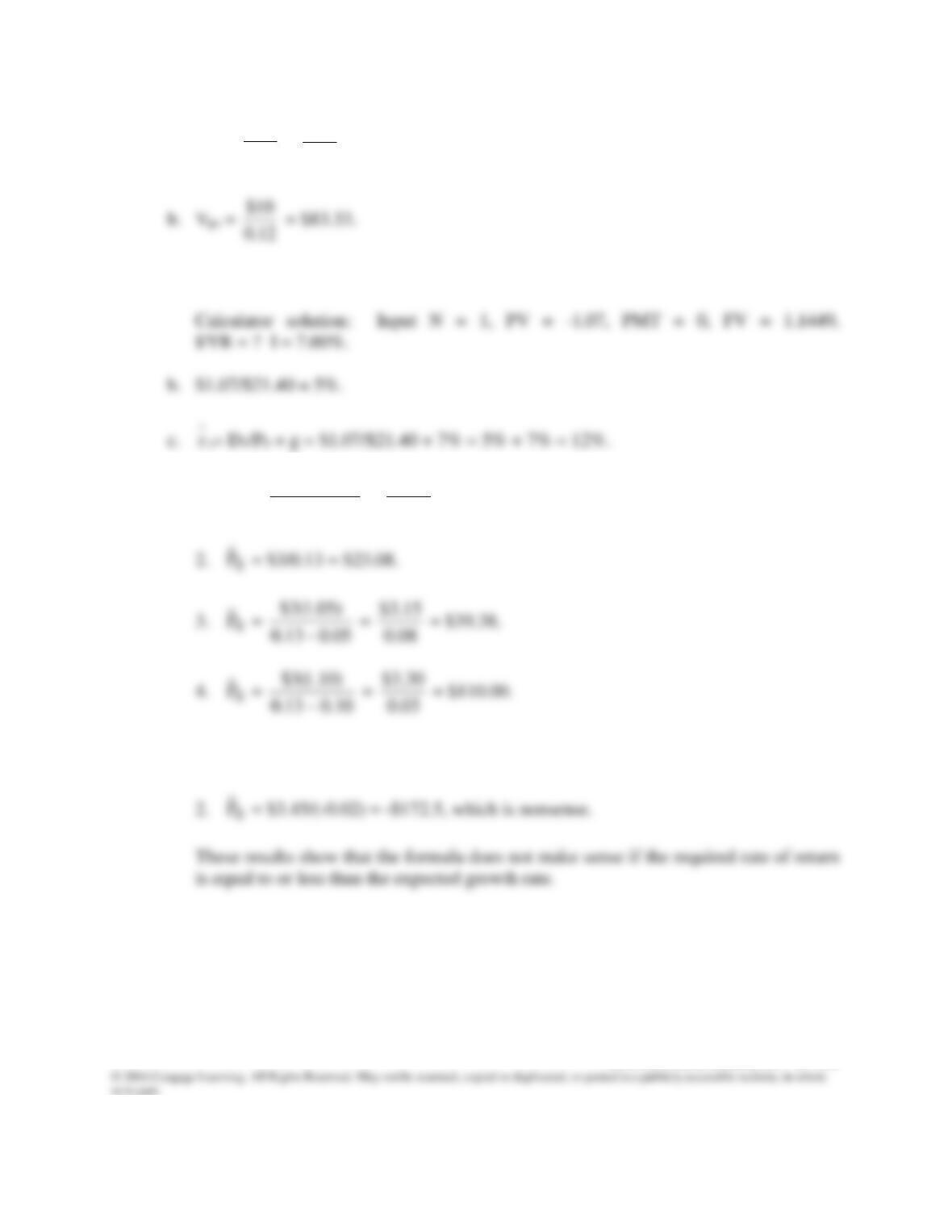
8-14 a. Vps =
ps
ps
r
D
=
08.0
10$
= $125.
8-15 a. g = $1.1449/$1.07 – 1.0 = 7%.
8-16 a. 1.
0
P
ˆ
=
05.013.0
)05.01(3$
+
−
=
18.0
85.2$
= $15.83.
0
P
ˆ
0
P
ˆ
0
P
ˆ
b. 1.
0
P
ˆ
= $3.39/0 = Undefined.
0
P
c. No.
Answers and Solutions: 8 – 13
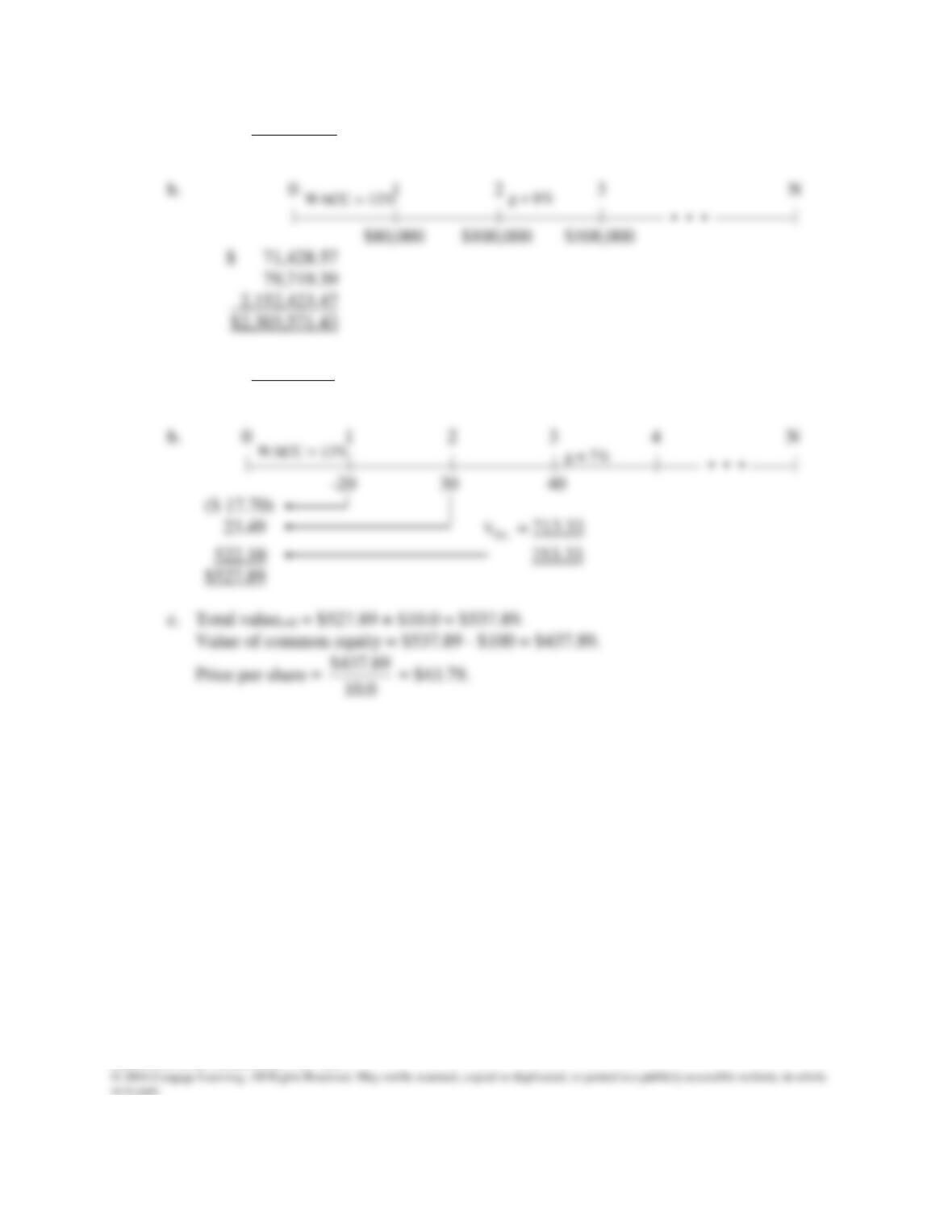
8-17 a. HV2 =
08.012.0
000,108$
−
= $2,700,000.
8-18 a. HV3 =
07.013.0
)07.1( 40$
−
= $713.33.
Answers and Solutions: 8 – 14
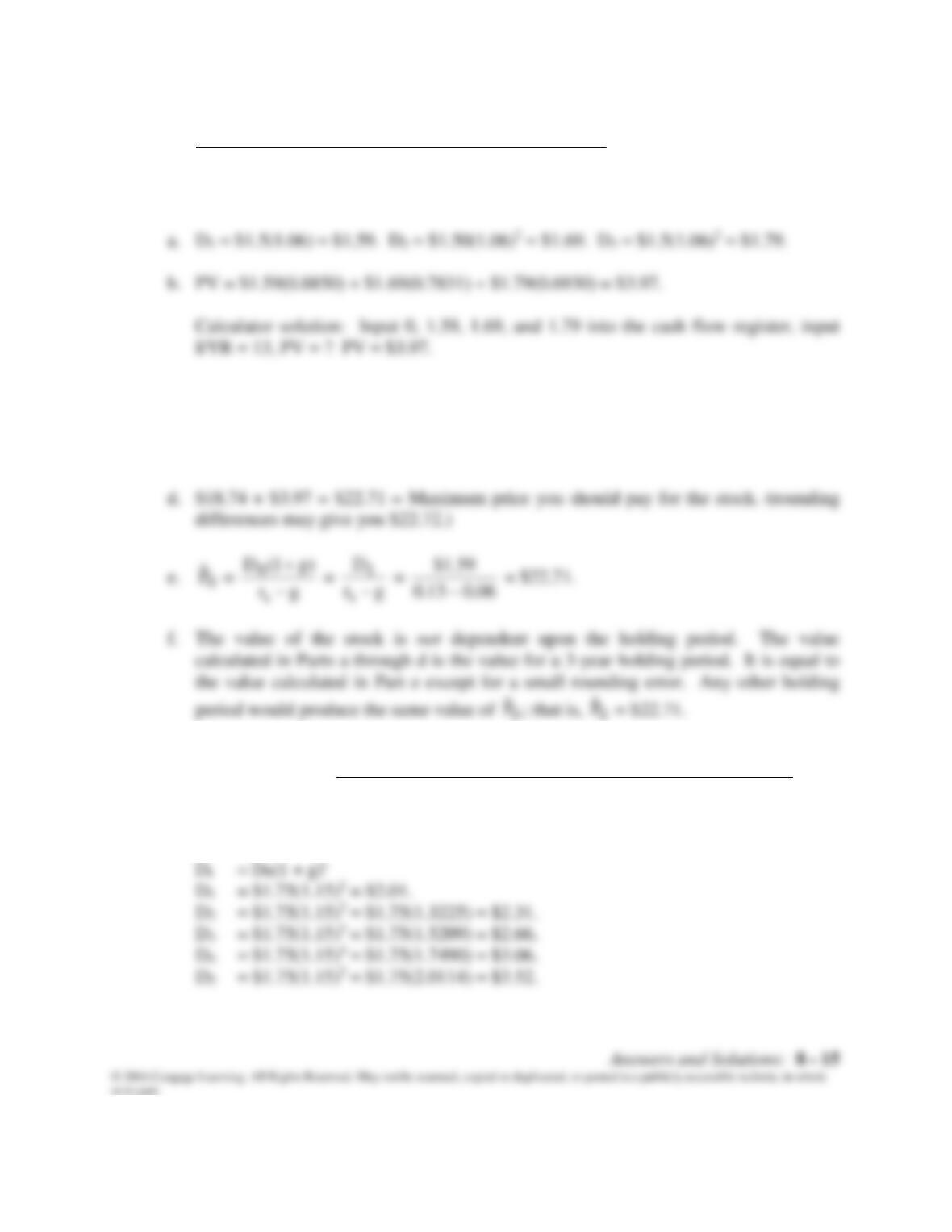
8-19 0 g=6% 1 2 3 4
| | | | |
D0 = 1.50 D1 D2 D3 D4
3
P
ˆ
c. $27.05(0.6930) = $18.74.
Calculator solution: Input 0, 0, 0, and 27.05 into the cash flow register, I/YR = 13,
PV = ? PV = $18.74.
8-20 a. End of Year: 0 1 2 3 4 5 6
| | | | | | |
D0 = 1.75 D1
D2 D3 D4 D5 D6
r = 12%
g = 5%
g = 15%
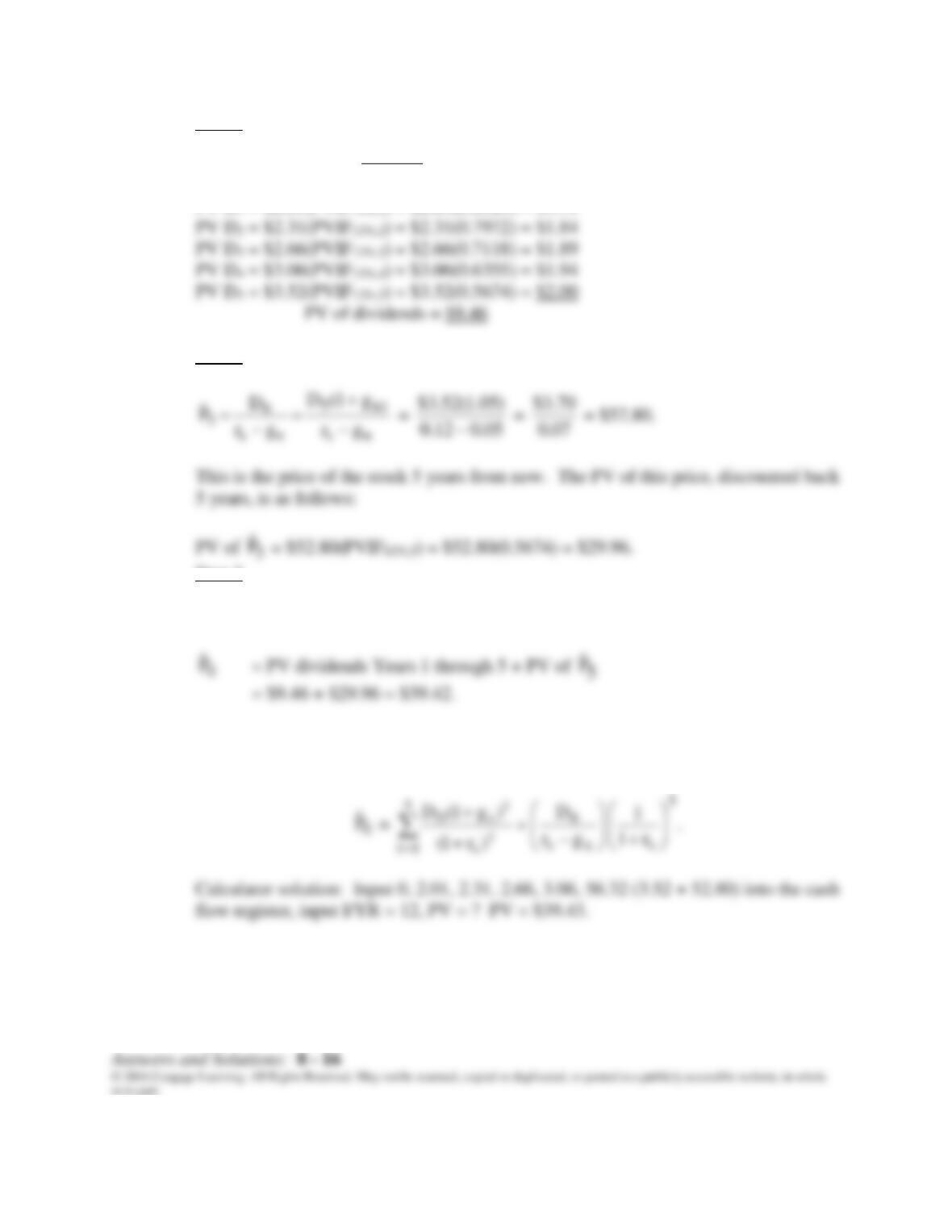
b. Step 1
PV of dividends =
∑
=
+
5
1t t
s
t
)r1(
D
.
PV D1 = $2.01(PVIF12%,1) = $2.01(0.8929) = $1.79
Step 2
Step 3
The price of the stock today is as follows:
This problem could also be solved by substituting the proper values into the following
equation:
c. First Year (t = 0)
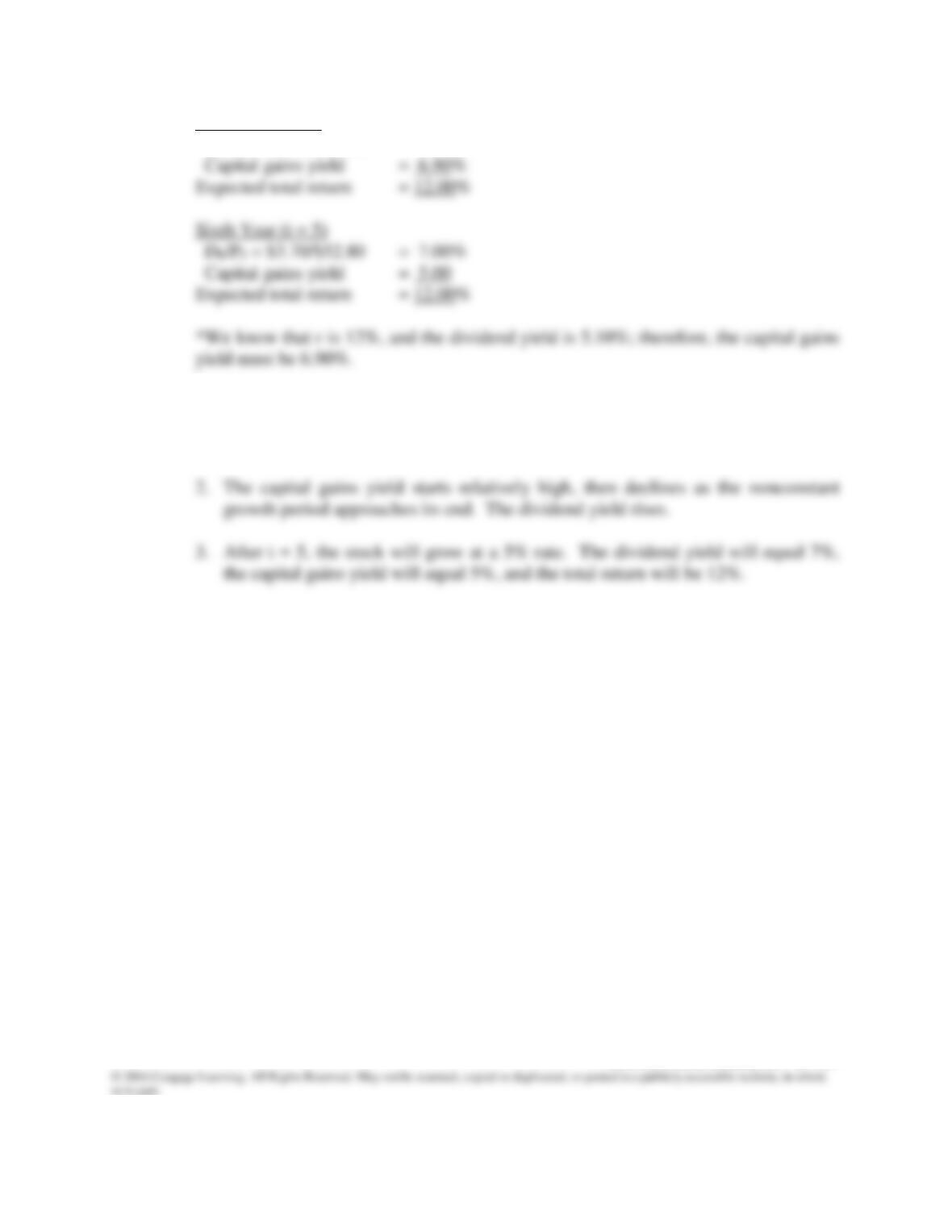
D1/P0 = $2.01/$39.42 = 5.10%
The main points to note here are as follows:
1. The total yield is always 12% (except for rounding errors).
Answers and Solutions: 8 – 17
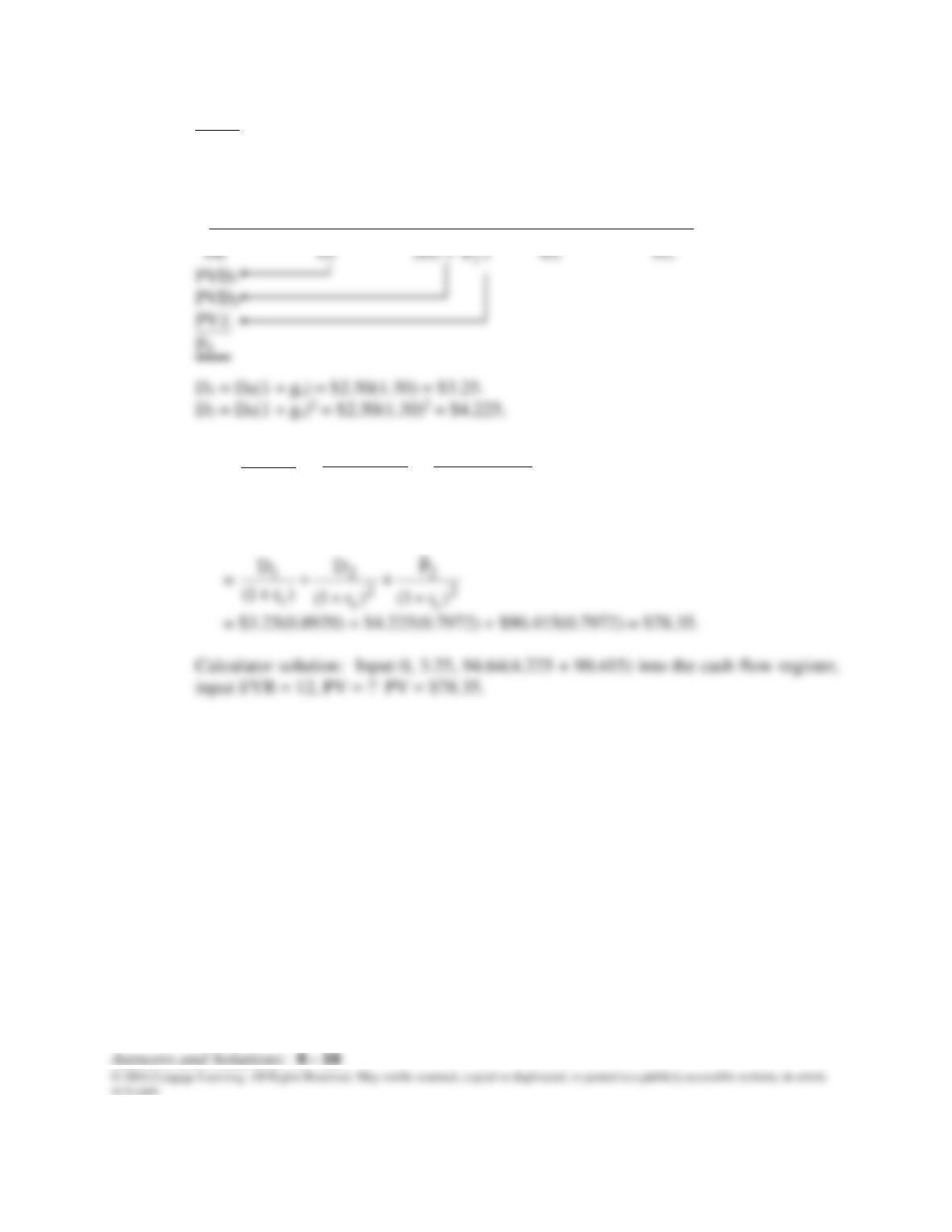
8-21 a. Part 1. Graphical representation of the problem:
Nonconstant Normal
growth growth
0 1 2 3 ∞
| | | | |
ˆ
2
P
ˆ
=
ns
3
gr
D
−
=
ns
n2
gr
)g1(D
−
+
=
07.012.0
)06.1( 225.4$
−
= $90.415.
0
P
ˆ
= PV(D1) + PV(D2) + PV(
2
P
ˆ
)
2
P
P
ˆ
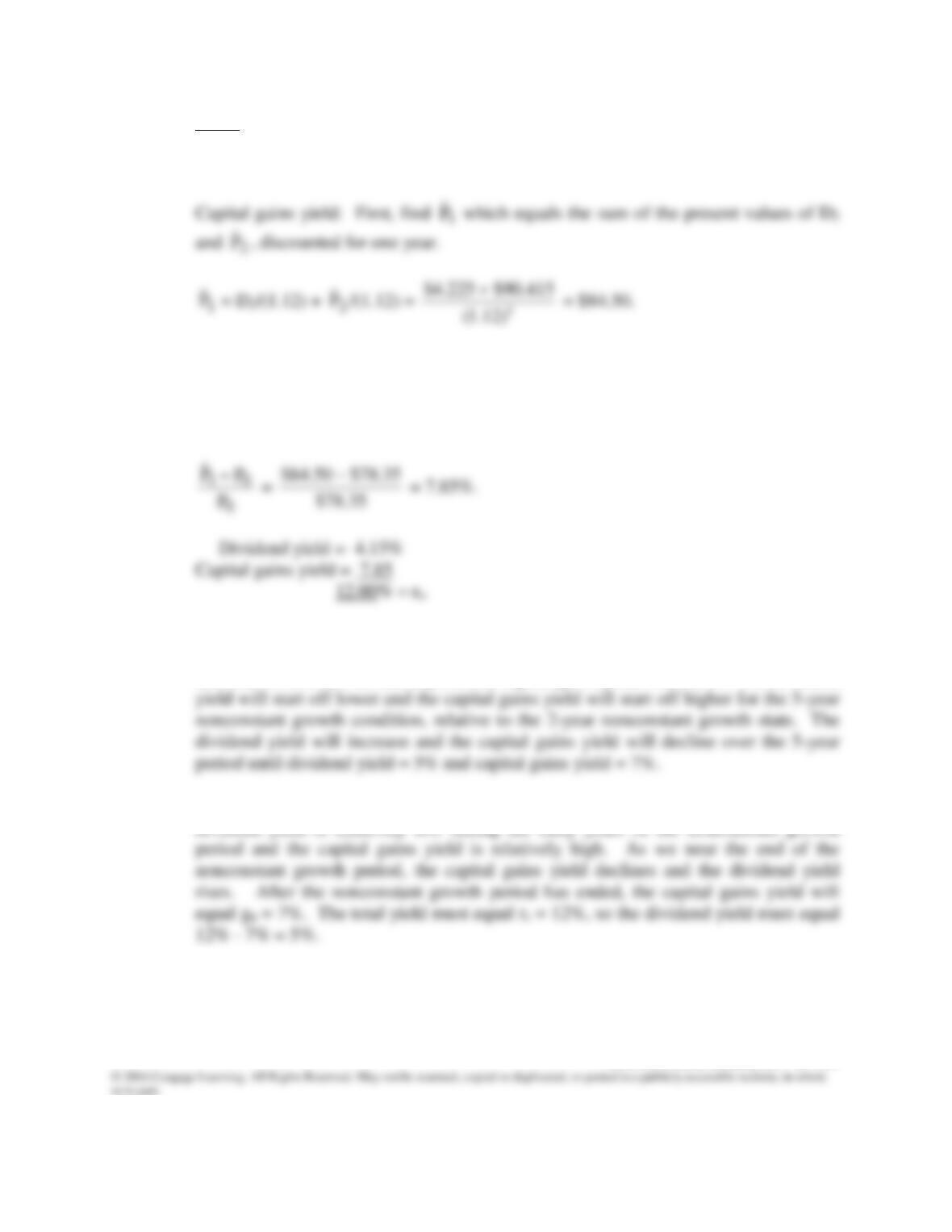
Part 2.
Expected dividend yield: D1/P0 = $3.25/$78.35 = 4.15%.
Calculator solution: Input 0, 94.64 (4.225 + 90.415) into the cash flow register, input
I/YR = 12, PV = ? PV = $84.50.
Second, find the capital gains yield:
b. Due to the longer period of supernormal growth, the value of the stock will be higher
for each year. Although the total return will remain the same, rs = 12%, the
distribution between dividend yield and capital gains yield will differ: The dividend
c. Throughout the nonconstant growth period, the total yield will be 12%, but the
Answers and Solutions: 8 – 19
d. Some investors need cash dividends (retired people) while others would prefer
Answers and Solutions: 8 – 20