1
2
3
4
5
6
7
8
9
10
11
12
13
14
15
16
17
18
19
20
21
24
25
27
28
31
32
33
34
35
36
37
38
39
40
58
59
60
61
62
63
A B C D E F G H I J K L M N
1/6/2015
Situation
Features of Common Stock
Classified Stock
Data for charts
Column1
10
Mkt. Sec. 1
Claims on Value
Pref. Stk. 1
Debt 3
7
a. Describe briefly the legal rights and privileges of common stockholders.
d. Suppose the free cash flow at Time 1 is expected to grow at a constant rate of gL forever. If gL < WACC, what is a formula for
the present value of expected free cash flows when discounted at the WACC? If the most recent free cash flow is expected to
grow at a constant rate of gL forever (and gL < WACC), what is a formula for the present value of expected free cash flows when
discounted at the WACC?
b. What is free cash flow (FCF)? What is the weighted average cost of capital? What is the free cash flow valuation model?
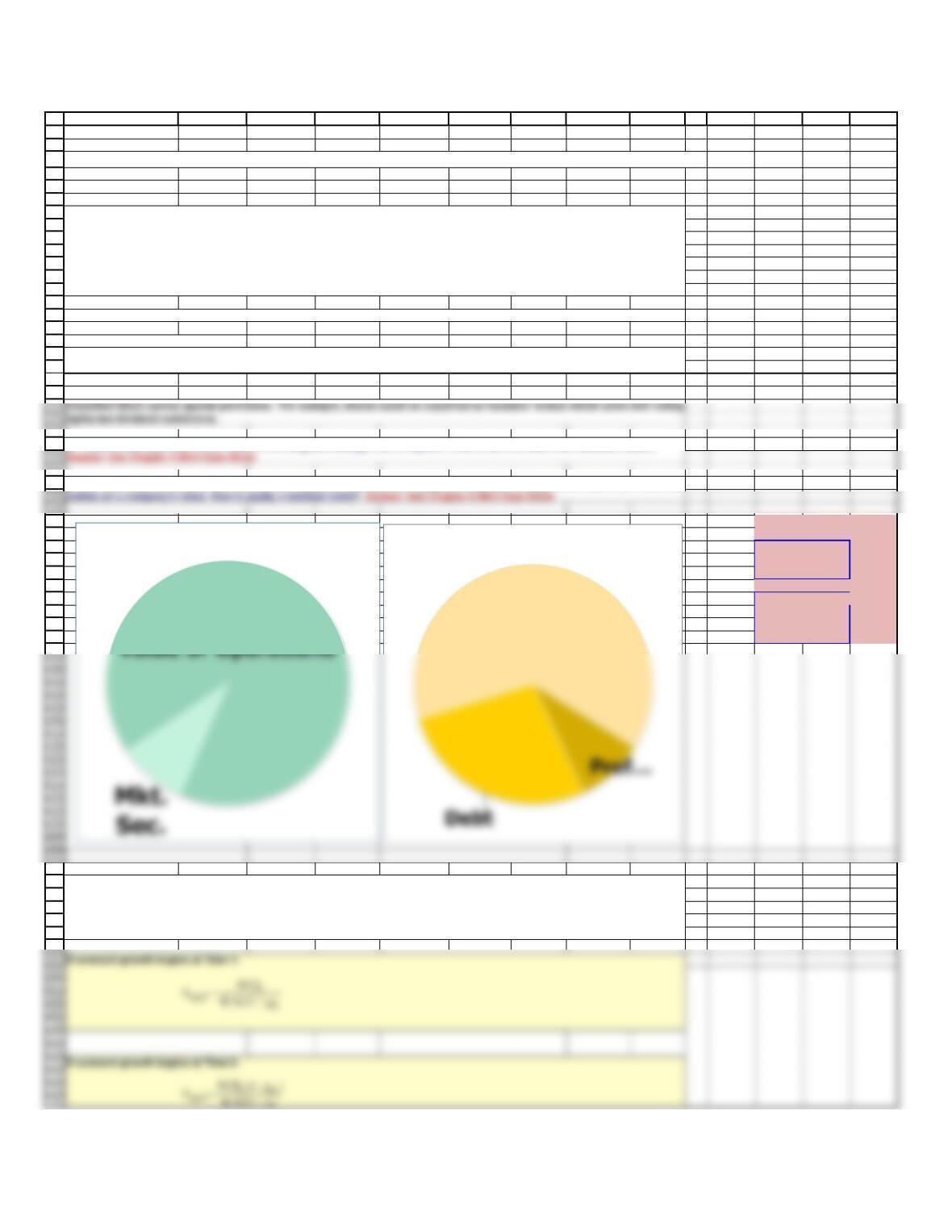
c. Use a pie chart to illustrate the sources that comprise a hypothetical company’s total value. Using another pie chart, show the
Chapter 8 Mini Case
Your employer, a mid-sized human resources management company, is considering expansion into related fields, including the
acquisition of Temp Force Company, an employment agency that supplies word processor operators and computer
programmers to businesses with temporary heavy workloads. Your employer is also considering the purchase of a Biggerstaff &
McDonald (B&M), a privately held company owned by two friends, each with 5 million shares of stock. B&M currently has free
cash flow of $24 million, which is expected to grow at a constant rate of 5%. B&M’s financial statements report marketable
securities of $100 million, debt of $200 million, and preferred stock of $50 million. B&M’s weighted average cost of capital
(WACC) is 11%. Answer the following questions.
1. Common Stock represents ownership. 2. Ownership implies control. 3. Stockholders elect directors. 4. Directors hire
management who attempt to maximize stock price.
Equity