Introduction to Corporate Finance, Fourth Edition Booth, Cleary, Rakita
Chapter 7: Equity Valuation
Multiple Choice Questions
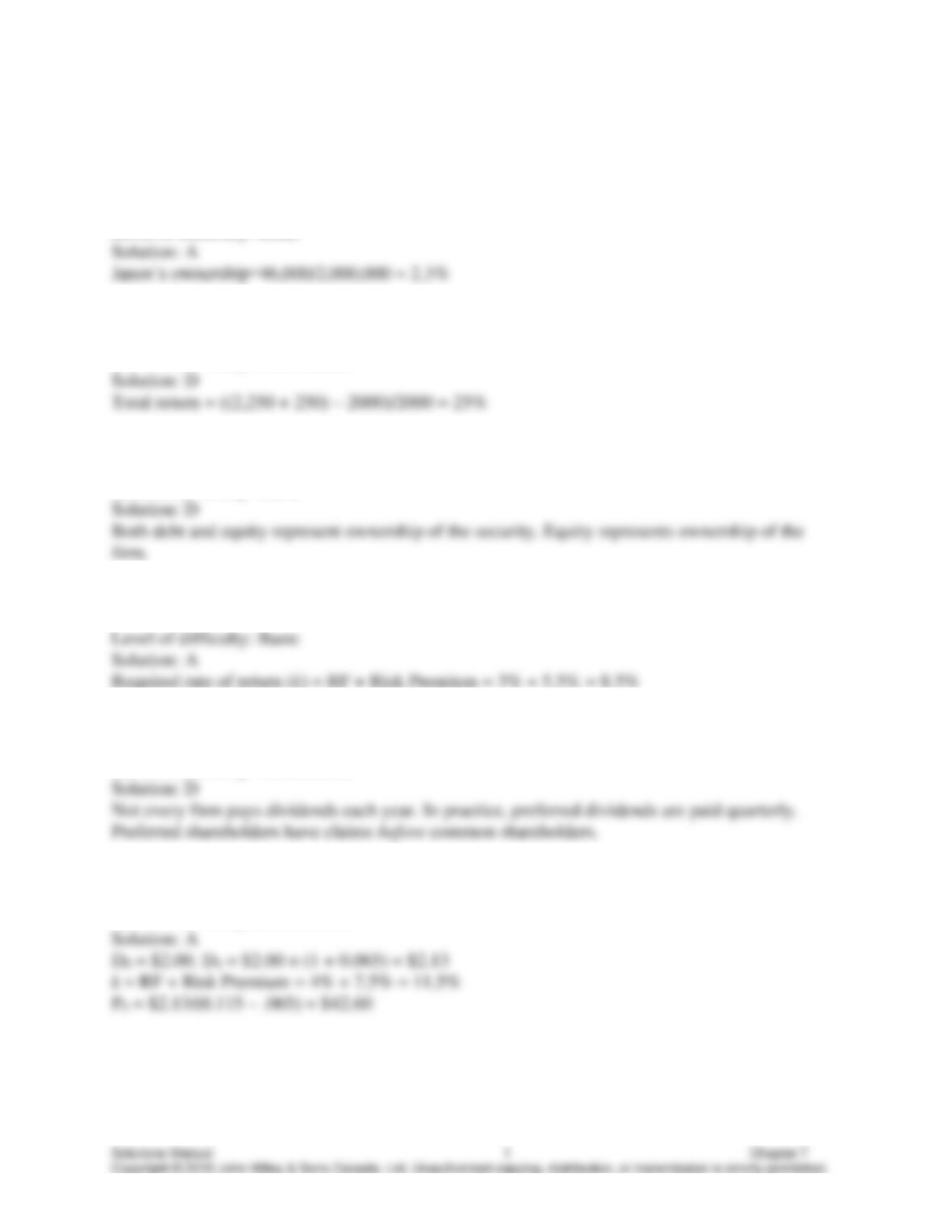
1. Section: 7.1 Equity Securities
Learning Objective: 7.1
Level of difficulty: Basic
2. Section: 7.1 Equity Securities
Learning Objective: 7.1
Level of difficulty: Intermediate
3. Section: 7.1 Equity Securities
Learning Objective: 7.1
Level of difficulty: Basic
4. Section: 7.1 Equity Securities
Learning Objective: 7.1
5. Section: 7.3 Common Share Valuation: The Dividend Discount Model (DDM)
Learning Objective: 7.3
Level of difficulty: Intermediate
6. Section: 7.3 Common Share Valuation: The Dividend Discount Model (DDM)
Learning Objective: 7.3
Level of difficulty: Intermediate
7. Section: 7.3 Common Share Valuation: The Dividend Discount Model (DDM)
Learning Objective: 7.3
Level of difficulty: Intermediate
Introduction to Corporate Finance, Fourth Edition Booth, Cleary, Rakita
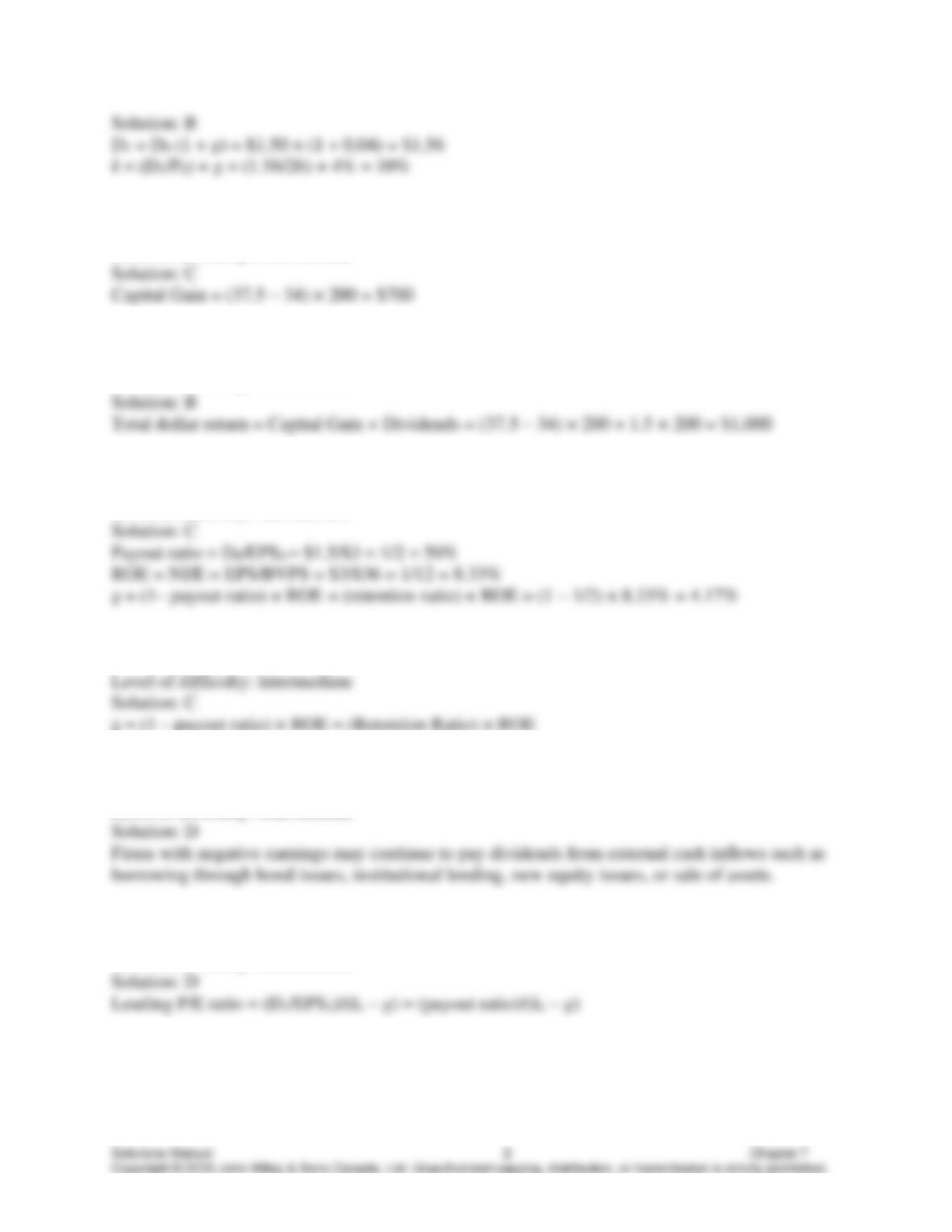
8. Section: 7.2 Preferred Share Valuation
Learning Objective: 7.2
Level of difficulty: Intermediate
9. Section: 7.1 Equity Securities
Learning Objective: 7.1
Level of difficulty: Intermediate
10. Section: 7.3 Common Share Valuation: The Dividend Discount Model (DDM)
Learning Objective: 7.3
Level of difficulty: Intermediate
11. Section: 7.3 Common Share Valuation: The Dividend Discount Model (DDM)
Learning Objective: 7.3
12. Section: 7.3 Common Share Valuation: The Dividend Discount Model (DDM)
Learning Objective: 7.3
Level of difficulty: Intermediate
13. Section: 7.4 Using Multiples to Value Shares
Learning Objective: 7.4
Level of difficulty: Intermediate
14. Section: 7.4 Using Multiples to Value Shares
Learning Objective: 7.4
Level of difficulty: Basic
Introduction to Corporate Finance, Fourth Edition Booth, Cleary, Rakita
Practice Problems
Basic
15. Section: 7.2 Preferred Share Valuation
Learning Objective: 7.2
Level of difficulty: Basic
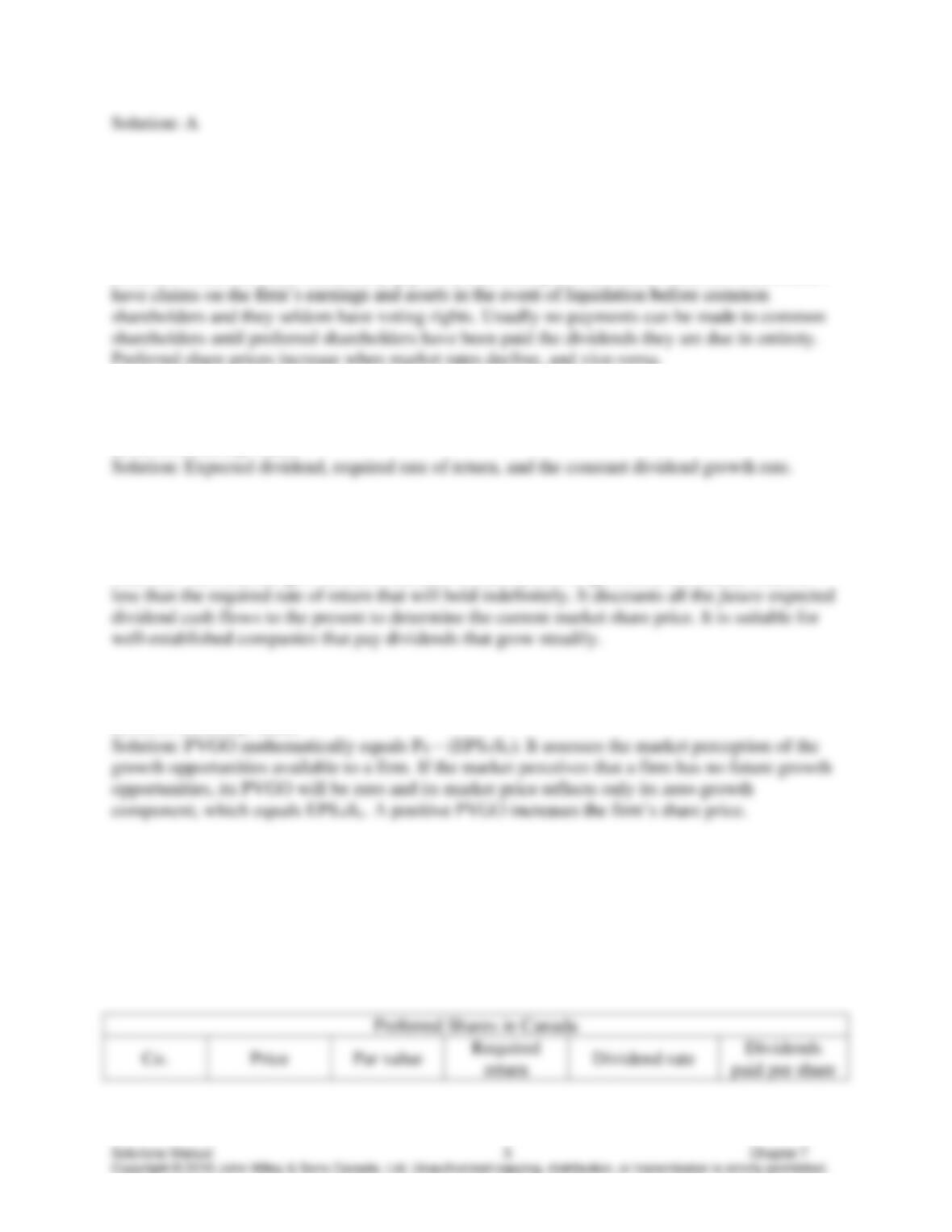
Solution: Preferred shares essentially pay a fixed amount just like bonds. Preferred shareholders
Preferred share prices increase when market rates decline, and vice-versa.
16. Section: 7.3 Common Share Valuation: The Dividend Discount Model (DDM)
Learning Objective: 7.3
Level of difficulty: Basic
17. Section: 7.3 Common Share Valuation: The Dividend Discount Model (DDM)
Learning Objective: 7.3
Level of difficulty: Basic
Solution: The constant growth DDM assumes a constant rate of growth in dividends, which is
18. Section: 7.3 Common Share Valuation: The Dividend Discount Model (DDM)
Learning Objective: 7.3
Level of difficulty: Basic
19. Section: 7.2 Preferred Share Valuation
Learning Objective: 7.2
Level of difficulty: Basic
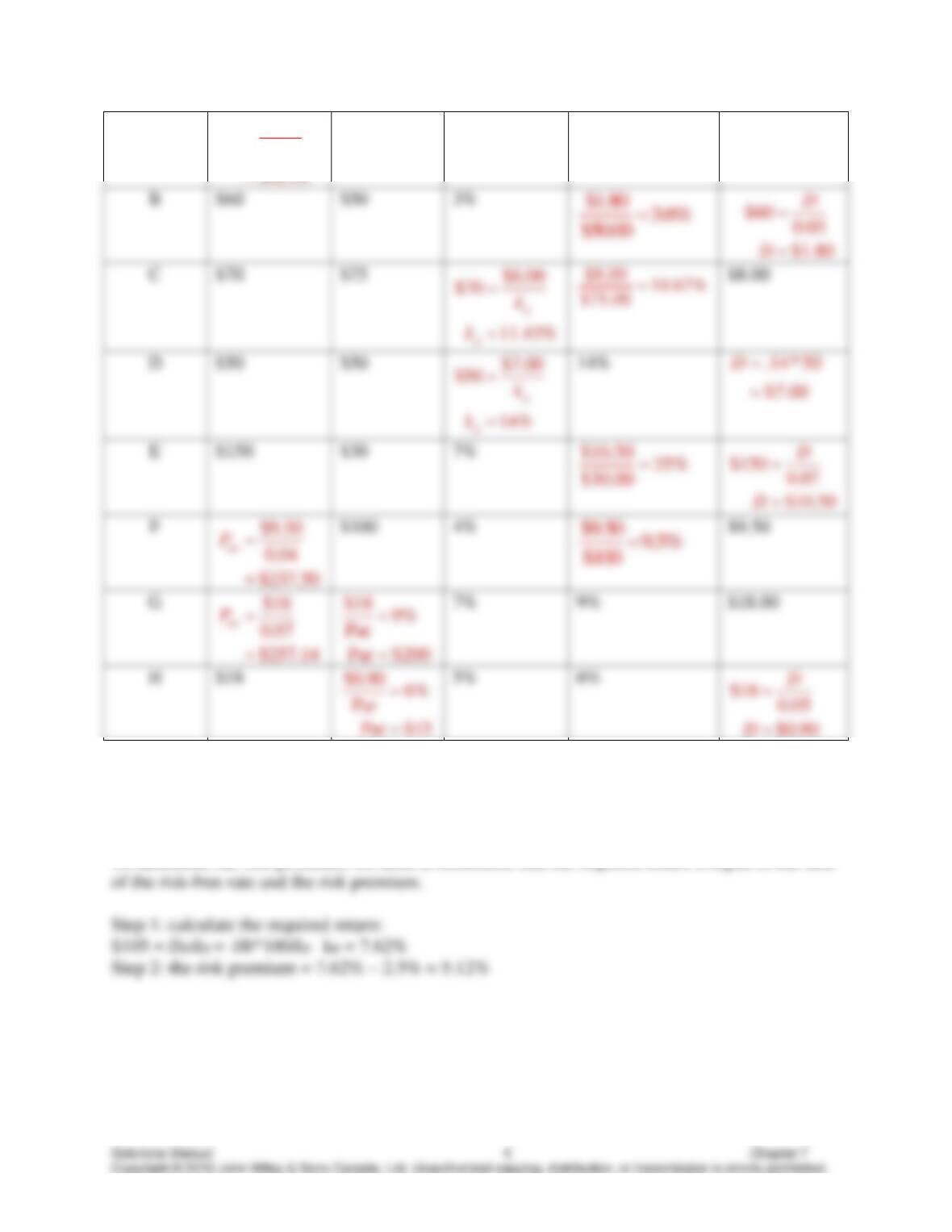
Solution:
Solving these questions involves the algebraic manipulation of the preferred share valuation
formula.
Introduction to Corporate Finance, Fourth Edition Booth, Cleary, Rakita
A
B
$60
$50
3%
$150
$30
7%
$100
4%
$9.50
H
$18
5%
6%
$5.00
0.08
ps
P=
$100
8%
5%
$5.00
20. Section: 7.1 Equity Securities
Learning Objective: 7.1
Level of difficulty: Basic
Solution:
To determine the risk premium, we need to remember that the required return is equal to the sum
21. Section: 7.3 Common Share Valuation: The Dividend Discount Model (DDM)
Learning Objective: 7.3
Level of difficulty: Basic
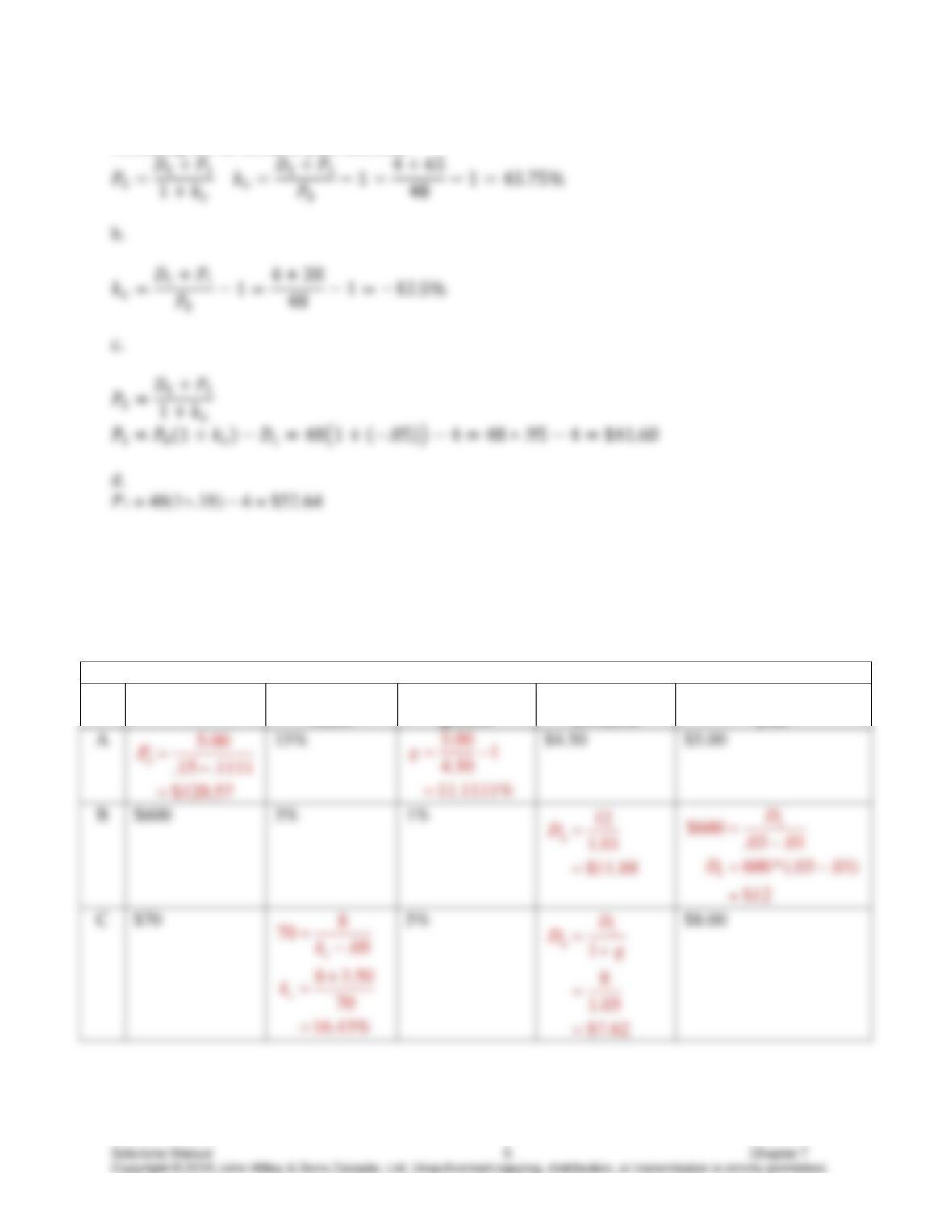
Solution:
Introduction to Corporate Finance, Fourth Edition Booth, Cleary, Rakita
a.
Assuming the dividend is paid annually:
22. Section: 7.3 Common Share Valuation: The Dividend Discount Model (DDM)
Learning Objective: 7.3
Level of difficulty: Basic
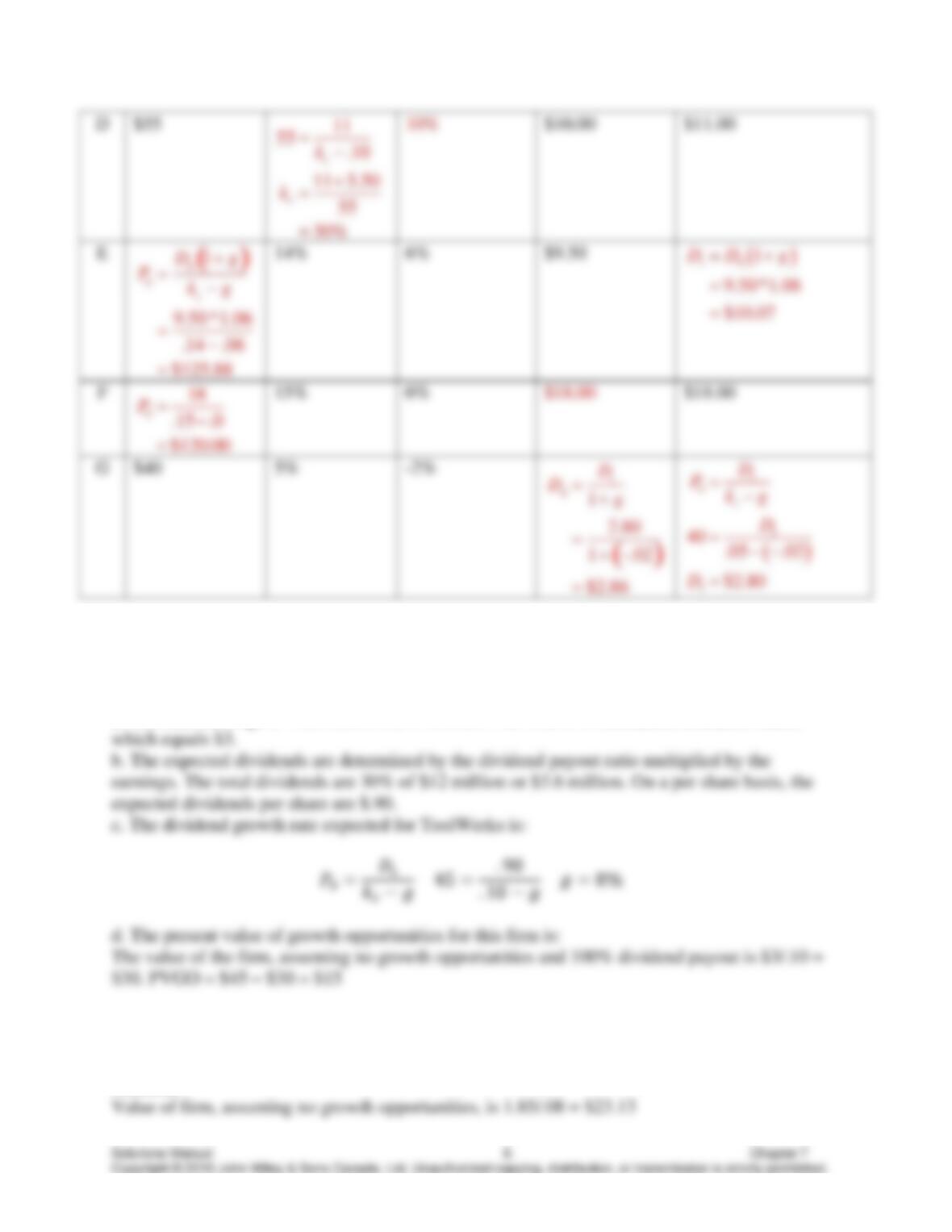
Solution:
Solving these requires algebraic manipulation of the dividend discount formula.
Common Shares in Canada
Co.
Price
Required
return
Dividend
growth
Current
dividend
Dividend expected in 1
year
Introduction to Corporate Finance, Fourth Edition Booth, Cleary, Rakita
23. Section: 7.3 Common Share Valuation: The Dividend Discount Model (DDM)
Learning Objective: 7.3
Level of difficulty: Basic
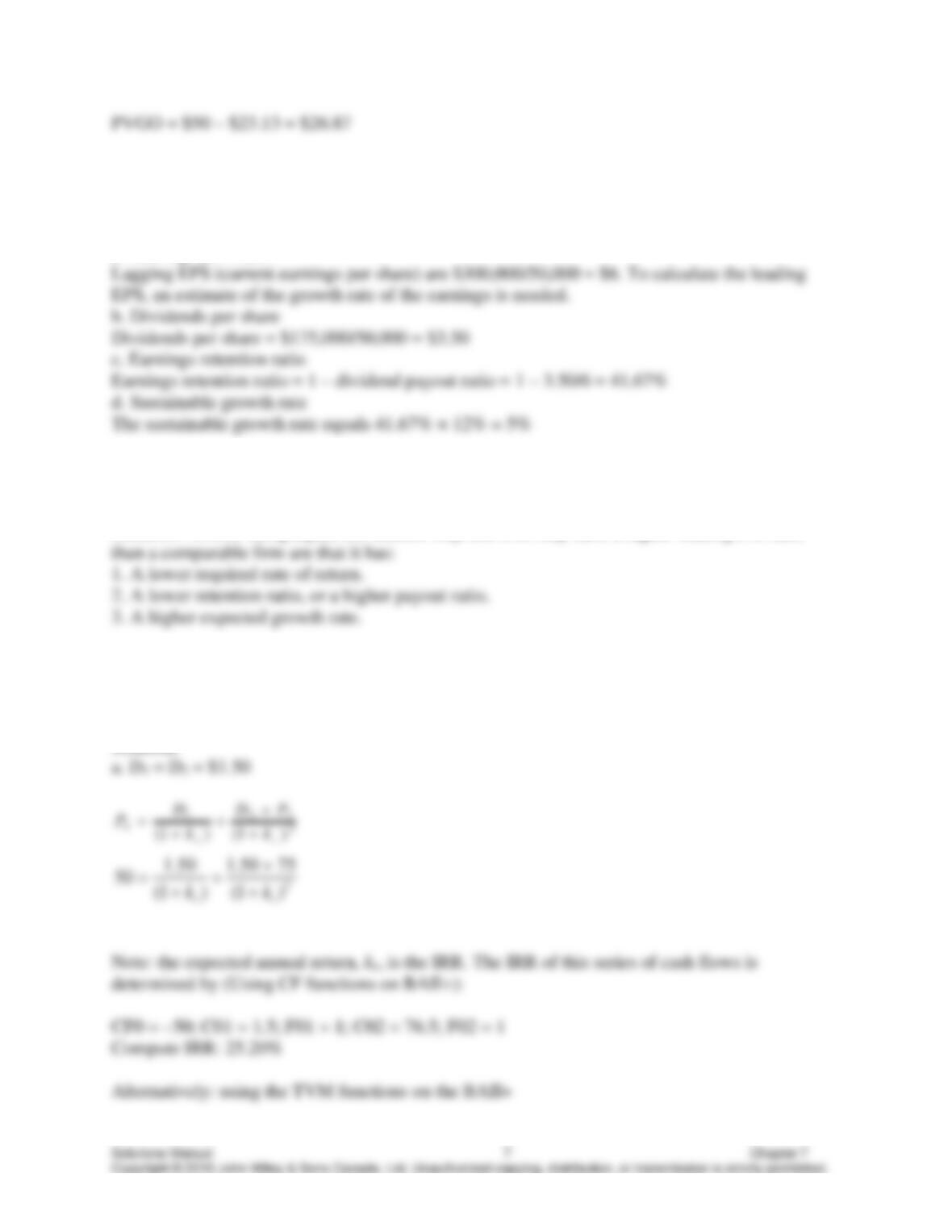
Solution:
a. The total earnings of ToolWerks is $12 million. The EPS is $12,000,000/4,000,000 shares
24. Section: 7.3 Common Share Valuation: The Dividend Discount Model (DDM)
Learning Objective: 7.3
Level of difficulty: Basic
Solution:
Introduction to Corporate Finance, Fourth Edition Booth, Cleary, Rakita
25. Section: 7.3 Common Share Valuation: The Dividend Discount Model (DDM)
Learning Objective: 7.3
Level of difficulty: Basic
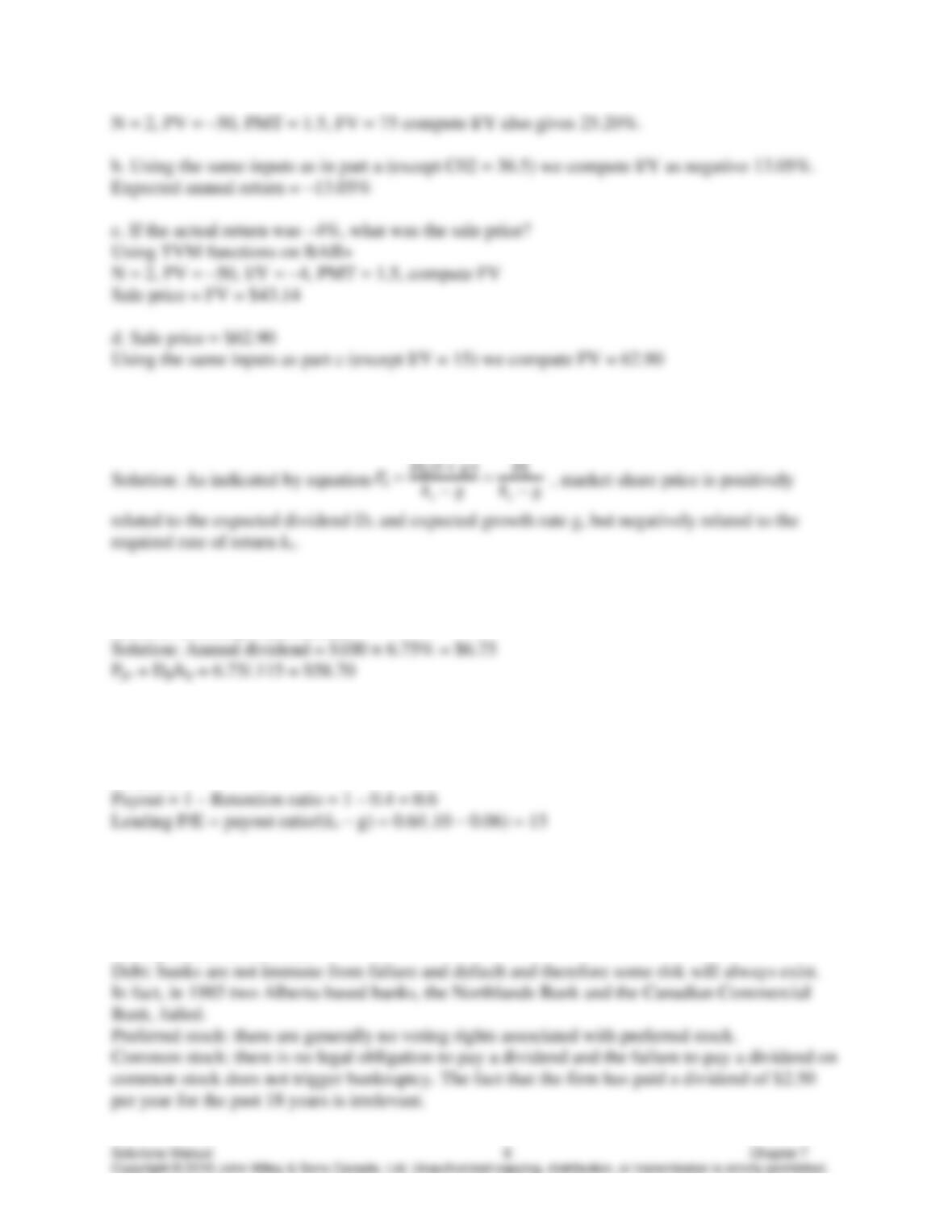
Solution:
a. Earnings per share.
26. Section: 7.4 Using Multiples to Value Shares
Learning Objective: 7.4
Level of difficulty: Basic
Solution: All else being equal, the reasons why one firm may have a higher leading P/E ratio
Intermediate
27. Section: 7.3 Common Share Valuation: The Dividend Discount Model (DDM)
Learning Objective: 7.3
Level of difficulty: Intermediate
Solution:
Introduction to Corporate Finance, Fourth Edition Booth, Cleary, Rakita
28. Section: 7.3 Common Share Valuation: The Dividend Discount Model (DDM)
Learning Objective: 7.3
Level of difficulty: Intermediate
29. Section: 7.2 Preferred Share Valuation
Learning Objective: 7.2
Level of difficulty: Intermediate
30. Section: 7.4 Using Multiples to Value Shares
Learning Objective: 7.4
Level of difficulty: Intermediate
Solution:
31. Section: 7.3 Common Share Valuation: The Dividend Discount Model (DDM)
Learning Objective: 7.3
Level of difficulty: Intermediate
Solution:
No, my broker is incorrect.
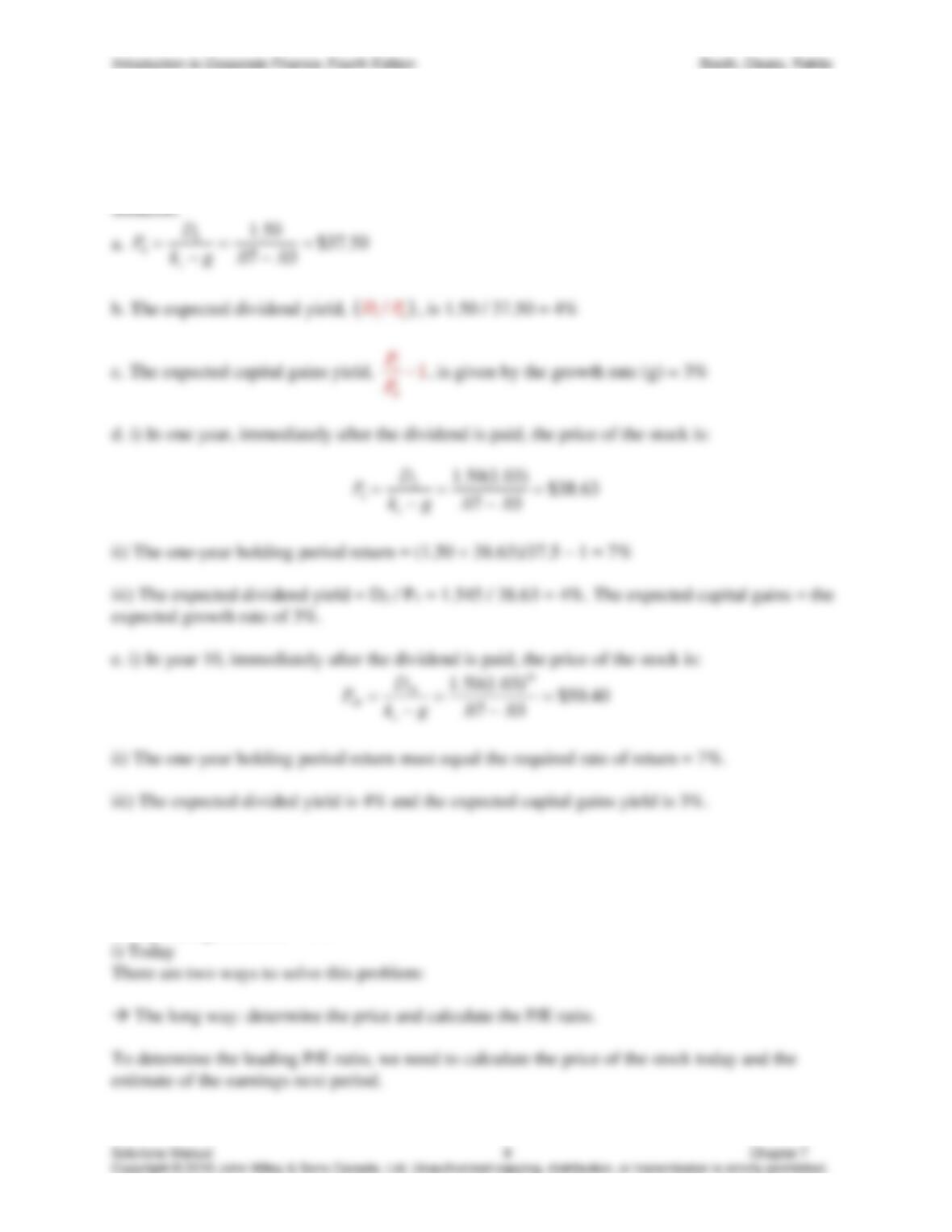
32. Section: 7.3 Common Share Valuation: The Dividend Discount Model (DDM)
Learning Objective: 7.3
Level of difficulty: Intermediate
33. Section: 7.4 Using Multiples to Value Shares
Learning Objective: 7.4
Level of difficulty: Intermediate
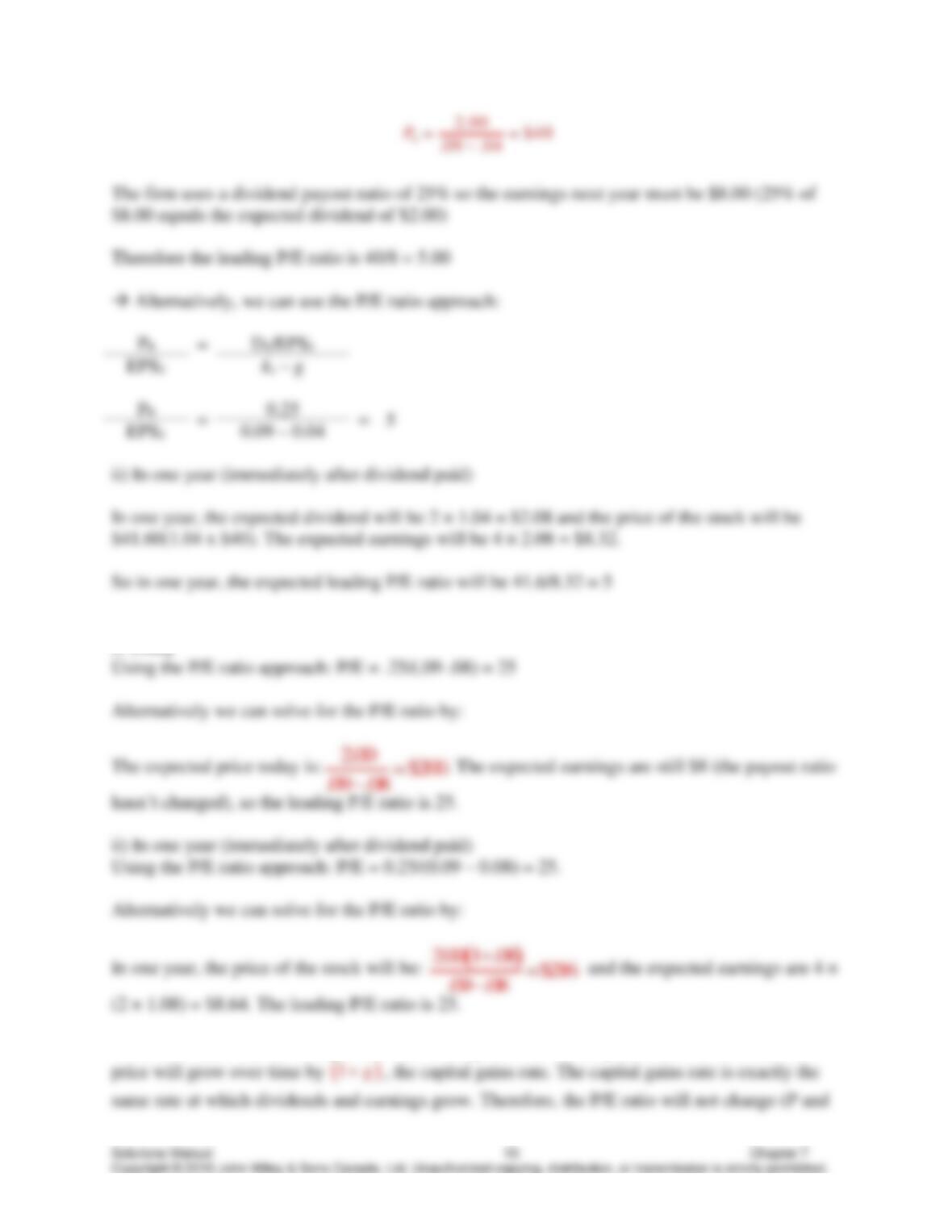
Solution:
a. Expected growth rate = 4%
Introduction to Corporate Finance, Fourth Edition Booth, Cleary, Rakita
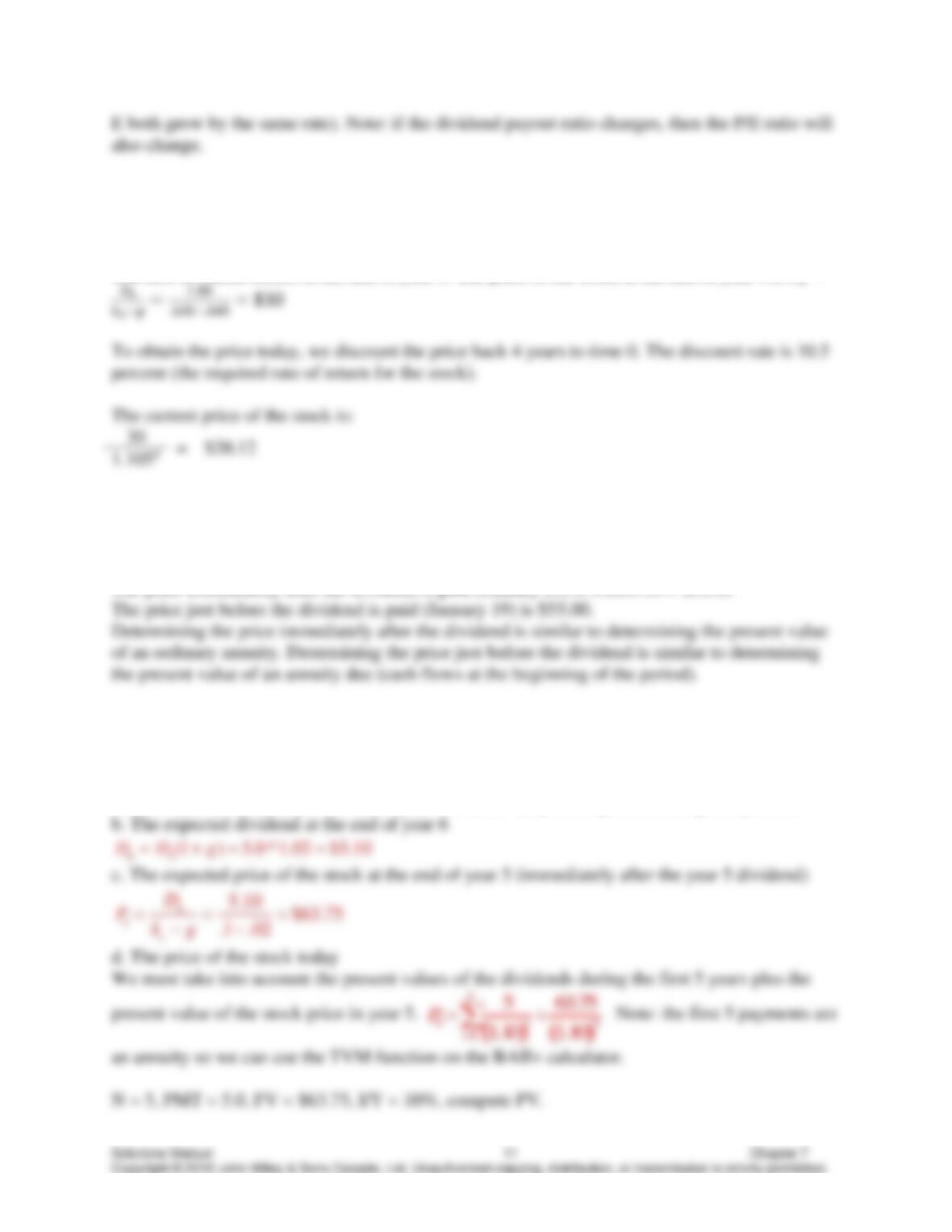
b. Expected growth rate = 8%
i) Today
c. The P/E ratio will not change over time as long as the dividend payout ratio is constant. The
Introduction to Corporate Finance, Fourth Edition Booth, Cleary, Rakita
34. Section: 7.3 Common Share Valuation: The Dividend Discount Model (DDM)
Learning Objective: 7.3
Level of difficulty: Intermediate
Solution:
The first dividend occurs at the end of year 5. The price of the stock at the end of year 4 is 𝑃4=
35. Section: 7.3 Common Share Valuation: The Dividend Discount Model (DDM)
Learning Objective: 7.3
Level of difficulty: Intermediate
Solution:
The price immediately after the dividend is paid (January 21) is 5.00/0.10 = $50.00
36. Section: 7.3 Common Share Valuation: The Dividend Discount Model (DDM)
Learning Objective: 7.3
Level of difficulty: Intermediate
Solution:
a. The expected dividend at the end of year 5 is $5.00 (expect no growth during this period)
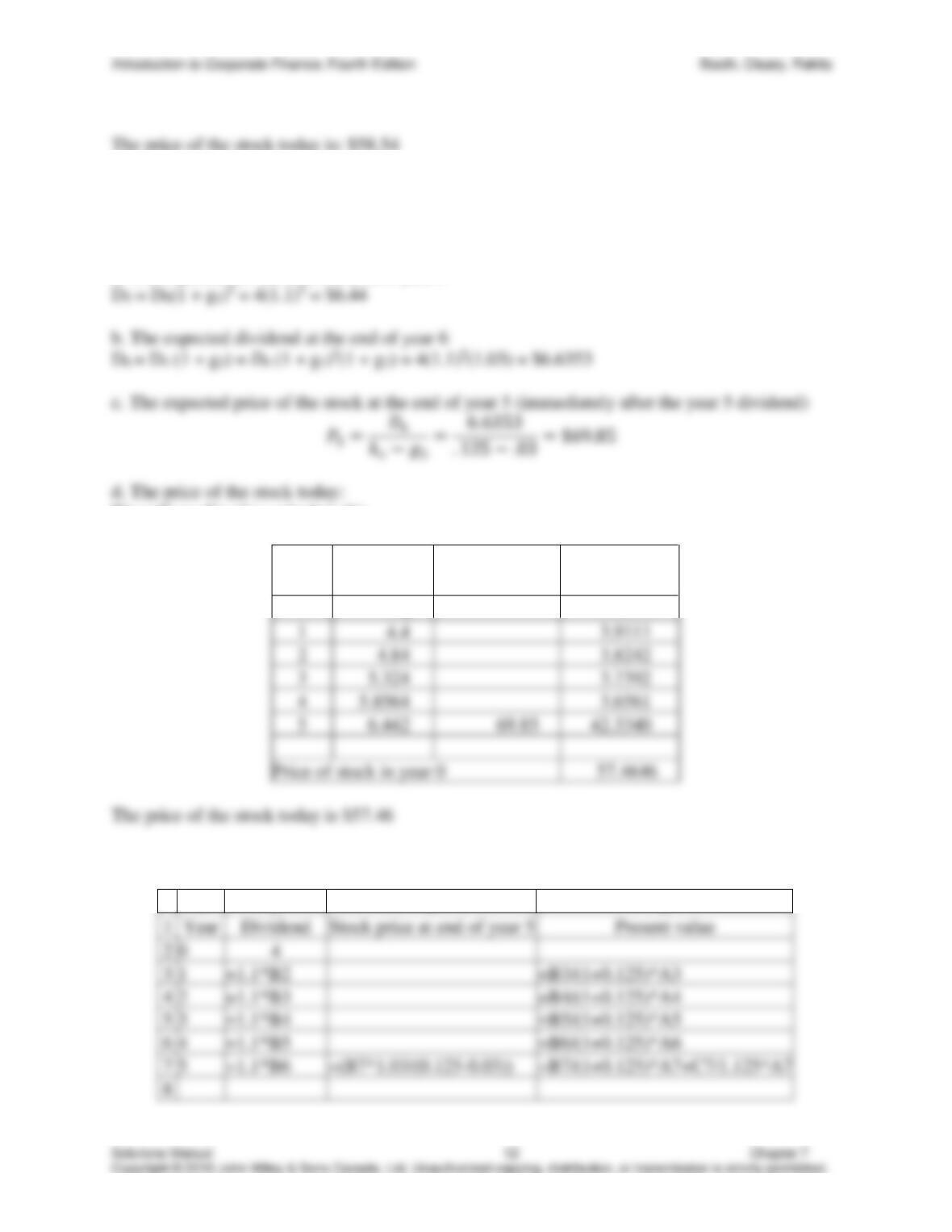
37. Section: 7.3 Common Share Valuation: The Dividend Discount Model (DDM)
Learning Objective: 7.3
Level of difficulty: Intermediate
Solution:
a. The expected dividend at the end of year 5
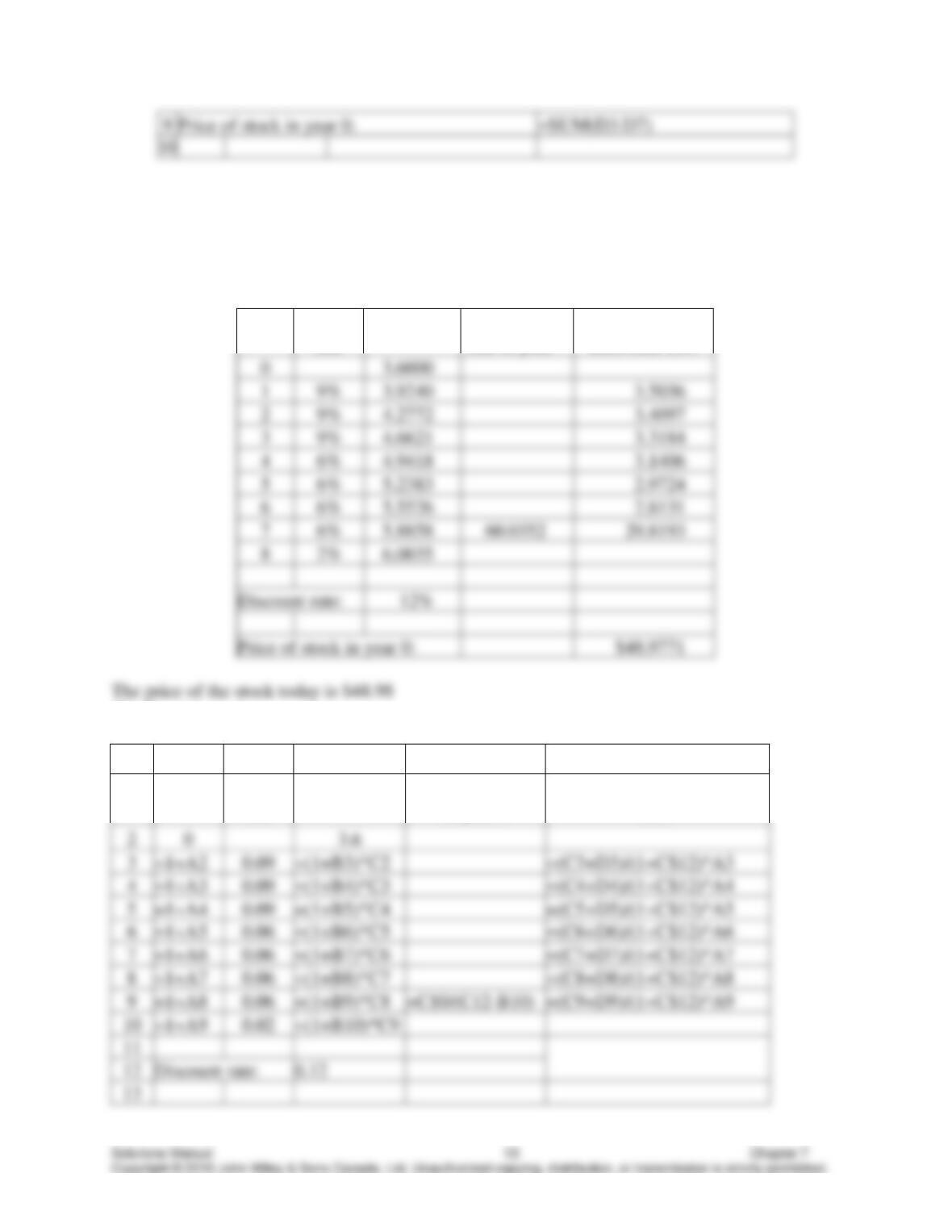
We will use Excel to calculate this.
Year
Dividend
Stock price at
end of year 5
Present value
4
4.84
42.3340
Price of stock in year 0
The formulas used in Excel are given below:
A
B
C
D
0
=B3/(1+0.125)^A3
=B4/(1+0.125)^A4
=B5/(1+0.125)^A5
=B6/(1+0.125)^A6
Introduction to Corporate Finance, Fourth Edition Booth, Cleary, Rakita
38. Section: 7.3 Common Share Valuation: The Dividend Discount Model (DDM)
Learning Objective: 7.3
Level of difficulty: Intermediate
Solution:
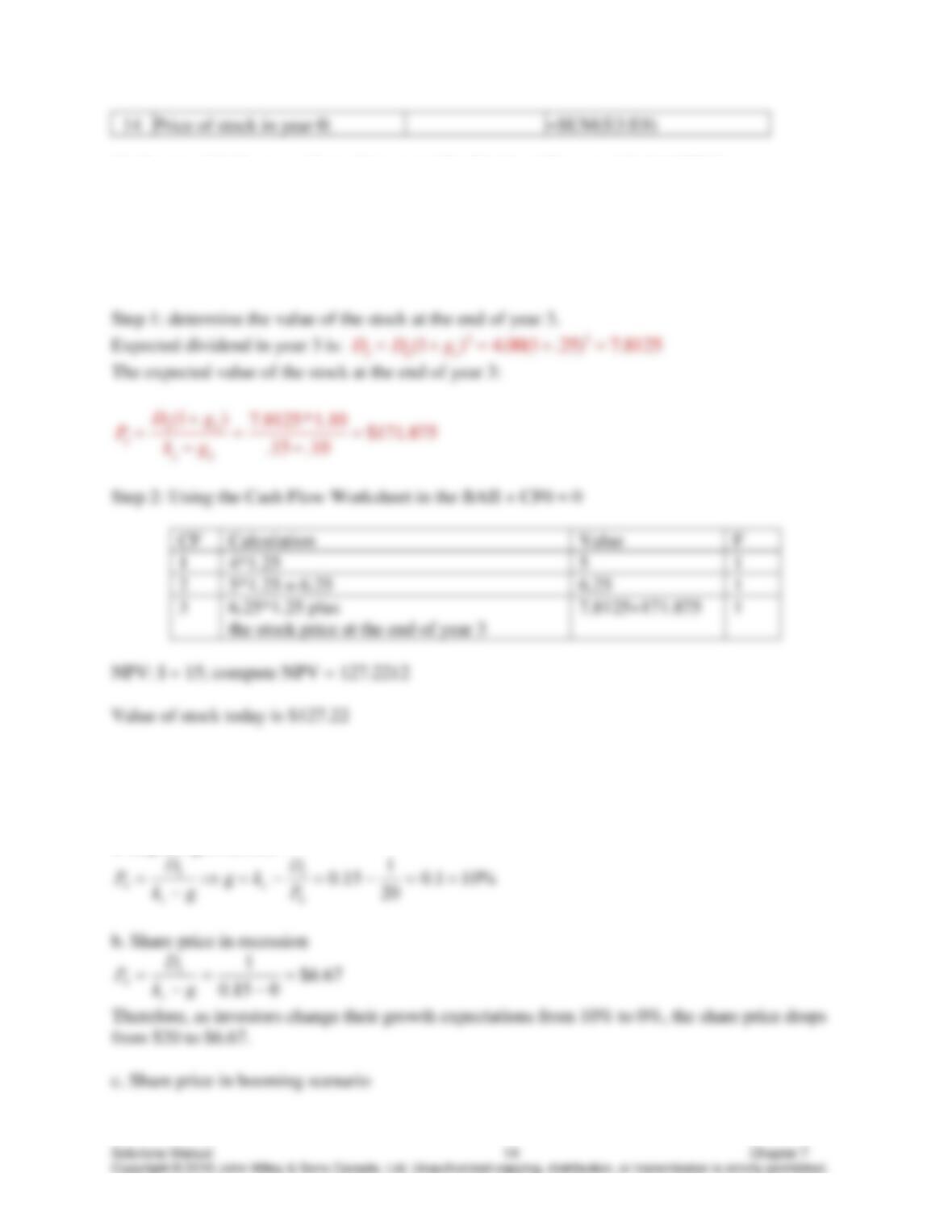
The easiest way to solve this problem is to use Excel.
Year
Growth
rate
Dividend
Stock price at
end of year 7
Present value of
each cash flow
The Excel formulas:
A
B
C
D
E
1
Year
Growth
rate
Dividend
Stock price at end
of year 7
Present value of each cash
flow
Introduction to Corporate Finance, Fourth Edition Booth, Cleary, Rakita
39. Section: 7.3 Common Share Valuation: The Dividend Discount Model (DDM)
Learning Objective: 7.3
Level of difficulty: Intermediate
Solution:
The easiest way to solve this problem is to use Excel; however, we will show how to solve it
using the BA II+.
40. Section: 7.3 Common Share Valuation: The Dividend Discount Model (DDM)
Learning Objective: 7.3
Level of difficulty: Intermediate
Solution:
a. Implied growth rate