Introduction to Corporate Finance, Fourth Edition Booth, Cleary, Rakita
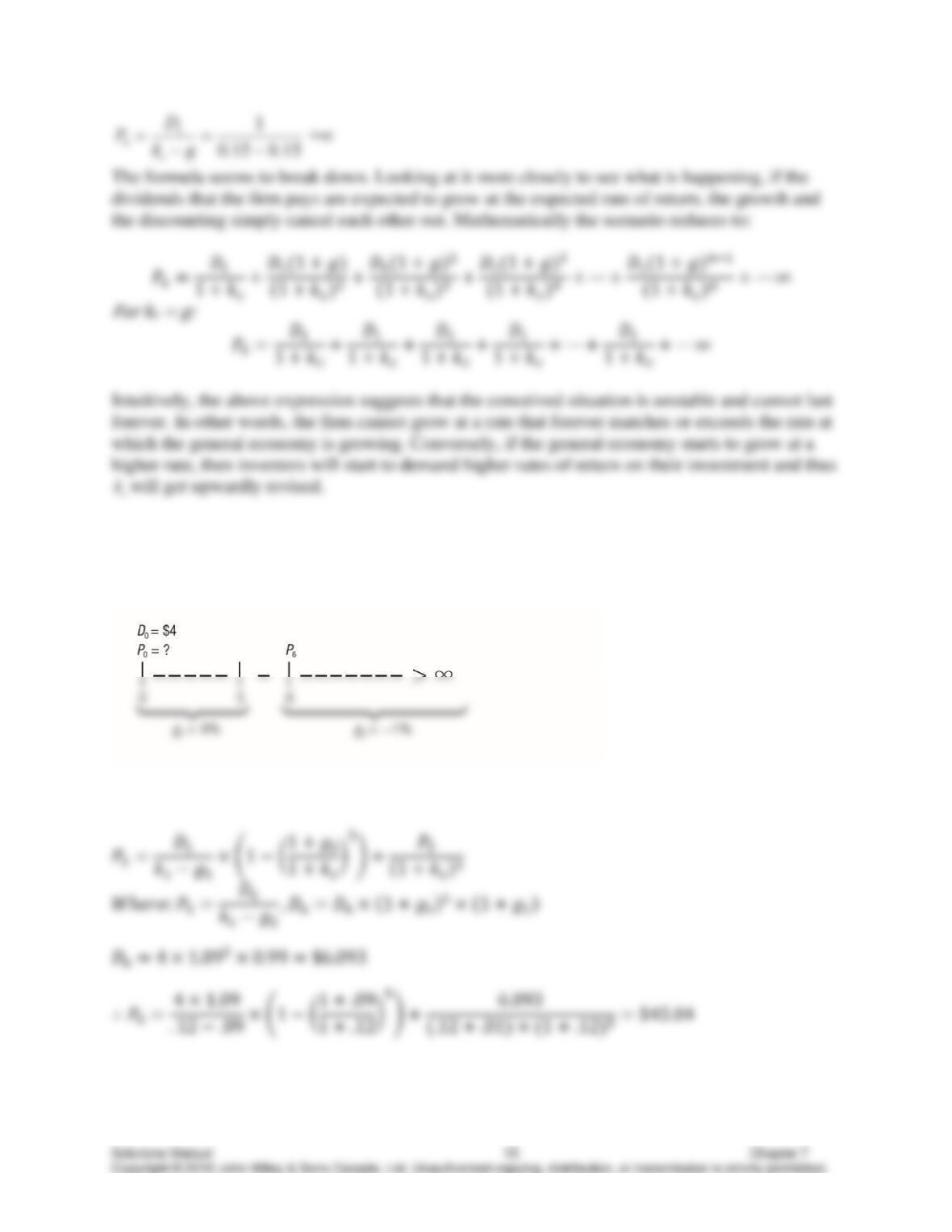
41. Section: 7.3 Common Share Valuation: The Dividend Discount Model (DDM)
Learning Objective: 7.3
Level of difficulty: Intermediate
Solution:
42. Section: 7.3 Common Share Valuation: The Dividend Discount Model (DDM)
Learning Objective: 7.3
Introduction to Corporate Finance, Fourth Edition Booth, Cleary, Rakita
Level of difficulty: Intermediate
Solution:
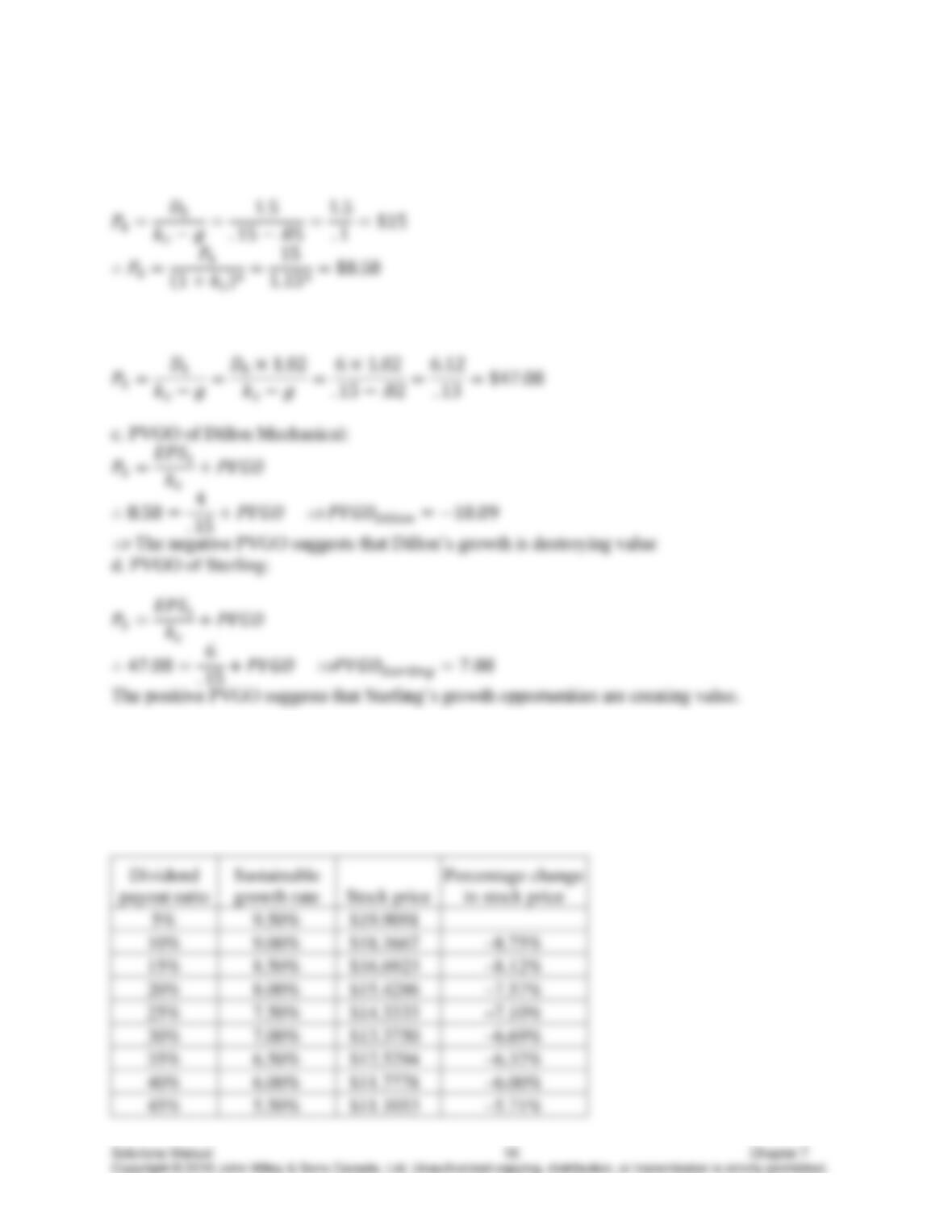
a. Current share price of Dillon Mechanical:
b. Current share price of Sterling:
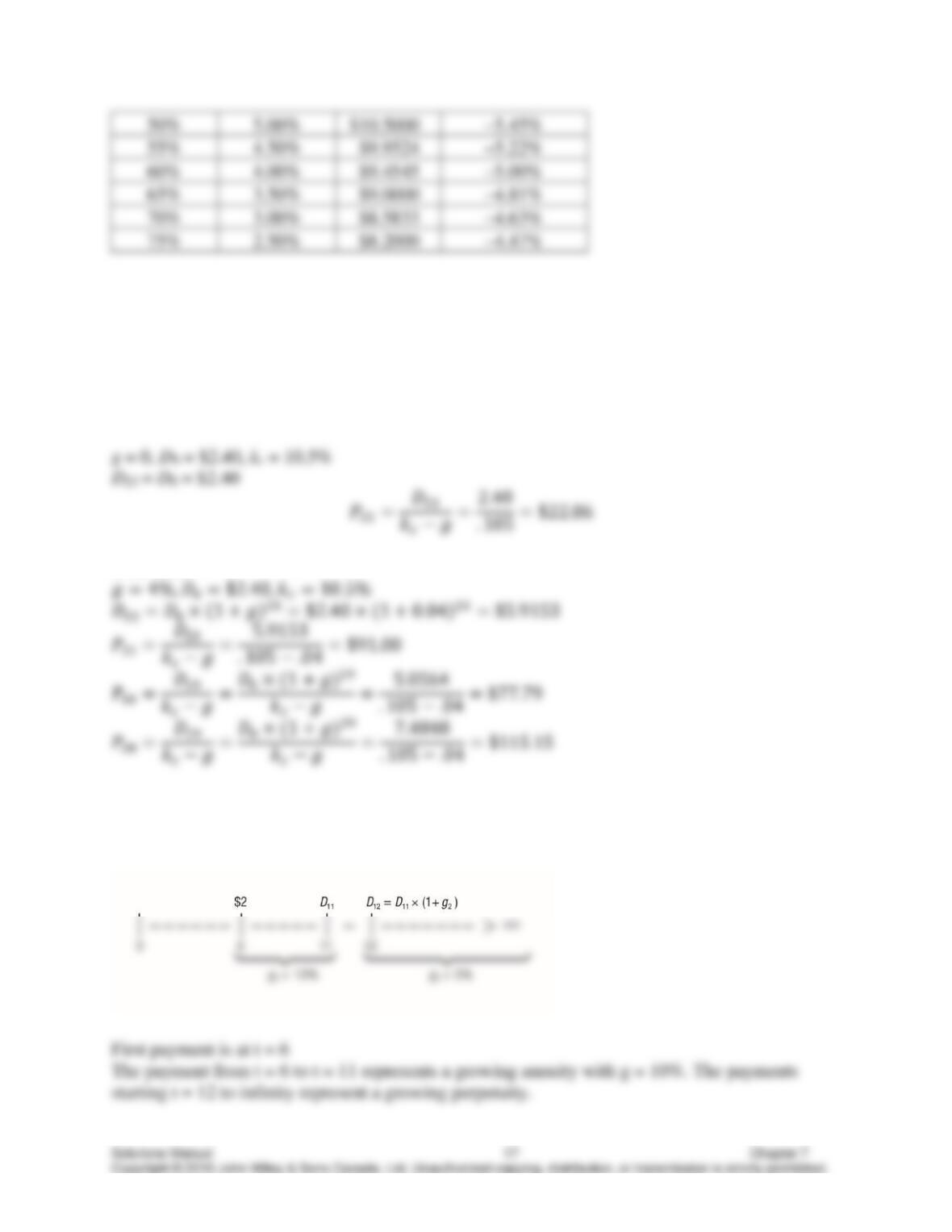
43. Section: 7.3 Common Share Valuation: The Dividend Discount Model (DDM)
Learning Objective: 7.3
Level of difficulty: Intermediate
Solution:
No. As the dividend payout ratio increases, the percentage change in stock prices decreases.
Introduction to Corporate Finance, Fourth Edition Booth, Cleary, Rakita
Challenging
44. Sections: 7.1 Equity Securities, 7.2 Preferred Share Valuation, and 7.3 Common Share
Valuation: The Dividend Discount Model (DDM)
Learning Objectives: 7.1 to 7.3
Level of difficulty: Challenging
Solution:
a. No growth
b. Growth:
45. Section: 7.3 Common Share Valuation: The Dividend Discount Model (DDM)
Learning Objective: 7.3
Level of difficulty: Challenging
Solution:
Introduction to Corporate Finance, Fourth Edition Booth, Cleary, Rakita
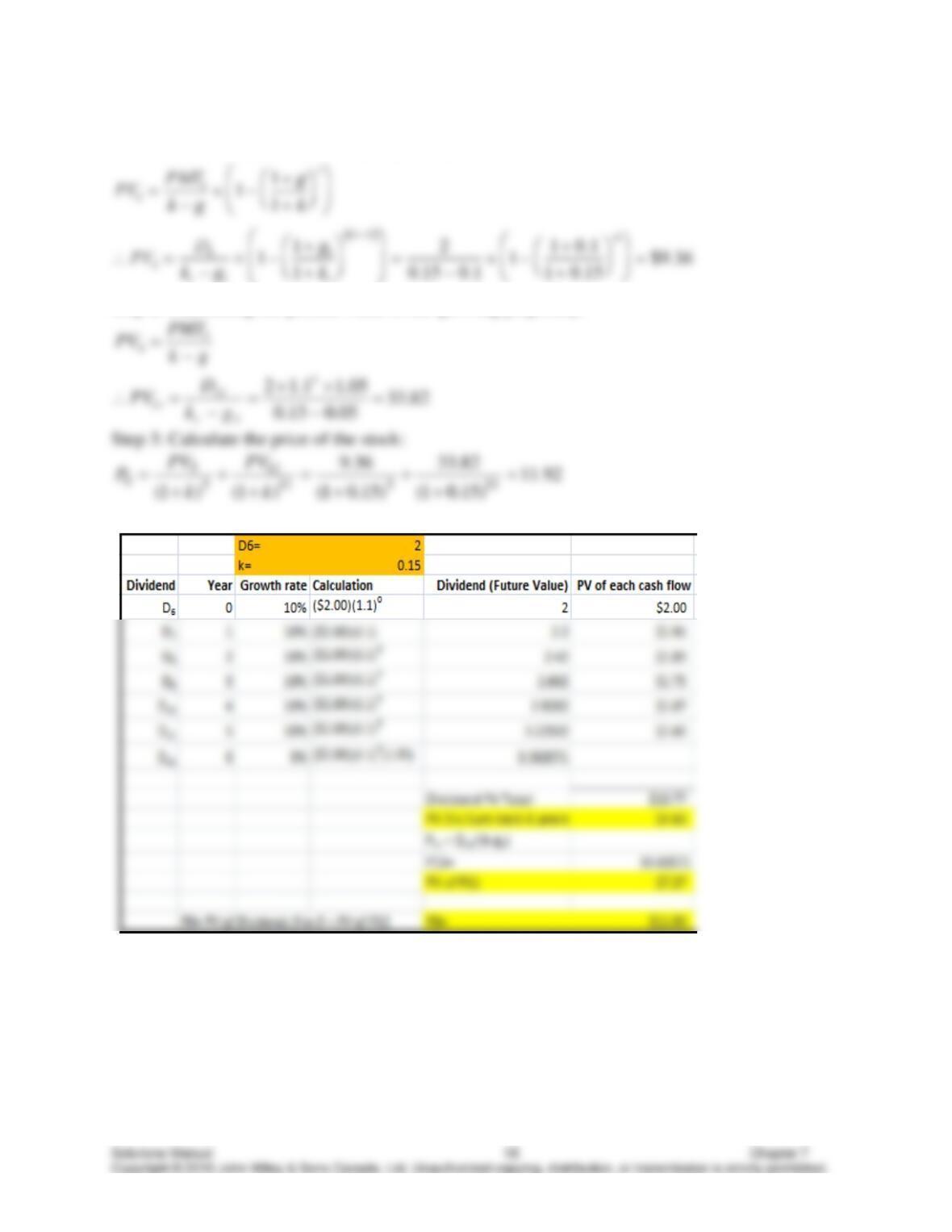
Step 1: Calculating the present value of the growing annuity:
Present value of a growing annuity is given by:
Step 2: Calculating the present value of the growing perpetuity:
Excel Solution:
46. Section: 7.3 Common Share Valuation: The Dividend Discount Model (DDM)
Learning Objective: 7.3
Level of difficulty: Challenging
Solution:
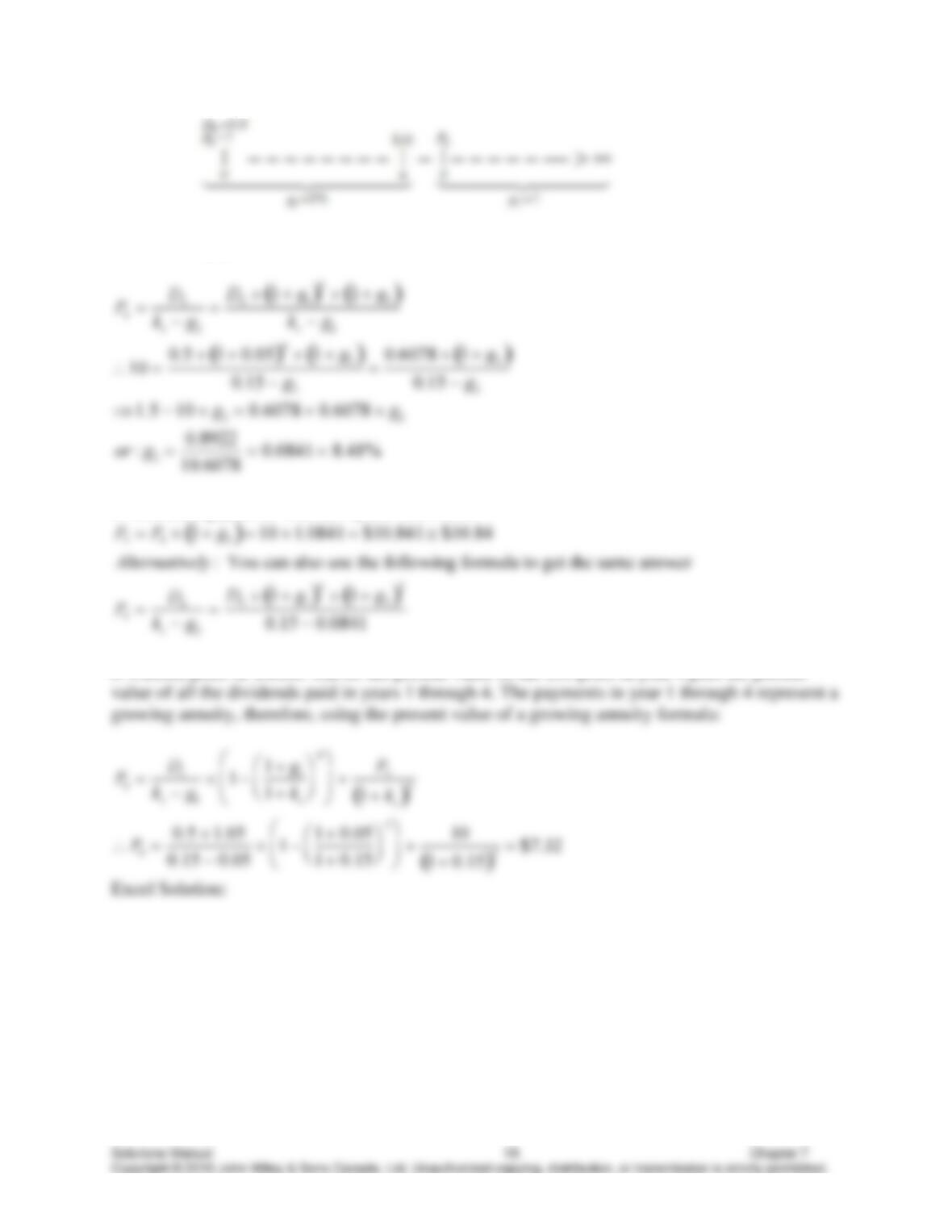
Time line:
Introduction to Corporate Finance, Fourth Edition Booth, Cleary, Rakita
a. Calculating g2
b. Calculating price of TelTec 5 years from now:
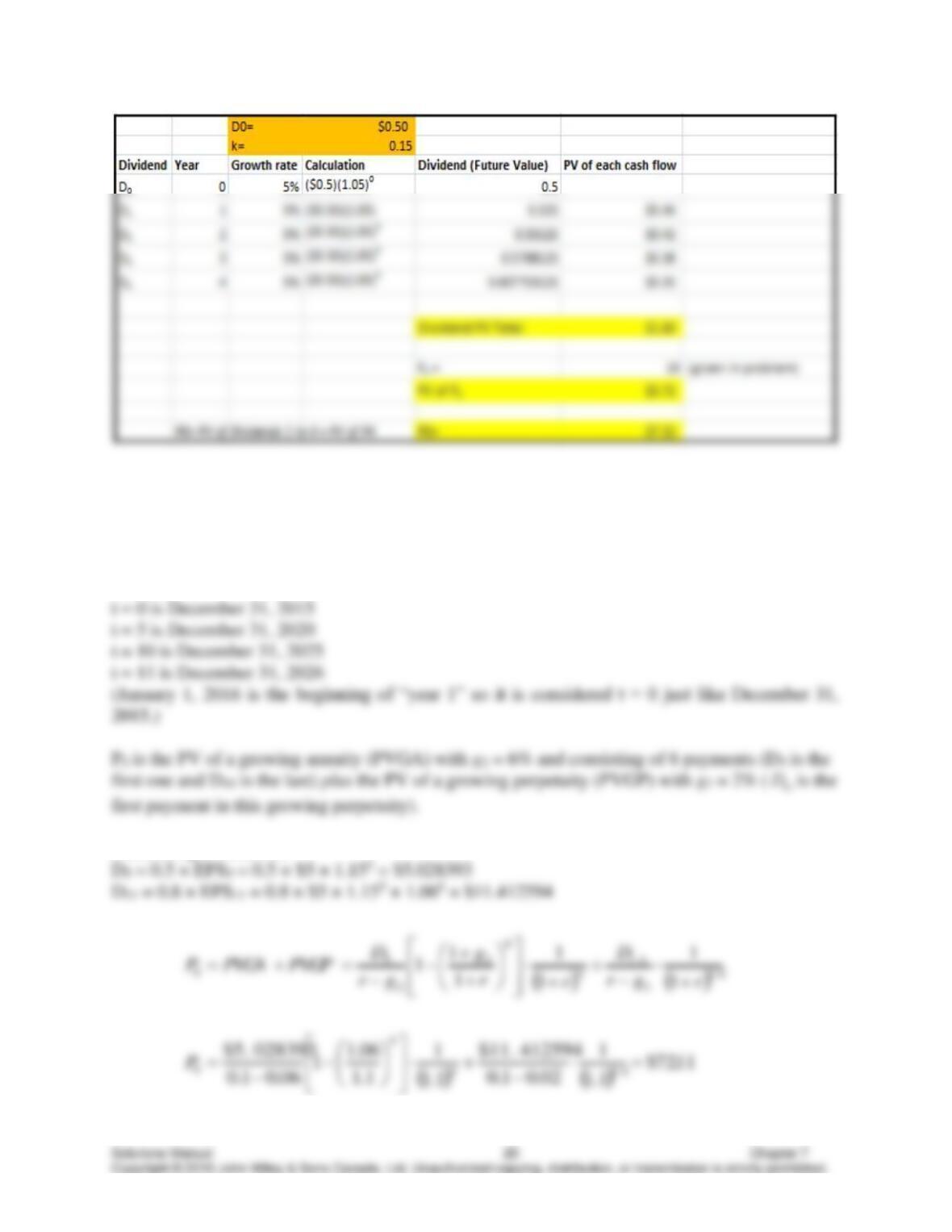
c. Current price of TelTec will be the present value of the $10 price in year 4 plus the present
Introduction to Corporate Finance, Fourth Edition Booth, Cleary, Rakita
47. Section: 7.3 Common Share Valuation: The Dividend Discount Model (DDM)
Learning Objective: 7.3
Level of difficulty: Challenging
Solution:
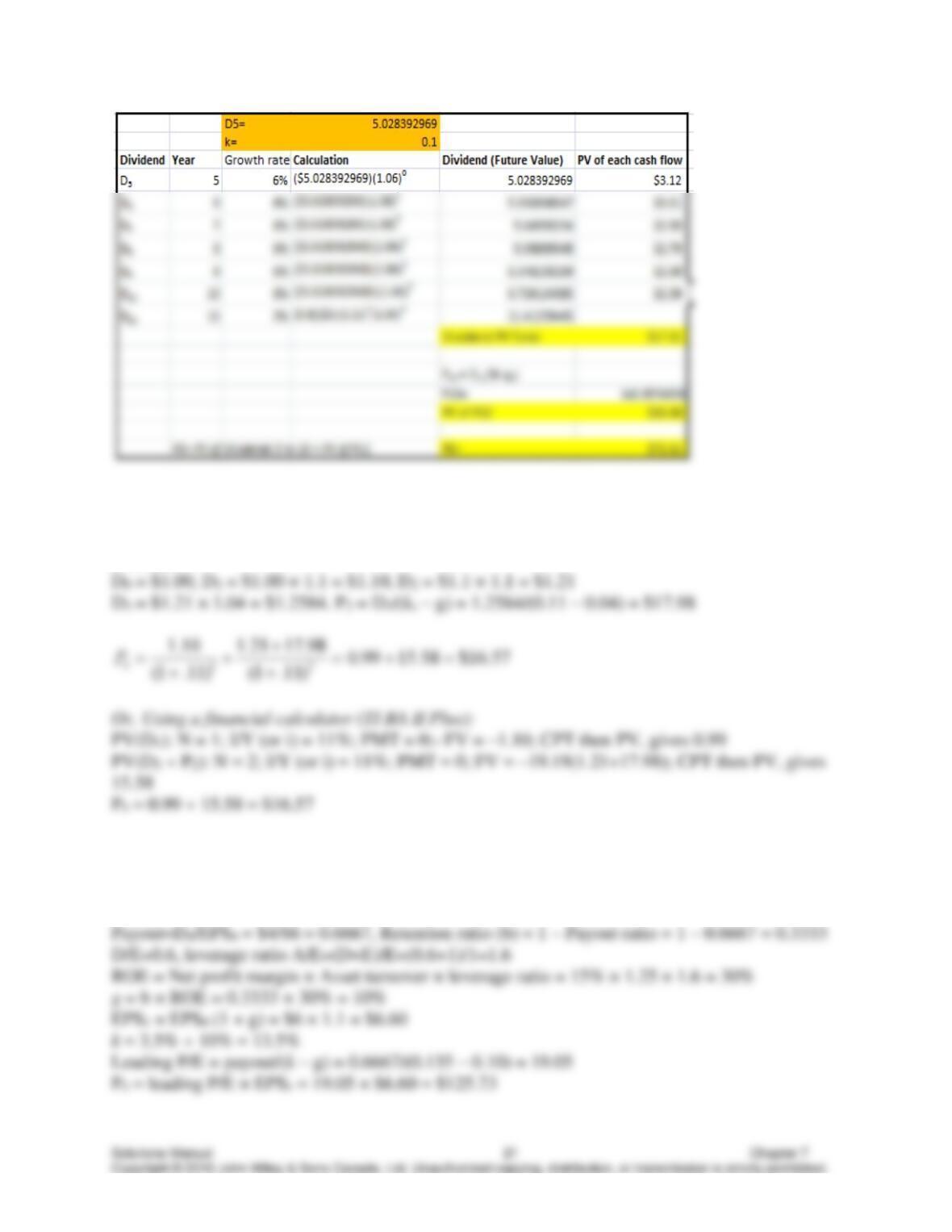
Notation:
Calculating D5 and D11:
Introduction to Corporate Finance, Fourth Edition Booth, Cleary, Rakita
48. Section: 7.3 Common Share Valuation: The Dividend Discount Model (DDM)
Learning Objective: 7.3
Level of difficulty: Challenging
Solution:
49. Section: Appendix 7B Additional Multiples or Relative Value Ratios
Learning Objective: 7.7
Level of difficulty: Challenging
Solution:
50. Section: 7.2 Preferred Share Valuation
Learning Objective: 7.2
Level of difficulty: Challenging
Solution:
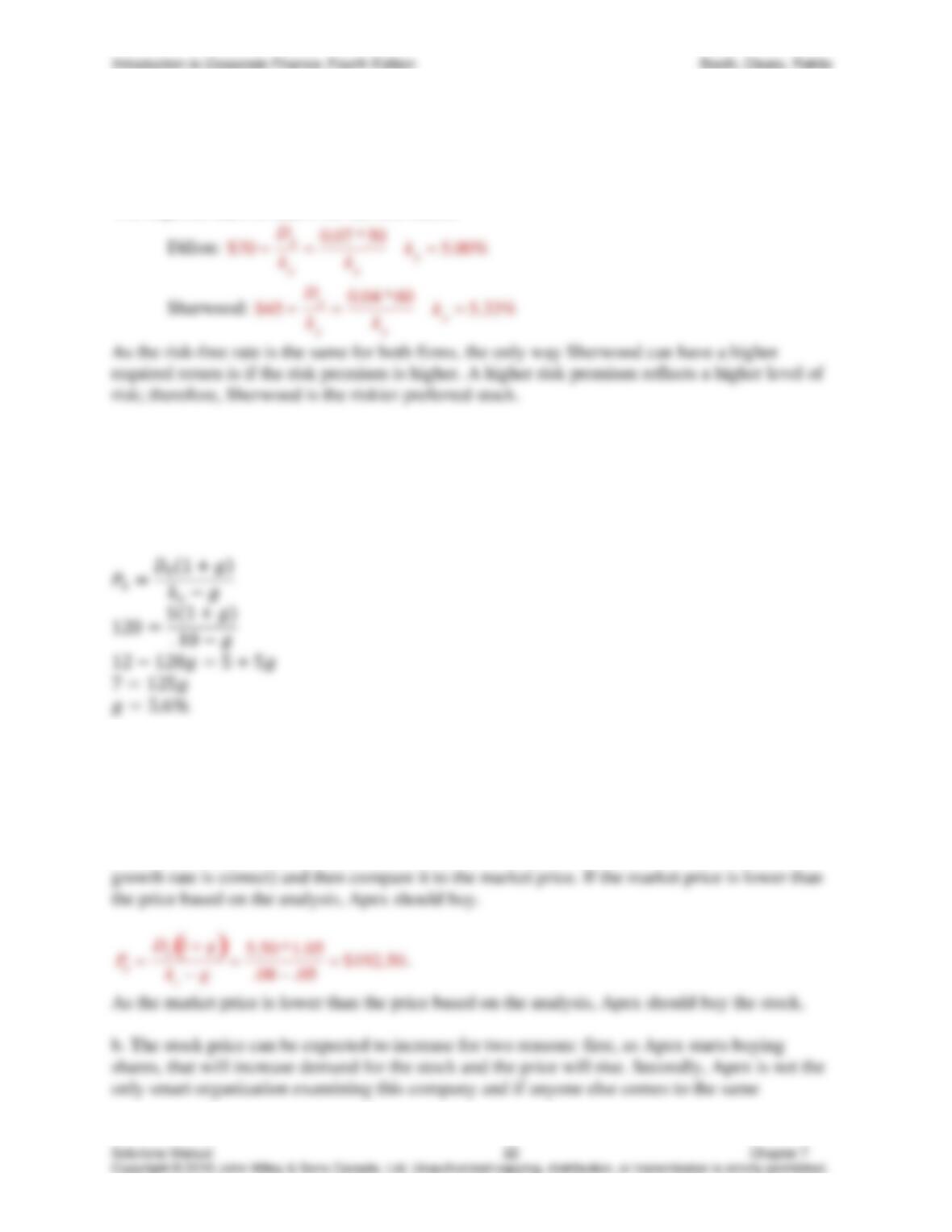
The required rates of return for the two stocks:
51. Section: 7.3 Common Share Valuation: The Dividend Discount Model (DDM)
Learning Objective: 7.3
Level of difficulty: Challenging
Solution:
52. Section: 7.3 Common Share Valuation: The Dividend Discount Model (DDM)
Learning Objective: 7.3
Level of difficulty: Challenging
Solution:
a. To solve this problem we need to determine what the price of the stock should be (if Scion’s
Introduction to Corporate Finance, Fourth Edition Booth, Cleary, Rakita
53. Section: 7.4 Using Multiples to Value Shares
Learning Objective: 7.4
Level of difficulty: Challenging
Solution:
There are two problems with Prime’s analyst’s statement: first, a constant P/E ratio implies a
54. Section: 7.3 Common Share Valuation: The Dividend Discount Model (DDM)
Learning Objective: 7.3
Level of difficulty: Challenging
Solution:
To solve this problem, we must find the inputs to the DDM model.
55. Section: 7.3 Common Share Valuation: The Dividend Discount Model (DDM)
Learning Objective: 7.3
Level of difficulty: Challenging
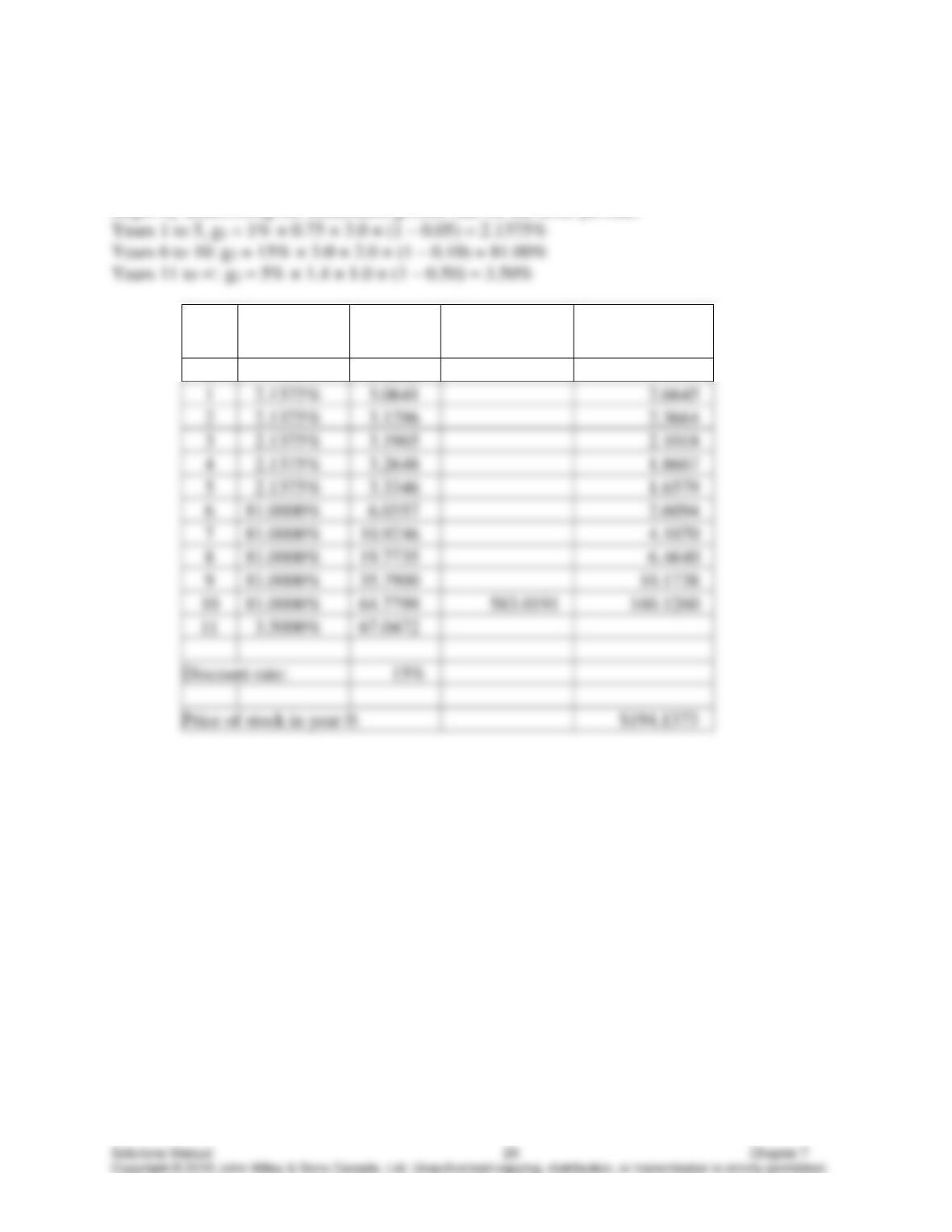
Solution:
Year
Growth rate
Dividend
Stock price at
end of year 3
Present value of
each cash flow
Introduction to Corporate Finance, Fourth Edition Booth, Cleary, Rakita
56. Section: 7.3 Common Share Valuation: The Dividend Discount Model (DDM)
Learning Objective: 7.3
Level of difficulty: Challenging
Solution:
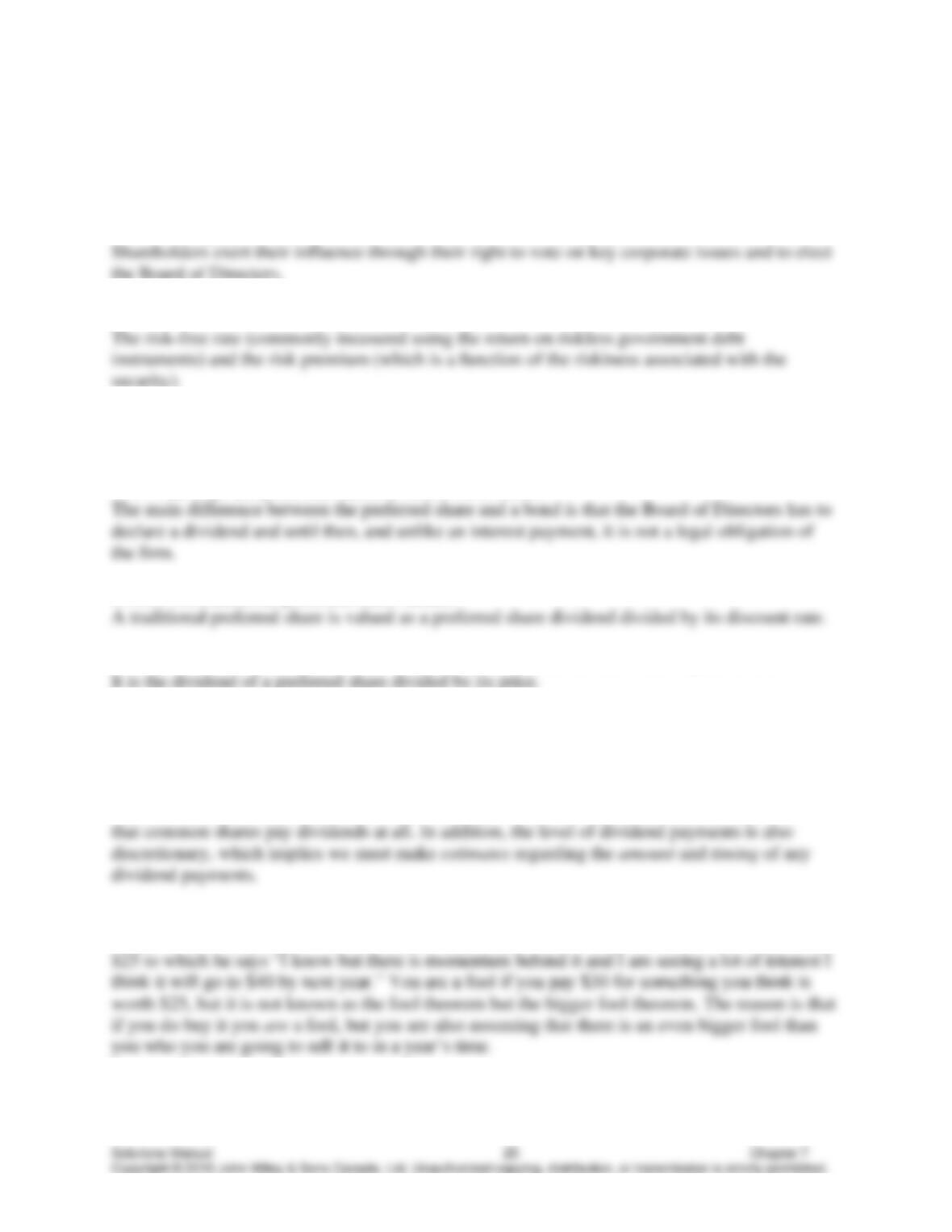
Begin by determining the sustainable growth rate for the three periods:
Year
Growth rate
Dividend
Stock price at
end of year 10
Present value of
each cash flow
0
3.0000
1
3.0641
2
3.1296
3
3.1965
4
3.2648
5
3.3346
6
6.0357
7
8
9
10
11
Discount rate:
Price of stock in year 0:
Introduction to Corporate Finance, Fourth Edition Booth, Cleary, Rakita
Answers to Concept Review Questions
7.1 Equity Securities
Concept Review Questions
1. How do equity shareholders exert their influence over a company?
2. What are the two main components of the required rate of return on equity securities?
7.2 Preferred Share Valuation
Concept Review Questions
1. In what ways are preferred shares different from bonds?
2. How is a traditional preferred share valued?
3. How can we estimate the investor’s required rate of return for a traditional preferred share?
7.3 Common Share Valuation: The Dividend Discount Model (DDM)
Concept Review Questions
1. Why is share value based on the present value of expected future dividends?
Unlike bonds or even preferred shares this is not a trivial issue because there is no requirement
2. What is the “bigger fool theorem” of valuation?
Suppose, for example, your broker calls and says “buy XYZ at $30.” You say no it’s only worth
3. Why does an increase in the expected dividend growth rate increase share prices?
Introduction to Corporate Finance, Fourth Edition Booth, Cleary, Rakita
4. Why can’t the expected growth rate exceed the investor’s required return in the constant
growth model?
5. How can we estimate future growth rates?
One approach is to determine the company’s sustainable growth rage, which equals the retention
7.4 Using Multiples to Value Shares
Concept Review Questions
1. Why can the P/E ratio be viewed as a type of payback period?
P/E ratio means that if this level of earnings stays constant it will take (P/E) years to earn back
2. What drives P/E ratios?
3. Why do P/E ratios differ even between comparable firms?
There are differences in the expected dividend payout ratio (D1/EPS1), the required rate of return
4. How are multiples linked to a discounted cash flow valuation?
7.5 A Simple Valuation Example
Concept Review Questions
1. What are some of the key assumptions that must be made when applying the valuation
concepts discussed in this chapter to an actual valuation situation?
The analyst must make judgments regarding: which models will work best for a given company;
Appendix 7B Additional Multiples or Relative Value Ratios
1. What other relative valuation multiples are useful in valuation?

Introduction to Corporate Finance, Fourth Edition Booth, Cleary, Rakita