Chapter 7/Investment Decision Rules 105
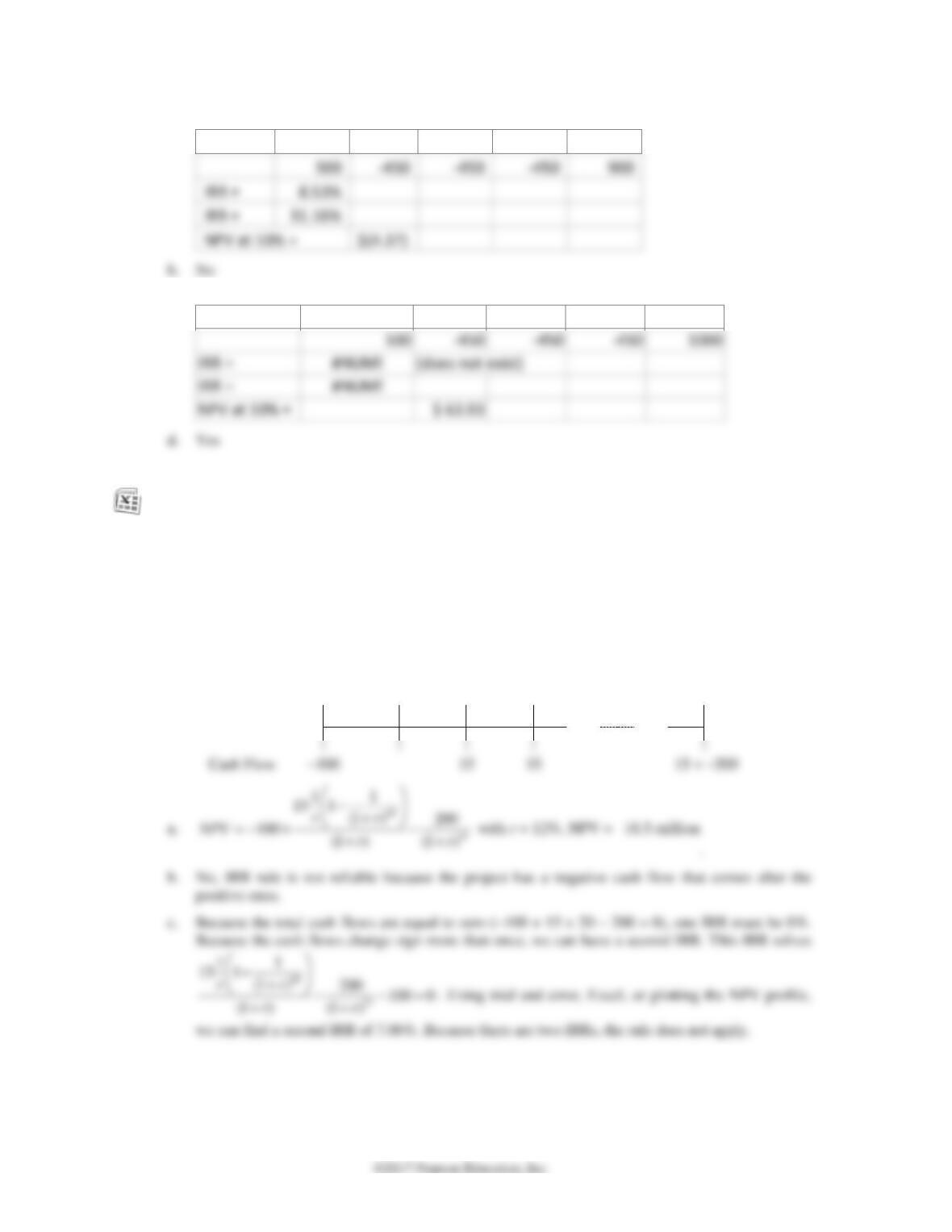
7-19. Your firm has been hired to develop new software for the university’s class registration system.
Under the contract, you will receive $500,000 as an upfront payment. You expect the
development costs to be $450,000 per year for the next three years. Once the new system is in
place, you will receive a final payment of $900,000 from the university four years from now.
a. What are the IRRs of this opportunity?
b. If your cost of capital is 10%, is the opportunity attractive?
Suppose you are able to renegotiate the terms of the contract so that your final payment in year 4
will be $1 million.
c. What is the IRR of the opportunity now?
d. Is it attractive at these terms?
106 Berk/DeMarzo, Corporate Finance, Fourth Edition
a.
0
1
2
3
4
c.
0
1
2
3
4
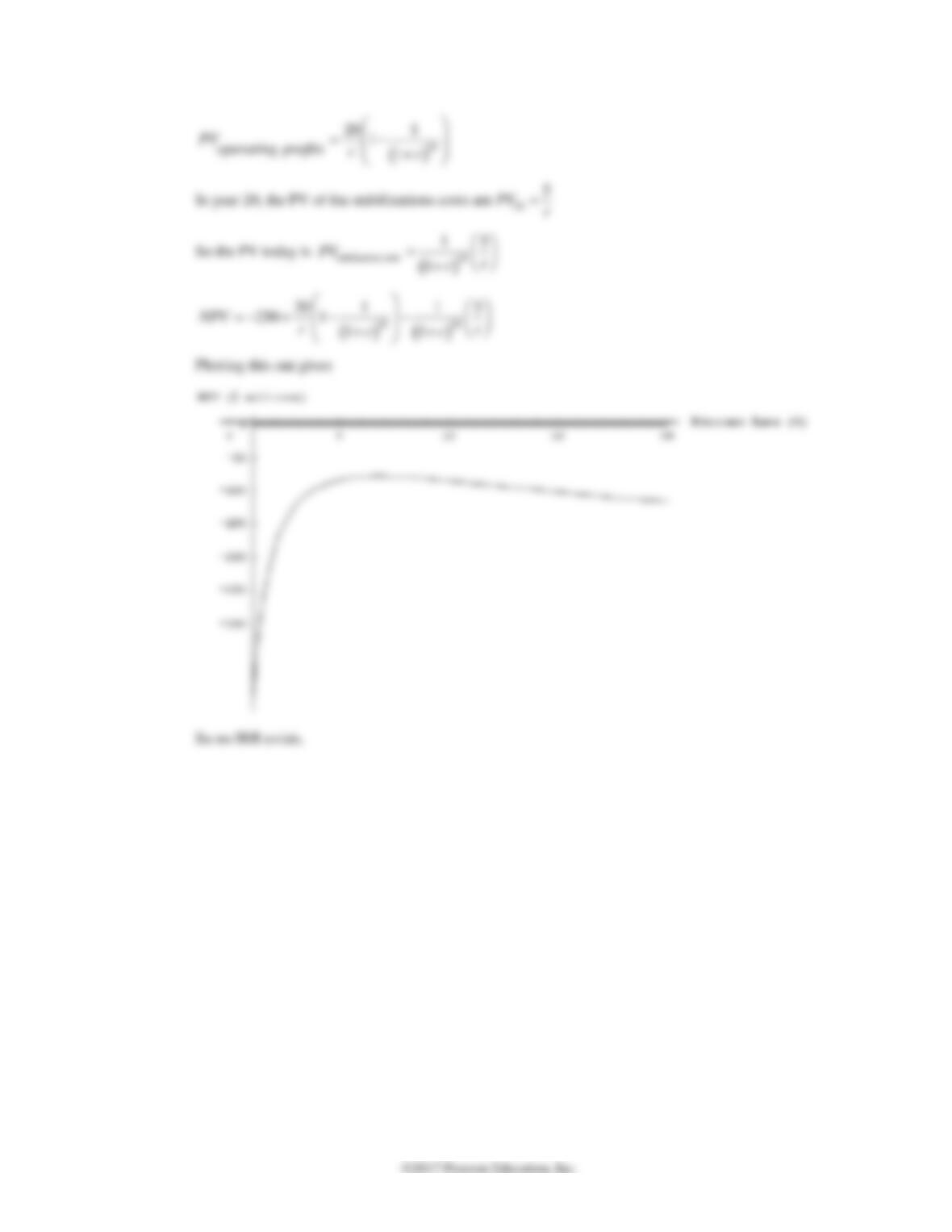
7-20. You are considering constructing a new plant in a remote wilderness area to process the ore
from a planned mining operation. You anticipate that the plant will take a year to build and cost
$100 million upfront. Once built, it will generate cash flows of $15 million at the end of every
year over the life of the plant. The plant will be useless 20 years after its completion once the
mine runs out of ore. At that point you expect to pay $200 million to shut the plant down and
restore the area to its pristine state. Using a cost of capital of 12%,
a. What is the NPV of the project?
b. Is using the IRR rule reliable for this project? Explain.
c. What are the IRR’s of this project?
Timeline:
0
1
2
3
21
7-21. You are a real estate agent thinking of placing a sign advertising your services at a local bus stop.
The sign will cost $5000 and will be posted for one year. You expect that it will generate
additional revenue of $500 per month. What is the payback period?
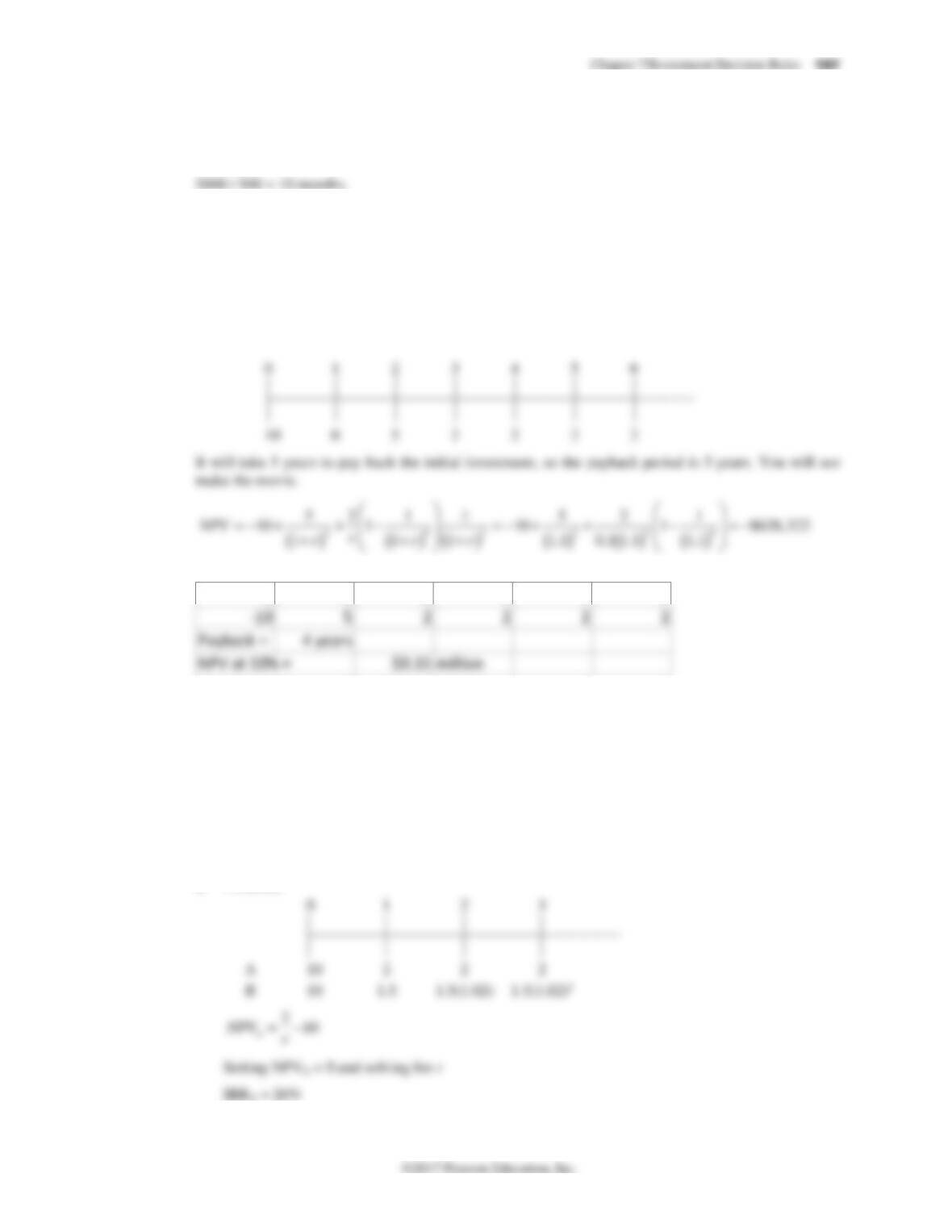
7-22. You are considering making a movie. The movie is expected to cost $10 million upfront and take
a year to make. After that, it is expected to make $5 million when it is released in one year and $2
million per year for the following four years. What is the payback period of this investment? If
you require a payback period of two years, will you make the movie? Does the movie have a
positive NPV if the cost of capital is 10%?
Timeline:
So the NPV agrees with the payback rule in this case.
0
1
2
3
4
5
5
2
2
2
2
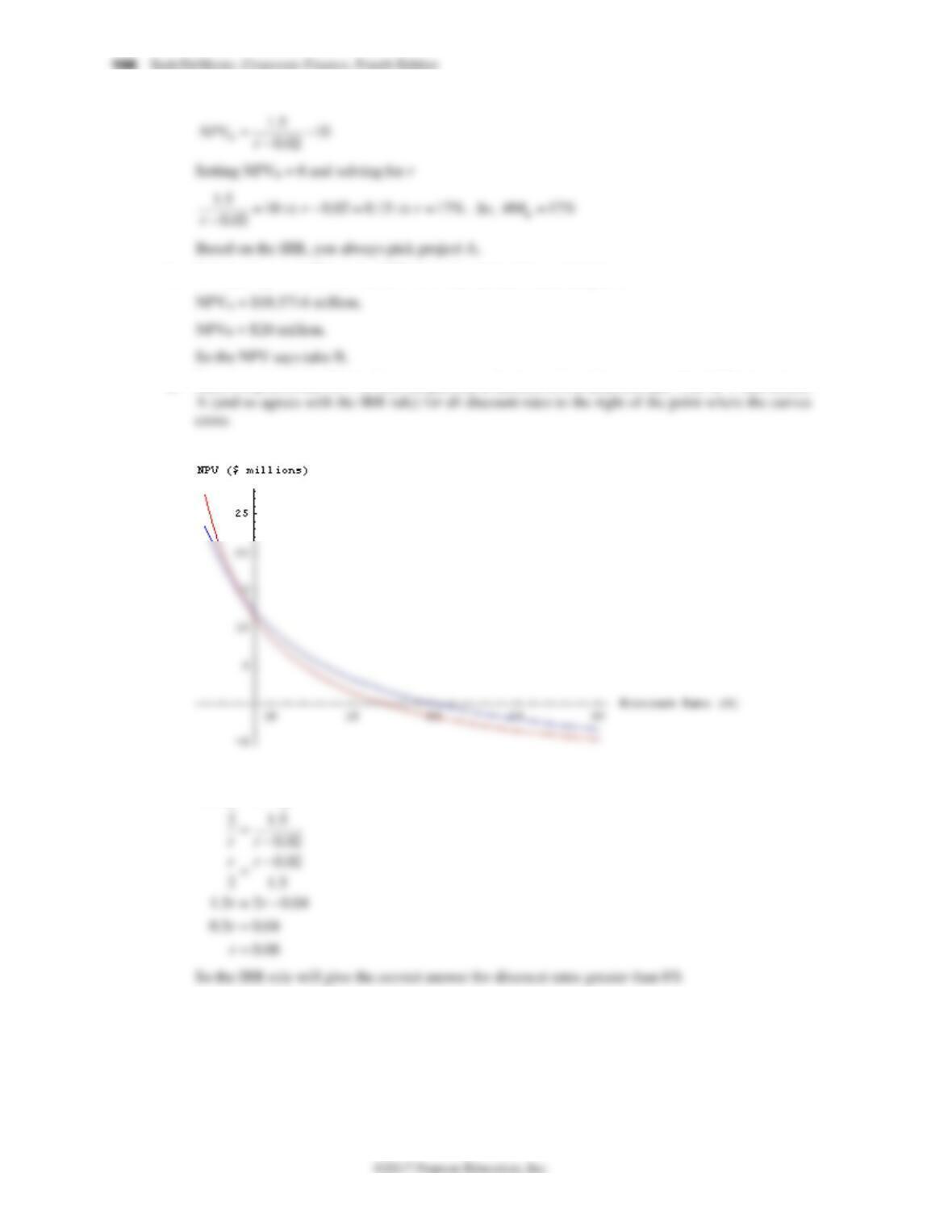
7-23. You are deciding between two mutually exclusive investment opportunities. Both require the
same initial investment of $10 million. Investment A will generate $2 million per year (starting at
the end of the first year) in perpetuity. Investment B will generate $1.5 million at the end of the
first year and its revenues will grow at 2% per year for every year after that.
a. Which investment has the higher IRR?
b. Which investment has the higher NPV when the cost of capital is 7%?
c. In this case, for what values of the cost of capital does picking the higher IRR give the
correct answer as to which investment is the best opportunity?
a. Timeline:
b. Substituting r = 0.07 into the NPV formulas derived in part (a) gives
c. Here is a plot of the NPV of both projects as a function of the discount rate. The NPV rule selects
AB
NPV NPV
=
7-24. You have just started your summer internship, and your boss asks you to review a recent
analysis that was done to compare three alternative proposals to enhance the firm’s
manufacturing facility. You find that the prior analysis ranked the proposals according to their
IRR, and recommended the highest IRR option, Proposal A. You are concerned and decide to
redo the analysis using NPV to determine whether this recommendation was appropriate. But
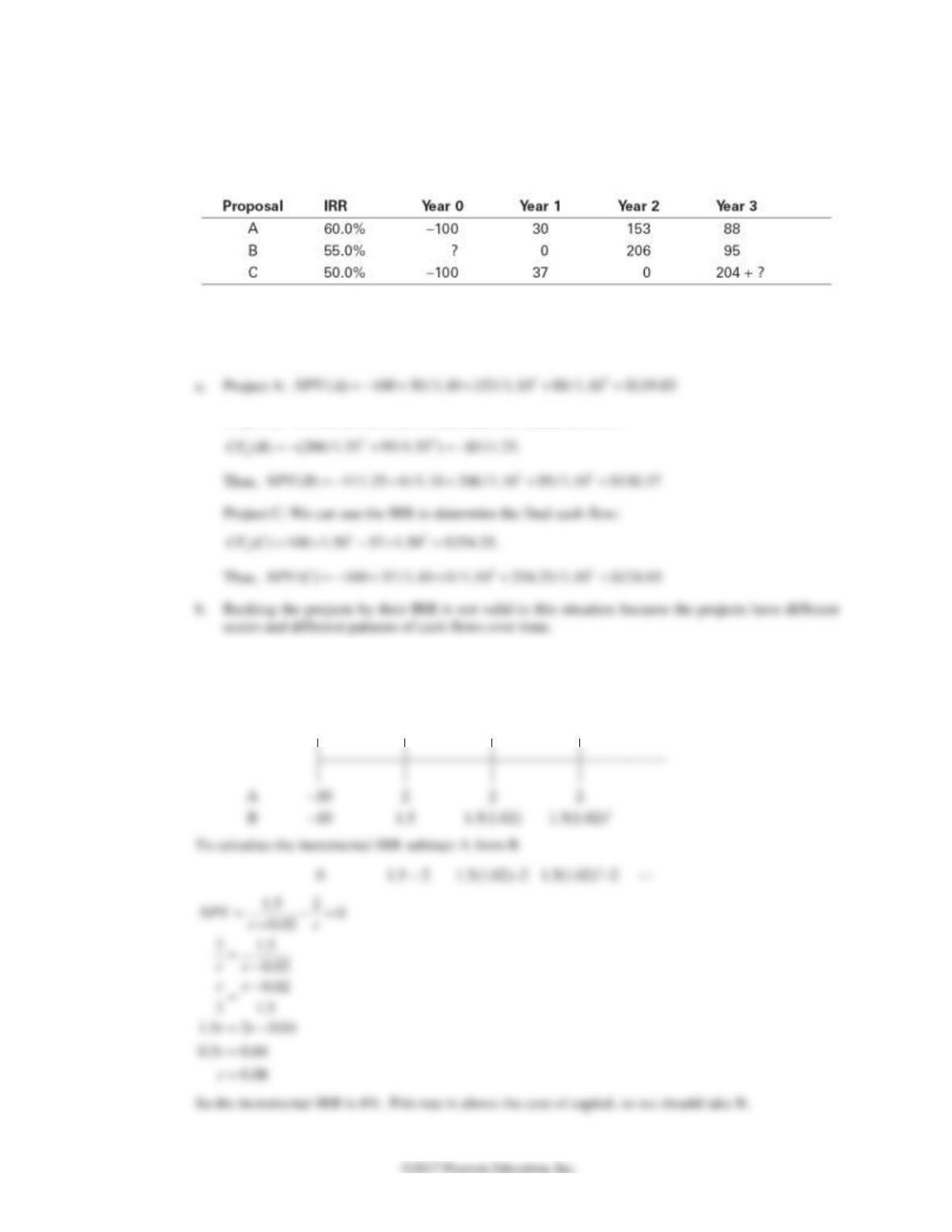
while you are confident the IRRs were computed correctly, it seems that some of the underlying
Chapter 7/Investment Decision Rules 109
data regarding the cash flows that were estimated for each proposal was not included in the
report. For Proposal B, you cannot find information regarding the total initial investment that
was required in year 0. And for Proposal C, you cannot find the data regarding additional
salvage value that will be recovered in year 3. Here is the information you have:
Suppose the appropriate cost of capital for each alternative is 10%. Using this information,
determine the NPV of each project. Which project should the firm choose?
Why is ranking the projects by their IRR not valid in this situation?
Project B: We can use the IRR to determine the initial cash flow:
7-25. Use the incremental IRR rule to correctly choose between the investments in Problem 21 when
the cost of capital is 7%. At what cost of capital would your decision change?
Timeline:
0
1
2
3
2
2
2
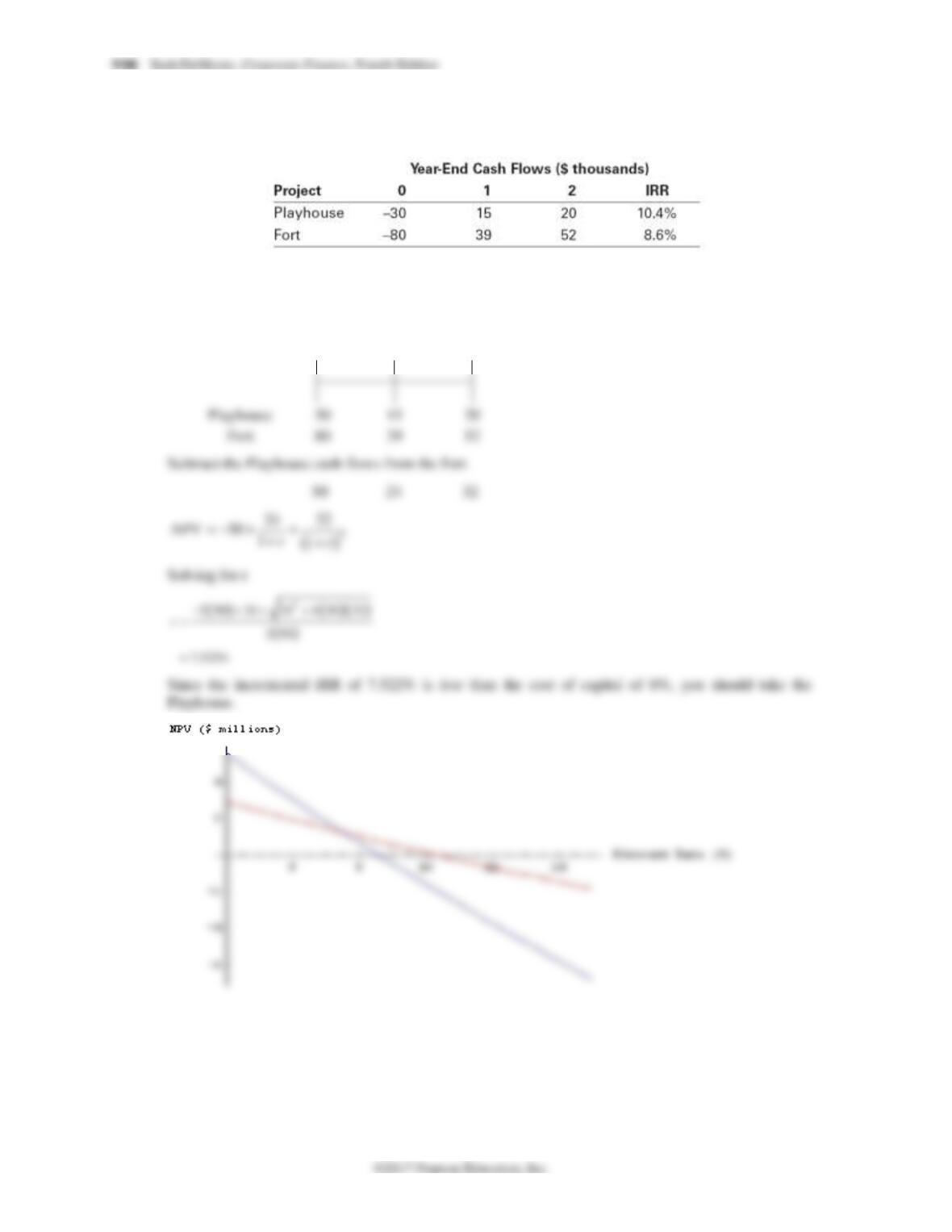
7-26. You work for an outdoor play structure manufacturing company and are trying to decide
between two projects:
You can undertake only one project. If your cost of capital is 8%, use the incremental IRR rule
to make the correct decision.
Timeline:
0
1
2
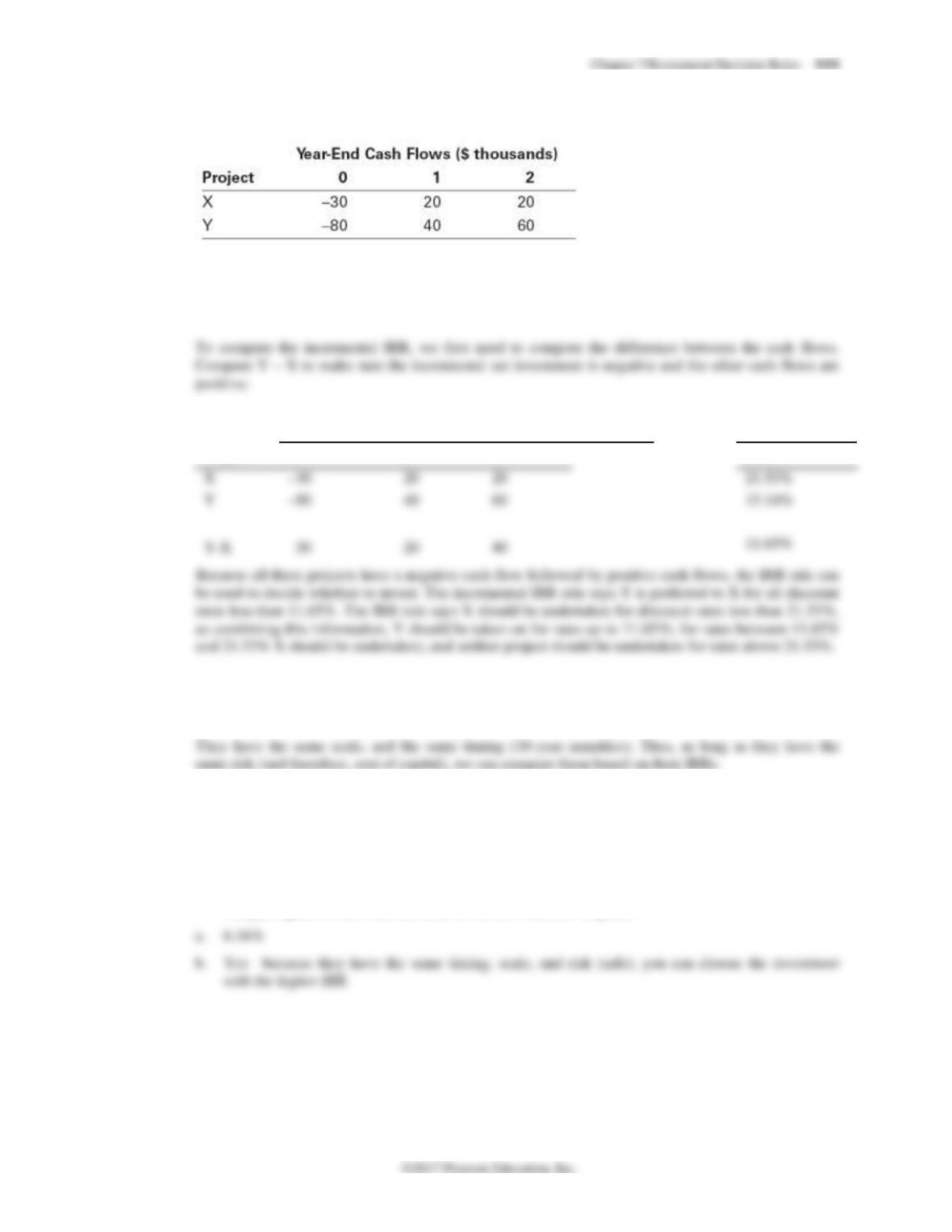
7-27. You are evaluating the following two projects:
Use the incremental IRR to determine the range of discount rates for which each project is
optimal to undertake. Note that you should also include the range in which it does not make
sense to take either project.
Year-End Cash Flows ($ thousands)
Project
0
1
2
Y-X
IRR
7-28. Consider two investment projects, which both require an upfront investment of $10 million, and
both of which pay a constant positive amount each year for the next 10 years. Under what
conditions can you rank these projects by comparing their IRRs?
7-29. You are considering a safe investment opportunity that requires a $1000 investment today, and
will pay $500 two years from now and another $750 five years from now.
a. What is the IRR of this investment?
b. If you are choosing between this investment and putting your money in a safe bank account
that pays an EAR of 5% per year for any horizon, can you make the decision by simply
comparing this EAR with the IRR of the investment? Explain.
7-30. AOL is considering two proposals to overhaul its network infrastructure. They have received
two bids. The first bid, from Huawei, will require a $20 million upfront investment and will
generate $20 million in savings for AOL each year for the next three years. The second bid, from
Cisco, requires a $100 million upfront investment and will generate $60 million in savings each
year for the next three years.
a. What is the IRR for AOL associated with each bid?
b. If the cost of capital for this investment is 12%, what is the NPV for AOL of each bid?
Suppose Cisco modifies its bid by offering a lease contract instead. Under the terms of the
lease, AOL will pay $20 million upfront, and $35 million per year for the next three years.
AOL’s savings will be the same as with Cisco’s original bid.
c. Including its savings, what are AOL’s net cash flows under the lease contract? What is the
IRR of the Cisco bid now?
d. Is this new bid a better deal for AOL than Cisco’s original bid? Explain.
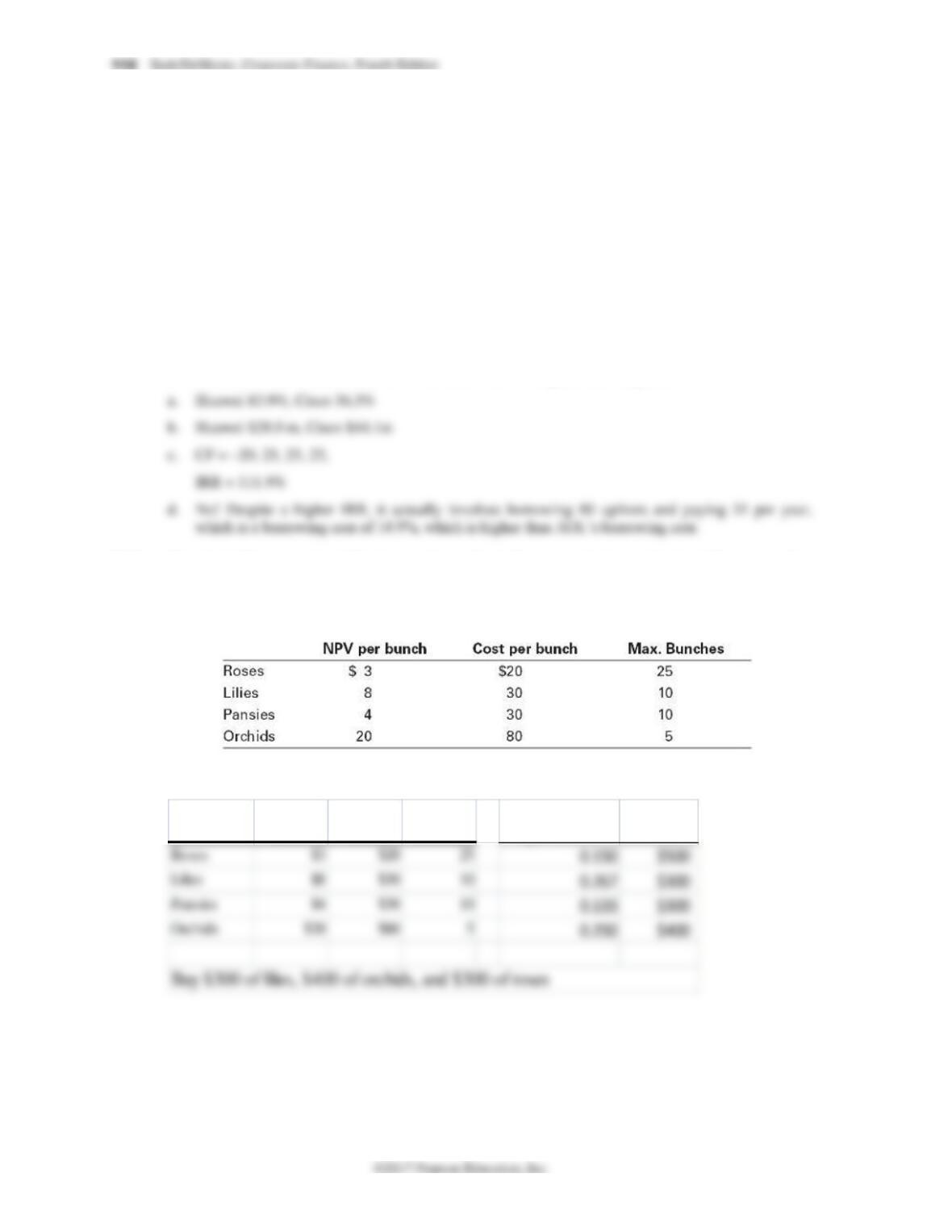
7-31. Natasha’s Flowers, a local florist, purchases fresh flowers each day at the local flower market.
The buyer has a budget of $1000 per day to spend. Different flowers have different profit
margins, and also a maximum amount the shop can sell. Based on past experience, the shop has
estimated the following NPV of purchasing each type:
What combination of flowers should the shop purchase each day?
NPV per
bunch
Cost per
bunch
Max .
Bunches
Profitability Index
(per bunch)
Max
Investment
7-32. You own a car dealership and are trying to decide how to configure the showroom floor. The
floor has 2000 square feet of usable space. You have hired an analyst and asked her to estimate
the NPV of putting a particular model on the floor and how much space each model requires:
In addition, the showroom also requires office space. The analyst has estimated that office space
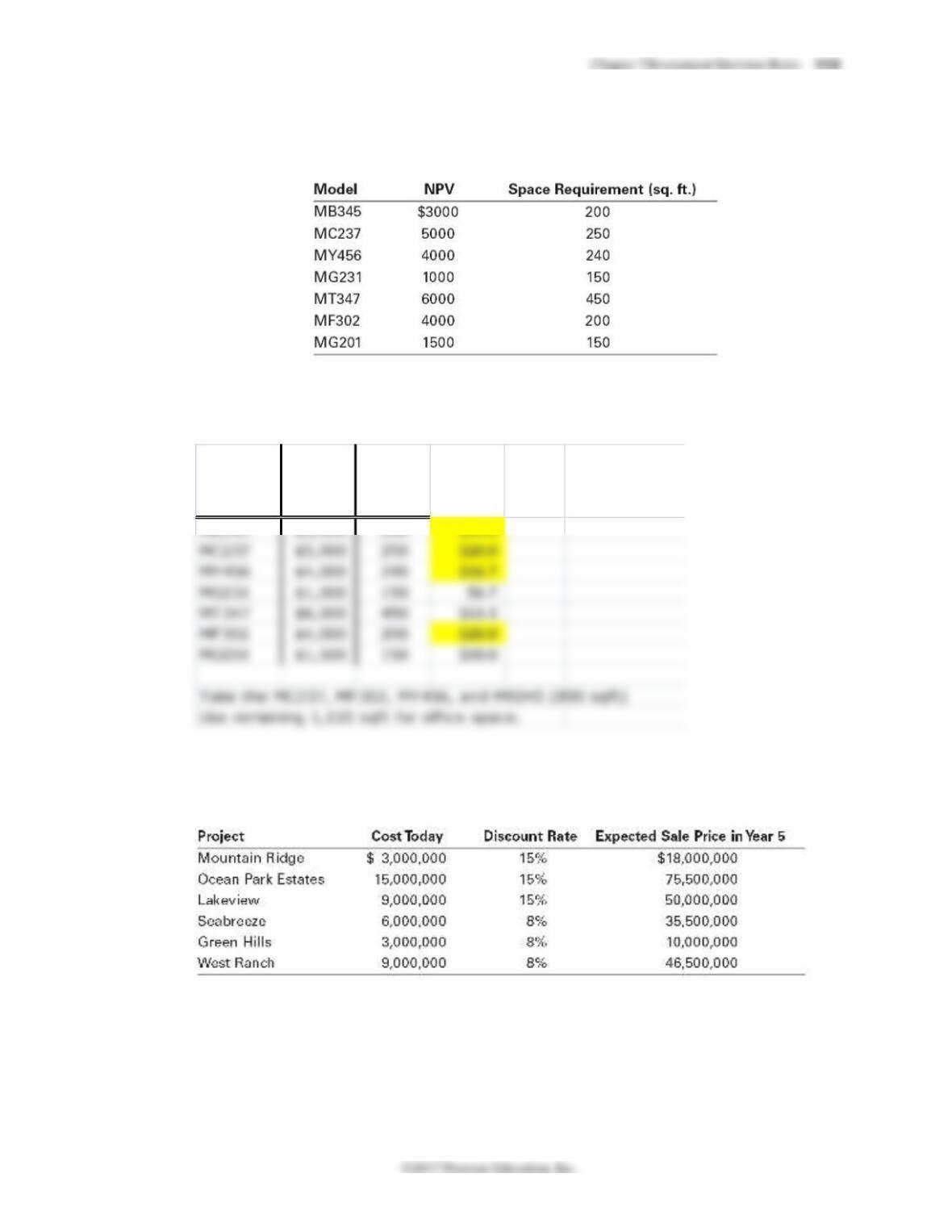
generates an NPV of $14 per square foot. What models should be displayed on the floor and how
many square feet should be devoted to office space?
Model NPV
Space
Requirem
ent (sq.
ft.)
NPV/sqft
7-33. Kaimalino Properties (KP) is evaluating six real estate investments. Management plans to buy
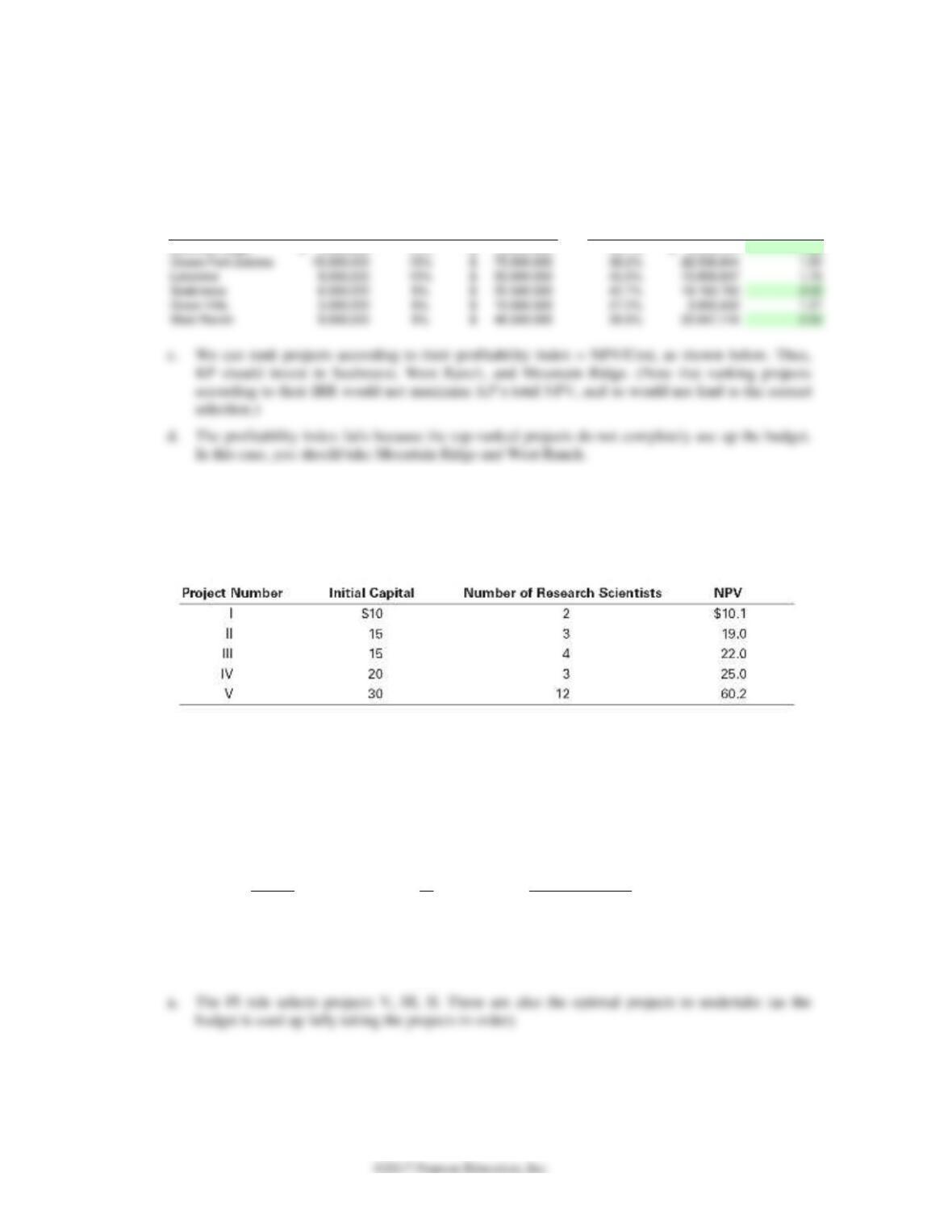
the properties today and sell them five years from today. The following table summarizes the
initial cost and the expected sale price for each property, as well as the appropriate discount rate
based on the risk of each venture.
KP has a total capital budget of $18,000,000 to invest in properties.
a. What is the IRR of each investment?
b. What is the NPV of each investment?
c. Given its budget of $18,000,000, which properties should KP choose?
114 Berk/DeMarzo, Corporate Finance, Fourth Edition
d. Explain why the profitability index method could not be used if KP’s budget were
$12,000,000 instead. Which properties should KP choose in this case?
a. We can compute the IRR for each as IRR = (Sale Price/Cost)1/5 – 1. See spreadsheet below.
b. We can compute the NPV for each as NPV = Sale Price/(1 + r)5 – Cost. See spreadsheet below.
Project Cost Today Discount Rate
Expected Sale
Price in Year 5
IRR NPV
Profitability
Index
Mountain Ridge 3,000,000$ 15% 18,000,000$ 43.1% 5,949,181$ 1.98
7-34. Orchid Biotech Company is evaluating several development projects for experimental drugs.
Although the cash flows are difficult to forecast, the company has come up with the following
estimates of the initial capital requirements and NPVs for the projects. Given a wide variety of
staffing needs, the company has also estimated the number of research scientists required for
each development project (all cost values are given in millions of dollars).
a. Suppose that Orchid has a total capital budget of $60 million. How should it prioritize these
projects?
b. Suppose in addition that Orchid currently has only 12 research scientists and does not
anticipate being able to hire any more in the near future. How should Orchid prioritize these
projects?
c. If instead, Orchid had 15 research scientists available, explain why the profitability index
ranking cannot be used to prioritize projects. Which projects should it choose now?
Project
PI
NPV/Headcount
I
1.01
5.1
II
1.27
6.3
III
1.47
5.5
IV
1.25
8.3
V
2.01
5.0