94
Chapter 7
Investment Decision Rules
7-1. Your brother wants to borrow $10,000 from you. He has offered to pay you back $12,000 in a
year. If the cost of capital of this investment opportunity is 10%, what is its NPV? Should you
undertake the investment opportunity? Calculate the IRR and use it to determine the maximum
deviation allowable in the cost of capital estimate to leave the decision unchanged.
7-2. You are considering investing in a start-up company. The founder asked you for $200,000 today
and you expect to get $1,000,000 in nine years. Given the riskiness of the investment opportunity,
your cost of capital is 20%. What is the NPV of the investment opportunity? Should you
undertake the investment opportunity? Calculate the IRR and use it to determine the maximum
deviation allowable in the cost of capital estimate to leave the decision unchanged.
7-3. You are considering opening a new plant. The plant will cost $100 million upfront. After that, it
is expected to produce profits of $30 million at the end of every year. The cash flows are expected
to last forever. Calculate the NPV of this investment opportunity if your cost of capital is 8%.
Should you make the investment? Calculate the IRR and use it to determine the maximum
deviation allowable in the cost of capital estimate to leave the decision unchanged.
Timeline:
7-4. Your firm is considering the launch of a new product, the XJ5. The upfront development cost is
$10 million, and you expect to earn a cash flow of $3 million per year for the next five years. Plot
the NPV profile for this project for discount rates ranging from 0% to 30%. For what range of
discount rates is the project attractive?
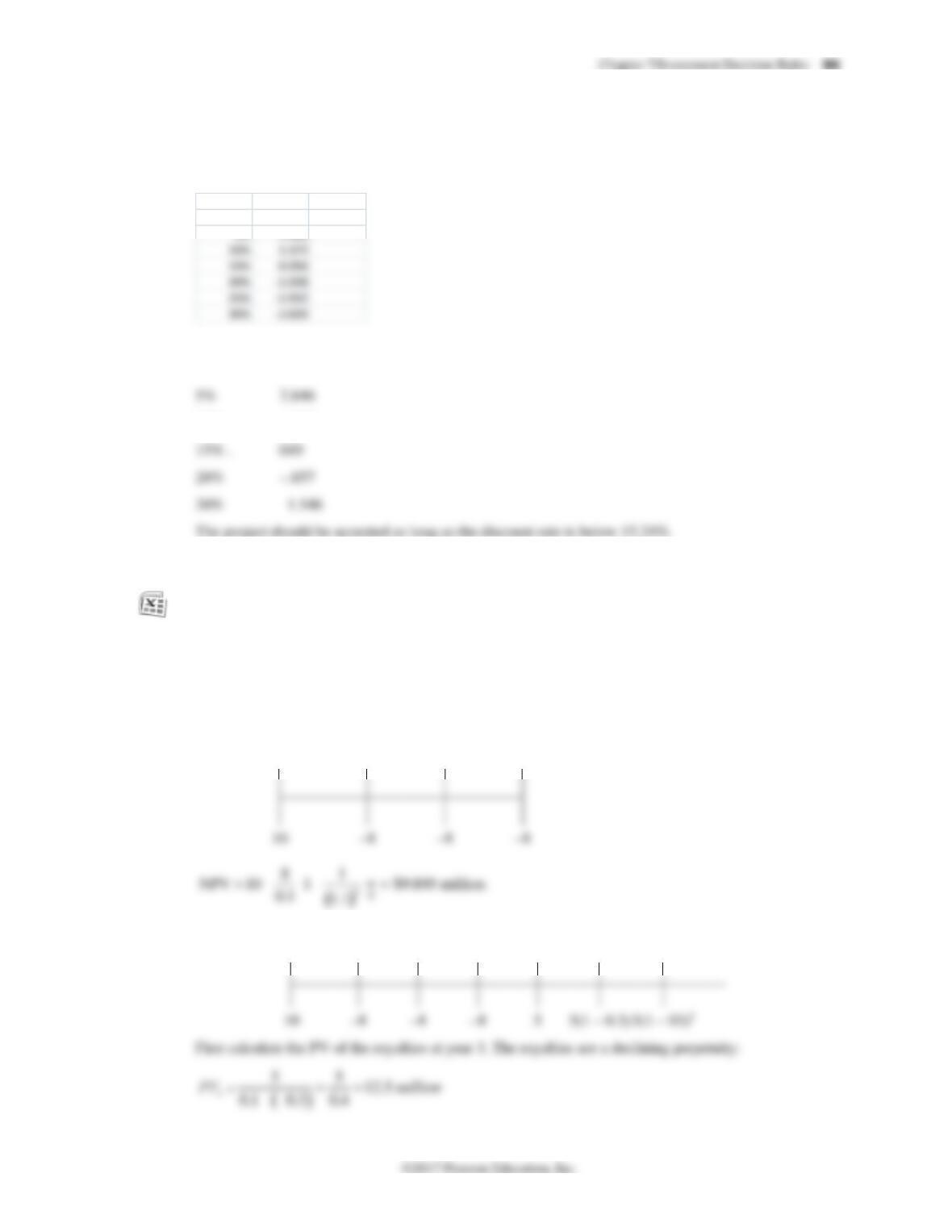
r NPV IRR
0% 5.000 15.24%
5% 2.988
R NPV IRR
0% 5.000 15.24%
10% 1.248
7-5. Bill Clinton reportedly was paid $10 million to write his book My Way. The book took three
years to write. In the time he spent writing, Clinton could have been paid to make speeches.
Given his popularity, assume that he could earn $8 million per year (paid at the end of the year)
speaking instead of writing. Assume his cost of capital is 10% per year.
a. What is the NPV of agreeing to write the book (ignoring any royalty payments)?
b. Assume that, once the book is finished, it is expected to generate royalties of $5 million in the
first year (paid at the end of the year) and these royalties are expected to decrease at a rate
of 30% per year in perpetuity. What is the NPV of the book with the royalty payments?
a. Timeline:
0
1
2
3
b. Timeline:
0
1
2
3
4
5
6
5
96 Berk/DeMarzo, Corporate Finance, Fourth Edition
So the value today is
7-6. FastTrack Bikes, Inc. is thinking of developing a new composite road bike. Development will
take six years and the cost is $200,000 per year. Once in production, the bike is expected to make
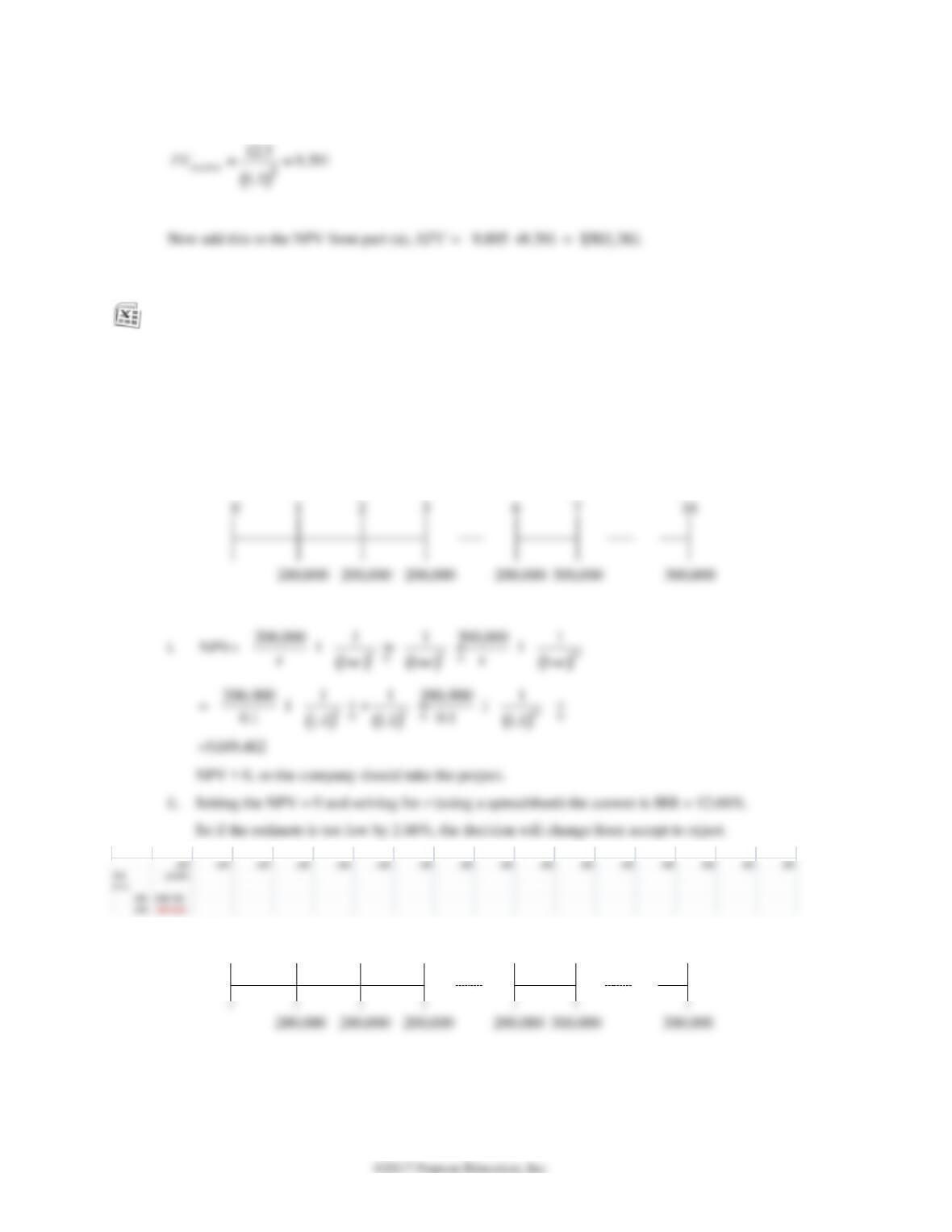
$300,000 per year for 10 years. Assume the cost of capital is 10%.
a. Calculate the NPV of this investment opportunity, assuming all cash flows occur at the end
of each year. Should the company make the investment?
b. By how much must the cost of capital estimate deviate to change the decision? (Hint: Use
Excel to calculate the IRR.)
c. What is the NPV of the investment if the cost of capital is 14%?
a. Timeline:
0
1
2
3
6
7
16
1 2 3 4 5 6 1 2 3 4 5 6 7 8 9 10
iii. Timeline:
0
1
2
3
6
7
16
Chapter 7/Investment Decision Rules 97
7-7. OpenSeas, Inc. is evaluating the purchase of a new cruise ship. The ship would cost $500 million,
and would operate for 20 years. OpenSeas expects annual cash flows from operating the ship to
be $70 million (at the end of each year) and its cost of capital is 12%.
a. Prepare an NPV profile of the purchase.
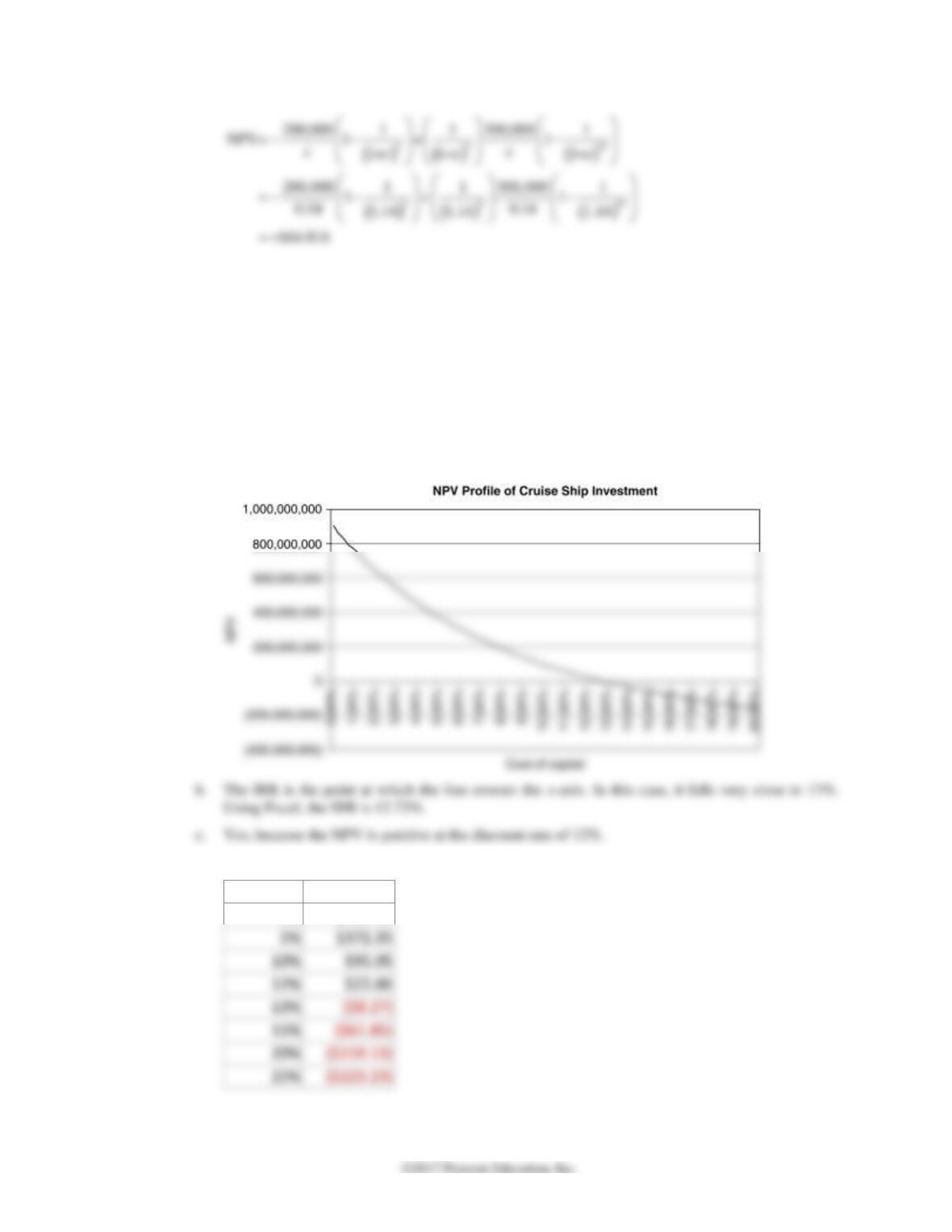
b. Estimate the IRR (to the nearest 1%) from the graph.
c. Is the purchase attractive based on these estimates?
d. How far off could OpenSeas’ cost of capital be (to the nearest 1%) before your purchase
decision would change?
a.
d. The discount rate could be off by 0.72% before the investment decision would change.
R
NPV (000s)
0%
$900.00
7-8. You are CEO of Rivet Networks, maker of ultra-high performance network cards for gaming
computers, and you are considering whether to launch a new product. The product, the Killer
X3000, will cost $900,000 to develop up front (year 0), and you expect revenues the first year of
$800,000, growing to $1.5 million the second year, and then declining by 40% per year for the
next 3 years before the product is fully obsolete. In years 1 through 5, you will have fixed costs
associated with the product of $100,000 per year, and variable costs equal to 50% of revenues.
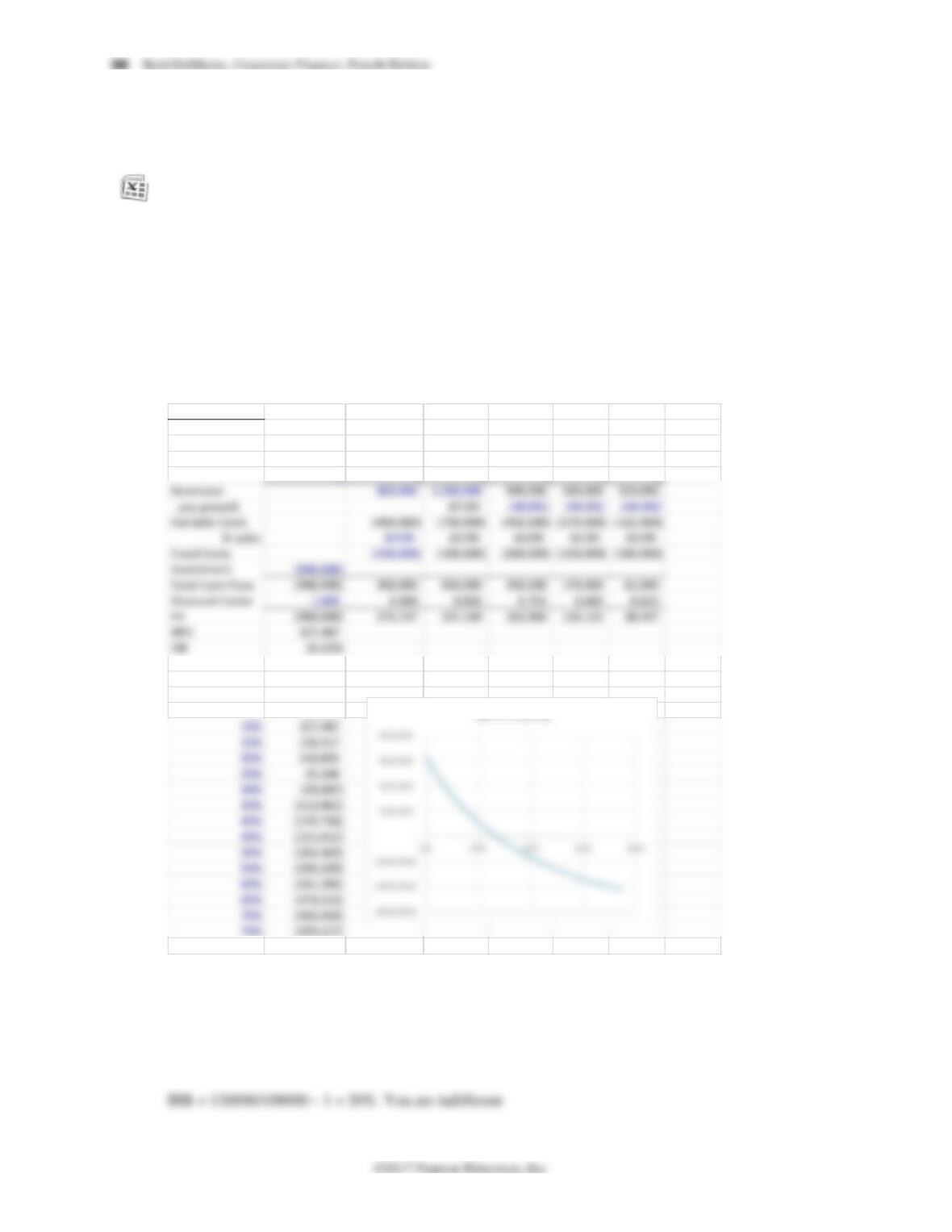
a. What are the cash flows for the project in years 0 through 5?
b. Plot the NPV profile for this investment from 0% to 40% in 10% increments.
c. What is the project’s NPV if the project’s cost of capital is 10%?
d. Use the NPV profile to estimate the cost of capital at which the project would become
unprofitable; that is, estimate the project’s IRR.
Rivet Networks
Cost of Capital 10.0%
01 2 3 4 5
Discount rate 327,487
0% 632,000
5% 466,065
7-9. You are considering an investment in a clothes distributor. The company needs $100,000 today
and expects to repay you $120,000 in a year from now. What is the IRR of this investment
opportunity? Given the riskiness of the investment opportunity, your cost of capital is 20%.
What does the IRR rule say about whether you should invest?
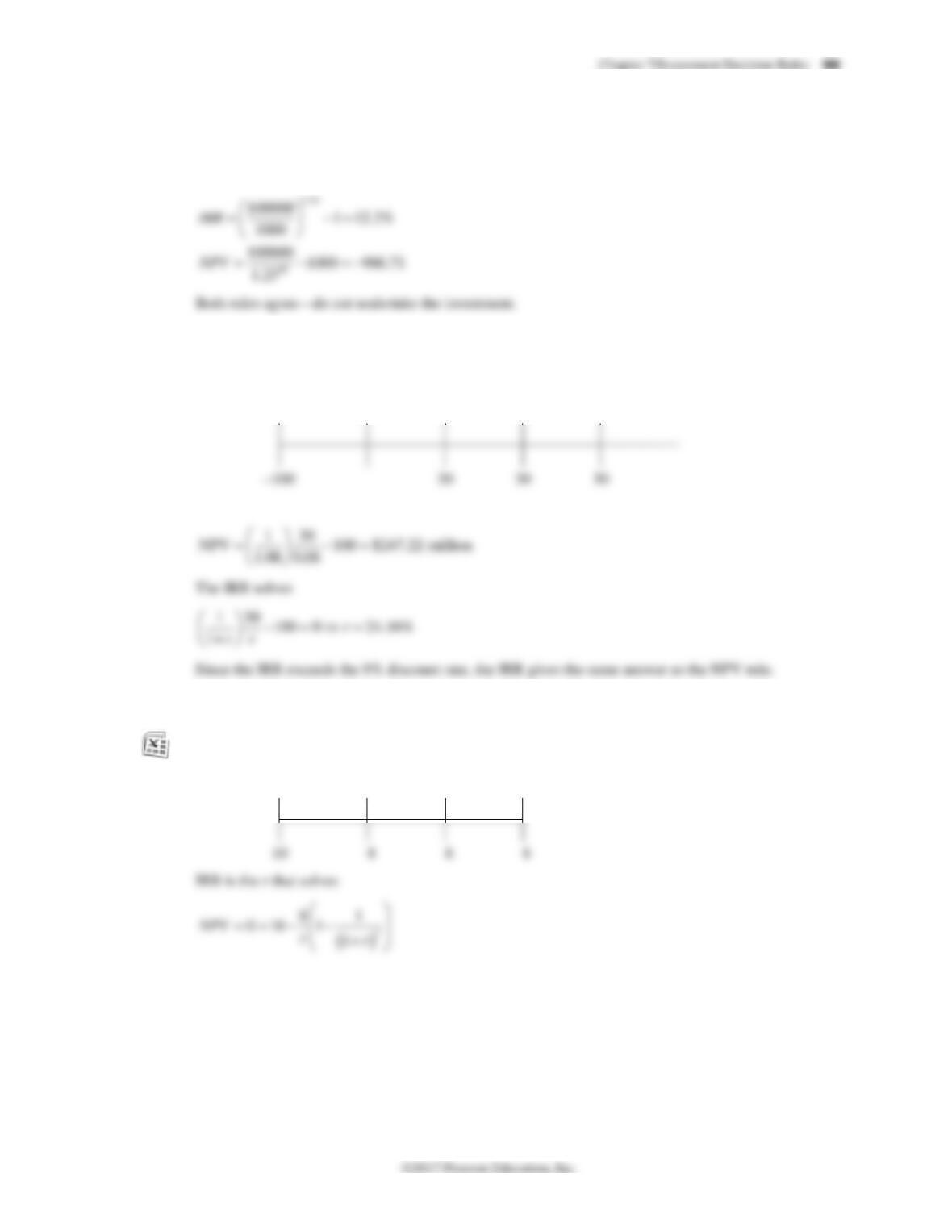
7-10. You have been offered a very long term investment opportunity to increase your money one
hundredfold. You can invest $1000 today and expect to receive $100,000 in 40 years. Your cost of
capital for this (very risky) opportunity is 25%. What does the IRR rule say about whether the
investment should be undertaken? What about the NPV rule? Do they agree?
7-11. Does the IRR rule agree with the NPV rule in Problem 3? Explain.
Timeline:
0
1
2
3
4
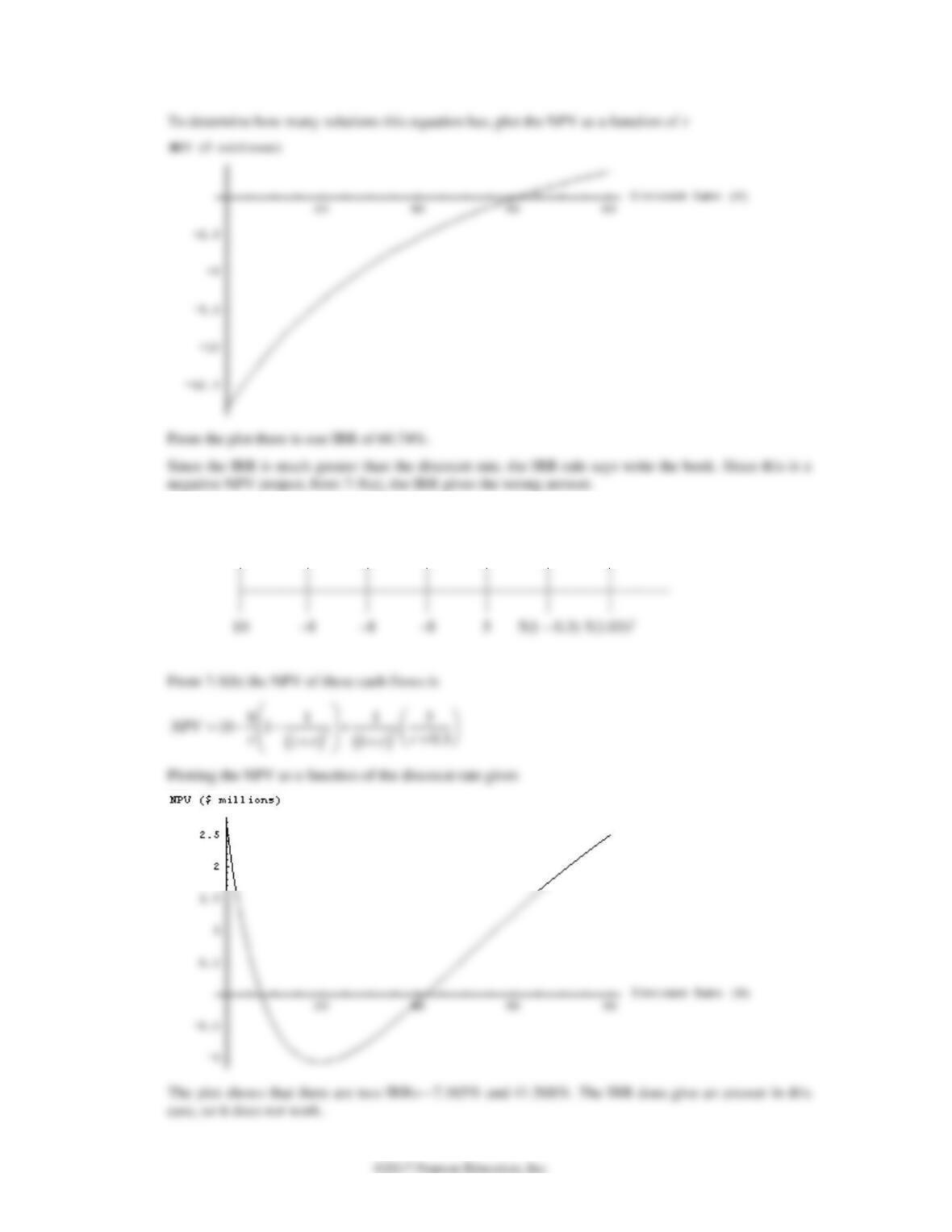
7-12. How many IRRs are there in part (a) of Problem 5? Does the IRR rule give the right answer in
this case? How many IRRs are there in part (b) of Problem 5? Does the IRR rule work in this
case?
Timeline:
0
1
2
3
100 Berk/DeMarzo, Corporate Finance, Fourth Edition
Timeline:
0
1
2
3
4
5
6
5
7-13. Professor Wendy Smith has been offered the following deal: A law firm would like to retain her
for an upfront payment of $50,000. In return, for the next year the firm would have access to 8
hours of her time every month. Smith’s rate is $550 per hour and her opportunity cost of capital
is 15% (EAR). What does the IRR rule advise regarding this opportunity? What about the NPV
rule?
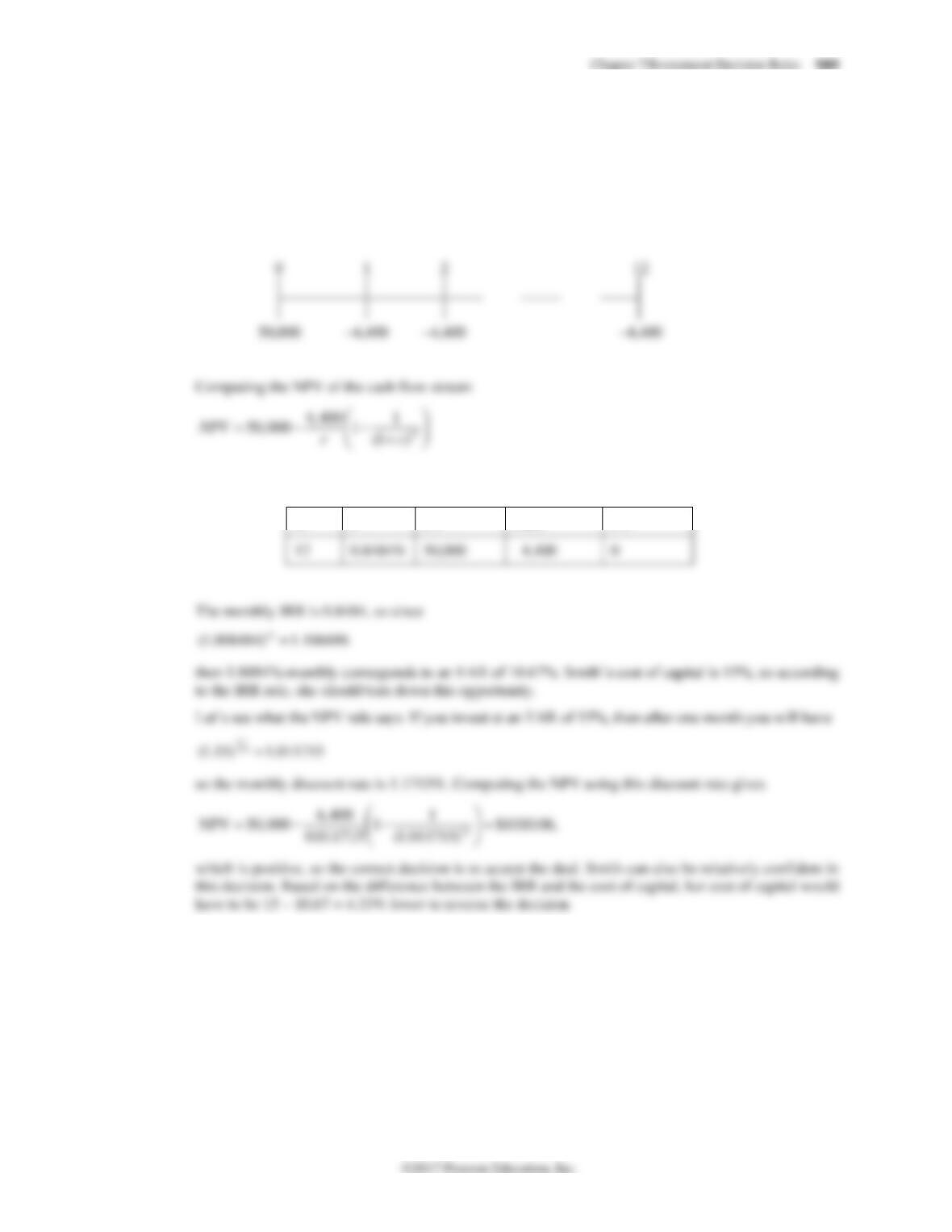
The timeline of this investment opportunity is:
To compute the IRR, we set the NPV equal to zero and solve for r. Using the annuity spreadsheet gives
N
I
PV
PMT
FV
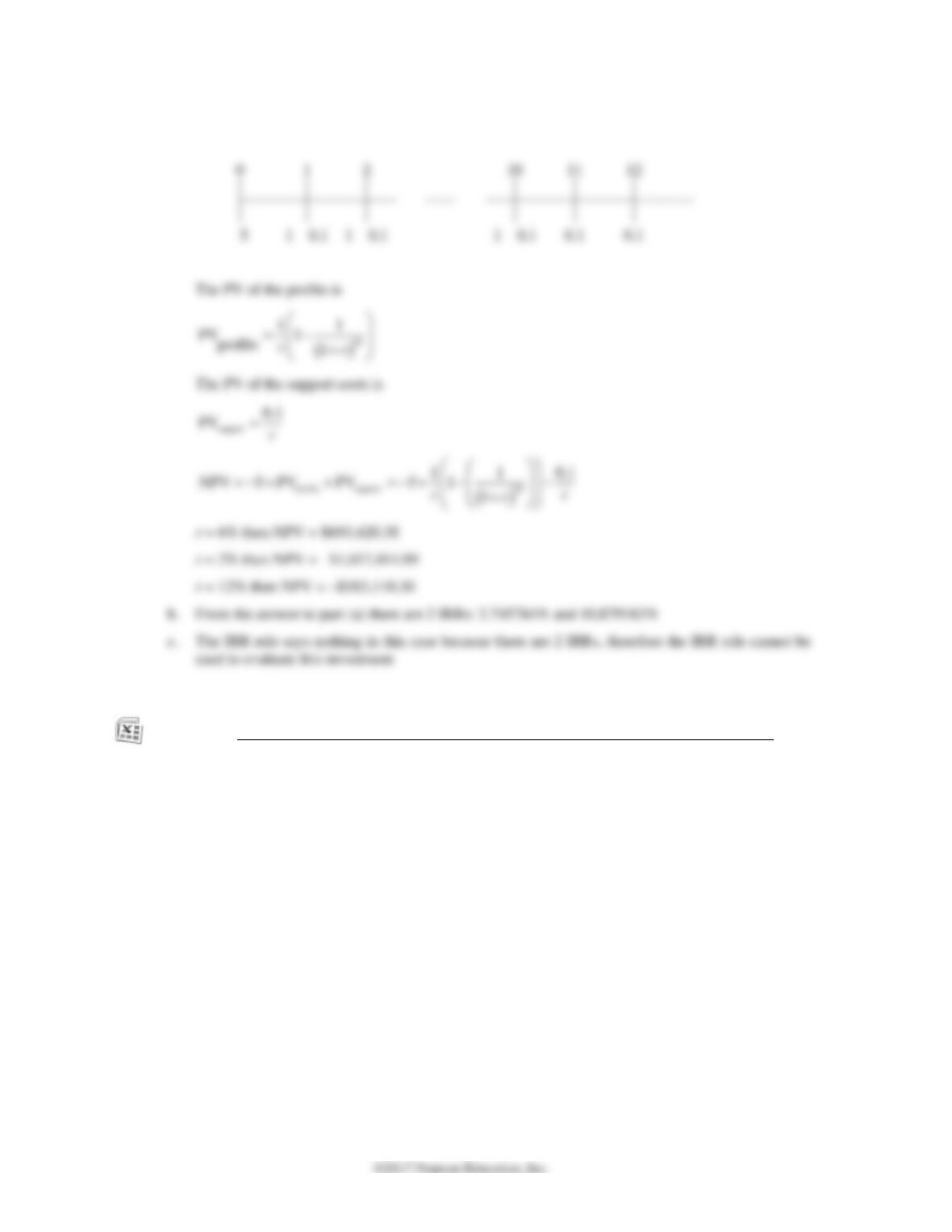
7-14. Innovation Company is thinking about marketing a new software product. Upfront costs to
market and develop the product are $5 million. The product is expected to generate profits of $1
million per year for 10 years. The company will have to provide product support expected to cost
$100,000 per year in perpetuity. Assume all profits and expenses occur at the end of the year.
a. What is the NPV of this investment if the cost of capital is 6%? Should the firm undertake
the project? Repeat the analysis for discount rates of 2% and 12%.
b. How many IRRs does this investment opportunity have?
c. Can the IRR rule be used to evaluate this investment? Explain.
102 Berk/DeMarzo, Corporate Finance, Fourth Edition
a. Timeline:
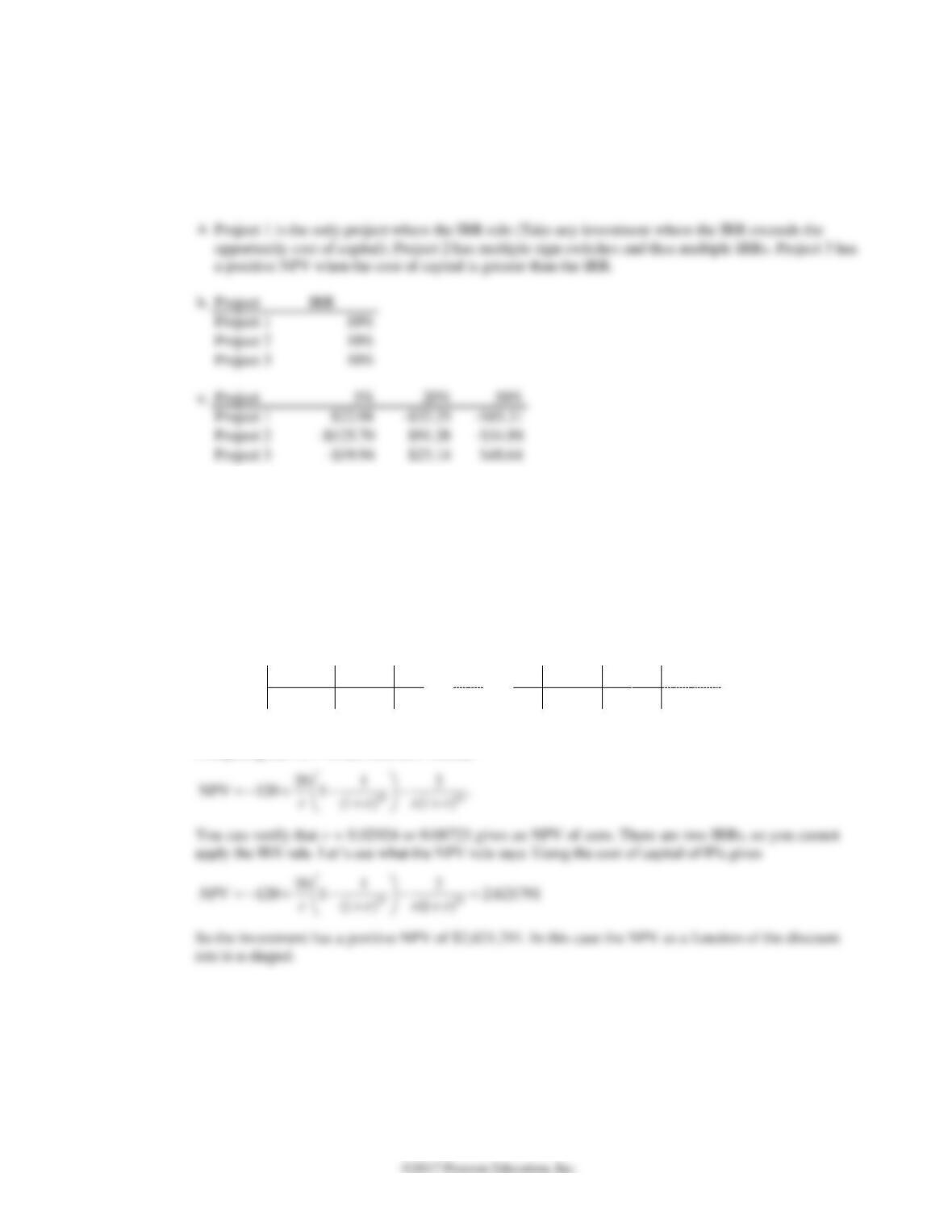
7-15. You have 3 projects with the following cash flows:
Year
0
1
2
3
4
Project 1
–150
20
40
60
80
Project 2
–825
0
0
7000
–6500
Project 3
20
40
60
80
–245
a. For which of these projects is the IRR rule reliable?
b. Estimate the IRR for each project (to the nearest 1%).
c. What is the NPV of each project if the cost of capital is 5%? 20%? 50%?
Chapter 7/Investment Decision Rules 103
Year 0 1 2 3 4
Project 1 -150 20 40 60 80
Project 2 -825 0 0 7000 -6500
Project 3 20 40 60 80 -245
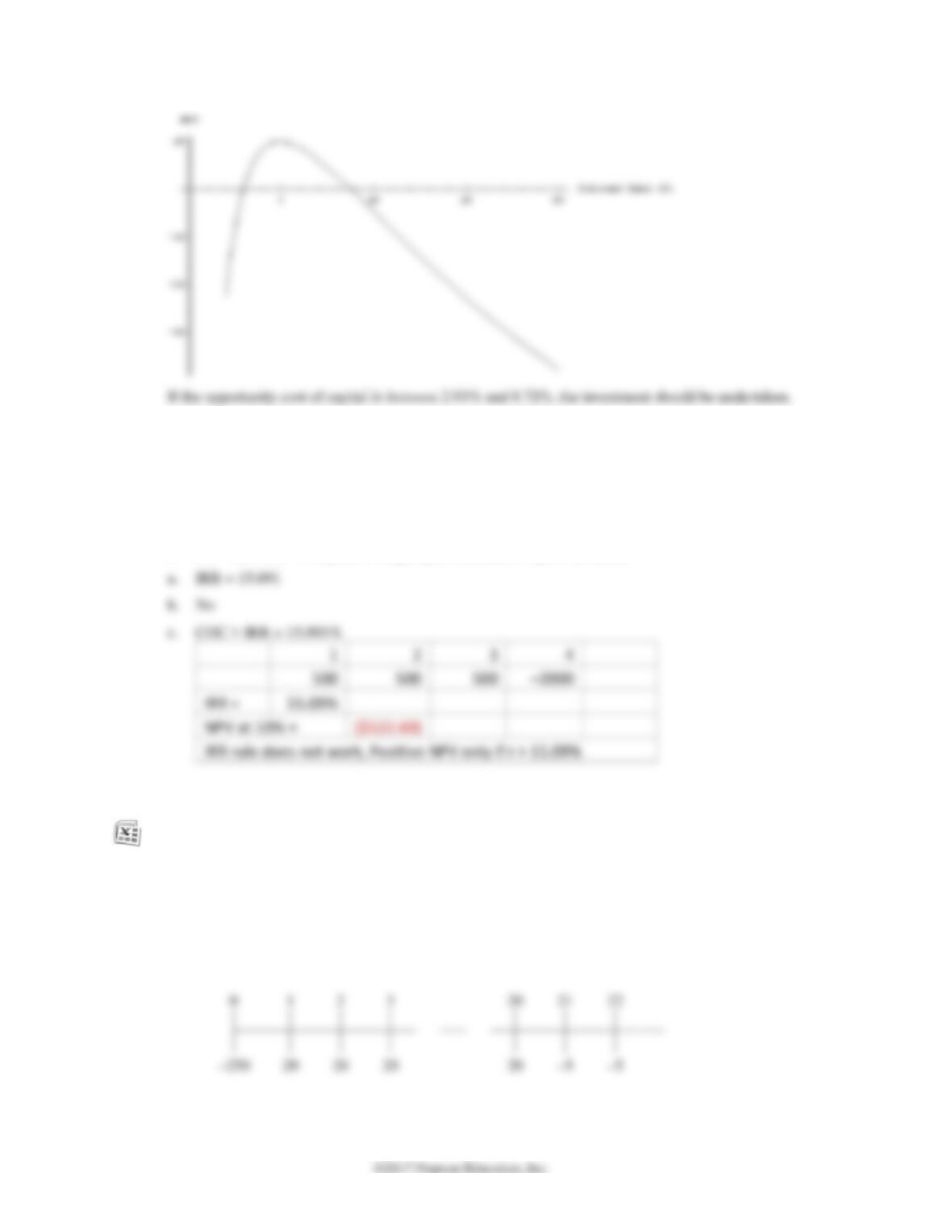
7-16. You own a coal mining company and are considering opening a new mine. The mine itself will
cost $120 million to open. If this money is spent immediately, the mine will generate $20 million
for the next 10 years. After that, the coal will run out and the site must be cleaned and
maintained at environmental standards. The cleaning and maintenance are expected to cost $2
million per year in perpetuity. What does the IRR rule say about whether you should accept this
opportunity? If the cost of capital is 8%, what does the NPV rule say?
The timeline of this investment opportunity is:
0
1
2
10
11
12
–120
20
20
20
–2
–2
Computing the NPV of the cash flow stream:
104 Berk/DeMarzo, Corporate Finance, Fourth Edition
7-17. Your firm spends $500,000 per year in regular maintenance of its equipment. Due to the
economic downturn, the firm considers forgoing these maintenance expenses for the next three
years. If it does so, it expects it will need to spend $2 million in year 4 replacing failed equipment.
a. What is the IRR of the decision to forgo maintenance of the equipment?
b. Does the IRR rule work for this decision?
c. For what costs of capital is forgoing maintenance a good decision?
7-18. You are considering investing in a new gold mine in South Africa. Gold in South Africa is buried
very deep, so the mine will require an initial investment of $250 million. Once this investment is
made, the mine is expected to produce revenues of $30 million per year for the next 20 years. It
will cost $10 million per year to operate the mine. After 20 years, the gold will be depleted. The
mine must then be stabilized on an ongoing basis, which will cost $5 million per year in
perpetuity. Calculate the IRR of this investment. (Hint: Plot the NPV as a function of the
discount rate.)
Timeline: