Chapter 7 CFIN6
Chapter 7 Solutions
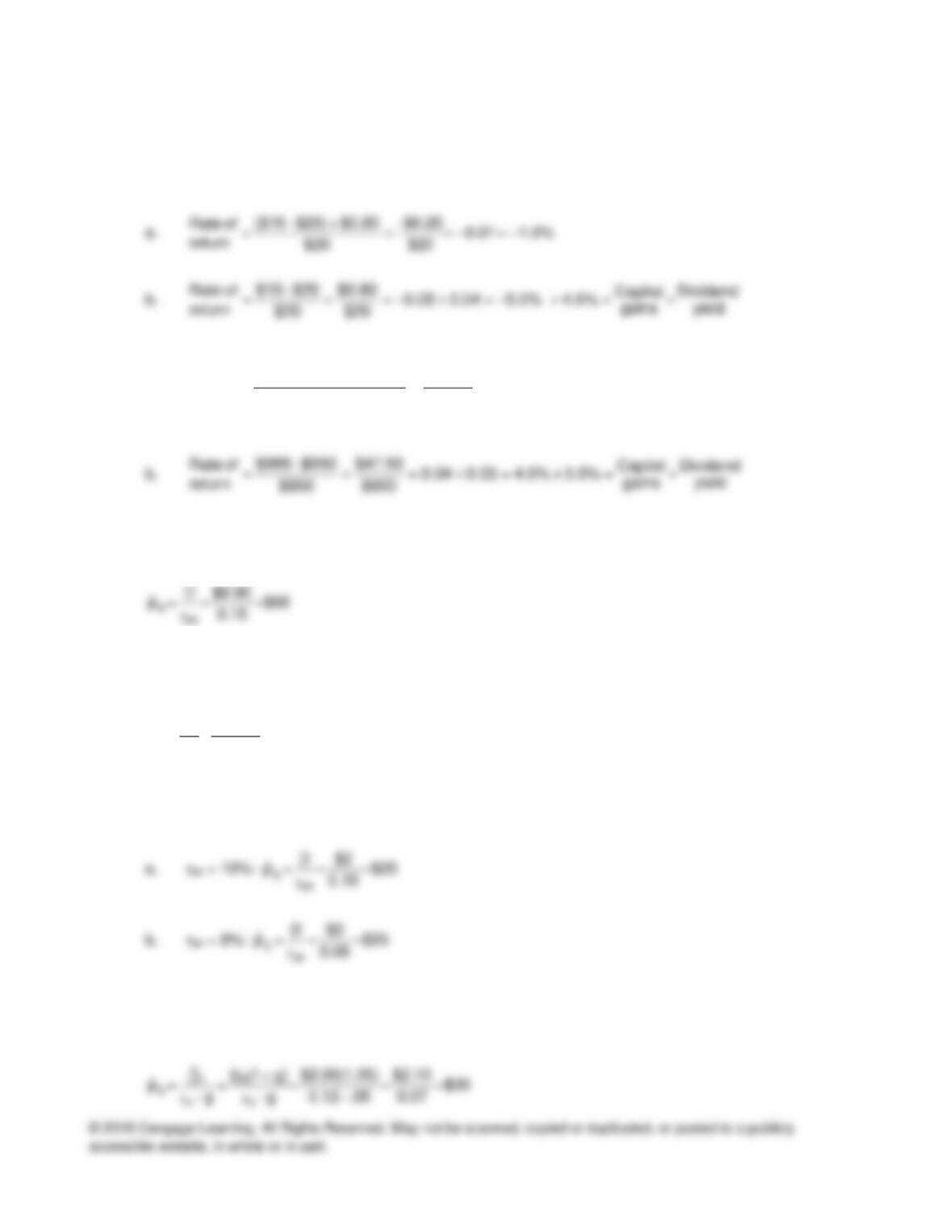
7-1 Total dollar return per share = ($19 – $20) + 4($0.20) = -$0.20
7-2 a.
($988 – $950) + $47.50 $85.50
Rate of = 0.09 9.0%
return $950 $950
= = =
7-3 Dividend = 0.09($110) = $9.90
7-4 Dividend = $16.50
0ps
D $16.50
ˆ = $150
P0.11
r==
7-5 Dividend = 0.05($40) = $2
7-6
1
ˆ
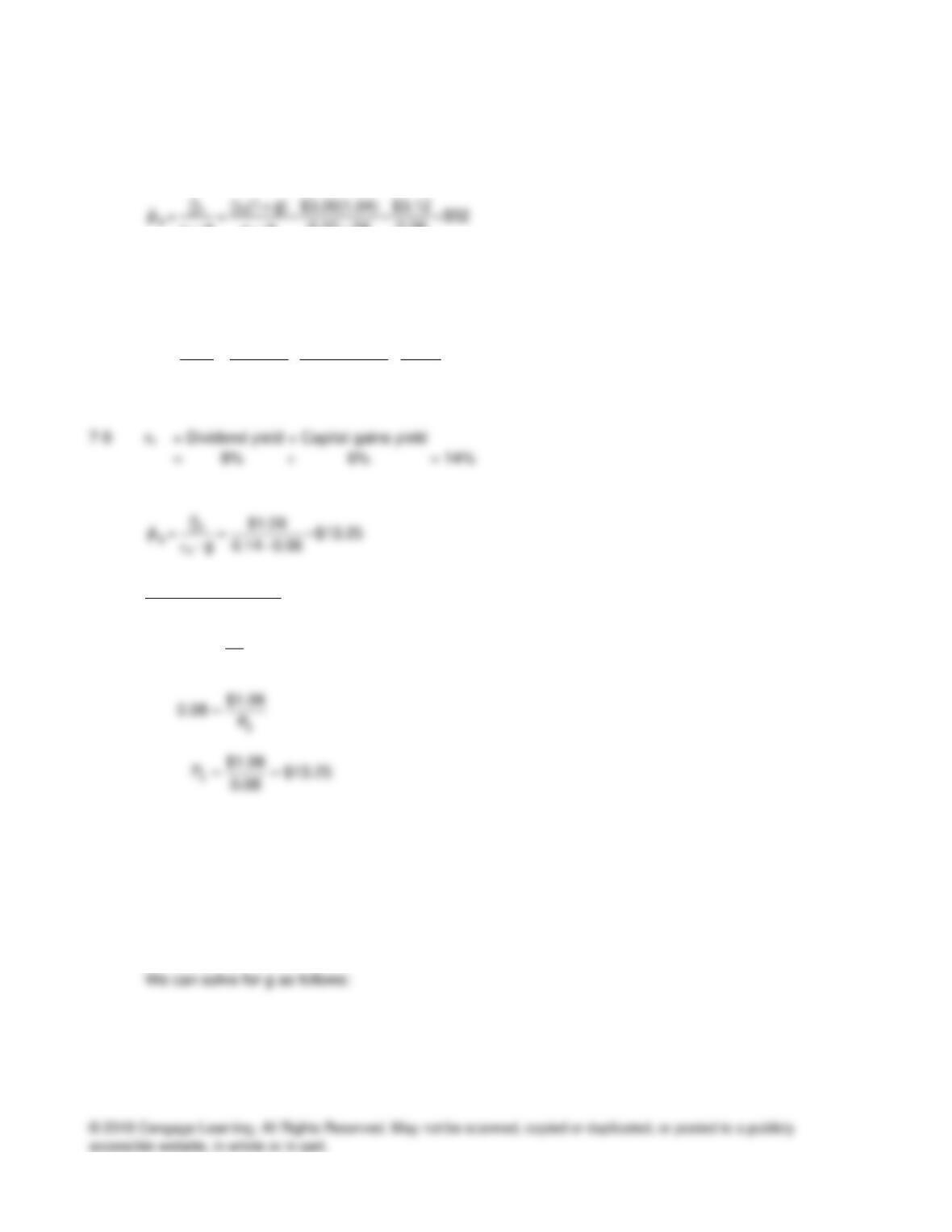
D $2(1.05) $2.10==
Chapter 7 CFIN6
7-7
1
ˆ
D $3(1.04) $3.12==
rr
−
7-8
1
ˆ
D $1.20(1.025) $1.23==
0
1
0ss
ˆ(1 + g) $1.20(1.025) $1.23
D
D
ˆ = = $9.84
P – g – g 0.15 .025 0.125
rr
= = =
−
Alternative solution:
1
0
ˆ
D
Dividend
yield P
=
7-10 rs = 16%
g = ?, but we know the price of the stock is P0 = $19.50
1
ˆ
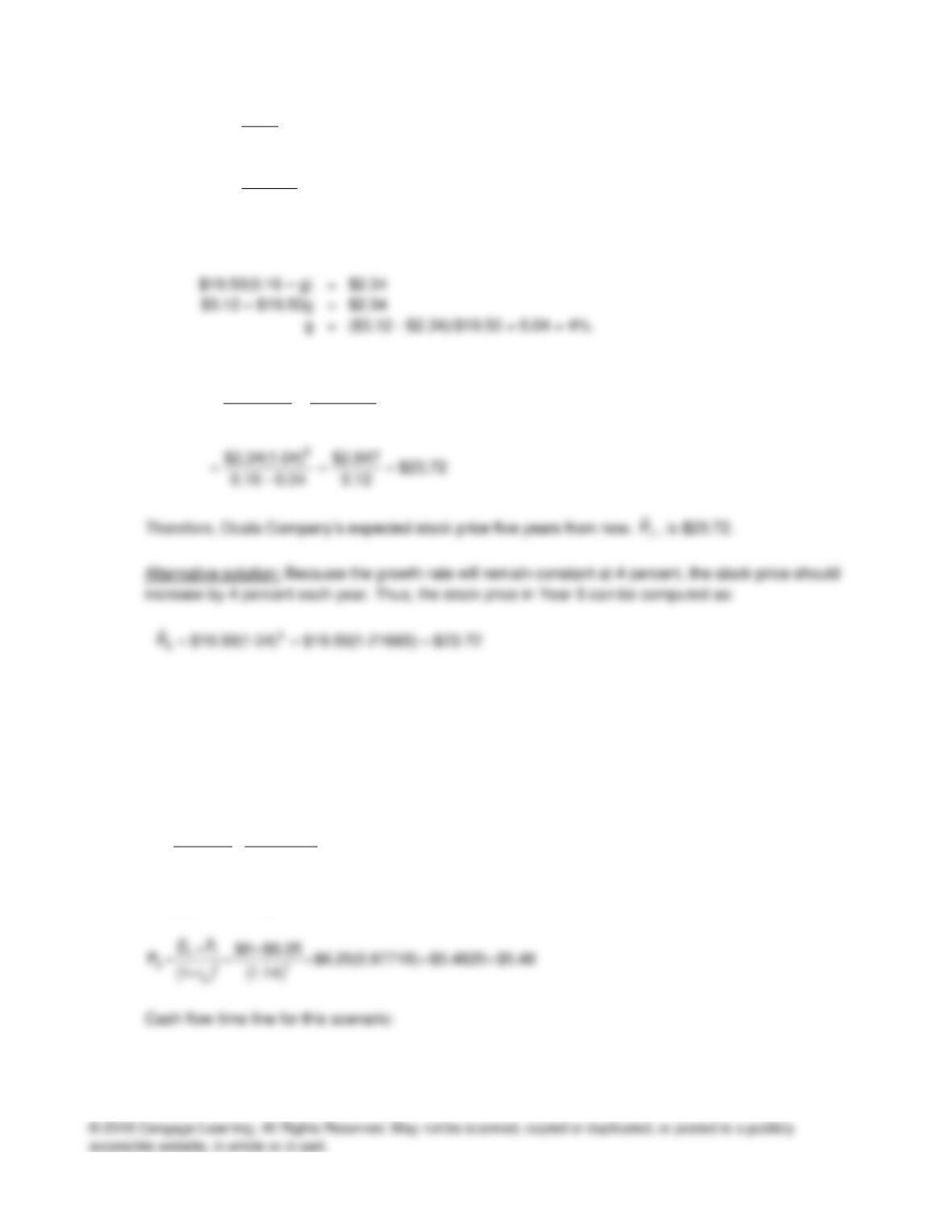
D $2.34=
Chapter 7 CFIN6
1
0s
ˆ
D
Prg
$2.34
$19.50 0.16 g
=−
=−
Solving for g, we find the growth rate to be 4 percent:
The next step is to use the growth rate to project the stock price five years hence:
P
65
01
5ss
D (1 g) D (1 g)
ˆ
Pr g r g
++
==
−−
7-11 D0 =
1
ˆ
D
= $0
2
ˆ
D
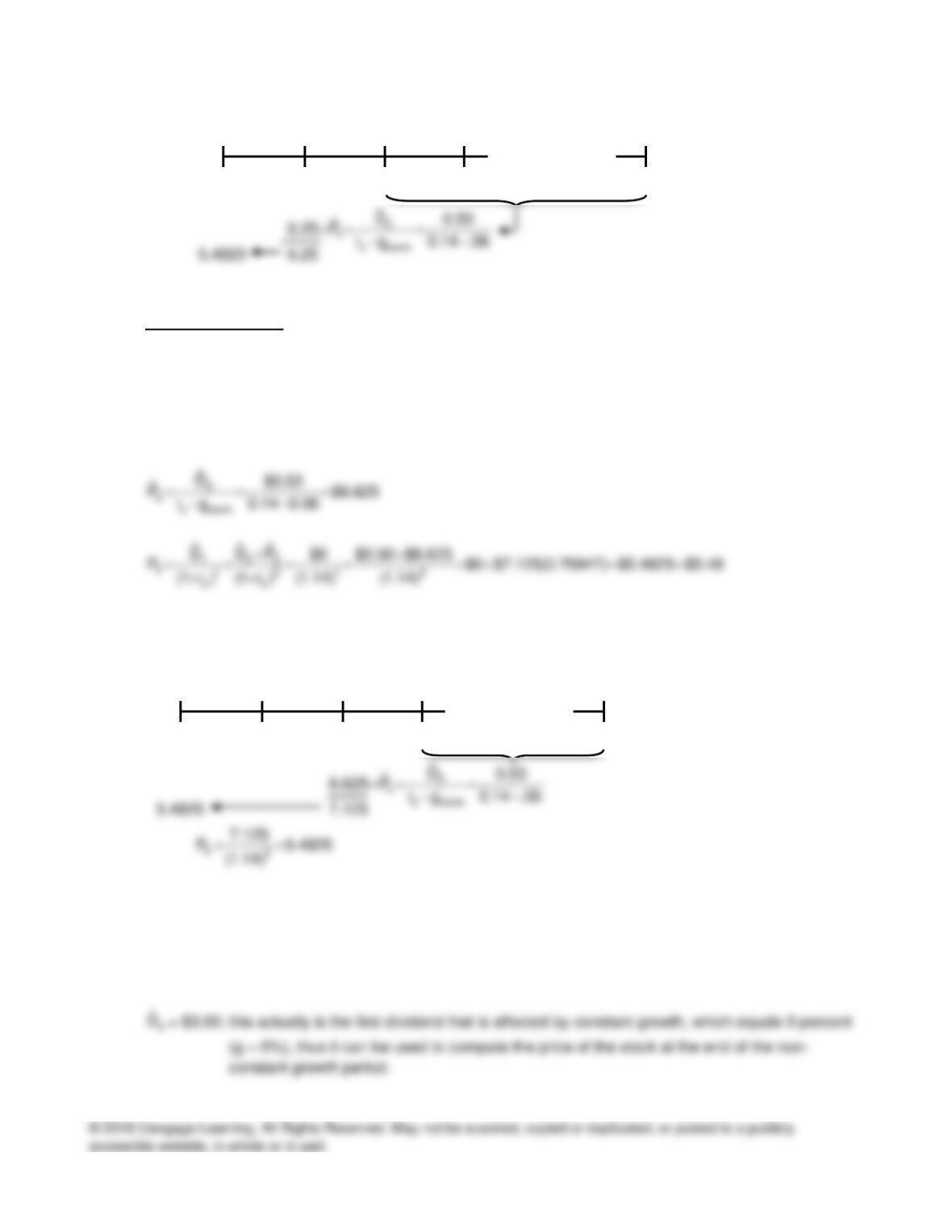
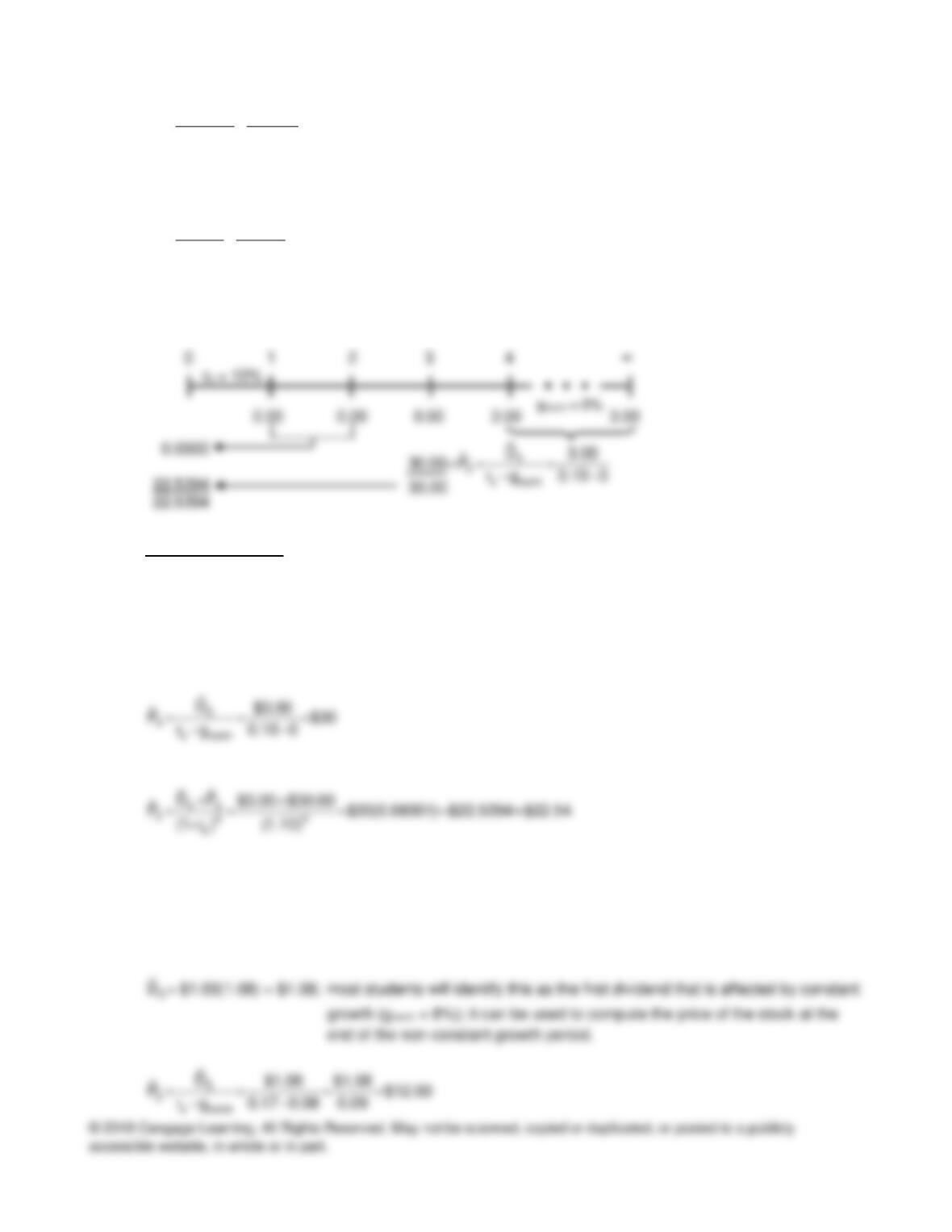
= $0.50; this actually is the first dividend that is affected by constant growth (gnorm = 6%), thus it can
be used to compute the price of the stock at the end of the non-constant growth period.
2
1s norm
ˆ
D$0.50
ˆ
P $6.25
r g 0.14 0.06
= = =
−−
Thus, the current price of the stock is
Chapter 7 CFIN6
5.4825
Alternative Solution:
Students might solve the problem by computing the price at the end of Year 2, because they believe
that the first year of constant growth is in Year 3. The solution in this case would be:
3
ˆ
D
= $0.50(1.06) = $0.53
Cash flow time line for this scenario:
7.125
5.4825
7-12 D0 = $0
1 2 3
ˆ ˆ ˆ
D D D===
$0
0 1 2 3 ∞
0.00 0.50 0.53 0.50(1.06)∞-2
rs = 14%
gnorm = 6%
…
0 1 2 3 ∞
0.00 0.50 0.53 0.50(1.06)∞-2
rs = 14%
gnorm = 6%
…
Chapter 7 CFIN6
4
3s norm
ˆ
D$3.00
ˆ
P $30.00
r g 0.10 0
= = =
−−
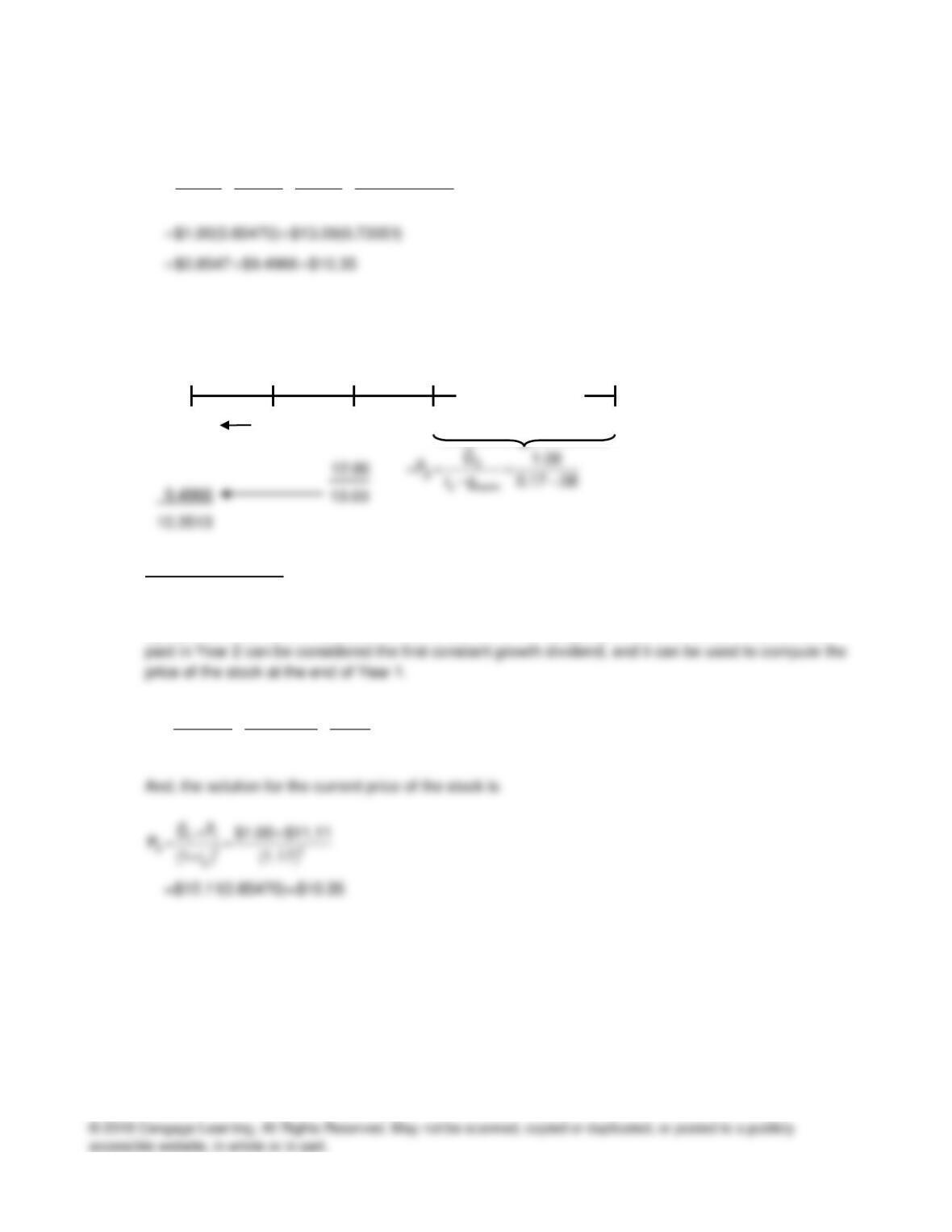
Thus, the current price of the stock is
3
033
s
ˆ
P$30.00
P $30.00(0.751315) $22.5394 $22.54
(1 r ) (1.10)
= = = =
+
Cash flow time line:
Alternative Solution:
Students might solve the problem by computing the price at the end of Year 4, because they believe
that the first year of constant growth is in Year 4. The solution in this case would be:
4
ˆ
D
= $3.00
7-13 D0 = $1.00
1
ˆ
D
=
2
ˆ
D
= $1.00
Chapter 7 CFIN6
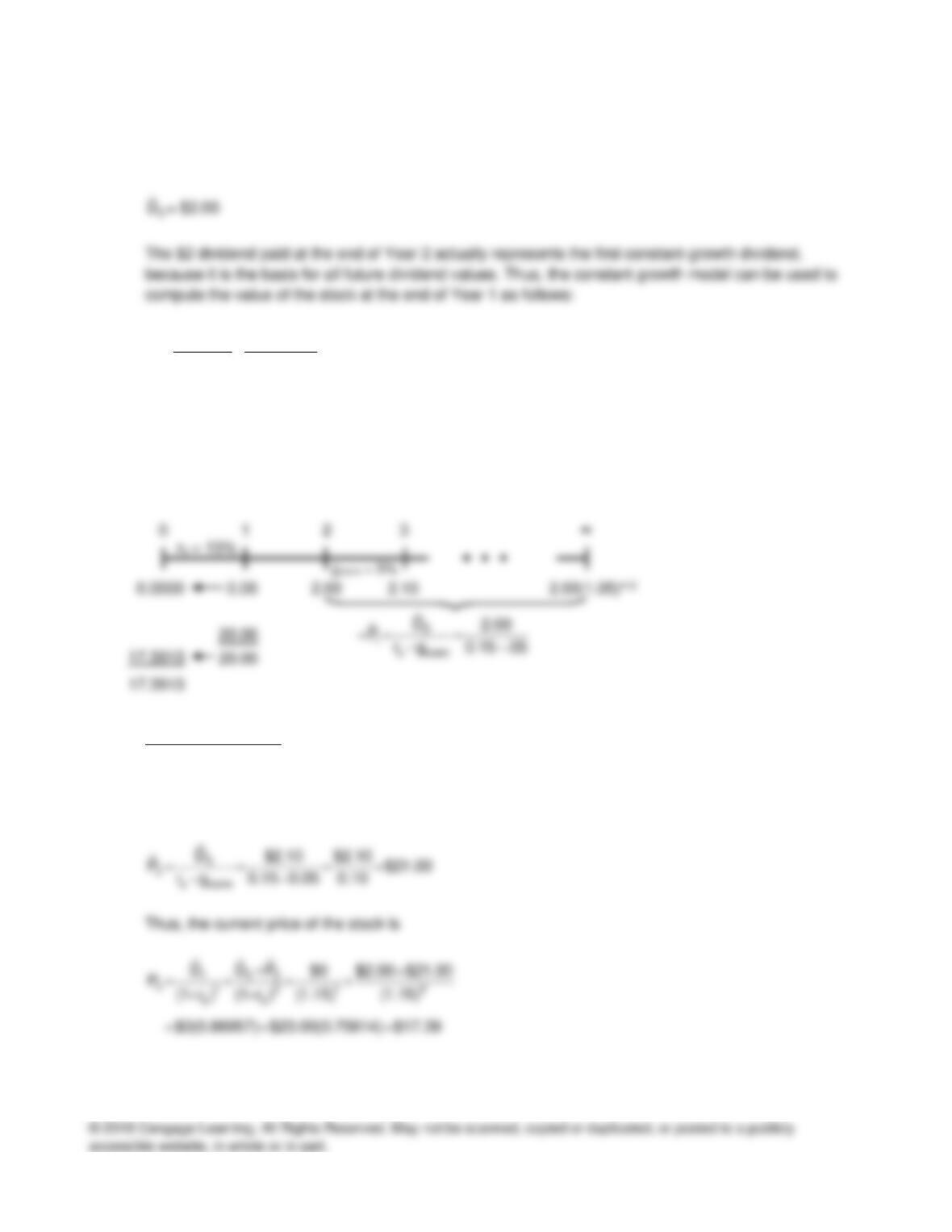
Thus, the current price of the stock is
1 2 2
01 2 1 2
ss
ˆ ˆ ˆ
D D P $1.00 $1.00 $12.00
P(1 r ) (1 r ) (1.17) (1.17)
++
= + = +
++
Cash flow time line:
13.00
10.3513
Alternative Solution:
Some students might recognize that the last $1 dividend that is paid is the base dividend that will grow
by 8 percent each year thereafter for the remainder of the company’s life. As a result, the $ dividend
2
1s norm
ˆ
D$1.00 $1.00
ˆ
P $11.11
r g 0.17 0.08 0.09
= = = =
−−
0 1 2 3 ∞
1.00 1.00 1.08 1.00(1.08)∞-2
rs = 17%
gnorm = 8%
…
0.8547
Chapter 7 CFIN6
7-14 D0 = $0
1
ˆ
D
= $0
2
1s norm
ˆ
D$2.00
ˆ
P $20.00
r g 0.15 0.05
= = =
−−
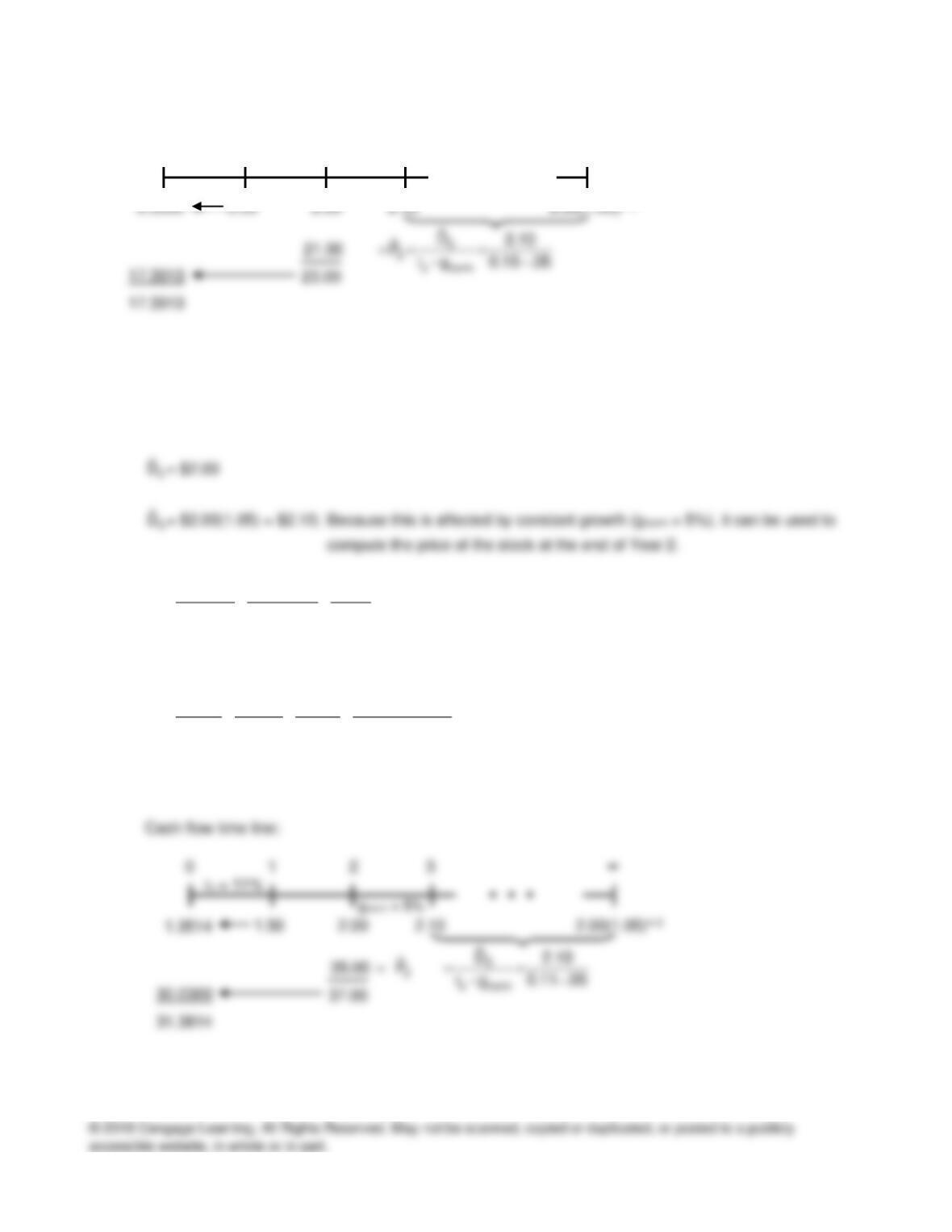
The PV of $20 one year from today is: PV = P0 = $20/1.15 = $17.39
Cash flow time line:
Alternative solution:
3
ˆ
D
= $2.00(1.05) = $2.10; Because this is affected by constant growth (gnorm = 5%), it can be used to
compute the price of the stock at the end of Year 2.
Chapter 7 CFIN6
Cash flow time line:
0.0000
17.3913
7-15 D0 = $0
1
ˆ
D
= $1.50
3
2s norm
ˆ
D$2.10 $2.10
ˆ
P $35
r g 0.11 0.05 0.06
= = = =
−−
Thus, the current price of the stock is
1 2 2
01 2 1 2
ss
ˆ ˆ ˆ
D D P $1.50 $2.00 $35.00
P(1 r ) (1 r ) (1.11) (1.11)
$1.50(0.90090) $37.00(0.81162) $31.38
++
= + = +
++
= + =
0 1 2 3 ∞
rs = 11%
gnorm = 5%
37.00
1.3514
31.3814
0 1 2 3 ∞
rs = 15%
gnorm = 5%
…
Chapter 7 CFIN6
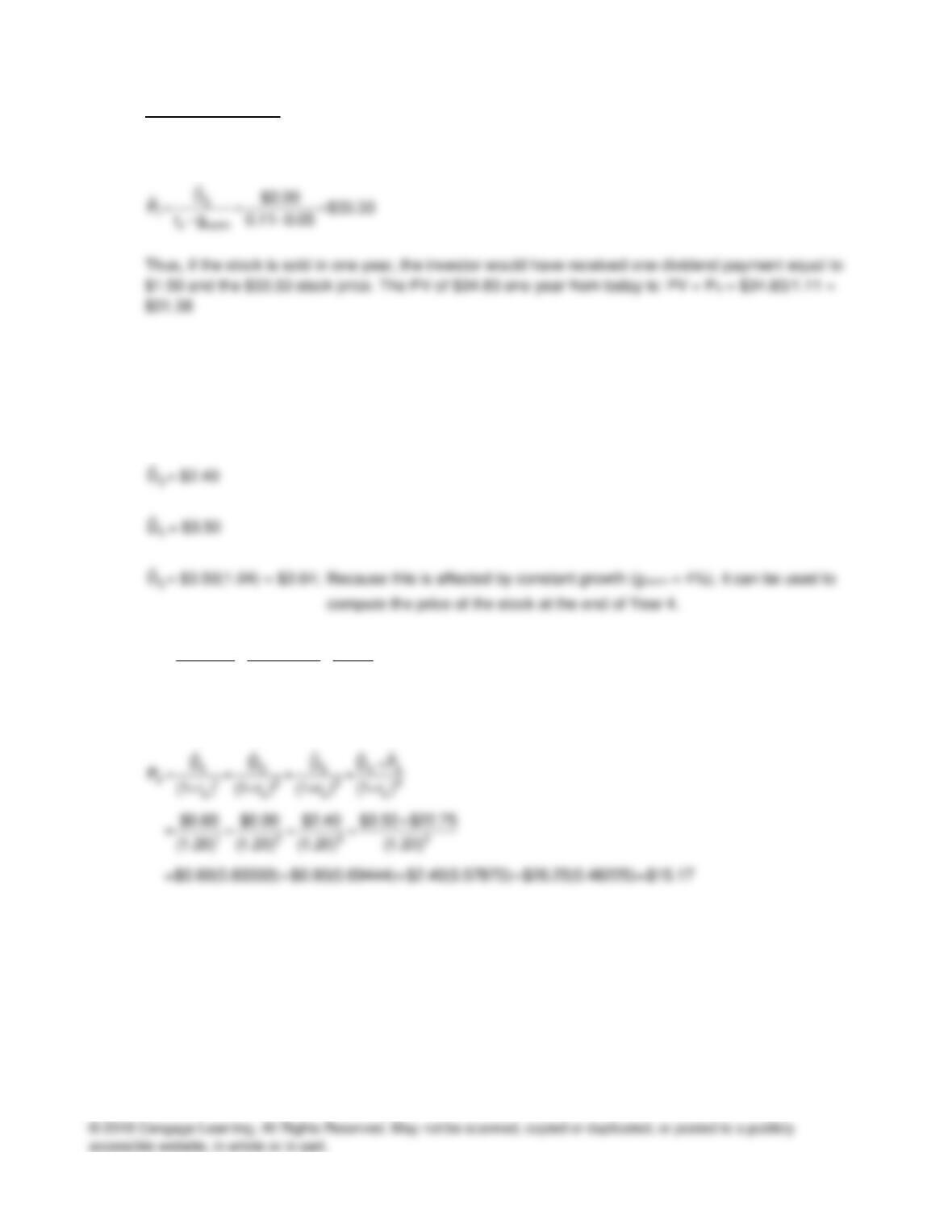
Alternative solution: Because the $2 dividend actually represents the first constant–growth dividend (the
starting basis for constant growth), the constant growth model can be used to compute the value of the
stock at the end of Year 1 as follows:
7-16
1
ˆ
D
= $0.60
2
ˆ
D
= $0.90
3
ˆ
D
5
4s norm
ˆ
D$3.64 $3.64
ˆ
P $22.75
r g 0.20 0.04 0.16
= = = =
−−
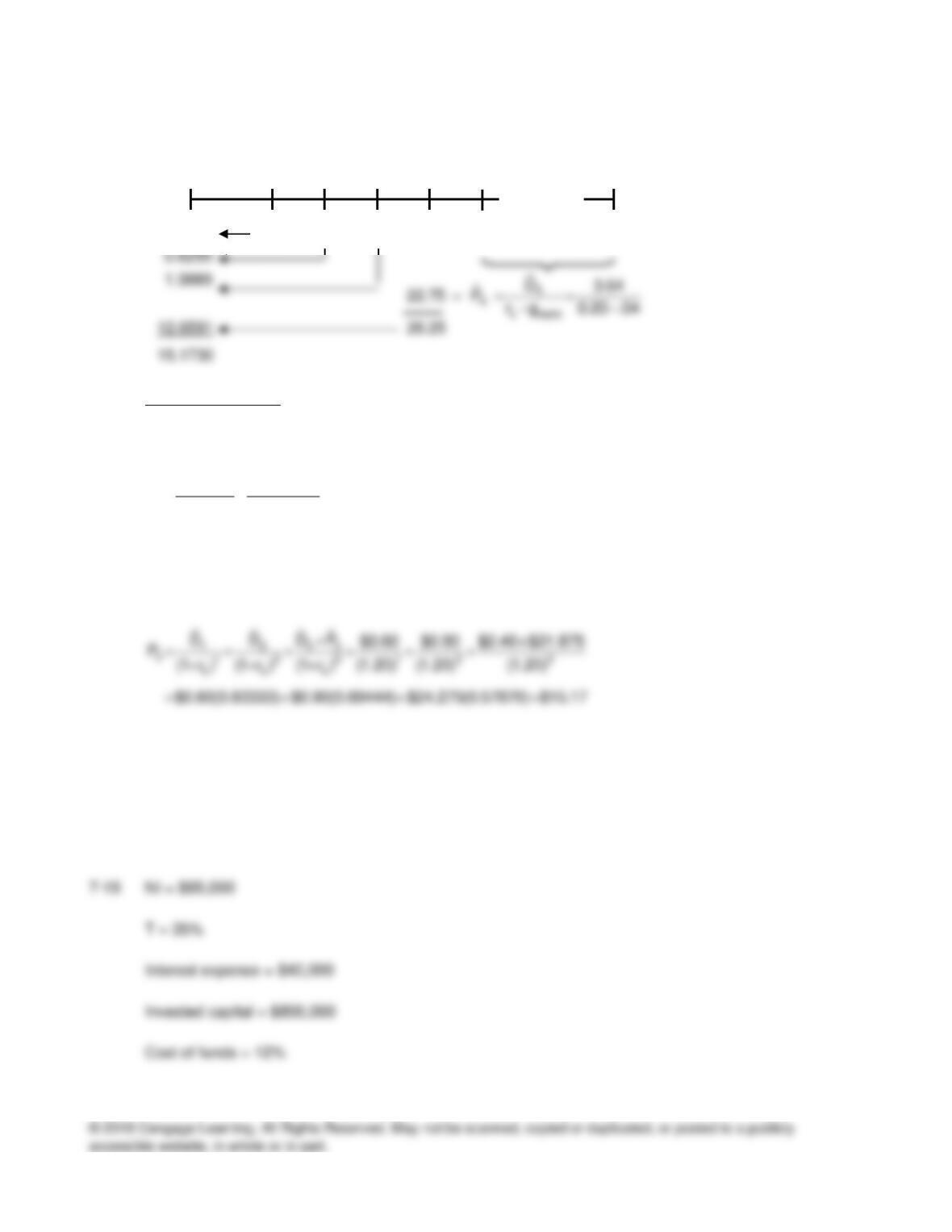
Thus, the current price of the stock is
Chapter 7 CFIN6
Cash flow time line:
26.25
15.1730
Alternative solution: Because the $3.50 dividend actually represents the first constant-growth dividend
(the starting basis for constant growth), the constant growth model can be used to compute the value of
the stock at the end of Year 3 as follows:
4
3s norm
ˆ
D$3.50
ˆ
P $21.875
r g 0.20 0.04
= = =
−−
Thus, if the stock is sold in three years, the investor would have received three dividend payments equal
to $0.60, $0.90, and $2.40, respectively, and the $21.875 stock price at the end of Year 3. The PV of
this cash flow stream is:
7-17 P0 19 x $3.70 = $70.30
7-18 Price range: 28 x $4 = $112 to 30 x 4 = $120
0 1 2 3 4 5 ∞
0.60 0.90 2.40 3.50 3.64 3.50(1.05)∞-4
rs = 11%
gnorm = 4%
…
0.5000
Chapter 7 CFIN6
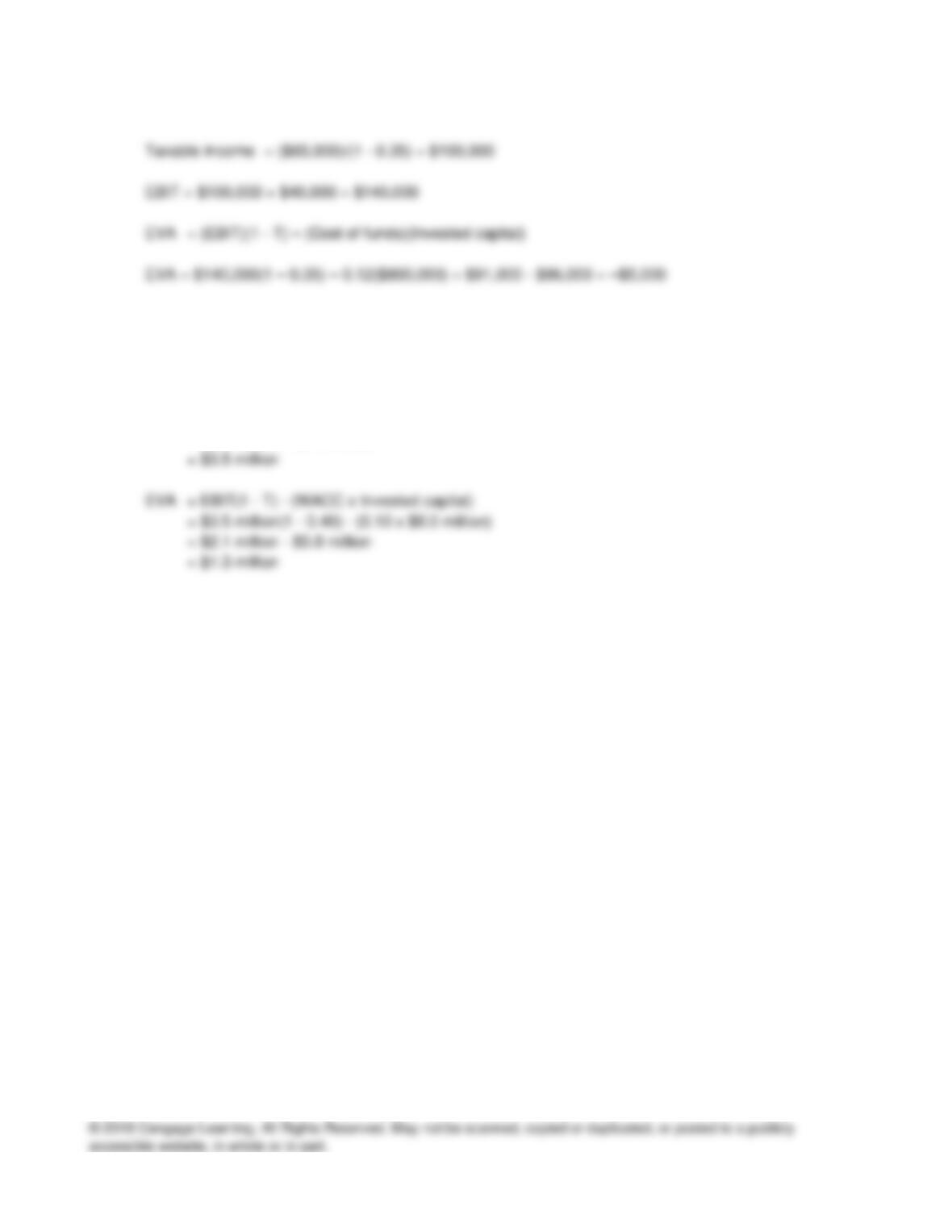
Net income = $65,000 = (Taxable income)(1 – 0.40)
7-20 Net income = $1.2 million = (Taxable income)(1 – 0.40)
Taxable income = ($1.2 million)/(1 – 0.40) = $2.0 million
EBIT = Taxable income + Interest
= $2.0 million + $1.5 million