Chapter 7
Question 18
Input area:
Settlement date 1/1/2000
Output area:
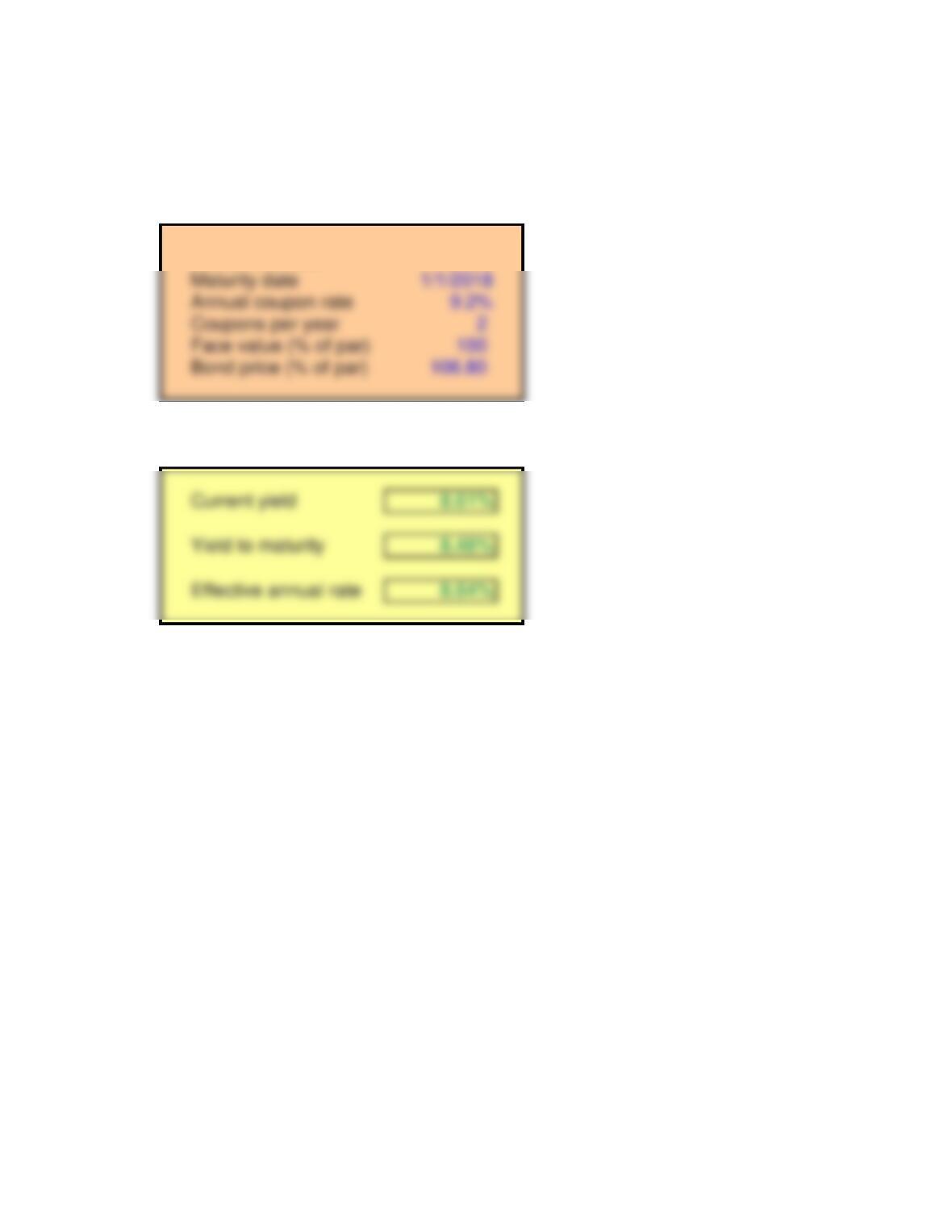
Maturity date 1/1/2018
Annual coupon rate 9.2%
Coupons per year 2
Face value (% of par) 100
Bond price (% of par) 106.80
Chapter 7
Question 19
Input area:
Output area:
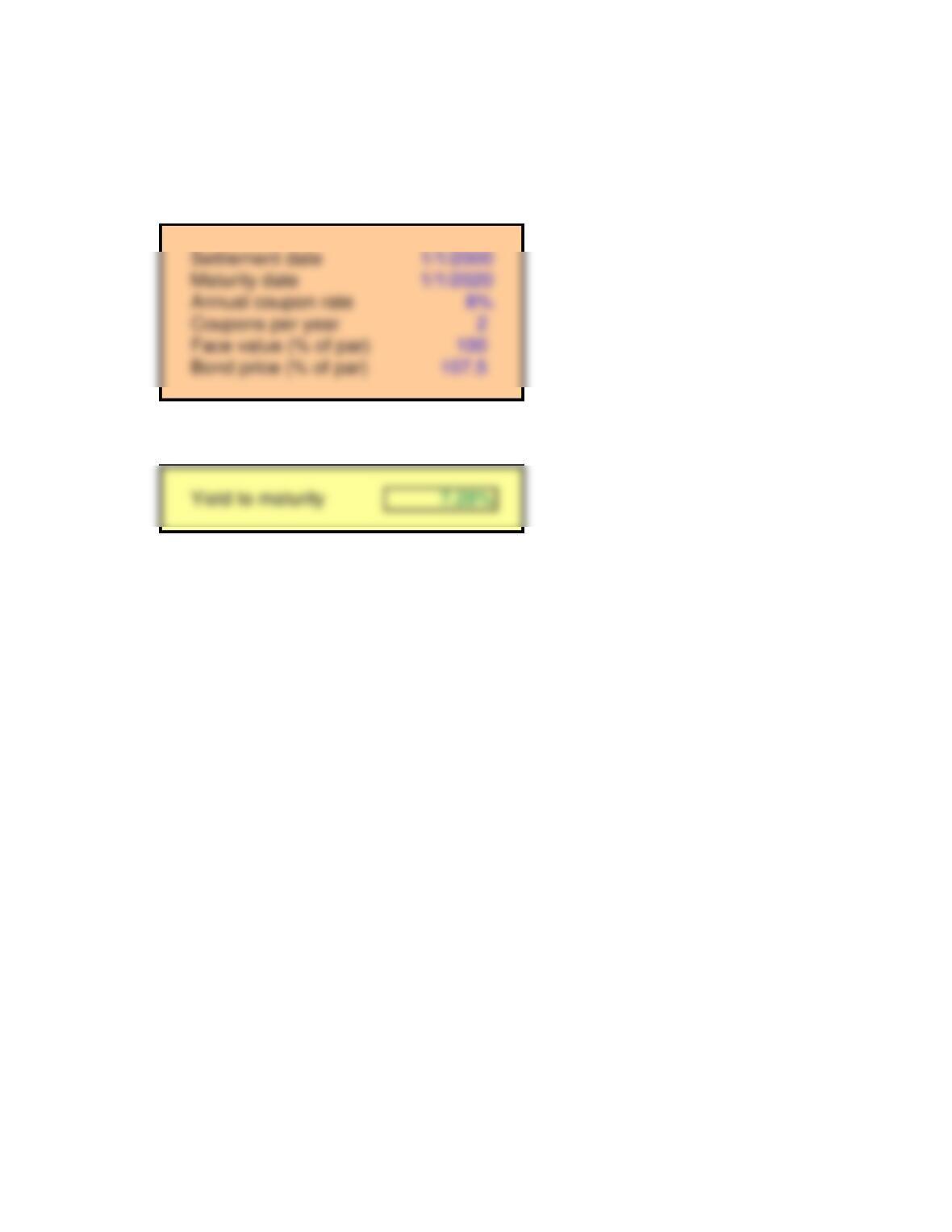
Settlement date 1/1/2000
Maturity date 1/1/2020
Annual coupon rate 8%
Coupons per year 2
Face value (% of par) 100
Bond price (% of par) 107.5
Chapter 7
Question 20
Input area:
Output area:
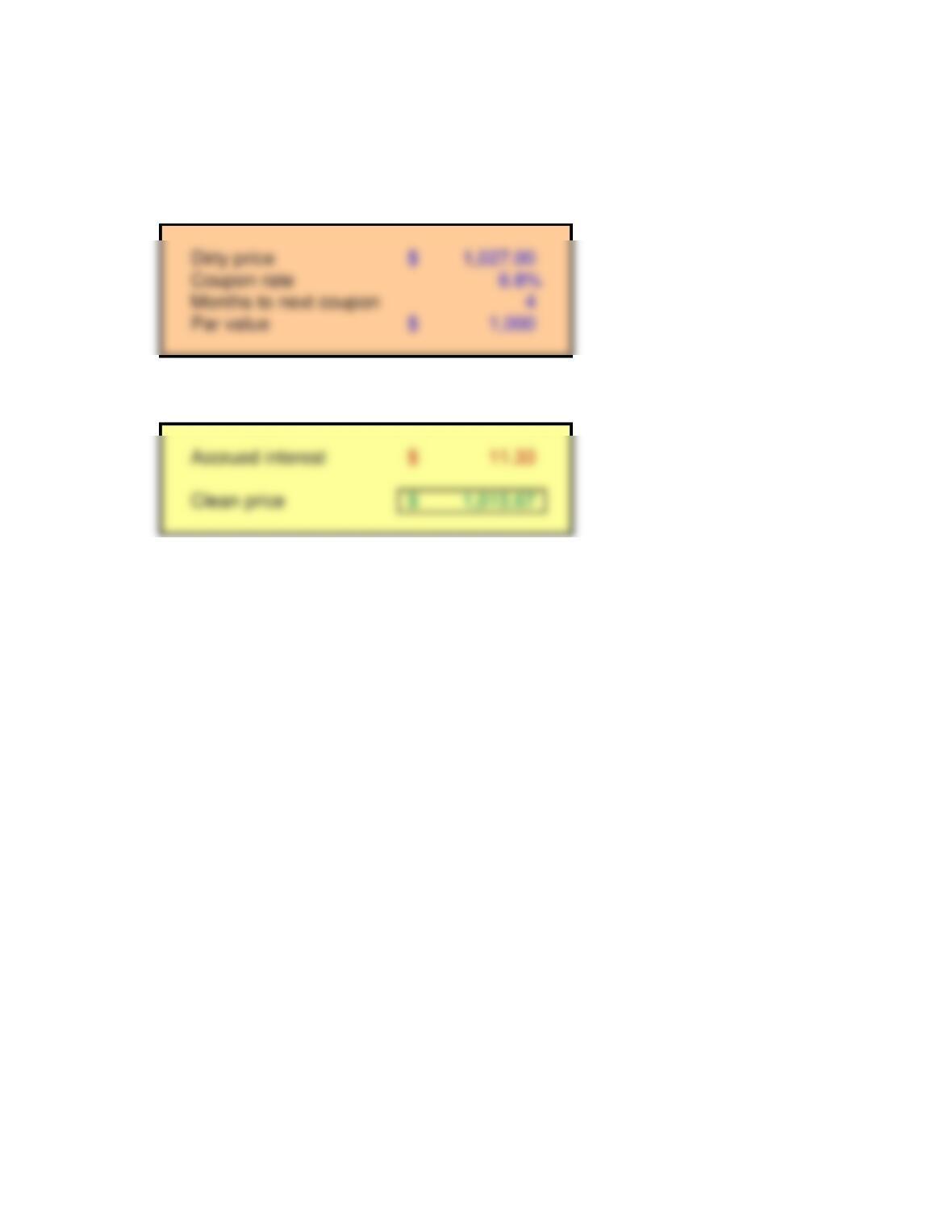
Accrued interest 11.33$
Dirty price 1,027.00$
Coupon rate 6.8%
Months to next coupon 4
Par value 1,000$
Chapter 7
Question 21
Input area:
Output area:
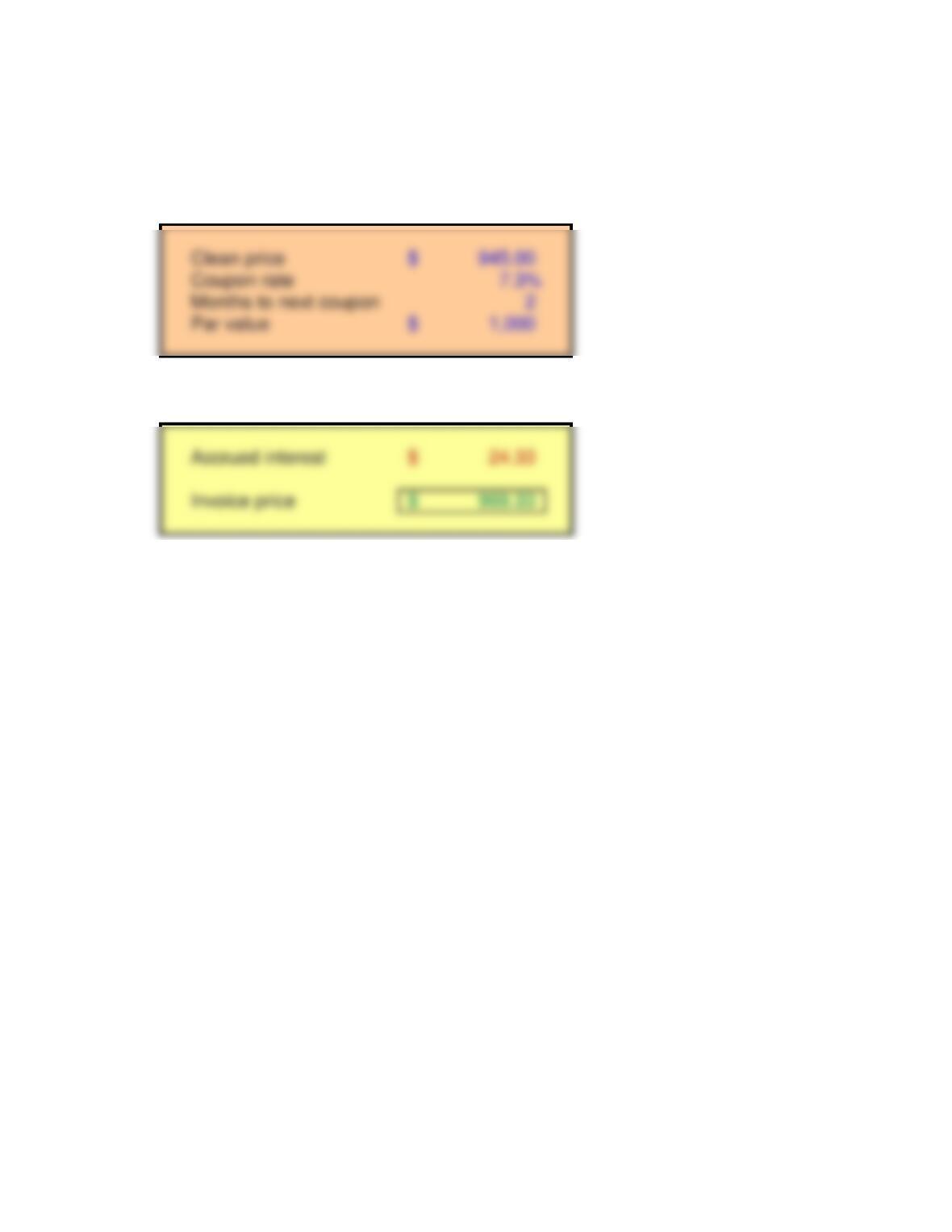
Accrued interest 24.33$
Clean price 945.00$
Coupon rate 7.3%
Months to next coupon 2
Par value 1,000$
Chapter 7
Question 22
Input area:
Output area:
Current price 1,059.60$
Annual coupon rate 8.00%
Yield to maturity 7.20%
Current yield 7.55%
Face value 1,000$
Chapter 7
Question 23
Input area:
Output area:
Coupon rate 6.20%
Last price 108.960
Face value 1,000$
Chapter 7
Question 24
Output area:
a) Bond price is the present value term when valuing the cash flows from
c) Current yield is defined as the annual coupon payment divided by the
current bond price. For premium bonds, the current yield exceeds the
YTM, for discount bonds the current yield is less thatn the YTM, and for
bonds selling at par value, the current yield is equal to the YTM. In all
cases, the current yield plus the expected one-period capital gains
yield of the bond must be equal to the YTM.
a bond; YTM is the interest rate used in valuing the cash flows from a
bond. The bond price and YTM are inversely related. If the YTM
increases, the bond price decreases and if the YTM decreases, the
bond price increases.
b) If the coupon rate is higher than the required return on a bond, the bond
will sell at a premium, since it provides periodic income in the form
of coupon payments in excess of that required by investors on other
similar bonds. If the coupon rate is lower than the required return on
a bond, the bond will sell at a discount, since it provides insufficient
coupon payments compared to that required by investors on the similar
bonds. For premium bonds, the coupon rate exceeds the YTM;
for discount bonds, the YTM exceeds the coupon rate, and for bonds
selling at par, the YTM is equal to the coupon rate.
Chapter 7
Question 25
Input area:
Output area:
a) Price at issuance 179.05$
Price one year before maturity 933.51$
d) The company will prefer the straight-line
Years to maturity 25
Required return 7%
Face value 1,000$
Chapter 7
Question 26
Input area:
Years to maturity 30
Output area:
a) Price of coupon bond 1,000$
Price of zero coupon bond 169.73$
Required return 6%
Face value 1,000$
Coupon rate 6%
Tax rate 35%
Chapter 7
Question 27
Output area:
Output area:
The maturity is indeterminate. A bond selling at par can have any length
of maturity.
Coupon rate 10%
Chapter 7
Question 28
Input area:
Output area:
Real rate 5.97%
Future value 2,000,000$
Number of years 40
Nominal rate 10.00%
Inflation rate 3.80%
Chapter 7
Question 29
Input area:
Bond P:
Output area:
Current price of Bond P 1,179.14$
Current price of Bond D 820.86$
Coupon rate 10%
Bond D:
Coupon rate 4%
Date one year from now 1/1/2001
Chapter 7
Question 30
Input area:
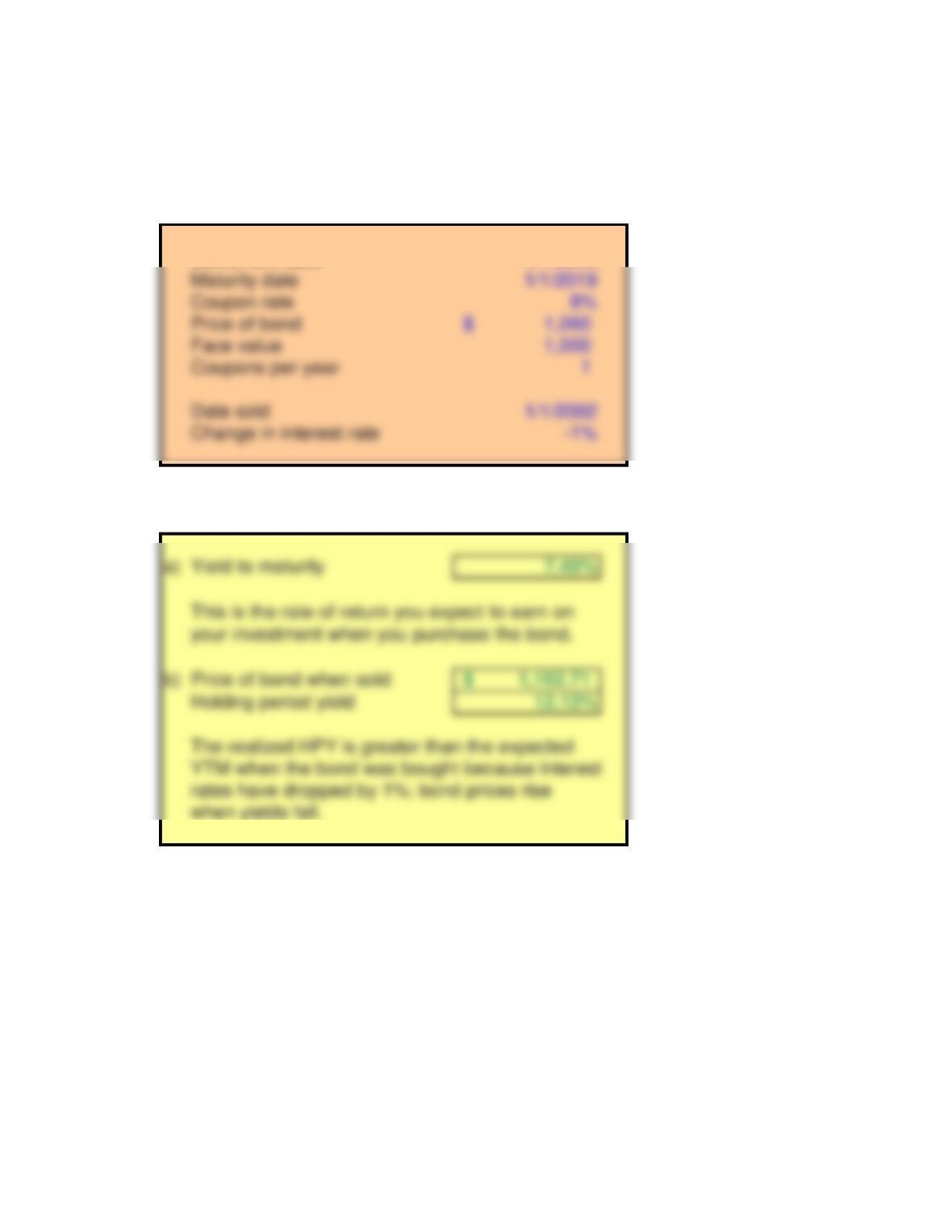
Settlement date 1/1/2000
Output area:
The realized HPY is greater than the expected
YTM when the bond was bought because interest
rates have dropped by 1%; bond prices rise
when yields fall.
Maturity date 1/1/2019
Coupon rate 8%
Price of bond 1,060$
Face value 1,000
Coupons per year 1
Date sold 1/1/2002
Change in interest rate -1%
Chapter 7
Question 31
Input area:
Bond M:
Output area:
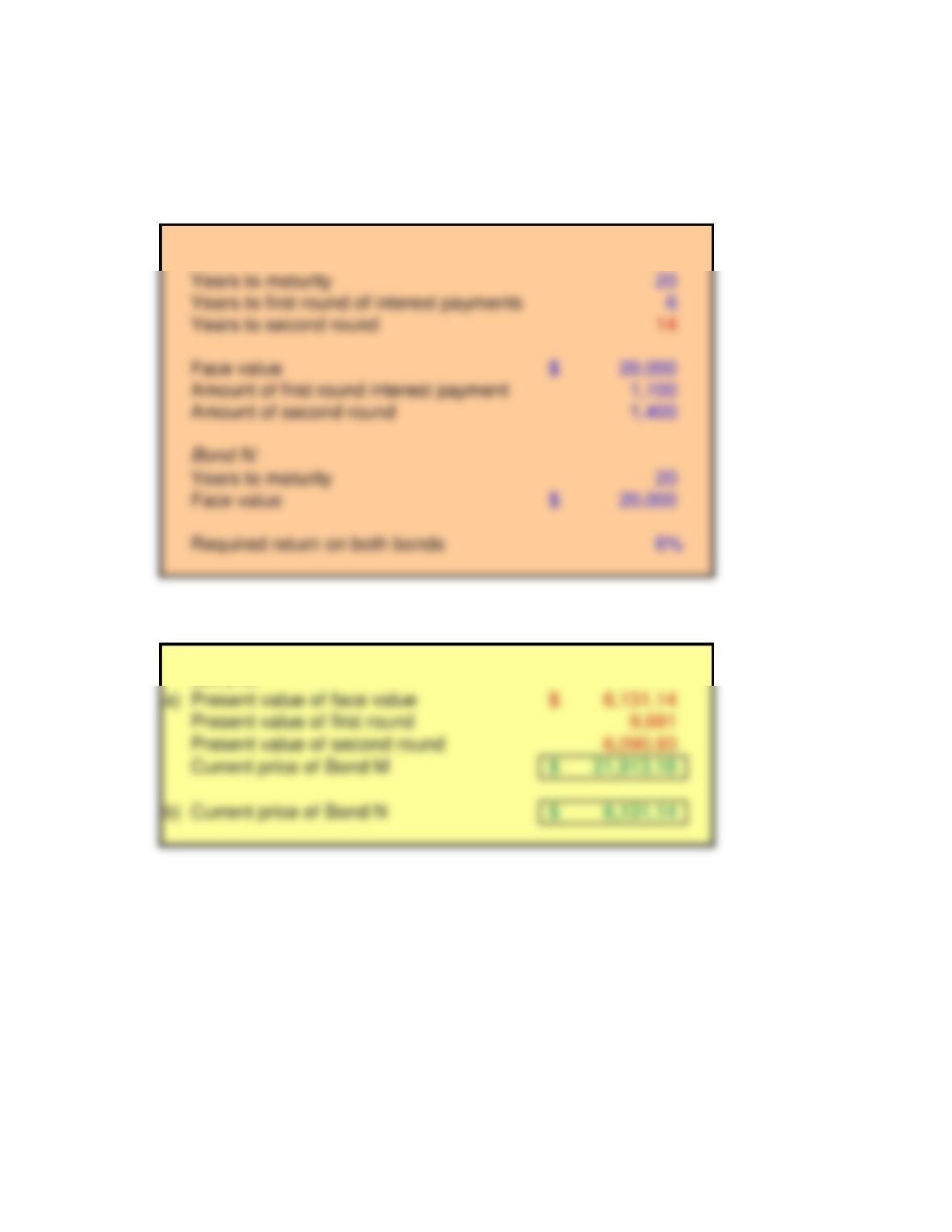
Bond M:
Years to maturity 20
Years to first round of interest payments 6
Years to second round 14
Face value 20,000$
Amount of first round interest payment 1,100
Amount of second round 1,400
Bond N:
Years to maturity 20
Face value 20,000$
Required return on both bonds 6%
Chapter 7
Question 32
Input area:
Output area:
Chapter 7
Question 34
Input area:
Output area:
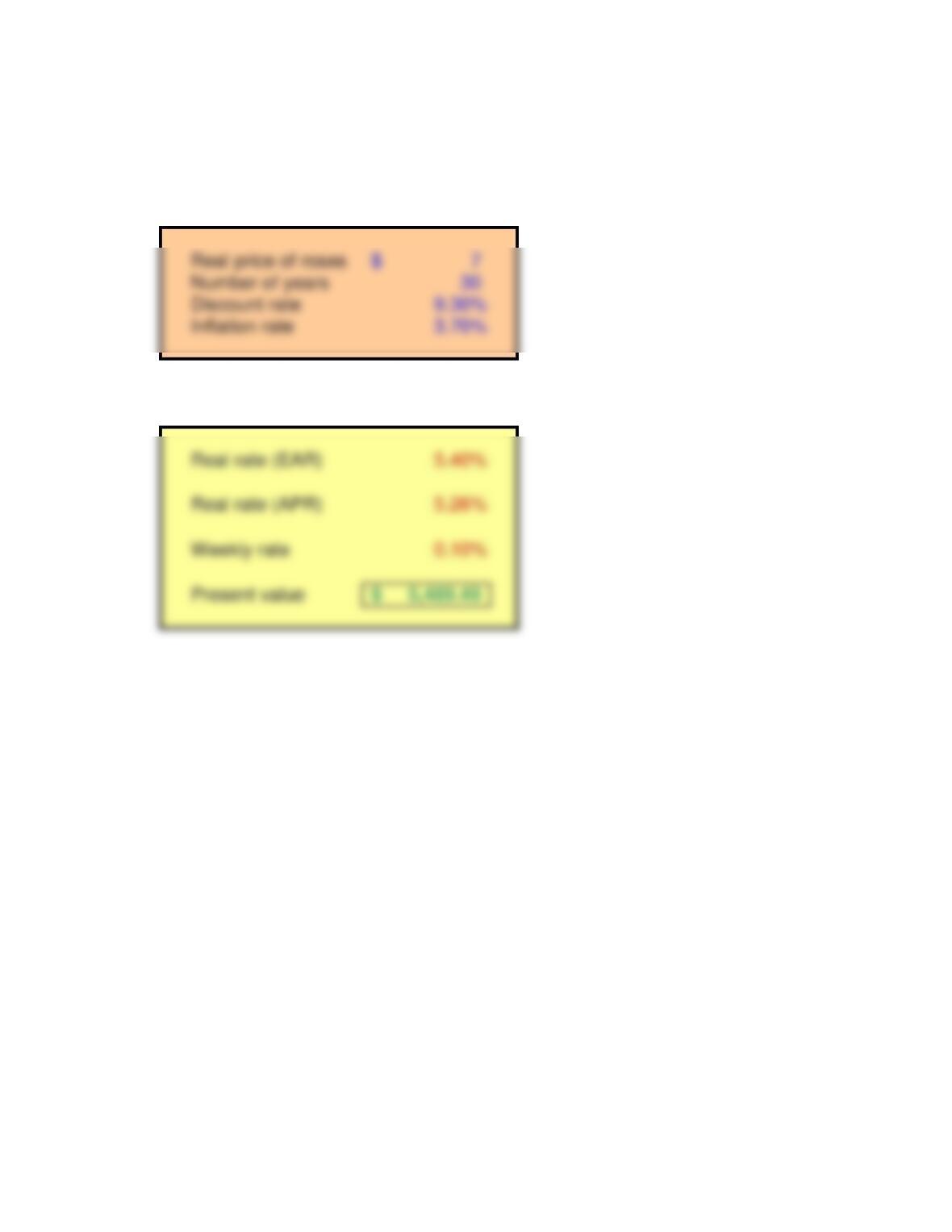
Real rate (EAR) 5.40%
Real price of roses 7$
Number of years 30
Discount rate 9.30%
Inflation rate 3.70%
Chapter 7
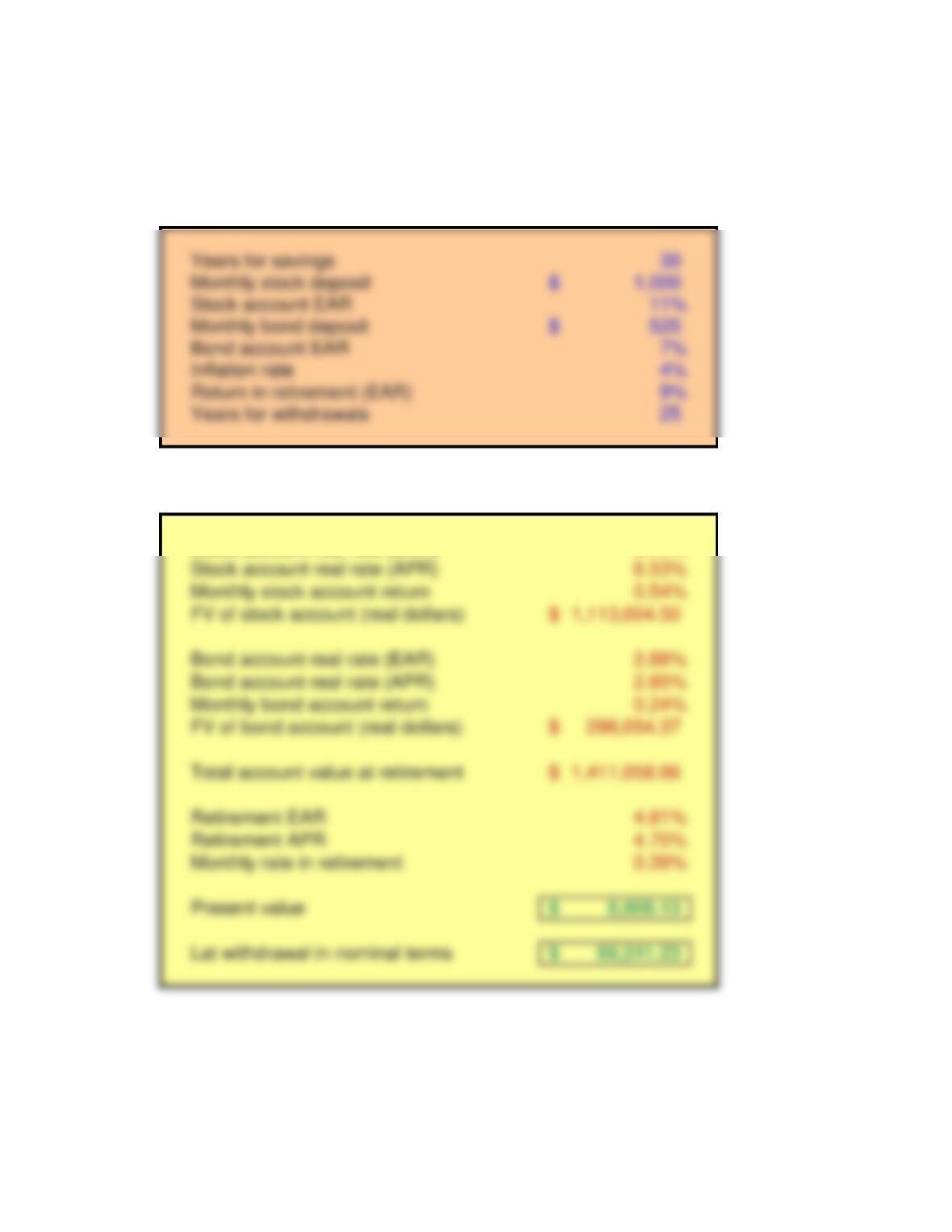
Question 35
Input area:
Output area:
Stock account real rate (EAR) 6.73%
Years for savings 30
Monthly stock deposit 1,000$
Stock account EAR 11%
Monthly bond deposit 525$
Bond account EAR 7%
Inflation rate 4%
Return in retirement (EAR) 9%
Years for withdrawals 25