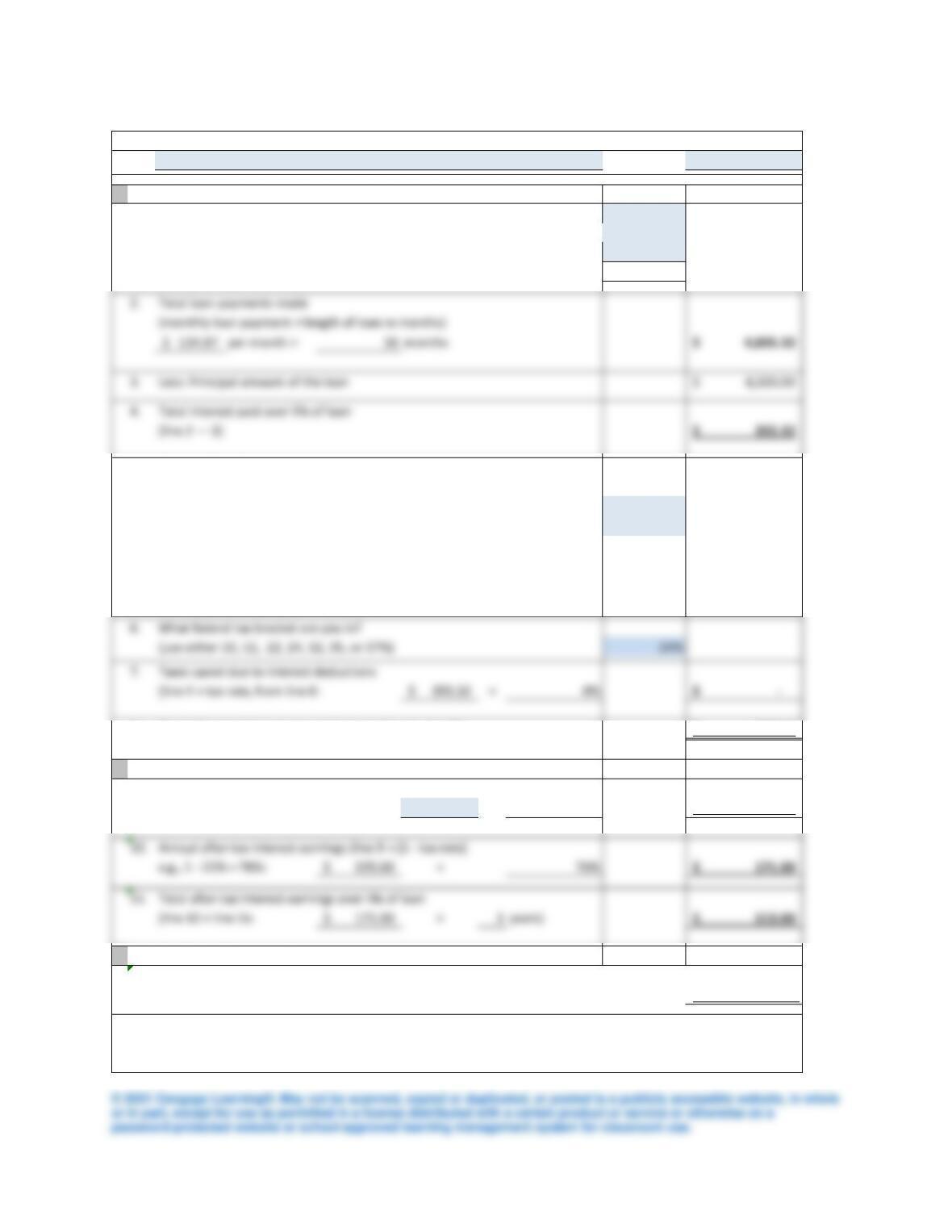
Worksheet 7.2, Chapter 7 Exercise 13 Part a
Date
1. 0.05
4,500.00$
3
$134.87
(line 2 — 3)
Less: Principal amount of the loan
Total loan payments made
(monthly loan payment × length of loan in months)
5.
NO
NO
(use either 10, 12, 22, 24, 32, 35, or 37%)
Taxes saved due to interest deductions
What federal tax bracket are you in?
8. 355.32$
9.
5 % × 4,500.00$ 225.00
$
Annual after-tax interest earnings (line 9 × [1 – tax rate]
e.g., 1 – 22% = 78%:
Total after-tax interest earnings over life of loan
(line 10 × line 1b:
12.
(157.68)
$
BASIC DECISION RULE:
Pay cash if line 12 is positive ; borrow the money if line 12 is negative .
Note: For simplicity, compounding is ignored in calculating both the cost of interest
and interest earnings.
Annual interest earned on savings (annual rate of interest earned
on savings × amount of loan:
(line 8 minus line 11)
Difference in cost of borrowing vs. cost of paying cash
Net Cost of Borrowing
Total after-tax interest cost on the loan (line 4 – line 7)
Cost of Paying Cash
Tax considerations:
• Is this a home equity loan (where interest expenses can
be deducted from taxes)? . . . . . . . . . . . . . . . . . . . . . . .
• Do you itemize deductions on your federal tax returns?.
• If you answered yes to BOTH questions, then proceed
to line 6; if you answered no to either one or both of
the questions, then proceed to line 8 and use line 4 as
the after-tax interest cost of the loan.
BUY ON TIME OR PAY CASH
Name
Mariah Lane
Terms of the loan Rate, enter in decimal form, e.g. .05 not 5.
Cost of Borrowing
a. Amount of the loan
b. Length of the loan (in years)
c. Monthly payment
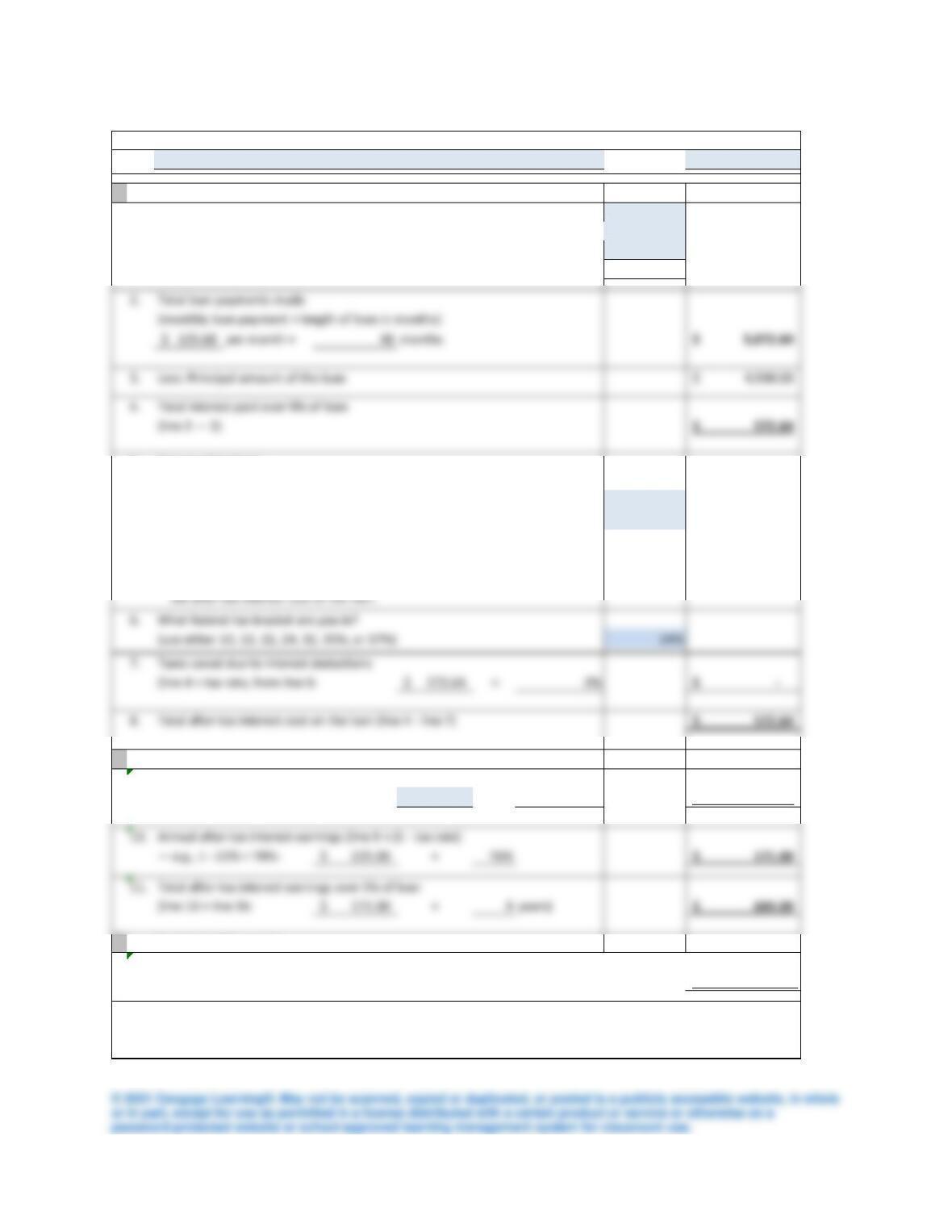
Worksheet 7.2 Chapter 7 Exercise 13 Part b
Date
1. 0.06
4,500.00$
4
$105.68
Total interest paid over life of loan
(line 2 — 3)
Less: Principal amount of the loan
Total loan payments made
(monthly loan payment × length of loan in months)
5.
NO
NO
(use either 10, 12, 22, 24, 32, 35%, or 37%)
Taxes saved due to interest deductions
What federal tax bracket are you in?
9.
5 % × 4,500.00$ 225.00
$
Annual after-tax interest earnings (line 9 × [1 – tax rate]
— e.g., 1 – 22% = 78%:
Total after-tax interest earnings over life of loan
(line 10 × line 1b:
12.
(111.36)
$
BASIC DECISION RULE:
Pay cash if line 12 is positive ; borrow the money if line 12 is negative .
Note: For simplicity, compounding is ignored in calculating both the cost of interest
and interest earnings.
Annual interest earned on savings (annual rate of interest earned
on savings × amount of loan:
(line 8 minus line 11)
Difference in cost of borrowing vs. cost of paying cash
Net Cost of Borrowing
Cost of Paying Cash
Tax considerations:
• Is this a home equity loan (where interest expenses can
be deducted from taxes)? . . . . . . . . . . . . . . . . . . . . . . .
• Do you itemize deductions on your federal tax returns?.
• If you answered yes to BOTH questions, then proceed
to line 6; if you answered no to either one or both of
the questions, then proceed to line 8 and use line 4 as
BUY ON TIME OR PAY CASH
Name
Mariah Lane
Terms of the loan Rate, enter in decimal form, e.g. .05 not 5.
Cost of Borrowing
a. Amount of the loan
b. Length of the loan (in years)
c. Monthly payment
14. Comparing payments and APRs of financing alternatives. Because of a job change, Seth
Armstrong has just relocated to the southeastern United States. He sold his furniture
before he moved, so he’s now shopping for new furnishings. At a local furniture store, he’s
found an assortment of couches, chairs, tables, and beds that he thinks would look great in
his new two-bedroom apartment; the total cost for everything is $6,400.
a. Compute the monthly payments for both of the loan offers.
b. Determine the APR for both loans.
The APR for the loan from the furniture store can be calculated with the financial calculator,
because the time value of money equations programmed into the financial calculator use the
simple interest method, which yields the APR. Set your calculator on End Mode and 12
c. Which is more important: low payments or a low APR? Explain.
Low APR is more important. With loans, it is all about the APR and your ability to make
payments. Ability to make payments may force you to pay a higher APR, but perhaps you
should forgo the purchase in this case.
Critical Thinking Cases
7.1 Financing Katie’s Education
At age 19, Katie Hicks is in the middle of her second year of studies at a community college
in Atlanta. She has done well in her course work; majoring in pre-business studies, she
currently has a 3.75 grade point average. Katie lives at home and works part-time as a
filing clerk for a nearby electronics distributor. Her parents can’t afford to pay any of her
tuition and college expenses, so she’s virtually on her own as far as college goes. Zoe plans
to transfer to the University of Georgia next year. (She has already been accepted.) After
talking with her counselor, Katie feels she won’t be able to hold down a part-time job and
a. Georgia State Bank will lend $30,000 at 6 percent discount interest. The loan principal
would be due at the end of 2 years.
b. National Bank of Atlanta will lend $25,000 under a 2-year note. The note would carry a
7 percent simple interest rate and would also be due in a single payment at the end of 2
years.
Critical Thinking Questions
1. How much would Katie (a) receive in initial loan proceeds and (b) be required to repay
at maturity under the Georgia State Bank loan?
a. Amount received is the principal less the interest. $30,000 * 6% * 2 = $3,600
Proceeds from the loan are $30,000 – $3,600 = $26,400
2. Compute (a) the finance charges and (b) the APR on the loan offered by Georgia State
Bank.
3. Compute (a) the finance charges and (b) the APR on the loan offered by the National
Bank of Atlanta. How big a loan payment would be due at the end of two years?
a. The finance charge is the simple interest for the period of the loan.
[$25,000 * 7%] * 2 = $3,500
4. Compare your findings in Questions 2 and 3, and recommend one of the loans to Zoe.
Explain your recommendation.
Method
Stated
Rate
Finance
Charge
Amount
Received
Amount
Repaid
APR
a. Discount loan
6%
$3,600
$26,400
$30,000
6.8%
b. Simple interest loan
7%
$3,500
$25,000
$28,500
7%
5. What other recommendations might you offer Katie regarding disposition of the loan
proceeds?
Since Katie plans to spend the $25,000 over the following two years, she should either (1) try to
arrange a line of credit in which she can draw the money as needed, with the interest being
7.2 Cody Gets His Outback
Cody Andrews, a 27-year-old bachelor living in Richmond, Virginia, has been a high–
school teacher for 5 years. For the past four months, he’s been thinking about buying a
Subaru Outback, but he feels that he can’t afford a brand-new one. Recently, however, his
friend Devin Carpenter has offered to sell Cody his fully loaded Subaru Outback 3.6R.
Martin wants $26,900 for his Outback, which has been driven only 8,000 miles and is in
very good condition. Cody is eager to buy the vehicle but has only $10,000 in his savings
account at Central Bank. He expects to net $8,000 from the sale of his Chevrolet Malibu,
but this will still leave him about $8,900 short. He has two alternatives for obtaining the
money:
Critical Thinking Questions
1. Using a financial calculator or spreadsheet, determine the required monthly payments if
the loan is taken out at First National Bank of Richmond.
2. Compute (a) the finance charges and (b) the APR on the loan offered by First National
Bank of Richmond.
a. Total Finance charges = Total payments less principal,
36 * $270.76 = $9,747.19 less $8,900 = $847.19
3. Determine the size of the monthly payment required on the loan from the Richmond
Teacher’s Credit Union. [an add-on loan]
4. Compute (a) the finance charges and (b) the APR on the loan offered by the Richmond
Teacher’s Credit Union.
a. The finance charges are 36 * $280.60 – $8,900 = $1,201.60.
b. Approximate APR = (1,201.60 / 3) / (8,900/2) = 9% or
using a financial calculator,
5. Compare the two loans and recommend one of them to Cody. Explain your
recommendation.
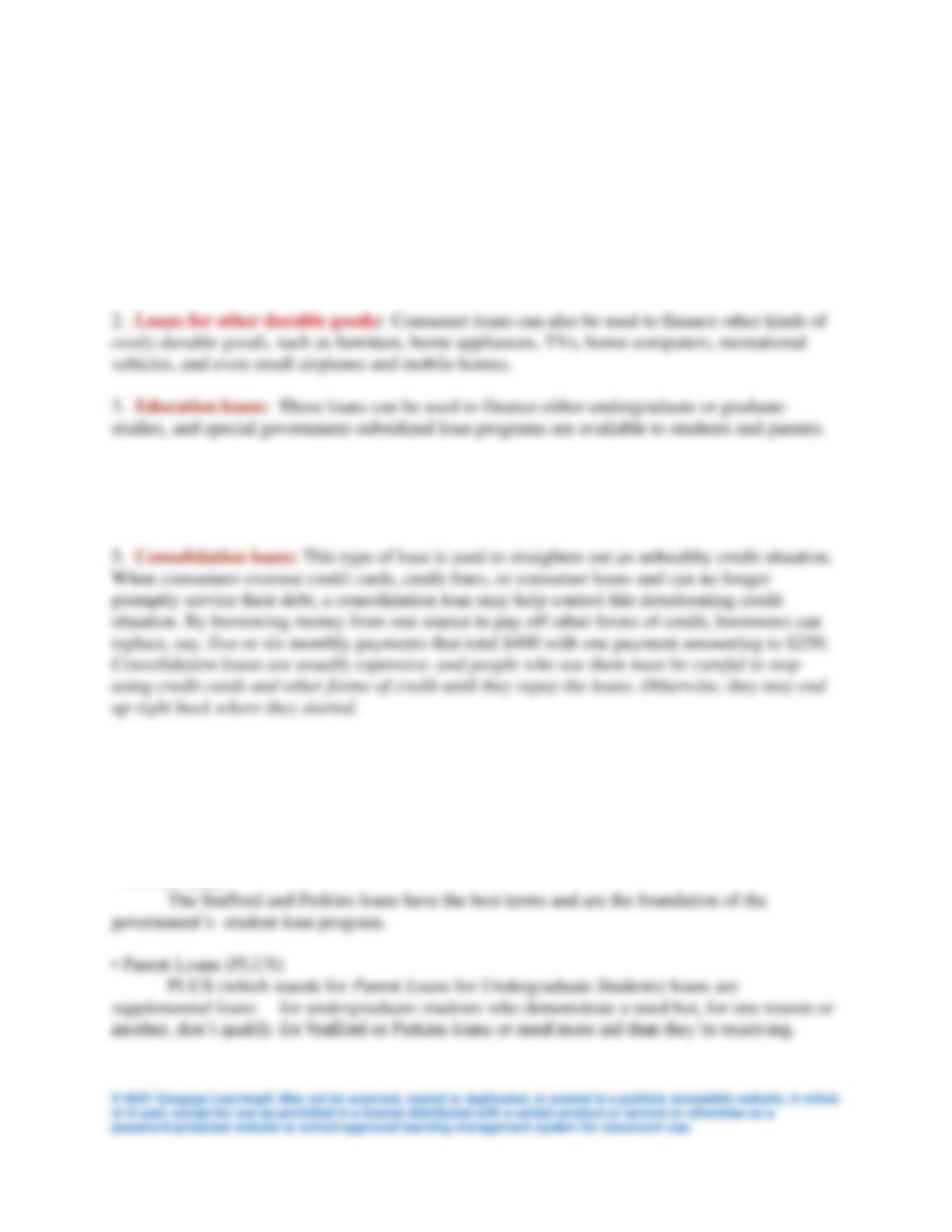
The following table summarizes the key characteristics of the two loans. Comparing the monthly
payment, total finance charges, and APR on the two loans, it’s clear that while the two loans are
about equal, the one from First National of Richmond (line a) has a slight edge over the one from
the credit union (line b), which has a slightly higher monthly payment, total finance charge, and
Test Yourself Questions
7-1 List and briefly discuss the five major reasons for borrowing money through a
consumer loan.
1. Auto loans: The loan is secured with the auto, meaning that the vehicle serves as collateral
for the loan and can be repossessed by the lender should the buyer fail to make payments. These
loans generally have maturities ranging from 36 to 60 months.
4. Personal loans: These loans are typically used for nondurable expenditures, such as an
expensive European vacation or to cover temporary cash shortfalls. Many personal loans are
unsecured.
7-2 Identify several different types of federally sponsored student loan programs.
The federal government (and some state governments) have available several different types of
subsidized educational loan programs. The federally sponsored programs are:
• Stafford loans (Direct and Federal Family Education Loans—FFELs)
See Exhibit 7.1, Federal Government Student Loan Programs at a Glance for a concise
explanation of the loan programs.
7-3 As a college student, what aspects of these student loan programs appeal to you the
most?
Most students will prefer subsidized loans with low rates and interest deferred until student leave
school [only Stafford and Perkins loans allow deferral]. To help you service the debt, if you
7-4 Explain some strategies for reducing the cost of student loans.
It’s important to borrow as little as possible to cover college costs. This common-sense goal can
7-5 Define and differentiate between (a) fixed- and variable-rate loans and (b) a single
payment loan and an installment loan.
Fixed v Variable-rate loans refers to the change in interest. The fixed rate is constant
throughout the loan period. Variable rate allows the rate to change typically once a year and is
tied to a widely reported rate [federal funds rate + 3 percentage points, for example].
7-6 Compare the consumer lending activities of (a) consumer finance companies and (b)
sales finance companies. Describe a captive finance company.
Consumer finance companies make secured and unsecured (signature) loans to qualified
individuals. These companies do not accept deposits but obtain funds from their stockholders and
through open market borrowing. Because they don’t have the inexpensive sources of funds that
banks and other deposit-type institutions do, their interest rates are generally quite high.
Consumer finance companies specialize in small loans to high-risk borrowers. These loans are
quite costly, but they may be the only alternative for people with poor credit ratings. Because of
the high rates of interest charged, individuals should consider this source only after exhausting
other alternatives.
7-7 Discuss the role in consumer lending of (a) credit unions and (b) savings and loan
associations. Point out any similarities or differences in their lending activities. How do
they compare with commercial banks?
A credit union is a cooperative financial institution that is owned and controlled by the people
(“members”) who use its services. Only the members can obtain installment loans and other
types of credit from these institutions, but credit unions can offer membership to just about
7-8 What two questions should be answered before taking out a consumer loan? Explain.
From a financial planning perspective, you should ask yourself two questions when considering
the use of a consumer loan:
(1) does making this purchase fit into your financial plans; and
7-9 List and briefly discuss the different factors to consider when shopping for a loan. How
would you determine the total cost of the transaction?
The major factors are:
Finance Charges—What’s it going to cost me? That’s appropriate, because borrowers should
know what they’ll have to pay to get the money The rate of interest, known as the APR (annual
percentage rate), includes not only the basic cost of money but also any additional fees that
might be required on the loan.
Loan Maturity—Make sure that the size and number of payments will fit comfortably into your
spending and savings plans. As a rule, the cost of credit increases with the length of the
repayment period. Thus, to lower your cost, you should consider shortening the loan maturity—
but only to the point where doing so won’t place an unnecessary strain on your cash flow.
7-10 What is a lien, and when is it part of a consumer loan?
Most single-payment loans are secured by certain specified assets. For collateral, lenders prefer
items they feel are readily marketable at a price that’s high enough to cover the principal portion
7-11 When might you request a loan rollover?
7-12 Describe the two methods used to calculate the finance charges on a single payment
loan. As a borrower, which method would you prefer? Explain.
The two basic procedures used to calculate the finance charges on single-payment loans are the
simple interest method and the discount method.
7-13 Briefly describe the basic features of an installment loan.
Installment loans differ from single-payment loans in that they require the borrower to repay the
debt in a series of installment payments (usually monthly) over the life of the loan. Installment
loans have long been one of the most popular forms of consumer credit. As a financing vehicle,
7-14 What is a home equity loan, and what are its major advantages and disadvantages?
An installment loans secured by second mortgages typically on personal residence is referred to
as home equity loans. The major advantage of home equity loans is the relatively low interest
7-15 Explain why a borrower is often required to purchase credit life and disability
insurance as a condition of receiving an installment loan.
Sometimes, as a condition of receiving an installment loan, a borrower is required to buy credit
life insurance and possibly credit disability insurance. Credit life (and disability) insurance is
7-16 Define simple interest as it relates to an installment loan. Are you better off with add–
on interest? Explain.
When simple interest is used with installment loans, interest is charged only on the outstanding
balance of the loan. Thus, as the loan principal declines with monthly payments, the amount of
interest being charged also decreases.
7-17 When does it make more sense to pay cash for a big-ticket item than to borrow the
money to finance the purchase?
Key Terms
529 college savings
plan
A government-sponsored investment vehicle that allows earnings to
grow free from federal taxes, so long as they are used to meet college
education expenses.
add-on method
A method of calculating interest by computing finance charges on the
original loan balance and then adding the interest to that balance.
captive finance
company
A sales finance company that is owned by a manufacturer of big-ticket
merchandise. GMAC is a captive finance company.
cash value (of life
insurance)
An accumulation of savings in an insurance policy that can be used as a
source of loan collateral.
chattel mortgage
A mortgage on personal property given as security for the payment of
an obligation.
collateral
An item of value used to secure the principal portion of a loan.
collateral note
A legal note giving the lender the right to sell collateral if the borrower
defaults on the obligation.
consumer finance
company
A firm that makes secured and unsecured personal loans to qualified
individuals; also called a small loan company.
consumer loans
Loans made for specific purposes using formally negotiated contracts
that specify the borrowing terms and repayment.
credit life (or
disability)
insurance
A type of life (or disability) insurance in which the coverage decreases
at the same rate as the loan balance.
discount method
A method of calculating finance charges in which interest is computed
and then subtracted from the principal, with the remainder being
disbursed to the borrower.
installment loan
A loan that is repaid in a series of fixed, scheduled payments rather
The use of a single payment loan to finance a purchase or pay bills in
situations where the funds to be used for repayment are known to be
forthcoming in the near future.
lien
A legal claim permitting the lender, in case the borrower defaults, to
liquidate the items serving as collateral to satisfy the obligation.
loan application
An application that gives a lender information about the purpose of the
loan disclosure
statement
A document, which lenders are required to supply borrowers, that
states both the dollar amount of finance charges and the APR
applicable to a loan.
loan rollover
The process of paying off a loan by taking out another loan.
Rule of 78s (sum-of
the-digits method)
A method of calculating interest that has extra-heavy interest charges
in the early months of the loan.
sales finance
method
the actual loan balance outstanding.
loan
in full.
A firm that purchases notes drawn up by sellers of certain types of
Chapter Outline
Learning Objectives
I. Basic Features of Consumer Loans
A. Using Consumer Loans
B. Different Types of Loans
2. Single-Payment or Installment Loans
3. Student loans
C. Where Can You Get Consumer Loans?
1. Commercial Banks
2. Consumer Finance Companies
II. Managing Your Credit
A. Shopping for Loans
1. Finance Charges
2. Loan Maturity
III. Single-Payment Loans
A. Important Loan Features
B. Finance Charges and the Annual Percentage Rate
IV. Installment Loans
A. A Real Consumer Credit Workhorse
B. Finance Charges, Monthly Payments, and the APR
1. Using Simple Interest