Chapter 7
Investment Decision Rules
I. Chapter Outline
The following chapter outline is correlated to the PowerPoint Lecture Slides. The PowerPoint slides
are referenced in bold. Alternative Examples to selected textbook examples are also available in the
PowerPoint Lecture Slides and are also referenced in bold.
7.1 NPV and Stand-Alone Projects (Slide 5)
• Applying the NPV Rule (Slide 6)
7.2 The Internal Rate of Return Rule (Slides 9–10)
• Applying the IRR Rule (Slide 11)
• Pitfall #1: Delayed Investments (Slides 12–15)
• Figure 7.2 NPV of Star’s $1 Million Book Deal (Slide 16)
• Pitfall #2: Multiple IRRs (Slides 17-19, 21)
• Figure 7.5 NPV Profiles for Example 7.1 (Slide 27)
• PowerPoint Alternative Example 7.1 (Slides 29–30)
7.3 The Payback Rule (Slide 31)
• Applying the Payback Rule
7.4 Choosing Between Projects (Slide 37)
• NPV Rule and Mutually Exclusive Investments
• Example 7.3 NPV and Mutually Exclusive Projects (Slides 38-39)
• PowerPoint Alternative Example 7.3 (Slides 40–41)
7.5 Project Selection with Resource Constraints (Slide 57)
• Evaluating Projects with Different Resource Requirements (Slide 57)
II. Learning Objectives
7.2 Describe decision rules for each of the tools in Objective 1, for both stand-alone and mutually
exclusive projects.
7.4 Compare each of the capital budgeting tools above, and tell why NPV always gives the
correct decision.
7.6 Describe situations in which the profitability index cannot be used to make a decision.
III. Chapter Overview
This chapter introduces techniques that firms use to evaluate investments and decide which projects
7.1 NPV and Stand-Alone Projects
The text emphasizes NPV as the only reliable way to make capital budgeting decisions. The internal
7.2 The Internal Rate of Return Rule
This section defines IRR and gives the IRR decision rule. The authors then discuss reasons that NPV
7.3 The Payback Rule
7.4 Choosing Between Projects
The previous discussion addressed only stand-alone projects. Sometimes firms must decide among
mutually exclusive projects. The manager must rank the projects and choose the best one. In this case,
NPV again yields the correct decision.
Suppose a project with a positive NPV is being compared with another project that is identical in
7.5 Project Selection with Resource Constraints
The previous discussion has assumed that resources are unlimited. If resource constraints exist,
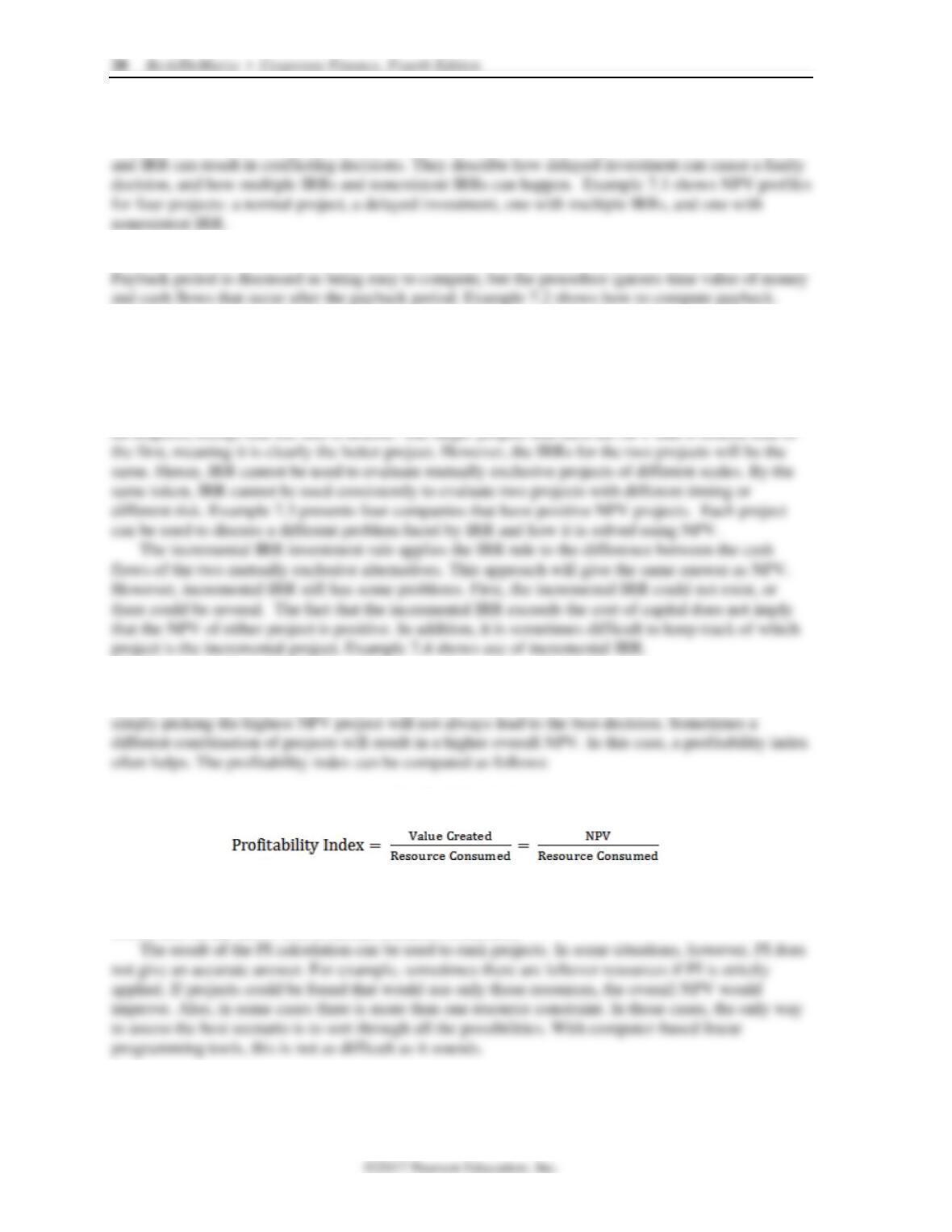
(7.2)
Note that this text treats PI a little differently than the typical text. First, NPV is in the numerator,
rather than PV of future cash flows. Also, the resource constraint need not be financial. Example 7.5
shows how to use the PI with a human resources constraint.

Berk/DeMarzo • Corporate Finance, Fourth Edition 29
IV. Spreadsheet Solutions in Excel
The following Problems for Chapter 7 have spreadsheet versions of the problems available: 5, 6, 8,
12, 15, 18, and 20.