Using Consumer Loans
Chapter 7
How Will This Affect Me?
Consumer loan sources abound, and their terms vary significantly. The primary types are single-
payment and installment consumer loans. It’s important to understand when to use each credit
source, to be able to calculate and compare their costs, and to determine the circumstances in
which it is best to take out a loan or pay cash. Practical examples considered in this chapter
LEARNING GOALS
6-1 Know when to use consumer loans and be able to differentiate between the major types.
It is important to point out that the ability to get a loan does not mean that you need to get the
loan. Loans are useful to help purchase high cost items but should be used only when you can
afford the item being purchased and the related payoff of the loan. Major types of consumer
loans are single-payment and installment loans. Most loans have a fixed rate, but longer-term
6-2 Identify the various sources of consumer loans.
Section 7-1b has a list of common types of consumer loans. The power point slides has these
loans listed and will be sufficient to discuss the various types. It may prove useful to ask
students if they have one of the loans. You could ask a couple of students why they have that
6-3 Choose the best loans by comparing finance charges, maturity, collateral and other loan
terms.
Section 7-2a discusses each of the factors to consider when shopping for a loan. But, the key
6-4 Describe the features of, and calculate the finance charges on, single-payment loans.
Computation of the APR [Annual Percentage Rate] is the key point here. [APR = Average
6-5 Evaluate the benefits of an installment loan.
Installment loans are the most common consumer loans. The simple interest method of
6-6 Determine the costs of installment loans and analyze whether it is better to pay cash or take
out a loan.
Financial Facts or Fantasies?
These may be used as “teasers” to get the students on the right page with you. Also, they may be
used as quizzes after you covered the material or as “pre–test questions” to get their attention.
• Buying a new car is the major reason that people borrow money through consumer loans.
Fact: Buying a new car accounts for about 35 percent of all consumer loans outstanding, which
is the single most common reason for taking out a consumer loan.
• Single-payment loans are often secured with some type of collateral and are usually relatively
short-term in duration (maturities of 1 year or less).
Fact: Because these loans require only one payment at maturity, banks and other lenders
generally keep them fairly short-term and often require some type of collateral.
• Using the discount method to calculate interest is one way of lowering the effective cost of a
consumer loan.

Financial Facts or Fantasies?
These true/false questions may be used as quizzes or as pretest to get the students’ attention.
1. True False Buying a new car is the major reason that people borrow money through
consumer loans.
2. True False Consumer loans can be set up with fixed rates of interest or with variable
loan rates.
3. True False An S&L is the only type of financial institution that is prohibited from
making consumer loans.
4. True False Single-payment loans are often secured with some type of collateral and
are usually relatively short-term in duration (maturities of 1 year or
less).
5. True False Using the discount method to calculate interest is one way of lowering the
effective cost of a consumer loan.
6. True False The Rule of 78 is a regulation that grew out of the Consumer Credit
Enhancement Act of 1978 and mandates how installment loans will be set
up.
YOU CAN DO IT NOW
The “You Can Do It Now” cases may be assigned to the students as short cases or problems.
They will help make the topic more real or relevant to the students. In most cases, it will only
take about ten minutes to do, that is, until the student starts looking around at the web site. But
they will learn by doing so.
Current Auto Loan Rates
If you’re considering buying a car, you need to know current auto loan rates to estimate
Financial Impact of Personal Choices
Read and think about the choices being made. Do you agree or not? Ask the students to discuss
the choices being made.
Maya and Ian Calculate their Auto Loan Backwards
Maya and Ian Kelly budget and spend their money carefully. Their Honda CRV has over

Applying Personal Finance
Making the Payments!
A project to help understand how loan payments are determined
For many of us, new cars can be so appealing! We get bitten by the “new car bug” and think how
great it would be to have a new car. Then we tell ourselves that we really need a new car because
our old one is just a piece of junk waiting to fall apart in the middle of the road. Of course, we
don’t have the money to purchase a new car outright, so we’ll have to get a loan. That means car
payments. The trouble is, car payments often turn out to be a lot less affordable after we actually
get the loan than we thought they would be before we signed on the dotted line. And they last
way beyond the time the new car aura wears off. This project will help you understand how loan
payments are determined, as well as the obligation that they place on you as the borrower.
Solutions to Financial Planning Exercises
1. Student loan options. Alexa Rose is a sophomore at State College and is running out of
money. Wanting to continue her education, Alexa is considering a student loan. Explain
her options. How can she minimize her borrowing costs and maximize her flexibility?
Exhibit 7.1 gives basic information on the type of student loans available. It’s important to
borrow as little as possible to cover college costs. This commonsense goal can be quantified by
considering the student’s expected future salary when borrowing. Based on her expected future
salary and using a debt safety ratio of 15, Alexa can figure out what monthly payment she will be
2. Evaluating finance packages. Assume that you’ve been shopping for a new car and
intend to finance part of it through an installment loan. The car you’re looking for has a
sticker price of $18,000. The local dealership has offered to sell it to you for $3,000 down
and finance the balance with a loan that will require 48 monthly payments of $333.67.
Adventure Vehicles will sell you the exact same vehicle for $3,500 down, plus a 60-month
loan for the balance, with monthly payments of $265.02.
Which of these two finance packages is the better deal? Explain.
The analysis should look at the total cost of the loan.
Local Dealership: $3,000 down plus 48*$333.67; total payments of $19,016.16.
Adventure Vehicles: $3,500 down plus $265.02 * 60 = $19,401.20.

3. Calculating debt safety ratio. Use Worksheet 7.1. Every 6 months, Sean Ma takes an
inventory of the consumer debts that he has outstanding. His latest tally shows that he still
owes $4,000 on a home improvement loan (monthly payments of $125); he is making $85
monthly payments on a personal loan with a remaining balance of $750; he has a $2,000,
secured, single-payment loan that’s due late next year; he has a $70,000 home mortgage on
which he’s making $750 monthly payments; he still owes $8,600 on a new car loan
(monthly payments of $375); and he has a $960 balance on his MasterCard (minimum
payment of $40), a $70 balance on his Exxon credit card (balance due in 30 days), and a
$1,200 balance on a personal line of credit ($60 monthly payments).
Use Worksheet 7.1 to prepare an inventory of Sean’s consumer debt. Find Sean’s debt
safety ratio given that his take-home pay is $2,500 per month. Would you consider this
ratio to be good or bad? Explain.
A useful credit guideline (and one widely used by lenders) is to make sure your monthly
repayment burden (not including mortgages) doesn’t exceed 20 percent of your monthly take-
Loan on life insurance
Margin loan from broker
Other loans
Worksheet 7.1, Chapter 7 Exercise 3
Name Date
1. $ 375.00 $ 8,600.00
2.
Education loans
Personal installment loans
Home improvement loan
Other installment loans
1. 2,000.00
2.
1. 40.00 960.00
2. 70.00 70.00
3.
4.
5.
6.
7.
60.00 1,200.00
Personal line of credit
Single-payment loans
Credit cards (retail charge
cards, bank cards, etc.
Overdraft protection line
AN INVENTORY OF CONSUMER DEBT
Sean Ma
Type of Consumer Debt
Creditor
Current
Monthly
Payment*
Latest
Balance
Due
Auto loans
4. Calculating single payment loan amount due at maturity. Chase Boyd plans to borrow
$8,000 for 5 years. The loan will be repaid with a single payment after 5 years, and the
interest on the loan will be computed using the simple interest method at an annual rate of
6 percent. How much will Chase have to pay in five years? How much will he have to pay at
maturity if he’s required to make annual interest payments at the end of each year?
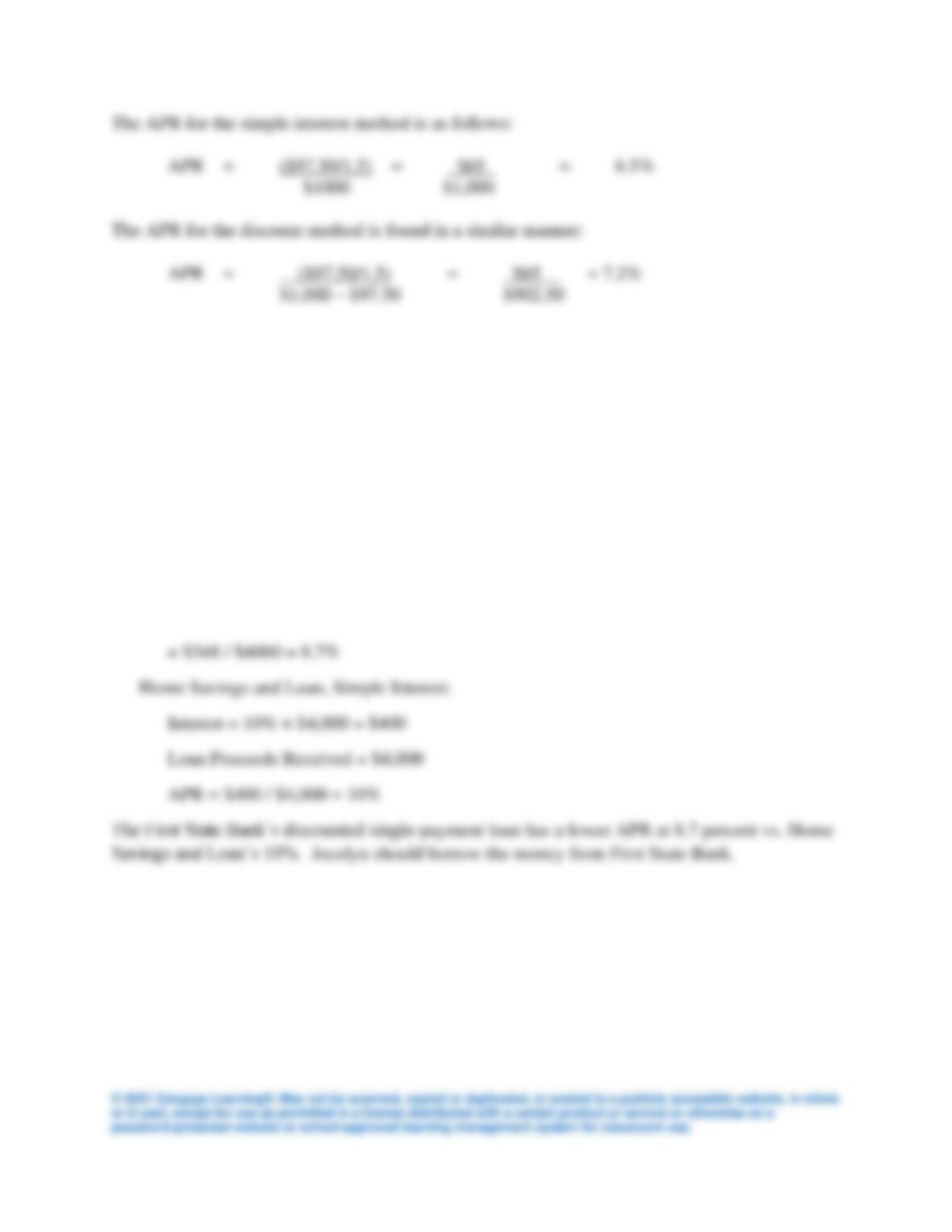
5. Calculating the APR on simple interest and discount loans. Find the finance charges on a
6.5 percent, 18-month, $1,000, single-payment loan when interest is computed using the
simple interest method. Find the finance charges on the same loan when interest is
computed using the discount method. Determine the APR in each case.
Using the simple interest method, the finance charges on a 6.5 percent, 18-month single-payment
$1,000 loan would be:
Finance Charge = Principal × 6.5% × 1.5 years
= $1,000 × 0.065 × 1.5
= $97.50
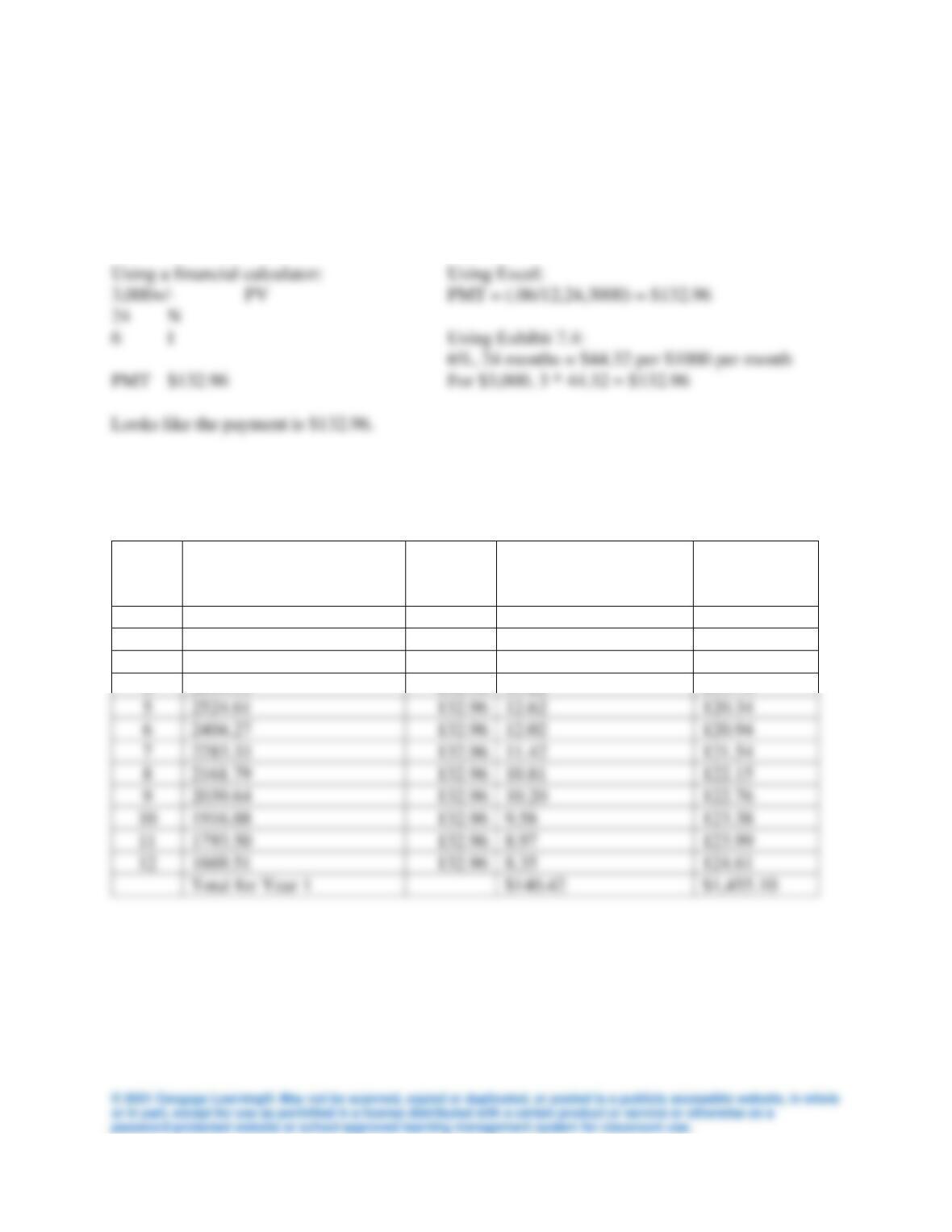
6. Comparing the costs of single-payment discount and simple interest loans. Jocelyn Dixon
needs to borrow $4,000. First State Bank will lend her the money for 12 months through a
single payment loan at 8 percent, discount; Home Savings and Loan will make her a
$4,000, single payment, 12-month loan at 10 percent, simple interest. From where should
Jocelyn borrow the money? Explain.
First State Bank, Discounted:
Loan Amount = Amount Requested / (1 – Interest Rate) = $4,000 / 0.92 = $4,348
Loan Proceeds Received = Loan Amount – Interest = $4,348 – (8% × $4,348) = $4,000
Payment = Loan Amount + Interest = $4,000 + $348 = $4,348
APR = Average Annual Finance Charge / Average Loan Balance Outstanding
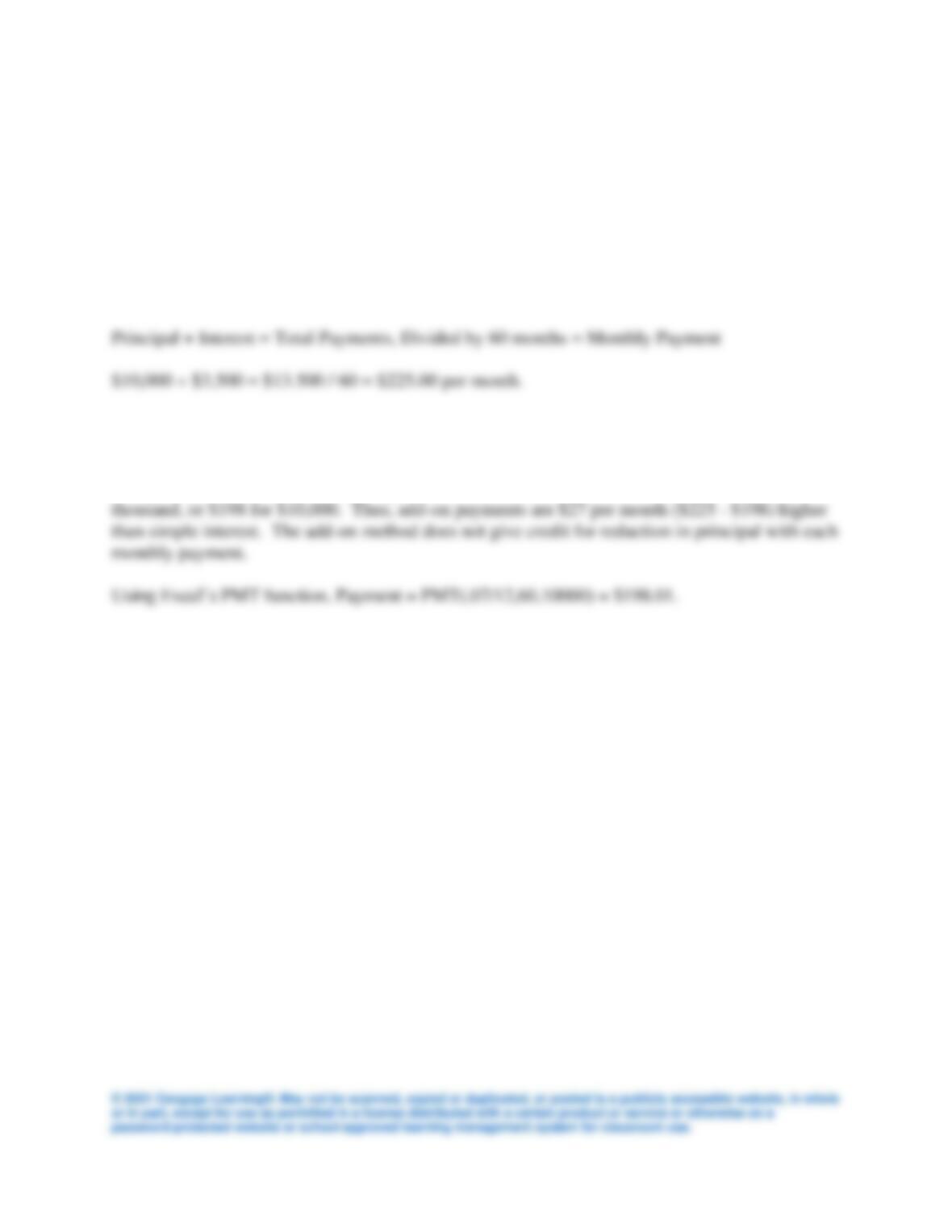
7. Calculating monthly installment loan payments. Using the simple interest method, find
the monthly payments on a $3,000 installment loan if the funds are borrowed for 24
months at an annual interest rate of 6 percent. How much interest will be paid during the
first year of the loan. (Use a monthly payment analysis similar to the one in Exhibit 7.7)
Computation of the monthly payment amount:
From table below, interest paid for year is $140.42 and reduction in principal for the first year is
$1,455.10.
Month
Balance, Beginning of
Month
Monthly
Payment
Interest, Beginning
balance times monthly
rate
Principal,
payment less
interest
1
$3,000.00
$132.96
15.00 (6%/12 * 3,000)
$117.96
2
2,882.04 (3,000 – 117.96)
132.96
14.41 (.005*2882.04)
118.55
3
2763.49 (2,882.04–118.55)
132.96
13.82 (.005*2763.49)
119.14
4
2644.35
132.96
13.22
119.74
5
2524.61
132.96
12.62
120.34
6
2404.27
132.96
12.02
120.94
7
2283.33
132.96
11.42
121.54
8
2161.79
132.96
10.81
122.15
9
2039.64
132.96
10.20
122.76
1916.88
132.96
9.58
123.38
1793.50
132.96
8.97
123.99
1669.51
132.96
8.35
124.61
Total for Year 1
$140.42
$1,455.10
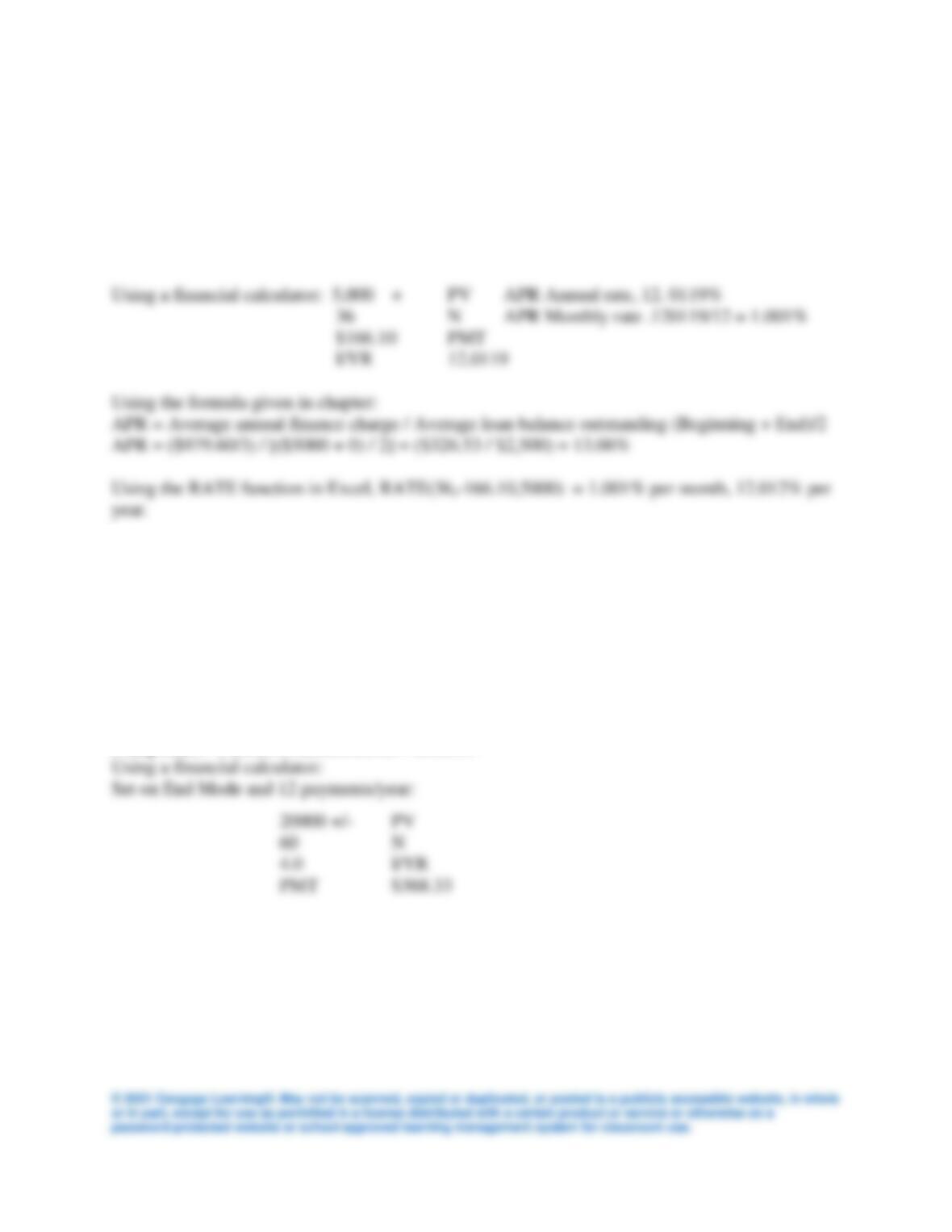
8. Calculating and comparing add-on and simple interest loans. Steven Riley is borrowing
$10,000 for 5 years at 7 percent. Payments, which are made on a monthly basis, are
determined using the add-on method.
a. How much total interest will Steven pay on the loan if it is held for the full 5-year term?
Interest using the Add-on Method = $10,000 * 7% * 5 years = $3,500, the total interest.
b. What are Steven’s monthly payments?
c. How much higher are the monthly payments under the add-on method than under the
simple interest method?
Using simple interest, payments using Exhibit 7.6 for 7% over 60 months are $19.80 per
9. Calculating interest and APR of installment loan. Assuming that interest is the only
finance charge, how much interest would be paid on a $5,000 installment loan to be repaid
in 36 monthly installments of $166.10? What is the APR on this loan?
How much interest?
Total Payments = 36 * $166.10 = $5,979.60
Total Interest = Total Payments less Principal = $5,979.60 – $5,000 = $979.60
10. Calculating payments, interest, and APR on auto loan. After careful comparison
shopping, Noah Griffin decides to buy a new Toyota Camry. With some options added, the
car has a price of $23,558—including plates and taxes. Because he can’t afford to pay cash
for the car, he will use some savings and his old car as a trade-in to put down $3,558. Noah
plans to finance the rest with a $20,000, 60-month loan at a simple interest rate of 4
percent.
a. What will his monthly payments be?
Using Excel: PMT(.04/12,60,15,058) = $368.33
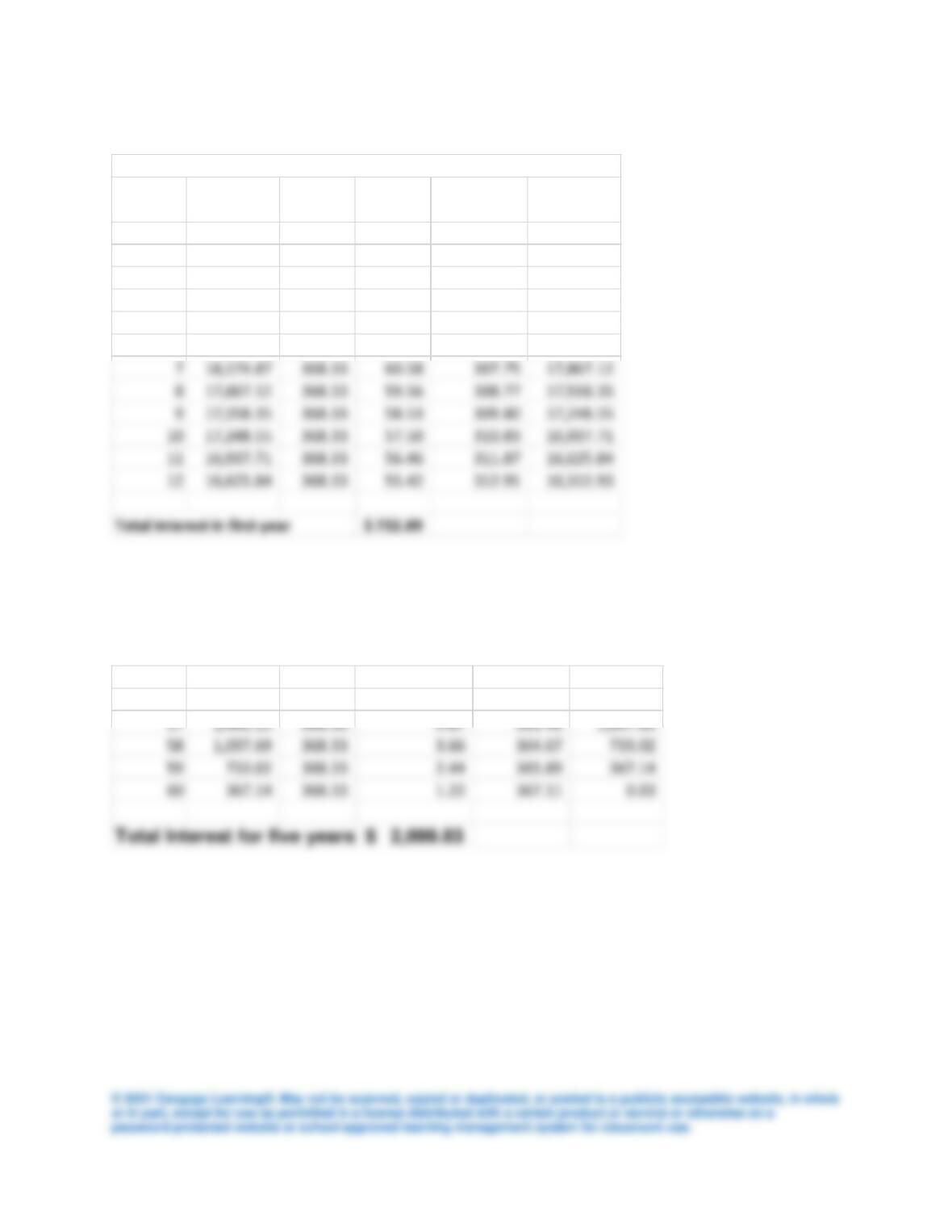
b. How much total interest will Noah pay in the first year of the loan?
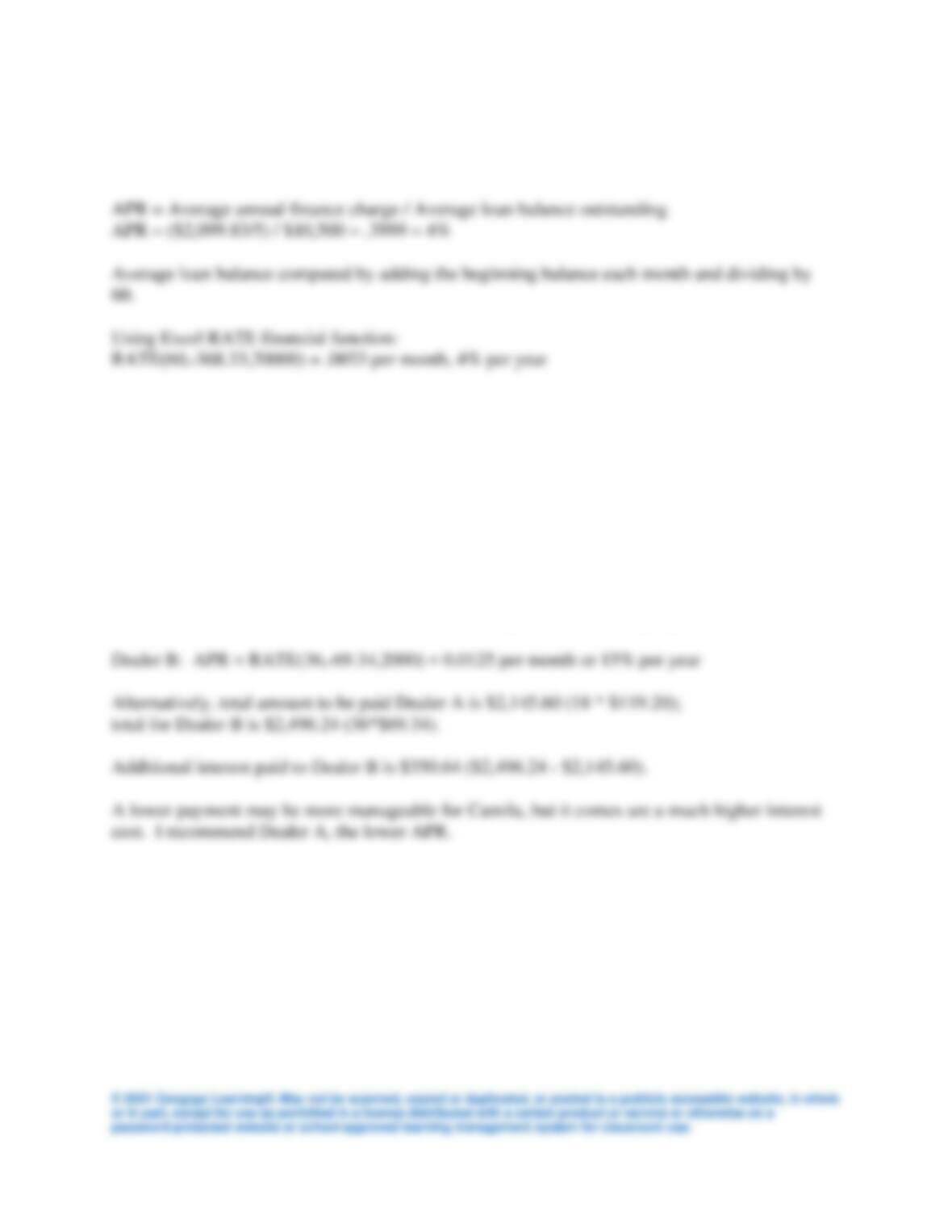
c. How much interest will Noah pay over the full (60-month) life of the loan?
Alternatively, [$368.33 * 60] = $22,099.80 – 20,000 = $2,099.80
Payment
Number
Beginning
Balance
Payment Interest
Reduction in
Principal
Ending
Balance
1 20,000.00$ 368.33$ 66.67$ 301.66$ 19,698.34$
2 19,698.34 368.33 65.66 302.67 19,395.67
3 19,395.67 368.33 64.65 303.68 19,091.99
4 19,091.99 368.33 63.64 304.69 18,787.30
5 18,787.30 368.33 62.62 305.71 18,481.59
6 18,481.59 368.33 61.61 306.72 18,174.87
Loan Amortization Schedule
55 2,184.45 368.33 7.28 361.05 1,823.40
56 1,823.40 368.33 6.08 362.25 1,461.15
d. What is the APR on this loan?
Using the approximation formula:
11. Calculating and comparing APRs of competing financing alternatives. Camila Torres
wants to buy a new high-end audio system for her car. The system is being sold by two
dealers in town, both of whom sell the equipment for the same price of $2,000. Camila can
buy the equipment from Dealer A, with no money down, by making payments of $119.20 a
month for 18 months; she can buy the same equipment from Dealer B by making 36
monthly payments of $69.34 (again, with no money down). Camila is considering
purchasing the system from Dealer B because of the lower payment. Find the APR for each
alternative. What do you recommend?
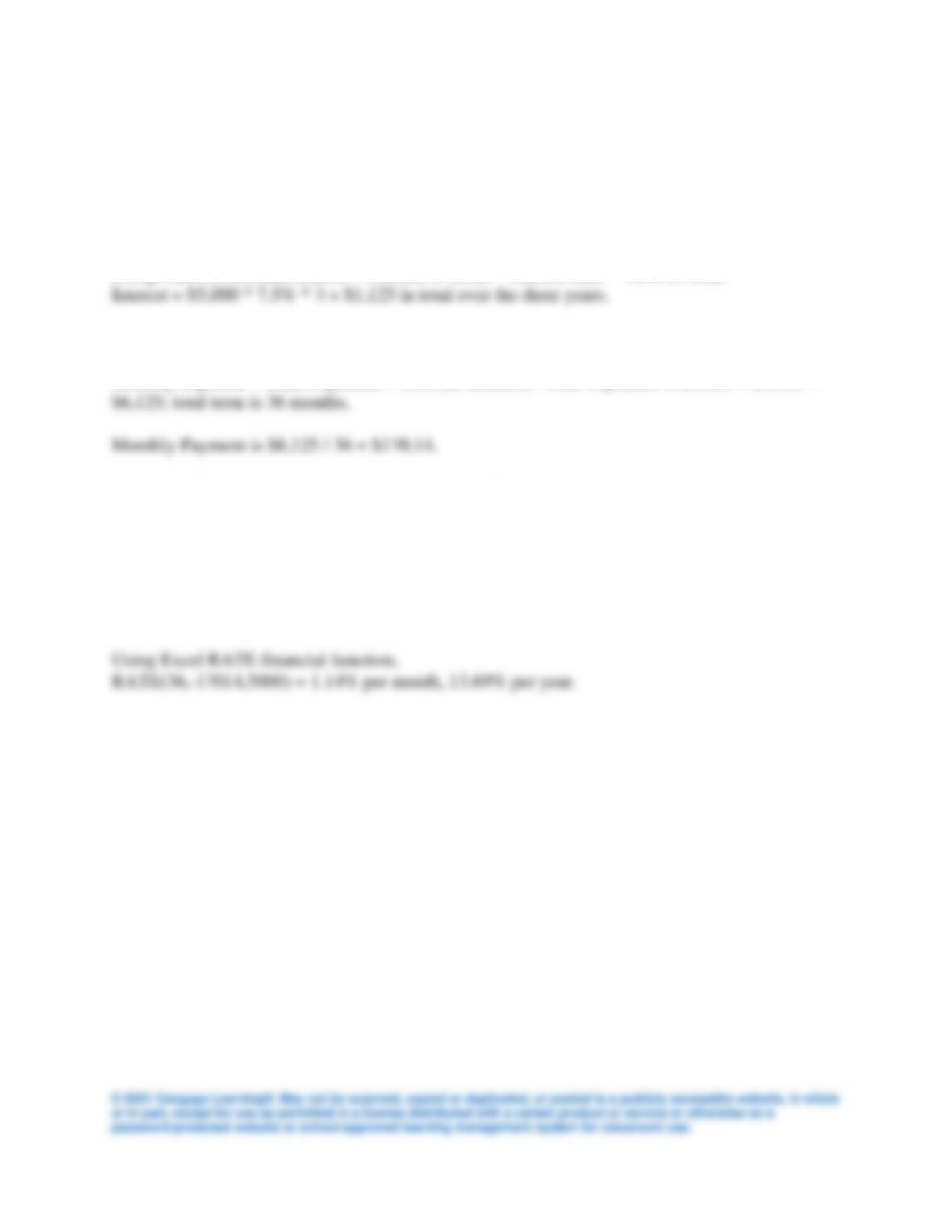
Using Excel RATE financial function:
Dealer A: APR = RATE(18,-119.20,2000) = 0.0075 per month or 9% per year
12. Calculating interest and APR of add-on loan. Timothy Lawrence plans to borrow $5,000
and to repay it in 36 monthly installments. This loan is being made at an annual add-on
interest rate of 7.5 percent.
a. Calculate the finance charge on this loan, assuming that the only component of the
finance charge is interest.
b. Use your finding in part (a) to calculate the monthly payment on the loan.
c. Using a financial calculator, determine the APR on this loan. Confirm your result with a
spreadsheet.
Using a financial calculator: 5,000 + PV APR Annual rate, 13.69%
36 N APR Monthly rate .136915/12 = 1.14%
$170.14 PMT
I/YR .136915
13. Deciding whether to pay cash or finance a purchase. Use Worksheet 7.2. Mariah Lane
wants to buy a home entertainment center. Complete with a big-screen TV and sound
system, the unit would cost $4,500. Mariah has over $15,000 in a money fund, so she can
easily afford to pay cash for the whole thing (the fund is currently paying 5 percent
interest, and Mariah expects that yield to hold for the foreseeable future). To stimulate
sales, the dealer is offering to finance the full cost of the unit with a 36-month installment
loan at 5 percent, simple. (Note: Assume Mariah is in the 24 percent tax bracket and that
she does not itemize deductions on her tax returns.) Briefly explain your answer.
a. Should she pay cash for the entertainment center?
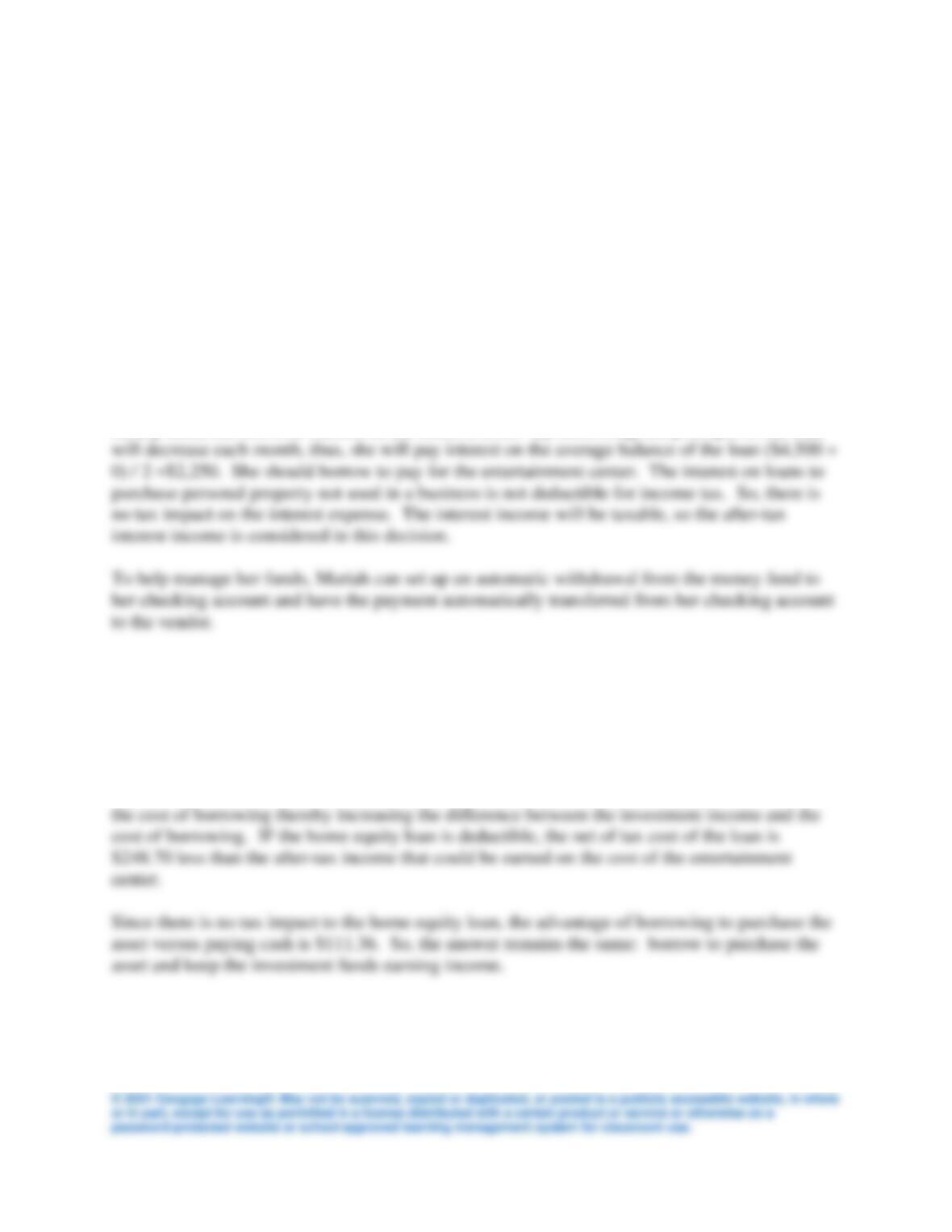
Using the decision rule of Worksheet 7.2, Mariah should borrow the $4,500. She will earn
$157.68 [after-tax] more than the cost of borrowing, thus she should borrow. If she uses her
b. Rework the problem, assuming that Mariah has the option of using a 48-month, 6
percent home equity loan to finance the full cost of this entertainment center. Again, use
Worksheet 7.2 to determine if Mariah should pay cash or buy on time. Does your answer
change from the one you came up with in part (a)? Explain.
If the loan was a deductible home equity loan (it is not: only home equity loans used to renovate
a personal residence can be deductible as an itemized deduction), the tax impact would reduce