CHAPTER 7: CURRENCY FUTURES AND OPTIONS MARKETS
1
CHAPTER 7
CURRENCY FUTURES AND OPTIONS MARKETS
This chapter describes foreign currency futures and options contracts and shows how they can be used to
manage foreign exchange risk or take speculative positions on currency movements. It also shows how
to read the prices of these contracts as they appear in the financial press.
SUGGESTED ANSWERS TO CHAPTER 7 QUESTIONS
1. On April 1, the spot price of the British pound was $1.96 and the price of the June futures
contract was $1.95. During April the pound appreciated so that by May 1 it was selling for
$2.01. What do you think happened to the price of the June pound futures contract during
April? Explain.
2. What are the basic differences between forward and futures contracts? Between futures and
options contracts?
3. A forward market already existed, so why was it necessary to establish currency futures and
currency options contracts?
4. Suppose that Texas Instruments must pay a French supplier €10 million in 90 days.
4.a. Explain how TI can use currency futures to hedge its exchange risk. How many futures
contracts will TI need to fully protect itself?
4.b. Explain how TI can use currency options to hedge its exchange risk. How many options
contracts will TI need to fully protect itself?
4.c. Discuss the advantages and disadvantages of using currency futures versus currency options
to hedge TI’s exchange risk.
ANSWER. A futures contract is most valuable when the quantity of foreign currency being hedged is
5. Suppose that Bechtel Group wants to hedge a bid on a Japanese construction project. Because
the yen exposure is contingent on acceptance of its bid, Bechtel decides to buy a put option for
the ¥15 billion bid amount rather than sell it forward. To reduce its hedging cost, however,
Bechtel simultaneously sells a call option for ¥15 billion with the same strike price. Bechtel
reasons that it wants to protect its downside risk on the contract and is willing to sacrifice the
upside potential to collect the call premium. Comment on Bechtel’s hedging strategy.
ADDITIONAL CHAPTER 7 QUESTIONS AND ANSWERS
1. What is the last day of trading and the settlement day for the IMM Australian dollar futures
for September of the current year?
2. Which contract is likely to be more valuable, an American or a European call option? Explain.
3. In Exhibit 7.9, the value of the call option is shown as approaching its intrinsic value as the
option goes deeper and deeper in-the-money or further and further out-of-the-money. Explain
why this is so.
ANSWER. As the call option moves further out-of-the-money, the chances that it will expire unexercised
4. During September 1992, options on ERM currencies with strike prices outside the ERM bands
had positive values. At the same time, actual currency volatility was close to zero.
4.a. Is there a paradox here? Explain.
4.b. Why might actual currency volatility have been close to zero? What does a zero volatility
imply about the value of currency options?
4.c. What does the positive values of ERM options outside the bands tell you about the market’s
perceptions of the possibility of currency devaluations or revaluations?
INSTRUCTORS MANUAL: FOUNDATIONS OF MULTINATIONAL FINANCIAL MANAGEMENT, 6TH ED.
4
SUGGESTED SOLUTIONS TO CHAPTER 7 PROBLEMS
1. On Monday morning, an investor takes a long position in a pound futures contract that
matures on Wednesday afternoon. The agreed-on price is $1.95 for £62,500. At the close of
trading on Monday, the futures price has risen to $1.96. At Tuesday close, the price rises
further to $1.98. At Wednesday close, the price falls to $1.955, and the contract matures. The
investor takes delivery of the pounds at the prevailing price of $1.955. Detail the daily
settlement process (see Exhibit 7.3). What will be the investor’s profit (loss)?
ANSWER
Time
Action
Cash Flow
Monday Open
Investor buys a pound futures contract
that matures in two days
None.
Price is $1.95
2. Suppose that the forward ask price for March 20 on euros is $1.3327 at the same time the price
of IMM euro futures for delivery on March 20 is $1.3345. How could an arbitrageur profit
from this situation? What will be the arbitrageur’s profit per futures contract (size is
€125,000)?
3. Suppose DEC buys a Swiss franc futures contract (size is SFr 125,000) at a price of $0.83. If
the spot rate for the Swiss franc at the date of settlement is SFr 1 = $0.8250, what is DEC’s
gain or loss on this contract?
Contract is marked-to-market.
62,500 * (1.96 – 1.95) = $625
Contract is marked-to-market.
62,500 * (1.98 – 1.96) = $1,250
62,500 * 1.955 = $122,187.50
4. On January 10, Volkswagen agrees to import auto parts worth $7 million from the U.S. The
parts will be delivered on March 4 and are payable immediately in dollars. VW decides to
hedge its dollar position by entering into IMM futures contracts. The spot rate is $1.3447/€ and
the March futures price is $1.3502.
4.a. Calculate the number of futures contracts that VW must buy to offset its dollar exchange
risk on the parts contract.
4.b. On March 4, the spot rate turns out to be $1.3452/€, while the March futures price is
$1.3468/€. Calculate VW’s net euro gain or loss on its futures position. Compare this figure
with VW’s gain or loss on its unhedged position.
ANSWER. Under its futures contract, VW has agreed to sell €5,250,000 and receive $7,088,550
(5,250,000 * 1.3502). On March 4, VW can close out its futures position by buying back 42 March euro
5. Citigroup sells a call option on euros (contract size is €500,000) at a premium of $0.04 per euro.
If the exercise price is $1.34 and the spot price of the euro at expiration is $1.36, what is
Citigroup’s profit (loss) on the call option?
6. Suppose you buy three June PHLX call options with a 90 strike price at a price of 2.3 (¢/€).
6.a. What would be your total dollar cost for these calls, ignoring broker fees?
6.b. After holding these calls for 60 days, you sell them for 3.8 (¢/€). What is your net profit on
the contracts assuming that brokerage fees on both entry and exit were $5 per contract and
that your opportunity cost was 8% per annum on the money tied up in the premium?
7. A trader executes a “bear spread” on the Japanese yen consisting of a long PHLX 103 March
put and a short PHLX 101 March put.
7.a. If the price of the 103 put is 2.81 (100ths of ¢/¥), while the price of the 101 put is 1.6 (100ths
of ¢/¥), what is the net cost of the bear spread?
7.b. What is the maximum amount the trader can make on the bear spread in the event the yen
depreciates against the dollar?
ANSWER. To begin, the 103 March put gives the trader the right but not the obligation to sell yen at a
7.c. Redo your answers to parts a and b assuming the trader executes a “bull spread” consisting
of a long PHLX 97 March call priced at 0.0321¢/¥ and a short PHLX 103 March call priced
at 0.0196¢/¥. What is the trader‘s maximum profit? Maximum loss?
8. Apex Corporation must pay its Japanese supplier ¥125 million in three months. It is thinking
of buying 20 yen call options (contract size is ¥6.25 million) at a strike price of $0.00800 to
protect against the risk of a rising yen. The premium is 0.015 cents per yen. Alternatively,
Apex could buy 10 three-month yen futures contracts (contract size is ¥12.5 million) at a price
of $0.007940 per yen. The current spot rate is ¥1 = $0.007823. Suppose Apex’s treasurer
believes that the most likely value for the yen in 90 days is $0.007900, but the yen could go as
high as $0.008400 or as low as $0.007500.
8.a. Diagram Apex’s gains and losses on the call option position and the futures position within
its range of expected prices (see Exhibit 8.4). Ignore transaction costs and margins.
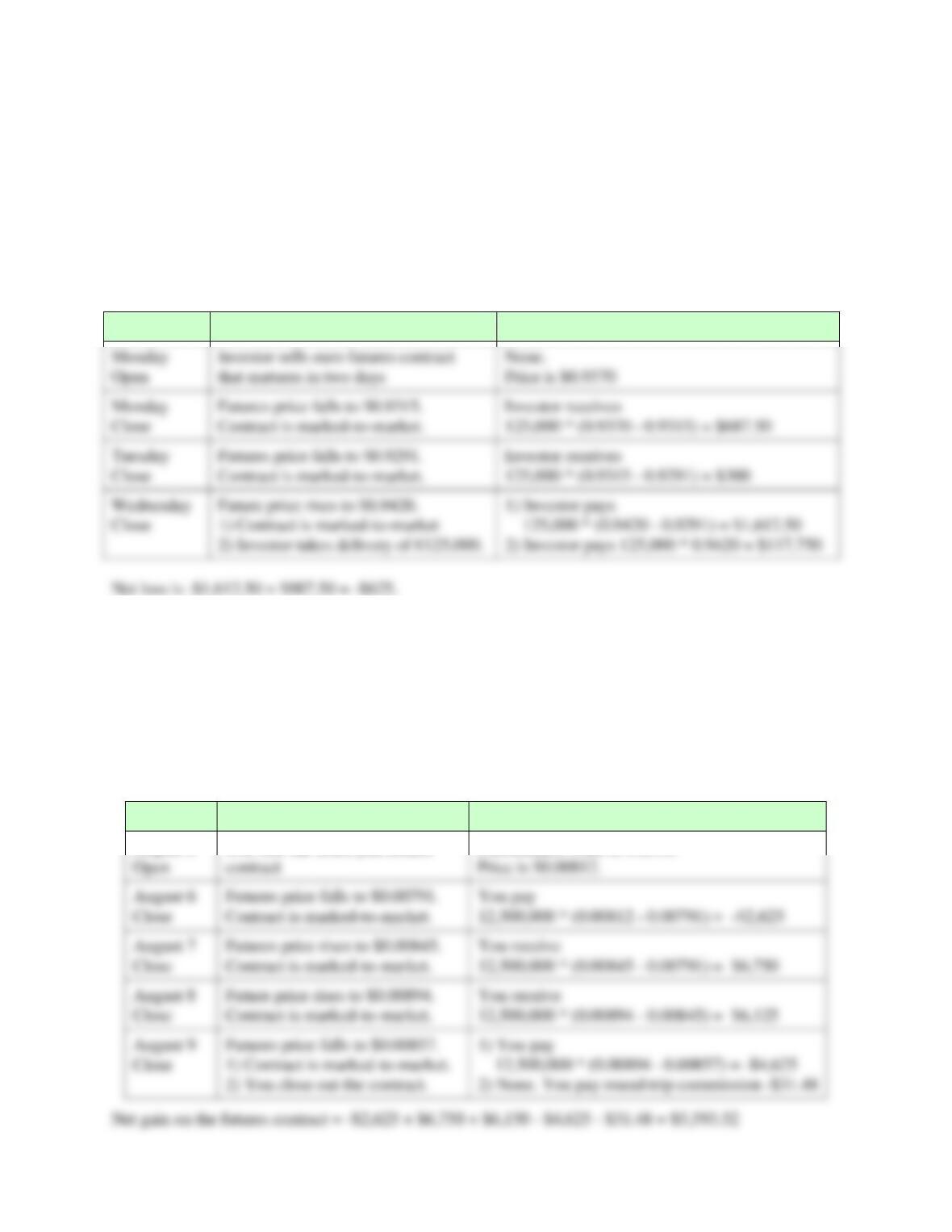
ANSWER. In the following calculations, note that the current spot rate is irrelevant. When a spot rate is
PROFIT (LOSS) ON APEX CORPORATION’S FUTURES AND OPTIONS POSITIONS
$40,000
$60,000
$57,500
INSTRUCTORS MANUAL: MULTINATIONAL FINANCIAL MANAGEMENT, 6TH ED.
8
Contract
Yen Price
Option
75
79.4
81.5
84
As the diagram and table show, Apex can use a futures contract to lock in a price of $0.007940/¥ at a
8.b. Calculate what Apex would gain or lose on the option and futures positions if the yen settled
at its most likely value.
8.c. What is Apex’s break-even future spot price on the option contract? On the futures contract?
8.d. Calculate and diagram the corresponding profit-and-loss and break-even positions on the
futures and options contracts for the sellers of these contracts.
ANSWER. The sellers’ profit-and-loss and break-even positions on the futures and options contracts will
Profit
Futures
CHAPTER 7: CURRENCY FUTURES AND OPTIONS MARKETS
9
ADDITIONAL CHAPTER 7 PROBLEMS AND SOLUTIONS
1. On Monday morning, an investor takes a short position in a euro futures contract that matures
on Wednesday afternoon. The agreed-on price is $0.9370 for €125,000. At the close of trading
on Monday, the futures price has fallen to $0.9315. At Tuesday close, the price falls further to
$0.9291. At Wednesday close, the price rises to $0.9420, and the contract matures. The investor
delivers the euros at the prevailing price of $0.8420. Detail the daily settlement process (see
Exhibit 8.2). What will be the investor’s profit (loss)?
ANSWER
Time
Action
Cash Flow
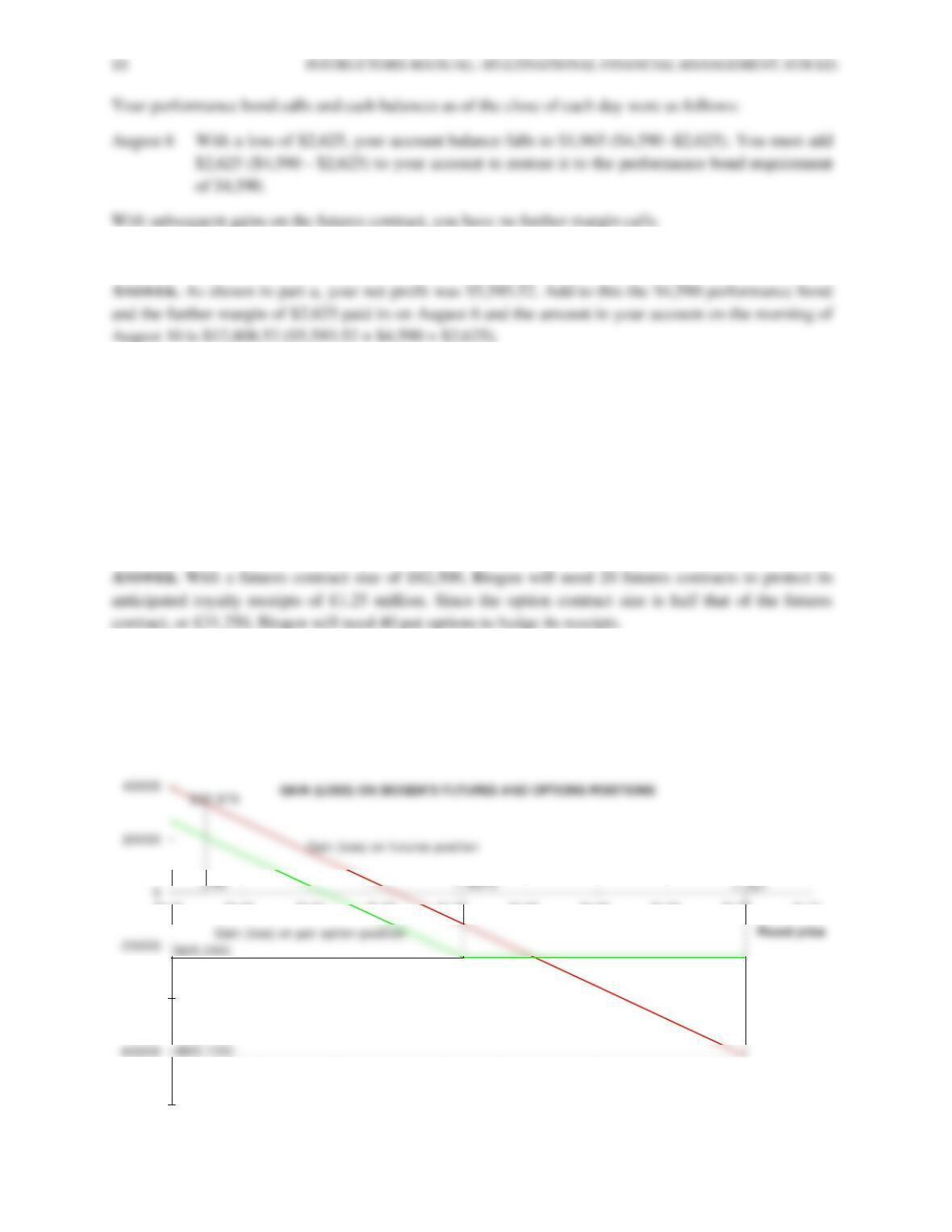
2. On August 6, you go long one IMM yen futures contract at an opening price of $0.00812 with a
performance bond of $4,590 and a maintenance performance bond of $3,400. The settlement
prices for August 6, 7, and 8 are $0.00791, $0.00845, and $0.00894, respectively. On August 9,
you close out the contract at a price of $0.00857. Your round-trip commission is $31.48.
2.a. Calculate the daily cash flows on your account. Be sure to take into account your required
performance bond and any performance bond calls.
ANSWER
Time
Action
Cash Flow
August 6
You sell one IMM yen futures
Performance bond of $4,590.
Close
2.b. What is your cash balance with your broker on the morning of August 10?
3. Biogen expects to receive royalty payments totaling £1.25 million next month. It is interested in
protecting these receipts against a drop in the value of the pound. It can sell 30-day pound
futures at a price of $1.6513 per pound or it can buy pound put options with a strike price of
$1.6612 at a premium of 2.0 cents per pound. The spot price of the pound is currently $1.6560,
and the pound is expected to trade in the range of $1.6250 to $1.7010. Biogen’s treasurer
believes that the most likely price of the pound in 30 days will be $1.6400.
3.a. How many futures contracts will Biogen need to protect its receipts? How many options
contracts?
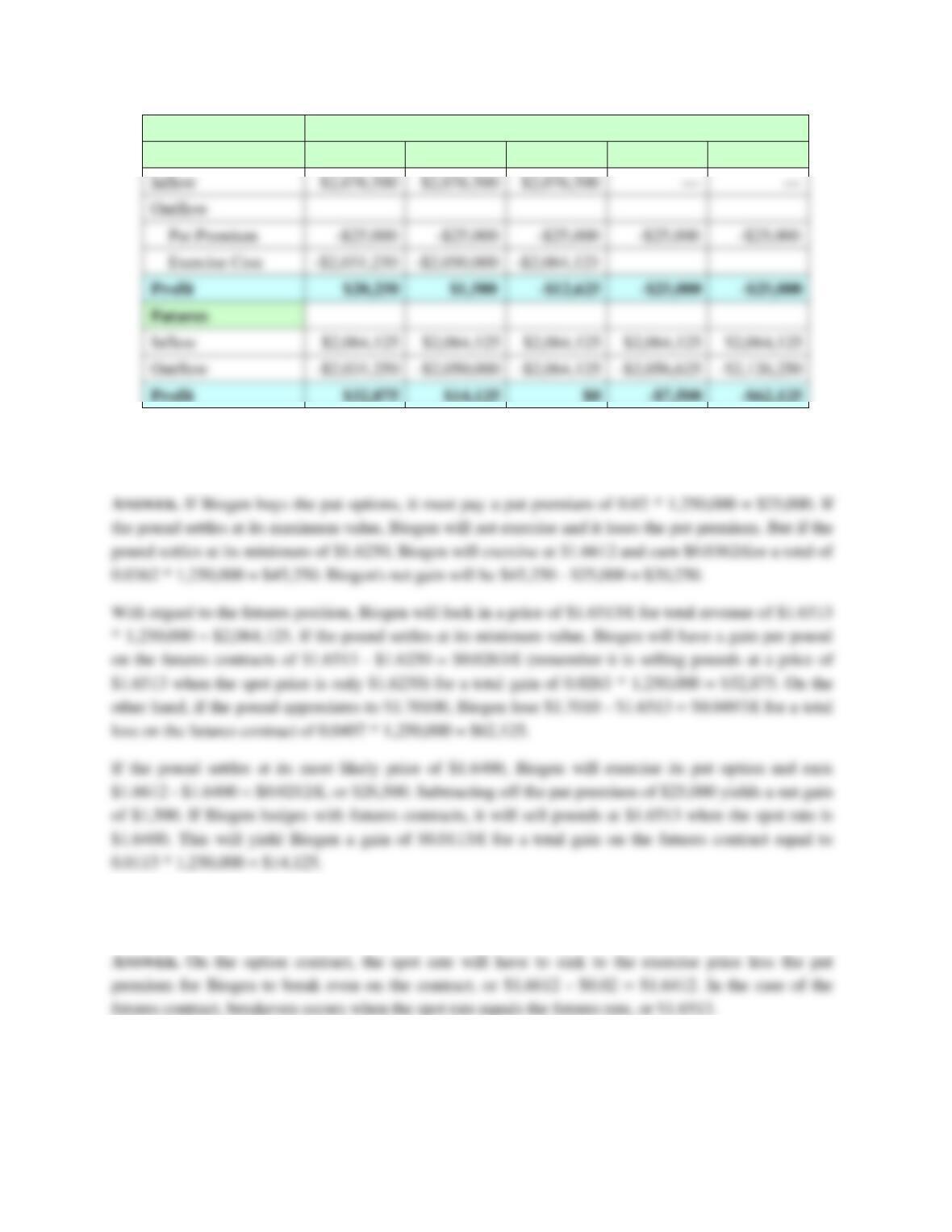
3.b. Diagram Biogen’s profit and loss associated with the put option position and the futures
position within its range of expected exchange rates (see Exhibit 7.6). Ignore transaction
costs and margins.
–80000
–40000
$1.62 $1.63 $1.64 $1.65 $1.66 $1.67 $1.68 $1.69 $1.70 $1.71
CHAPTER 7: CURRENCY FUTURES AND OPTIONS MARKETS
11
Contract
Pound Price
Option
1.6250
1.6400
1.6513
1.6612
1.7010
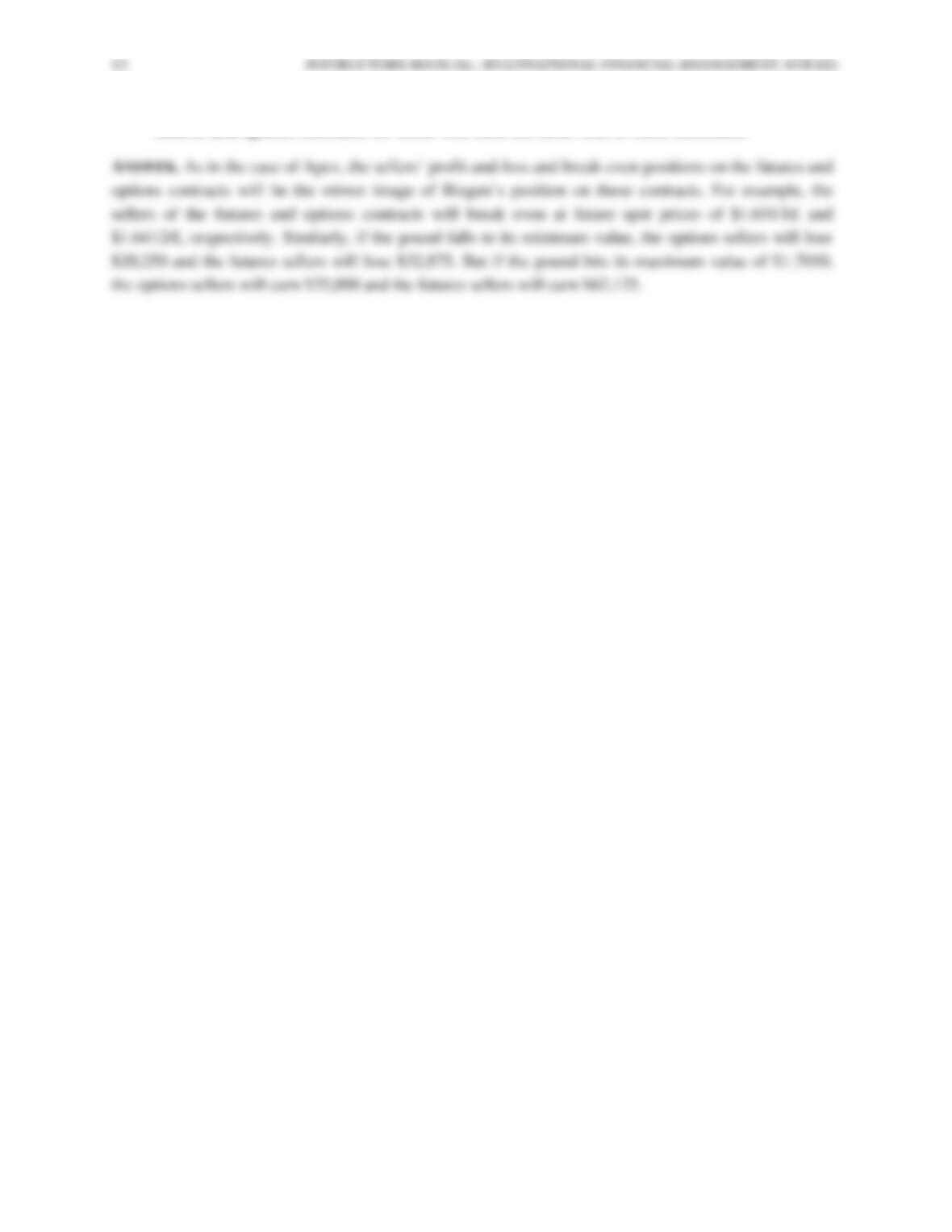
3.c. Calculate what Biogen would gain or lose on the option and futures positions within the
range of expected future exchange rates and if the pound settled at its most likely value.
3.d. What is Biogen’s break-even future spot price on the option contract? On the futures
contract?
Profit
Futures
3.e. Calculate and diagram the corresponding profit-and-loss and break-even positions on the
futures and options contracts for those who took the other side of these contracts.