Chapter 7
Corporate Valuation and Stock Valuation
ANSWERS TO END-OF-CHAPTER QUESTIONS
7-1 a. A proxy is a document giving one person the authority to act for another, typically the
power to vote shares of common stock. If earnings are poor and stockholders are
dissatisfied, an outside group may solicit the proxies in an effort to overthrow
management and take control of the business, known as a proxy fight. The preemptive
right gives the current shareholders the right to purchase any new shares issued in
number of years.
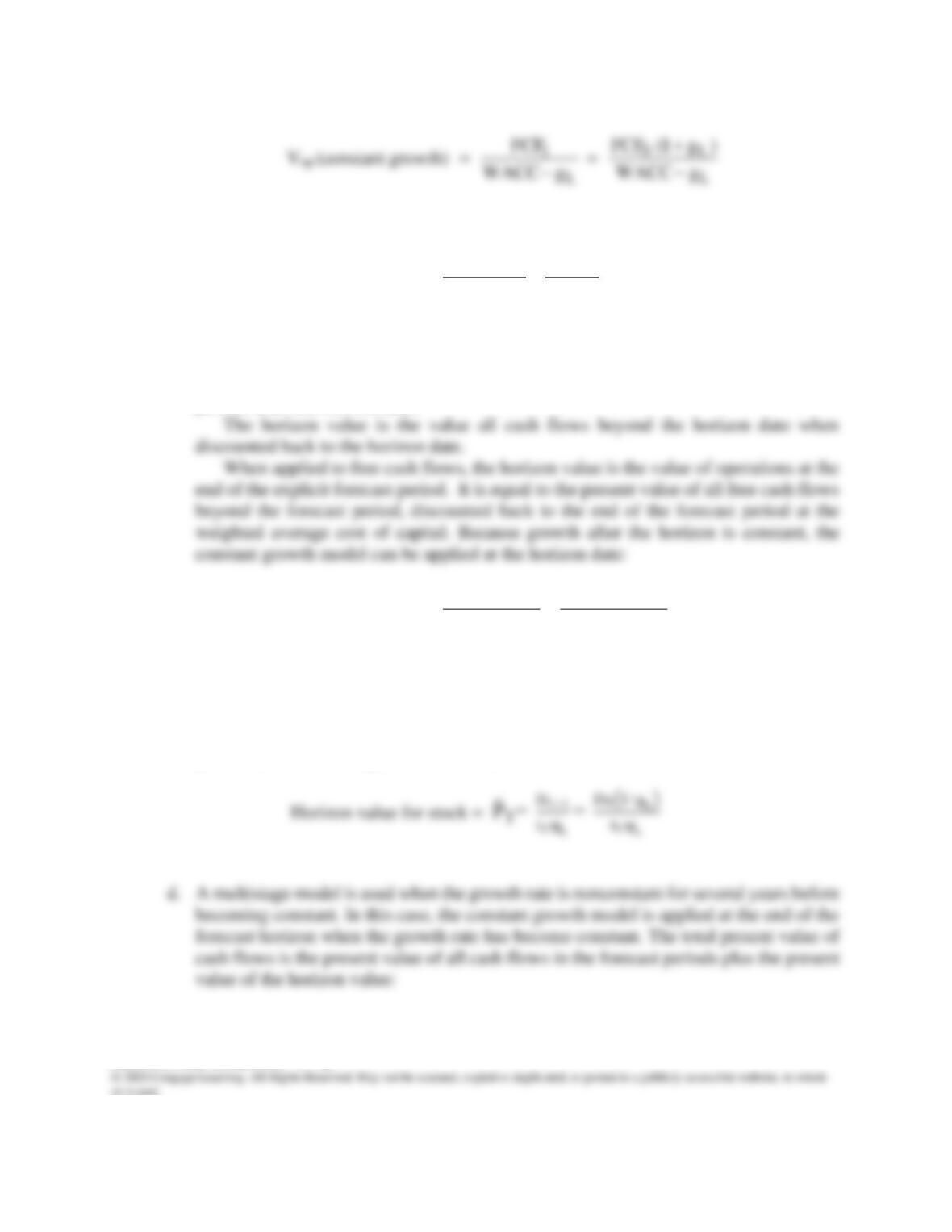
b. The free cash flow model defines the total value of a company as the value of operations
plus the value of nonoperating assets.
The value of operations is the present value of all the future expected free cash
flows when discounted at the weighted average cost of capital:
( )
.
WACC1
FCF
V
1t t
t
0)timeop(at
=+
=
Nonoperating assets include investments in marketable securities and non-
controlling interests in the stock of other companies, and other financial securities.
Answers and Solutions: 7 – 2
When applied to dividends, the model is:
P
^0 =
Ls
1
Ls
L0
gr
D
gr
)g1(D
−
=
−
+
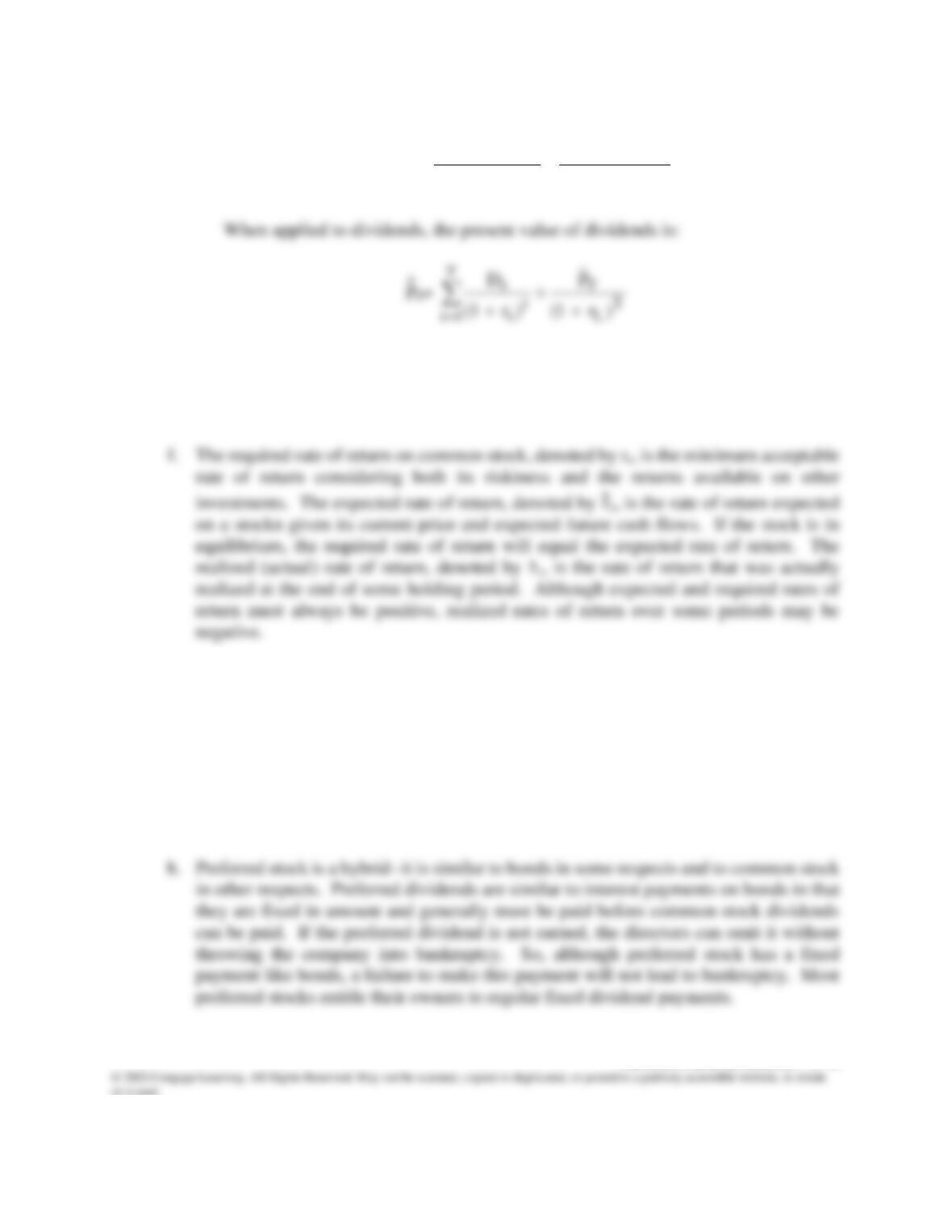
The horizon date is the last year in a cash flow forecast. Cash flows may grow
unevenly during the forecast period, but are assumed to grow at a constant rate for all
periods after the horizon date.
.
gWACC
)g1(FCF
gWACC
FCF
VHV
L
LT
L
1T
T)timeop(atT −
+
=
−
== +
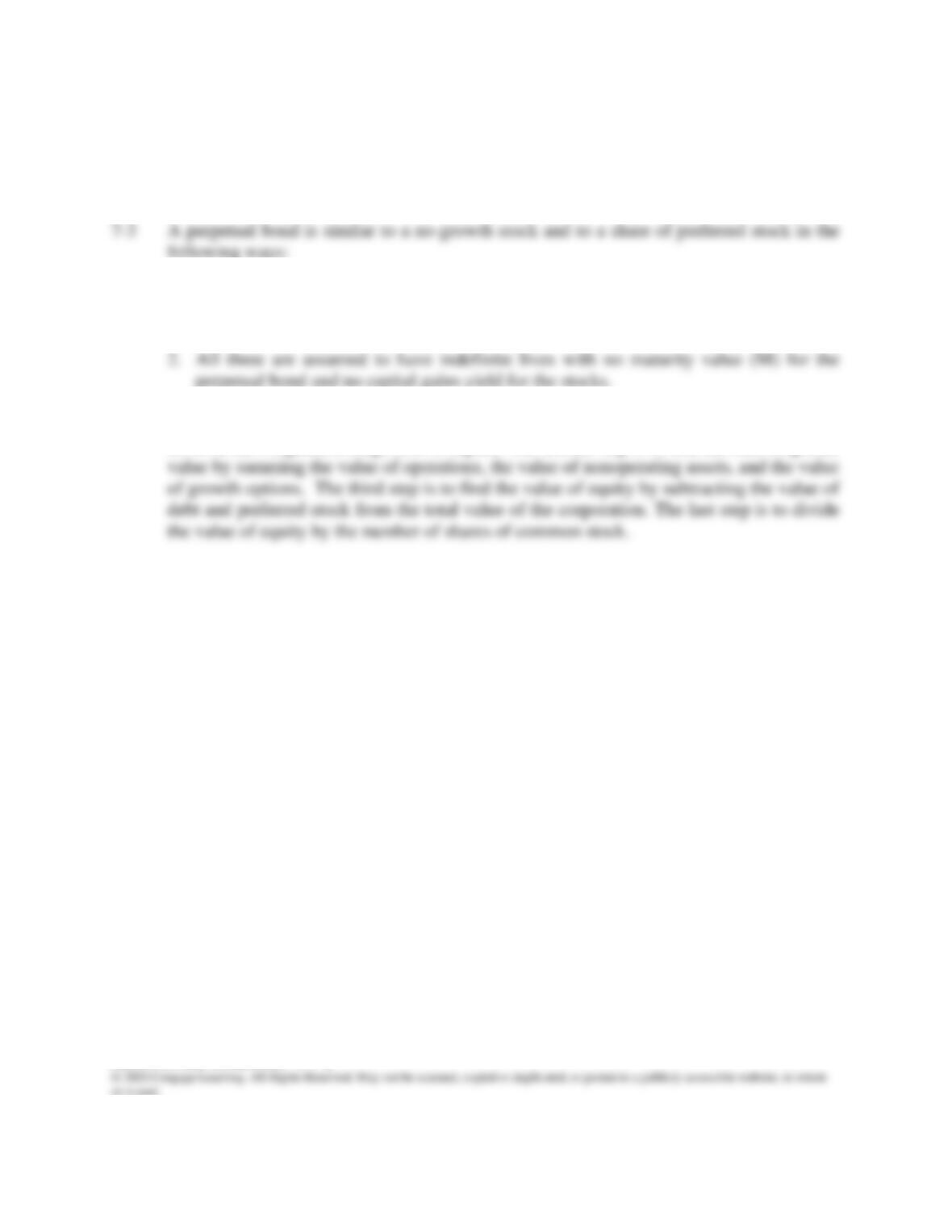
When applied to dividends, the horizon value is the intrinsic stock price at the end
of the explicit forecast period. It is equal to the present value of all dividends beyond
the forecast period, discounted back to the end of the forecast period at the required
rate of return on stock. Because growth after the horizon is constant, the constant
growth model can be applied at the horizon date:
Answers and Solutions: 7- 3
Vop,0 =
T
T
T
1t t
t
)WACC1(
HV
)WACC1(
FCF
+
+
+
=
e. Estimated value (
0
P
ˆ
) is the present value of the expected future cash flows. The market
price (P0) is the price at which an asset can be sold.
g. The capital gains yield results from changing prices and is calculated as (P1 – P0)/P0,
where P0 is the beginning-of-period price and P1 is the end-of-period price. For a
constant growth stock, the capital gains yield is g, the constant growth rate. The
dividend yield on a stock can be defined as either the end-of-period dividend divided
by the beginning-of-period price, or the ratio of the current dividend to the current
price. Valuation formulas use the former definition. The expected total return, or
expected rate of return, is the expected capital gains yield plus the expected dividend
yield on a stock. The expected total return on a bond is the yield to maturity.
Answers and Solutions: 7 – 4
7-2 True. The value of a share of stock is the PV of its expected future dividends. If the two
investors expect the same future dividend stream, and they agree on the stock’s riskiness,
then they should reach similar conclusions as to the stock’s value.
1. All three derive their values from a series of cash inflows—coupon payments from the
perpetual bond, and dividends from both types of stock.
7-4 The first step is to find the value of operations by discounting all expected future free cash
flows at the weighted average cost of capital. The second step is to find the total corporate
Answers and Solutions: 7- 5
SOLUTIONS TO END-OF-CHAPTER PROBLEMS
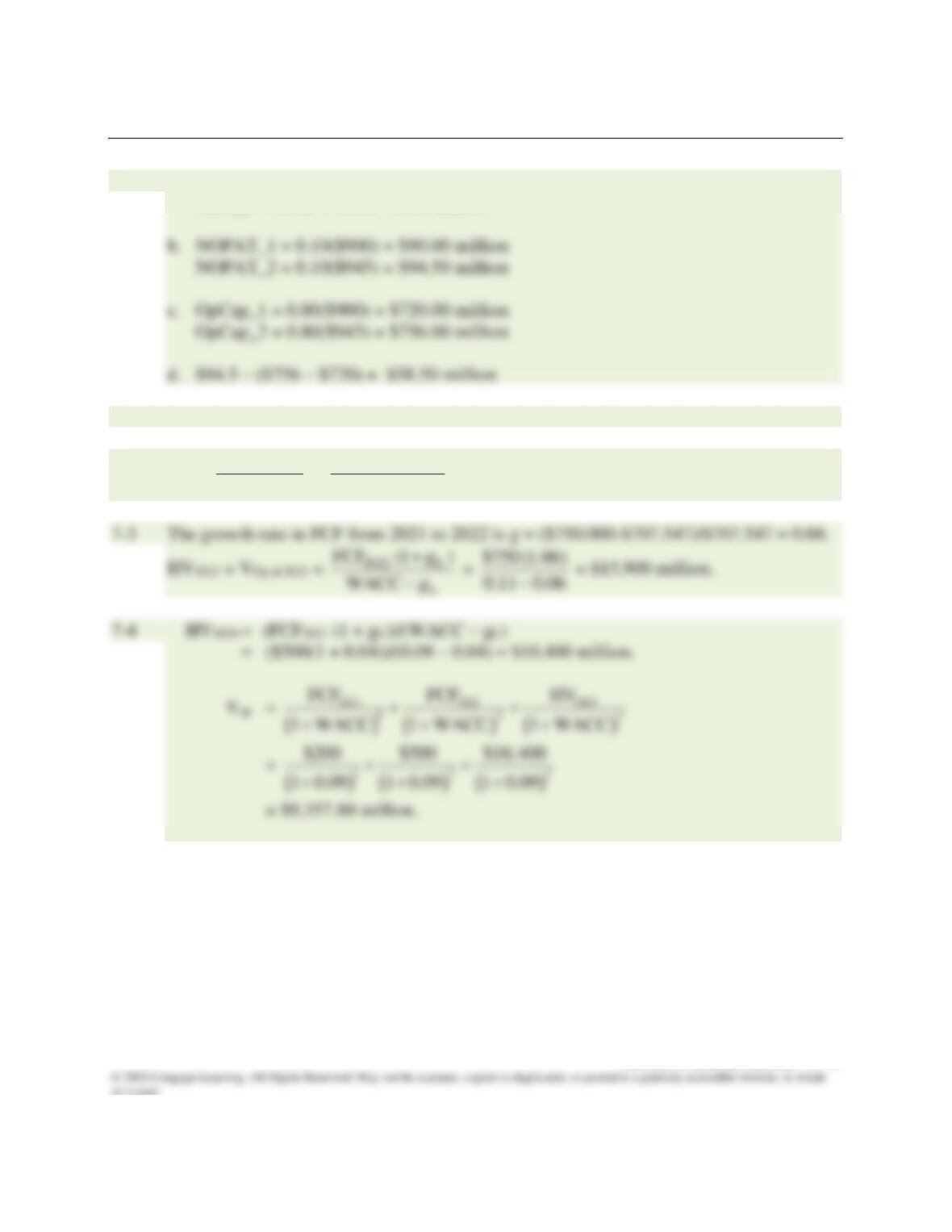
7-1 a. Sales_1 = $800(1 + 0.10) =$900 million
Sales_2 = $00(1 + 0.05) =$945 million
7-2 Value of operations = Vop = PV of expected future free cash flow
Vop =
gWACC
)g1( FCF
−
+
=
05.012.0
)05.1(000,400$
−
= $6,000,000.
Answers and Solutions: 7 – 6
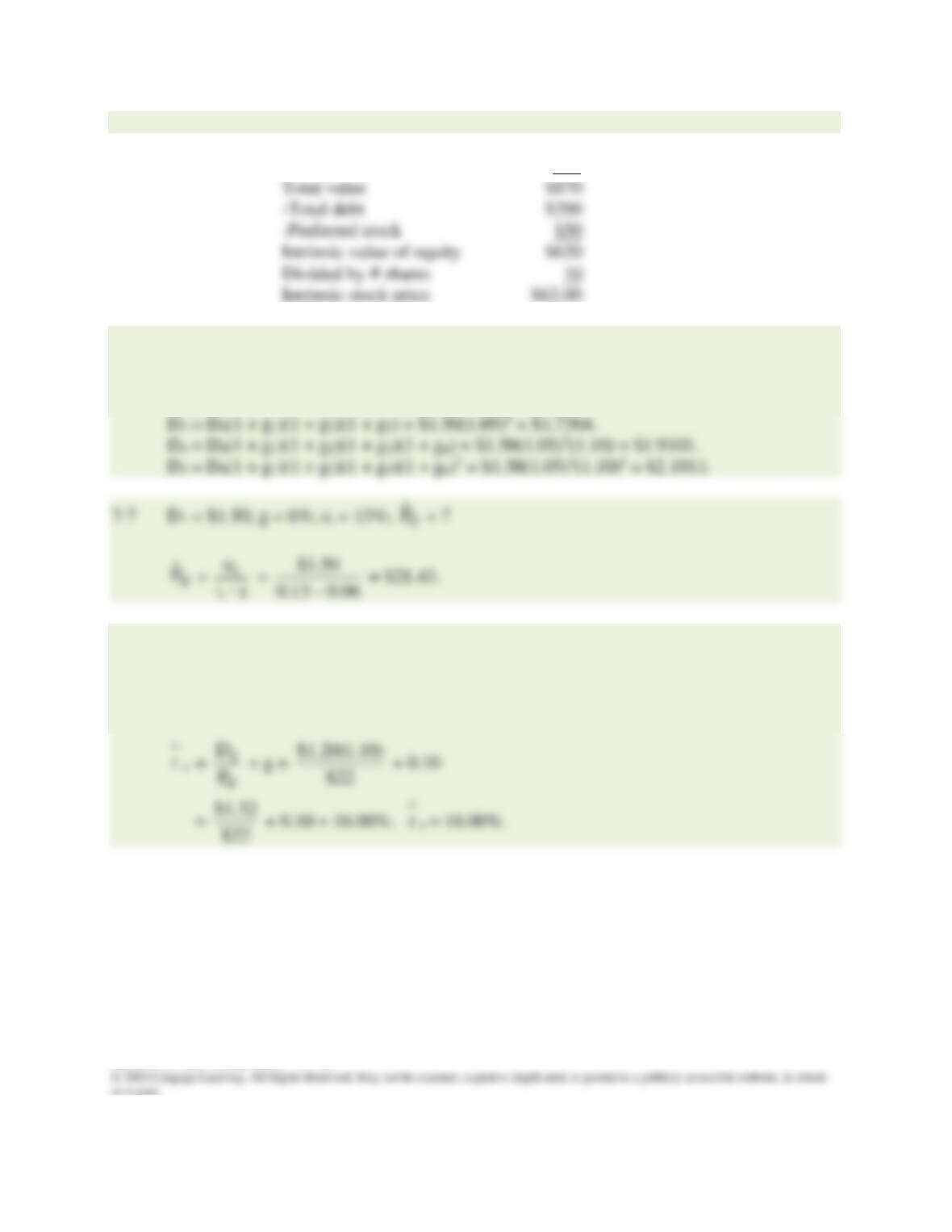
7-5
V_op
$800
+ ST investments
$70
Total value
$870
-Total debt
$200
-Preferred stock
$50
Intrinsic value of equity
$620
Divided by # shares
Intrinsic stock price
7-6 D0 = $1.50; g1-3 = 5%; gn = 10%; D1 through D5 = ?
D1 = D0(1 + g1) = $1.50(1.05) = $1.5750.
D2 = D0(1 + g1)(1 + g2) = $1.50(1.05)2 = $1.6538.
7-8 P0 = $22; D0 = $1.20; g = 10%;
1
P
ˆ
= ?;
r
s= ?
1
P
ˆ
= P0(1 + g) = $22(1.10) = $24.20.
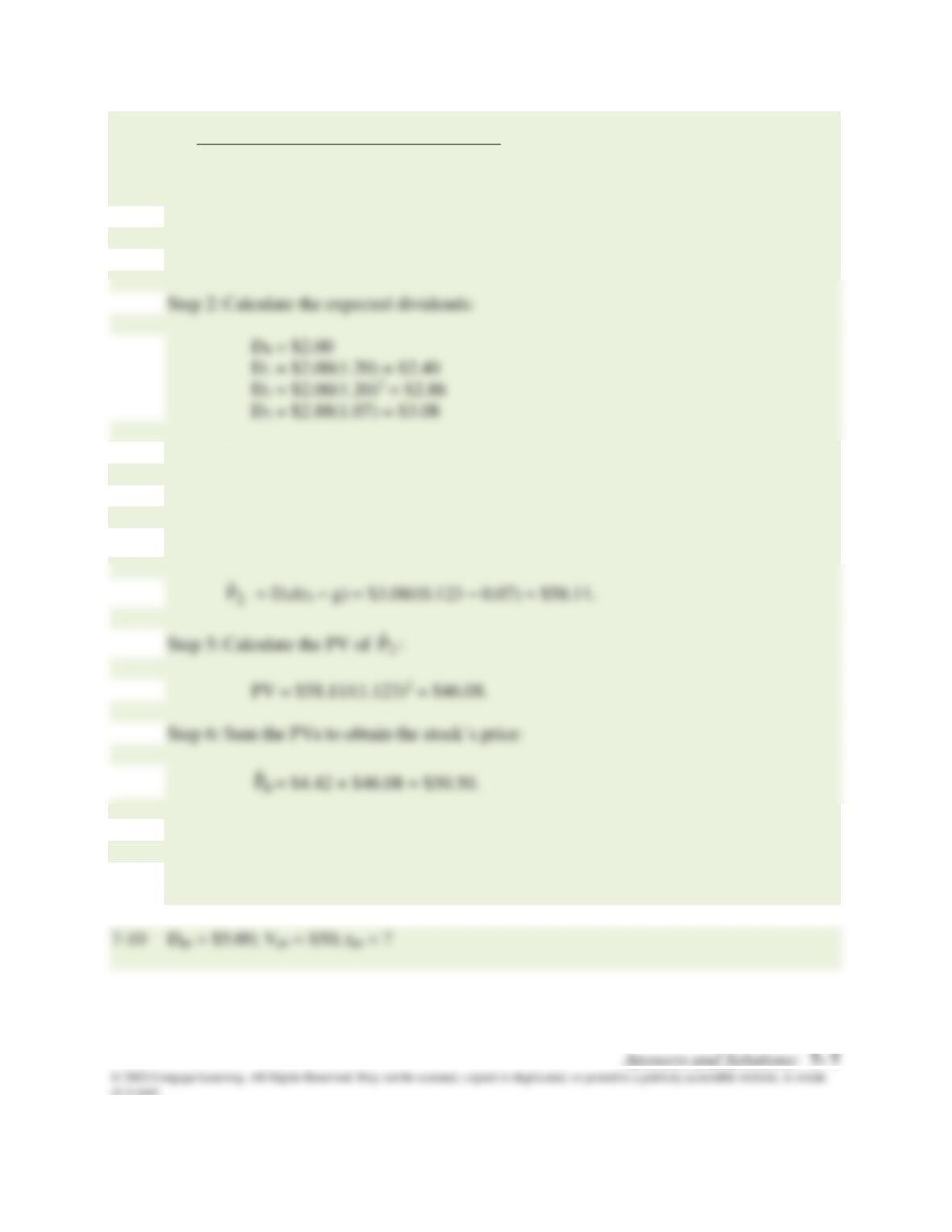
7-9 0 1 2 3
| | | |
D0 = 2.00 D1 D2 D3
2
P
ˆ
Step 1: Calculate the required rate of return on the stock:
rs = rRF + (rM – rRF)b = 7.5% + (4%)1.2 = 12.3%.
Step 3: Calculate the PV of the expected dividends:
PVDiv = $2.40/(1.123) + $2.88/(1.123)2 = $2.14 + $2.28 = $4.42.
Step 4: Calculate
2
P
ˆ
:
Alternatively, using a financial calculator, input the following:
CF0 = 0, CF1 = 2.40, and CF2 = 60.99 (2.88 + 58.11) and then enter I/YR = 12.3 to solve
for NPV = $50.50.
Answers and Solutions: 7 – 8
rps =
ps
ps
v
D
=
00.50$
00.5$
= 10%.
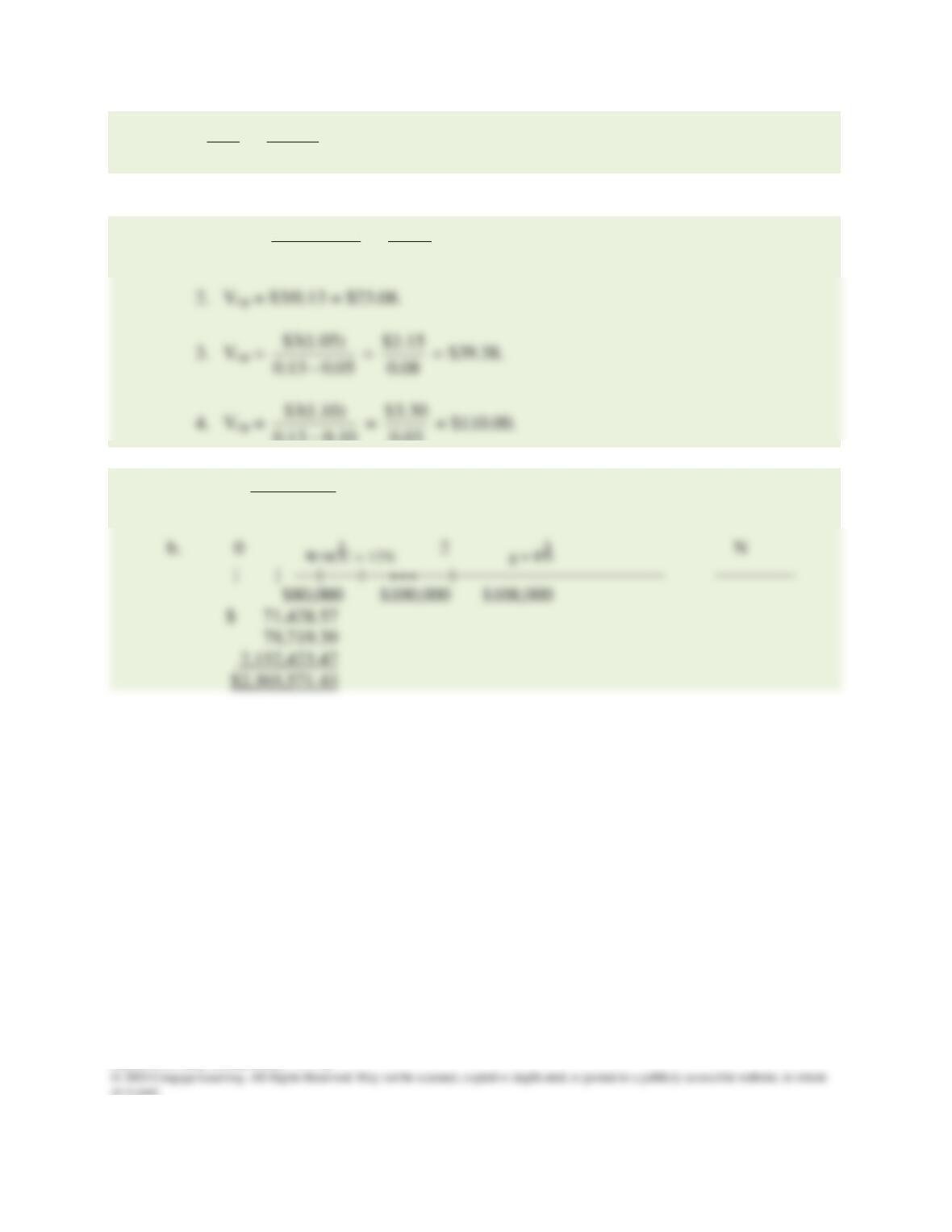
7-11 a. 1. Vop =
05.013.0
)05.01(3$
+
−
=
18.0
85.2$
= $15.83.
08.0
10.013.0
−
03.0
7-12 a. HV2 =
08.012.0
000,108$
−
= $2,700,000.
Answers and Solutions: 7- 9
7-13 a. HV3 =
07.013.0
)07.1( 40$
−
= $713.33.
b. 0 1 2 3 4 N
| | | | | • • • |
-20 30 40
7-14
0
P
ˆ
=
gr
D
s
1
−
=
gr
)g1(D
s
0
−
+
=
)]04.0(14.0
)]04.0(1[6$
−−
−+
=
18.0
76.5$
= $32.00.
gL = 0.09 = 9%.
WACC = 13%
g = 7%
Answers and Solutions: 7 – 10
7-16 The problem asks you to determine the value of
3
P
ˆ
, given the following facts: D1 = $3, b
= 0.8, rRF = 5.2%, RPM = 6%, and P0 = $40. Proceed as follows:
Step 1: Calculate the required rate of return:
rs = rRF + (rM – rRF)b = 5.2% + (6%)0.8 = 10%.
3
P
3
P
ˆ
Alternatively, you could calculate D4 and then use the constant growth rate formula to solve
for
3
P
ˆ
:
D4 = D1(1 + g)3 = $3.00(1.025)3 = $3.2307.
3
P
ˆ
= $3.2307/(0.10 – 0.025) = $43.0756 $43.08.
7-17 Vps = Dps/rps; therefore, rps = Dps/Vps.
Answers and Solutions: 7- 11
7-18 D0 = $1, rS = 7% + 6% = 13%, g1 = 50%, g2 = 25%, gn = 6%.
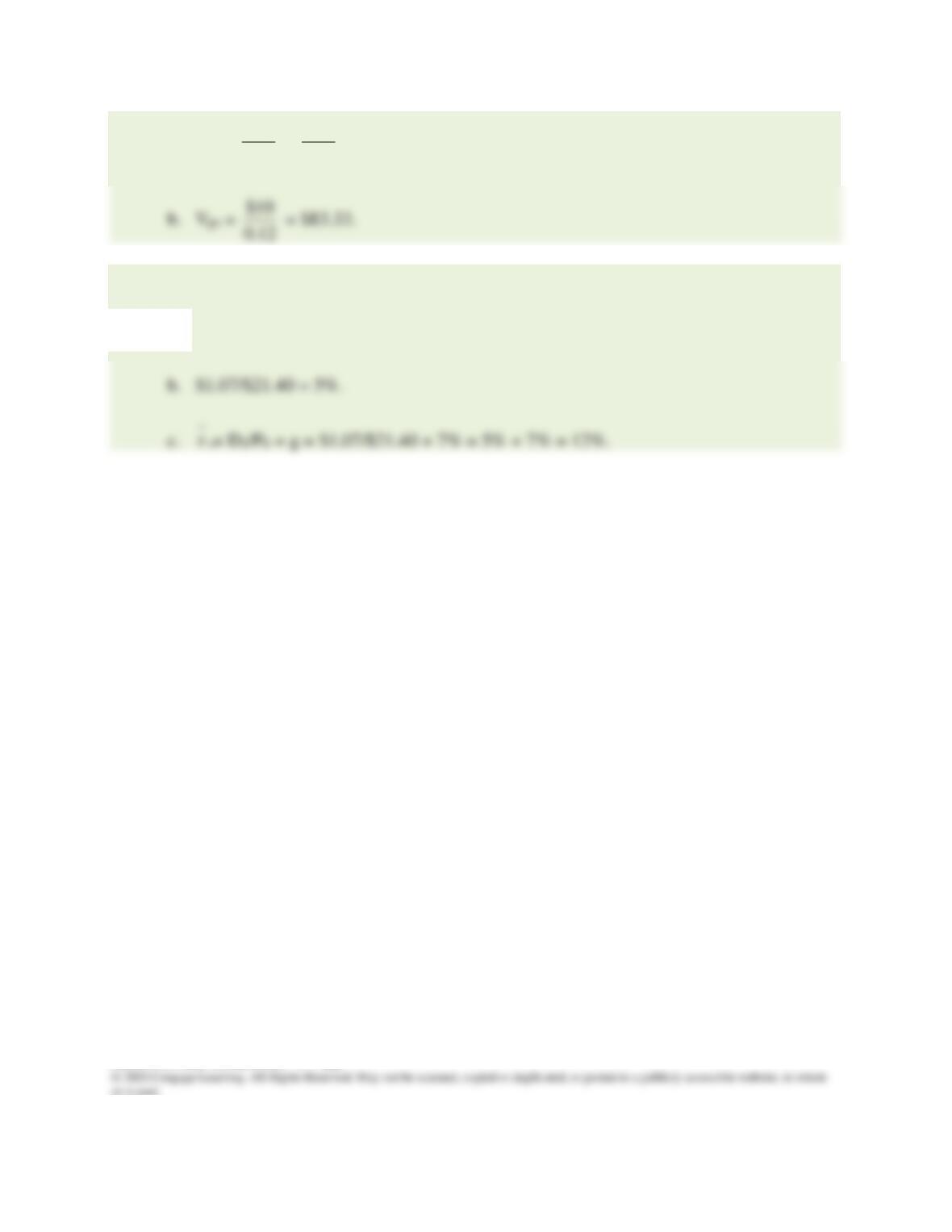
7-19 Calculate the dividend stream and place them on a time line. Also, calculate the price of
the stock at the end of the nonconstant growth period, and include it, along with the
dividend to be paid at t = 5, as CF5. Then, enter the cash flows as shown on the time line
into the cash flow register, enter the required rate of return as I = 15, and then find the value
of the stock using the NPV calculation. Be sure to enter CF0 = 0, or else your answer will
be incorrect.
D0 = 0; D1 = 0, D2 = 0, D3 = 0.50
D4 = 0.50(1.8) = 0.9; D5 = 0.50(1.8)2 = 1.62; D6 = 0.80(1.8)2(1.07)
= $1.7334.
0
P
ˆ
= ?
0 1 2 3 4 5 6
| | | | | | |
rs = 16%
g = 7%
g = 80%
Answers and Solutions: 7 – 12
7-20 a. Vps =
ps
ps
r
D
=
08.0
10$
= $125.
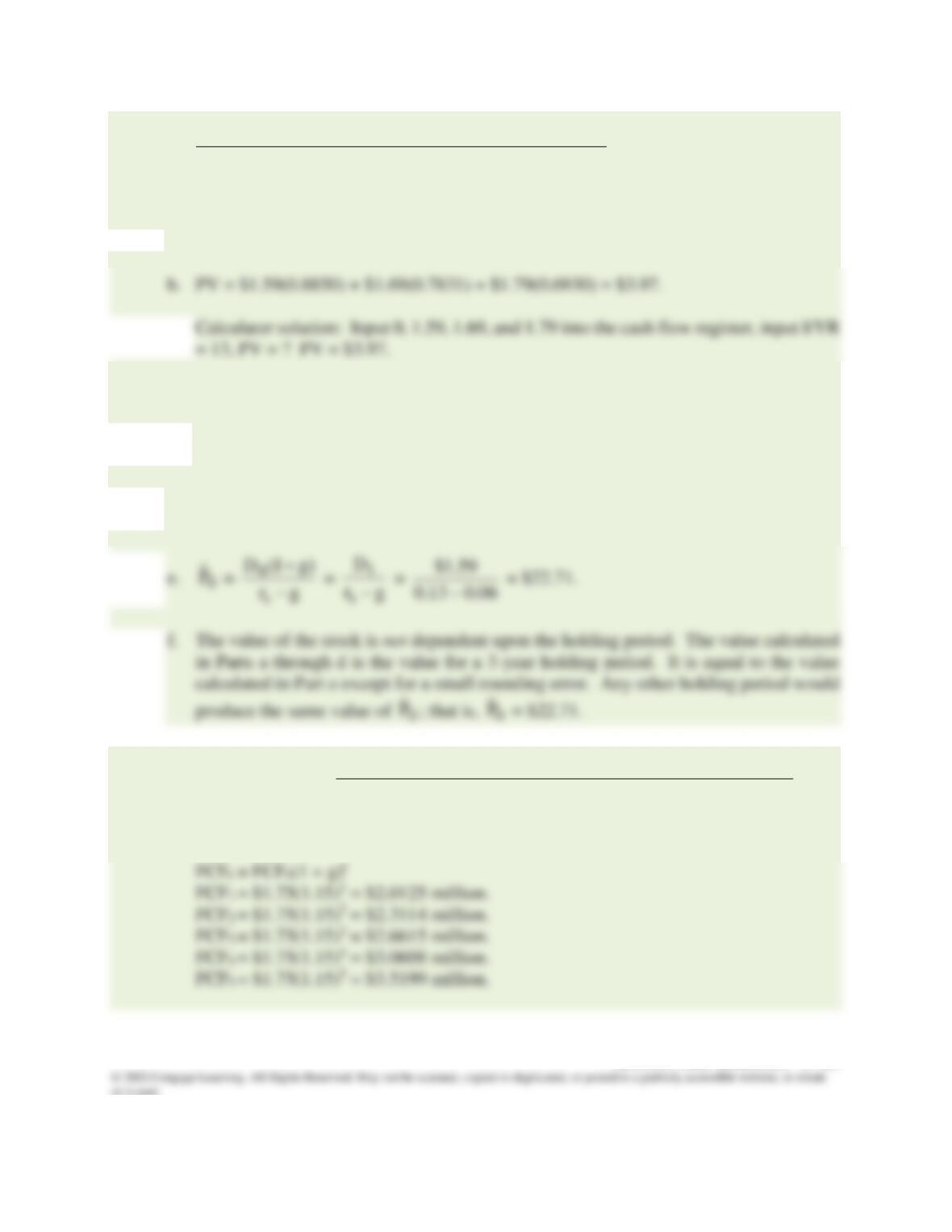
7-21 a. g = $1.1449/$1.07 – 1.0 = 7%.
Calculator solution: Input N = 1, PV = -1.07, PMT = 0, FV = 1.1449,
I/YR = ? I = 7.00%.
Answers and Solutions: 7- 13
7-22 0 g=6% 1 2 3 4
| | | | |
D0 = 1.50 D1 D2 D3 D4
3
P
ˆ
a. D1 = $1.5(1.06) = $1.59. D2 = $1.50(1.06)2 = $1.69. D3 = $1.5(1.06)3 = $1.79.
c. $27.05(0.6930) = $18.74.
Calculator solution: Input 0, 0, 0, and 27.05 into the cash flow register, I/YR = 13, PV
= ? PV = $18.74.
d. $18.74 + $3.97 = $22.71 = Maximum price you should pay for the stock. (rounding
differences may give you $22.72.)
7-23 a. End of Year: 0 1 2 3 4 5 6
| | | | | | |
FCF0 = 1.75 FCF1 FCF2 FCF3 FCF4 FCF5 FCF6
= 12%
g = 5%
g = 15%
b. HV5 =
6 5 n
nn
FCF FCF (1 g )
WACC g WACC g
+
=
−−
=
$3.5199 (1.05)
0.12 0.05−
= $52.80 million.
This is the value of operations 5 years from now.
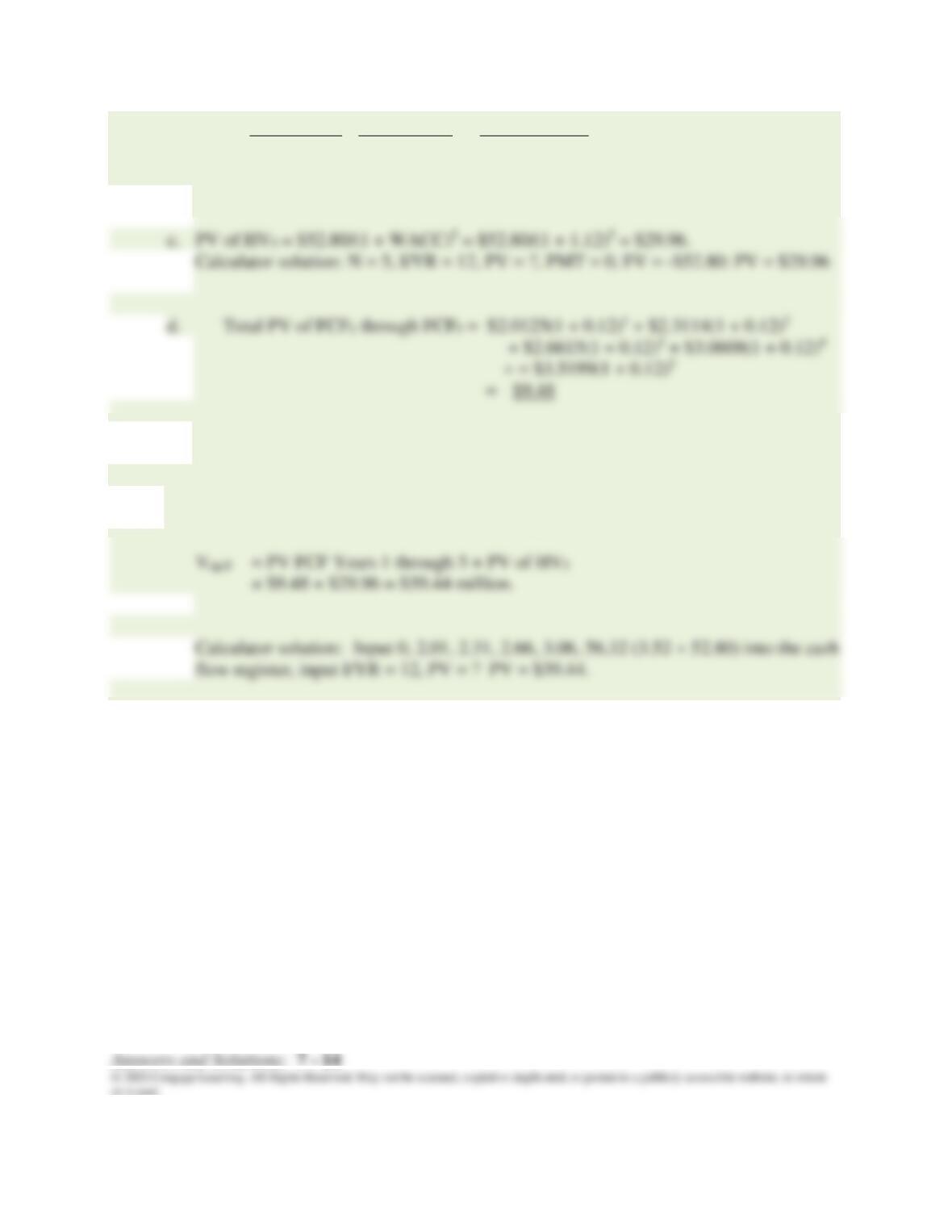
Calculator solution: Input 0, 2.0125, 2.3114, 2.6615, 3.0608, 3.5199 into the cash flow
register, input I/YR = 12, PV = ? PV = $9.48.
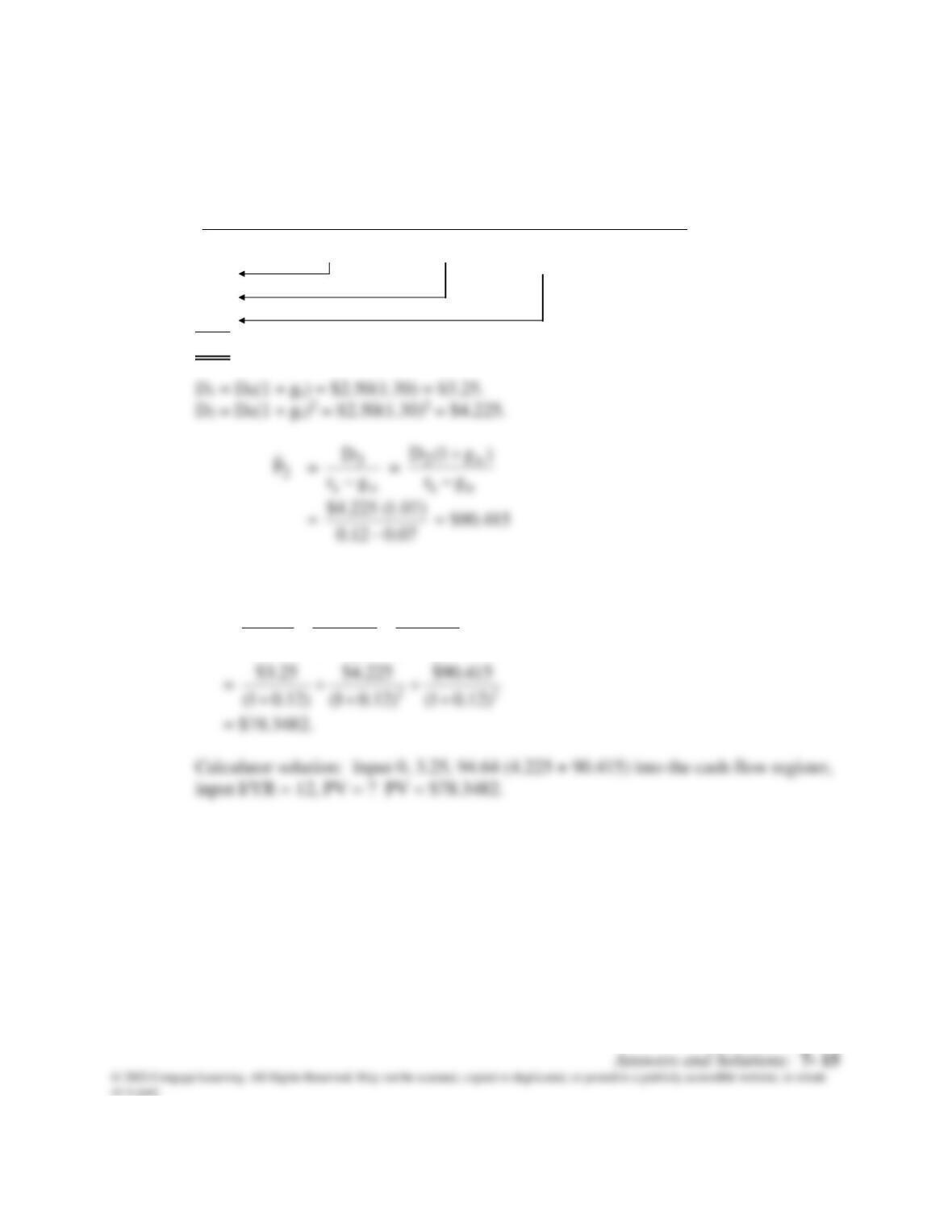
e. The total value of operations today is the sum or the PV of the horizon value and the
PVs of the free cash flows from Year 1 through 5:
7-21 a. Graphical representation of the problem:
Nonconstant Normal
growth growth
0 1 2 3 ∞
| | | |
D0 D1 (D2 +
2
P
ˆ
) D3 D∞
PVD1
PVD2
PV
2
P
ˆ
P0
0
P
ˆ
= PV(D1) + PV(D2) + PV(
2
P
ˆ
)
=
2
s
2
2
s
2
s
1
)r1(
P
ˆ
)r1(
D
)r1(
D
+
+
+
+
+
Answers and Solutions: 7 – 16
b.
1
ˆ
P
=
22
s
HV D
1r
+
+
=
$90.415 $4.225
1 0.12
+
+
= $84.50.
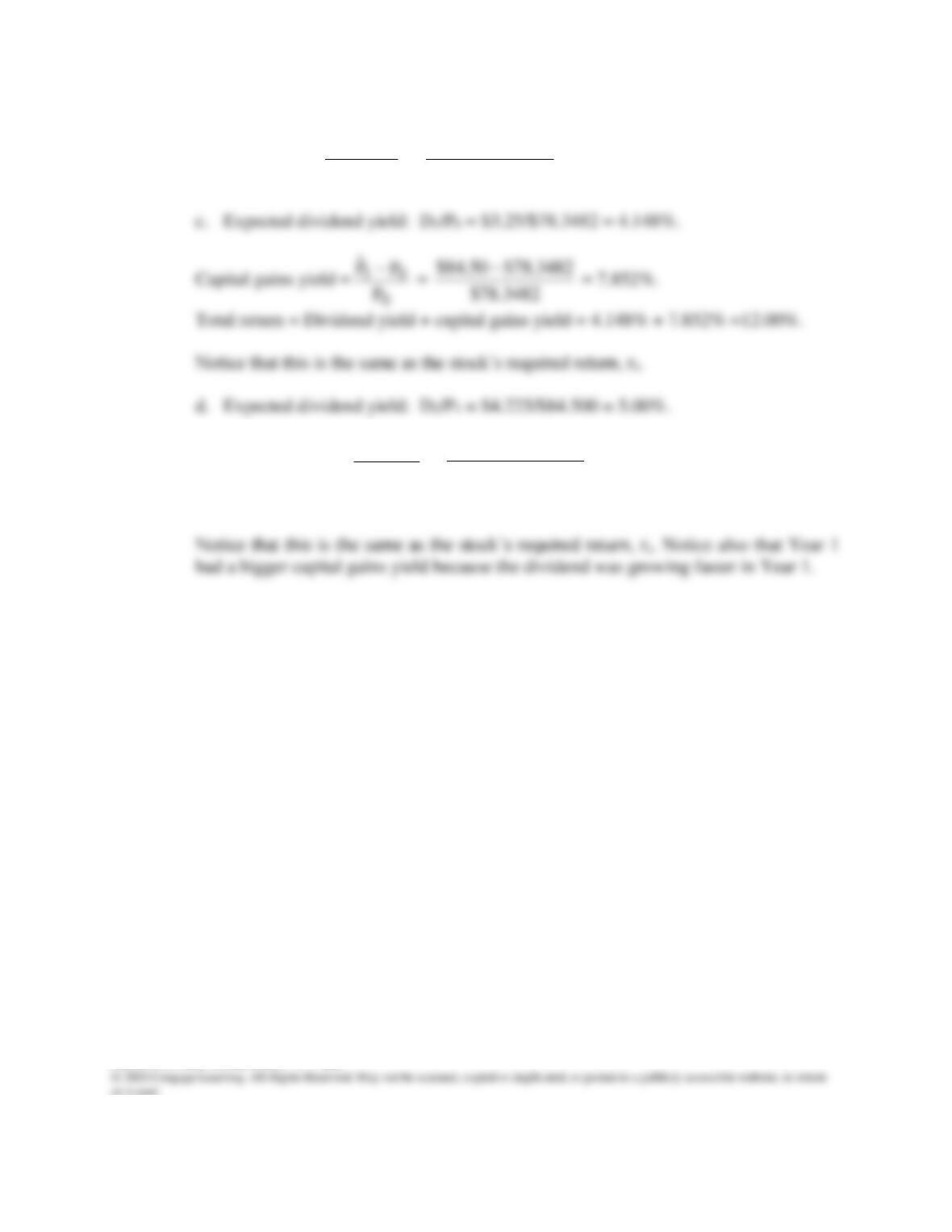
Capital gains yield =
21
1
HV P
P
−
=
$84.500
$84.500
$90.415 −
= 7.00%.
Total return = Dividend yield + capital gains yield = 5.00% + 7.00% =12.00%.
Answers and Solutions: 7- 17
SOLUTION TO SPREADSHEET PROBLEMS
7-25 The detailed solution for the spreadsheet problem, Ch07 P25 Build a Model Solution.xlsx,
is available at the textbook’s Web site.
Mini Case: 7 – 18
MINI CASE
Your employer, a mid-sized human resources management company, is considering
expansion into related fields, including the acquisition of Temp Force Company, an
employment agency that supplies word processor operators and computer programmers to
businesses with temporary heavy workloads. Your employer is also considering the purchase
of Biggerstaff & McDonald (B&M), a privately held company owned by two friends, each
with 5 million shares of stock. B&M currently has free cash flow of $24 million, which is
expected to grow at a constant rate of 5%. B&M’s financial statements report short-term
investments of $100 million, debt of $200 million, and preferred stock of $50 million. B&M’s
weighted average cost of capital (WACC) is 11%. Answer the following questions.
a. Describe briefly the legal rights and privileges of common stockholders.
Answer: The common stockholders are the owners of a corporation, and as such, they have
certain rights and privileges as described below.
b. What is free cash flow (FCF)? What is the weighted average cost of capital? What
is the free cash flow valuation model?
Answer: Free cash flow (FCF) is the cash flow available for distribution to all of a company’s
investors. FCF is generated by a company’s operations.