1
2
3
4
5
6
7
8
14
15
16
17
24
25
26
27
28
If constant growth begins at Time 0:
29
30
31
32
33
34
35
36
37
38
39
40
57
58
59
60
61
62
63
64
65
66
78
A B C D E F G H I J K L
11/20/2018
Situation
Features of Common Stock
Data for charts
Column1
10
Mkt. Sec.
1
Claims on Value
Pref. Stk.
1
Debt
3
If constant growth begins at Time 1:
Chapter 7 Mini Case
Your employer, a mid-sized human resources management company, is considering expansion into related fields, including the
acquisition of Temp Force Company, an employment agency that supplies word processor operators and computer programmers
a. Describe briefly the legal rights and privileges of common stockholders.
d. Suppose the free cash flow at Time 1 is expected to grow at a constant rate of gL forever. If gL < WACC, what is a formula for
the present value of expected free cash flows when discounted at the WACC? If the most recent free cash flow is expected to
grow at a constant rate of gL forever (and gL < WACC), what is a formula for the present value of expected free cash flows when
discounted at the WACC?
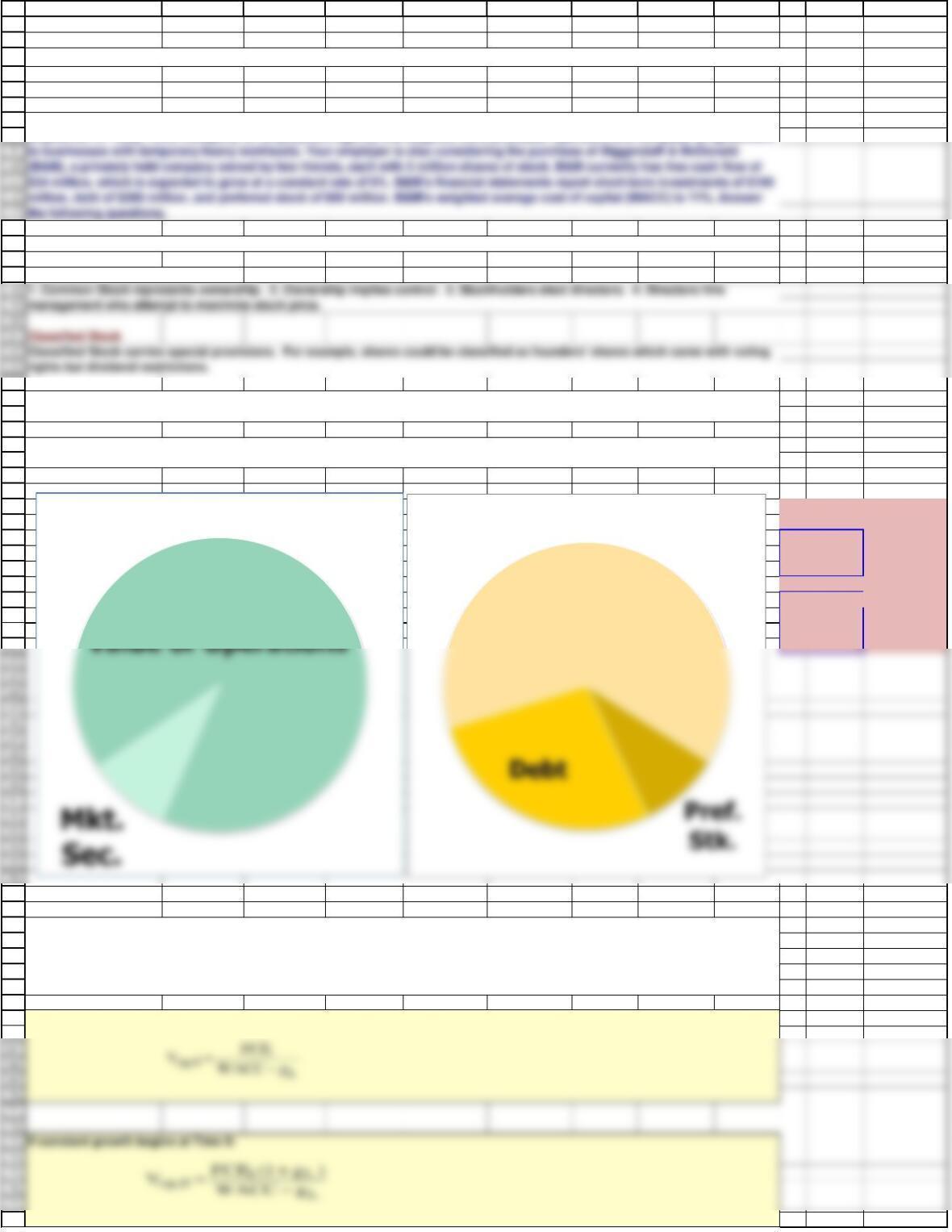
c. Use a pie chart to illustrate the sources that comprise a hypothetical company’s total value. Using another pie chart, show the
claims on a company’s value. How is equity a residual claim? Answer: See Chapter 7 Mini Case Show
b. What is free cash flow (FCF)? What is the weighted average cost of capital? What is the free cash flow valuation model?
Answer: See Chapter 7 Mini Case Show
Equity
Classified Stock
79
80
81
82
83
84
85
86
92
93
94
95
96
97
98
101
102
103
104
105
106
107
116
117
Total Corporate Value $520.0
Minus Value of Debt $200.0
Minus Value of Preferred Stock $50.0
108
109
110
111
112
123
124
Intrinsic Value of Equity $270.0
Divided by number of shares 10.0
118
119
120
126
127
128
133
134
129
130
144
145
146
147
148
149
150
151
A B C D E F G H I J K L
INPUT DATA SECTION: Data used for valuation (in millions)
$24.0
11%
(1) What is its estimated value of operations?
FCF1 FCF0 (1+gL)
(WACC-gL) (WACC-gL)
Value of Operation $420.0
Plus Value of Non-operating Assets $100.0
Total Corporate Value $520.0
INPUTS:
Value of operations = $420.00
Value of nonoperating assets = $100.00
(4) What is its estimated intrinsic stock price per share?
=
Vop =
(2) What is its estimated total corporate value?
(3) What is its estimated intrinsic value of equity?
Estimating the Value of R&R’s Stock Price (Millions, Except for Per Share
Data)
f. You have just learned that B&M has undertaken a major expansion that will change its expected free cash flows to −$10 million
in 1 year, $20 million in 2 years, and $35 million in 3 years. After 3 years, free cash flow will grow at a rate of 5%. No new debt or
preferred stock were added, the investment was financed by equity from the owners. Assume the WACC is unchanged at 11% and
it that there are still has 10 million shares of stock outstanding.
(1.) What is its horizon value (i.e., its value of operations at year three)? What is its current value of operations (i.e., at time
zero)?
Debt holders have the first claim on corporate value. Preferred stockholders have the next claim and the remaining is left to
common stockholders.
e. Use B&M’s data and the free cash flow valuation model to answer the following questions.
Free cash flow
WACC
88
Number of shares of stock 10.0
Debt
Preferred stock
Growth
0 1 2 3 4 5 … t
152
153
154
155
156
157
158
159
164
165
166
167
168
173
174
175
176
182
183
184
189
190
191
192
193
194
195
196
197
198
199
200
FCF1FCF2FCF3
210
211
212
213
214
215
216
217
218
225
A B C D E F G H I J K L
Explicit forecast:
Year
0 1 2 3
FCF
FCF1FCF2FCF3
Constant growth from Year 3 and afterwards:
HV3 = Vop,3 = PV of FCF4 and beyond discounted back to Year 3
R&R’s explicit forecast:
Year
0 1 2 3
FCF
−$10.00 $20.00 $35.00
After Year 3, gL = 5%
WACC = 11%
R&R’s horizon value:
Year
0 1 2 3 4 5 … t
Explicit forecast ends at Year 3, so make the horizon date Year 3, too. (Note: it is possible to make the horizon date Year 2
because FCF3 is known and grows at a constant rate, but it is easy to make mistakes if horizon year is not set equal to end of
explicit forecast.)
After estimating the horizon value, you can estimate the current value of operations by following these steps: (1) Find the present
value of the FCFs from the explicit forecast, discounted back to Time 0 at the WACC; (2) find the present value of the horizon
value, discounted back to Time 0 at the WACC; and (3) sum the PV of the FCFs and the PV of the horizon value. This sum is the
present value of all future FCF from Time 0 to infinity, discounted back to Time 0. Therefore, this sum is the current value of
operations, Vop,0.
Because free cash flows are constant from Year 4 and beyond, we can apply the constant growth model at Year 3:
The general horizon value formula is:
(1.) What is its horizon value (i.e., its value of operations at year three)? What is its current value of operations (i.e., at time
zero)?
0 1 2 3 4 5 … t
FCF1FCF2FCF3FCF3(1+gL) FCF4(1+gL) FCFt(1+gL)
226
227
228
229
230
231
232
244
245
246
247
248
249
250
255
256
251
252
253
265
266
267
268
269
270
271
272
273
274
275
276
277
278
279
289
290
291
292
293
294
295
296
A B C D E F G H I J K L
B&M’s Value of Operations (Millions of Dollars)
INPUTS:
gL = 5.00%
WACC = 11.00%
Year 0 1 2 3 4
FCF −$10.00 $20.00 $35.00
↓ ↓ ↓
INPUTS:
Value of operations = $480.67
Value of nonoperating assets = $100.00
All debt = $200.00
INPUTS:
Vop,0 = $480.67
HV3 = $612.50
PV of HV3 = HV3 / (1+WACC)3
PV of HV3 = $447.85
i. Your employer also is considering the acquistion of Hatfield Medical Supplies. You have gathered the following data regarding
Hatfield, with all dollars reported in millions: (1) most recent sales of $2,000; (2) most recent total net operating capital, OpCap =
$1,120; (3) most recent operating profitability ratio, OP = NOPAT/Sales = 4.5%; and (4) most recent capital requirement ratio, CR =
OpCap/Sales = 56%. You estimate that the growth rate in sales from Year 0 to Year 1 will be 10%, from Year 1 to Year 2 will be 8%,
from Year 2 to Year 3 will be 5%, and from Year 3 to Year 4 will be 5%. You also estimate that the long-term growth rate beyond
Year 4 will be 5%. Assume the operating profitability and capital requirement ratios will not change. Use this information to
forecast Hatfield’s sales, net operating profit after taxes (NOPAT), OpCap, free cash flow, and return on invested capital (ROIC) for
Years 1 through 4. Also estimate the annual growth in free cash flow for Years 2 through 4. The weighted average cost of capital
(WACC) is 9%. How does the ROIC in Year 4 compare with the WACC?
h. Based on your answer to the previous question, what are two reasons why managers often emphasize short-term earnings?
Answer: See Chapter 7 Mini Case Show
First, calculate the present value of the horizon value. Then divide the Year 0 value of operations by the present value of the
horizon value. This will show what percent of value is due to cash flows occurring 4 or more years in the future.
g. If B&M undertakes the expansion, what percent of B&M’s value of operations at Year 0 is due to cash flows from Years 4 and
beyond? Hint: use the horizon value at t = 3 to help answer this question.
Estimating the Value of B&M’s Stock Price (Millions, Except for Per Share
Data)
(2.) What is its value of equity on a price per share basis?
Projections
240
Value of Operations:
g1,2 8% 9%
g2,3 5% 6%
g3,4 5% 6%
303
304
305
306
307
308
327
328
329
330
331
332
340
341
342
343
344
345
346
347
348
355
356
357
358
359
360
361
362
363
364
365
366
367
368
No Change Actual Forecast
Year 0 1 2 3 4
Inputs
WACC 9.0%
Sales $2,000
Horizon Value:
ROIC needed to make HV greater than Vop at horizon: ROIC = WACC/(1+gL)
Using the Scenario Manager, the new ROIC and value of operations are:
Scenario No Change Improve Growth
g0,1 10% 11%
i. Your employer also is considering the acquistion of Hatfield Medical Supplies. You have gathered the following data regarding
Hatfield, with all dollars reported in millions: (1) most recent sales of $2,000; (2) most recent total net operating capital, OpCap =
k. What are value drivers? What happens to the ROIC and current value of operations if expected growth increases by 1
percentage point relative to the original growth rates (including the long-term growth rate)? What can explain this? Hint: Use
j. What is the horizon value at Year 4? What is the value of operations at Year 0? How does the value of operations compare with
the current total net operating capital?
Note that the horizon value at Year 4 (HV4 = $958) is less than the total net operating capital at Year 4 (OpCap4 = $1,466.94). This is
expected because ROIC4 < WACC/(1+gL).
Value drivers are the inputs to the free cash flow valuation model that managers are able to influence: sales growth rates, operating profitability,
capital requirements, and the cost of capital.
The value of operations at Year 0 is less than the total net operating capital at Year 0 because the ROIC is too low when compared
to the WACC. ROIC must be greater than WACC/(1+gL) before the horizon value exceeds the total net operating capital.
Years 1 through 4. Also estimate the annual growth in free cash flow for Years 2 through 4. The weighted average cost of capital
(WACC) is 9%. How does the ROIC in Year 4 compare with the WACC?
g2,3 5% 5%
g1,2 8% 8%
g2,3 5% 5%
g3,4 5% 5%
g2,3 5% 5%
g3,4 5% 5%
g2,3 5% 6%
g3,4 5% 6%
379
380
381
382
383
384
385
386
387
388
389
390
391
392
393
394
395
405
406
407
408
409
410
421
422
423
424
425
426
436
437
438
439
440
441
442
A B C D E F G H I J K L
Growth hurts value because the ROIC is too low. Growth will only help value if ROIC>WACC/(1+WACC).
Using the Scenario Manager and improving operating profitability, the new ROIC and value of operations are:
Scenario No Change Improve OP
g0,1 10% 10%
g1,2 8% 8%
Using the Scenario Manager and improving capital requirements, the new ROIC and value of operations are:
Scenario No Change Improve CR
g0,1 10% 10%
Using the Scenario Manager and improving operating profitability and capital requirements, the new ROIC and value of operations are:
Scenario No Change Improve OP and CR
g0,1 10% 10%
g1,2 8% 8%
Using the Scenario Manager and improving growth rates, operating profitability, and capital requirements, the new ROIC and value of operations are:
Scenario No Change Improve All
g0,1 10% 11%
g1,2 8% 9%
l. Assume growth rates are at their original levels. What happens to the ROIC and current value of operations if the operating
profitability ratio increases to 5.5%? Now assume growth rates and operating profitability ratios are at their original levels. What
happens to the ROIC and current value of operations if the capital requirement ratio decreases to 51%? Assume growth rates are
at their original levels. What is the impact of simultaneous improvements in operating profitability and capital requirements?
What is the impact of simultaneous improvements in the growth rates, operating profitability, and capital requirements? Hint: Use
Scenario Manager.
450
451
452
453
454
455
456
457
458
462
463
464
465
466
467
468
469
470
471
472
473
474
475
484
485
486
487
488
489
490
491
492
growth, we are trying to find the average of the good times and the bad times, and we assume that we will see both scenarios
over the firm’s life. In addition to assuming a constant growth rate, we will be estimating a long-term required return for the
stock. By assuming these variables are constant, our price equation for common stock simplifies to the following expression:
503
504
505
A B C D E F G H I J K L
WACC
9.00% 9.00%
WACC/(1+WACC)
8.26% 8.26%
Notice that small changes in ROIC and growth cause large changes in value.
ROIC
m. What insight does the free cash flow valuation model give provide us about possible reasons for market volatility? Hint: Look
at the value of operations for the combinations of ROIC and gL in the previous questions.
Naturally, trying to estimate an infinite series of dividends and interest rates forever would be a tremendously difficult task. Now,
we are charged with the purpose of finding a valuation model that is easier to predict and construct. That simplification comes in
the form of valuing stocks on the premise that they have a constant growth rate.
n. (2.) What is a constant growth stock? How are constant growth stocks valued?
n. (1.) Write out a formula that can be used to value any dividend-paying stock, regardless of its dividend pattern.
The value of any financial asset is equal to the present value of future cash flows provided by the asset. When an investor buys a
share of stock, he or she typically expects to receive cash in the form of dividends and then, eventually, to sell the stock and to
receive cash from the sale. Moreover, the price any investor receives is dependent upon the dividends the next investor expects
to earn, and so on for different generations of investors. Thus, the stock’s value ultimately depends on the cash dividends the
company is expected to provide and the discount rate used to find the present value of those dividends.
In this stock valuation model, we first assume that the dividend and stock will grow forever at a constant growth rate. Naturally,
In this equation, the long-run growth rate (g) can be approximated by multiplying the firm’s return on assets by the retention ratio.
Generally speaking, the long-run growth rate of a firm is likely to fall between 5% and 8% a year.
Here is the basic dividend valuation equation:
506
507
508
509
523
524
525
539
526
527
528
529
541
542
543
544
545
546
547
548
549
550
551
559
560
565
566
D1CG Yield = P1 – P0
Dividend Yield = $2.12 CG Yield = $1.82
552
567
568
569
570
571
572
D1
578
A B C D E F G H I J K L
Constant Growth Model:
INPUTS:
D0 = $2.00
gL = 6%
rs =13.0%
Stock Price 1 year from now:
D2
( rs – gL )
D2 = D1 (1+gL) = $2.2472
$2.2472
0.07
P1 = $32.10
Rearrange to rate of return formula
$30.29
n. (3.) What happens if a company has a constant gL which exceeds rs? Will many stocks have expected growth greater than the
required rate of return in the short run (i.e., for the next few years)? In the long run (i.e., forever)? Answer: See Chapter 7 Mini
Case Show.
q. Now assume that the stock is currently selling at $30.29. What is its expected rate of return?
P1 =
P1 =
511
512
522
whose dividend is expected to grow indefinitely at a 6% rate.
579
580
581
582
583
584
585
586
587
588
589
590
601
602
603
604
605
606
628
629
630
631
632
633
634
635
639
640
641
642
643
644
651
Expected Dividend and CG Yields at t = 3
Dividend Yield = 0.0%
CG Yield = 13.0%
Total Return = 13.0%
636
A B C D E F G H I J K L
13%
Process for Finding the Value of a Nonconstant Growth Stock
INPUTS:
D0 = $2.00 Last dividend the company paid.
rs = 13.0% Stockholders’ required return.
Expected Dividend and CG Yields at t = 0
Dividend Yield = 5.6%
CG Yield = 7.4%
Total Return = 13.0%
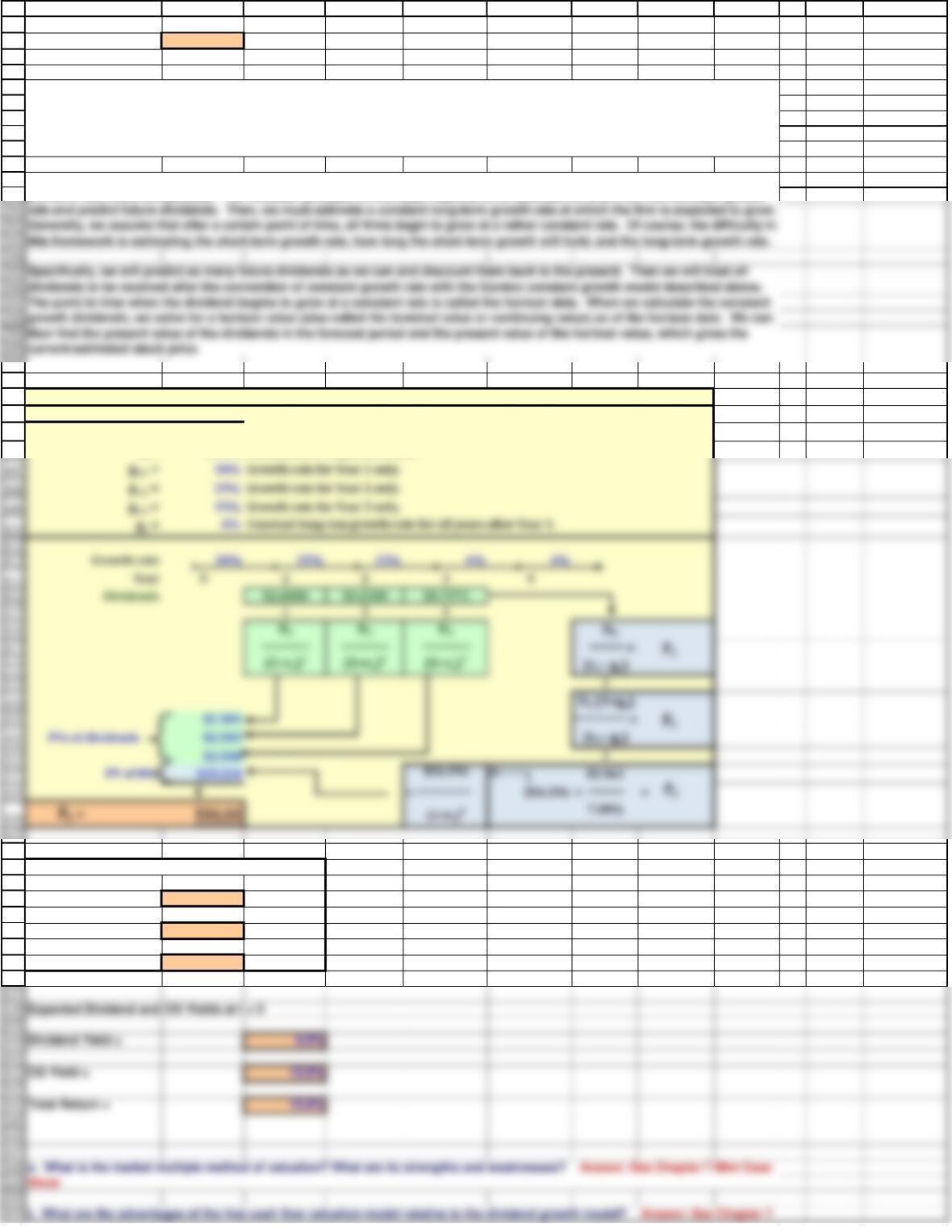
For many companies, it is unreasonable to assume that it grows at a constant growth rate. Hence, valuation for these companies
proves a little more complicated. The valuation process, in this case, requires us to estimate the short-run non-constant growth
r. Now assume that Temp Force’s dividend is expected to experience nonconstant growth of 30% from Year 0 to Year 1, 25% from
Year 1 to Year 2, and 15% from Year 2 to Year 3. After Year 3, dividends will grow at a constant rate of 6%. What is the stock’s
intrinsic value under these conditions? What are the expected dividend yield and capital gains yield during the first year? What
are the expected dividend yield and capital gains yield during the fourth year (from Year 3 to Year 4)?
Mini Case Show
ො
𝐫𝐬=
595
dividends to be received after the convention of constant growth rate with the Gordon constant growth model described above.
The point in time when the dividend begins to grow at a constant rate is called the horizon date. When we calculate the constant
652
653
654
655
656
A B C D E F G H I J K L
u. What is preferred stock? Suppose a share of preferred stock pays a dividend of $2.10 and investors require a return of 7%.
What is the estimated value of the preferred stock?
t. What are the advantages of the free cash flow valuation model relative to the dividend growth model? Answer: See Chapter 7
Mini Case Show