Introduction to Corporate Finance, Fourth Edition Booth, Cleary, Rakita
Chapter 6: Bond Valuation and Interest Rates
Multiple Choice Questions
1. Section: 6.1 The Basic Structure of Bonds
Learning Objective: 6.1
2. Section: 6.1 The Basic Structure of Bonds
Learning Objective: 6.1
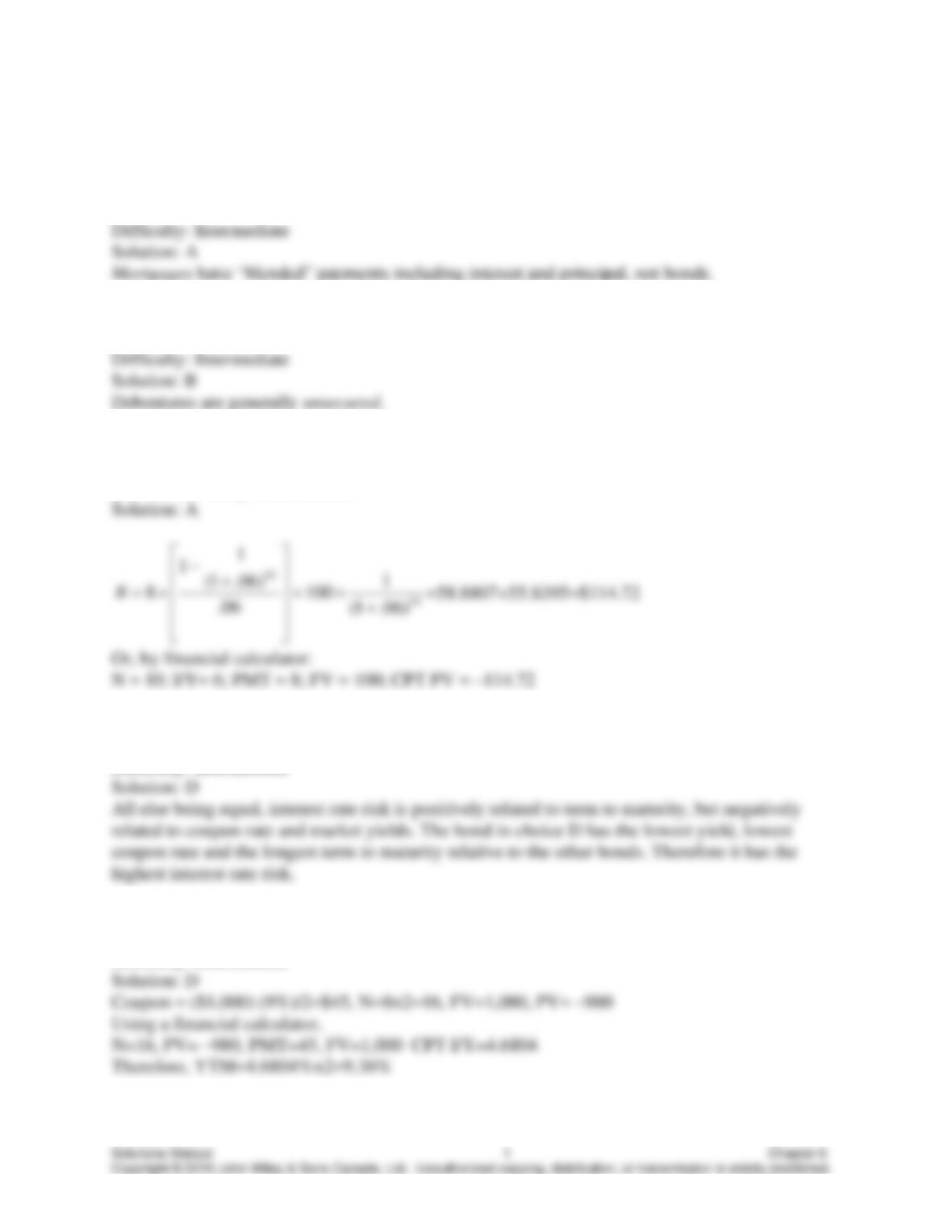
3. Section: 6.2 Bond Valuation
Learning Objective: 6.2
Level of difficulty: Intermediate
4. Section: 6.2 Bond Valuation
Learning Objective: 6.2
Difficulty: Intermediate
5. Section: 6.3 Bond Yields
Learning Objective: 6.3
Difficulty: Intermediate
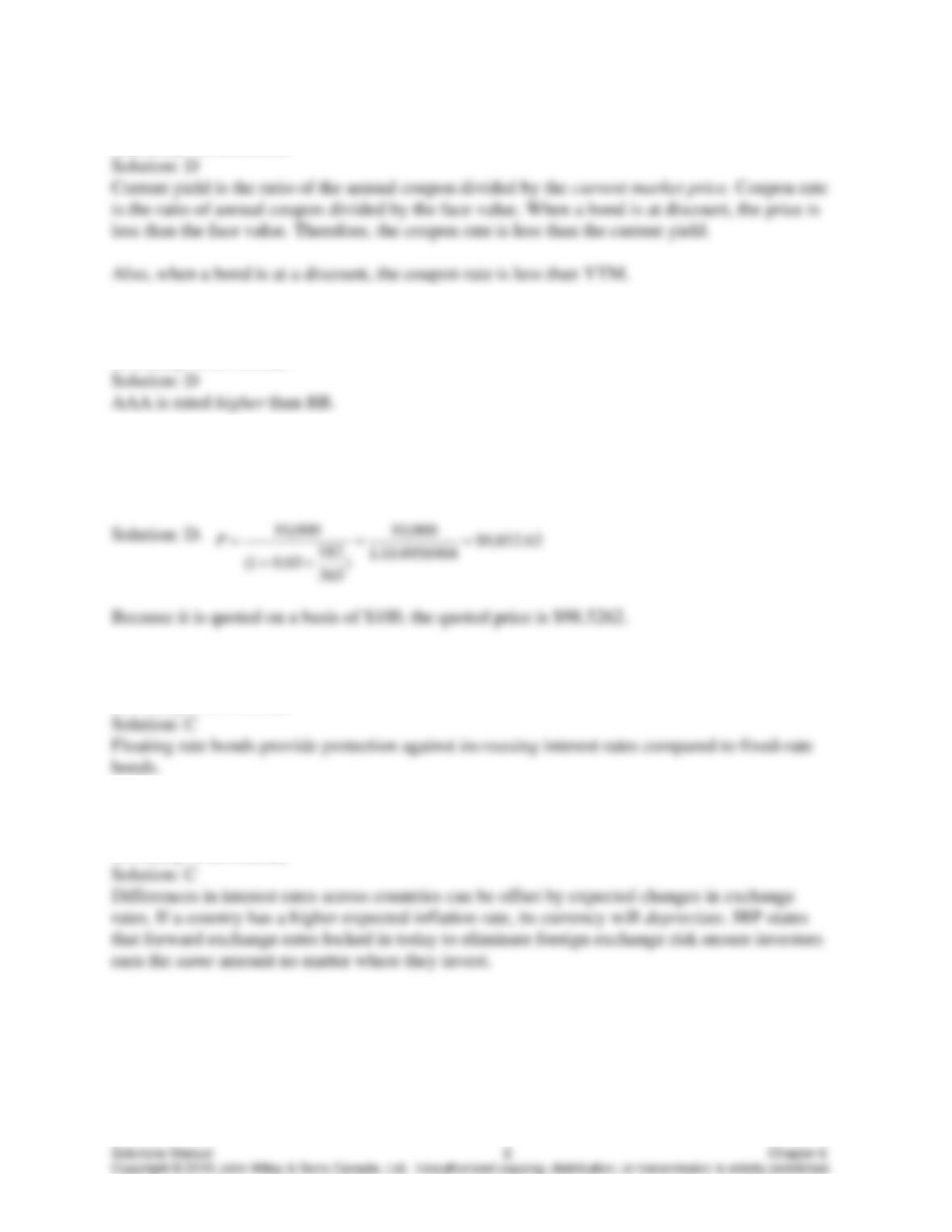
6. Section: 6.3 Bond Yields
Introduction to Corporate Finance, Fourth Edition Booth, Cleary, Rakita
Learning Objective: 6.3
Difficulty: Intermediate
7. Section: 6.4 Interest Rate Determinants
Learning Objective: 6.4
Difficulty: Intermediate
8. Section: 6.5 Other Types of Bonds/Debt Instruments
Learning Objective: 6.5
Level of difficulty: Intermediate
9. Section: 6.5 Other Types of Bonds/Debt Instruments
Learning Objective: 6.5
Difficulty: Intermediate
10. Section: Appendix 6A: Interest Rate Parity
Learning Objective: 6.6
Difficulty: Intermediate
Practice Problems
Basic
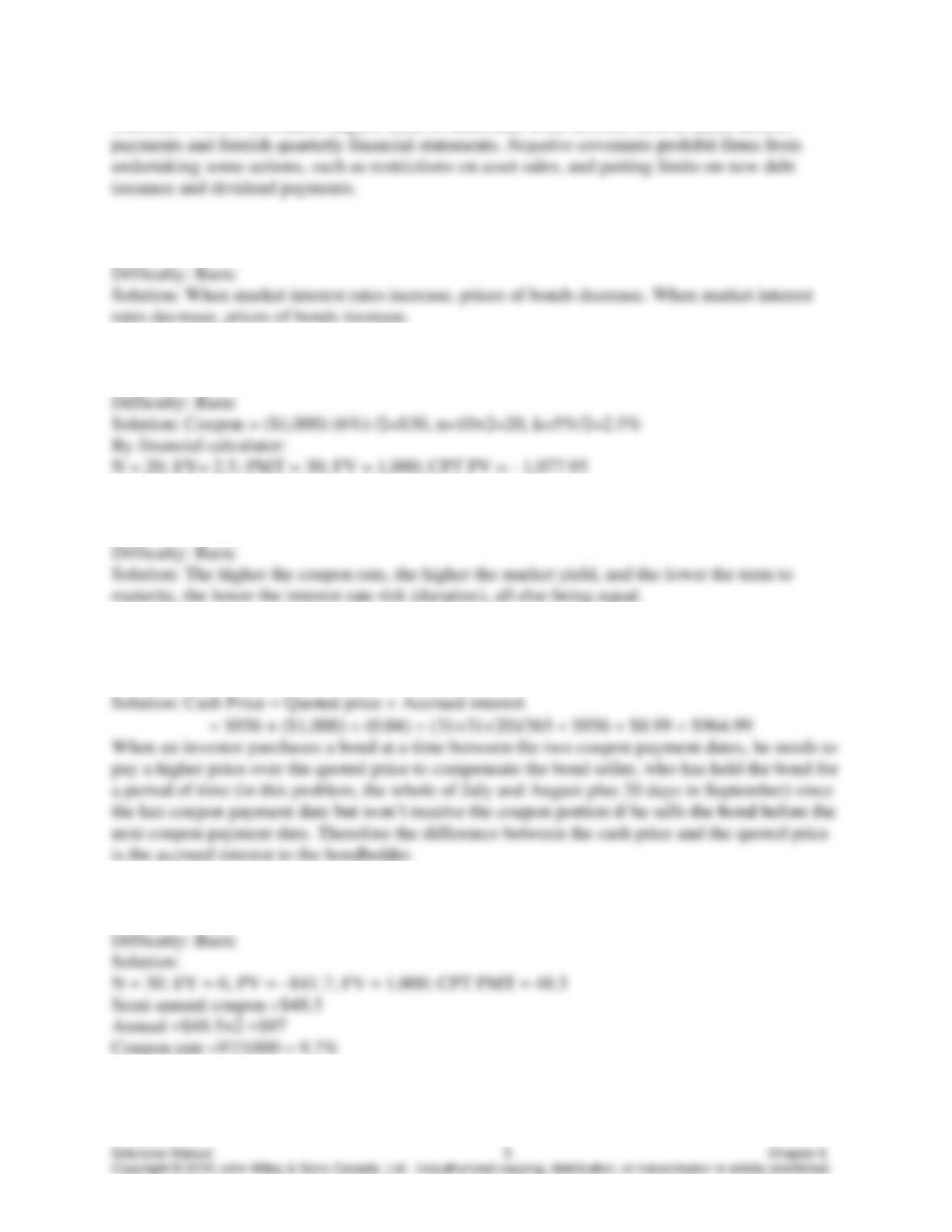
11. Section: 6.1 The Basic Structure of Bonds
Learning Objective: 6.1
Difficulty: Basic
Introduction to Corporate Finance, Fourth Edition Booth, Cleary, Rakita
Solution: Positive covenants require firms to undertake some actions, such as make interest
12. Section: 6.2 Bond Valuation
Learning Objective: 6.2
13. Section: 6.2 Bond Valuation
Learning Objective: 6.2
14. Section: 6.2 Bond Valuation
Learning Objective: 6.2
15. Section: 6.2 Bond Valuation
Learning Objective: 6.2
Difficulty: Basic
16. Section: 6.2 Bond Valuation
Learning Objective: 6.2
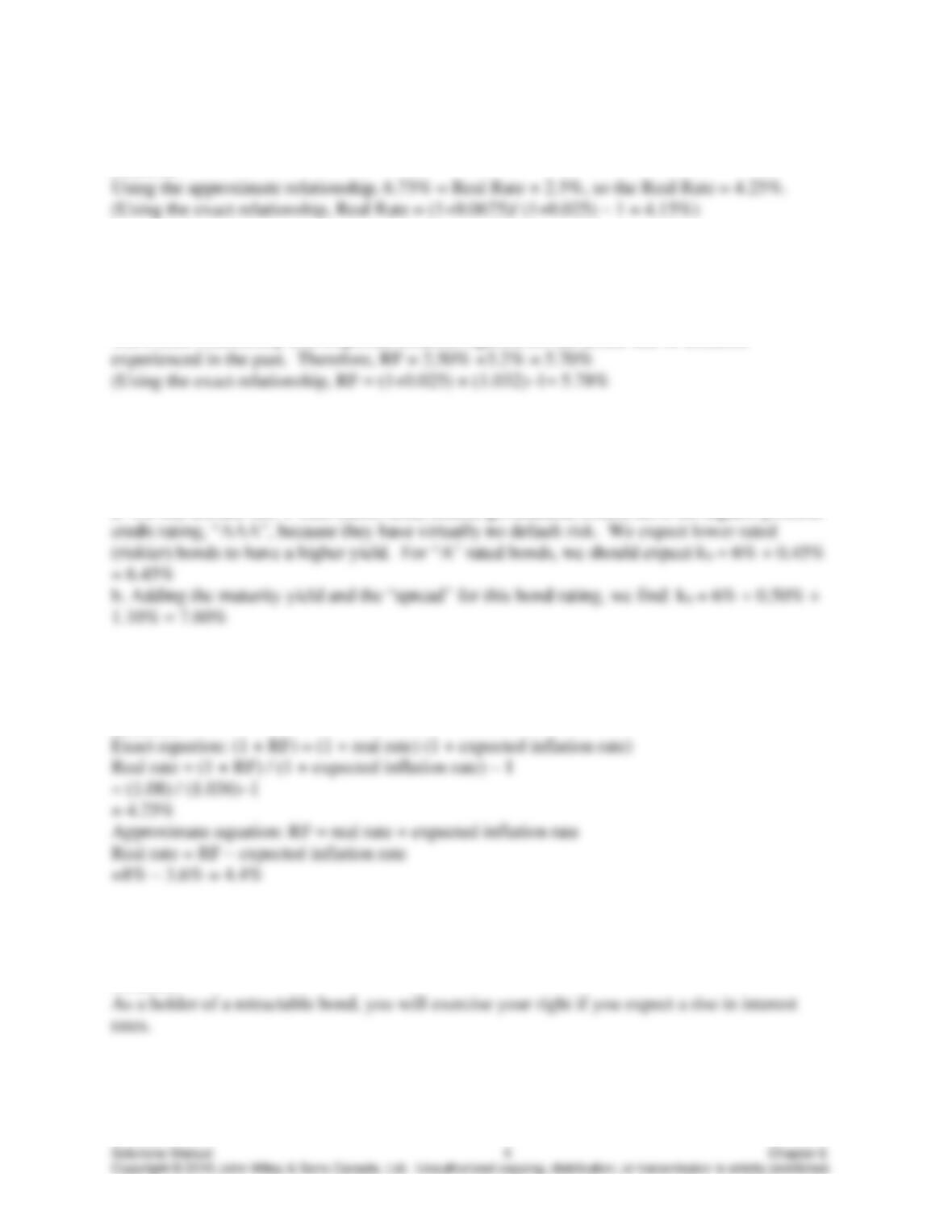
17. Section: 6.4 Interest Rate Determinants
Introduction to Corporate Finance, Fourth Edition Booth, Cleary, Rakita
Learning Objective: 6.4
Difficulty: Basic
Solution:
18. Section: 6.4 Interest Rate Determinants
Learning Objective: 6.4
Difficulty: Basic
Solution:
The Fisher relationship uses expected inflation figures, not the actual rate of inflation
19. Section: 6.4 Interest Rate Determinants
Learning Objective: 6.4
Level of difficulty: Basic
Solution:
a. We can assume that T-bills (short-term, federal government bonds) have the highest possible
20. Section: 6.4 Interest Rate Determinants
Learning Objective: 6.4
Level of difficulty: Basic
Solution:
21. Section: 6.5 Other Types of Bonds/Debt Instruments
Learning Objective: 6.5
Difficulty: Basic
Solution:
22. Section: 6.4 Interest Rate Determinants
Learning Objective: 6.4
Introduction to Corporate Finance, Fourth Edition Booth, Cleary, Rakita
Difficulty: Basic
Solution:
Intermediate
23. Section: 6.2 Bond Valuation
Learning Objective: 6.2
Difficulty: Intermediate
Solution:
Using a financial calculator:
24. Section: 6.2 Bond Valuation
Learning Objective: 6.2
Difficulty: Intermediate
Solution:
a. by financial calculator:
25. Section: 6.2 Bond Valuation
Learning Objective: 6.2
Difficulty: Intermediate
Solution:
26. Section: 6.2 Bond Valuation
Introduction to Corporate Finance, Fourth Edition Booth, Cleary, Rakita
Learning Objective: 6.2
Difficulty: Intermediate
Solution:
27. Section: 6.2 Bond Valuation
Learning Objective: 6.2
Difficulty: Intermediate
Solution
a. The quoted price can be interpreted as a percentage of face value. Therefore, you would pay
28. Section: 6.2 Bond Valuation
Learning Objective: 6.2
Difficulty: Intermediate
29. Section: 6.2 Bond Valuation
Learning Objective: 6.2
Difficulty: Intermediate
Solution:
When the bond was trading at $102.50, the interest rate was lower than the coupon rate. When
30. Section: 6.3 Bond Yields
Introduction to Corporate Finance, Fourth Edition Booth, Cleary, Rakita
Learning Objective: 6.3
Difficulty: Intermediate
Solution:
Using a financial calculator:
31. Section: 6.3 Bond Yields
Learning Objective: 6.3
Difficulty: Intermediate
Solution:
32. Section: 6.3 Bond Yields
Learning Objective: 6.3
Difficulty: Intermediate
Solution:
33. Section: 6.3 Bond Yields
Learning Objective: 6.3
Difficulty: Intermediate
Solution:
Introduction to Corporate Finance, Fourth Edition Booth, Cleary, Rakita
34. Section: 6.3 Bond Yields
Learning Objective: 6.3
Difficulty: Intermediate
Solution:
Using a financial calculator:
35. Section: 6.5 Other Types of Bonds/Debt Instruments
Learning Objective: 6.5
Difficulty: Intermediate
Solution:
Using a financial calculator:
36. Section: 6.5 Other Types of Bonds/Debt Instruments
Learning Objective: 6.5
Difficulty: Intermediate
Solution:
37. Section: 6.5 Other Types of Bonds/Debt Instruments
Learning Objective: 6.5
Difficulty: Intermediate
Solution:
38. Section: 6.5 Other Types of Bonds/Debt Instruments
Learning Objective: 6.5
Difficulty: Intermediate
Introduction to Corporate Finance, Fourth Edition Booth, Cleary, Rakita
Solution:
Find the price of the U.S. T-Bill (remembering to use the correct day-count convention and the
39.
Section: 6.5 Other Types of Bonds/Debt Instruments
Learning Objective: 6.5
Difficulty: Intermediate
Solution:
40. Section: 6.3 Bond Yields
Learning Objective: 6.3
Difficulty: Intermediate
Solution:
41. Section: 6.3 Bond Yields
Learning Objective: 6.3
Difficulty: Intermediate
Solution:
We can calculate yield to maturity using the formula below, where r1, r2, … rn are the spot rates
42. Section: 6.3 Bond Yields
Learning Objective: 6.3
Difficulty: Intermediate
Solution:
Introduction to Corporate Finance, Fourth Edition Booth, Cleary, Rakita
43. Section: 6.5 Other Types of Bonds/Debt Instruments
Learning Objective: 6.5
Difficulty: Intermediate
Solution:
First, since the coupon is higher than the market rate of interest, it implies that the bond is trading
44. Section: Appendix 6A: Interest Rate Parity
Learning Objective: 6.6
Difficulty: Intermediate
Solution:
Investing funds in the Canadian T-Bill would give $1,000×1.0450 = $1,045 at the end of one
Challenging
45. Section: 6.2 Bond Valuation
Learning Objective: 6.2
Difficulty: Challenging
Solution:
With a coupon rate equal to the market yield, the price of the bond is $1,000.
46. Section: 6.2 Bond Valuation
Learning Objective: 6.2
Difficulty: Challenging
Introduction to Corporate Finance, Fourth Edition Booth, Cleary, Rakita
Solution:
Using a financial calculator:
47. Section: 6.2 Bond Valuation
Learning Objective: 6.2
Difficulty: Challenging
Solution:
Using a financial calculator:
48. Section: 6.3 Bond Yields
Learning Objective: 6.3
Difficulty: Challenging
Solution:
If the YTM were 10%, the bond’s price would be exactly $1,000. We know the price is higher
Introduction to Corporate Finance, Fourth Edition Booth, Cleary, Rakita
49. Section: 6.4 Interest Rate Determinants
Learning Objective: 6.4
Difficulty: Challenging
Solution:
50. Section: 6.2 Bond Valuation, 6.3 Bond Yields, and 6.5 Other Types of Bonds/Debt
Instruments
Learning Objective: 6.2; 6.3; 6.5
Difficulty: Challenging
Solution:
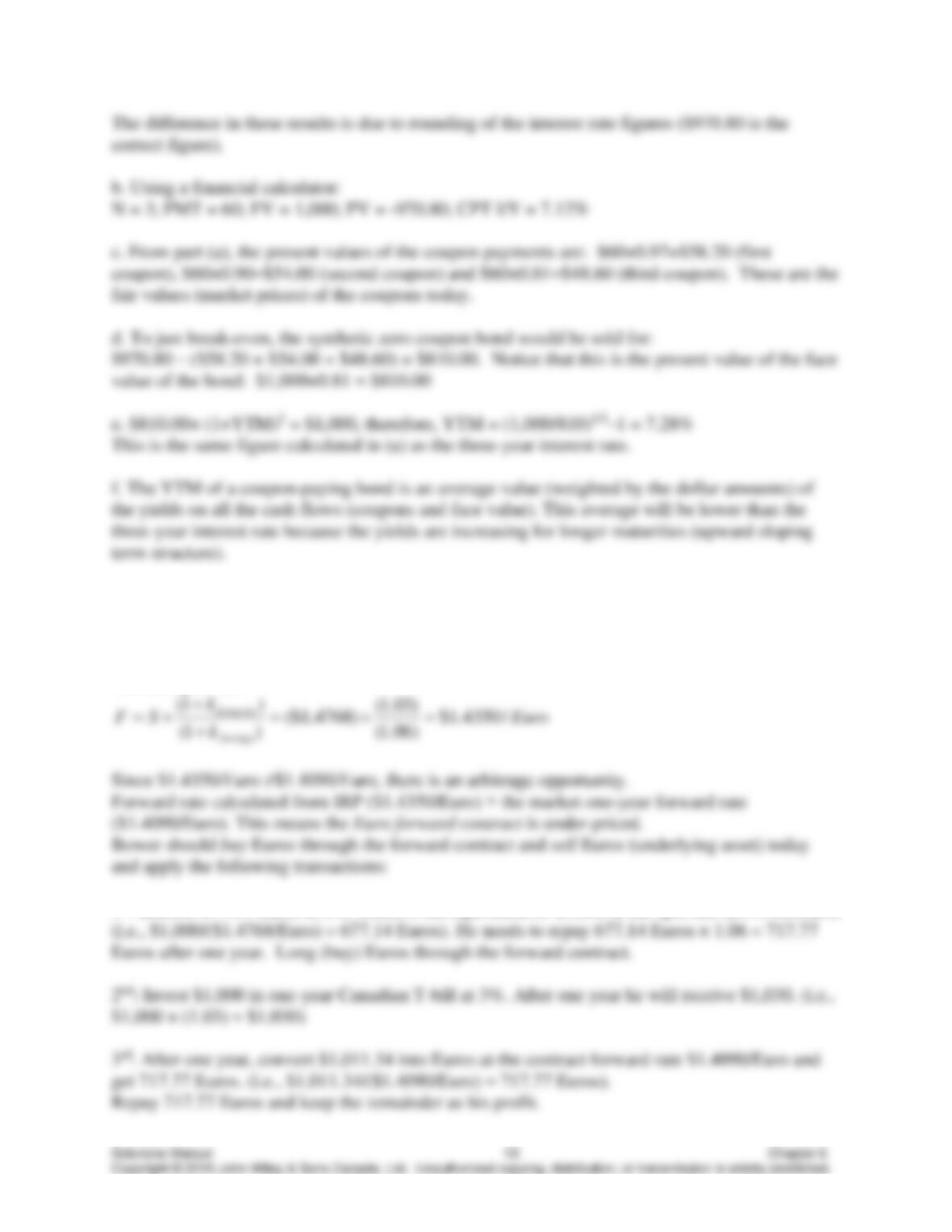
a. We do not have a yield to maturity figure with which to discount all the cash flows (coupons
Introduction to Corporate Finance, Fourth Edition Booth, Cleary, Rakita
51. Section: Appendix 6A: Interest Rate Parity
Learning Objective: 6.6
Difficulty: Challenging
Solution:
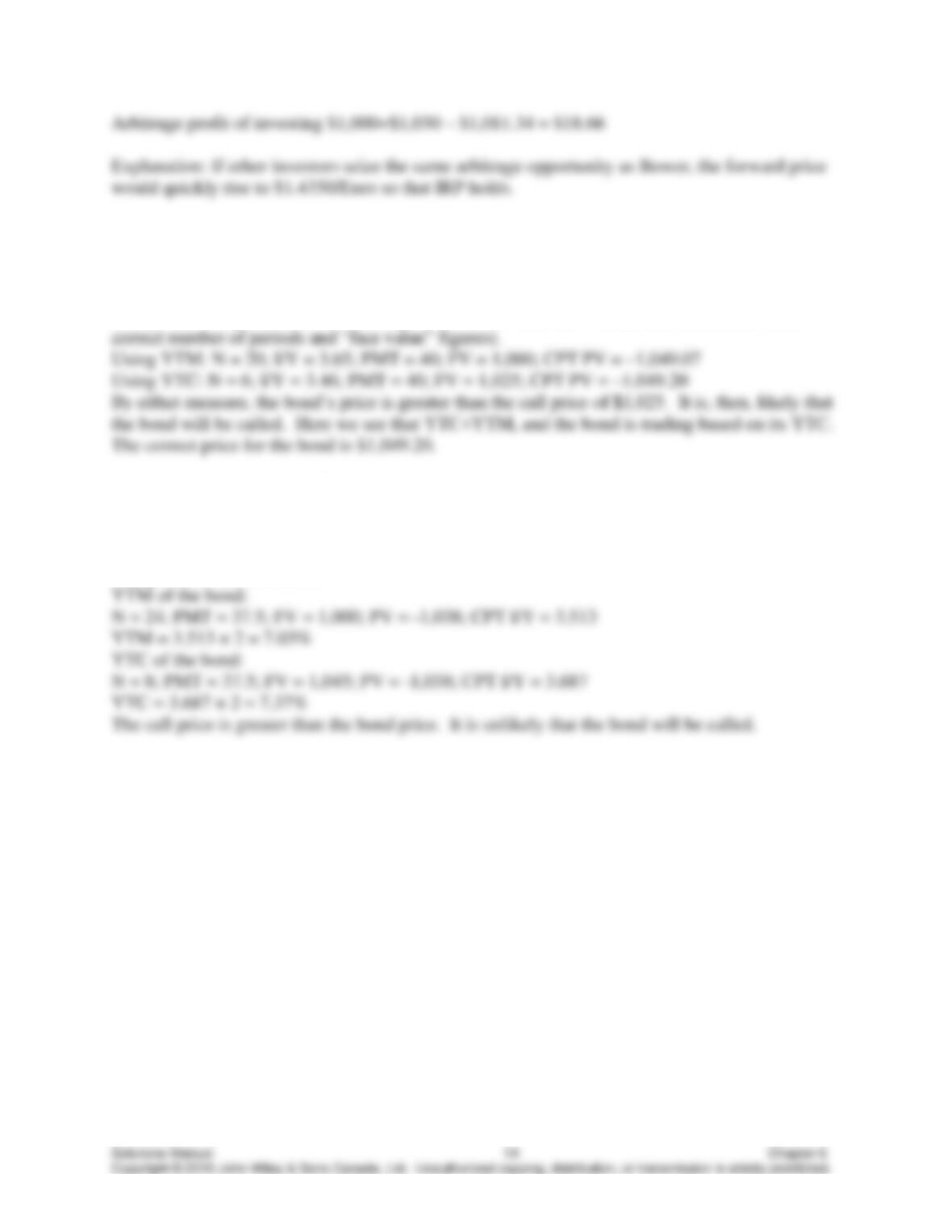
According to IRP,
1st: Borrow 677.14 Euros at 6%, which is the equivalent of $1,000 at the spot rate ($1.4768/Euro)
Introduction to Corporate Finance, Fourth Edition Booth, Cleary, Rakita
52. Section: Appendix 6B: The Yield for Callable Bonds
Learning Objective: 6.7
Difficulty: Challenging
Solution:
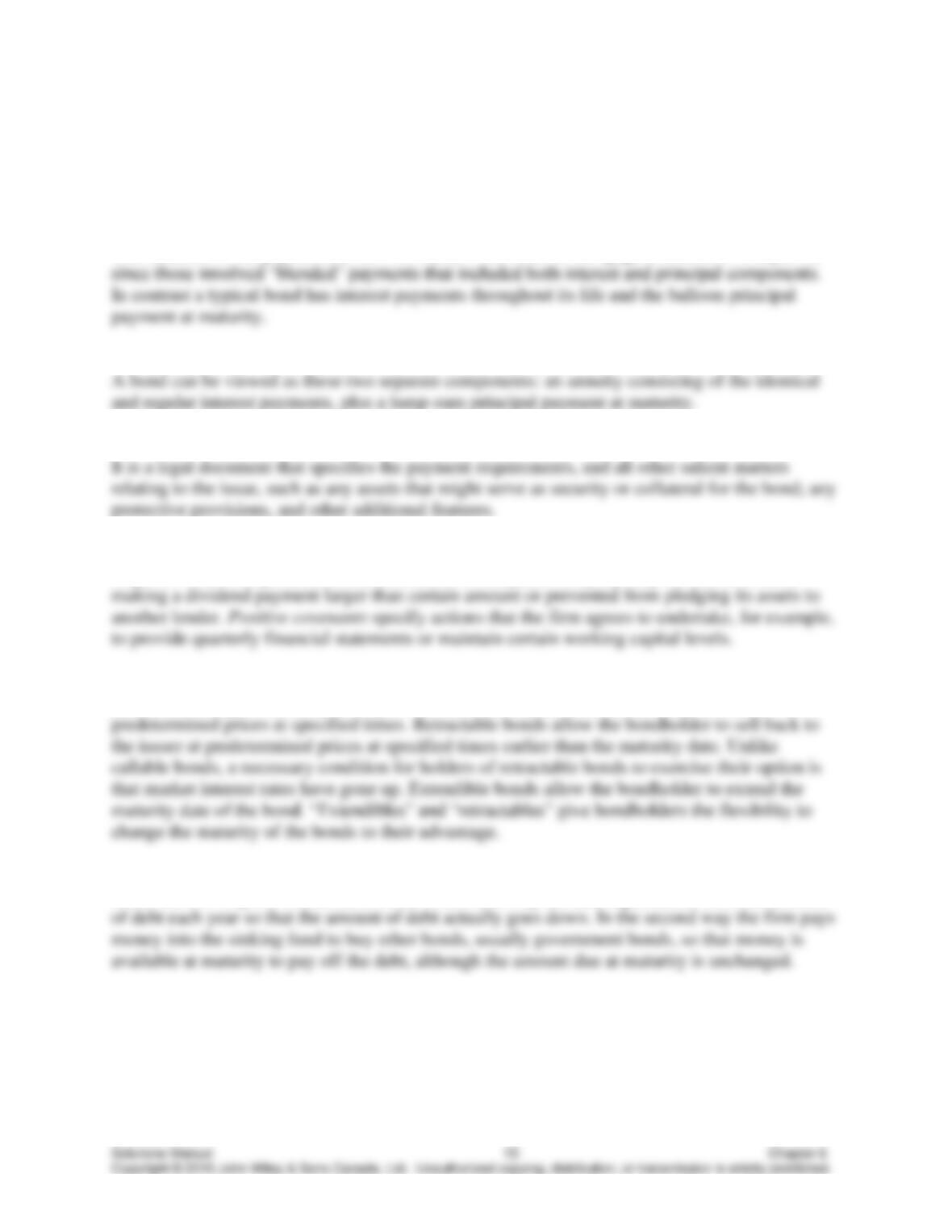
We can find the price of the bond using either the YTM or the YTC (but take care to use the
53. Section: Appendix 6B: The Yield for Callable Bonds
Learning Objective: 6.7
Difficulty: Challenging
Solution:
Using a financial calculator:
Introduction to Corporate Finance, Fourth Edition Booth, Cleary, Rakita
Answers to Concept Review Questions
6.1 The Basic Structure of Bonds
Concept Review Questions
1. In what ways are bonds different from mortgages?
The structure of the payments differs from that of the loan or mortgage discussed in Chapter 5,
2. How is a traditional bond structured?
3. What is a bond indenture?
4. What is the difference between a positive and a negative covenant provision?
Negative covenants prohibit certain actions, for example, a company may be restricted from
5. How do callable bonds differ from retractable and extendable bonds?
Callable bonds give the issuer the option to “call,” or repurchase, outstanding bonds at
6. How do sinking funds work?
There are two ways in which this is done. In the first way the firm repurchases a certain amount
6.2 Bond Valuation
Concept Review Questions
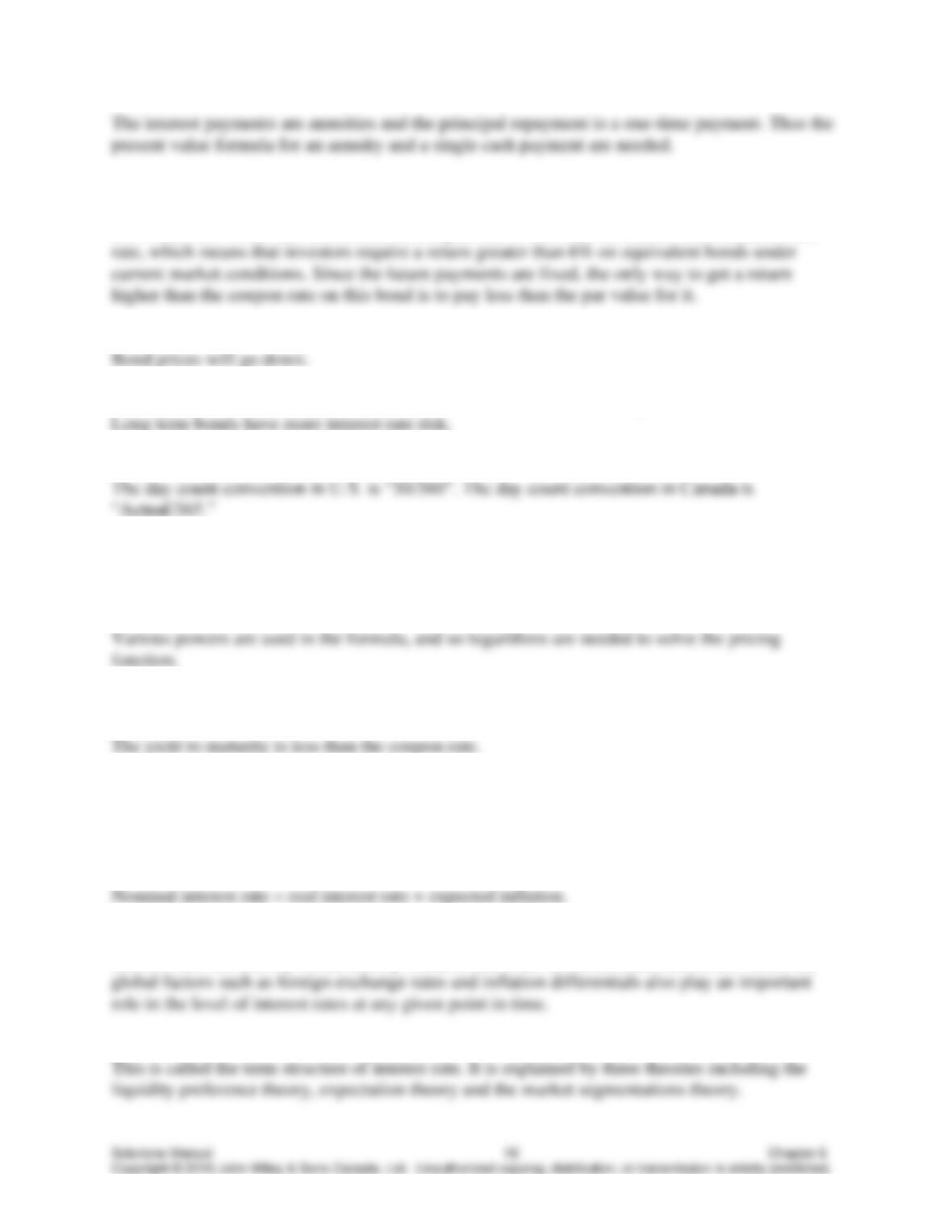
1. What time-value-of-money formula do we need to value a bond?
Introduction to Corporate Finance, Fourth Edition Booth, Cleary, Rakita
2. When market interest rates are above the coupon rate on a bond, is it a premium or discount
bond?
It is a discount bond. This is because the coupon rate is less than the market interest (discount)
3. If market interest rates go up, what happens to bond prices?
4. Which types of bonds have more interest rate risk: short-term or long-term bonds?
5. What is the day count convention in Canada and the United States?
6.3 Bond Yields
Concept Review Questions
1. Why is there no simple analytical formula for the yield to maturity?
2. When bonds sell above their par value, is the yield to maturity greater or less than the coupon
rate?
6.4 Interest Rate Determinants
Concept Review Questions
1. How does the expected rate of inflation affect nominal interest rates?
2. Why do interest rates differ between Canada and the United States?
Interest rates are heavily influenced by inflation and other domestic macroeconomic variables,
3. Why do interest rates on different-maturity Canada bonds differ?
4. What is a corporate spread?
Corporate spread is the required rate of return of a corporate bond minus risk free rate and
6.5 Other Types of Bonds/Debt Instruments
Concept Review Questions
1. How does the formula for determining the price of a T-bill resemble the formula for
determining the price of a zero coupon bond? Why is this so?
2. How do U.S. bank discount yields differ from bond equivalent yields?
3. How do floaters and real return bonds provide protection against inflation?
Floating rate bonds (floaters) have “adjustable” coupons that are usually tied to some variable
Appendix 6B The Yield for Callable Bonds
Concept Review Questions
1. Is the yield to call always greater than the yield to maturity?
Generally speaking, the yield to call will be greater than the yield to maturity when a callable