Chapter 06 – Perceptions about Risk and Return
CHAPTER 6
Perceptions about Risk and Return
1. These remarks are consistent with the responses in the Duke/FEI survey of CFOs. That
survey found that most CFOs do use capital budgeting rules NPV and IRR, and these rules
2. Wall Street strategists’ predictions feature gambler’s fallacy, the unwarranted prediction of
reversals. People who are susceptible to gambler’s fallacy make predictions as if they
3. The discussion in this chapter, as well as Chapters 3 and 5, describes the wide range of
opinions about the magnitude of the market risk premium, the variability in measured beta,
and the pertinence of return factors besides the market return. The discussion in Chapter 4
2
©2018 McGraw-Hill Education. All rights reserved. Authorized only for instructor use in the classroom. No
reproduction or further distribution permitted without the prior written consent of McGraw-Hill Education.
4. The discussion in Chapter 3 includes the following description of the Morgan Stanley
team’s assumptions: “Note that we use a Hurdle Rate rather than the Weighted Average Cost
1.38 from Bloomberg relative to the S&P 500 as of 10/31/02. Note that eBay’s debt is
immaterial.”
Given that eBay’s debt level was immaterial, eBay’s WACC is effectively its cost of
Chapter 06 – Perceptions about Risk and Return
Minicase
Case Analysis Questions
1. Chapter 6 states the following: “At the same time, the evidence suggests the strong
presence of dispositional optimism among entrepreneurs… If entrepreneurs are not just
dispositionally optimistic but excessively optimistic, then they will be predisposed to
overestimate the returns to entrepreneurial activity… At the same time, non-pecuniary
benefits can compensate for inferior financial benefits. For entrepreneurs, non-pecuniary
overconfidence is essential for leadership. However, leaders for whom these biases are
extreme place their organizations at risk in respect to value destruction, if not survival.”
Elon Musk displays several characteristics that fit the discussion above. The minicase
states: “In 1999, Compaq Computer purchased Zip2 for $307 million, from which Musk’s
share was $22 million. He set aside $4 million for personal use, and invested the rest in a
5
©2018 McGraw-Hill Education. All rights reserved. Authorized only for instructor use in the classroom. No
reproduction or further distribution permitted without the prior written consent of McGraw-Hill Education.
startup called X.com… A busy person, Musk and his first wife Justine together raised five
sons.” These passages indicate that Musk chooses to hold a highly undiversified portfolio,
concentrating it in the startups he founds. In addition, the minicase indicates that he was
married, at the time to his then wife Justine, with a large family.
Musk’s investments in Tesla, Solar City and SpaceX all suggest that value
expressiveness is a very important driver of his investment decisions. The minicase states:
“Tesla’s raison d’être: an entity created to provide a transportation solution to address the
dangers posed by man-made climate change.”
Notably, when Tesla experienced a crisis, Musk faced a dilemma: “a choice between
investing all of his remaining personal wealth in Tesla, $20 million at the time, or walking
away and allowing the firm to fold. Musk’s brother, and former partner in Zip2, asked him if
2. The key passage reads as follows: “On his blog, Damodaran wrote that when he posted his
$67 valuation (max) for Tesla on his blog, he ‘learned a lesson about how passionate its
stockholders were in defending it, viewing it less as an investment and more as a calling.’
One of his readers commented that investing in Tesla was an investment in Elon Musk, just
Chapter 06 – Perceptions about Risk and Return
©2018 McGraw-Hill Education. All rights reserved. Authorized only for instructor use in the classroom. No
reproduction or further distribution permitted without the prior written consent of McGraw-Hill Education.
d’être: an entity created to provide a transportation solution to address the dangers posed by
man-made climate change.”
The second issue pertains to investing in Elon Musk, whose track record in respect to
PayPal and moving Tesla forward might have led to investors associating strong positive
affect to Musk, provide grounds for being optimistic, and viewing Musk as representative of
an extremely successful entrepreneur, icons like Walton and Jobs.
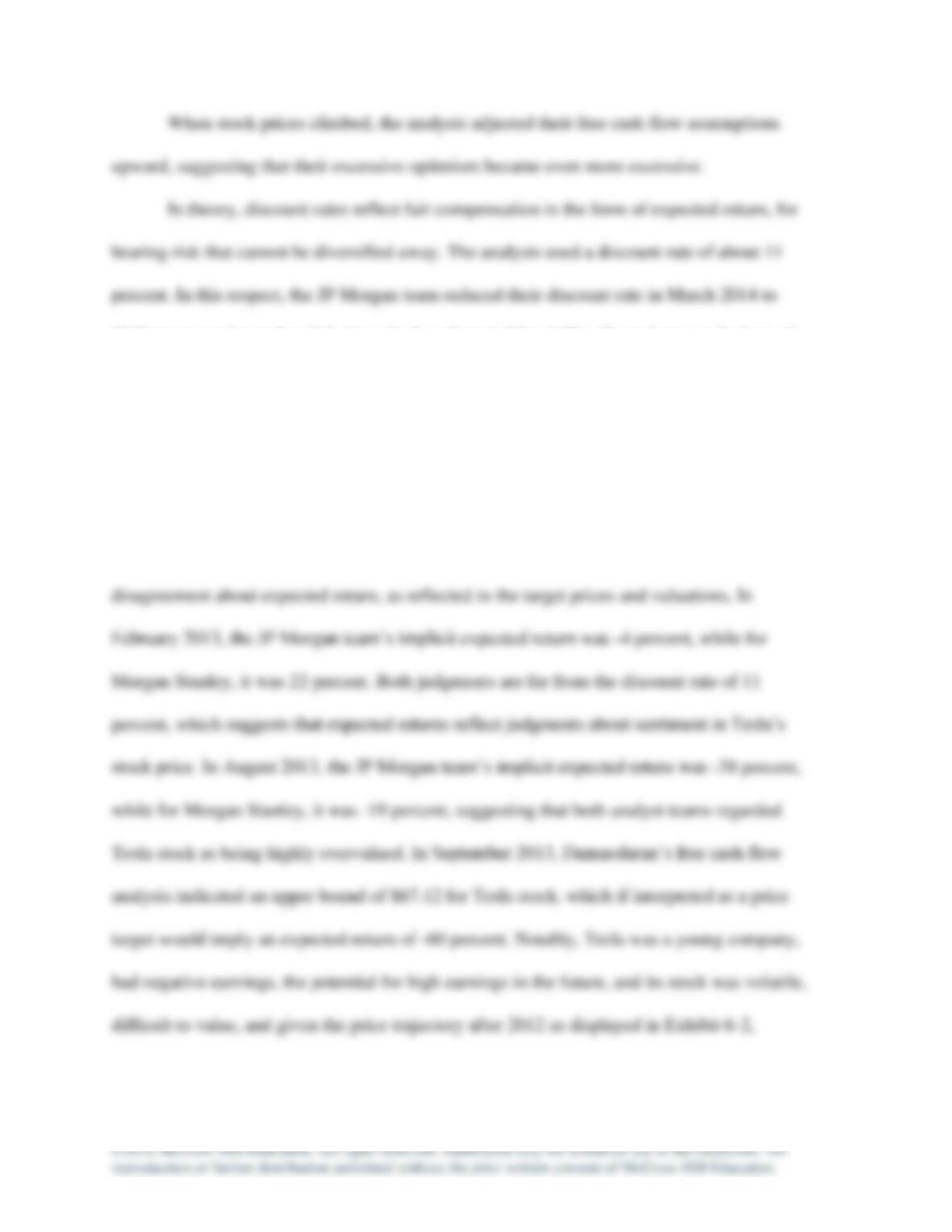
3. The following chart contrasts the various free cash flow forecasts. Damodaran’s forecasts
are negative during most of the intermediate horizon, whereas the forecasts of the Morgan
Stanley report and JP Morgan report are positive during this time. Damodaran’s terminal
-$8,000
-$6,000
-$4,000
-$2,000
$0
$2,000
$4,000
$6,000
$8,000
$10,000
$12,000
2012
2014
2016
2018
2020
2022
2024
2026
2028
2030
2032
2034
Morgan Stanley 2013
Morgan Stanley 2014
JP Morgan 2013
JP Morgan 2014
Damodaran
Chapter 06 – Perceptions about Risk and Return
7
©2018 McGraw-Hill Education. All rights reserved. Authorized only for instructor use in the classroom. No
reproduction or further distribution permitted without the prior written consent of McGraw-Hill Education.
When stock prices climbed, the analysts adjusted their free cash flow assumptions
upward, suggesting that their excessive optimism became even more excessive.
In theory, discount rates reflect fair compensation in the form of expected return, for
bearing risk that cannot be diversified away. The analysts used a discount rate of about 11
percent. In this respect, the JP Morgan team reduced their discount rate in March 2014 to
10.2 percent and m reduced their equity beta from 1.19 to 1.08.) Damodaran used a beta of
approximately 1.2, a risk-free rate of 2.75 percent, and arrived at a discount rate of 8 percent
for the terminal period. Overall, there appears to have been little disagreement about risk,
although Damodaran might have assumed a lower market risk premium.
The relationship between risk and expected return is the theme of Chapter 6. Despite
the similar views about the risk associated with Tesla’s stock, there is much wider
Chapter 06 – Perceptions about Risk and Return
difficult to arbitrage. These traits are the hallmarks of a high sentiment beta, the concept
introduced in Chapter 5.
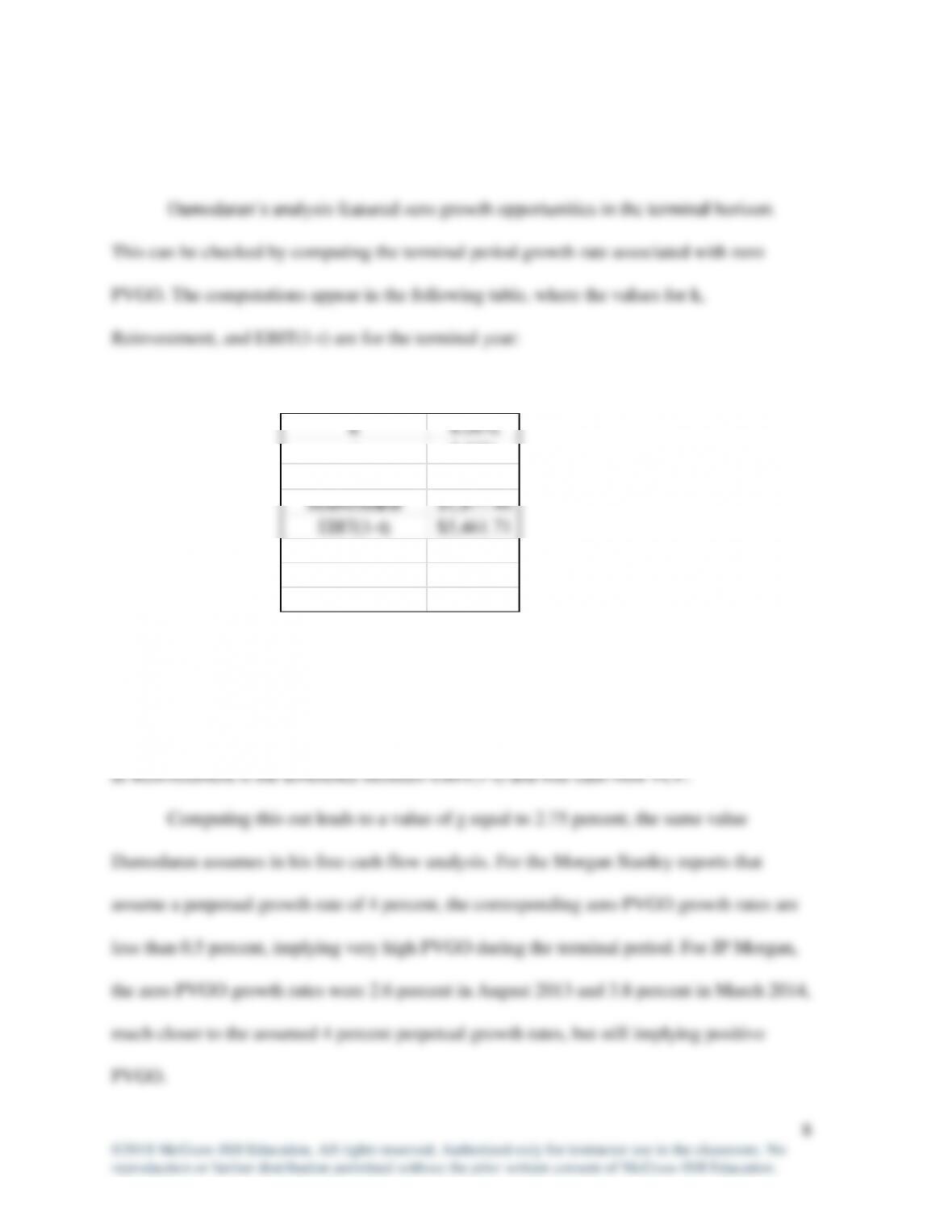
The equation for the growth rate g associated with zero PVGO is
g = k × Reinvestment / EBIT(1-t)
PVGO.
k 8.00%
g 2.75%
Reinvestment 1,877.46$
EBIT(1-t) 5,461.71$
Ratio 34.4%
Implied 0-PVGO g 2.75%