CHAPTER 6: THE FOREIGN EXCHANGE MARKET
1
CHAPTER 6
THE FOREIGN EXCHANGE MARKET
Chapter 6 is basically institutional in nature, although it opens by discussing the rationale for a foreign
exchange market, namely to facilitate the transfer of purchasing power denominated in one currency to
purchasing power denominated in another currency. Like other financial markets, the foreign exchange
market facilitates trading in financial assets by lowering transaction costs.
The balance of the chapter provides the institutional framework of the foreign exchange market, both
spot and forward transactions. It discusses pricing conventions, costs, size, and participants, and goes
through some of the mechanics of foreign exchange trading. I always illustrate this subject matter with
quotes found in The Wall Street Journal. Every issue of the Journal (Section C) contains a story on the
foreign exchange market, providing spot quotations for the Canadian dollar, pound sterling, Swiss francs,
euros, and Japanese yen. The financial section also carries a more extensive listing of spot and forward
prices for about forty currencies.
SUGGESTED ANSWERS TO “ARBITRAGING CURRENCY CROSS RATES”
1. Do any triangular arbitrage opportunities exist among these currencies? Assume that any
deviations from the theoretical cross rates of 5 points or less are due to transaction costs.
ANSWER. Unfortunately, there are no shortcuts here. It is necessary to try out each possibility. Here are
2. Compute the profit from a $5 million transaction associated with each arbitrage opportunity.
ANSWER. All answers are based on rounding the arbitrage profit per dollar to the fourth decimal place.
INSTRUCTORS MANUAL: FOUNDATIONS OF MULTINATIONAL FINANCIAL MANAGEMENT, 6TH ED.
2
SUGGESTED ANSWERS TO CHAPTER 6 QUESTIONS
1. Answer the following questions based on data in Exhibit 6.5.
1.a. How many Swiss francs can you get for one dollar?
1.b. How many dollars can you get for one Swiss franc?
1.c. What is the three-month forward rate for the Swiss franc?
1.d. Is the Swiss franc selling at a forward premium or discount?
1.e. What is the 90-day forward discount or premium on the Swiss franc?
2. What risks confront dealers in the foreign exchange market? How can they cope with these
risks?
3. Suppose a currency increases in volatility. What is likely to happen to its bid-ask spread? Why?
4. Who are the principal users of the forward market? What are their motives?
5. How does a company pay for the foreign exchange services of a commercial bank?
SUGGESTED SOLUTIONS TO CHAPTER 6 PROBLEMS
1. The $: € exchange rate is €1 = $1.35, and the €/SFr exchange rate is SFr 1 = €0.61. What is the
SFr/$ exchange rate?
2. Suppose the direct quote for sterling in New York is 1.9880-5.
2.a. How much would £500,000 cost in New York?
2.b. What is the direct quote for dollars in London?
3. Using the data in Exhibit 6.5, calculate the 30-day, 90-day, and 180-day forward discounts for
the Canadian dollar.
ANSWER. Here are the relevant rates for the Canadian dollar:
4. An investor wishes to buy euros spot (at $1.3480) and sell euros forward for 180 days (at
$1.3526).
4.a. What is the swap rate on euros?
4.b. What is the premium on 180-day euros?
5. Suppose Credit Suisse quotes spot and 90-day forward rates of $0.7957-60 and 8-13, respectively.
5.a. What are the outright 90-day forward rates that Credit Suisse is quoting?
5.b. What is the forward discount or premium associated with buying 90-day Swiss francs?
5.c. Compute the percentage bid-ask spreads on spot and forward Swiss francs.
ANSWER. The bid-ask spread is calculated as follows:
6. Suppose Dow Chemical receives quotes of $0.008242-45 for the yen and $0.03023-27 for the
Taiwan dollar (NT$).
6.a. How many U.S. dollars will Dow Chemical receive from the sale of ¥50 million?
6.b. What is the U.S. dollar cost to Dow Chemical of buying ¥1 billion?
6.c. How many NT$ will Dow Chemical receive for U.S.$500,000?
6.d. How many yen will Dow Chemical receive for NT$200 million?
6.e. What is the yen cost to Dow Chemical of buying NT$80 million?
7. Suppose the euro is quoted at 0.6786-98 in London, and the pound sterling is quoted at 1.4724–
70 in Frankfurt.
7.a. Is there a profitable arbitrage situation? Describe it.
7.b. Compute the percentage bid-ask spreads on the pound and euro.
8. As a foreign exchange trader at Sumitomo Bank, one of your customers would like a yen quote
on Australian dollars. Current market rates are:
8.a. What bid and ask yen cross rates would you quote on spot Australian dollars?
ANSWER. By means of triangular arbitrage, we can calculate the market quotes for the Australian dollar
8.b. What outright yen cross rates would you quote on 30-day forward Australian dollars?
ANSWER. Given the swap rates, we can compute the outright forward direct quotes for the yen and
Australian dollar by adding or subtracting the forward points as follows
INSTRUCTORS MANUAL: FOUNDATIONS OF MULTINATIONAL FINANCIAL MANAGEMENT, 6TH ED.
6
8.c. What is the forward premium or discount on buying 30-day Australian dollars against yen
delivery?
9. Suppose Air France receives the following indirect quotes in New York: €0.92-3 and £0.63-4.
Given these quotes, what range of £/€ bid and ask quotes in Paris will permit arbitrage?
ANSWER. Triangular arbitrage can take place in either of two ways: (1) Convert from euros to dollars (at
the ask rate), then from dollars to pounds (at the bid rate), or (2) convert from pounds to dollars (at the ask
10. On checking the Telerate screen, you see the following exchange rate and interest rate quotes:
Currency
90-Day Interest
Rates Annualized
Spot Rates
90-Day
Forward Rates
Dollar
4.99% – 5.03%
Swiss franc
3.14% – 3.19%
$0.711-22
$0.726-32
10.a. Can you find an arbitrage opportunity?
10.b. What steps must you take to capitalize on it?
10.c. What is the profit per $1,000,000 arbitraged?
ADDITIONAL CHAPTER 6 PROBLEMS AND SOLUTIONS
1. Suppose the quote on pounds is $1.624-31.
1.a. If you converted $10,000 to pounds and then back to dollars, how many dollars would you
end up with?
1.b. Suppose you could buy pounds at the bid rate and sell them at the ask rate. How many dollars
would you have to transact in order to earn $1,000 on a round-trip transaction (buying
pounds for dollars and then selling the pounds for dollars)?
2. Using the following data, calculate the 30-day, 90-day, and 180-day forward premiums for the
British pound.
Spot: £1 = $1.4487
30-day forward: £1 = $1.4498
90-day forward: £1 = $1.4511
180-day forward: £1 = $1.4529
ANSWER. Here are the relevant calculations for the pound:
3. The spot and 90-day forward rates for the pound are $1.1376 and $1.1350, respectively. What is
the forward premium or discount on the pound?
4. Suppose the spot quote on the euro is $0.9302-18, and the spot quote on the Swiss franc is
$0.6180-90.
4.a. Compute the percentage bid-ask spreads on the euro and franc.
4.b. What is the direct spot quote for the franc in Frankfurt?
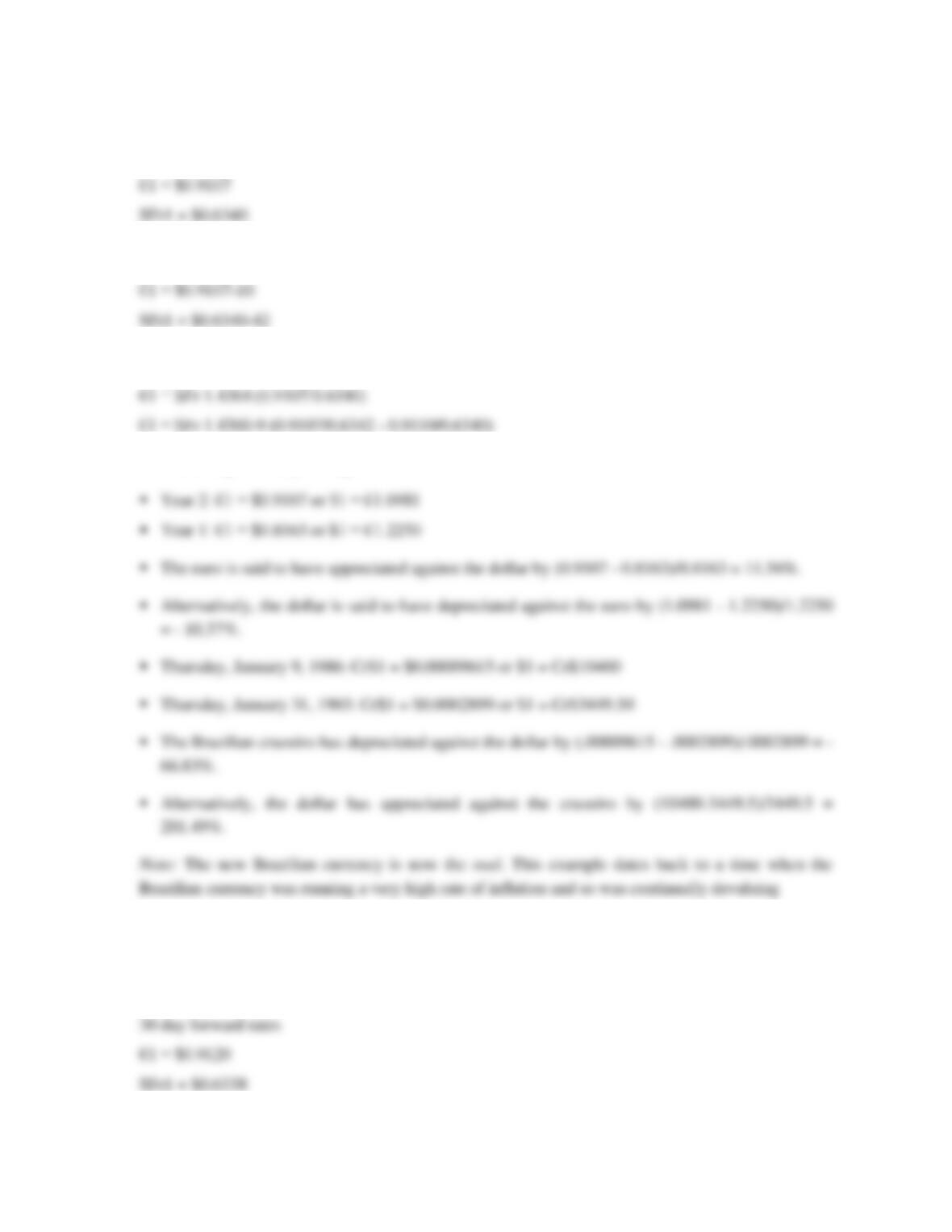
5. Suppose you observe the following direct spot quotations in New York and Toronto, respectively:
0.8000-50 and 1.2500-60. What are the arbitrage profits per $1 million?
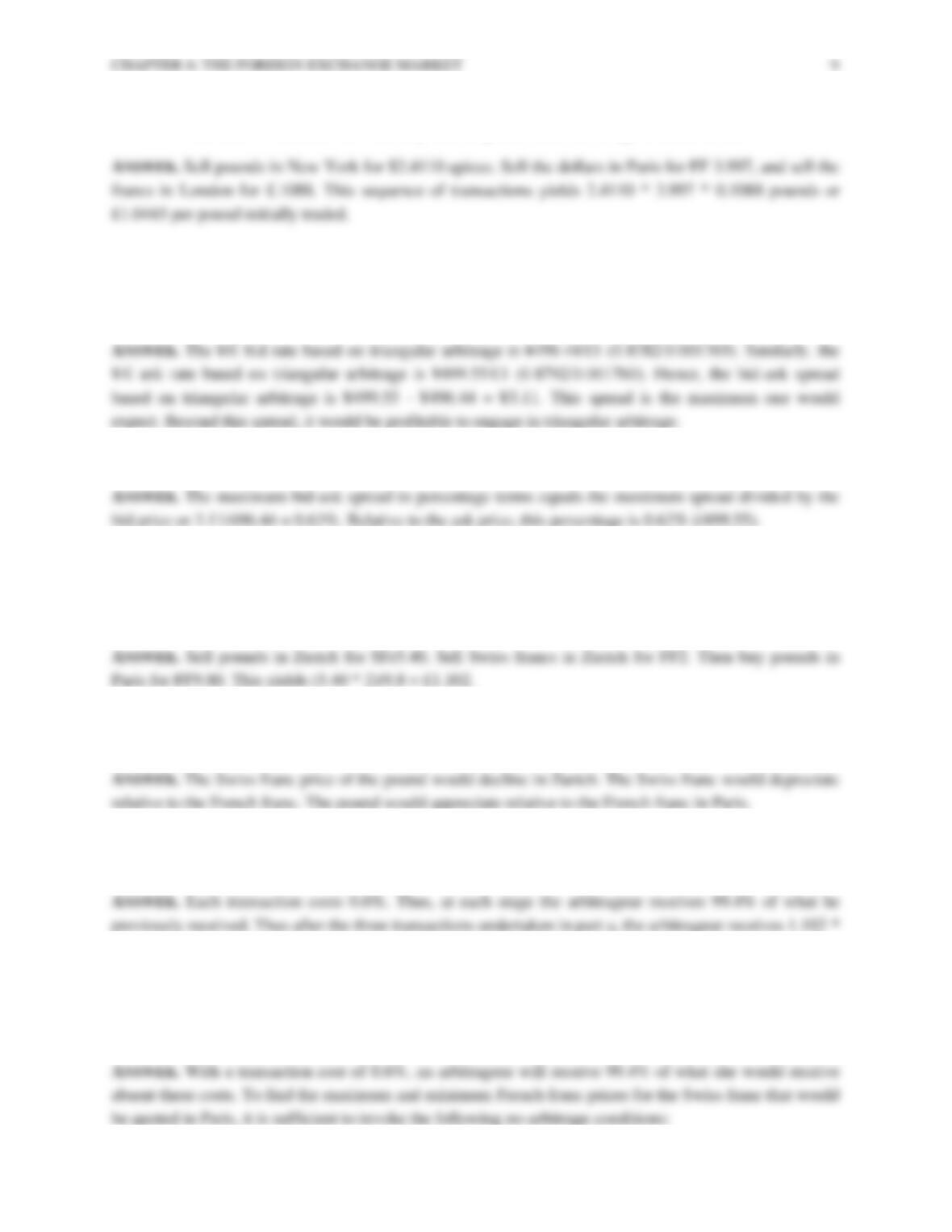
6. Assuming no transaction costs, suppose £1 = $2.4110 in New York, $1 = FF 3.997 in Paris, and
FF 1 = £0.1088 in London. How could you take profitable advantage of these rates?
7. Suppose the euro is quoted at $0.8782-92, while the yen is quoted at $0.001760-69.
7.a. Given these quotes for the euro and yen, what is the maximum bid-ask spread in the ¥/DM
rate for which there is no arbitrage?
7.b. What is the maximum bid-ask spread in percentage terms?
8. Assume that back in 1995 the pound sterling is worth FF9.80 in Paris and SFr5.40 in Zurich.
8.a. Show how British arbitrageurs can make profits given that the Swiss franc is worth two
French francs. What would be the profit per pound transacted?
8.b. What would be the eventual outcome on exchange rates in Paris and Zurich given these
arbitrage activities?
8.c. Rework 8.a, assuming that transaction costs amount to 0.6% of the amount transacted. What
would be the profit per pound transacted?
(.994)3 = £1.0823 for a profit per pound sold equal to £0.0823.
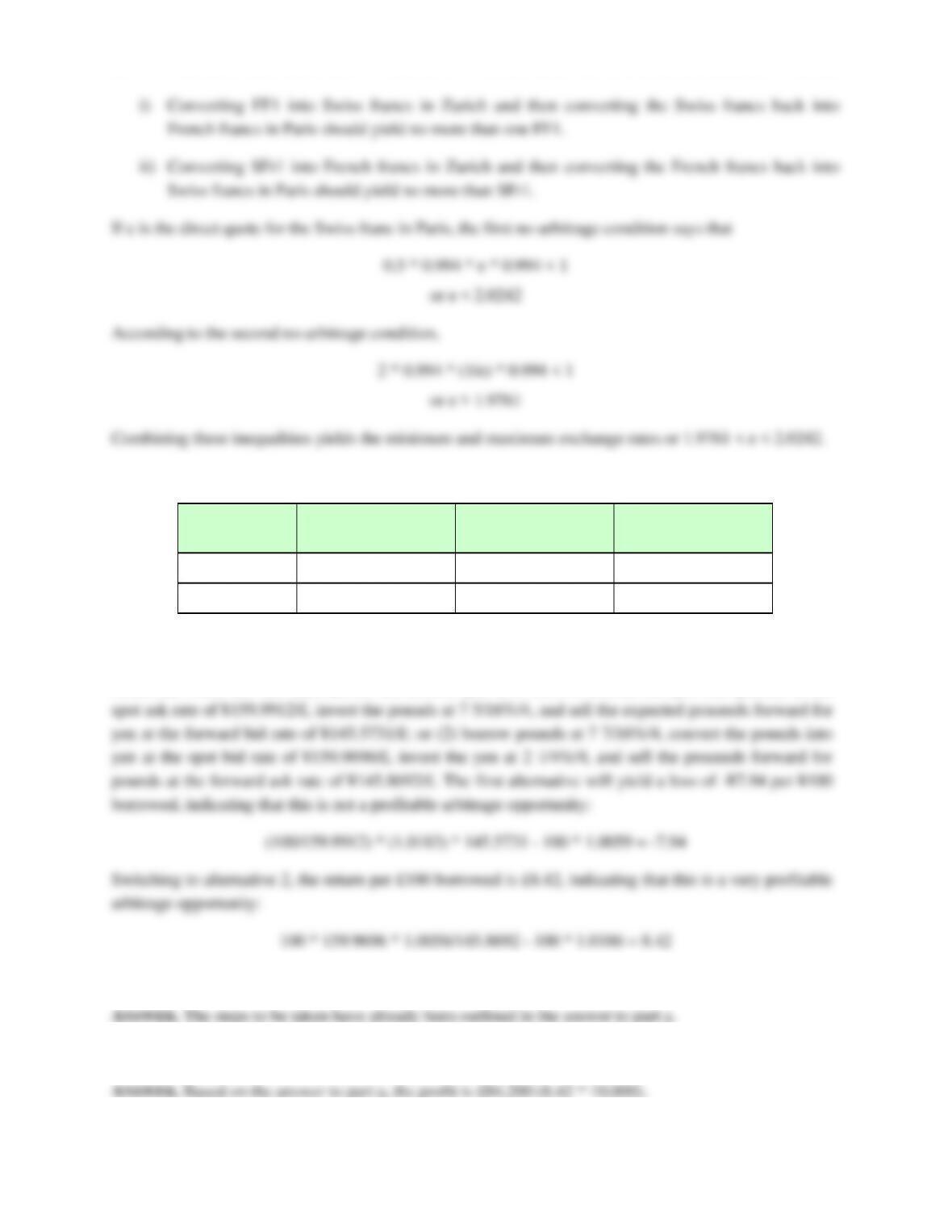
8.d. Suppose the Swiss franc is quoted at FF2 in Zurich. Given a transaction cost of 0.6% of the
amount transacted, what are the minimum/maximum French franc prices for the Swiss franc
that you would expect to see quoted in Paris?
INSTRUCTORS MANUAL: FOUNDATIONS OF MULTINATIONAL FINANCIAL MANAGEMENT, 6TH ED.
10
9. On checking the Reuters screen, you see the following exchange rate and interest rate quotes:
Currency
90-Day Interest
Rates
Spot Rates
90-day Forward
Rates
Pound
7 7/16 – 5/16%
¥159.9696-9912/£
¥145.5731-8692/£
Yen
2 3/8 – 1/4%
9.a. Can you find an arbitrage opportunity?
ANSWER. There are two alternatives: (1) Borrow yen at 2 3/8%/4, convert the yen into pounds at the
9.b. What steps must you take to capitalize on it?
9.c. What is the profit per £1,000,000 arbitraged?
CHAPTER 6: THE FOREIGN EXCHANGE MARKET
11
NOTES ON FOREIGN EXCHANGE QUOTES
1. Spot rate – rate at which foreign exchange can be bought or sold for immediate delivery.
1.a. Actual rates are given in pairs: a bid (buy) rate and ask (sell) rate
1.b. Cross rates:
1.c. Measuring currency changes
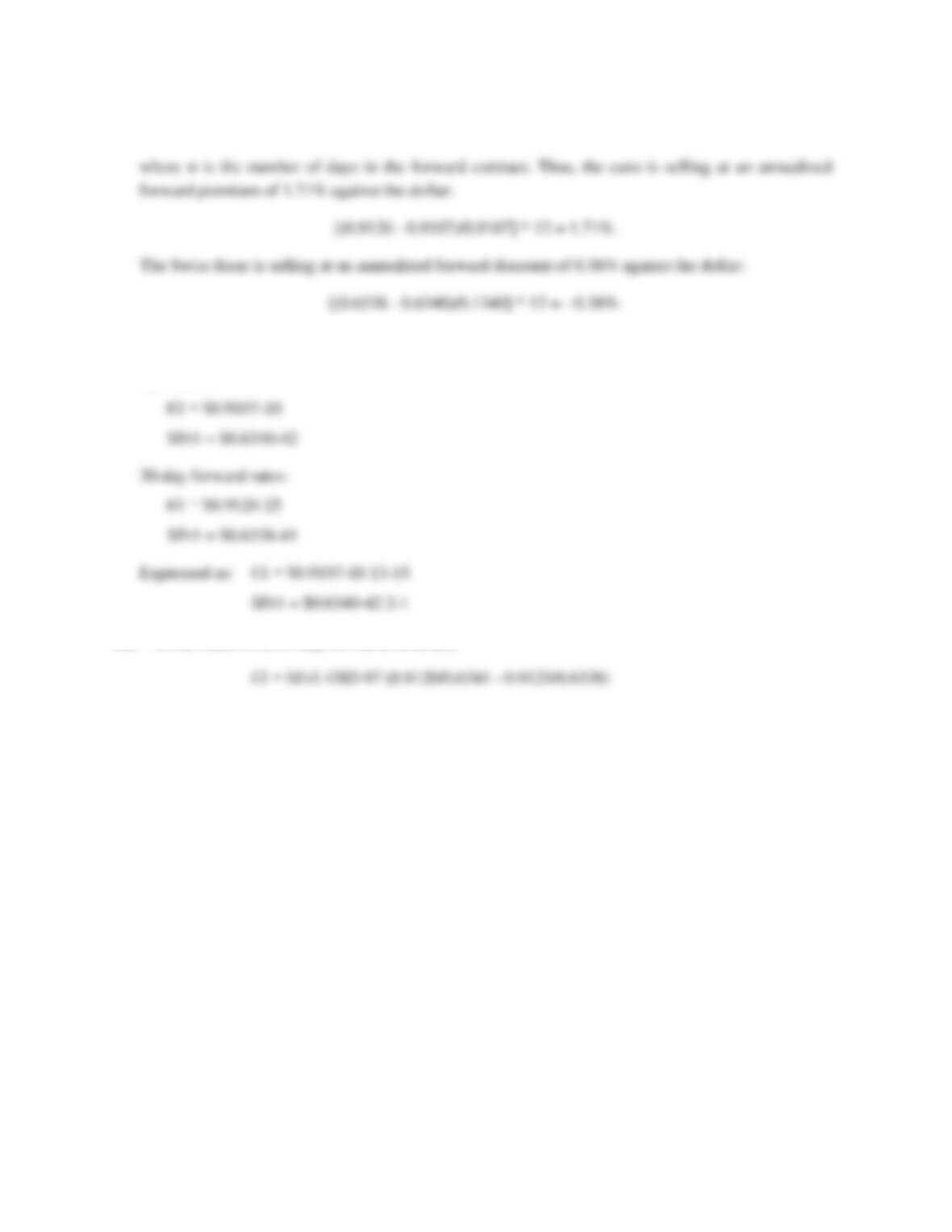
2. Forward rate – rate at which foreign exchange can be bought or sold today for delivery at a
fixed future date, typically in multiples of 30 days, e.g., 30, 60, 90, or 180 days.
2.a. Forward quotations
INSTRUCTORS MANUAL: FOUNDATIONS OF MULTINATIONAL FINANCIAL MANAGEMENT, 6TH ED.
12
2.b. Forward premium (+) or discount (-) (annualized) = [(forward rate – spot rate)/spot rate] *
(360/n)
2.c. Swap rates
Spot rates:
2.d. Cross rates on a 30-day forward contract: