Using Credit
Chapter 6
How Will This Affect Me?
The ability to borrow funds to buy goods and services is as convenient as it is seductive. It is
important to understand how to get and maintain access to credit via credit cards, debit cards,
lines of credit, and other means. This chapter reviews the common sources of consumer credit
and provides a framework for choosing among them. It also discusses the importance of
developing a good credit history, achieving and maintaining a good credit score, and protecting
LG1 Describe the reasons for using consumer credit, and identify its benefits and problems.
This topic is discussed in the section 6–1a Why We Use Credit.
LG2 Develop a plan to establish a strong credit history.
Section 6-1c included a highlighted graphic, Evaluating Creditworthiness, The 5 C’s of Credit,
that discusses things you can do to build a strong credit history. The Debt safety credit ratio is
LG3 Distinguish among the different forms of open account credit.
Section 6.2 discusses the various forms of open account credit. Home Equity Loans are an
LG4 Apply for, obtain, and manage open forms of credit.
Use the Power Points. This topic is well covered in the text. The answer to Test Yourself
questions 12-14 [included below] discusses the common method used to compute finance
charges. Section 6-3b discusses the FICO scores and includes a graphic “Improving Your FICO
Score” that has useful information.
LG5 Choose the right credit cards and recognize their advantages and disadvantages.
Section 6-4a list four card features to look for:
Bottom line: Do not take the first credit card offered to you; get the one that is right for you.
LG6 Avoid credit problems, protect yourself against credit card fraud, protect yourself against
identity theft, and understand the personal bankruptcy process.
The best way to avoid credit problems is to use credit for specific purposes:
To purchase large outlay items, such as a car, major furniture purposes, etc.
Credit card fraud and identity theft are major problems. Section 6-4c has a graphic that discusses
ways of protecting yourself from identity theft.
Personal bankruptcy follows periods of excess debt. Two most common bankruptcy are:
Wage earner plan – Chapter 13, allows creditor to work out a plan to pay debt off,
normally during a 3 to 5-year period
Financial Planning Exercise 9 requires the student to compare two credit cards and discuss which
should be used.
Financial Facts or Fantasies?
These may be used as “teasers” to get the students on the right page with you. Also, they may be
used as quizzes after you covered the material or as “pre–test questions” to get their attention.
• Excluding mortgage payments, most families will have little or no credit problems so long as
they limit their monthly credit payments to 25 to 30 percent their monthly take-home pay.
Fantasy: Most experts suggest that you keep your monthly debt
repayment burden, excluding mortgage payments, to 20 percent or less of
your take-home pay. Letting it get as high as 25 to 30 percent can lead to
serious credit problems.
• You use a check rather than a credit card to obtain funds from an unsecured personal line of
credit.
Fact: Credit cards are not issued with unsecured personal credit lines.
Instead, if you want to borrow money through such a line, you do it by
simply writing a check directly against it.
Financial Facts or Fantasies?
1. True False One of the benefits of using credit is that it allows you to purchase
expensive goods and services while spreading the payment for them
overtime.
2. True False It’s a good idea to contact your creditors immediately if, for some reason,
you can’t make payments as agreed.
3. True False Excluding mortgage payments, most families will have little or no credit
problems so long as they limit their monthly credit payments to 25 to 30
percent their monthly take-home pay.
4. True False When you apply for credit, most lenders will contact a credit bureau and
let them decide whether or not you should receive the credit.
5. True False Credit card issuers are required by truth-in-lending laws to use the average
daily balance in your account when computing the amount of finance
charges you’ll have to pay.
6. True False You use a check rather than a credit card to obtain funds from an
unsecured personal line of credit.
YOU CAN DO IT NOW
The “You Can Do It Now” cases may be assigned to the students as short cases or problems.
They will help make the topic more real or relevant to the students. In most cases, it will only
take about ten minutes to do, that is, until the student starts looking around at the web site. But
they will learn by doing so.
Is Your Credit Card a Good Deal?
While your credit card might have been a good deal when you first got it, that may not still be
How Does Your Credit Report Look?
When did you last check your credit report? It’s a good idea look at it at least once a year to
Financial Impact of Personal Choices
Read and think about the choices being made. Do you agree or not? Ask the students to discuss
the choices being made.
Austin Has Had It and Files for Bankruptcy
Austin Ferguson is overwhelmed by his bills. While making $60,000 a year, he has amassed
credit card debt of $24,000, has an $80,000 college loan, holds a $150,000 mortgage, and pays
monthly on his leased Jetta. He’s having trouble paying the mortgage monthly and can never
Applying Personal Finance
How’s Your Credit?
Establishing credit and maintaining your creditworthiness are essential to your financial well-
being. Good credit allows you to obtain loans and acquire assets that you otherwise might not be
able to attain. This project will help you to examine your credit.
Solutions to Financial Planning Exercises
1. Establishing credit history. After graduating from college last fall, Jennifer Grant took a
job as a consumer credit analyst at a local bank. From her work reviewing credit
applications, she realizes that she should begin establishing her own credit history.
Describe for Jennifer several steps that she could take to begin building a strong credit
record. Does the fact that she took out a student loan for her college education help or hurt
her credit record?
Here are some things you can do to build a strong credit history:
• Use credit only when you can afford it and only when the repayment schedule fits comfortably
into the family budget—in short, don’t overextend yourself.
2. Evaluating debt burden. Kevin Mills has a monthly take-home pay of $3,865; he makes
payments of $410 a month on his outstanding consumer credit (excluding the mortgage on
his home). How would you characterize Kevin’s debt burden? What if his take-home pay
was $850 a month and he had monthly credit payments of $150?
The debt safety ratio is total monthly consumer credit payments divided by the monthly take-
home pay. In Kevin’s case, with monthly take-home pay of $3,865 and payments of $410, his
debt safety ratio is $410/$3,865 = 10.6 percent. This ratio is well under the preferred maximum
3. Calculating and interpreting personal debt safety ratio. Calculate your own debt safety
ratio. What does it tell you about your current credit situation and your debt capacity?
Does this information indicate a need to make any changes in your credit use patterns? If
so, what steps should you take?
The debt safety ratio is total monthly consumer credit payments divided by the monthly take-
home pay. If this ratio is greater than 20 percent, it suggests that you will have difficulty making
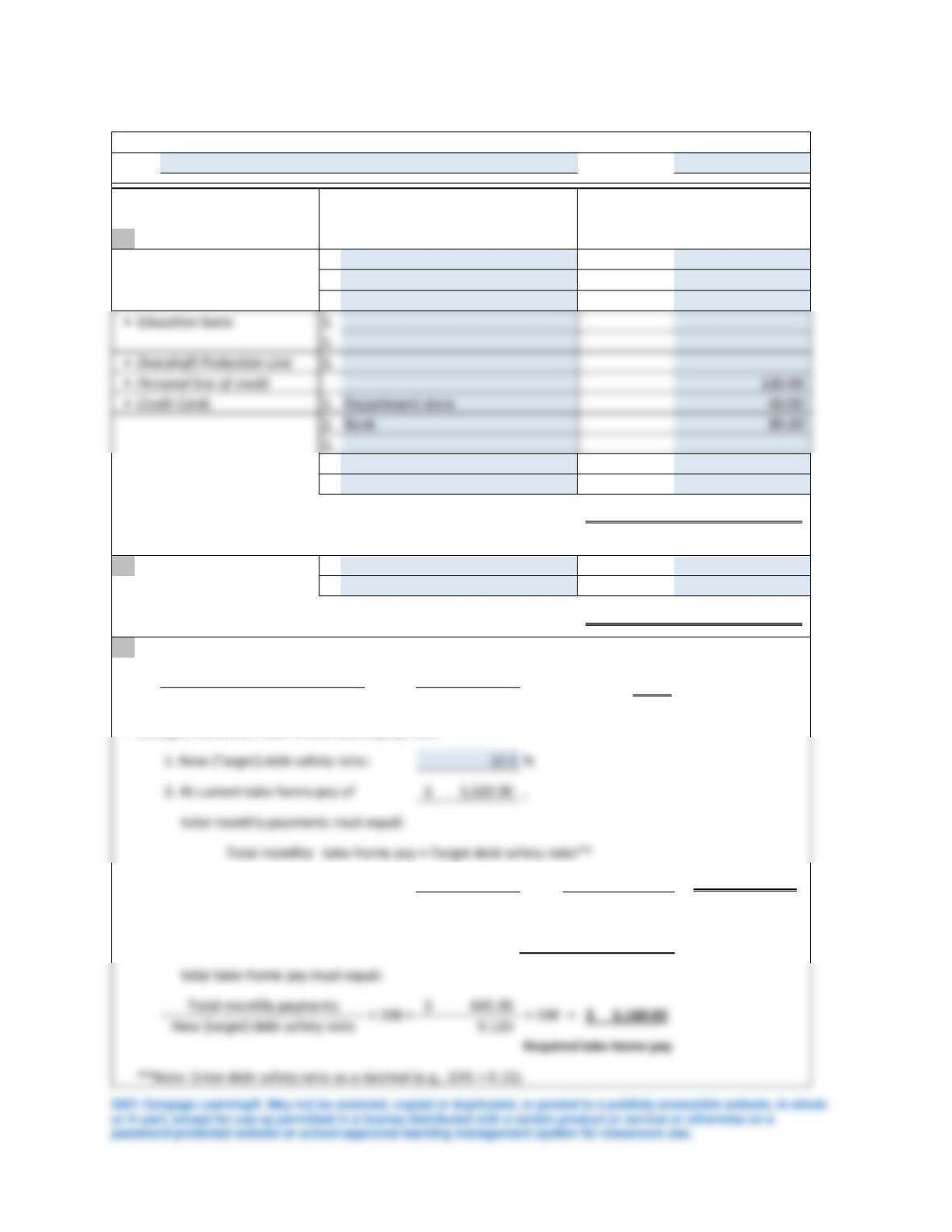
4. Evaluating debt safety ratio. Use Worksheet 6.1. Katherine Hunt is evaluating her debt
safety ratio. Her monthly take- home pay is $3,320. Each month, she pays $380 for an auto
loan, $120 on a personal line of credit, $60 on a department store charge card, and $85 on
her bank credit card. Complete Worksheet 6.1 by listing Katherine’s outstanding debts,
and then calculate her debt safety ratio. Given her current take-home pay, what is the
maximum amount of monthly debt payments that Katherine can have if she wants her debt
safety ratio to be 12.5 percent? Given her current monthly debt payment load, what would
Katherine’s take-home pay have to be if she wanted a 12.5 percent debt safety ratio?
From Worksheet 6.1 below, Katherine’s current debt safety ratio is 19.4 percent which is close to
Dated
•1. $
2.
3.
Personal line of credit
Department store
120.00
Bank
4.
•1.
1. $
2.
645.00$
3,320.00$
Changes needed to reach a new debt safety ratio
2. At current take-home pay of
total monthly payments must equal:
3,320.00$ ×=415.00$
3. With current monthly payments of ,
Worksheet 6.1, Chapter 6, Exercise 4
Debt Safety Ratio:
Auto and Personal loans
Total monthly payments
Total monthly take-home pay
× 100
MONTHLY CONSUMER LOAN PAYMENTS & DEBT SAFETY RATIO
19.4%
× 100
=
0.125
New Monthly Payments
OR
645.00$
Katherine Hunt
Type of Loan*
Name
Lender
Current
Monthly (or Min.)
Payment
380.00
3,320.00$
Home Equity Line
TOTAL MONTHLY PAYMENTS
645.00$
*Note: List only those loans that require regular monthly payments.
Monthly Take-Home Pay
3,320.00
TOTAL MONTHLY TAKE HOME PAY
total take-home pay must equal:
New (target) debt safety ratio
5. Implications of Credit Card Act. What are the main features and implications of the
Credit Card Act of 2009?
The Credit Card Act of 2009 major provisions are:
• The new law requires credit card companies to give 45 days’ notice before changing your
agreement.
Exhibit 6.4 summarizes the provisions of the law. In the year after the law went into effect in
2010, credit card balances fell, late payments dropped, payment defaults declined, and the use of
debit cards over credit cards increased.
6. Using overdraft protection line. Kaylee Holmes has an overdraft protection line. Assume
that her October 2021 statement showed a latest (new) balance of $862. If the line had a
minimum monthly payment requirement of 5 percent of the latest balance (rounded to the
nearest $5 figure), then what would be the minimum amount that she’d have to pay on her
overdraft protection line?
5% * $862 = $43.10, rounded to nearest $5, = $45.
7. Home equity lines interest. Isaiah and Allison Burton have a home with an appraised
value of $180,000 and a mortgage balance of only $90,000. Given that an S&L is willing to
lend money at a loan to-value ratio of 75 percent, how big of a home equity credit line can
Isaiah and Allison obtain? How much, if any, of this line would qualify as tax deductible
interest if their house originally cost $100,000?
Loan-to-value ratio of 75 percent yields (.75 * 180.000) – $90,000 = $45,000 of available credit.
Under the 2017 tax act, interest on the home equity loan is only deductible if the proceeds are
8. Calculating credit card interest. Joseph Simpson, a student at State College, has an
average balance of $380 on his retail charge card; if the store levies a finance charge of 21
percent per year, how much monthly interest will be added to his account?
9. Choosing between credit cards. Justin Nichols recently graduated from college and is
evaluating two credit cards. Card A has an annual fee of $75 and an interest rate of 9
percent. Card B has no annual fee and an interest rate of 16 percent. Assuming that Justin
intends to carry no balance and to pay off his charges in full each month, which card
represents the better deal? If Justin expected to carry a significant balance from one month
to the next, which card would be better? Explain.
Assuming that Justin intends to carry no balance and to pay off his charges in full each month
Card B would not cost Justin any fees. Card A would cost him the annual fee of $75.
10. Balance transfer credit cards. Camila Martinez has several credit cards, on which she is
carrying a total current balance of $14,500. She is considering transferring this balance to a
new card issued by a local bank. The bank advertises that, for a 2 percent fee, she can
transfer her balance to a card that charges a 0 percent interest rate on transferred balances
for the first nine months. Calculate the fee that Camila would pay to transfer the balance
and describe the benefits and drawbacks of balance transfer cards.
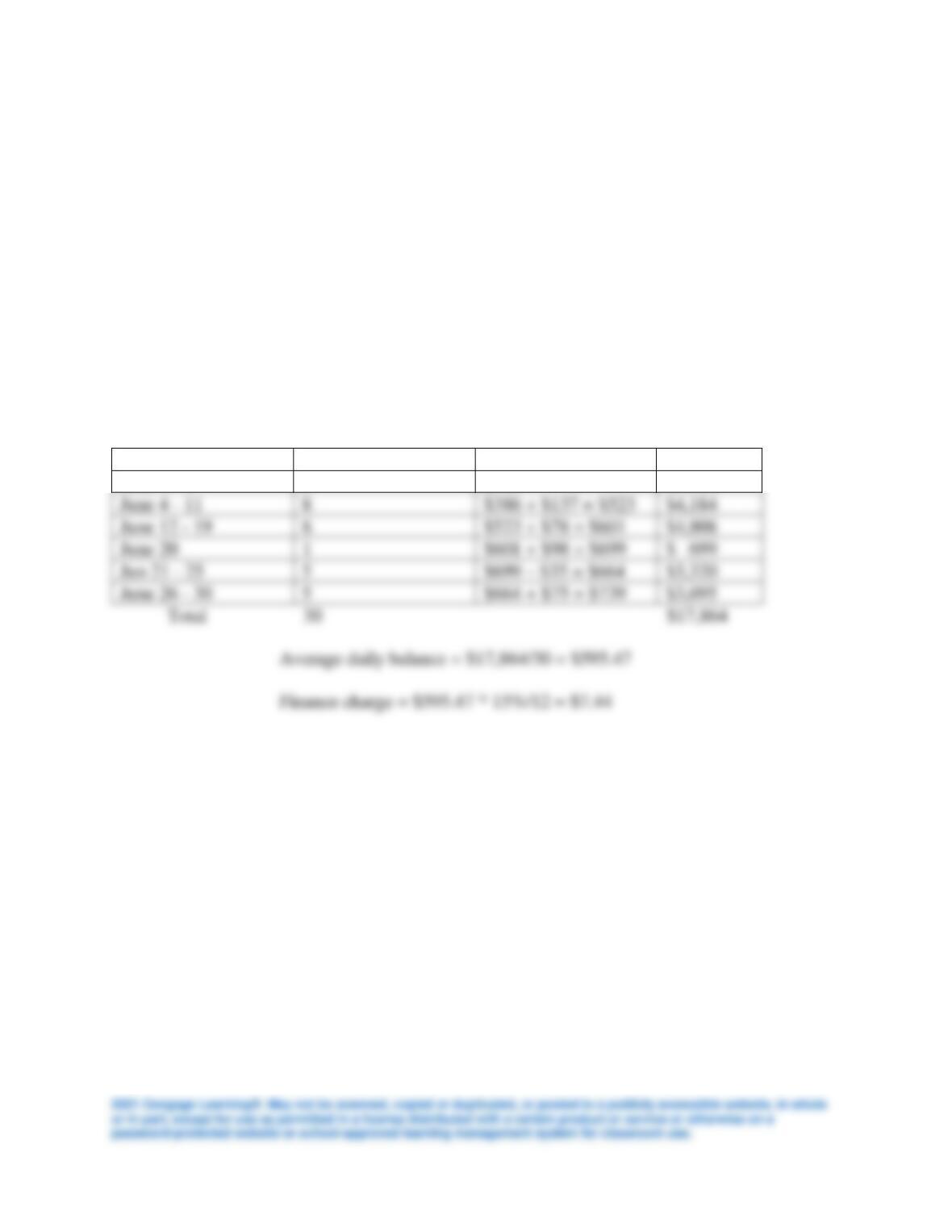
Camila has a fairly large balance of $14,500 on her credit cards. If her current cards charge her
12% per year, she would be paying $1,740 per year or $145 per month ($14,500 x .12/12) in
11. Calculating credit card finance charge. Blake Miller recently received his monthly
MasterCard bill for the period June 1–30, 2021, and wants to verify the monthly finance
charge calculation, which is assessed at a rate of 15 percent per year and based on ADBs,
including new purchases. His outstanding balance, purchases, and payments are as
follows:
Previous Balance: $386
Purchases: Payments:
June 4 $137 June 21 $35
June 12 78
June 20 98
June 26 75
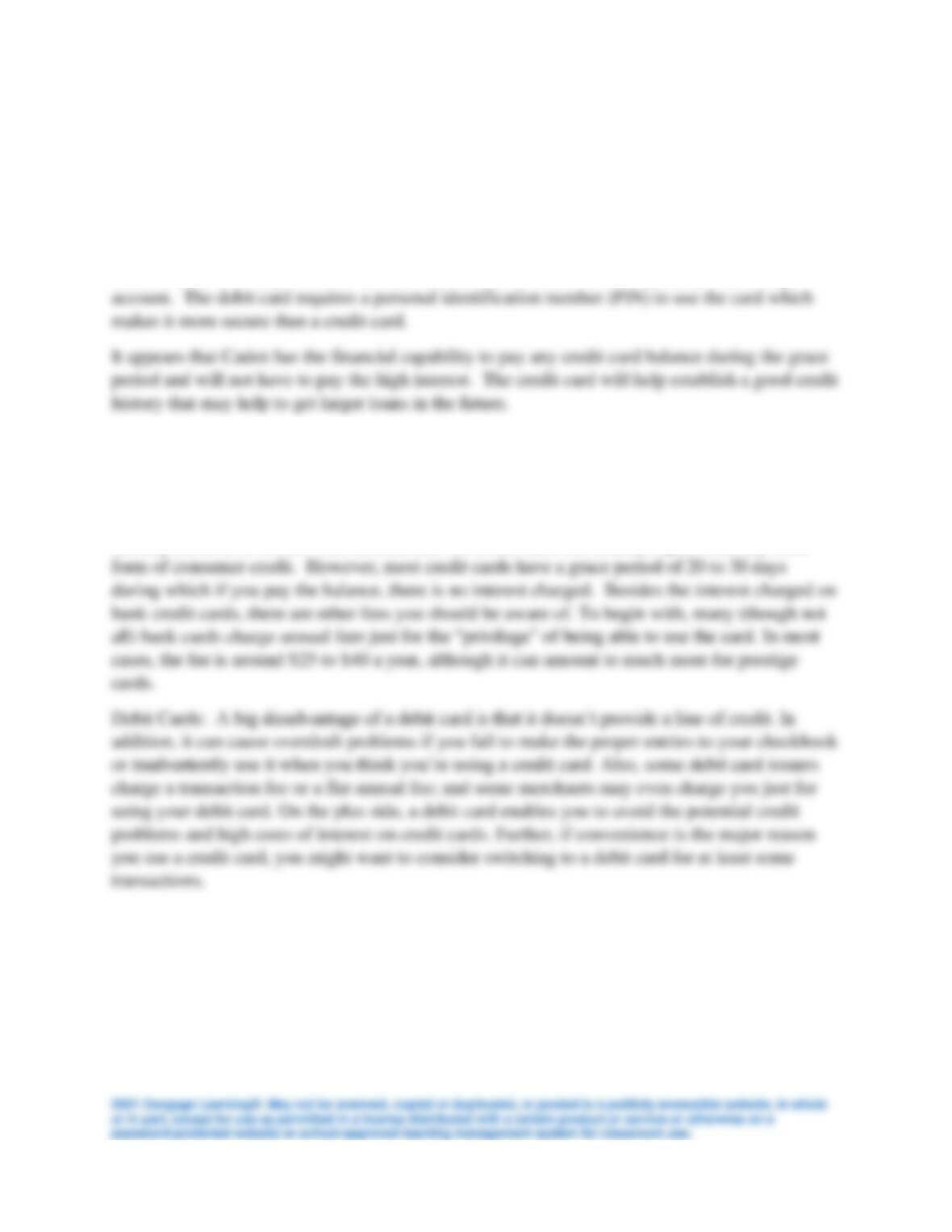
What are his ADB and finance charges for the period? (Use a table like the one in Exhibit
6.7 for your calculations.)
Dates
Number of Days
Balance
Calculation
June 1 – 3
3
$386
$1,158
June 4 – 11
8
$386 + $137 = $523
$4,184
June 12 – 19
8
$523 + $78 = $601
$4,808
June 20
1
$601 + $98 = $699
$ 699
Jun 21 – 25
5
$699 – $35 = $664
$3,320
June 26 – 30
5
$664 + $75 = $739
$3,695
12. Comparing credit and debit cards. Caden Walker is trying to decide whether to apply for
a credit card or a debit card. He has $8,500 in a savings account at the bank and spends his
money frugally. What advice would you have for Caden? Describe the benefits and
drawbacks of each type of card.
If Caden is willing to keep good records of use, a debit card provides the desired convenience
without the possibility of high interest on balances. However, if he does not keep good records,
use of a debit card may result in overdraft of the related bank account, typically a checking
My advice is to use credit cards and pay balance during the grace period.
Credit Cards: Probably the most popular form of open account credit is the bank credit card. If
you have a regular job, you will probably be able to get a credit card although initially the credit
limit may be small ($1,000). These cards allow their holders to charge purchases worldwide at
literally millions of stores. The interest rates on credit cards are usually higher than any other
13. Credit card liability. Cheryl Lee was reviewing her credit card statement and noticed
several charges that didn’t look familiar to her. Cheryl is unsure whether she should pay
the bill in full and forget about the unfamiliar charges, or “make some noise”. If some of
these charges aren’t hers, is she still liable for the full amount? Is she liable for any part of
these charges, even if they’re fraudulent?
Cheryl should immediately notify the credit card issuer of any charges on her statement which
14. Evaluating loan request. Justin Moss recently graduated from college and wants to
borrow $50,000 to start a business, which he believes will produce a cash flow of at least
$10,000 per year. As a student, Justin was active in clubs, held leadership positions, and did
a lot of community service. He currently has no other debts. He owns a car worth about
$10,000 and has $6,000 in a savings account. Although the economy is currently in a
recession, economic forecasters expect the recession to end soon. If you were a bank loan
officer, how would you evaluate Justin’s loan request within the context of the “5 C’s of
Credit”? Briefly describe each characteristic and indicate whether it has favorable or
unfavorable implications for Justin’s loan request.
The 5 Cs of Credit
Lenders often look to the “5 Cs of Credit” as a way to assess the willingness and
ability of a borrower to repay a loan.
1. Character. A key factor in defining the borrower’s willingness to live up to the
terms of the loan.
2. Capacity. The ability of the borrower to service the loan in a timely fashion.
How does Justin rank on the 5 C’s?
Character: Justin appears to have good character—active in clubs, leadership positions,
community service. Good for Justin.