Build a Model Solution 11/26/2018
Chapter: 6
Problem: 15
Data as given in the problem are shown below:
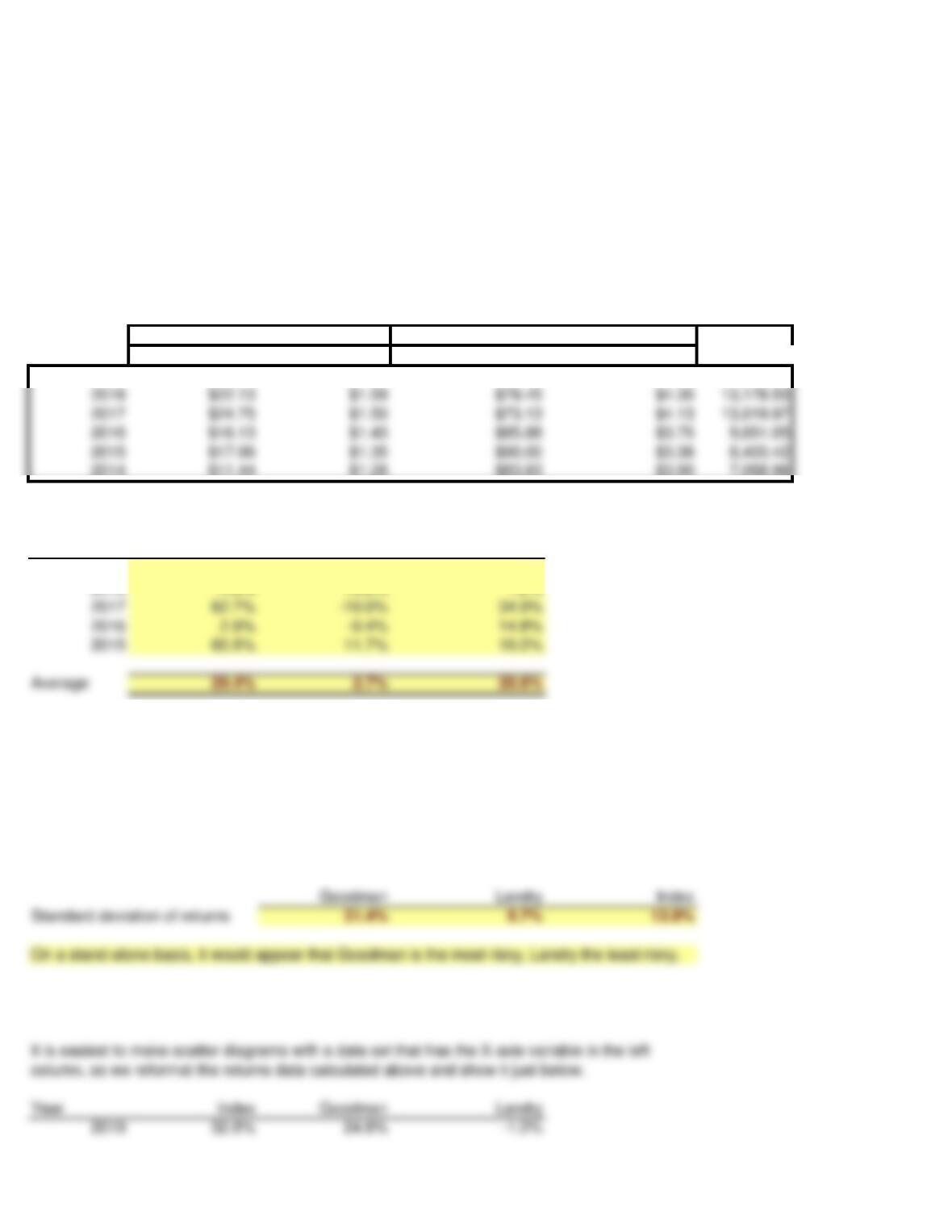
Market Index
Year Stock Price Dividend Stock Price Dividend Includes Divs.
2019 $25.88 $1.73 $73.13 $4.50 17,495.97
2014 $11.44 $1.28 $83.63 $3.00 7,058.96
We now calculate the rates of return for the two companies and the index:
Goodman Landry Index
2019 24.8% -1.0% 32.8%
2018 -4.2% 13.2% 1.2%
Use the function wizard to calculate the standard deviations.
b. Calculate the standard deviation of the returns for Goodman, Landry, and the Market Index. (Hint:
Use the sample standard deviation formula given in the chapter, which corresponds to the STDEV
Landry Incorporated
Goodman Industries
a. Use the data given to calculate annual returns for Goodman, Landry, and the Market Index, and then
calculate average returns over the five-year period. (Hint: Remember, returns are calculated by
subtracting the beginning price from the ending price to get the capital gain or loss, adding the
dividend to the capital gain or loss, and dividing the result by the beginning price. Assume that
dividends are already included in the index. Also, you cannot calculate the rate of return for 2014
because you do not have 2013 data.)
Note: To get the average, you could get the column sum and divide by 5, but you could also use the function
wizard, fx. Click fx, then statistical, then Average, and then use the mouse to select the proper range. Do this
for Goodman and then copy the cell for the other items.
c. Construct a scatter diagram graph that shows Goodman’s and Landry’ returns on the vertical axis
and the Market Index’s returns on the horizontal axis.
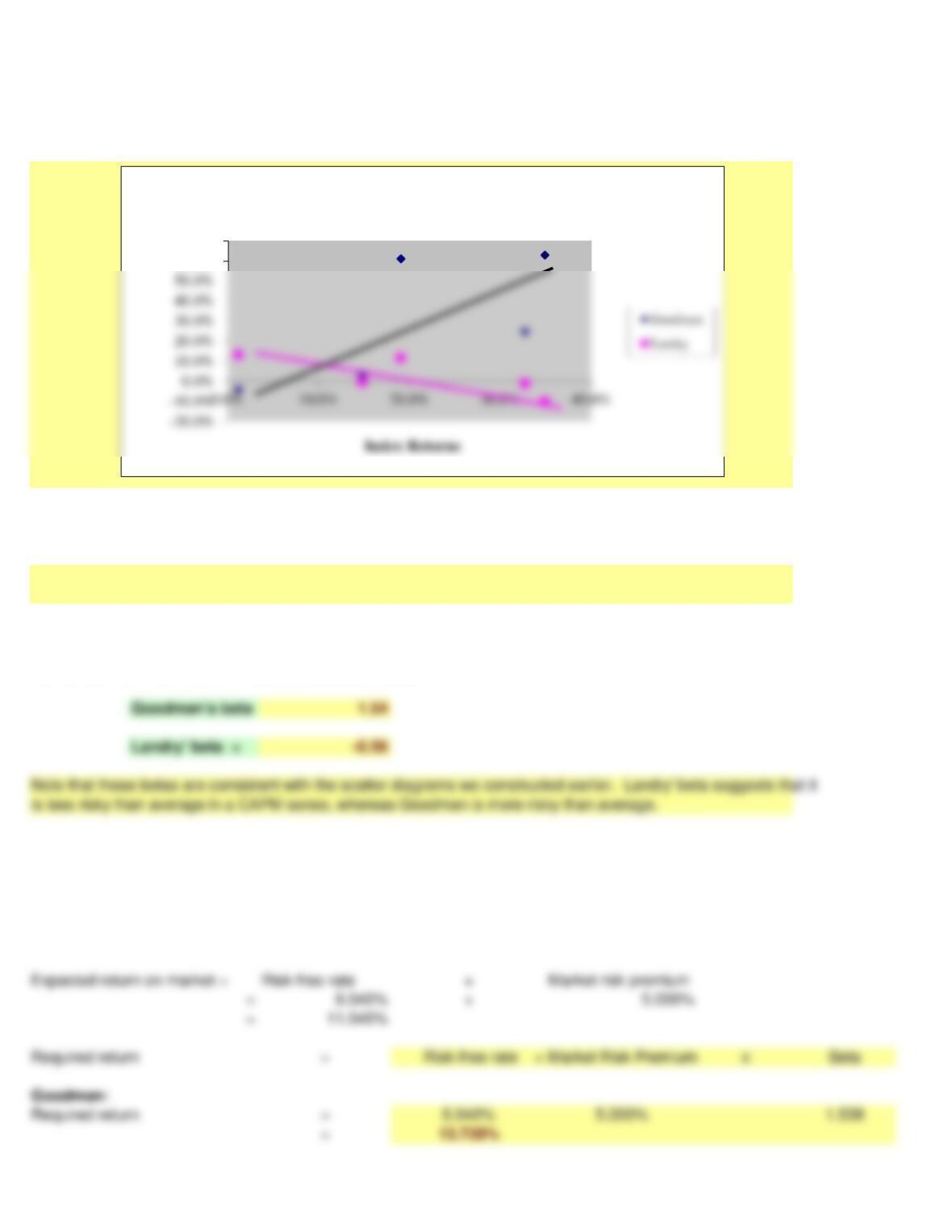
2018 1.2% -4.2% 13.2%
2017 34.9% 62.7% -10.0%
2016 14.8% 2.9% -0.4%
2015 19.0% 60.9% 11.7%
It is clear that Goodman moves with the market and Landry moves counter to the market. So, Goodman has a positive
beta and Landry a negative one.
Market risk premium (RPM) = 5.000%
Risk-free rate = 6.040%
To make the graph, we first selected the range with the returns and the column heads, then clicked the chart
wizard, then choose the scatter diagram without connected lines. That gave us the data points. We then used
the drawing toolbar to make free-hand (“by eye”) regression lines, and changed the lines color and weights to
d. Estimate Goodman’s and Landry’s betas as the slopes of regression lines with stock returns on
the vertical axis (y-axis) and market return on the horizontal axis (x-axis). (Hint: use Excel’s SLOPE
function.) Are these betas consistent with your graph?
e. The risk-free rate on long-term Treasury bonds is 6.04%. Assume that the market risk premium is 5%. What is
the expected return on the market? Now use the SML equation to calculate the two companies’ required returns.
60.0%
70.0%
Stocks’ Returns
Stock Returns Vs. Index
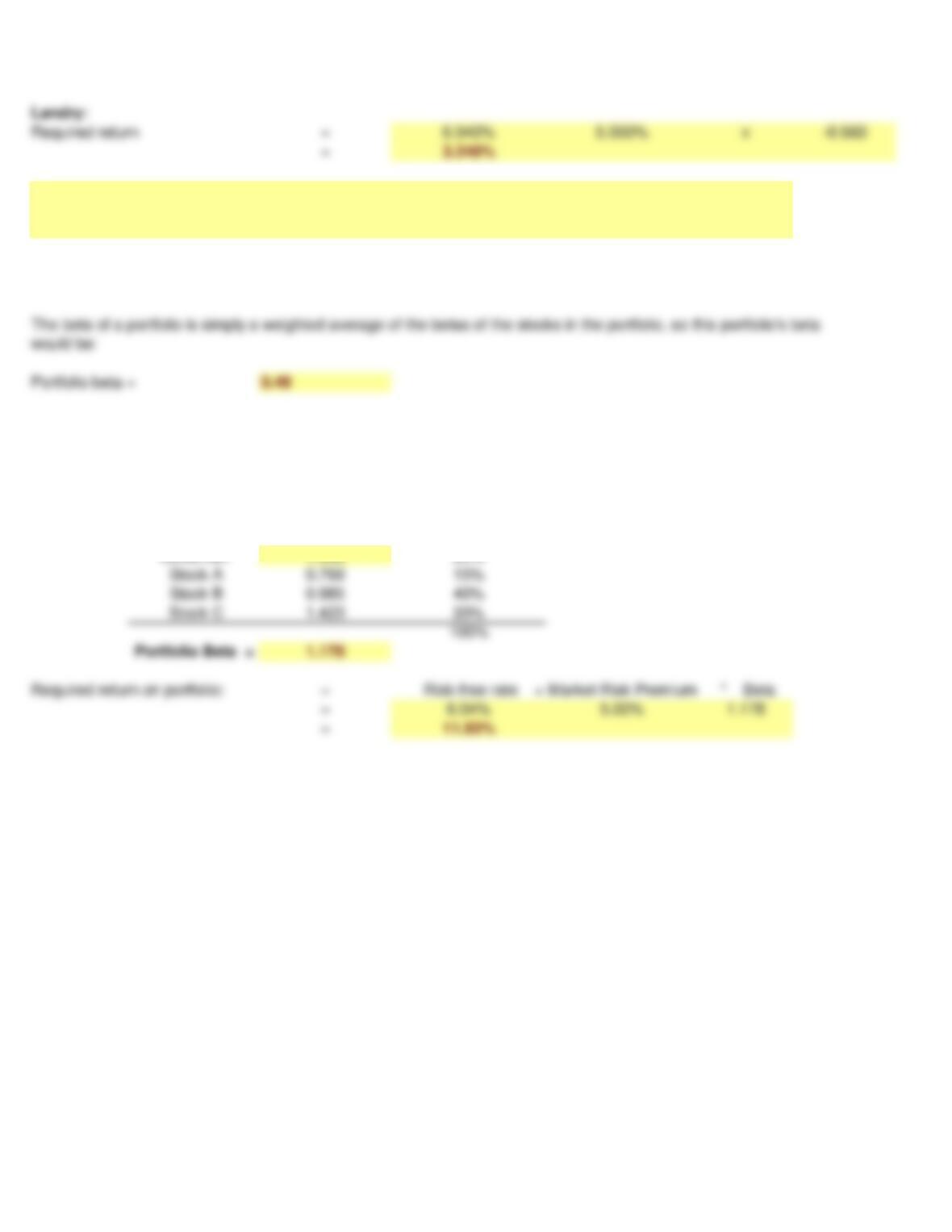
This suggests that Landry’ stock is like an insurance policy that has a low expected return, but it will pay off in the
event of a market decline. Actually, it is hard to find negative beta stocks, so we would not be inclined to believe the
Landry data.
Beta Portfolio Weight
Goodman 1.538 25%
f. If you formed a portfolio that consisted of 50% Goodman stock and 50% Landry stock, what would
be its beta and its required return?
g. Suppose an investor wants to include Goodman Industries’ stock in his or her portfolio. Stocks A,
B, and C are currently in the portfolio, and their betas are 0.769, 0.985, and 1.423, respectively.
Calculate the new portfolio’s required return if it consists of 25% of Goodman, 15% of Stock A, 40% of
Stock B, and 20% of Stock C.