
Chapter 6
Budgeting
Go to the Chapter 6 folder in the Additional Instructor Resources & Solutions folder to find
the Excel spread sheets that accompany the material in this chapter.
Chapter Overview
I. Introduction
II. What is a budget?
a. Relation of planning and forecasting to budgeting
i. Planning
ii. Forecasting
1. Guidelines for forecasting
III. Budget preparation
a. Timing and budgets
i. Budget time horizon
ii. Business planning horizon
iii. Strategic planning horizon
b. Keys to successful budgeting
c. Best practices in budgeting
iii. Decision packages
iv. Ranking decision packages
v. Allocating resources
vi. Advantages and disadvantages
V. Budgets within budgets
a. Revenue budget
b. Expense budget
c. Cash budget
d. Capital expenditure budget
VI. Conclusion
Key Concepts
When reading this chapter, students should focus on the following key concepts.
1. For most sport organizations, budgeting is a tool for financial planning and
reflects management’s opinions about future financial circumstances.
2. Four main approaches to budgeting exist: incremental, program planning, zero-
based, and modified zero-based. Each method has its own advantages and
disadvantages.
Quiz Questions
1. Which of the followings forms of budgeting is preferred in sport as it begins with
a floor of expenses while also using cost behavior and cost identification
techniques?
a. Incremental budgeting
b. Program planning budgeting systems
2. Last year’s budget is increased or decreased by a percentage using this method
of budgeting (a form of line-item budgeting).
d. Zero based budgeting
e. Modified zero based budgeting
3. This budgeting system is associated with output budgeting in which specific goals
and objectives form the framework for a strategic, goal oriented budgeting
process.
a. Incremental budgeting
b. Program planning budgeting systems
4. This budgeting system requires starting the budgeting process with a zero base.
d. Zero based budgeting
e. Modified zero based budgeting
5. Which of the following budgets allows management to forecast future
requirements related to property, facilities, and major equipment?
a. Revenue budget
b. Expense budget
6. A __________ is a forecast because it is based on projecting future sales.
a. Revenue budget
e. Fixed asset budget
7. The __________ lists the primary activities undertaken by a unit to achieve its
goals and allocate dollar amounts to each.
a. Revenue budget
b. Expense budget
8. The __________ forecasts how much cash the organization will have on hand
and how much it will need to meet expenses.
d. Capital expenditure budget
e. Fixed asset budget
9. When using zero-based budgeting, each part of the organization in which budget
decisions are made is referred to as a __________.
d. Decision unit
e. None of the above
10. Of the following, which is not an advantage of incremental budgeting?
a. The budget is stable and change is gradual.
b. The approach encourages managers to spend up to the budget to ensure
that the budget is maintained the following year.
Answers to Quiz Questions
1. e (p. 159–163)
2. a (p. 147)
Responses
1. Why is the budgeting process important to the success of a sport organization?
See page 142. A budget is the financial plan for the organization based on
projections resulting from a most-likely scenario of the organization’s financial
2. How do budgeting and forecasting differ?
See pages 142–144. A forecast is a prediction of future events and their
quantification for the purpose of budgeting; it is simply a prediction of what will
3. How does incremental budgeting differ from program planning budgeting? How
does it differ from zero-based budgeting?
See pages 147–159. Using incremental budgeting methods, next year’s budget
will be determined by increasing or decreasing the individual revenue and
expense lines by the same percentage. Incremental budgeting differs from
4. What are the advantages and disadvantages of incremental budgeting?
See page 151 (Exhibit 6.2).
Advantages:
• The budget is stable, and change is gradual.
• Managers can operate their departments on a consistent basis.
• The budget is relatively simple to prepare and easy to understand.
Disadvantages:
• Activities and methods of working are assumed to continue in the
same way as before.
• The budget process provides no incentive for developing new ideas.
5. How does program planning budgeting differ from zero-based budgeting?
See pages 151–159. Both methods include performance objectives and
6. What are the advantages and disadvantages of program planning budgeting?
See page 154 (Exhibit 6.4).
Advantages:
• Enables an organization to allocate its resources purposefully.
• Shows managers how their department’s work relates to the whole
organization.
Disadvantages:
• Limits flexibility to shift dollars between programs.
• Increases the potential for conflict if programs with strong support
receive cuts.
7. What are the advantages and disadvantages of zero-based budgeting?
See page 159 (Exhibit 6.6).
Advantages:
• Forces budget setters to examine every item
• Allocates resources based on results and needs
• Fosters a questioning attitude
Disadvantages:
• Is a complex, time-consuming process
• May result in emphasis on short-term benefits to the detriment of
long-term planning
8. How does modified zero-based budgeting differ from zero-based budgeting?
See pages 154–163. MZBB does not roll back the budget to zero, as does ZBB.
9. What are the advantages and disadvantages of modified zero-based budgeting?
See page 164 (Exhibit 6.9).
Advantages:
• Focuses budget setters on variable costs
• Allocates resources based on results and variable needs
Disadvantages:
• May result in emphasis on short-term benefits to the detriment of
long-term planning
• Does not consider previous money outlays
10. In team sport (professional or college), which form of budgeting should be used?
See pages 159–163. To contain costs and reduce budgetary inflation, MZBB
should be used. This is especially true as team sport operates in the service
Responses
1. See the Practice Problems Excel file (Ch06 Practice Problems Solutions, in the
Additional Instructor Resources & Solutions folder) for the solution to Problem 1.
2. After you have calculated the 2016 budget (see Problem 1), suppose your boss
asks you to revise it so that overall revenues increase by 4% and operating
expenses decrease by 1.5%.
a. Based on current trends in facility management, what revenues do you
anticipate can be increased? What expenses can be decreased?
One possibility is presented here with the related budget in the Practice
Problems Excel file:
As the economy is currently growing, suite revenue and club seat
revenue can be slightly raised (2%) despite declining ticket
sponsorship revenue may increase through a combination of
increased rates and/or increased sales. A conservative 2% growth
estimate will be made for this revenue source. I would also raise
rent by 0.5% so that it would be increased an even 6% from 2015.
For expenses, be sure to discuss which ones may be fixed through
contract (i.e., management fee, insurance). One possibility is as follows:
I would reduce the amount in the reserve by $50,000 as there was
$2.8 million in operating income in 2015. Though, with the
b. Use the 2016 budget that you created in Problem 1 and create a new
2016 budget based on the revenue increases and expense decreases as
outlined in Problem 2 and your work on Problem 2a.
Responses to Questions
1. If you were advising the athletic director at CAU, what budgeting advice would
you provide?
The athletic director has to figure out a way to reduce spending or increase
revenues. Recent economic pressures faced by many universities makes deficit
2. What budgeting approach should the athletic department use if it intends to
balance its budget in the 2015 fiscal year?
I would question every expenditure, as departmental expenditures were $16
million greater than department generated revenues. I would recommend ZBB
3. For the average athletic department, which budgeting method would most likely
keep the program from running a deficit? Why?
For the average department, MZBB or ZBB would most likely keep programs
Additional Classroom/Exam Problem
Note: The solution to this problem is in the related Chapter 6 Additional Problem with
Solution Excel file (in the Additional Instructor Resources & Solutions folder). You’ll
also need the Chapter 6 Student Excel File for Additional Problem.
Problem:
organization, was not good at his job, unfortunately. The financials are a mess. In
addition, the president of the club is asking you to create pro forma financials for the
next fiscal year. The information is not altogether good, but you know how to create
financial statements for the club. The facts you do know regarding the financial
operation of the club are as follows:
a. You have a copy of last year’s financials (balance sheet and income statement)
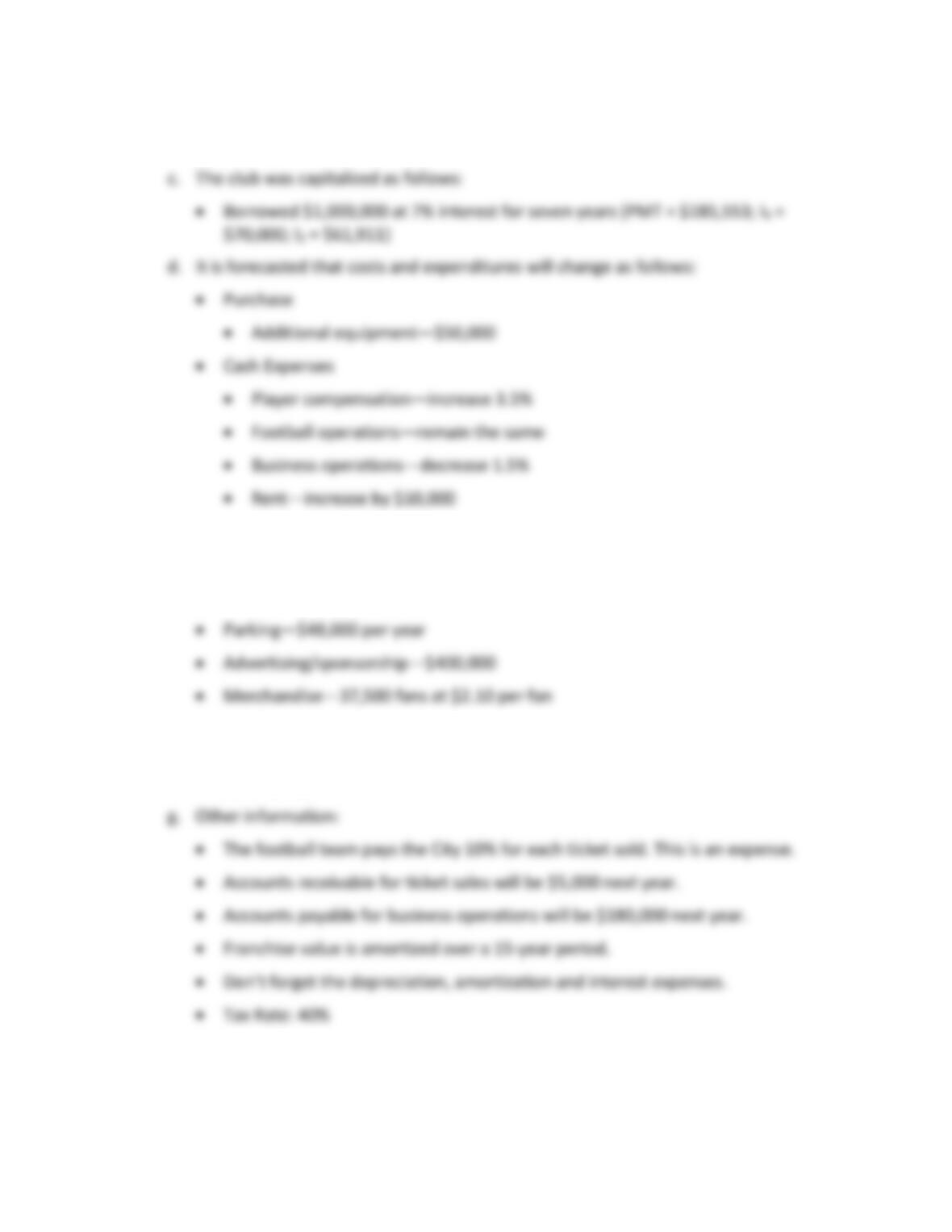
b. The club was purchased last year for $1 million and uses the accrual basis of
accounting.
e. The team is expected to generate cash receipts as follows:
• Ticket sales—37,500 fans at $16.25 per ticket
• Concessions—37,500 fans at $3.50 per fan
f. Depreciation:
• All short-term fixed assets depreciated over a 5-year life using the straight
line method
To Do: Using Excel, Prepare Pro Forma Financials for the Next Fiscal Year.