
Chapter 6
Money Markets
Outline
Money Market Securities
Treasury Bills
Commercial Paper
Institutional Use of Money Markets
Globalization of Money Markets
International Interbank Market

Chapter 6: Money Markets ❖ 2
Key Concepts
1. Explain the main role of money market securities.
POINT/COUNTER-POINT:
Should Firms Invest in Money Market Securities?
COUNTER-POINT: Yes. Firms need money markets for liquidity. If they do not hold any money market
securities, they will frequently be forced to borrow to cover unanticipated cash needs. The lenders may
charge higher risk premiums when lending so frequently to these firms.
WHO IS CORRECT? Use the Internet to learn more about this issue and then formulate your own
opinion.
ANSWER: Firms should not hold an excessive amount of money in the form of money market securities.
But they should invest in money market securities so that they have access to funds before being forced to
rely on short-term loans.
Questions
1. Primary Market. Explain how the Treasury uses the primary market to obtain adequate funding
from the U.S. government.
ANSWER: The Treasury issues Treasury bills through a weekly auction. Investors can submit
2. T-bill Auction. How can investors using the primary T-bill market be assured that their bid will be
accepted? Why do large corporations typically make competitive bids rather than noncompetitive bids
for T-bills?
ANSWER: Noncompetitive bids in the Treasury auction ensure acceptance by the Treasury.

Chapter 6: Money Markets ❖ 3
3. Secondary Market for T-bills. Describe the activity in the secondary T-bill market. How can this
degree of activity benefit investors in T-bills? Why might a financial institution sometimes consider
T-bills as a potential source of funds?
ANSWER: The secondary market for Treasury bills is very active, which makes Treasury bills more
4. Commercial Paper. Who issues commercial paper? Which types of financial institutions issue
commercial paper? Why do some firms create a department that can directly place commercial
paper? Which criteria affect the decision to create such a department?
ANSWER: Commercial paper is normally issued by well-known, creditworthy firms.
5. Commercial Paper Ratings. Why do ratings agencies assign ratings to commercial paper?
6. Commercial Paper Rates. Explain how investors’ preferences for commercial paper change during a
recession. How would this reaction affect the difference between commercial paper rates and T-bill
rates during recessionary periods?
7. Negotiable CDs. How can small investors participate in investments in negotiable certificates of
deposits (NCDs)?
ANSWER: Money market funds can pool invested funds by individual investors and purchase NCDs.
8. Repurchase Agreements. Based on what you know about repurchase agreements, would you expect
them to have a lower or higher annualized yield than commercial paper? Why?
ANSWER: Repurchase agreements with a similar maturity as commercial paper would likely have a
9. Banker’s Acceptances. Explain how each of the following would use banker’s acceptances: (a)
exporting firms, (b) importing firms, (c) commercial banks, and (d) investors.

Chapter 6: Money Markets ❖ 4
ANSWER: A banker’s acceptance can (a) protect an exporter from the risk of nonpayment by the
10. Foreign Money Market Yield. Explain how the yield on a foreign money market security would be
affected if the foreign currency denominating that security declined to a significant degree.
ANSWER: The foreign money market yield would be reduced if the foreign currency denominating the
11. Motive to Issue Commercial Paper. The maximum maturity of commercial paper is 270 days. Why
would a firm issue commercial paper instead of longer-term securities, even if it needs funds for a
long period of time?
ANSWER: The firm may be unwilling to lock in the prevailing long-term yield on bonds, perhaps
12. Risk and Return of Commercial Paper. You have the choice of investing in top-rated commercial
paper or commercial paper that has a lower risk rating. How do you think the risk and return
performances of the two investments differ?
ANSWER: The commercial paper with the lower rating should have a higher rate of return and also a
13. Commercial Paper Yield Curve. How do you think the shape of the yield curve for commercial
paper and other money market instruments compares to the yield curve for Treasury securities?
Explain your logic.
ANSWER: The shape of the commercial paper yield curve is generally upward sloping, but it only
Advanced Questions
14. Influence of Money Market Activity on Working Capital. Assume that interest rates for most
maturities are unusually high. Also assume that the net working capital (defined as current assets
minus current liabilities) levels of many corporations are relatively low in this period. Explain how
the money markets play a role in this relationship between the interest rates and the level of net
working capital.
ANSWER: When interest rates are relatively high, corporations are unwilling to issue long-term debt

15. Applying Term Structure Theories to Commercial Paper. Apply the term structure of interest rate
theories that were discussed in Chapter 3 to explain the shape of the existing commercial paper yield
curve.
ANSWER: The yields offered on commercial paper can vary because of liquidity differences,
segmented maturity markets, or interest rate expectations. Other things being equal, longer-term
16. How Money Market Rates Should Respond to Prevailing Conditions. How have money market
rates changes since the beginning of the semester? Consider the existing economic conditions. Do you
think money market rates will increase or decrease during the semester? Offer some logic to support
your answer.
ANSWER: This question is open-ended. It requires students to apply the concepts that were presented
17. Impact of Lehman Brothers Failure. Explain how the bankruptcy of Lehman Brothers (a large
securities firm) reduced the liquidity of the commercial paper market.
18. Bear Stearns and the Repo Market. Explain the lesson to be learned about the repo market based
on the experience of Bear Stearns.
ANSWER: The repo market funding requires collateral that is trusted by investors, and when
19. Impact of Credit Crisis on Liquidity. Explain why the credit crisis affected the ability of
financial institutions to access short-term financing in the money markets.
ANSWER: The credit crisis of 2008 had a major impact on the perceived credit risk of money market
20. Impact of Credit Crisis on Risk Premiums. Explain how the credit crisis affected the credit
risk premium in the commercial paper market.
ANSWER: During the credit crisis, some institutional investors avoided commercial paper issued by

21. Systemic Risk. Explain how systemic risk is related to the commercial paper market. That is, why
did problems in the market for mortgage-backed securities affect the commercial paper market?
ANSWER: Some issuers of asset-backed commercial paper used mortgage-backed securities (MBS)
as collateral. As the value of MBS declined during the credit crisis, institutional investors were no
22. Commercial Paper Credit Guarantees. Explain why investors that provided guarantees
on commercial paper were exposed to so much risk during the credit crisis.
ANSWER: During the credit crisis, the financial institutions providing credit guarantees were also
CRITICAL THINKING QUESTION
Money Market Funding During a Credit Crisis. Many financial institutions borrow heavily in the
money markets using mortgages and mortgage-backed securities as collateral. Write a short essay about
the lessons of the credit crisis to the deficit units and the surplus units that participate in the money
markets? Should money markets be regulated to a greater degree to ensure proper collateral in money
markets?
ANSWER
Deficit units need higher quality mortgages to serve as collateral, because surplus units were unwilling to
provide funding during the crisis based on mortgages of questionable quality. Deficit units that constantly
Interpreting Financial News
Interpret the following statements made by Wall Street analysts and portfolio managers.
a. “Money markets are not used to get rich, but to avoid being poor.”
Money markets provide a low return but have low risk. Investors maintain investments in money
market securities for safety and liquidity.

Chapter 6: Money Markets ❖ 7
b. “Until conditions are more favorable, investors are staying on the sidelines.”
Managing in Financial Markets
As a treasurer of a corporation, one of your jobs is to maintain investment in liquid securities such as
Treasury securities and commercial paper. Your goal is to earn as high a return as possible, but without
taking much of a risk.
a. The yield curve is currently upward sloping, such that 10-year Treasury bonds have an annualized
yield 3 percentage points above the annualized yield of three-month T-bills. Should you consider
using some of your funds to invest in 10-year Treasury securities?
No, unless you are willing to bear the risk. Ten-year Treasury bonds are subject to a high degree
b. Assume that your firm has substantially more cash than it would possibly need for any liquidity
problems. Your boss suggests that you consider investing the excess funds in some money market
securities that have a higher return than short-term Treasury securities, such as negotiable
certificates of deposit (NCDs). Even though NCDs are less liquid, this would not cause a problem
if your firm has more funds than it needs. Given the situation, which use of the excess funds
would benefit the firm the most?
The excess funds should not be invested in money market securities. If these funds are not needed
c. Assume that commercial paper is presently offering an annualized yield of 7.5 percent, while
Treasury securities are offering an annualized yield of 7 percent. Economic conditions have been
stable, and you expect conditions to be very favorable over the next six months. Given this
situation, would you prefer to hold T-bills, or a diversified portfolio of commercial paper issued
by various corporations?
d. Assume that commercial paper typically offers a premium of 0.5 percent above the T-bill rate.
Given that your firm typically maintains about $10 million in liquid funds, how much extra will

Chapter 6: Money Markets ❖ 8
you generate per year by investing in commercial paper versus T-bills? Is this extra return worth
the risk that the commercial paper could default?
Given an extra .5 percent per year, you would generate an extra $50,000 per year, as long as the
commercial paper did not default. There will be mixed opinions about whether the extra return is
Problems
1. T-bill Yield. Assume an investor purchased a six-month T-bill with a $10,000 par value for $9,000
and sold it ninety days later for $9,100. What is the yield?
ANSWER:
Y
SP –
PP
SP
365
n
=
t
=
2. T-bill Discount. Newly issued three-month T-bills with a par value of $10,000 sold for $9,700.
Compute the T-bill discount.
ANSWER:
Y
Par
PP
Par
360
n
90
D
=
−

Chapter 6: Money Markets ❖ 9
3. Commercial Paper Yield. Assume an investor purchased six-month commercial paper with a face
value of $1,000,000 for $940,000. What is the yield?
ANSWER:
4. Repurchase Agreement. Stanford Corporation arranged a repurchase agreement in which it
purchased securities for $4,900,000 and will sell the securities back for $5,000,000 in 40 days. What
is the yield (or repo rate) to Stanford Corporation?
ANSWER:
Repo rate
=
SP
−
PP
PP
360
n
5. T-bill Yield. You paid $98,000 for a $100,000 T-bill maturing in 120 days. If you hold it until
maturity, what is the T-bill yield? What is the T-bill discount?
ANSWER:
T-bill yield YT = (SP – PP/PP)(365 / n)
6. T-bill Yield. The Treasury is selling 91-day T-bills with a face value of $10,000 for $9,900. If the
investor holds them until maturity, calculate the yield.
ANSWER:
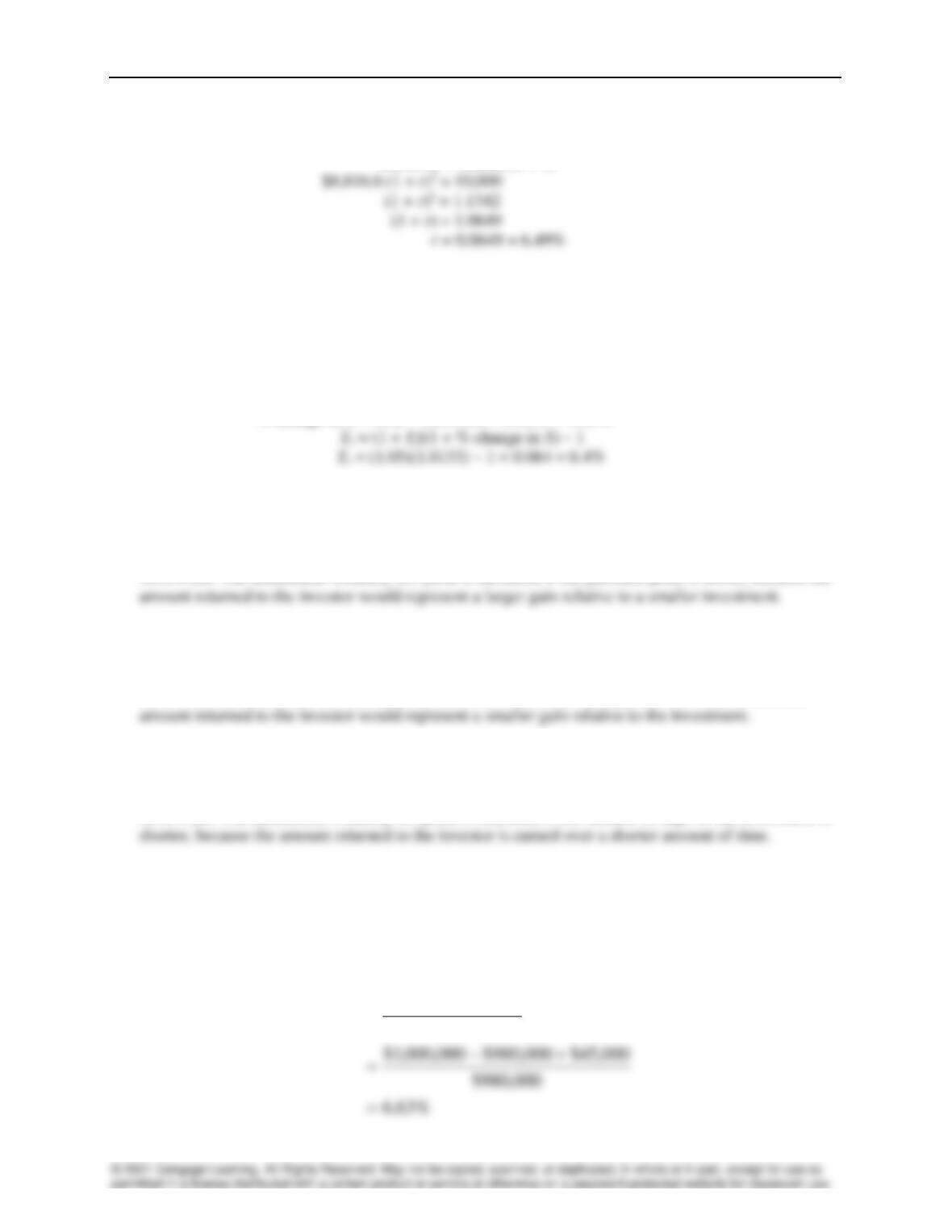
7. Required Rate of Return. A money market security that has a par value of $10,000 sells for
$8,816.60. Given that the security has a maturity of two years, what is the investor’s required rate of
return?
Chapter 6: Money Markets ❖ 10
ANSWER:
8. Effective Yield. A U.S. investor obtains British pounds when the pound is worth $1.50 and invests in
a one-year money market security that provides a yield of 5 percent (in pounds). At the end of one
year, the investor converts the proceeds from the investment back to dollars at the prevailing spot rate
of $1.52 per pound. Calculate the effective yield.
ANSWER:
9. T-bill Yield.
a. Determine how the annualized yield of a T-bill would be affected if the purchase price were
lower. Explain the logic of this relationship.
b. Determine how the annualized yield of a T-bill would be affected if the selling price were lower.
Explain the logic of this relationship.
ANSWER: The annualized Treasury bill yield is reduced if the selling price is lower, because the
c. Determine how the annualized yield of a T-bill would be affected if the number of days were
reduced, holding the purchase price and selling price constant. Explain the logic of this relationship.
10. Return on NCDs. Phil purchased an NCD a year ago in the secondary market for $980,000. The
NCD matures today at a price of $1,000,000, and Phil received $45,000 in interest. What is Phil’s
return on the NCD?
ANSWER:
Interest
Yield
+−
=PP
PPSP

Chapter 6: Money Markets ❖ 11
Flow of Funds Exercise
Financing in the Money Markets
Recall that Carson Company has obtained substantial loans from finance companies and commercial
banks. The interest rate on the loans is tied to market interest rates and is adjusted every six months. It has
a credit line with a bank in case it suddenly needs to obtain funds for a temporary period. It previously
purchased Treasury securities that it could sell if it experiences any liquidity problems.
a. The prevailing commercial paper rate on paper issued by large publicly traded firms is lower than
the rate Carson would pay when using a line of credit. Do you think that Carson could issue
commercial paper at this prevailing market rate?
No. Carson has a large amount of debt and would not be able issue commercial paper. It relies
b. Should Carson obtain funds to cover payments for supplies by selling its holdings of Treasury
securities or by using its credit line? Which alternative has a lower cost? Explain.
Carson should consider selling its holdings of Treasury securities, because the cost of forgoing