CHAPTER 6, Case #2
GOODWEEK TIRES, INC.
The cash flow to start the project is the $160 million equipment cost and the $9 million required for
net working capital, yielding a total cash outflow today of $169 million. The research and development
costs and the marketing test are sunk costs.
We can calculate the future cash flows on a nominal basis or a real basis. Since the depreciation is
given in nominal values, we will calculate the cash flows in nominal terms. The same solution can be
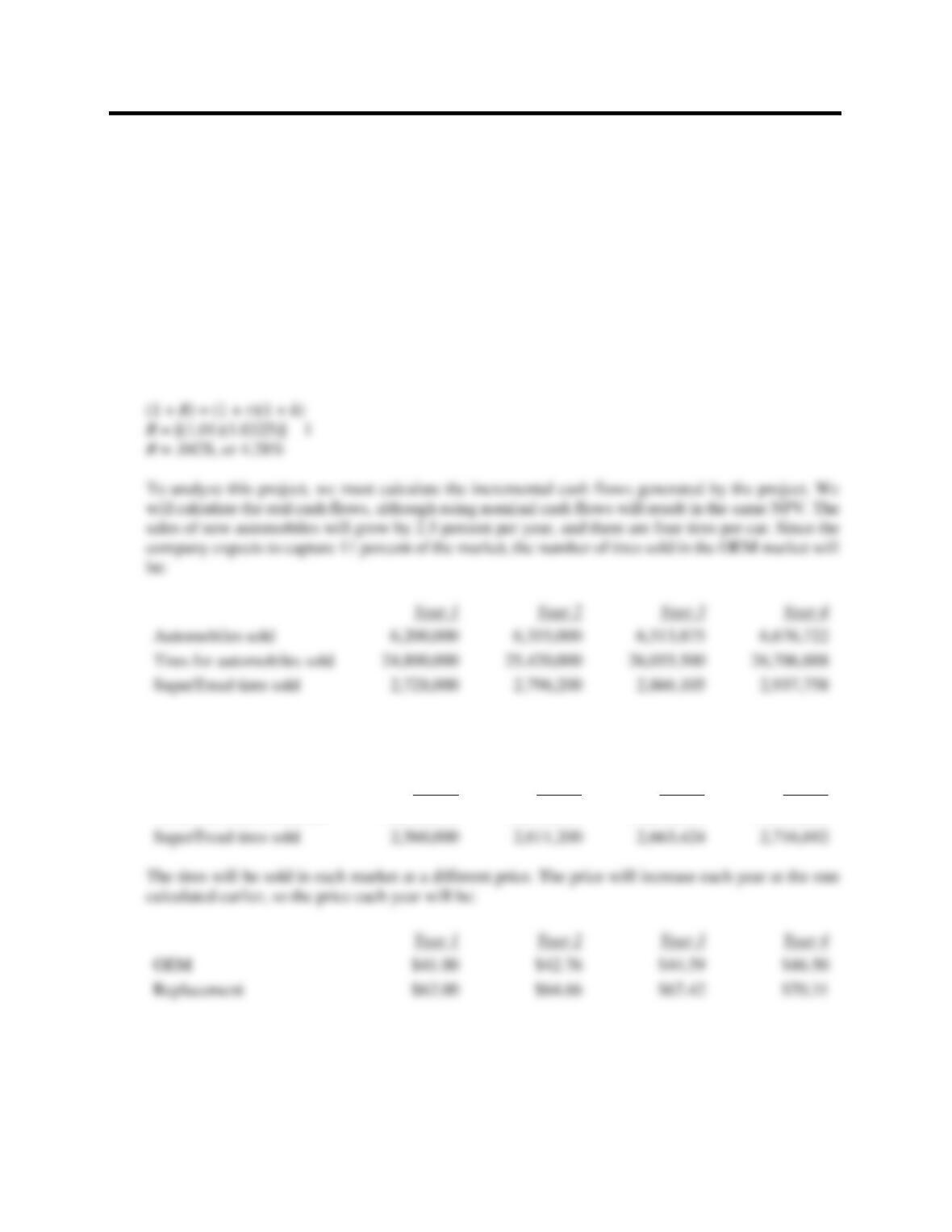
found using real cash flows. Since the price and variable costs increase by 1 percent, and the inflation
rate is 3.25 percent, the nominal growth in both variables is:
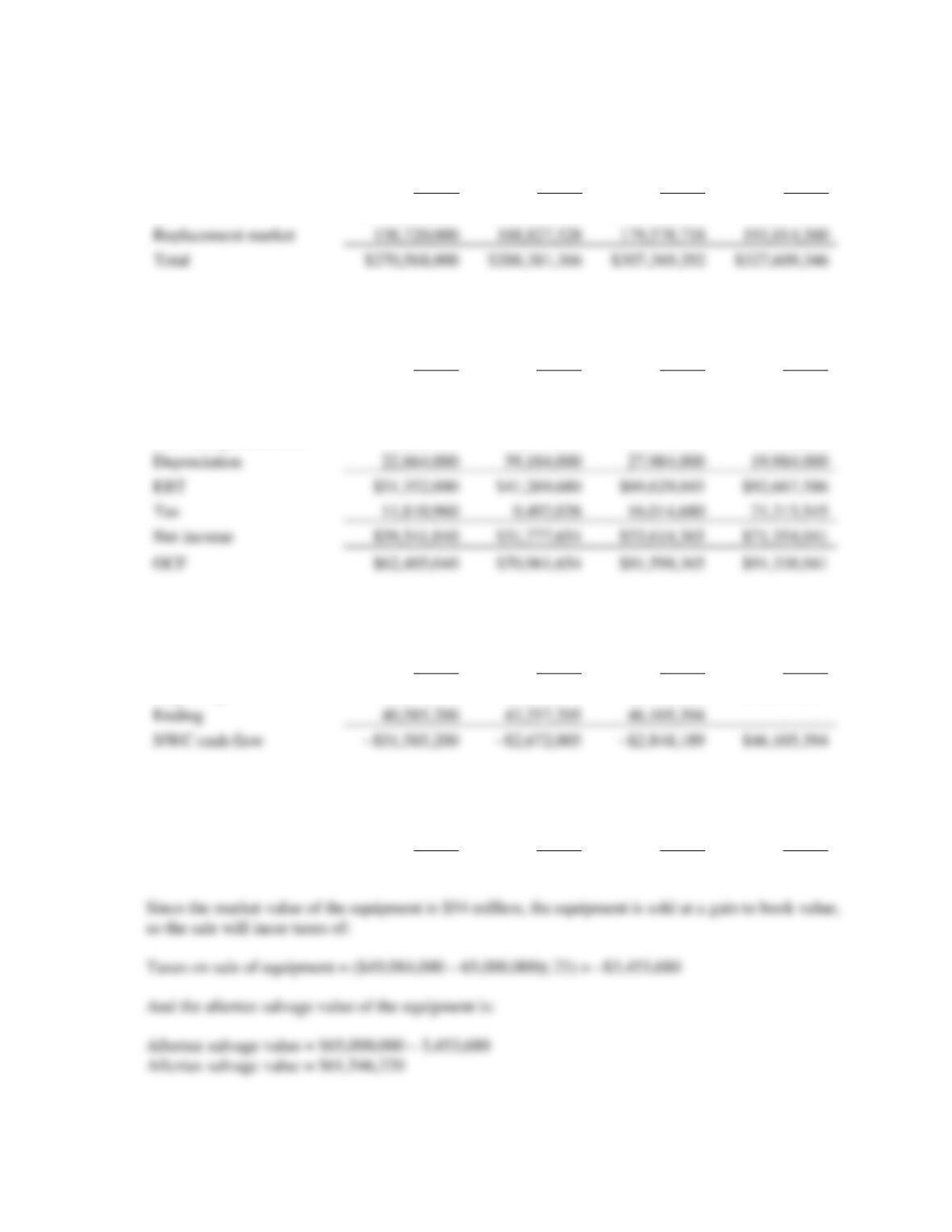
The number of tires sold in the replacement market will grow at 2 percent per year, and Goodweek
will capture 8 percent of the market. So, the number of tires sold in the replacement market will be:
Year 1
Year 2
Year 3
Year 4
Total tires sold in market
32,000,000
32,640,000
33,292,800
33,958,656
Year 1
Year 2
Year 3
Year 4
Replacement
Year 1
Year 2
Year 3
Year 4
Tires for automobiles sold
24,800,000
25,420,000
26,055,500
26,706,888
SuperTread tires sold
Multiplying the number of tires sold in each market by the respective price in that market, the revenue
each year will be:
Year 1
Year 2
Year 3
Year 4
OEM market
$111,848,000
$119,553,838
$127,790,574
$136,594,786
Now we can calculate the incremental cash flows each year. We will calculate the nominal cash flows.
Doing so, we find:
Year 1
Year 2
Year 3
Year 4
Revenue
$270,568,000
$288,381,366
$307,369,292
$327,609,346
Variable costs
153,352,000
163,530,185
163,915,828
167,627,528
Mkt. and general costs
43,000,000
44,397,500
45,840,419
47,330,232
Depreciation
22,864,000
39,184,000
27,984,000
19,984,000
EBT
$51,352,000
$41,269,680
$69,629,045
$92,667,586
Tax
11,810,960
16,014,680
21,313,545
Net income
$39,541,040
$31,777,654
$53,614,365
$71,354,041
$62,405,040
$70,961,654
$81,598,365
$91,338,041
Net working capital is a percentage of sales, so the net working capital requirements will change every
year. The net working capital cash flows will be:
Year 1
Year 2
Year 3
Year 4
Beginning
$9,000,000
$40,585,200
$43,257,205
$46,105,394
Ending
40,585,200
43,257,205
46,105,394
NWC cash flow
$46,105,394
The book value of the equipment is the original cost minus the accumulated depreciation. The book
value of equipment each year will be:
Year 1
Year 2
Year 3
Year 4
Book value of equipment
$137,136,000
$97,952,000
$69,968,000
$49,984,000
Replacement market
158,720,000
168,827,528
179,578,718
191,014,560
Total
$270,568,000
$288,381,366
$307,369,292
$327,609,346
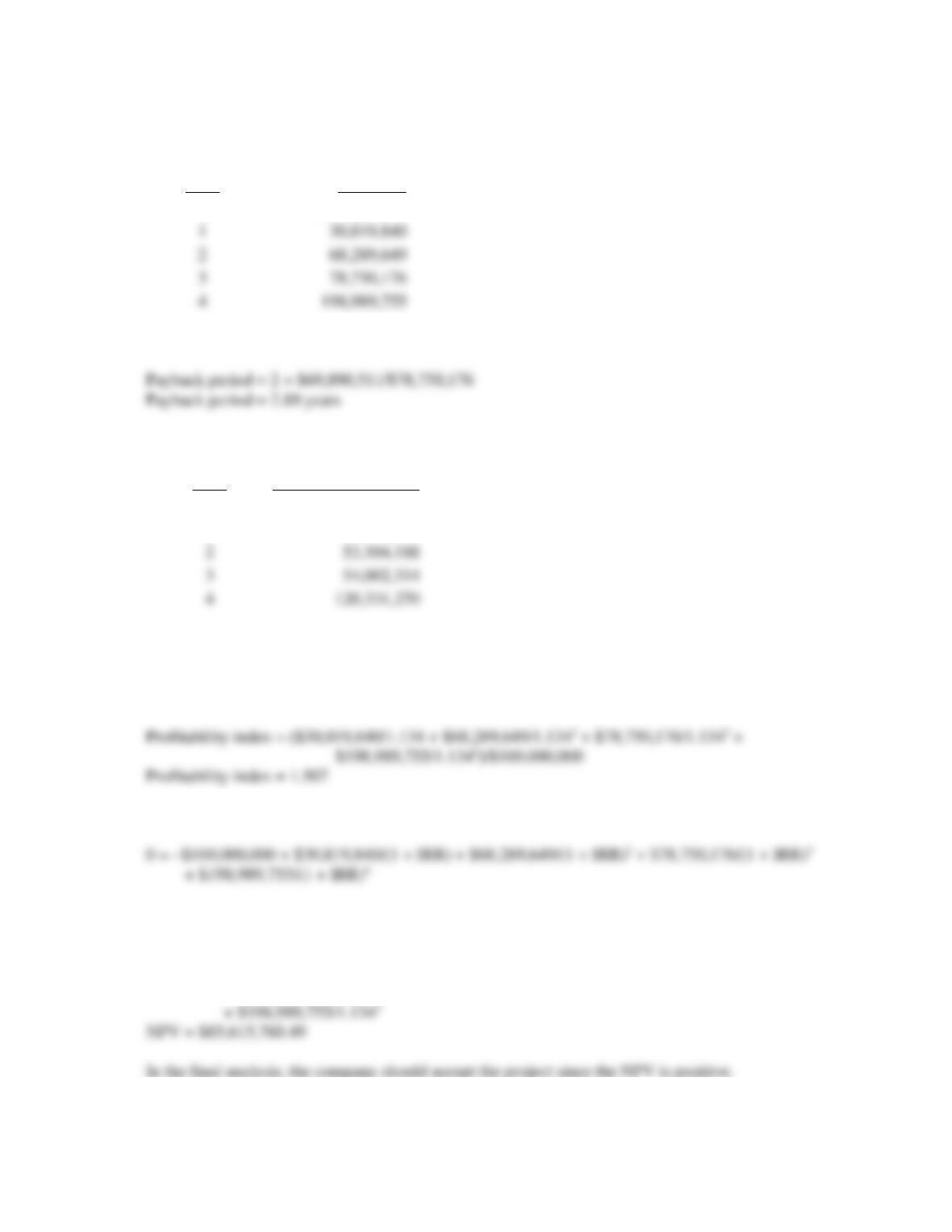
So, the net cash flows each year, including the operating cash flow, net working capital, and aftertax
salvage value, are:
Time
Cash flow
0
–$169,000,000
So, the payback period for the project is:
The discounted cash flows are:
Time
Discounted cash flow
0
–$169,000,000
1
27,177,989
2
53,104,188
3
54,002,314
4
Discounted payback period = 3 + $34,715,509/$120,331,270
Discounted payback period = 3.29 years
The required return for the project is in nominal terms, so the profitability index is:
The equation for IRR is:
Using a spreadsheet or financial calculator, the IRR for the project is:
IRR = 30.17%
NPV = –$169,000,000 + $30,819,840/1.134 + $68,289,649/1.1342 + $78,750,176/1.1343
1
2
3
4