Chapter 6
Accounting for Financial Management
ANSWERS TO BEGINNING-OF–CHAPTER QUESTIONS
6-1 The balance sheet shows the assets, along with the sources of funds used to acquire the
assets, at a point in time, say 12/31/15. The income statement shows the sales and profits
that were produced during an interval of time, say the year 2015. An individual would
6-2 a. WorldCom understated costs. This had the effect of increasing its reported profits
and its net worth. Also, since assets were not reduced by the correct amounts,
reported assets were too high. This caused the reported debt ratio (debt/assets) to be
too low, making the company look stronger than it actually was. Enron essentially
transferred and got off its books debt that it was responsible for, along with assets that
6-3 In essence, the statement of cash flows strips out non-cash charges that are shown on the
income statement and ends up showing the surplus or deficit of cash generated during the
6-4 Net income is the reported after–tax accounting profits, and EPS is net income divided
by the number of shares outstanding. (If options are outstanding, the number of shares
used to find EPS may be adjusted to reflect EPS after options have been exercised.)
EBITDA is operating income before interest, taxes, depreciation, and amortization. This
6-5 Regular accounting statements reported the combined results generated from operating
and non-operating assets (such as marketable security holdings), and cash and non-cash
6-6 Free cash flow shows the cash that is available to investors. Some of the cash is
generated by normal operations—selling items at prices greater than cost—but some may
6-7 a. Interest is deductible to the corporate payer, but dividend payments are not
deductible. This leads to a bias toward debt financing by businesses. Individual
investors must pay taxes on either interest or dividends. So, there is a double taxation
of dividend income (the company pays taxes, and then investors pay taxes on already–
6-8 a. Lowering personal tax rates would leave investors with more disposable income,
which could be spent to stimulate the economy. Also, recognize that small business
income is generally taxed as personal income to the owners, so lowering personal tax
rates would leave more cash to invest in the businesses, thus stimulating the
economy. Lowering corporate tax rates would leave more income to invest or pay
ANSWERS TO END-OF-CHAPTER QUESTIONS
6-1 a. The annual report is a report issued annually by a corporation to its stockholders. It
contains basic financial statements, as well as management’s opinion of the past
year’s operations and the firm’s future prospects. A firm’s balance sheet is a
b. Common Stockholders’ Equity (Net Worth) is the capital supplied by common
stockholders—capital stock, paid–in capital, retained earnings, and, occasionally,
c. The statement of stockholders’ equity shows how much of the firm’s earnings were
retained in the business rather than paid out in dividends. It also shows the resulting
d. Depreciation is a non-cash charge against tangible assets, such as buildings or
machines. It is taken for the purpose of showing an asset’s estimated dollar cost of
Answers and Solutions: 6 – 4
e. Operating current assets are the current assets used to support operations, such as
cash, accounts receivable, and inventory. It does not include short-term investments.
Operating current liabilities are the current liabilities that are a natural consequence of
f. Accounting profit is a firm’s net income as reported on its income statement. Net
cash flow, as opposed to accounting net income, is the sum of net income plus non-
cash adjustments. NOPAT, net operating profit after taxes, is the amount of profit a
g. Market value added is the difference between the market value of the firm (i.e., the
sum of the market value of common equity, the market value of debt, and the market
value of preferred stock) and the book value of the firm’s common equity, debt, and
h. A progressive tax means the higher one’s income, the larger the percentage paid in
taxes. Taxable income is defined as gross income less a set of exemptions and
i. Capital gain (loss) is the profit (loss) from the sale of a capital asset for more (less)
than its purchase price. Ordinary corporate operating losses can be carried backward
for 2 years or forward for 20 years to offset taxable income in a given year.
j. Improper accumulation is the retention of earnings by a business for the purpose of
6-2 The four financial statements contained in most annual reports are the balance sheet,
income statement, statement of stockholders’ equity, and statement of cash flows.
6-3 No, because the $20 million of retained earnings doesn’t mean the company has $20
million in cash. The retained earnings figure represents cumulative amount of net income
6-5 Operating capital is the amount of interest bearing debt, preferred stock, and common
6-6 NOPAT is the amount of net income a company would generate if it had no debt and held
no financial assets. NOPAT is a better measure of the performance of a company’s
6-7 Free cash flow is the cash flow actually available for distribution to investors after the
6-8 If the business were organized as a partnership or a proprietorship, its income could be
taken out by the owners without being subject to double taxation. Also, if you expected
to have losses for a few years while the company was getting started, if you were not
SOLUTIONS TO END-OF-CHAPTER PROBLEMS
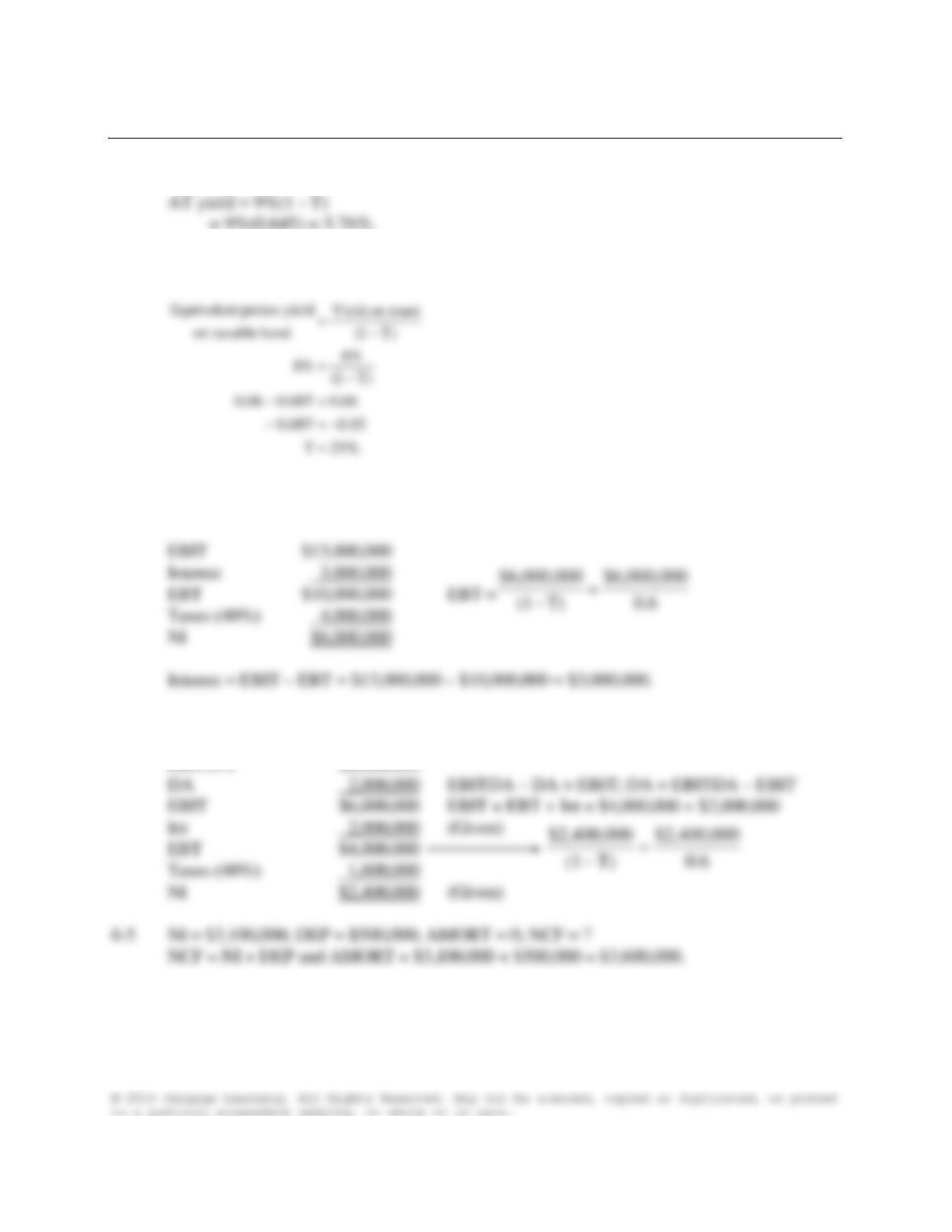
6-1 Corporate yield = 9%; T = 35.5%
6-2 Corporate bond yields 8%. Municipal bond yields 6%.
6-3 NI = $6,000,000; EBIT = $13,000,000; T = 40%; Interest = ?
Need to set up an income statement and work from the bottom up.
6-4 EBITDA = $8,000,000; NI = $2,400,000; Int = $2,000,000; T = 40%; DA = ?
Answers and Solutions: 6 – 7
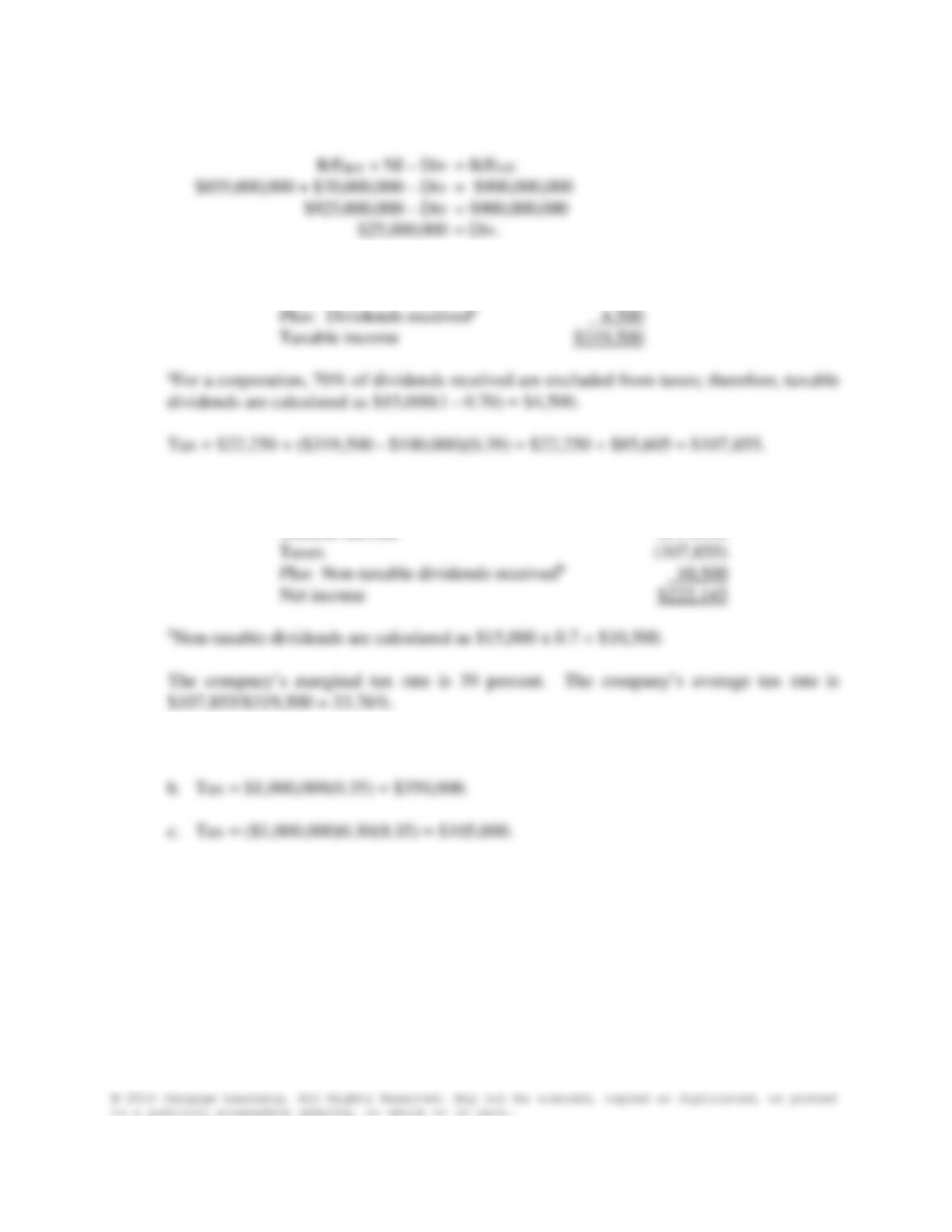
6-6 NI = $70,000,000; R/EY/E = $900,000,000; R/EB/Y = $855,000,000; Dividends = ?
6-7 Income $365,000
Less Interest deduction (50,000)
After–tax income:
Taxable income $319,500
6-8 a. Tax = $3,400,000 + ($10,500,000 – $10,000,000)(0.35) = $3,575,000.
Answers and Solutions: 6 – 8
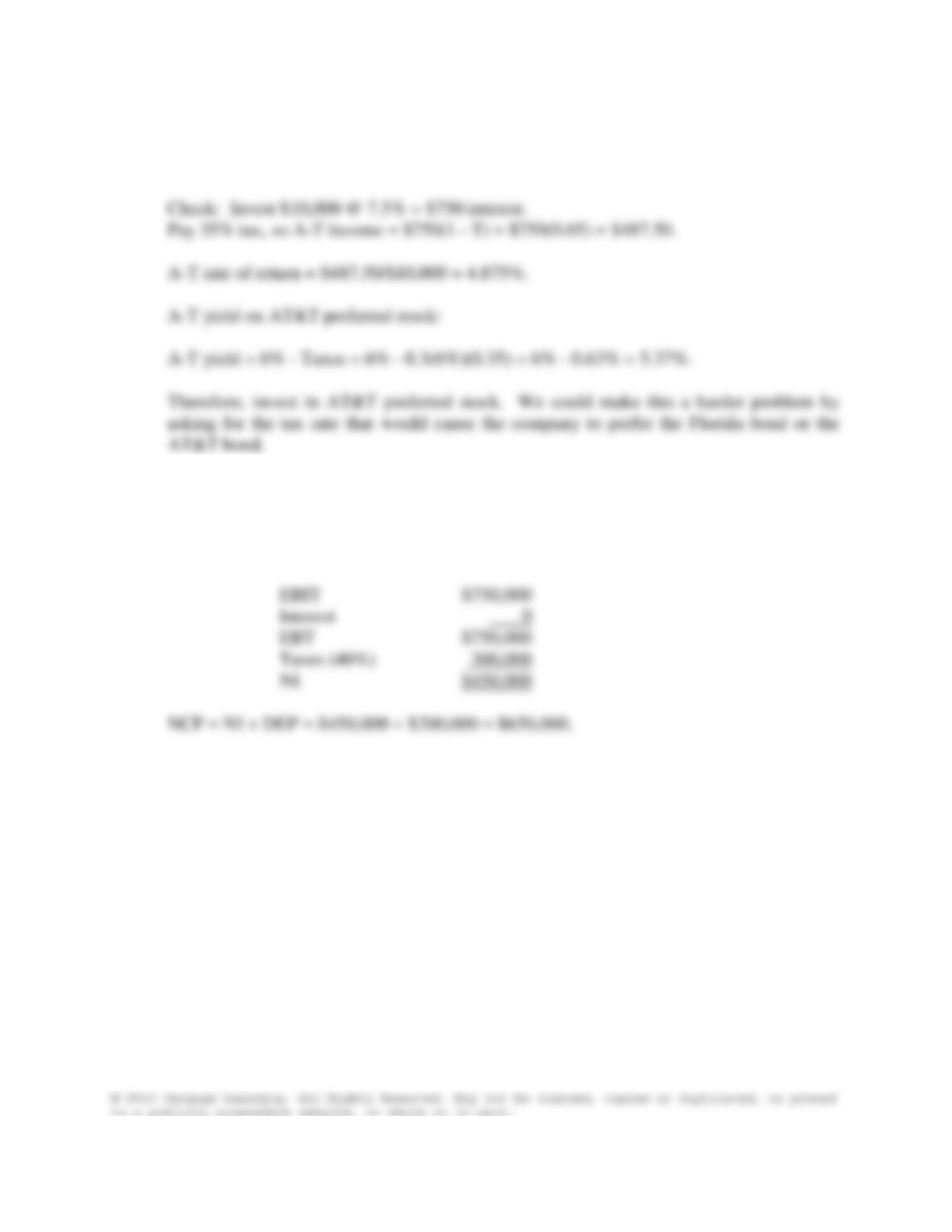
6-9 A-T yield on FLA bond = 5%.
A-T yield on AT&T bond = 7.5% – Taxes = 7.5% – 7.5%(0.35) = 4.875%.
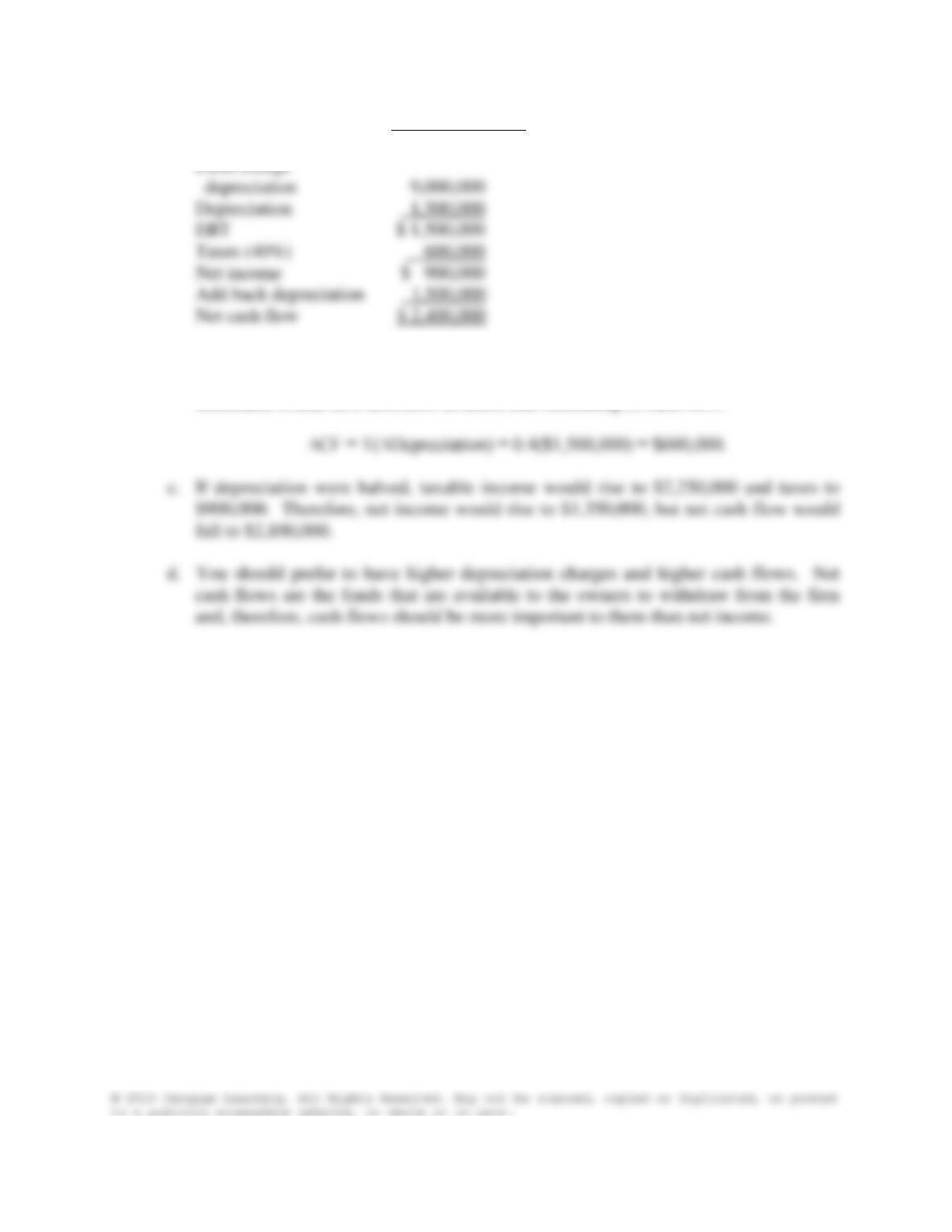
6-10 EBIT = $750,000; DEP = $200,000; 100% Equity; T = 40%
NI = ?; NCF = ?; OCF = ?
First, determine net income by setting up an income statement:
Answers and Solutions: 6 – 9
6-11 a. Income Statement
Sales revenues $12,000,000
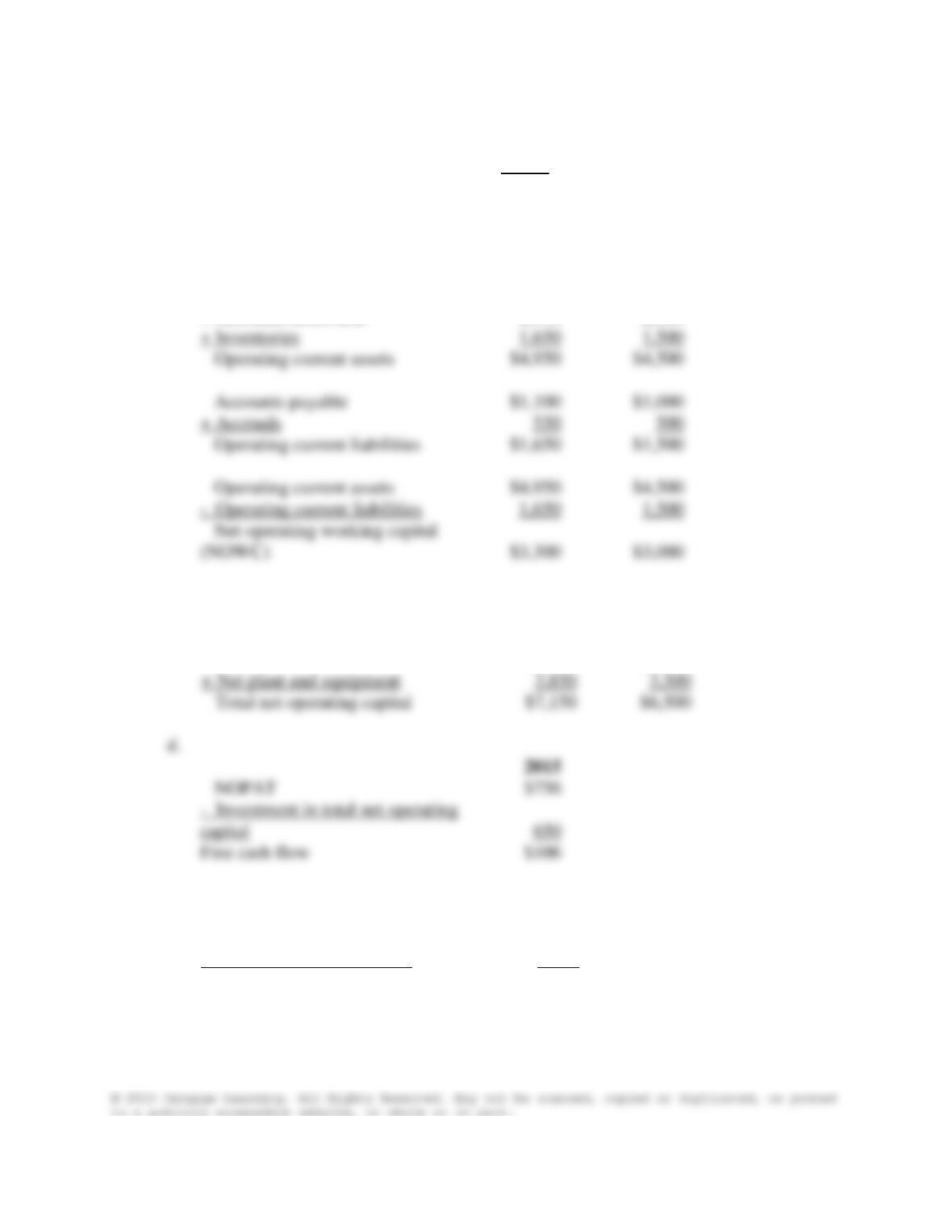
b. If depreciation doubled, taxable income would fall to zero and taxes would be zero.
Thus, net income would decrease to zero, but net cash flow would rise to $3,000,000.
Menendez would save $600,000 in taxes, thus increasing its cash flow:
Answers and Solutions: 6 – 10
6-12 a.
EBIT
$1,260
x (1–Tax rate)
60.0%
Net operating profit after taxes
(NOPAT)
$756
b.
2015
2014
Cash
$550
$500
+ Accounts receivable
2,750
2,500
c.
2015
2014
Net operating working capital
(NOWC)
$3,300
$3,000
+ Net plant and equipment
Total net operating capital
$7,150
$6,500
NOPAT
– Investment in total net operating
650
Free cash flow
e.
2015
NOPAT
$756
÷ Total net operating capital
7,150
Return on invested capital
(ROIC)
10.57%
Answers and Solutions: 6 – 11
1,650
1,500
Operating current assets
Accounts payable
+ Accruals
Operating current liabilities
Operating current assets
– Operating current liabilities
1,650
1,500
Net operating working capital
(NOWC)
f.
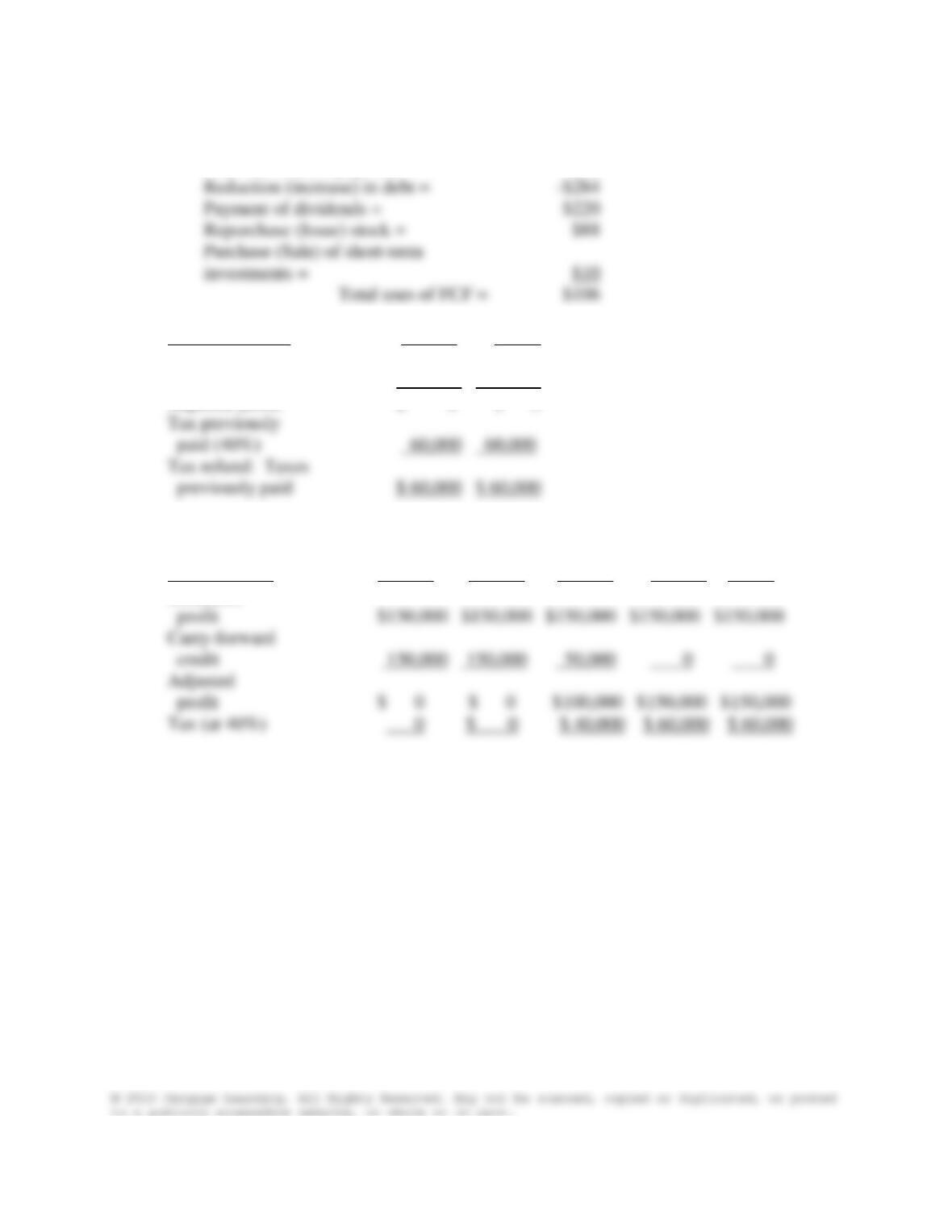
Uses of FCF
2015
After–tax interest payment =
$72
6-13 Prior Years 2013 2014
Profit earned $150,000 $150,000
Carry–back credit 150,000 150,000
Adjusted profit $ 0 $ 0
Total check from U.S. Treasury = $60,000 + $60,000 = $120,000.
Future Years 2016 2017 2018 2019 2020
Estimated
Answers and Solutions: 6 – 12
$88
$10