1
2
3
4
5
6
7
8
9
10
11
12
13
14
15
A B C D E F G H I
1/6/2015
Situation
Chapter 6 Mini Case
Jenny Cochran, a graduate of the University of Tennessee with 4 years of experience as an equities analyst, was recently brought in
as assistant to the chairman of the board of Computron Industries, a manufacturer of computer components.
The company doubled its plant capacity, opened new sales offices outside its home territory, and launched an expensive
advertising campaign. Computron’s results were not satisfactory, to put it mildly. Its board of directors, which consisted of its
Cochrane began by gathering financial statements and other data.
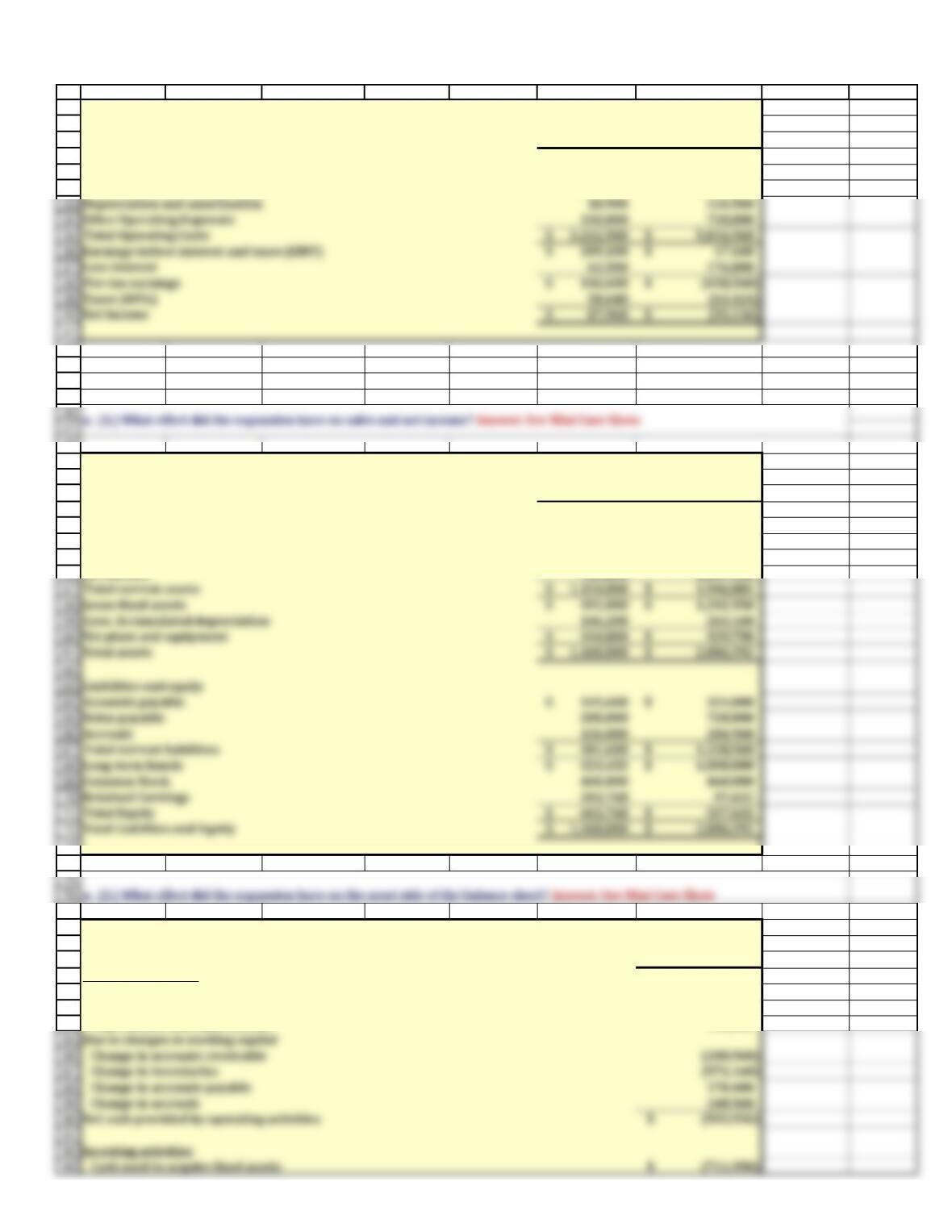
Gross fixed assets 491,000$ 1,202,950$
Net plant and equipment 344,800$ 939,790$
Liabilities and equity
Accounts payable 145,600$ 324,000$
Notes payable 200,000 720,000
Long-term bonds 323,432$ 1,000,000$
Common Stock 460,000 460,000
Retained Earnings 203,768 97,632
Due to changes in working capital
Change in accounts receivable (280,960)
Change in accounts payable 178,400
Change in accruals 148,960
Net cash provided by operating activities (503,936)$
Investing activities
27
28
29
30
31
32
42
43
44
45
48
49
50
51
52
53
54
55
56
73
74
77
78
79
80
81
82
83
84
A B C D E F G H I
Computron’s Income Statement
2014 2015
INCOME STATEMENT
Net sales 3,432,000$ 5,834,400$
Cost of Goods Sold Except Depr. 2,864,000 4,980,000
Dividends $22,000 $11,000
Tax rate 40% 40%
Computron’s Balance Sheets
2014 2015
Assets
Cash and equivalents 9,000$ 7,282$
Short-term investments 48,600 20,000
Accounts receivable 351,200 632,160
Inventories 715,200 1,287,360
Computron’s Statement of Cash Flows
2015
Operating Activities
Net Income before preferred dividends (95,136)$
Noncash adjustments
Depreciation and amortization 116,960
Depreciation and amortization 18,900 116,960
Other Operating Expenses 340,000 720,000
Earnings before interest and taxes (EBIT) 209,100$ 17,440$
Less interest 62,500 176,000
Taxes (40%) 58,640 (63,424)
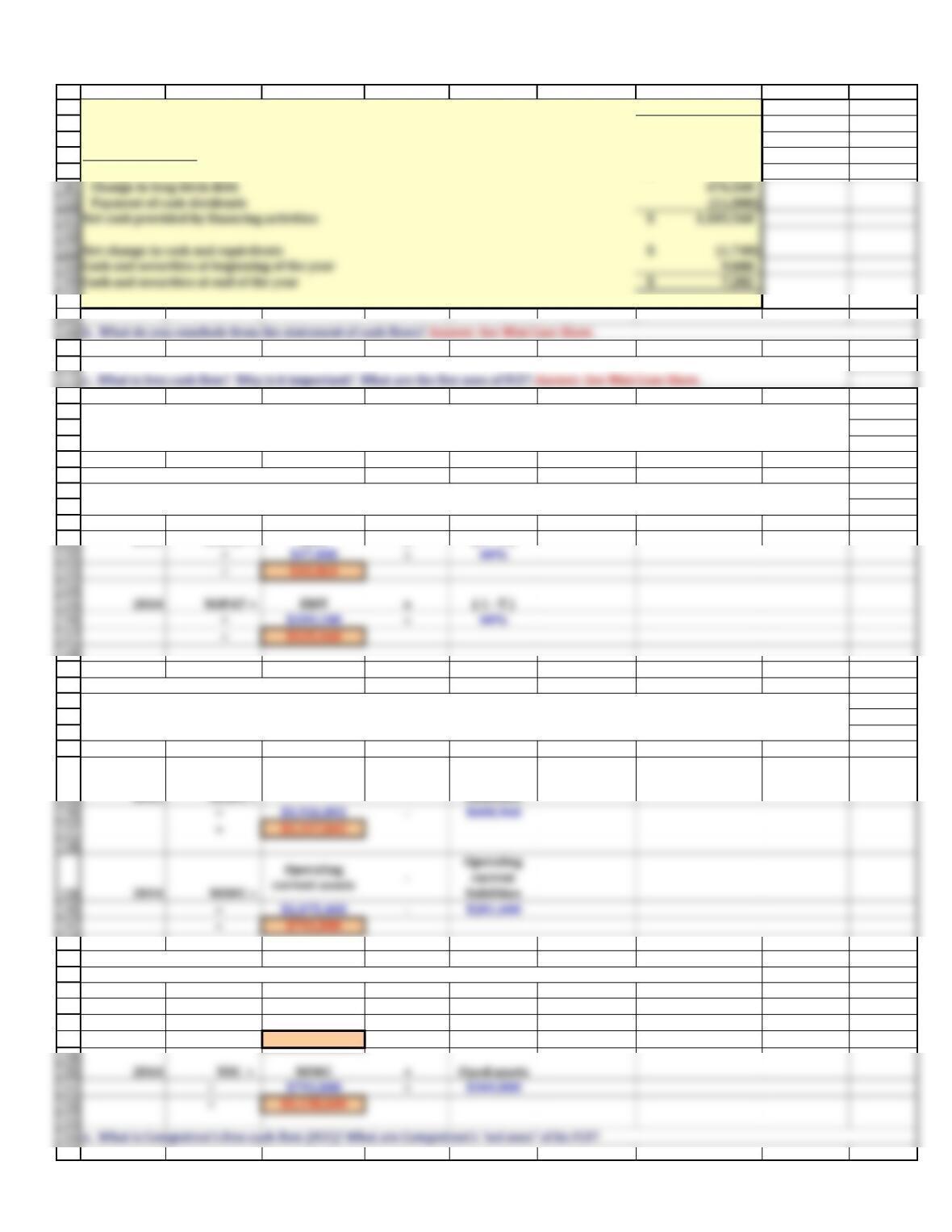
b. What do you conclude from the statement of cash flows? Answer: See Mini Case Show.
c. What is free cash flow? Why is it important? What are the five uses of FCF? Answer: See Mini Case Show.
= $17,440 x60%
= $10,464
2014 NOPAT = EBIT x ( 1 – T )
= $209,100 x60%
= $125,460
Operating
current assets
Operating
current
liabilities
= $793,800 +$344,800
= $1,138,600
94
95
96
97
98
106
109
110
112
113
114
115
116
117
118
119
120
121
128
129
130
131
132
133
134
135
142
143
144
145
146
147
148
155
A B C D E F G H I
Change in short-term investments 28,600
Net cash provided by investing activities (683,350)$
Financing Activities
Change in notes payable 520,000$
Net Operating Profit After Taxes
2015 NOPAT = EBIT x ( 1 – T )
Net Operating Working Capital
2015 NOWC =
Operating
current assets
–
Operating
current
liabilities
Total Net Operating Capital
2015 TOC = NOWC + Fixed assets
= $1,317,842 +$939,790
= $2,257,632
The Total OperatingCapital is Net Operating Working Capital plus any fixed assets.
d. What is Computron’s net operating profit after taxes (NOPAT)? What are operating current assets? What are operating current
liabilities? How much net operating working capital and total net operating capital does Computron have?
NOPAT is the amount of profit Computron would generate if it had no debt and held no financial assets.
Those current assets used in operations are called operating current assets, and the current liabilities that result from operations
are called operating current liabilities. Net operating working capital is equal to operating current assets minus operating current
liabilities.
Change in long-term debt 676,568
Payment of cash dividends (11,000)
Net cash provided by financing activities 1,185,568$
Net change in cash and equivilents (1,718)$
Cash and securities at beginning of the year 9,000
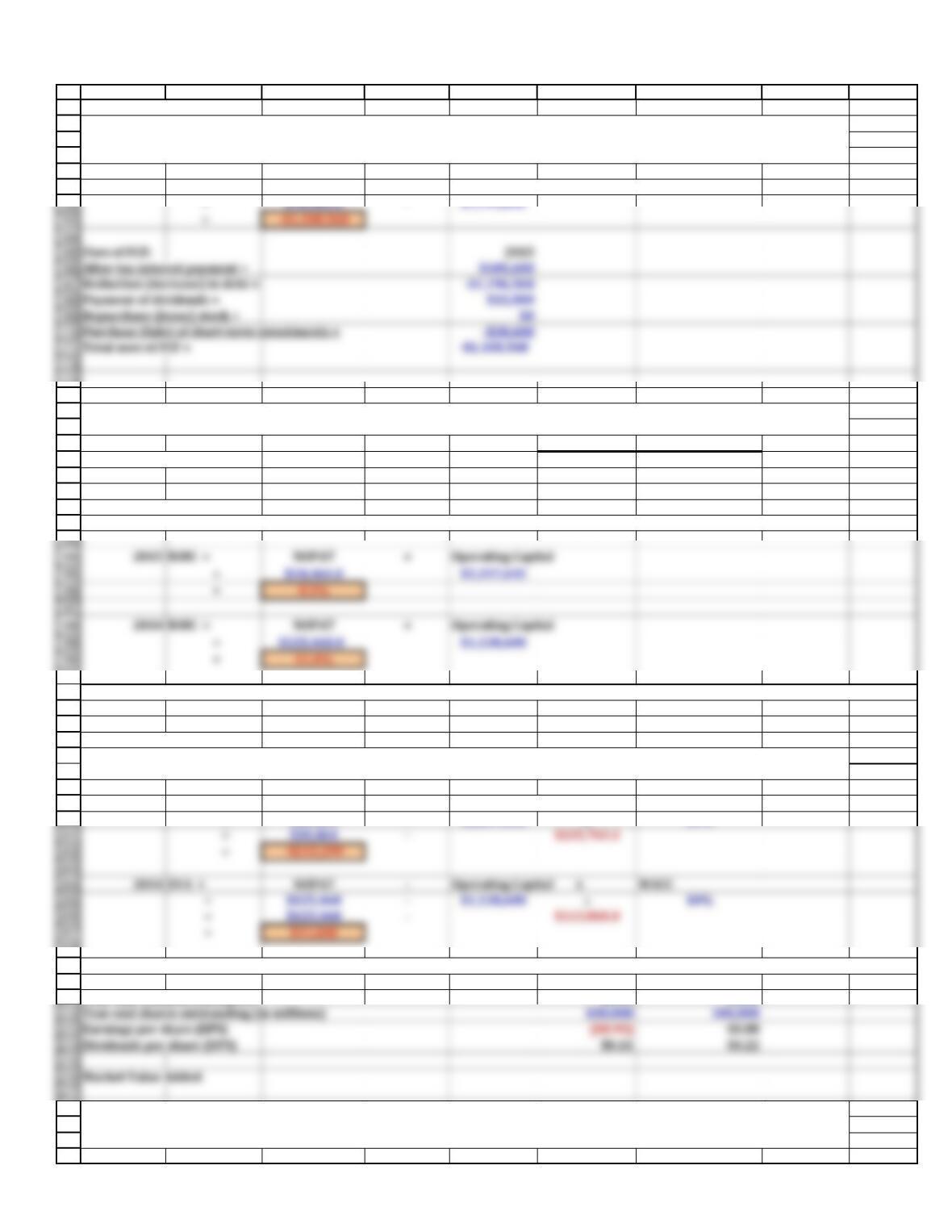
2014 EVA = NOPAT – Operating Capital x WACC
Year-end shares outstanding (in millions) 100,000 100,000
Earnings per share (EPS) ($0.95) $0.88
Dividends per share (DPS) $0.11 $0.22
Market Value Added
156
157
158
159
160
161
173
174
175
176
177
178
179
180
181
182
191
192
193
194
195
196
197
198
199
200
208
209
210
211
218
219
220
221
A B C D E F G H I
Free Cash Flow
2015 FCF = NOPAT –Net Investment in Operating Capital
2014 2015
Cost of Capital (WACC) 10% 10%
Return on Invested Capital
Economic Value Added
2015 EVA = NOPAT – Operating Capital x WACC
= $10,464 –$2,257,632 x10%
Year-end common stock price $8.50 $6.00
Assume that the market value of debt is equal to the book value of debt. In this case, Market Value Added (MVA) is the difference
between the market value of Computron’s stock and the amount of equity capital supplied by shareholders.
h. What happened to Computron’s market value added (MVA)?
g. What is Computron’s EVA? The after-tax cost of capital was 10 percent in both years.
f. Calculate Computron’s return on invested capital. Computron has a 10% cost of capital (WACC). Do you think Computron’s
growth added value?
The Return on Invested Capital tells us the amount of NOPAT per dollar of operating capital.
Economic Value Added represents Computron’s residual income that remains after the cost of all capital, including equity capital,
has been deducted.
Computron’s Free Cash Flow caluclation is the cash flow actually availabe for distribution to investors after the company has made
all necessary investments in fixed assets and working capital to sustain ongoing operations.
Uses of FCF: 2015
After-tax interest payment = $105,600
Reduction (increase) in debt = -$1,196,568
Payment of dividends = $11,000
Repurchase (Issue) stock = $0
Purchase (Sale) of short-term investments = -$28,600
Total uses of FCF = -$1,108,568
Income above base of bracket 8,000$
Tax on income above base 3,120$
ExxonMobil Yield 10%
California Yield 7%
Tax Rate 25.0%
222
223
224
232
233
234
235
241
242
243
244
245
246
247
248
249
250
258
259
260
261
268
269
270
271
272
273
274
275
276
277
278
A B C D E F G H I
2015 MVA = Stock price x # of shares – Total common equity
= $6.00 x100,000 –$557,632
= $600,000 –$557,632
Corporate Tax Rates for 2013
(1) (2) (3) (4)
$0 $50,000 $0 15.0%
Base amount of tax 22,250$
Marginal tax rate in bracket 39.0%
Taxable vs. Tax Exempt bonds
ExxonMobil bonds at 10% vs. California muni bonds at 7%
Amount to invest $5,000
i. Assume that a corporation has $100,000 of taxable income from operations plus $5,000 of interest income and $10,000 of
dividend income. What is the company’s tax liability?
j. Assume that you are in the 25 percent marginal tax bracket and that you have $5,000 to invest. You have narrowed your
investment choices down to California bonds with a yield of 7 percent or equally risky ExxonMobil bonds with a yield of 10 percent.
Which one should you choose and why? At what marginal tax rate would you be indifferent to the choice between California and
ExxonMobil bonds?
Plus this
percentage
on the excess
over the base
It pays this
amount on the
base of the
bracket:
If a corporation’s taxable
income is between:
= $42,368
2014
= $850,000 –$663,768
= $186,232

288
289
A B C D E F G H I
Tax rate which you would be indifferent