Introduction to Corporate Finance, Fourth Edition Booth, Cleary, Rakita
53. Section: 5.8 Comprehensive Examples
Learning Objective: 5.8
Level of difficulty: Intermediate
Solution:
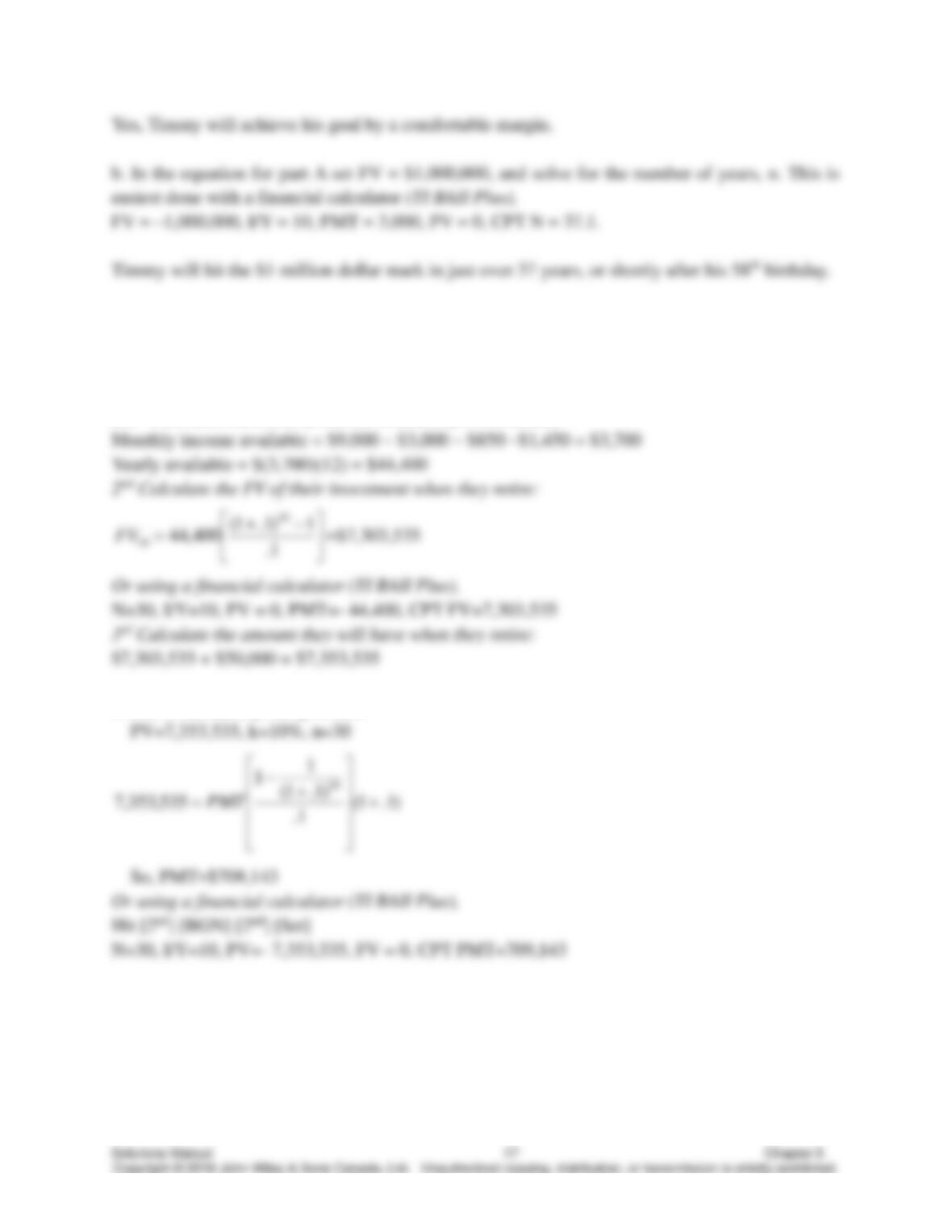
a. 1st Calculate their yearly income available for investment
b. This is an annuity due problem.
Challenging
54. Section: 5.1 Opportunity Cost; 5.3 Compound Interest
Learning Objective: 5.1; 5.3
Level of difficulty: Challenging
Solution:
Introduction to Corporate Finance, Fourth Edition Booth, Cleary, Rakita
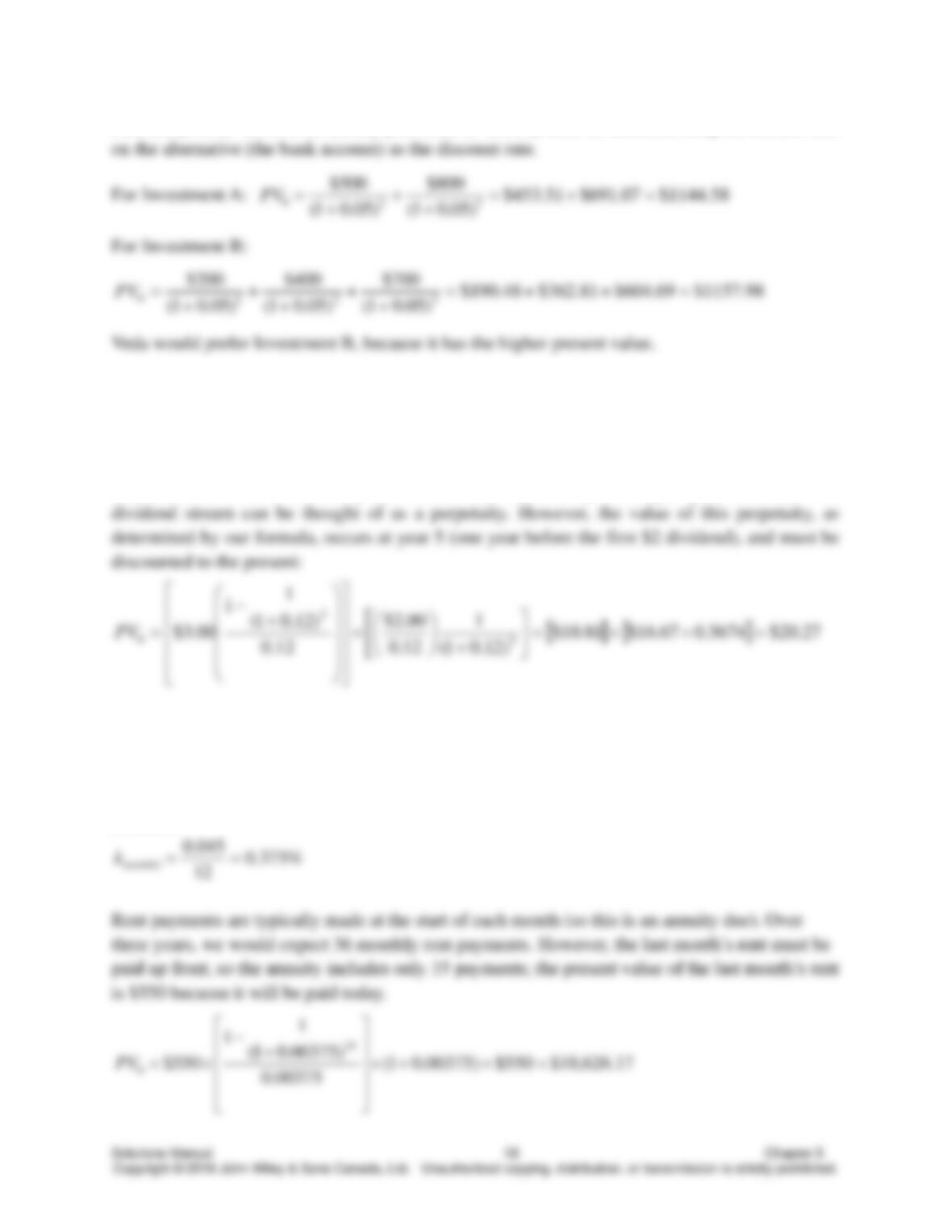
Find the present value of the money paid back to Veda by each investment, using the interest rate
55. Section: 5.4 Annuities and Perpetuities
Learning Objective: 5.4
Level of difficulty: Challenging
Solution:
The dividends for the first five years form an ordinary annuity. Starting in year 6, the reduced
56. Section: 5.4 Annuities and Perpetuities
Learning Objective: 5.4
Level of difficulty: Challenging
Solution:
Introduction to Corporate Finance, Fourth Edition Booth, Cleary, Rakita
57. Section: 5.4 Annuities and Perpetuities
Learning Objective: 5.4
Level of difficulty: Challenging
Solution:
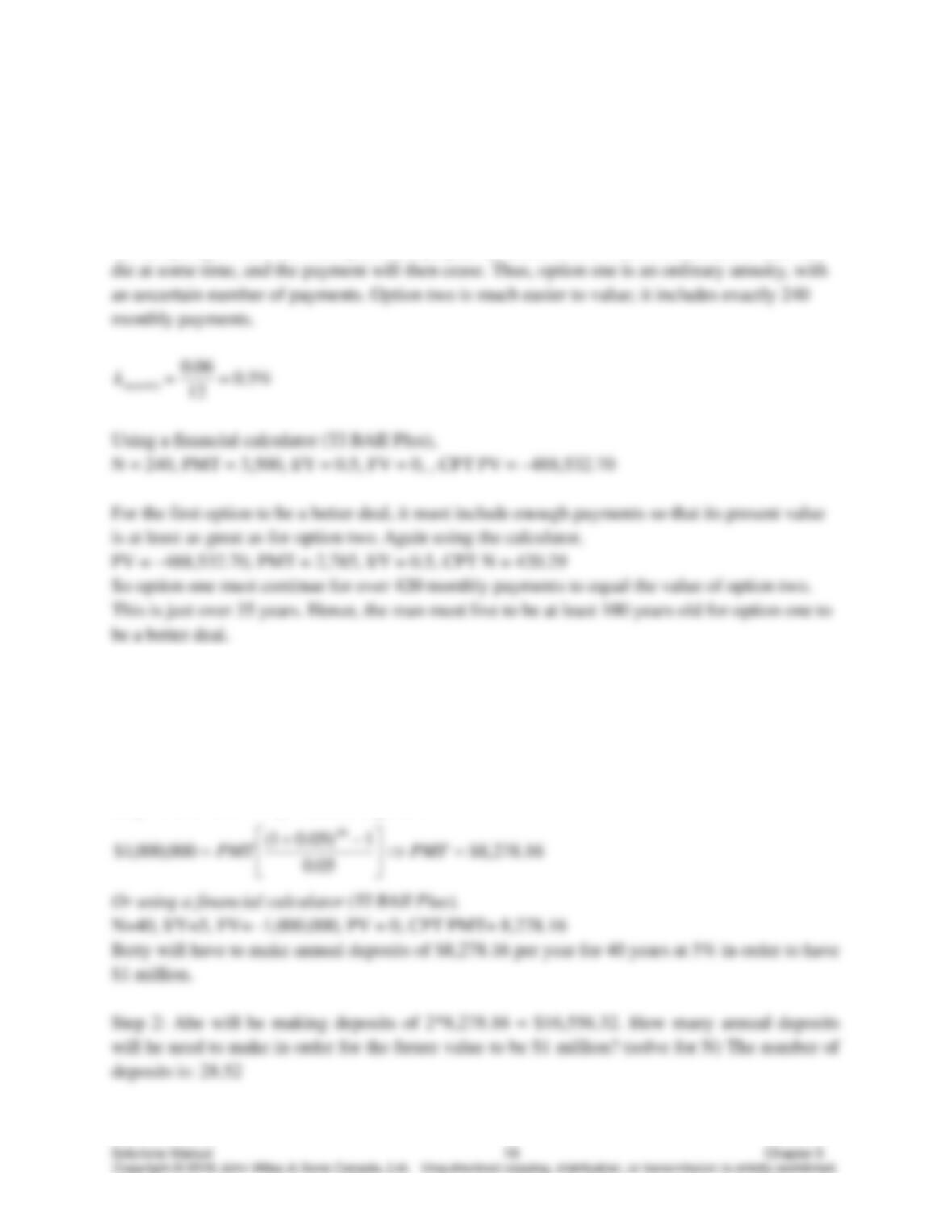
It is tempting to view the first option as a perpetuity, but this would be incorrect as the man will
58. Section: 5.4 Annuities and Perpetuities
Learning outcome: 5.4
Level of difficulty: Challenging
Solution:
Step 1: determine Betty’s annual deposits:

Introduction to Corporate Finance, Fourth Edition Booth, Cleary, Rakita
59. Section: 5.1 Opportunity Cost; 5.2 Simple Interest; 5.3 Compound Interest; 5.4 Annuities and
Perpetuities
Learning outcome: 5.1; 5.2; 5.3; 5.4
Level of difficulty: Challenging
Solution:
The manager is confused. To make the choice between the two options you should consider the
60. Section: 5.4 Annuities and Perpetuities; 5.6 Quoted versus Effective Rates
Learning Objective: 5.4; 5.6
Level of difficulty: Challenging
Solution:
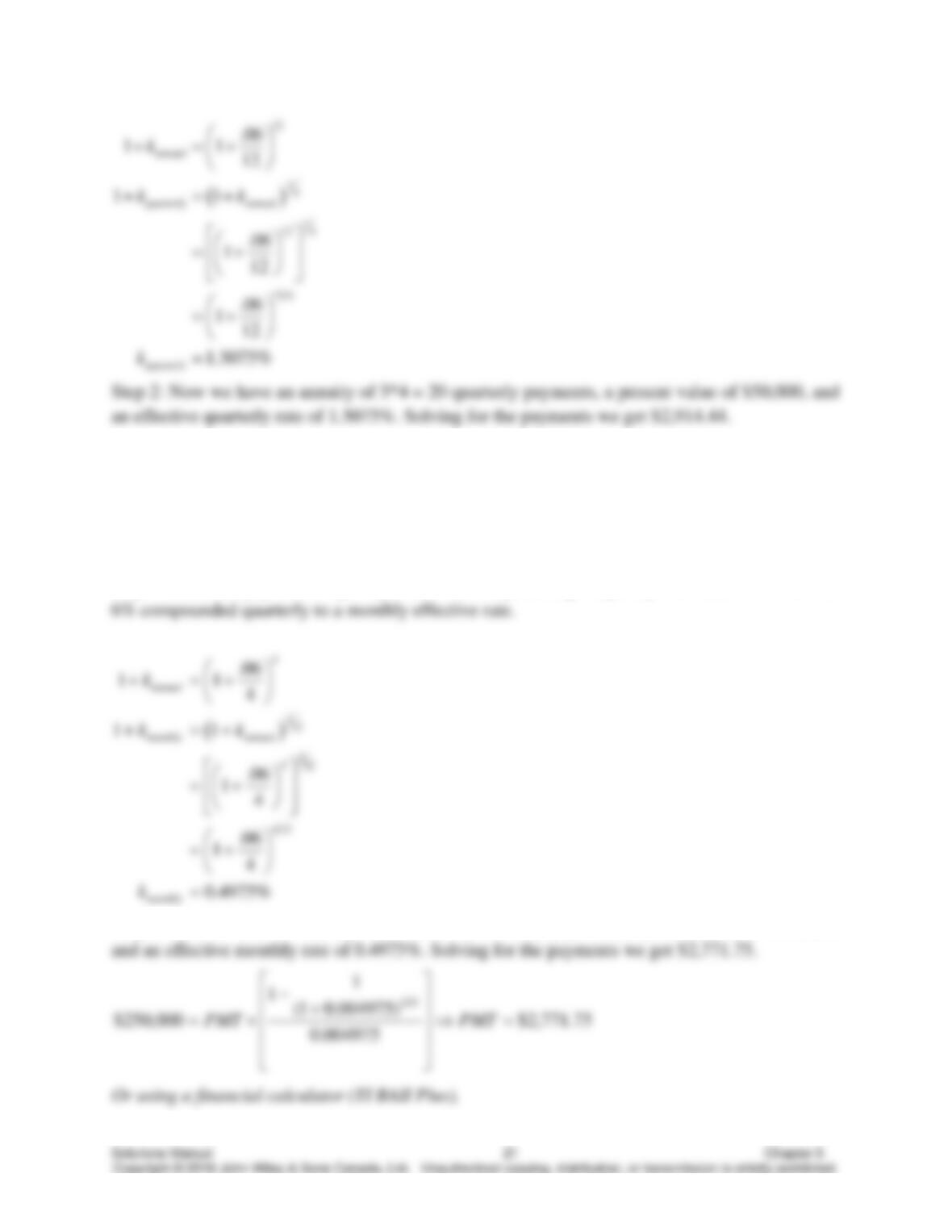
Step 1: make the payment frequency match the compounding frequency. We need to convert the
Introduction to Corporate Finance, Fourth Edition Booth, Cleary, Rakita
61. Section: 5.4 Annuities and Perpetuities; 5.6 Quoted versus Effective Rates
Learning Objective: 5.4; 5.6
Level of difficulty: Challenging
Solution:
Step 1: make the payment frequency match the compounding frequency. We need to convert the
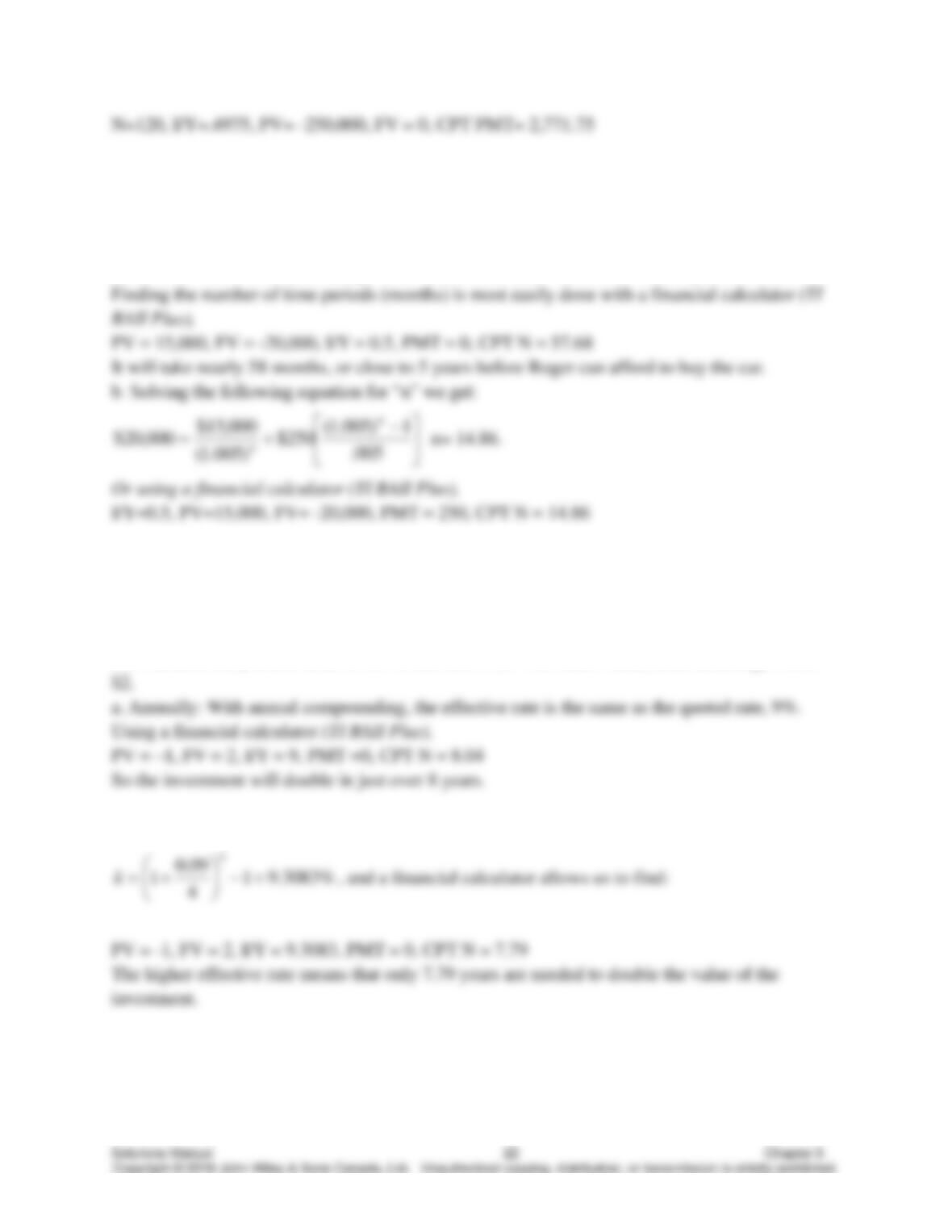
Step 2: Now we have an annuity of 10*12 = 120 monthly payments, a present value of $250,000
Introduction to Corporate Finance, Fourth Edition Booth, Cleary, Rakita
62. Section: 5.3 Compound Interest; 5.4 Annuities and Perpetuities
Learning Objective: 5.3; 5.4
Level of difficulty: Challenging
Solution:
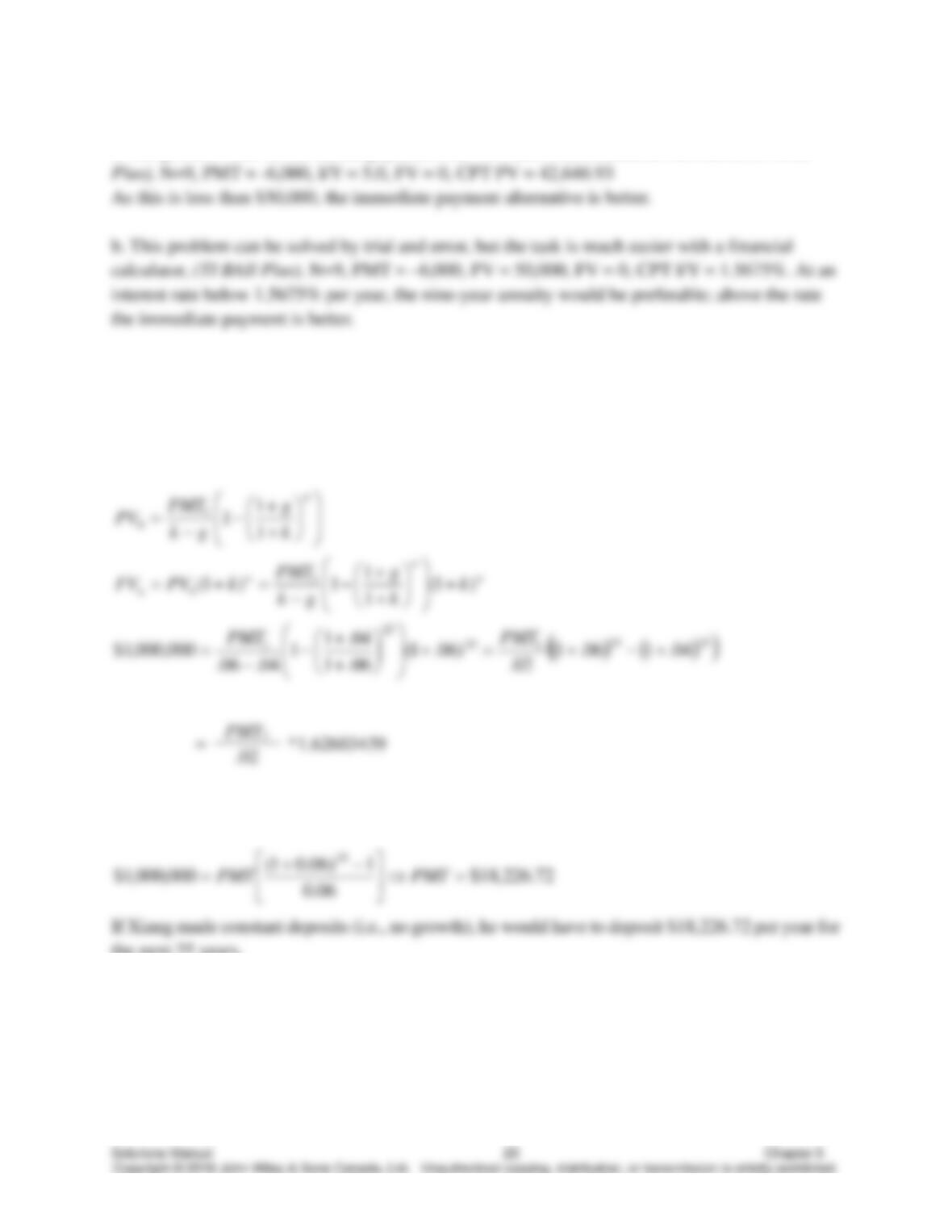
a. We know the future value and present value amounts, as well as the monthly interest rate.
63. Section: 5.3 Compound Interest; 5.6 Quoted versus Effective Rates
Learning Objective: 5.3; 5.6
Level of difficulty: Challenging
Solution:
Let’s assume the present value of the investment is $1. The future value, after doubling, is then
b. Quarterly: With quarterly compounding, the effective annual rate is,
64. Section: 5.4 Annuities and Perpetuities
Learning Objectives: 5.4
Level of difficulty: Challenging
Introduction to Corporate Finance, Fourth Edition Booth, Cleary, Rakita
Solution:
a. The present value of the annual payments can be found with a financial calculator, (TI BAII
65. Section: 5.5 Growing Annuities and Perpetuities
Learning Objective: 5.5
Level of difficulty: Challenging
Solution:
The initial deposit is $12,299.86
the next 25 years.
66. Section: 5.7 Loan or Mortgage Arrangements
Learning Objective: 5.7
Level of difficulty: Challenging
Solution:
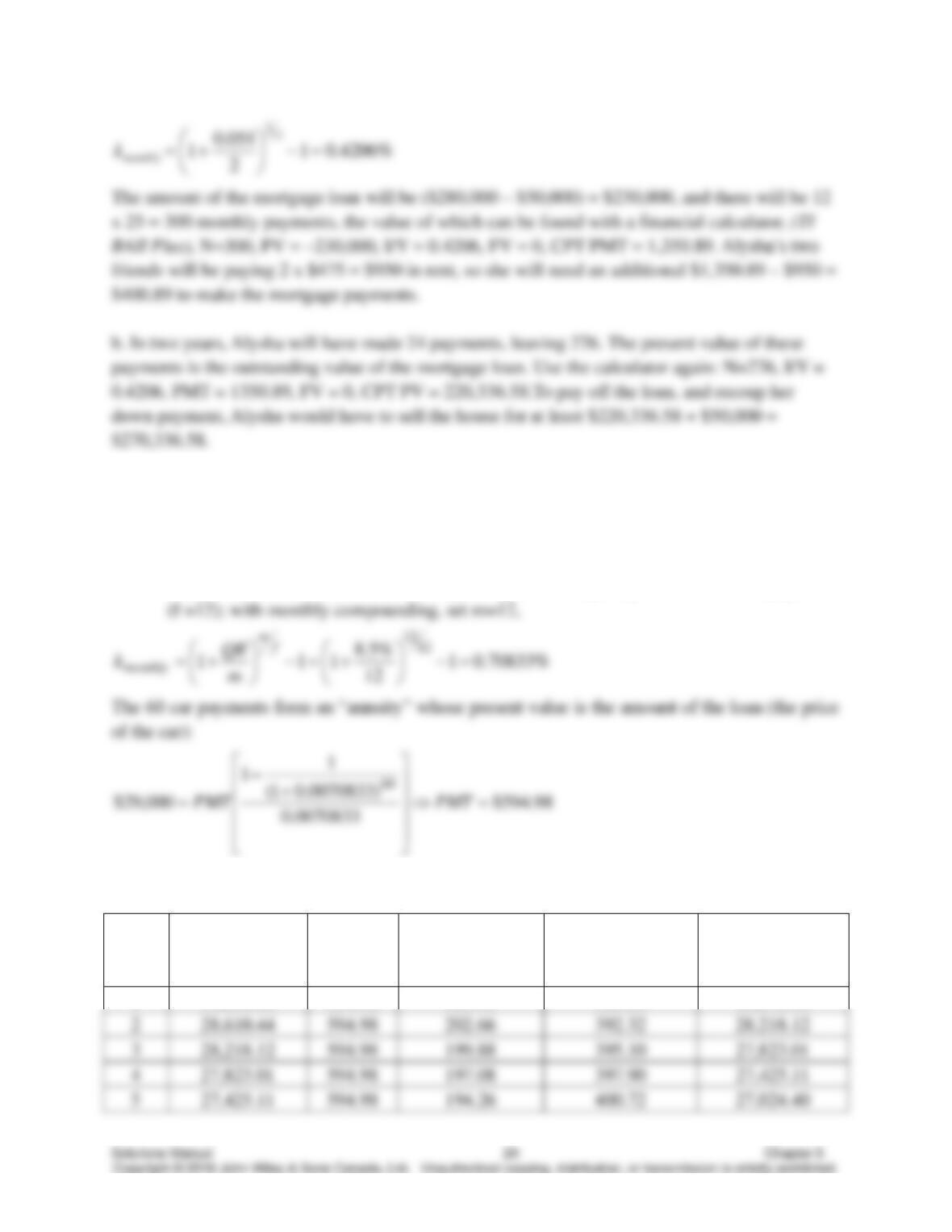
a. The effective monthly interest rate is,
Introduction to Corporate Finance, Fourth Edition Booth, Cleary, Rakita
67. Section: 5.6 Quoted versus Effective Rates; 5.7 Loan or Mortgage Arrangements
Learning Objective: 5.6; 5.7
Level of difficulty: Challenging
Solution:
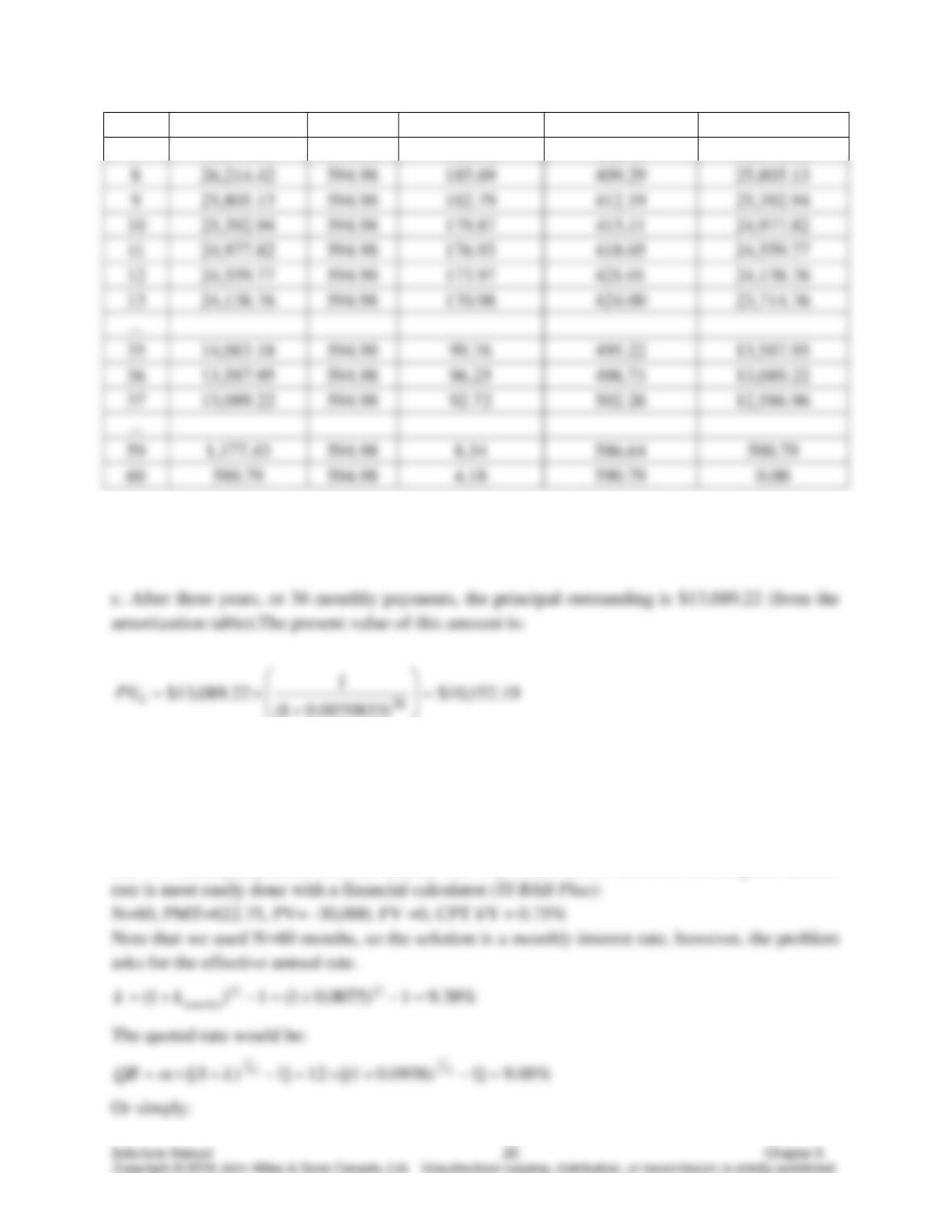
a. First, find the effective interest corresponding to the frequency of Jimmie’s car payments
b. Use the effective monthly interest rate from part A, k=0.70833%
Period
(1) Principal
Outstanding
(2)
Payment
(3) Interest
=k*(1)
(4) Principal
Repayment =
(2)-(3)
Ending Principal
= (1)-(4)
1
29,000.00
594.98
205.42
389.56
28,610.44
2
28,610.44
594.98
202.66
392.32
28,218.12
3
28,218.12
594.98
199.88
395.10
27,823.01
Introduction to Corporate Finance, Fourth Edition Booth, Cleary, Rakita
6
27,024.40
594.98
191.42
403.56
26,620.84
7
26,620.84
594.98
188.56
406.42
26,214.42
8
26,214.42
594.98
185.69
409.29
25,805.13
9
25,805.13
594.98
182.79
412.19
25,392.94
25,392.94
594.98
179.87
415.11
24,977.82
24,977.82
594.98
176.93
418.05
24,559.77
24,559.77
594.98
173.97
421.01
24,138.76
24,138.76
594.98
170.98
424.00
23,714.76
14,083.18
594.98
99.76
495.22
13,587.95
13,089.22
594.98
92.72
502.26
12,586.96
594.98
586.64
594.98
590.79
The first monthly payment repays $389.56 of the principal amount of the loan and the last
payment repays $590.79.
68. Section: 5.6 Quoted versus Effective Rates; 5.7 Loan or Mortgage Arrangements
Learning Objective: 5.6, 5.7
Level of difficulty: Challenging
Solution:
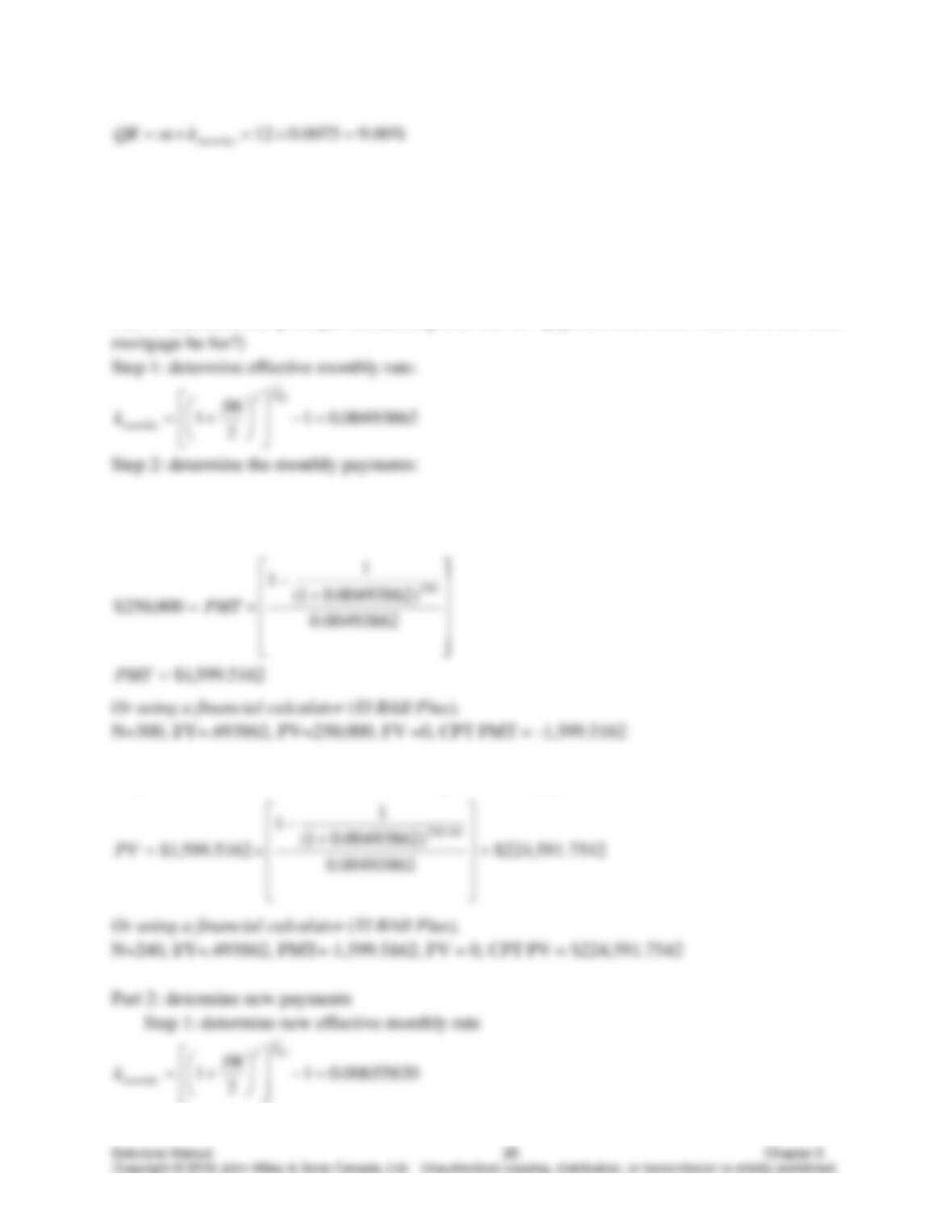
The 60 monthly payments form an annuity whose present value is $30,000. Finding the interest
Introduction to Corporate Finance, Fourth Edition Booth, Cleary, Rakita
69. Section: 5.7 Loan or Mortgage Arrangements
Learning Objective: 5.7
Level of difficulty: Challenging
Solution:
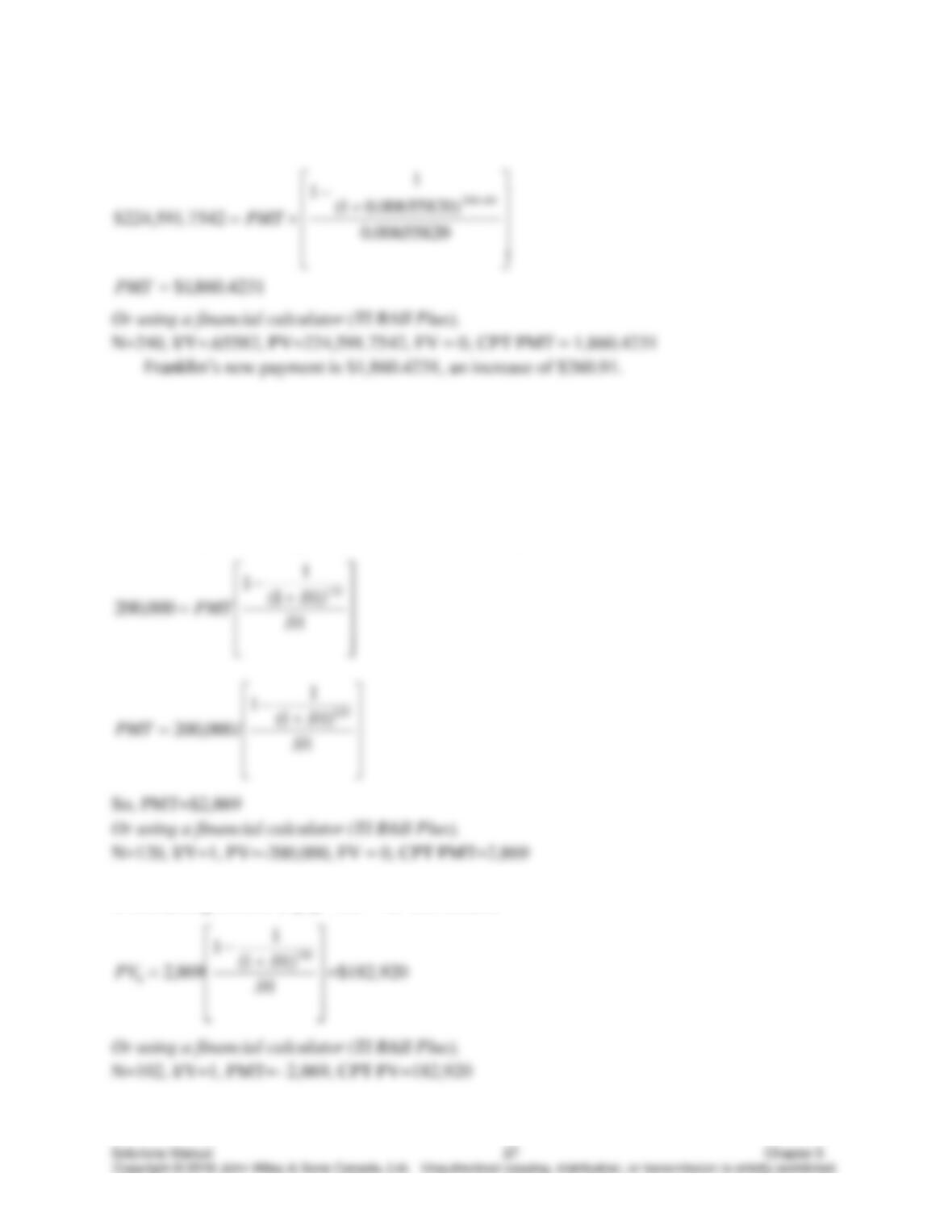
Part 1: determine the principal outstanding after the 60th payment (i.e., How much will the next
Step 3: determine Present Value of remaining (300 – 60) payments of $1,599.5162
Introduction to Corporate Finance, Fourth Edition Booth, Cleary, Rakita
Step 2: determine the new monthly payment
70. Section: 5.7 Loan or Mortgage Arrangements
Learning Objective: 5.7
Level of difficulty: Challenging
Solution:
a. PV=$200,000, monthly rate=12%/12=1%, N = (10)(12)=120 months
b. Remaining months to pay=120 – 18=102 months

Introduction to Corporate Finance, Fourth Edition Booth, Cleary, Rakita
c. kmonthly=
1)
2
12.
1( 12
2
−+
=.9759%
71. Section: 5.8 Comprehensive Examples
Learning Objective: 5.8
Level of difficulty: Challenging
Solution:
Investor A:
Investor B:

Introduction to Corporate Finance, Fourth Edition Booth, Cleary, Rakita

Introduction to Corporate Finance, Fourth Edition Booth, Cleary, Rakita
Answers to Concept Review Questions
5.1 Opportunity Cost
Concept review questions
1. Why does money have a “time value”?
An investor can simply store a dollar (tuck them under the bed!) and spend them in the future, in
2. What is an “opportunity cost”?
5.2 Simple Interest
Concept review questions
1. Explain how simple interest payments are determined.
5.3 Compound Interest
Concept review questions
1. Explain how to compute future values and present values when using compound interest.
2. What is the relationship between FVIFs and PVIFs? Why does this make sense?
3. Why does compound interest result in higher future values than simple interest?
Compound interest refers to a process whereby interest is earned on the invested principal
5.4 Annuities and Perpetuities
Concept review questions
Introduction to Corporate Finance, Fourth Edition Booth, Cleary, Rakita
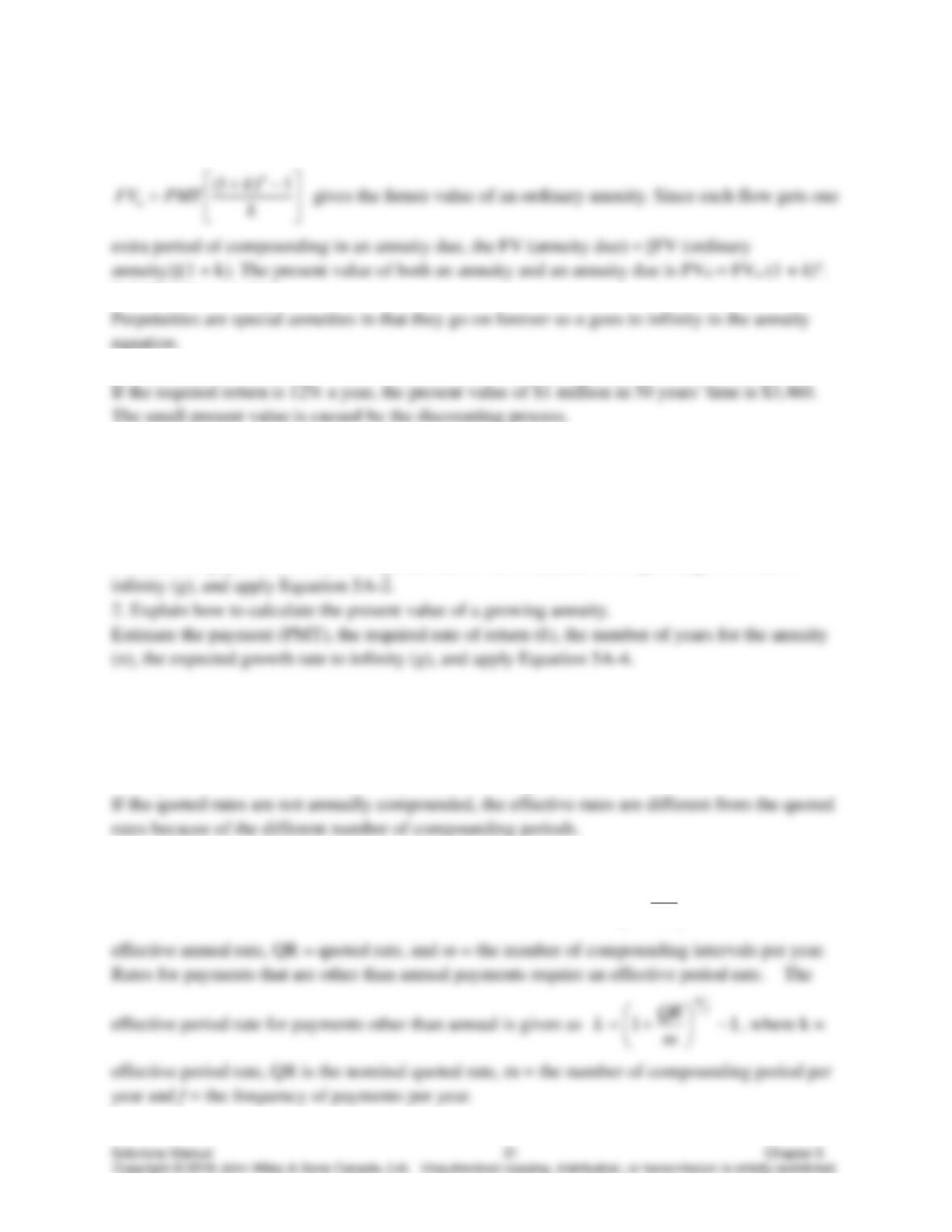
1. Explain how to calculate the present value and future value of an ordinary annuity and an
annuity due.
2. Define “perpetuity”.
3. Why is the present value of $1 million in 50 years’ time worth very little today?
5.5 Growing Perpetuities and Annuities
Concept review questions
1. Explain how to evaluate a growing perpetuity.
Estimate the payment (PMT), the required rate of return (k), and the expected growth rate to
5.6 Quoted versus Effective Rates
Concept review questions
1. Why can effective rates often be very different from quoted rates?
2. Explain how to calculate the effective rate for any period.
The effective annual rate for any given compounding interval:
11 −
+=
m
m
QR
k
, where k =

Introduction to Corporate Finance, Fourth Edition Booth, Cleary, Rakita
5.7 Loan or Mortgage Arrangements
Concept review questions
1. Explain how loan and mortgage payments can be determined using annuity concepts.
2. What complications arise when dealing with mortgage loans in Canada?
3. Why is a 6 percent U.S. mortgage not the same as a 6 percent Canadian mortgage?
Interest rates are compounded semi-annually in Canada and compounded monthly in U.S.
5.8 Comprehensive Examples
Concept review questions
1. Explain how timelines can be used to break a complicated time value of money problem into
2. Demonstrate how to solve a typical retirement problem.
There are three steps. First, calculate the present value of retirement funds in the year of