142 Instructor’s Manual
Q5–4. A common fallacy in stock market investing is assuming that a good company makes a
A5-4. If a company has enjoyed rapid growth in the past, it is likely that the expectation that this
growth will continue may already be incorporated into the stock’s price. For example, if
Q5–5. Why is it not surprising to learn that growth rates rarely show predictable trends?
A5-5. Competition makes growth largely unpredictable. High-growth industries attract new com-
petitors, and more competition will lead to lower growth for some or all of the firms in the
Q5–6. The book value of a firm’s common equity is usually lower than the market value of the
common stock. Why? Can you describe a situation in which the liquidation value of a
firm’s equity might exceed its market value?
A5-6. Market values are forward looking, while book values are backward looking. If the market
is optimistic about a firm’s future, it will almost always place a higher value on the firm’s
stock than book value. However, the opposite could be true. Suppose a firm is in the busi-
ness of producing a product that suddenly becomes technically obsolete. The book value of
Q5-7. What is a prospectus?
A5-7. A prospectus is a document that underwriters prepare for a firm issuing securities in the
Q5-8. Describe the role of the lead underwriter in a firm-commitment offering.
A5-8. In a firm-commitment offering, the investment bank agrees to buy the securities from the
issuing firm and resell them to investors. Because the investment bank takes possession of
Q5-9. Why is the relationship between an investment banker and a firm selling securities some-
what adversarial?
A5-9. The investment bank deals with large investors, mostly institutions like mutual funds, in-
surance companies, and pension funds, each time it brings new securities to market. In con-
Q5–10. Does secondary market trading generate capital for the company whose stock is trading?
A5-10. No. The company raises capital when it sells securities in the primary market. Subsequent
A5-11. Secondary markets are where securities trade after securities have been issued. Broker
markets are characterized by having a central trading floor with a broker matching the buy-
seller always sells to a dealer.
Solutions to End-of-Chapter Problems
Valuing Preferred and Common Stock
P5-1. Argaiv Towers has outstanding an issue of preferred stock with a par value of $100. It pays
an annual dividend equal to 8 % of par value. If the required return on Argaiv preferred
stock is 6 %, and if Argaiv pays its next dividend in one year, what is the market price of
the preferred stock today?
P5-2. Artivel Mining Corp.’s preferred stock pays a dividend of $5 each year. If the stock sells
for $40 and the next dividend will be paid in one year, what return do investors require on
Artivel preferred stock?
144 Instructor’s Manual
P5-3. Silaic Tools has issued preferred stock that offers investors a 10 % annual return. The stock
currently sells for $80, and the next dividend will be paid in one year. How much is the
dividend?
P5-4. Suppose a preferred stock pays a quarterly dividend of $2 per share. The next dividend
comes in exactly one-fourth of a year. If the price of the stock is $80, what is the effective
annual rate of return that the stock offers investors?
P5-5. A particular preferred stock pays a $1 quarterly dividend and offers investors an effective
annual rate of return of 12.55 %. What is the price per share?
P5-6. The C. Alice Stone Company’s common stock has paid a $3 dividend for so long that in-
vestors are now convinced that the stock will continue to pay that annual dividend forever.
If the next dividend is due in one year and investors require an 8% return on the stock,
what is its current market price? What will the price be immediately after the next dividend
payment?
P5-7. Propulsion Sciences’ (PS) stock dividend has grown at 10 % per year for many years. In-
vestors believe that a year from now the company will pay a dividend of $3 and that divi-
dends will continue their 10 % growth indefinitely. If the market’s required return on PS
stock is 12 %, what does the stock sell for today? How much will it sell for a year from
today after the stockholders receive their dividend?
P5-8. Investors believe that a certain stock will pay a $4 dividend next year. The market price of
the stock is $66.67, and investors expect a 12 % return on the stock. What long-run growth
rate in dividends is consistent with the current price of the stock?
Chapter 5 Valuing Stocks 145
P5-9. Gail Dribble is analyzing the shares of Petscan Radiology. Petscan’s stock pays a dividend
once each year, and it just distributed this year’s $0.85 dividend. The market price of the
stock is $12.14. Gail estimates that Petscan will increase it dividends by 7 % per year for-
ever. After contemplating the risk of Petscan stock, Gail is willing to hold the stock only if
it provides an annual expected return of at least 13 %. Should she buy Petscan shares or
not?
P5-10. Carbohydrates Anonymous (CA) operates a chain of weight-loss centers for carb lovers. Its
services have been in great demand in recent years and its profits have soared. CA recently
paid an annual dividend of $1.35 per share. Investors expect that the company will increase
the dividend by 20 % in each of the next three years, and after that they anticipate that div-
idends will grow by about 5 % per year. If the market requires an 11 % return on CA stock,
what should the stock sell for today?
A5-10. The dividend stream for the next few years looks like this:
P5-11. Hill Propane Distributors sells propane gas throughout the eastern half of the state of Tex-
as. Because of population growth and a construction boom in recent years, the company
has prospered and expects to continue to do well in the near term. The company will pay a
$0.75 per share dividend to investors one year from now. Investors believe that Hill Pro-
pane will increase that dividend at 15 % per year for the subsequent 5 years before settling
down to a long-run dividend growth rate of 3 %. Investors expect an 8 % return on Hill
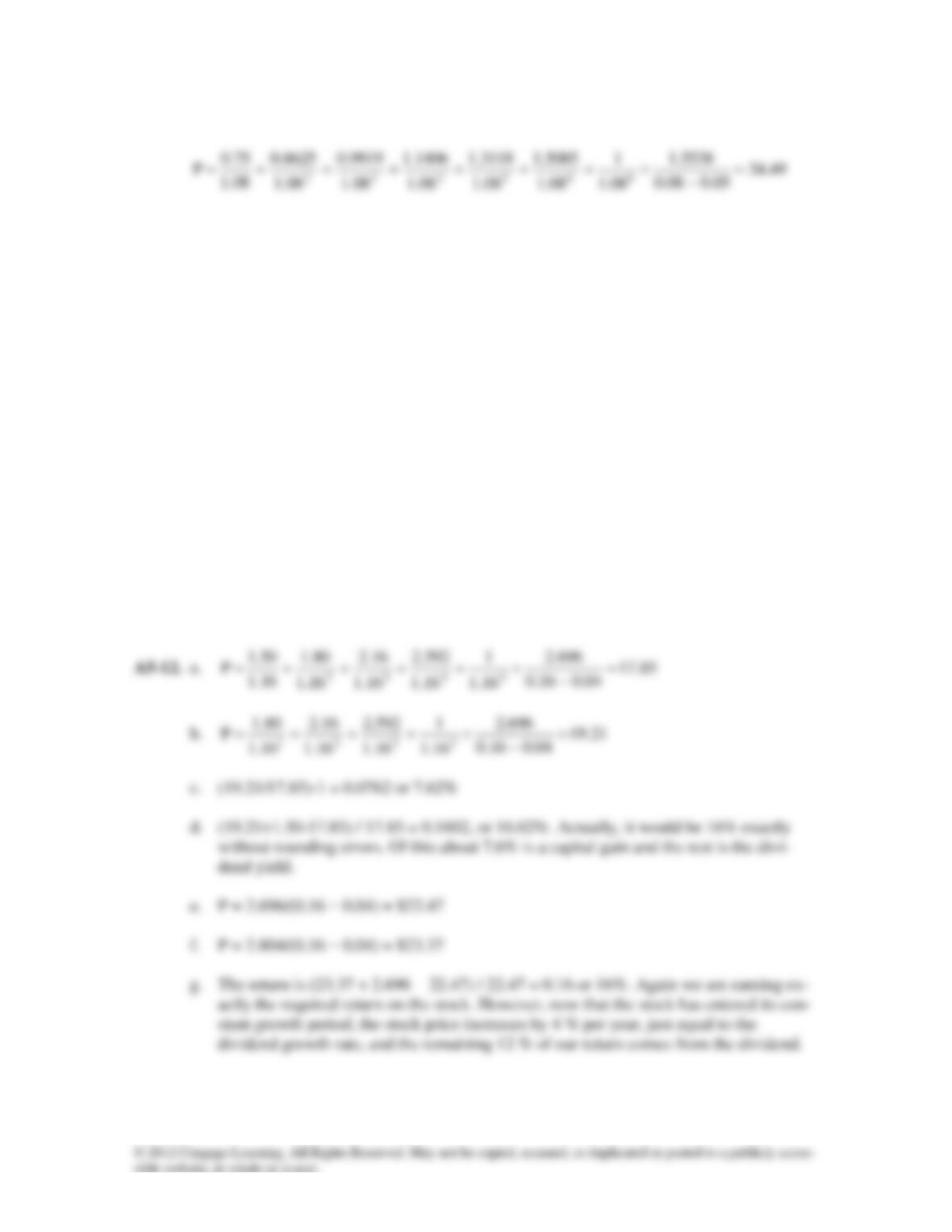
Propane common shares. What is the current selling price of the stock?
A5-11. The dividend stream for the next few years looks like this:
Next year $0.75
2nd year $0.8625 (up 15%)
146 Instructor’s Manual
P5-12. Yesterday, September 22, 2012, Wireless Logic Corp. (WLC) paid its annual dividend of
$1.25 per share. Because WLC’s financial prospects are particularly bright, investors be-
lieve that the company will increase its dividend by 20 % per year for the next four years.
After that, investors believe WLC will increase the dividend at a modest annual rate of 4%.
Investors require a 16 % return on WLC stock, and WLC always makes its dividend pay-
ment on September 22 of each year.
a. What is the price of WLC stock on September 23, 2012?
b. What is the price of WLC stock on September 23, 2013?
c. Calculate the percentage change in price of WLC stock from September 23, 2012, to
September 23, 2013.
d. For an investor who purchased WLC stock on September 23, 2012, received a divi-
dend on September 22, 2013, and sold the stock on September 23, 2013, what was the
total rate of return on the investment? How much of this return came from the divi-
dend, and how much came from the capital gain?
e. What is the price of WLC stock on September 23, 2016?
f. What is the price of WLC stock on September 23, 2017?
g. For an investor who purchased WLC stock on September 23, 2016, received a divi-
dend on September 22, 2017, and sold the stock on September 23, 2017, what was the
total rate of return on the investment? How much of this return came from the divi-
dend, and how much came from the capital gain? Comment on the differences between
your answers to this question and your answers to part (d).
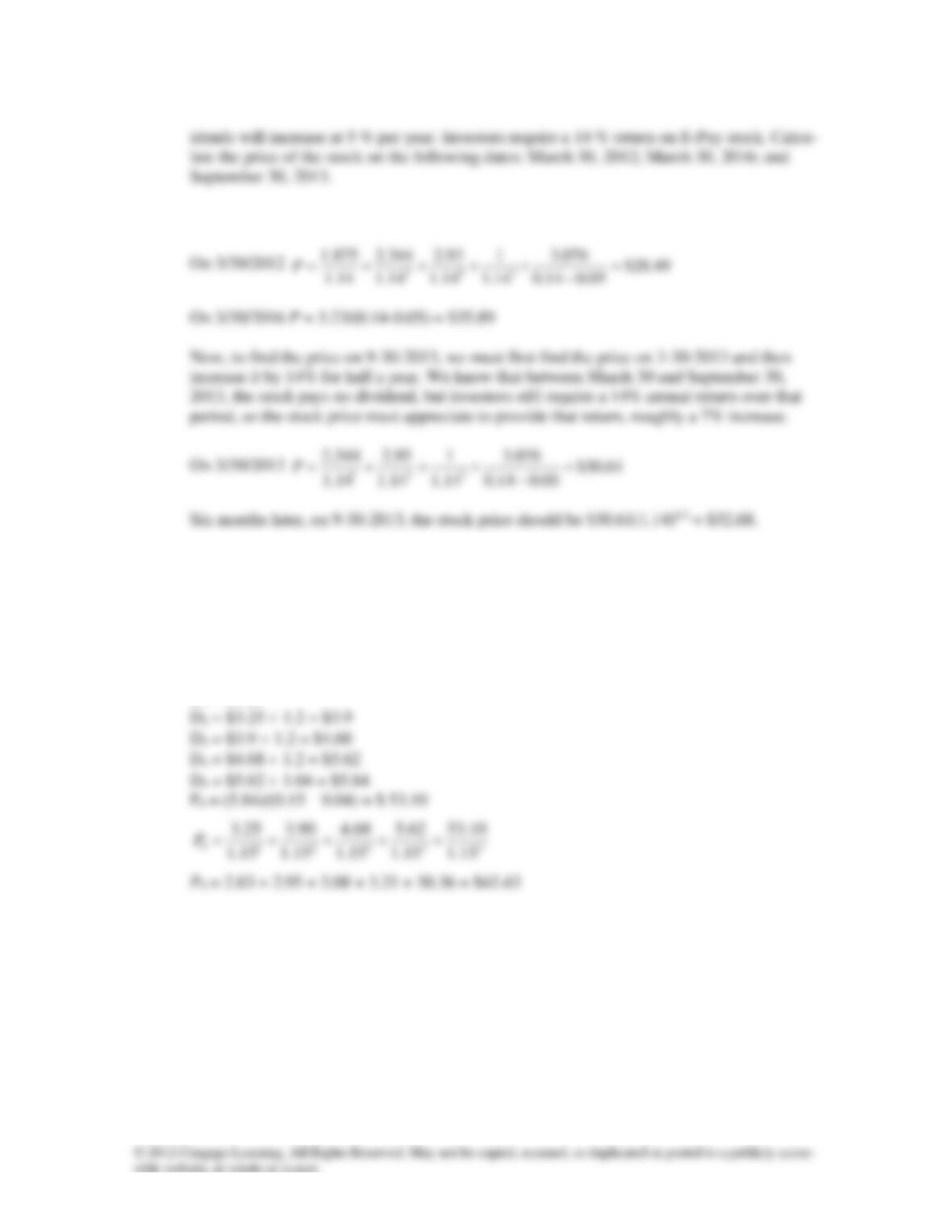
P5-13. Today’s date is March 30, 2012. E-Pay, Inc., stock pays a dividend every year on March
29. The most recent dividend was $1.50 per share. You expect the company’s dividends to
increase at a rate of 25 % per year through March 29, 2015. After that, you expect that div-
Chapter 5 Valuing Stocks 147
A5-13. The prices on the respective dates are
P5-14. One year from today, investors anticipate that Groningen Distillers Inc. stock will pay a
dividend of $3.25 per share. After that, investors believe that the dividend will grow at
20% per year for three years before settling down to a long-run growth rate of 4%. The re-
quired rate of return on Groningen stock is 15%. What is the current stock price?
A5-14. Here is the series of expected dividends for the next few years:
D1 = $3.25
P5-15. Investors expect the following series of dividends from a particular common stock:
Year 1 $1.10
Year 2 $1.25
Year 3 $1.45
Year 4 $1.60
Year 5 $1.75
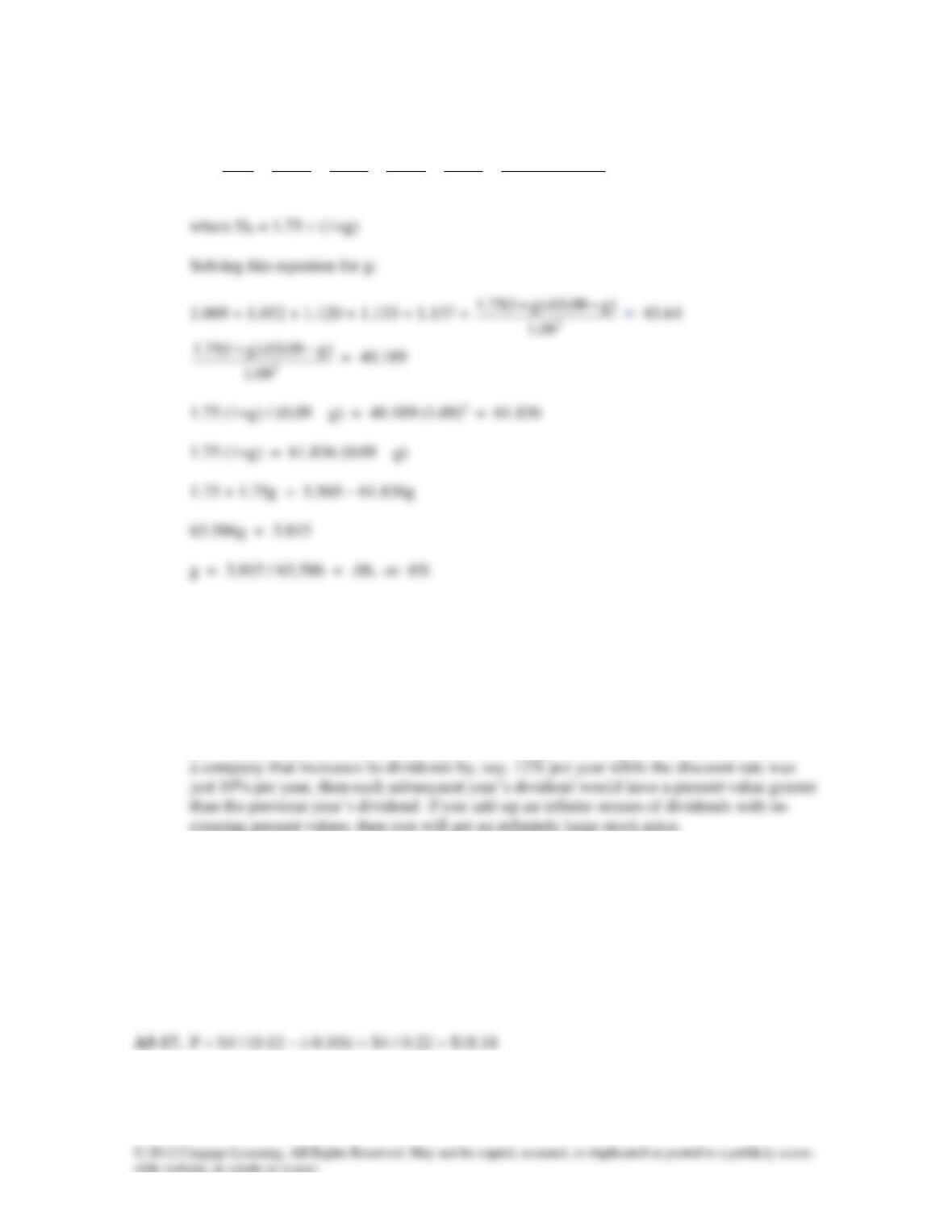
After the fifth year, dividends will grow at a constant rate. If the required rate of return on
this stock is 9 % and the current market price is $45.64, what is the long-term rate of divi-
dend growth expected by the market?
148 Instructor’s Manual
A5-15.
64.45
09.1
)g09.0/(D(
09.1
75.1
09.1
60.1
09.1
45.1
09.1
25.1
09.1
10.1
P5
6
5432 =
−
+++++=
P5-16. In the constant-growth model we can apply the equation that P = D ÷ (r-g) only under the
assumption that r > g. Suppose someone tries to argue with you that for a certain stock,
r < g forever, not just during a temporary growth spurt. Why can’t this be the case? What
would happen to the stock price if this were true? If you try to answer simply by looking at
the formula you will almost certainly get the wrong answer. Think it through.
A5-16. The requirement that r > g means that the cash flows that a firm pays in the long run cannot
grow faster than the rate used to discount them. Suppose the opposite were true. If there is
P5-17. Stephenson Technologies (ST) produces the world’s greatest single-lens-reflex (SLR)
camera. The camera has been a favorite of professional photographers and serious ama-
teurs for several years. Unfortunately, the camera uses old film technology and does not
take digital pictures. Ron Stephenson, owner and CEO of the company decided to let the
business continue for as long as it can without making any new R&D investments to de-
velop digital cameras. Accordingly, investors expect ST common stock to pay a $4 divi-
dend next year and shrink by 10 % per year indefinitely. What is the market price of ST
stock if investors require a 12 % return?
The Free Cash Flow Approach to Common Stock Valuation
P5-18. Roban Corporation is considering going public but is unsure of a fair offering price for the
company. Before hiring an investment banker to assist in making the public offering, man-
Chapter 5 Valuing Stocks 149
agers at Roban have decided to make their own estimate of the firm’s common stock value.
The firm’s CFO gathered the following data for performing the valuation using the free
cash flow valuation model.
The firm’s weighted average cost of capital is 12 %. It has $1,400,000 of debt at mar-
ket value and $500,000 of preferred stock at its assumed market value. The estimated free
cash flows over the next five years, 2013 through 2017, follow. Beyond 2017, to infinity,
the firm expects its free cash flow to grow by 4 % annually.
Year Free Cash Flow
2013 $250,000
2014 $290,000
2015 $320,000
2016 $360,000
2017 $400,000
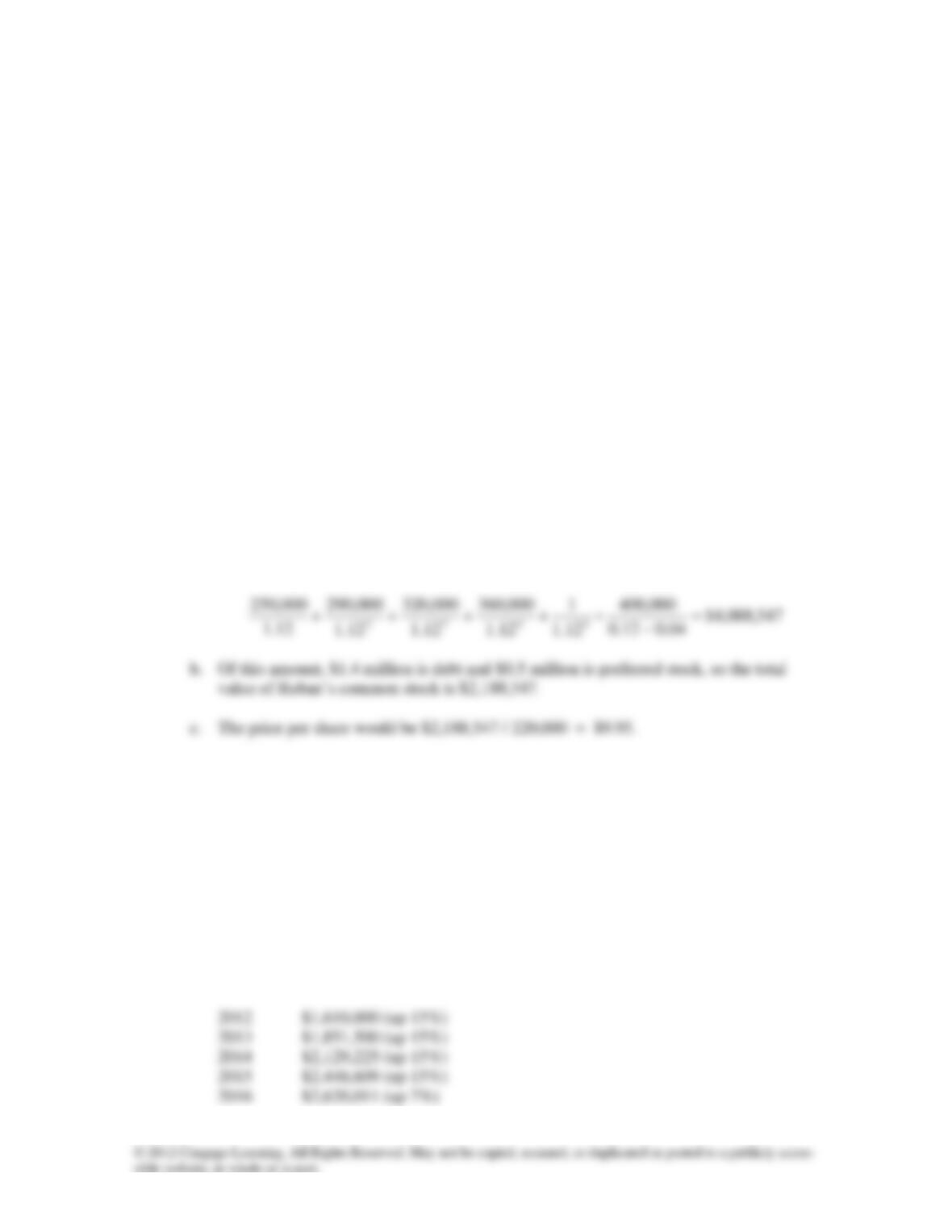
a. Estimate the value of Roban Corporation’s entire company by using the free cash flow
approach.
b. Use your finding in part (a), along with the data provided above, to find Roban Corpo-
ration’s common stock value.
c. If the firm plans to issue 220,000 shares of common stock, what is its estimated value
per share?
A5-18. a. The total value of the firm equals
P5-19. Dean and Estevez, Inc. (D&E) is a firm that provides temporary employees to businesses.
D&E’s client base has grown rapidly in recent years, and the firm has been quite profitable.
The firm’s co-founders, Mr. Dean and Mr. Estevez, believe in a conservative approach to
financial management and therefore have not borrowed any money to finance their busi-
ness. A larger company in the industry has approached D&E about buying them out. In the
most recent year, 2012, D&E generated free cash flow of $1.4 million. Suppose that D&E
projects that these cash flows will grow at 15% per year for the next four years, and then
will settle down to a long-run growth rate of 7% per year. The cofounders want a 14% re-
turn on their investment. What should be their minimum asking price from the potential
acquirer?
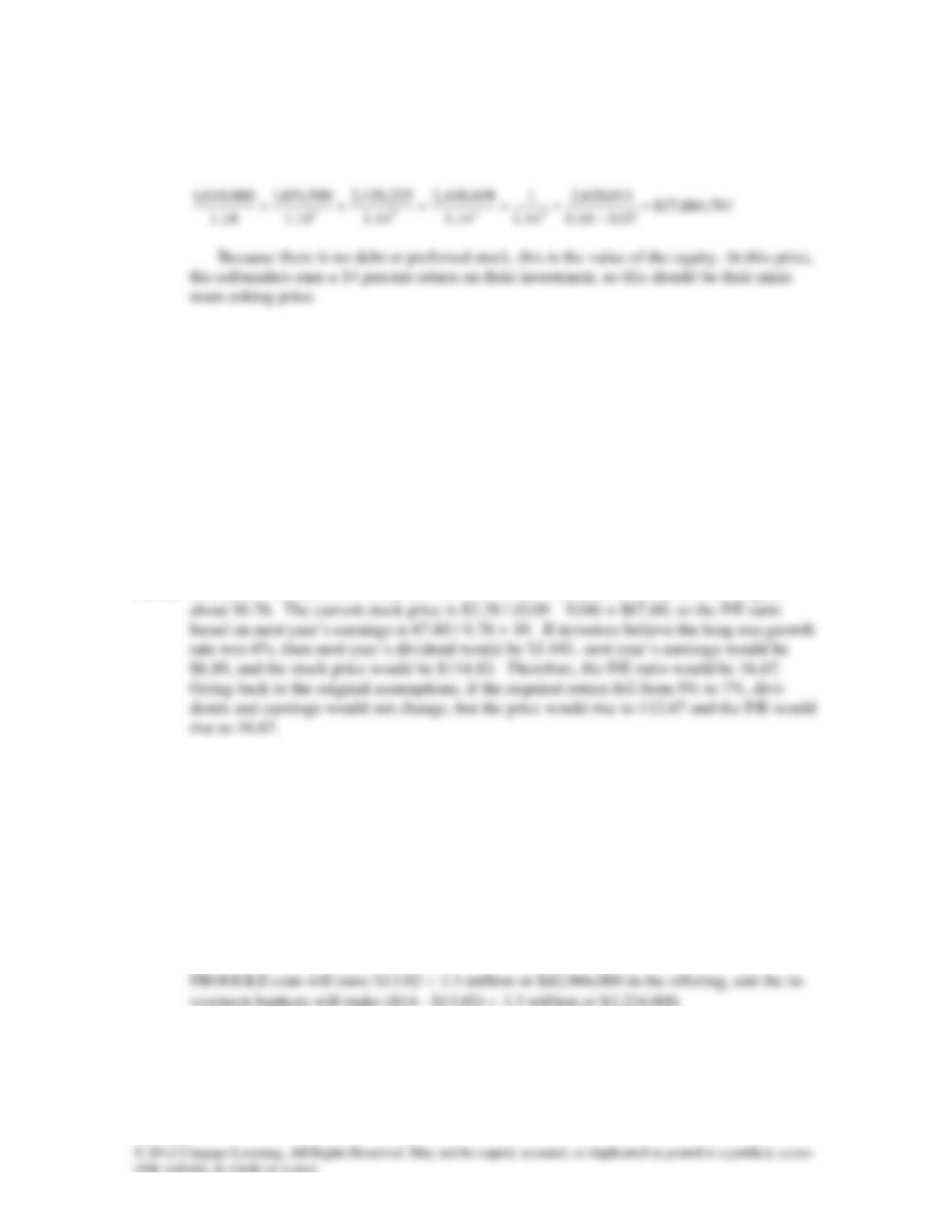
A5-19. The free cash flow forecasts look like this:
150 Instructor’s Manual
Use the variable growth model to calculate the present value of the stream and you obtain a
total enterprise value of
Other Approaches to Common Stock Valuation
P5-20. Dauterive Barber Shops (DBS) specializes in providing quick and inexpensive haircuts for
middle-aged men. The company retains about half of its earnings each year and pays the
rest out as a dividend. Recently, the company paid a $3.25 dividend. Investors expect the
company’s dividends to grow modestly in the future, about 4 percent per year, and they re-
quire a 9 percent return on DBS shares. Based on next year’s earnings forecast, what is
DBS’s price/earnings ratio? How would the price/earnings ratio change if investors be-
lieved that DBS’s long-run growth rate was 6 percent rather than 4 percent? Retaining the
original assumption of 4 percent growth, how would the price/earnings ratio change if in-
vestors became convinced that DBS was not very risky and were willing to accept a 7 per-
cent return on their shares going forward?
A5-20. Next year’s dividend will be $3.25 x 1.04 or $3.38. This means next year’s earning are
Primary And Secondary Markets for Equity Securities
P5-21. Owners of the Internet bargain site FROOGLE.com have decided to take their company
pubic by conducting an initial public offering of common stock. They have agreed with
their investment banker to sell 3.3 million shares to investors at an offer price of $14 per
share. The underwriting spread is 7 percent.
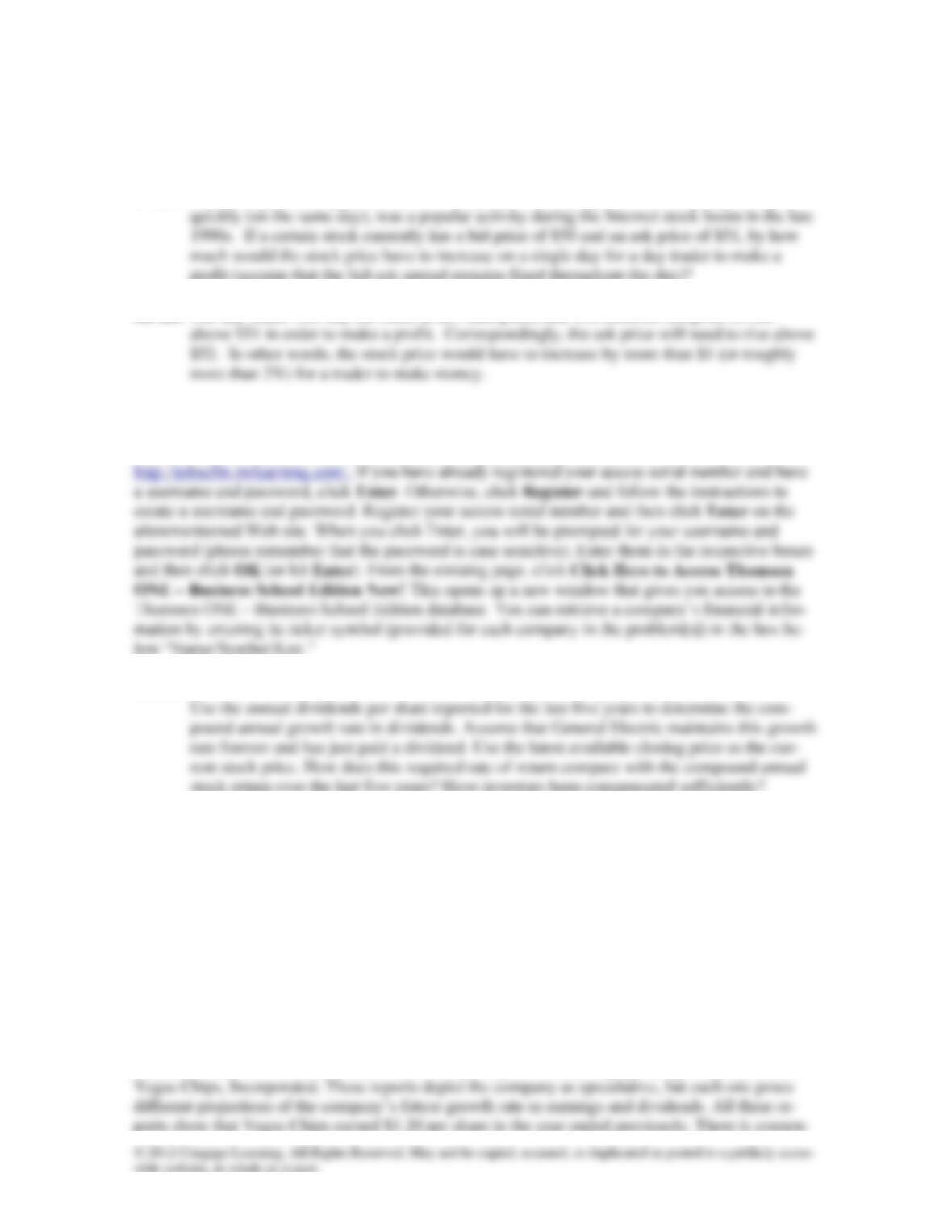
a. What is the net price that FROOGLE.com will receive for their shares?
b. How much money will FROOGLE.com raise in the offering?
c. How much do FROOGLE.com’s investment bankers make on this transaction?
A5-21. If the underwriting spread is 7 percent, then the net price is 0.93 $14 or $13.02 per share.
P5-22. An investor pays $101 to buy a share of Zenotrop stock. Simultaneously, a different inves-
tor sells one share of Zenotrop and receives $100 in cash. At the moment that these trades
took place, what were the bid and ask prices of Zenotrop stock?
Chapter 5 Valuing Stocks 151
A5-22. $101 is the ask price (the price at which an investor can buy a stock) and $100 is the bid
price (the price at which an investor can sell a stock).
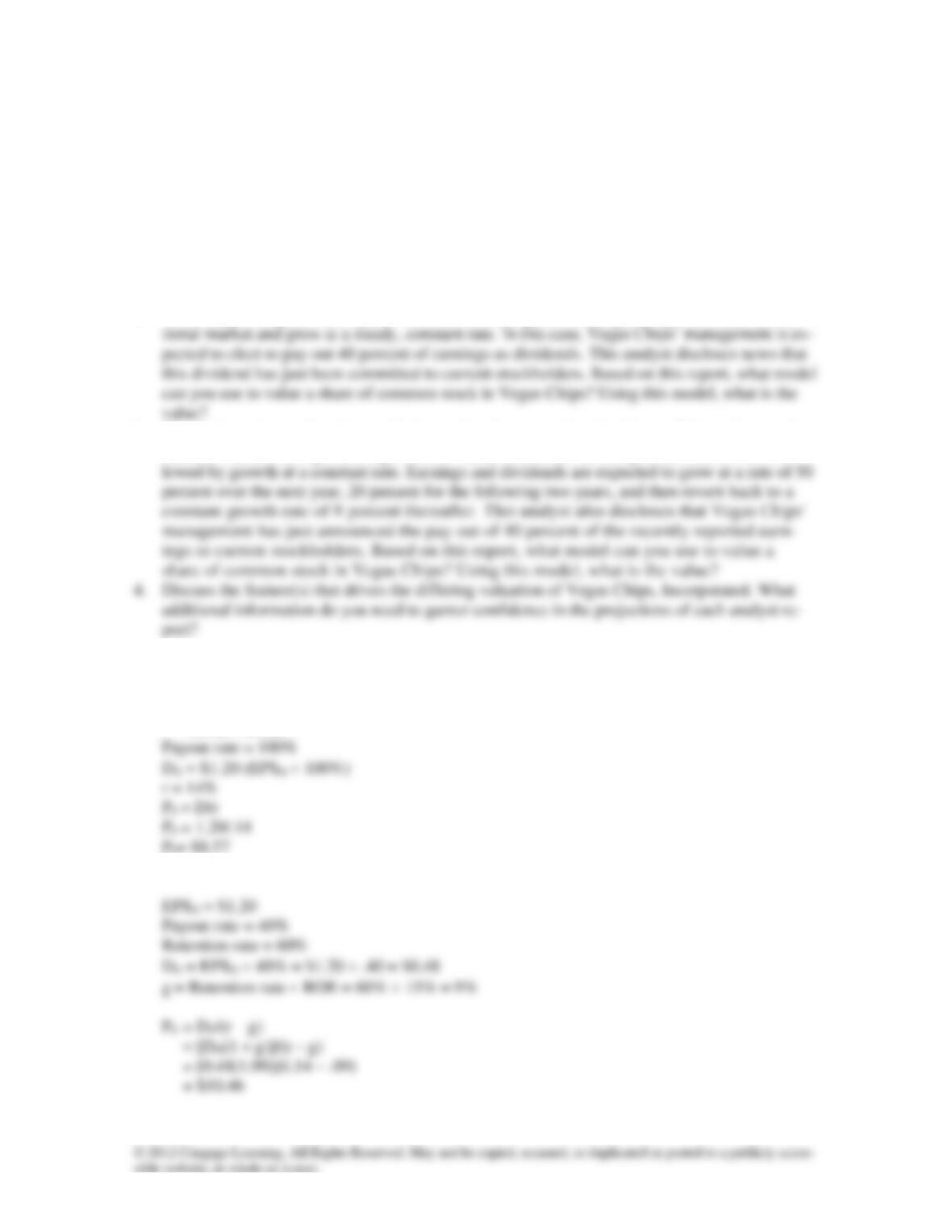
P5-23. Day trading, which typically refers to the practice of buying a stock and selling it very
profit (assume that the bid-ask spread remains fixed throughout the day)?
A5-23. The day trader will buy the stock at $51 (ask price) and will need the bid price to rise
THOMSON ONE Business School Edition: Access financial information from the Thomson ONE –
Business School Edition Web site for the following problem(s). Go to
P5-24. What rate of return do investors require on Eli Lilly & Company (LLY) common stock?
P5-25. Are shares of Eli Lilly & Company (LLY) currently under- or overpriced? Calculate the
average P/E ratio over the last five fiscal years. Assuming that Eli Lilly maintains this av-
erage P/E into the future, determine the price per share using the average EPS estimate for
the next fiscal year end. Is this estimate higher or lower than the latest closing price for Eli
Lilly?
Because these exercises depend upon real-time data, your answers will change continuously de-
pending upon when you access the Internet to download your data.
Answer to MiniCase
Valuing Stocks
Your investment adviser has sent you three analyst reports for a young, growing company named
152 Instructor’s Manual
sus that a fair rate of return to investors for this common stock is 14 percent, and that management
expects to consistently earn a 15 percent return on the book value of equity (ROE = 15 percent).
Assignment
1. The analyst who produced report A makes the assumption that Vegas Chips will remain a small,
regional company that, although profitable, is not expected to grow. In this case, Vegas Chips’
management is expected to elect to pay out 100 percent of earnings as dividends. Based on this re-
port, what model can you use to value a share of common stock in Vegas Chips? Using this model,
what is the value?
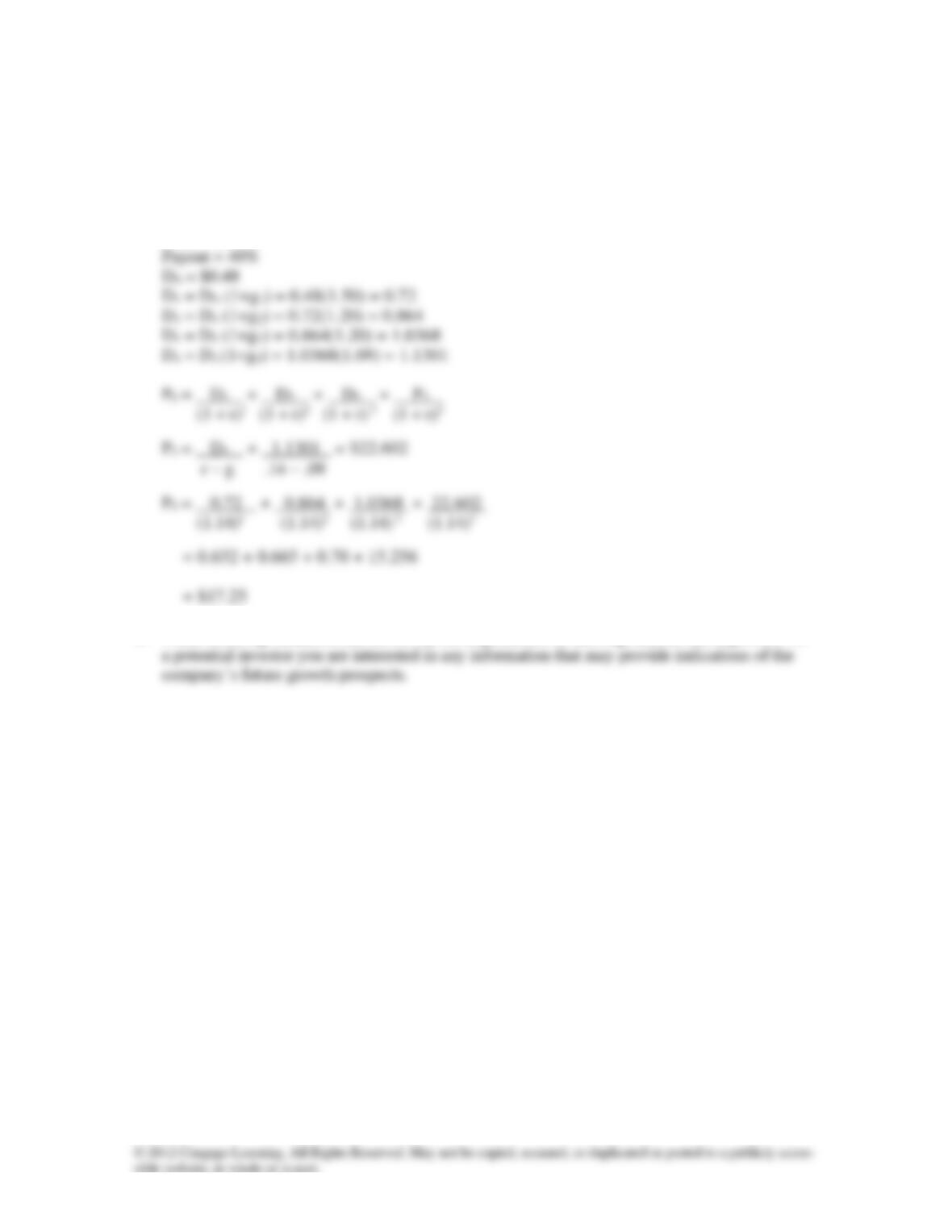
2. The analyst who produced report B makes the assumption that Vegas Chips will enter the na-
3. The analyst who produced report C also makes the assumption that Vegas Chips will enter the
national market but expects a high level of initial excitement for the product that is then fol-
Answers
1. Zero-growth model:
EPSO = $1.20
2. Constant-growth model:
Chapter 5 Valuing Stocks 153
3. Variable–growth model:
g1 = 50%
g2 = 20%
g3 = 20%
g4→ = 9%
EPSO = $1.20
4. These differing valuations are driven by the expectations of earnings and dividend growth. As