
Chapter 5
Introduction to Financial
Management
Chapter Overview
I. Introduction
II. Economic principles
a. Demand, scarcity, surplus and price
b. Microeconomics versus macroeconomics
c. Wealth maximization/profits
i. Accounting profit
ii. Economic profit
iii. Opportunity costs
III. Business types
a. Government-operated organizations
b. Community-owned entities
c. Non-profits
IV. Stock markets
V. Government influence on the business environment
a. Monetary policy and the Federal Reserve
i. Setting interest rates
1. Discount rate
2. Federal funds rate
ii. Monitoring the money supply
1. M1, M2, M3
2. Increasing the money supply
3. Decreasing the money supply
VI. Conclusion
Key Concepts
When reading this chapter, students should focus on the following key concepts:
1. Microeconomic and macroeconomic concepts and trends impact the financial
management of sport organizations.
2. Demand, scarcity, surplus, and price impact sport in a variety of ways, including the
location of franchises and ticket pricing.
Quiz Questions
1. The choices that individuals and organizations make regarding financial management
are influenced by which of the following?
a. Demand
b. Scarcity
2. When sport leagues do not expand into a market that can support a franchise, or when
they create rules to limit the movement of existing franchises, which of the following
economic concepts is being applied?
d. Equilibrium
e. None of the above
3. When the citizens of Hamilton County, Ohio, decided to raise their taxes to fund two
new sports stadiums rather than to raise taxes for something like improving the
educational system in the county, they missed a chance to improve the educational
system. What is this known as?
a. A marginal cost
e. None of the above
4. The vast majority of for-profit businesses in the United States operate as which of the
following?
a. Sole proprietorships
b. General partnerships
5. The major disadvantages of forming a business under a _____ structure is that there is
double taxation of profits, and the cost of forming the business and operating the
business is higher than other structures.
c. Subchapter S corporations
d. Limited liability corporations
e. C corporations
6. Which of the following is the depreciation method that is most aggressive at allocating
loss of useful life to the early years of the asset’s use?
a. Straight-line
b. Sum-of-years digits, decelerating deprecation
7. Which of the following methods of depreciation attempts to take the non-linear loss of
a fixed asset’s value into account, with depreciation occurring quickly after purchase.
Using this method, the denominator for a fixed asset with a useful life of five years is 15.
d. Double-declining balance
e. Units of production
8. Which of the following methods of depreciation attempts to take the non-linear loss of
a fixed asset’s value into account with depreciation occurring late after purchase. Using
this method, the denominator for a fixed asset with a useful life of five years is 15.
a. Straight-line
b. Sum-of-years digits, decelerating deprecation
9. What is the interest rate that banks charge their best customers?
d. Statement rate
e. None of the above
Answers to Quiz Questions
Numbers in parentheses represent where, in the text, you’ll find this discussed.
1. e (p. 112)
2. b (p. 113)

Responses
1. Define microeconomics and macroeconomics. What are the main differences between
the two?
See page 114. Microeconomics refers to the study of issues that occur at the firm level,
whereas macroeconomics refers to forces that affect numerous or all sectors of the
economy.
2. How do professional sports leagues use the concept of scarcity when locating franchises?
See pages 113-114. Most professional sport leagues do not create enough teams to
meet the market demand. This allows franchises in markets that could support
3. Define and discuss monetary policy. What specific actions can the Federal Reserve take
to achieve its goals?
See pages 125–126. Monetary policy is policy that government sets to control the
supply, demand, availability, and cost of money. The Federal Reserve can manipulate
4. List some actions that a government can take for establishing its fiscal policy. What are
some fiscal policies specifically targeted to the sport industry?
See pages 124–128. Fiscal policy involves government entities collecting and spending
money. The U.S. government as well as state and local governments have established a
5. What is a basis point? How does a change in a few basis points affect a loan?
See page 126. A basis point is a hundredth of a percent. Loans are based on a
percentage of interest that must be paid. An addition or subtraction of basis points
6. Define inflation and explain how it may affect sport business operations.
See page 125. Inflation is the gradual increase in prices for goods and services. Any
investment must account for inflation when determining its “real” potential rate of
7. What is a market index? What is an index designed to accomplish?
See page 124. A market index is a basket of stocks that are chosen to represent the
8. Explain the important differences between general and limited partners.
See pages 118–119. General partners retain personal liability for the actions of the
partnership, whereas limited partners are liable only for their direct financial
contribution.
9. What are the differences between a C corp and an S corp?
See pages 121–122. An S corp provides investors limited personal liability but permits
flow-through taxation. However, an S corp has limits on the types and number of people
10. What is an LLC and an LLP? Why have they become more popular business entities over
the past ten years? What concerns should an investor investigate before forming an LLC
or LLP?
See page 121. An LLC is a limited liability corporation, and an LLP is a limited liability
partnership. Before investing in an LLC or LLP, investors should understand the specific
11. How has globalization affected sport finance in the past 10 years? How might it affect
sport finance in the future?
See pages 114–115. There are certainly various points of discussion here; these might
include league scheduling of contests in foreign markets, currency exchanges,
integration of financial markets, etc.
12. What is your reaction to Phil Mickelson’s 2013 comments regarding taxes? What is the
potential impact of Mickelson and others’ leaving California because of high taxes?
See page 130. Students’ answers will vary, but they should support what they believe.
There is certainly a case to be made, and many students will likely argue, that everyone
13. What are jock taxes? How is Tennessee’s jock tax unique?
See pages 134–136. Jock taxes are charged to athletes, coaches, and administrators
who work in a municipality that is not their “home.” For example, an NBA player who
Responses
1. If an interest rate is currently 6% and a lending institution announces a 25 basis point
increase, what percentage of increase does this represent?
2. Calculate the straight-line and sum-of-years-digits depreciation schedules for a $450
video camera that will have a salvage value of $50 after five years of use.
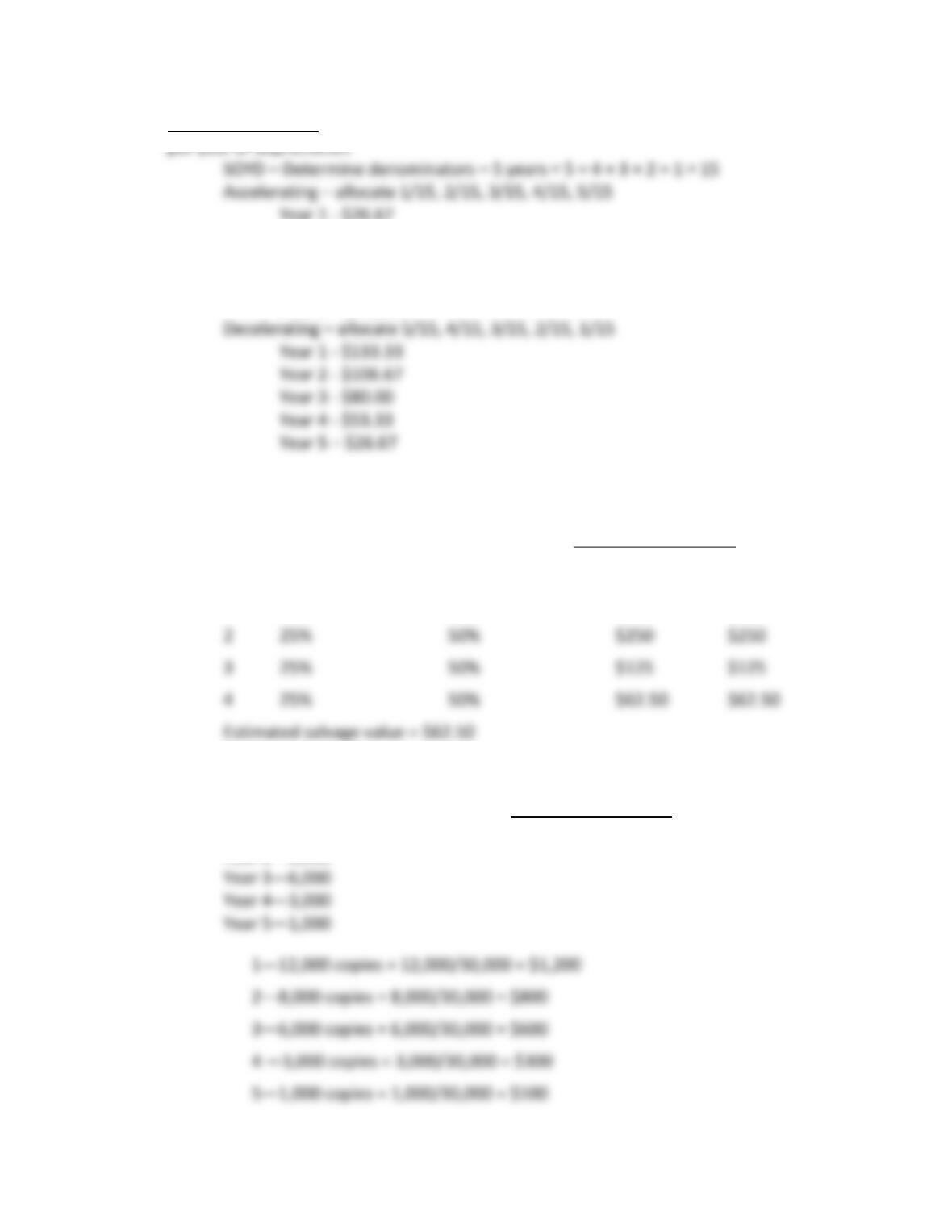
See pages 131–134. SL – $450 – $50 = $400, divide by number of years = $400/5 = $80
per year of depreciation
Year 2 – $53.33
Year 3 – $80.00
Year 4 – $106.67
Year 5 – $133.33
Salvage value = $50 for both accelerating and decelerating
3. Calculate the double-declining balance depreciation schedule for a $1,000 item that will
last four years. What is the estimated salvage value? (See pages 133–134.)
Year Straight-Line % Double Declining % Amount Remaining $
1 25% 50% $500 $500
4. For a fitness center purchasing a $3,000 photocopier expected to produce 30,000
copies, calculate the units of production depreciation schedule if the following number
of copies are expected to be made each year (see pages 133–134.):
Year 1―12,000
Year 2―8,000
Responses to Questions
Darlington Raceway is one of the most important tracks in the history of NASCAR. Opened
in 1950, Darlington Raceway became a model for many tracks that would be built later in
1. How might NASCAR’s decision to reduce Darlington’s races from two to one be
received by regular attendees at both events?
2. How might NASCAR’s decision affect ticket pricing for the one remaining Darlington
race? Explain your answer, referring to the economic and financial principles
discussed in this chapter.
Students should discuss the potential impact of scarcity and how attendees who were used
to attending both events may now elect to not attend any events; alternatively, they may
Additional Classroom/Exam Problems
1. Calculate the double-declining balance depreciation schedule for a $2,000 item that will
last five years. What is the estimated salvage value?
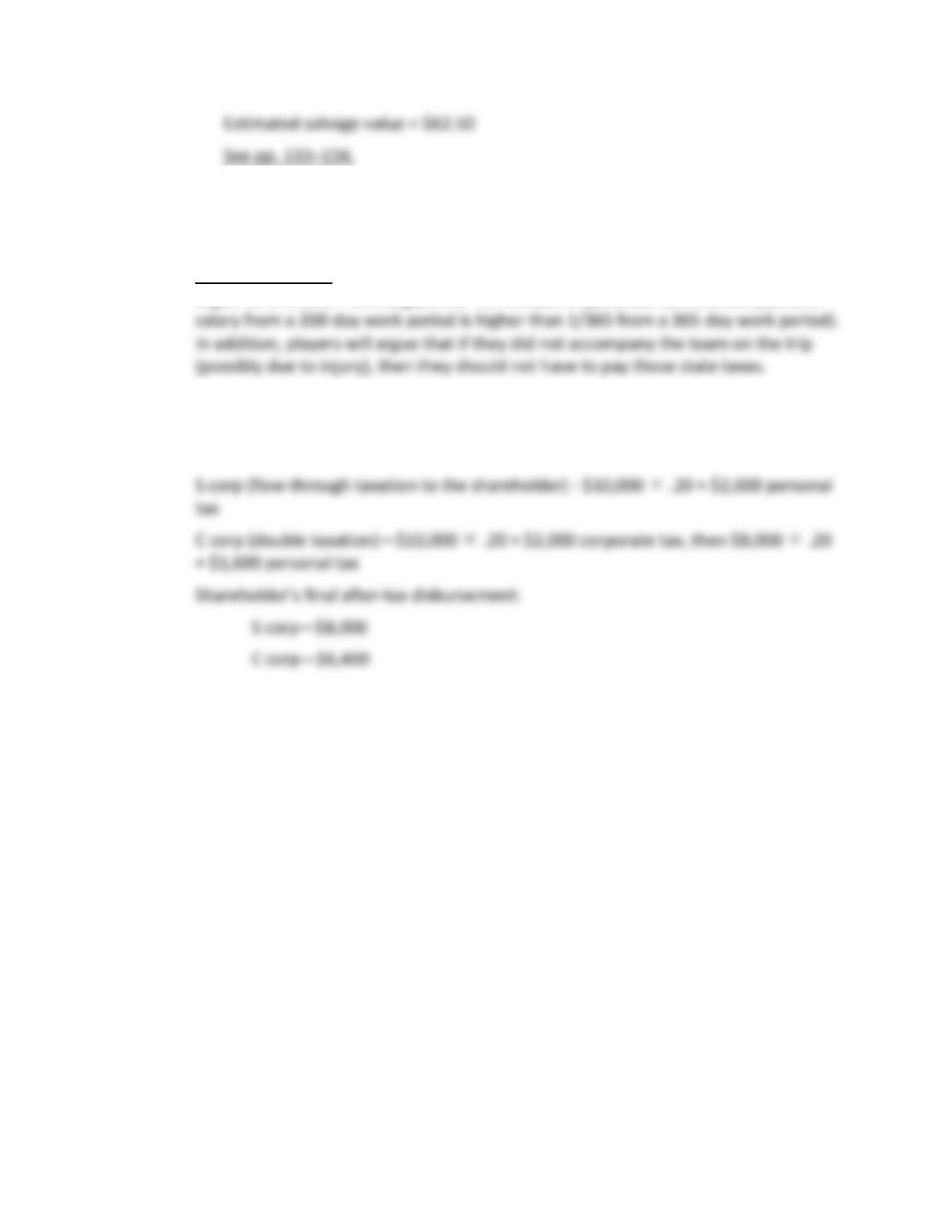
Year Straight-Line % Double Declining % Amount Remaining $
1 20% 40% $800 $1200
2 20% 40% $480 $720
2. If the state charges a jock tax on players who compete in that state, what arguments will
the player (or the player’s representative) potentially make regarding how much money
is owed?
See pp. 134–136. If the tax is based on a percentage of days worked, the state will
argue for a shorter “working period” to increase its potential tax revenue (1/200 of
3. Calculate the differences in total taxes paid if a $10,000 profit (that is disbursed to the
shareholders) is realized for an S corp versus a C corp. Assume a 20% personal tax rate
and a 20% corporate tax rate.