CHAPTER 5: THE BOP AND INTERNATIONAL ECONOMIC LINKAGES
1
CHAPTER 5
THE BOP AND
INTERNATIONAL ECONOMIC LINKAGES
This chapter helps students understand the financial and real linkages between the domestic and world
economies and how these linkages affect business viability. It identifies the basic forces underlying the
flows of goods, services, and capital between countries and relates these flows to key political, economic,
and cultural factors. These trade and capital flows are summarized in the BOP statistics.
KEY POINTS
1. The balance of payments (BOP) is an accounting statement that shows the sum of economic
transactions of individuals, businesses, and government agencies located in one nation with those
located in the rest of the world during a specified period. Thus, the U.S. BOP for a given year is an
accounting of all transactions between Americans and non-Americans during the year.
2. The balance-of-payments statement is based on double-entry bookkeeping; every transaction recorded
3. The BOP has several different components. Each shows a particular kind of transaction such as
merchandise exports or foreign purchases of U.S. government securities. The most basic distinction
4. Since double-entry bookkeeping ensures that debits equal credits, the sum of all transactions is zero.
Absent official reserve transactions, a capital account surplus must just offset the current account
deficit, and a capital account deficit must offset a current account surplus.
5. The total size of the current account deficit is a macroeconomic phenomenon; there is a basic
accounting identity that a nation’s current account deficit reflects excess domestic spending.
Equivalently, a current account deficit equals the excess of domestic investment over domestic
6. To reduce the current account deficit, domestic savings must rise, private investment must decline, or
the government deficit must be reduced. Absent any of these changes, the current account deficit will
not diminish, regardless of the trade barriers imposed or the amount of dollar depreciation.
7. The long-term consequences for a nation that runs a current account deficit depend on how the
resulting capital inflow is used. If the capital account surplus finances productive investment, the
nation is better off; the returns from these added investments will service the foreign debts and leave
something extra. Conversely, a capital account surplus that finances consumption will increase the
nation’s well-being today at the expense of its future well-being.
SUGGESTED ANSWERS “TO THE BANK OF KOREA REASSESSES ITS RESERVE POLICY”
1. What is the link between South Korea’s currency market interventions and its growing foreign
exchange reserves?
2. What is the annualized cost to the Bank of Korea of maintaining $205.5 billion in reserves?
Assume that the government of Korea is issuing bonds that yield about 4% annually while
buying dollar assets that yield about 3.25%.
3. Suppose that during the year the won rose by 8% against the dollar and that the Bank of Korea
kept 100% of its reserves in dollars. At a current exchange rate of W1,011/$, what would that
do to the won cost of maintaining reserves of $205.5 billion?
ANSWER. To maintain reserves of $205.5 billion while sterilizing its foreign exchange market intervention,
4. What are some pros and cons of the Bank of Korea diversifying its investment holdings out of
dollars and into other currencies, such as euros and yen?
5. How has the almost-universal central bank preference for investing reserve assets in U.S.
Treasury bonds affected the cost of financing the U.S. budget deficit?
SUGGESTED ANSWERS TO “WARREN BUFFETT OFFERS A SOLUTION TO AMERICA’S
TRADE DEFICITS”
1. In what way is Warren Buffett’s plan the equivalent of a tariff? What will be its likely impact
on American consumers?
ANSWER. A tariff is a tax on imports. Here the tax is the cost of the Import Certificates (ICs) that all
2. What will be the likely effect of Mr. Buffett’s plan on U.S. exports?
3. How would Mr. Buffett’s plan likely affect savings, investment, and interest rates in the U.S.?
The value of the U.S. dollar?
ANSWER. Given BOP accounting and the huge trade deficit the U.S. is currently experiencing, there is a
4. How would the “bonus” ICs affect the U.S. trade deficit?
5. Mr. Buffett’s plan focuses on the U.S. trade deficit. What would be its likely impact on the U.S.
current-account deficit?
6. What are some possible costs of Mr. Buffett’s plan?
SUGGESTED ANSWERS TO CHAPTER 5 QUESTIONS
1. In a freely floating exchange rate system, if the current account is running a deficit, what are
the consequences for the nation’s balance on capital account and its overall BOP?
2.a. As the value of the U.S. dollar rises, what is likely to happen to the U.S. balance on current
account? Explain.
2.b. What is likely to happen to the value of the dollar as the U.S. current-account deficit
increases? Explain.
ANSWER. It all depends on what is driving the increase in the U.S. current-account deficit. If the deficit
2.c. A current-account surplus is not always a sign of health; a current-account deficit is not
always a sign of weakness. Comment.
ANSWER. A current-account surplus represents an excess of domestic savings over domestic investment.
3. Lufthansa buys $400 million worth of Boeing jets in 2008 and is financed by the U.S. Eximbank
with a five-year loan that has no principal or interest payments due until 2009. What is the net
impact of this sale on the U.S. current account, capital account, and overall BOP for 2008?
ANSWER. In 2008, the sale of Boeing 747s is recorded on the U.S. BOP as a $400 million merchandise
4. What happens to Mexico’s ability to repay its foreign loans if the U.S. restricts imports of
Mexican agricultural produce?
5. Suppose Brazil starts welcoming foreign investment with open arms. How is this likely to affect
the value of the Brazilian real? The Brazilian current-account balance?
6. According to popular opinion, U.S. trade deficits indicate any or all of the following: a lack of
U.S. competitiveness owing to low productivity or low-quality products and/or lower wages,
superior technology, and unfair trade practices by foreign countries. Which of these factors is
likely to underlie the persistent U.S. trade deficits. Explain.
7. During the 1990s, Mexico and Argentina went from being economic pariahs with huge foreign
debts to countries posting strong economic growth and welcoming foreign investment. What
would you expect these changes to do to their current-account balances?
8. Suppose that the trade imbalances of the 2000s largely disappear during the next decade. What
is likely to happen to the huge global capital flows of the 2000s? What is the link between the
trade imbalances and the global movement of capital?
9. In the early 1990s, Japan underwent a recession that brought about a prolonged slump in
consumer spending and capital investment (it was estimated that in 1994 only 65% of Japan’s
manufacturing was being used). At the same time, the U.S. economy emerged from its recession
and began expanding rapidly. Under these circumstances, what would you predict would
happen to the U.S. trade deficit with Japan?
10. It has been argued that with freer markets, Third World nations are now able to attract
capital and technology from the advanced nations. As a result, they can achieve productivity
close to Western levels while paying low wages. Hence, the low-wage Third World nations will
run huge trade surpluses, creating either large-scale unemployment or sharply falling wages in
the advanced nations. Comment on this apocalyptic scenario.
ANSWER. Despite the persuasiveness of this vision of the future, it makes no economic sense. The reason
lies in the basic national income accounting identity presented by Equation 5.5 in the chapter:
INSTRUCTORS MANUAL: FOUNDATIONS OF MULTINATIONAL FINANCIAL MANAGEMENT, 6TH ED.
8
ADDITIONAL CHAPTER 5 QUESTIONS AND ANSWERS
1. How does a trade deficit affect the current-account balance?
2. On which BOP account does tourism show up?
3. Suppose the U.S. expropriates all foreign holdings of American assets. What will happen to the
U.S. current-account deficit? What will likely happen to U.S. savings and investment? Why?
ANSWER. If all foreign holdings of American assets are expropriated, the inflow of foreign capital to the
U.S. will cease and the U.S. capital account will be zero. This means that the U.S. current account must
4. For Brazil to service its foreign debts without borrowing more money, what must be true of its
trade balance?
5. Suppose the U.S. imposes import restrictions on Japanese steel. What is likely to happen to the
U.S. current-account deficit? What else is likely to happen?
6. Suppose that the trade imbalances of the 1990s largely disappear during the 2000s. What is
likely to happen to the huge global capital flows of the 1980s? What is the link between the
trade imbalances and the global movement of capital?
7. In 1965, about 34% of all adult workers were under the age of 34, compared with almost 47%
by 1980. Meanwhile, the share of the workforce between 35 years and 59 years shrank from
about 60% to 49%. What impact might this dramatic shift in the age distribution of the U.S.
workforce have had on the U.S. current-account balance over this 15-year period? (Hint:
Consider the difference in savings behavior between younger and older workers.)
ANSWER. According to the life-cycle theory of consumer spending, consumption today is based not on
current income but rather on an individual’s expected lifetime earnings. In the U.S., workers generally
8. In 1990, Japan’s Ministry of International Trade and Investment (MITI) proposed that firms
be given a tax credit equal to 5% of the value of its increased imports. The purpose of this tax
subsidy is to encourage Japanese imports of foreign products and thereby reduce Japan’s
persistent trade surplus. At the same time, the Japanese government announced that it will
reduce its budget deficit during the coming year.
8.a. What are the likely consequences of the tax subsidy plan on Japan’s trade balance, the value
of the yen, and the competitiveness of Japanese firms?
ANSWER. The tax subsidy plan by itself should lead to an increase in imports and consumption since it
8.b. What are the likely consequences of a lower Japanese budget deficit on Japan’s trade balance?
9. Currently, social security is minimal in Japan. Suppose Japan institutes a comprehensive social
security system. How is this policy switch likely to affect Japan’s trade surplus?
ANSWER. The existence of a comprehensive social security system will reduce the incentive for Japanese
10. In 1992, Japan entered a recession. However, at the same time, its current-account surplus hit
a record. Is there a contradiction between Japan’s large trade surplus and a weak national
economy? Explain.
11. What will strong economic growth do for the U.S. current account balance? A U.S. recession?
12. In the early 1990s, interest rates worldwide fell. As a net debtor nation, how should this affect
the U.S. current-account balance?
13. “The U.S. trade deficit is a consequence of the unwillingness of the current generation of
American taxpayers to pay fully for the goods and services they want from government.”
Comment.
ANSWER. There is some truth to this statement. If people demand more from government than they are
14. The devastating earthquake that hit Kobe, Japan on January 17, 1995, was estimated to cause
about $100 billion in damage to the Japanese economy. What is the likely effect of this
earthquake on Japan’s 1995 current account? On its capital account? Explain.
15. In 1990, Germany’s current-account surplus exceeded $50 billion. However, it is estimated
that the reunification process will require that Germany invest several hundred billion dollars
in its eastern states over the coming decade.
15.a. What implications does this huge investment have for Germany’s current-account balance in
the future? Explain.
ANSWER. Unless German savings rise in line with the increase in German domestic investment, balance-
15.b. How should the DM’s value change to facilitate the necessary shift in Germany’s economy?
16. On June 23, 1997, Japanese Prime Minister Ryutaro Hashimoto spooked Wall Street. At a
Columbia University luncheon, he appeared to warn that the Japanese might sell U.S.
Treasury bills unless the U.S. helped stabilize exchange rates. The Dow Jones Industrial
Average fell 192 points.
16.a. Why might the stock market have fallen on such a remark? Trace the causal links.
16.b. How much substance is there to the possibility that the Japanese might sell off their U.S.
investments? Explain.
SUGGESTED SOLUTIONS TO CHAPTER 5 PROBLEMS
1. How would each of the following transactions show up on the U.S. BOP accounts?
1.a. Payment of $50 million in Social Security to U.S. citizens living in Costa Rica.
1.b. Sale overseas of 125,000 Elvis Presley CDs.
1.c. Tuition receipts of $3 billion received by American universities from foreign students.
1.d. Payment of $1 million to U.S. consultants A.D. Little by a Mexican company.
1.e. Sale of a $100 million Eurobond issue in London by IBM.
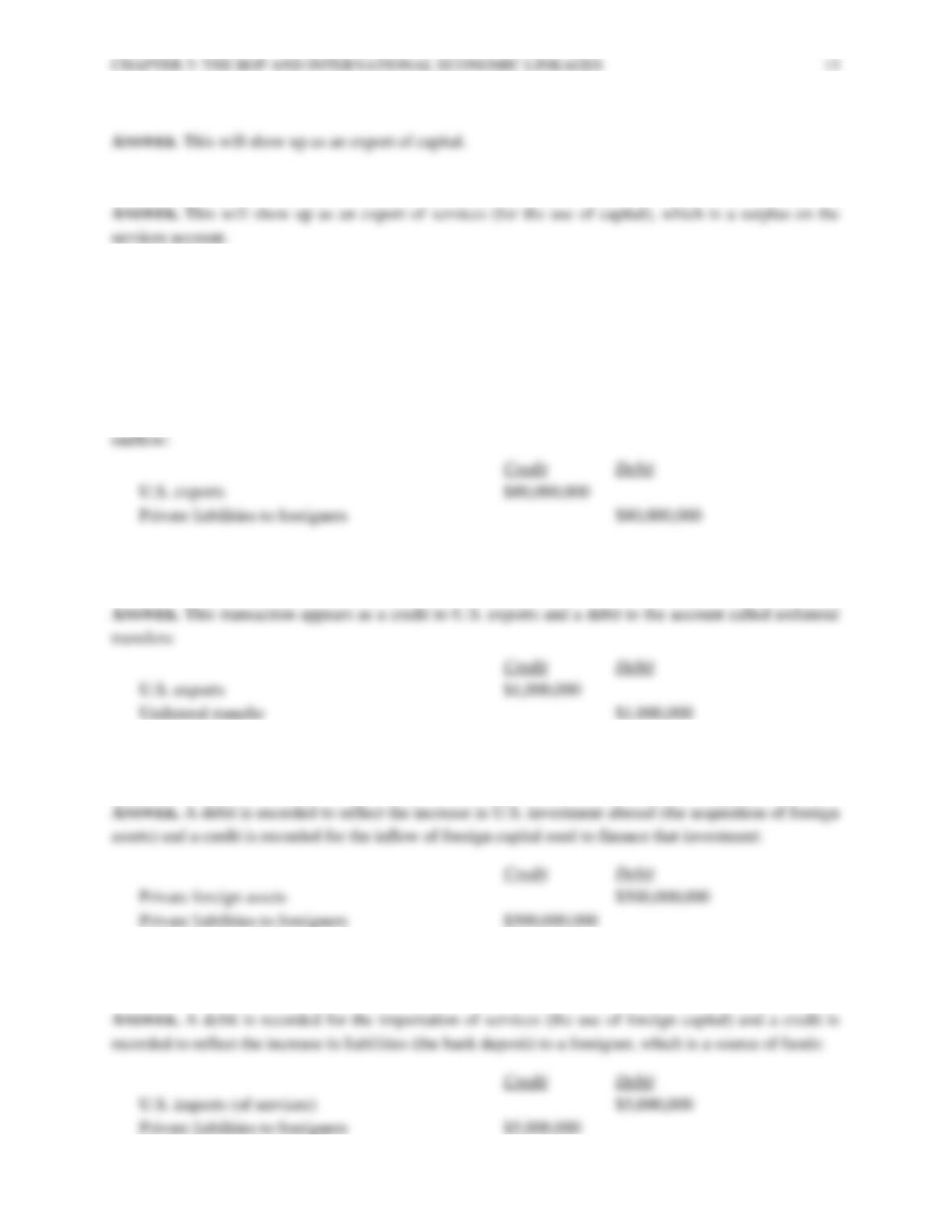
1.f. Investment of $25 million by Ford to build a parts plant in Argentina.
1.g. Payment of $45 million in dividends to U.S. citizens from foreign companies.
2. Set up the double-entry accounts showing the appropriate debits and credits associated with the
following transactions:
2.a. ConAgra, a U.S. agribusiness, exports $80 million of soybeans to China and receives payment
in the form of a check drawn on a U.S. bank.
ANSWER. A credit is recorded for the increase in U.S. exports and a debit is recorded to reflect a decrease
in liabilities to a foreigner associated with the check drawn on a U.S. bank, which is a private capital
2.b. The U.S. government provides refugee assistance to Somalia in the form of corn valued at $1
million.
2.c. Dow Chemical invests $500 million in a chemical plant in Germany financed by issuing bonds
in London.
2.d. General Motors pays $5 million in dividends to foreign residents, who choose to hold the
dividends in the form of bank deposits in New York.
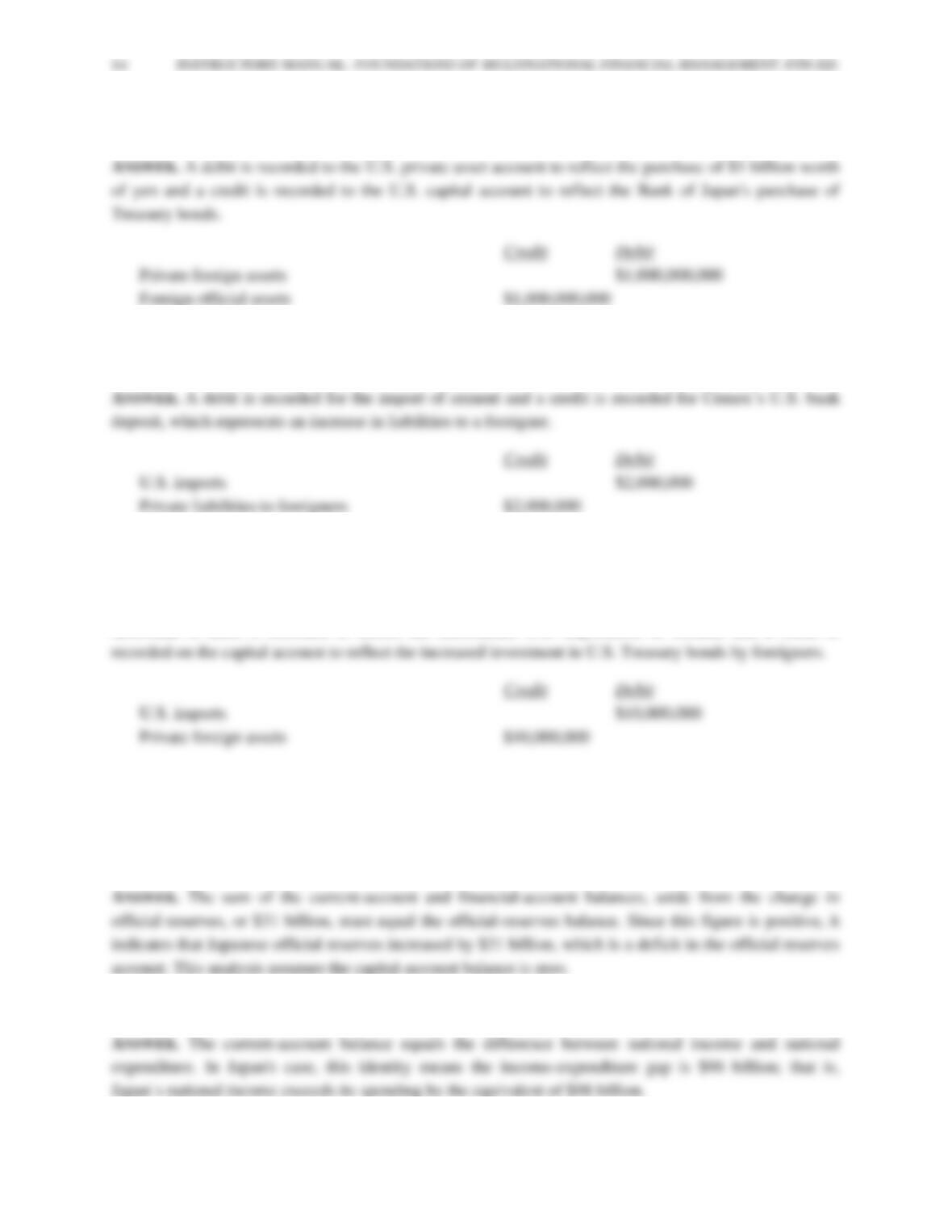
2.e. The Bank of Japan buys up one billion dollars in the foreign exchange market to hold down
the value of the yen and uses these dollars to buy U.S. Treasury bonds.
2.f. Cemex, a Mexican company, sells $2 million worth of cement to a Texas company and
deposits the check in a bank in Dallas.
2.g. Colombian drug dealers receive $10 million in cash for the cocaine they ship to the U.S.
market. The money is smuggled out of the U.S. and then invested in U.S. corporate bonds on
behalf of a Cayman Islands bank.
ANSWER. A debit is recorded to reflect the unfortunate U.S. importation of cocaine and a credit is
3. During the year, Japan had a current-account surplus of $98 billion and a financial-account
deficit, aside from the change in its foreign-exchange reserves, of $67 billion.
3.a. Assuming the preceding data are measured with precision, what can you conclude about the
change in Japan’s foreign exchange reserves during the year?
3.b. What is the gap between Japan’s national expenditure and its national income?
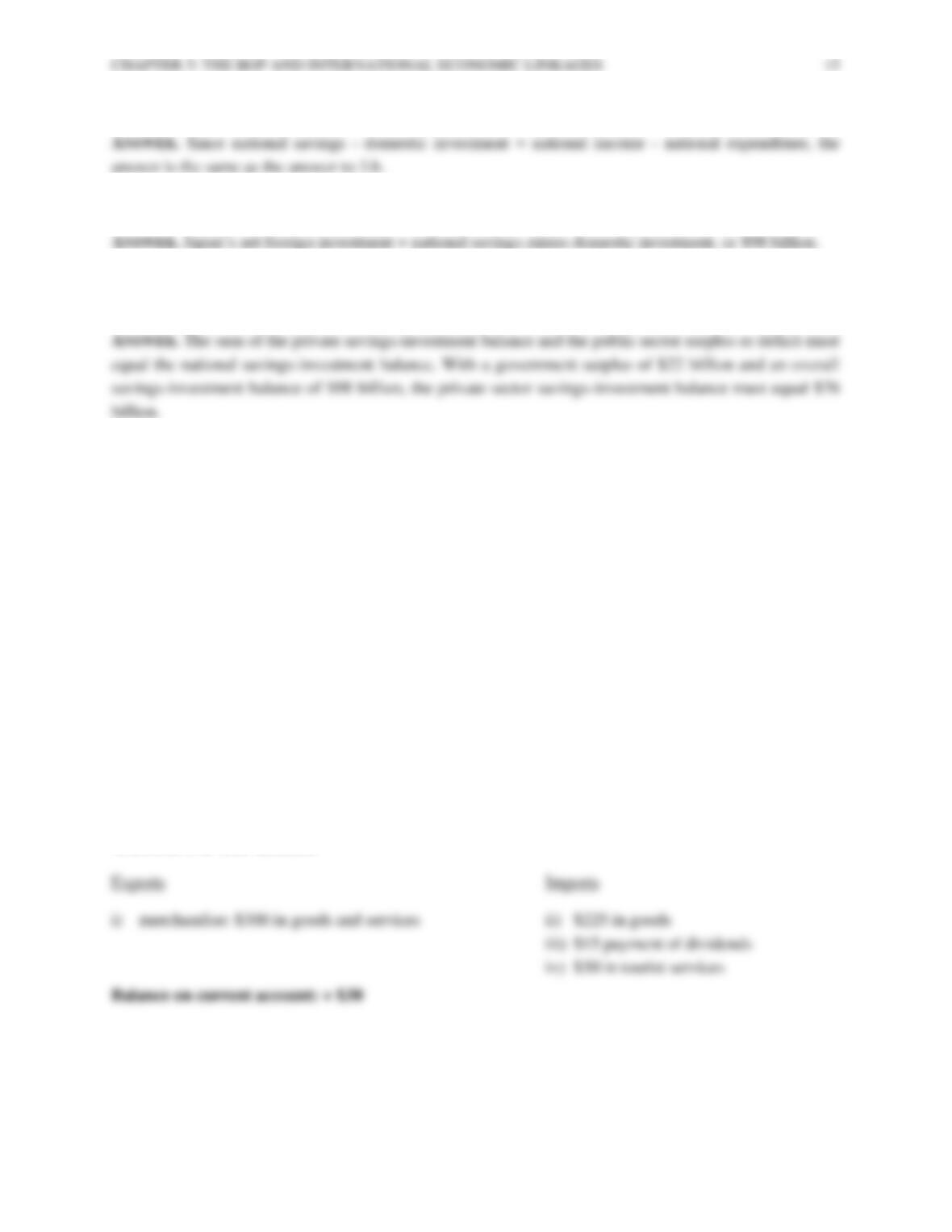
3.c. What is the gap between Japan’s savings and its domestic investment?
3.d. What was Japan’s net foreign investment for the year?
3.e. Suppose the Japanese government’s budget ran a $22 billion surplus during the year. What
can you conclude about Japan’s private savings-investment balance for the year?
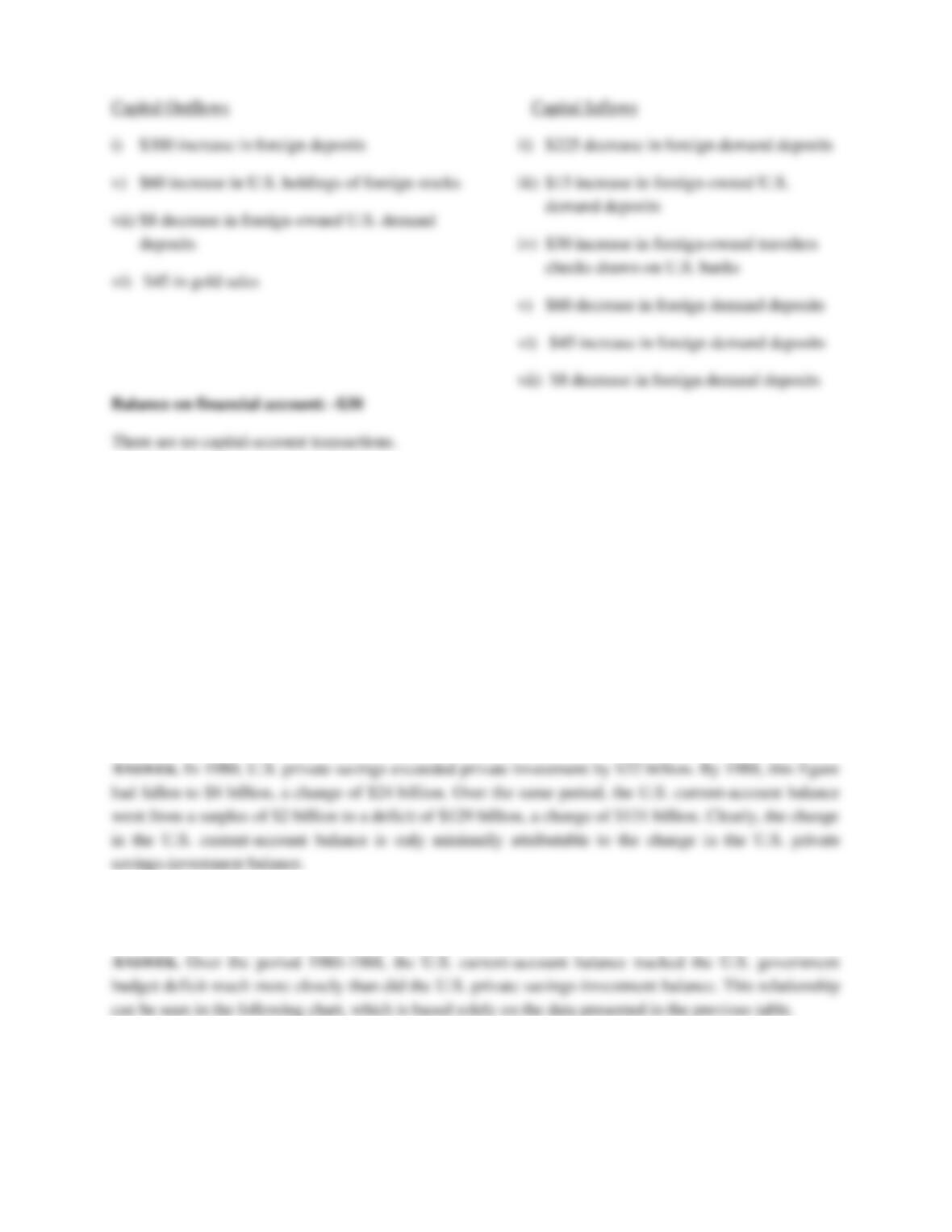
4. The following transactions (expressed in U.S. $ billions) take place during a year. Calculate the
U.S. merchandise-trade, current-account, capital-account, and financial-account balances.
i) The U.S. exports $300 of goods and receives payment in the form of foreign demand deposits
abroad.
ii) The U.S. imports $225 of goods and pays for them by drawing down its foreign demand
deposits.
iii) The U.S. pays $15 to foreigners in dividends drawn on U.S. demand deposits here.
iv) American tourists spend $30 overseas using traveler’s checks drawn on U.S. banks here.
v) Americans buy foreign stocks with $60, using foreign demand deposits held abroad.
vi) The U.S. government sells $45 in gold for foreign demand deposits abroad.
vii) In a currency support operation, the U.S. government uses its foreign demand deposits to
purchase $8 from private foreigners in the United States.
ANSWER. U.S. BOP accounts
INSTRUCTORS MANUAL: FOUNDATIONS OF MULTINATIONAL FINANCIAL MANAGEMENT, 6TH ED.
16
5. During the Reagan era, 1981-1988, the U.S. current account moved from a tiny surplus to a
large deficit. The following table provides U.S. macroeconomic data for that period.
Year
1980
1981
1982
1983
1984
1985
1986
1987
1988
Private savings
500
586
617
641
743
736
721
731
802
Private investment
468
558
503
547
719
715
718
749
794
Government budget deficit
-35
-30
-109
-140
-109
-125
-147
-112
-98
Current-account balance
2
5
-11
-45
-100
-125
-151
-167
-129
5.a. Based on these data, to what extent would you attribute the changes in the U.S. current-
account balance to a decline in the U.S. private savings-investment balance?
5.b. To what extent would you attribute the changes in the U.S. current-account balance to an
increase in the U.S. government budget deficit?
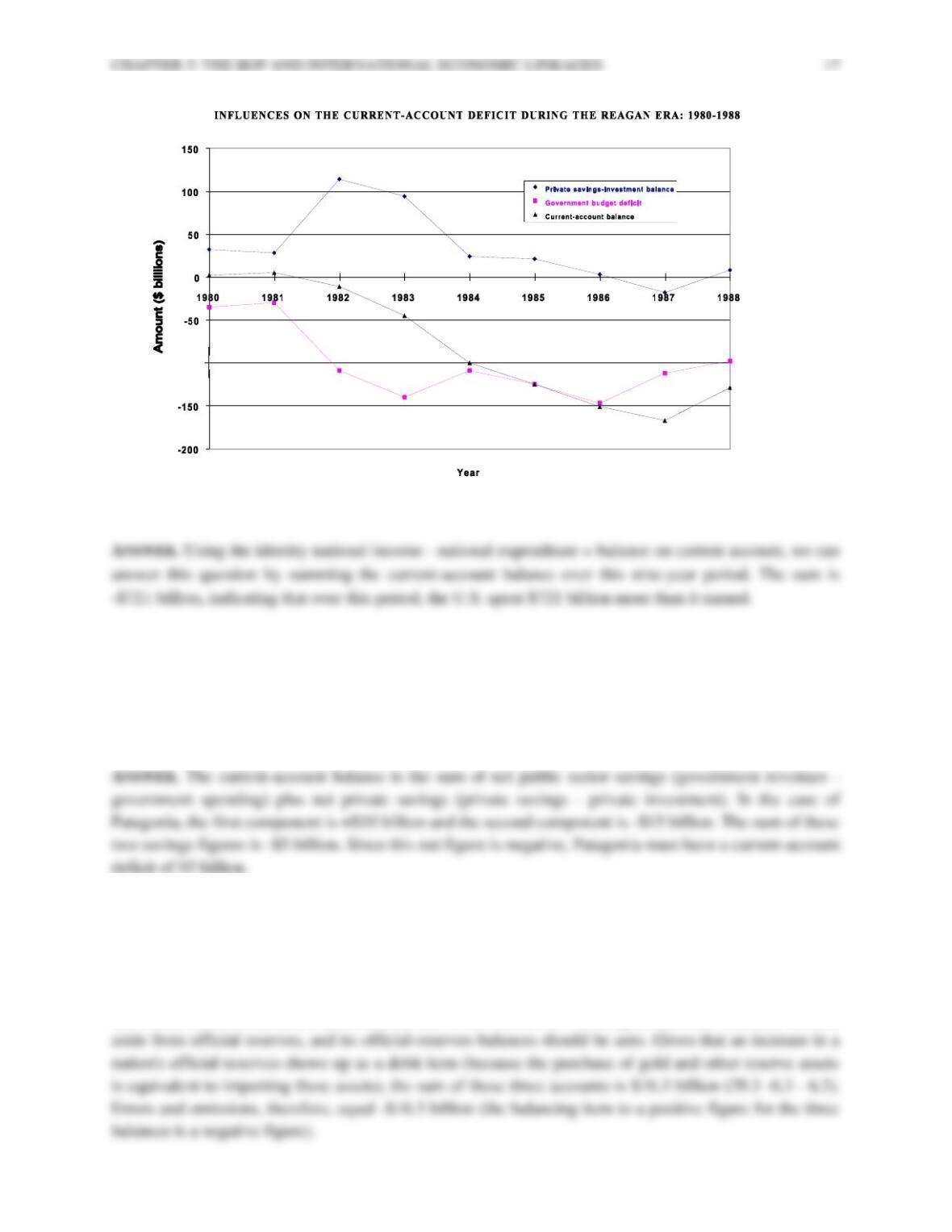
Based on these data, what was the excess of national spending over national income during this period?
ADDITIONAL CHAPTER 5 PROBLEMS AND SOLUTIONS
1. Suppose Patagonia has a government surplus of $10 billion. At the same time, private
investment in Patagonia exceeds private savings by $15 billion. What can you conclude about
Patagonia’s balance on current account?
2. In 1998, China’s current account had a surplus of $29.3 billion, its capital account had a zero
balance, its financial account aside from official reserves had a deficit of $6.3 billion, and its
official reserves increased by $6.2 billion.
2.a. What do these figures tell you about China’s errors and omissions?
ANSWER. Absent errors and omissions, the sum of the current-account, capital-account, financial-account
–100
2.b. What might account for these errors and omissions?
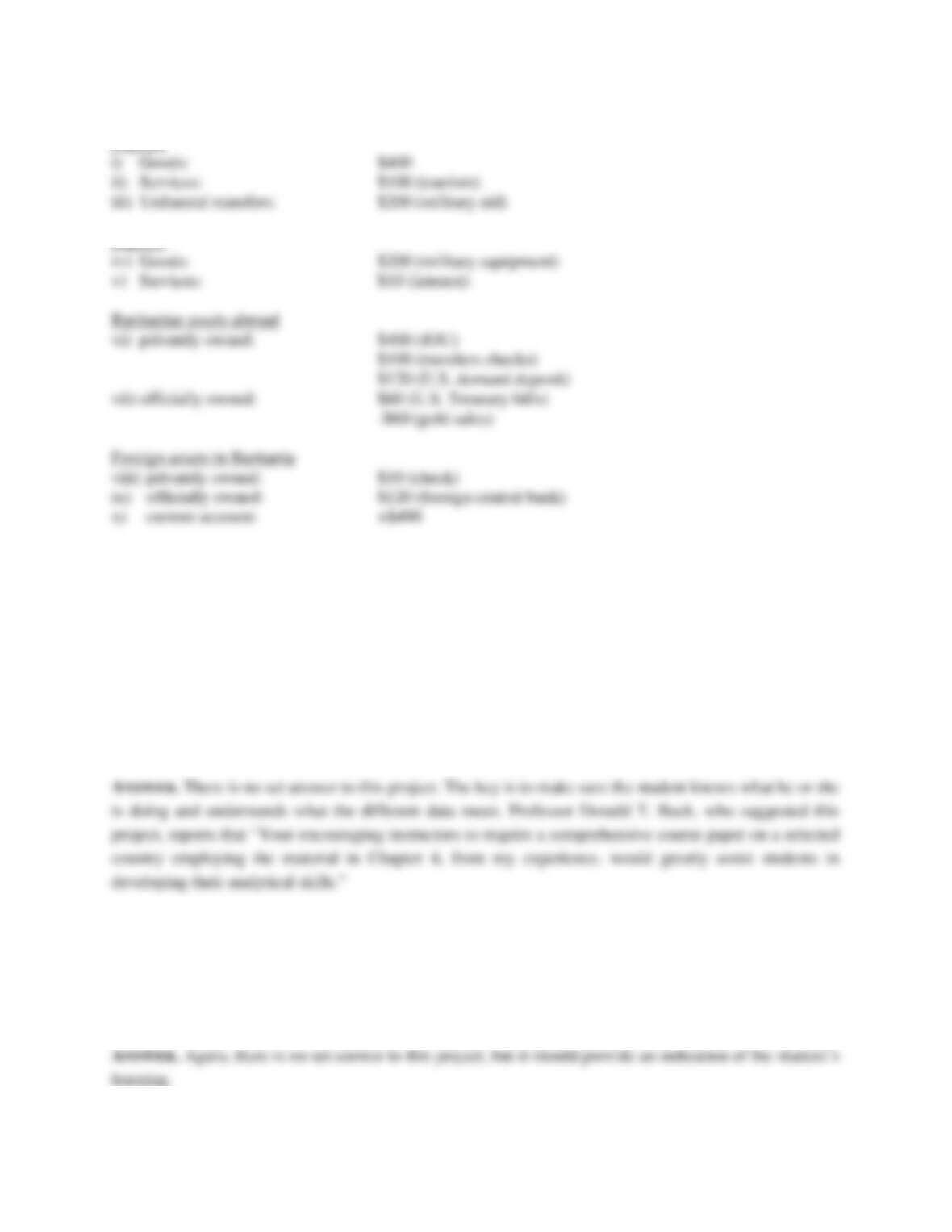
3. Ruritania is calculating its BOP for the year. As usual, its data are perfectly accurate. All of the
transactions for the year are listed below (in Rur$ millions).
i) Ruritania received weapons worth $200 from the United States under its military aid program; no
payment is necessary.
ii) A Ruritanian firm exported $400 of cloth and received an IOU from the foreign importer.
iii) A Ruritanian resident paid $10 in interest on a loan from a foreigner; the check was drawn on a
domestic Ruritanian bank.
iv) Foreign tourists visited Ruritania and spent $100 in traveler’s checks drawn on foreign banks.
v) The Ruritanian central bank sold $60 in gold to a foreign government and received U.S. Treasury
bills in return.
vi) A foreign central bank deposited $120 in a private domestic Ruritanian bank and paid with a
check drawn on a private bank in the United States.
Fill in the correct number for each balance-of-payments account for items a through j.
Exports
i) goods
ii) services
Imports
iii) goods
iv) services
v) unilateral transfers
Ruritanian assets abroad
vi) privately owned
vii) officially owned
Foreign assets in Ruritania
viii) privately owned
ix) officially owned
x) current account
CHAPTER 5: THE BOP AND INTERNATIONAL ECONOMIC LINKAGES
19
ANSWER. Ruritanian BOP accounts are as follows:
Exports
v) Services:
$10 (interest)
-$60 (gold sales)
Foreign assets in Ruritania
x) current account:
+$490
4. Select a country and undertake an analysis of that country’s BOP for 8 to 12 years, subject to
availability of data. The analysis must include examinations (presentation of statistical data
with discussion) of the trade balance, current-account balance, capital-account balance, basic
balance, and overall balance. Your report should also address the following issues:
4.a. What accounts for swings in these various balances over time?
4.b. What is the relationship between shifts in the current-account balance and changes in savings
and investment? Include an examination of government budget deficits and surpluses,
explaining how they relate to the savings-investment and current-account balances.
5. For the country selected in additional problem 4, analyze the exchange rate against the dollar
during the same period.
5.a. Is there any observable relationship between the BOP accounts and the exchange rate?
5.b. Provide a possible explanation for your observations in (a) above.