Making Automobile
and Housing Decisions
Chapter 5
How Will This Affect Me?
A home is typically the largest single investment you’ll ever make, and a car is usually the
second largest. As a result, the decisions to buy and finance these assets are important, personal,
and complicated.
Given these are the major interests of students and in fact are the major topics in the chapter, I
suggest that you build on them and use a case for each. The critical thinking case 5.1 uses
worksheet 5.1 to examines the lease v purchase of a car. The critical thinking case 5.3 uses
worksheet 5.2 to examine the question whether to rent or purchase a home [a condo in this case].
In addition, financial planning exercises 2 and 3 examine these same questions. I suggest you
discuss in class the critical thinking questions and assign as homework problems 2 and 3.
LEARNING GOALS
LG1 Design a plan to research and select a new or used automobile.
A useful exercise is to go to Carmax or other site and compare the cost of owning a car where:
Researching a car by reading Consumer Reports gives an independent look at cars. All the
manufacturers have website that gives information about their cars. Generally, for information
about prices, you will need to go to site like CARMAX or to a dealer and talk. You need to
research first then select the car you want. These steps need to occur before and separate from
the purchase activity.
LG2 Decide whether to buy or lease a car.
As noted above, homework problem 2 uses Worksheet 5.1.
Exhibit 5.2 discusses pros and cons of buying a used car, which is an alternative to consider.
LG3 Identify housing alternatives, assess the rental option, and perform a rent-or-buy analysis.
The Worksheet 5.2 gives a format for making this decision. It is an important decision. I knew a
couple of school teachers in Milwaukee that never purchased a home. They rented their entire
life—they did not want the maintenance issues and wanted to invest in the stock market. For
LG4 Evaluate the benefits and costs of homeownership and estimate how much you can afford
to pay for a home.
Worksheet 5.3 examines how much you can afford and is used in Financial Planning Exercise 8.
Discussing this problem will cover the topic.
LG5 Describe the home-buying process.
Exhibit 5.10 discusses strategies to improve the home-buying process. The chapter covers this
LG6 Choose mortgage financing that meets your needs.
The Test Yourself Questions 5-20, 5-21, and 5-22 below cover the options to consider. The
Financial Planning Exercises 7 and 10 give some examples of comparing mortgage types and

Financial Facts or Fantasies?
These may be used as “teasers” to get the students on the right page with you. Also, they may be
used as quizzes after you covered the material or as “pre–test questions” to get their attention.
For most people, an automobile will be their second largest purchase.
Fact: A car ranks second only to housing with respect to the amount of money spent.
t
The closing costs on a home are rather insignificant and seldom amount to more than a few
hundred dollars.
Fantasy: Closing costs – most of which must be paid by the buyer – on home purchases can
amount to several thousand dollars and often total an amount equal to 50 percent or more of the
down payment.

Financial Facts or Fantasies?
These may be used as a quiz or as a pre-test to get the students interested.
1. True False For most people, an automobile will be their second largest purchase.
2. True False The most popular form of single-family housing is the condominium.
3. True False Mortgage insurance guarantees the lender that the loan will be paid off in
the event of the borrower’s death.
4. True False The closing costs on a home are rather insignificant and seldom amount
to more than a few hundred dollars.
5. True False The amount of money you can borrow has a lot to do with the amount of
money you earn.
6. True False In an adjustable-rate mortgage, payment will change periodically, along
with prevailing interest rates.

YOU CAN DO IT NOW
The “You Can Do It Now” cases may be assigned to the students as short cases or problems.
They will help make the topic more real or relevant to the students. In most cases, it will only
take about ten minutes to do, that is, until the student starts looking around at the web site. But
they will learn by doing so.
What’s Your Car Worth?
If you have a car, it’s good to know what it is worth from time-to–time. That way you’ll have a
YOU CAN DO IT NOW
Rent vs. Buy a Home?
Thinking about buying a home rather than continuing to rent? Or would you just like to know the
YOU CAN DO IT NOW
Current Mortgage Rates

Financial Impact of Personal Choices
Read and think about the choices being made. Do you agree or not? Ask the students to discuss
the choices being made.
Brianna Wants to Buy a House but Doesn’t Want a Roommate Now
Brianna has saved $10,000 toward a $20,000 down payment on buying a home. She puts aside
$300 a month in her house fund and is currently renting a one-bedroom apartment on her own for
Additional comments:
The case demonstrates the kind of tradeoffs that are necessary to maintain and achieve a
financial plan. There are others issues that could be raised. For example, how would Brianna

Applying Personal Finance
How’s Your Local Housing Market?
What’s the best source of information about available housing in your community? The answer
is a well-informed professional real estate agent whose business is helping buyers find and
negotiate the purchase of the most suitable property at the best price. However, there’s another
Teaching suggestions:
Perhaps you could help the student by identifying neighborhoods or areas of the city based upon
Solutions to Financial Planning Exercises
1. Planning a new car purchase: Alexis Martin has just graduated from college and needs
to buy a car to commute to work. She estimates that she can afford to pay about $450 per
month for a loan or lease and has about $2,000 in savings to use for a down payment.
Develop a plan to guide her through her first car-buying experience, including researching
car type, deciding whether to buy a new or used car, negotiating the price and terms, and
financing the transaction.
Exhibit 5.1 lists the steps in buying a new car.
• Research which car best meets your needs and determine how much you can afford to
spend on it. Choose the best way to pay for your new car—cash, financing, or lease. Ask
your insurance agent for annual premium quotes for insuring various cars, as auto
insurance is another significant expense of owning a car. Assuming a 3-year loan at 5%
with a $450 per month payment plus $2,000, Alexis can purchase a $17,000 car.
[PV(.05/12,3*12,450) + $2,000 = $17,000] With a 1%, 6-year loan, she can purchase a
$33,000 car. [PV(.01/12,6*12,450) + $2,000 = $33,000, rounded down to nearest
thousand].
• If you are trading in your old car, you are not likely to get as high a price as you would if
you sell it yourself. Look up your car’s trade–in-value at Edmunds.com or kkb.com. Get
bids from several dealers. Check carmax.com.
• Negotiate the lowest price on your new car by getting bids from at least three dealers.
Hold firm on your target price before closing the deal.

2. Lease vs purchase car decision: Use Worksheet 5.1. Gavin Anderson is trying to decide
whether to lease or purchase a new car costing $18,000. If he leases, he’ll have to pay a
$600 security deposit and monthly payments of $425 over the 36-month term of the closed-
end lease. On the other hand, if he buys the car then he’ll have to make a $2,400 down
payment and will finance the balance with a 36-month, 5 percent loan requiring monthly
payments of $500; he’ll also have to pay a 6 percent sales tax ($1,080) on the purchase
price, and he expects the car to have a residual value of $6,500 at the end of 3 years. Gavin
can earn 2 percent interest on his savings and plans to include the sales tax in the amount
financed on the purchase. Use the automobile lease versus purchase analysis form in
Worksheet 5.1 to find the total cost of both the lease and the purchase and then recommend
the best strategy for Gavin.
From Worksheet 5.1 below, better alternative is to purchase the car. The total cost of leasing is
$15,336 and of purchasing, $14,044. If purchase, buyer bears the burden of repairs that may or
may not be covered by warranties. The major advantage of purchasing is you own the car at the
end of the loan. At the end of the lease, you do not have a car. However, if you lease a new car
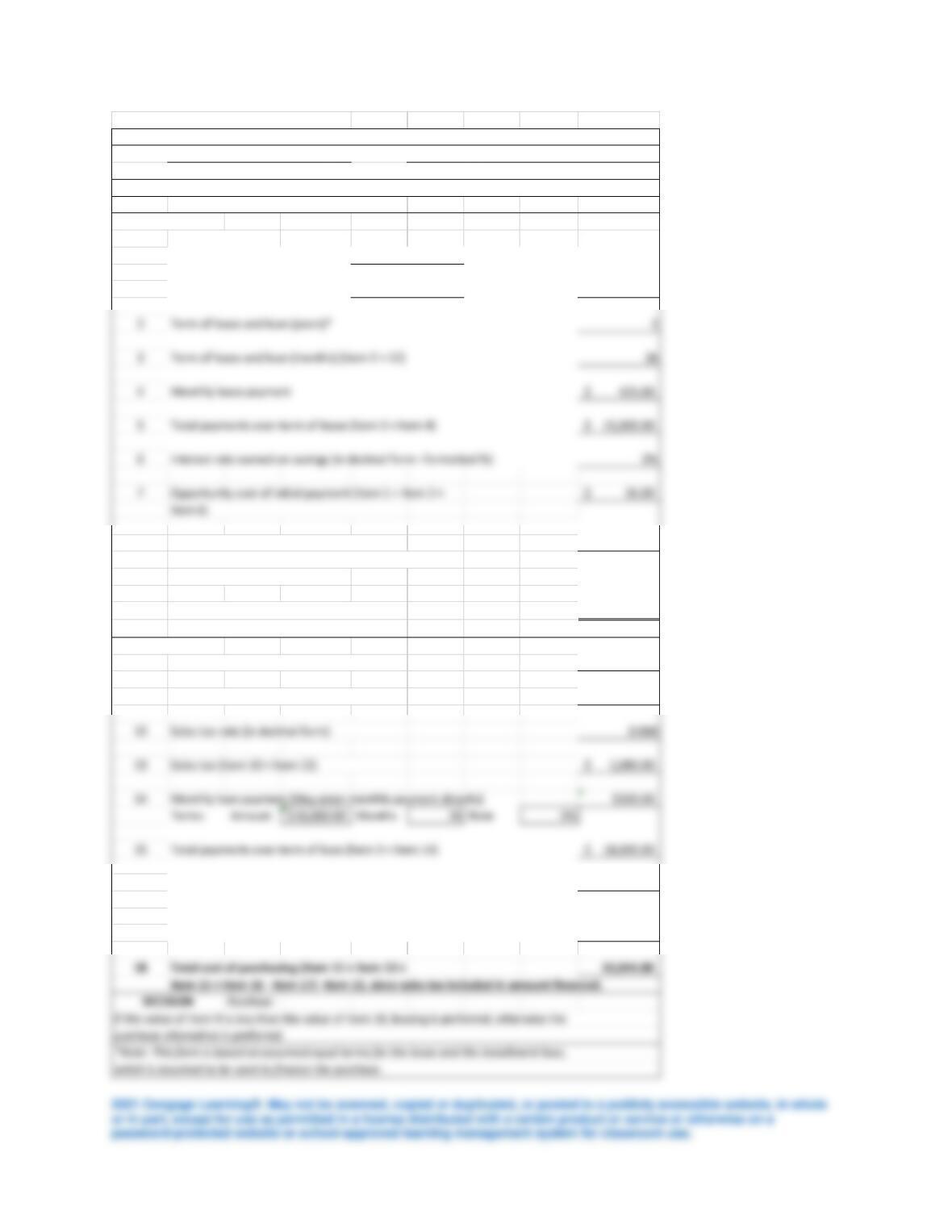
Worksheet 5.1, Chapter 5 Exercise 2
Name Date
Item Amount
1
a. Down payment (capital
600.00$
Monthly lease payment
Total payments over term of lease (Item 3 × Item 4)
Opportunity cost of initial payment (Item 1 × Item 2 ×
8 Payment/refund for market value adjustment –$
at end of lease ($0 for closed-end leases) and/or
estimated end-of-term charges
9 15,336.00$
10 18,000.00$
11 2,400.00$
Sales tax rate (in decimal form)
Sales tax (Item 10 × Item 12)
16 144.00$
17 6,500.00$
Opportunity cost of down payment (Item 2 ×
Item 6 × Item 11)
Estimated value of car at end of loan
PURCHASE
Purchase price
Down payment
Total cost of leasing (Item 1a + Item 5 +
Item 7 + Item 8)
LEASE
Initial payment:
–$
cost reduction):
b. Security deposit:
600.00$
Description
AUTOMOBILE LEASE VERSUS PURCHASE ANALYSIS*
Gavin Anderson
If the value of Item 9 is less than the value of Item 18, leasing is preferred; otherwise the
purchase alternative is preferred.

3. Rent versus buy home. Use Worksheet 5.2. Kayla Thompson is married and currently
renting an apartment for $725 per month and paying $275 annually for renter’s insurance.
Her landlord required a $1,000 security deposit on the apartment. She just found a small
townhouse that she can buy for $285,000. She has enough cash for a $10,000 down payment
and $4,000 in closing costs. Her bank is offering 30-year mortgages at a 6 percent annual
rate. Kayla estimated the following costs as a percentage of the home’s price: property
taxes, 2.5 percent; homeowner’s insurance, 0.5 percent; and maintenance, 0.7 percent. She
is in the 24 percent tax bracket, has an after-tax rate of return on invested funds of 4
percent, and expects the townhouse to appreciate 2 percent per year. Using Worksheet 5.2,
calculate the cost of each alternative and recommend the less costly option—rent or buy—
for Kayla.
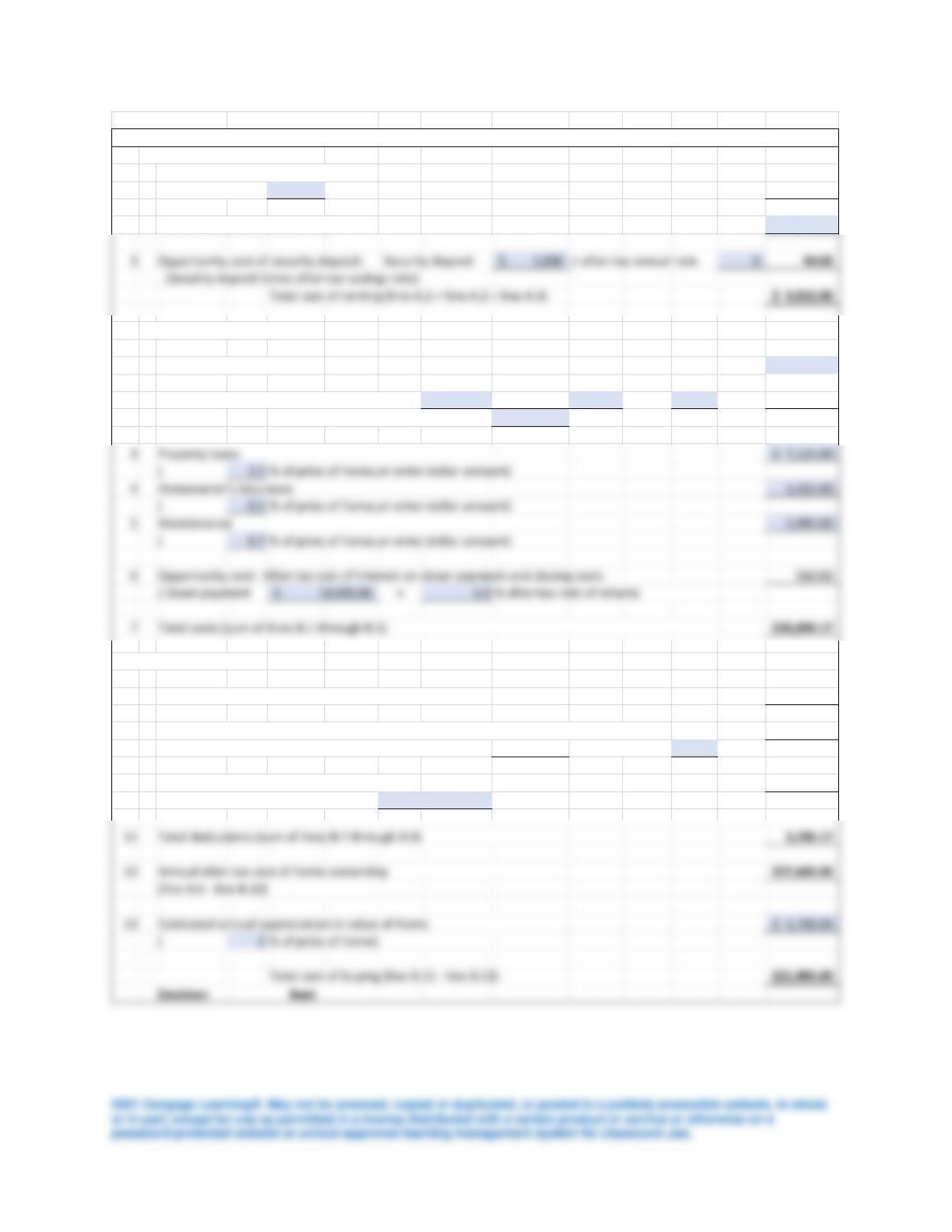
Kayla will most likely use the standard deduction of $24,000 for 2018. Therefore, the tax impact
of the mortgage interest and the property taxes is zero. For the interest and property tax to
reduce taxes, the Thompsons will have to elect to itemize their deductions.
Total deductions (sum of lines B.7 through B.9)
Annual after-tax cost of home ownership
(line B.6 – line B.10)
Estimated annual appreciation in value of home
% of price of home)
Worksheet 5.2 Chapter 5, Exercise 3
A.
1
Monthly Rent 725.00$ 8,700.00$
2 275.00$
Opportunity cost of security deposit:
B.
1 Purchase Price of the Home 285,000$
2
Annual mortgage payments (Terms:
275,000$ , 360 months, 6 %) 19,785$
(12 $1,648.76 )
Total costs (sum of lines B.1 through B.5)
Property taxes
Homeowner’s insurance
Maintenance
% after-tax rate of return)
8 Principal reduction in loan balance (see note below) 3,285.17$
9 –
16,500$ × tax rate of 0%)
10 Tax savings due to property tax deductions* –
%)
Annual rental costs, 12 times monthly re
Renter’s insurance, Annual Cost
COST OF BUYING
× monthly mortgage payment of
RENT-OR-BUY of HOME ANALYSIS
Less:
Tax savings due to interest deductions*
(Interest portion of mortgage payments
(line B.3 × tax rate of
0
COST OF RENTING
4. Calculating required down payment on home purchase. How much would you have to put
down on a house costing $100,000 if the house had an appraised value of $105,000 and the
lender required an 80 percent loan-to-value ratio?
A loan-to-value ratio of 80 percent indicates the maximum amount that a lender will loan on a
5. Determining maximum affordable mortgage payment. Using the maximum ratios for a
conventional mortgage, how big a monthly payment could the Sanchez family afford if
their gross (before-tax) monthly income amounted to $4,000?
Would it make any difference if they were already making monthly installment loan
payments totaling $750 on two car loans?
The range for mortgage payments over income is from 25 to 30 percent. The range for the total
of all installment payments is 33 to 38 percent. So, if the Taylor family income is $4,000 per
month:
6. Changes in mortgage principal and interest over time. Explain how the composition of the
principal and interest components of a fixed-rate mortgage change over the life of the
mortgage. What are the implications of this change?
Exhibit 5.8 graphs the relationship between principal and interest payments over the life of a
7. Calculating monthly mortgage payments. Find the monthly mortgage payments on the
following mortgage loans using either your calculator or a spreadsheet:
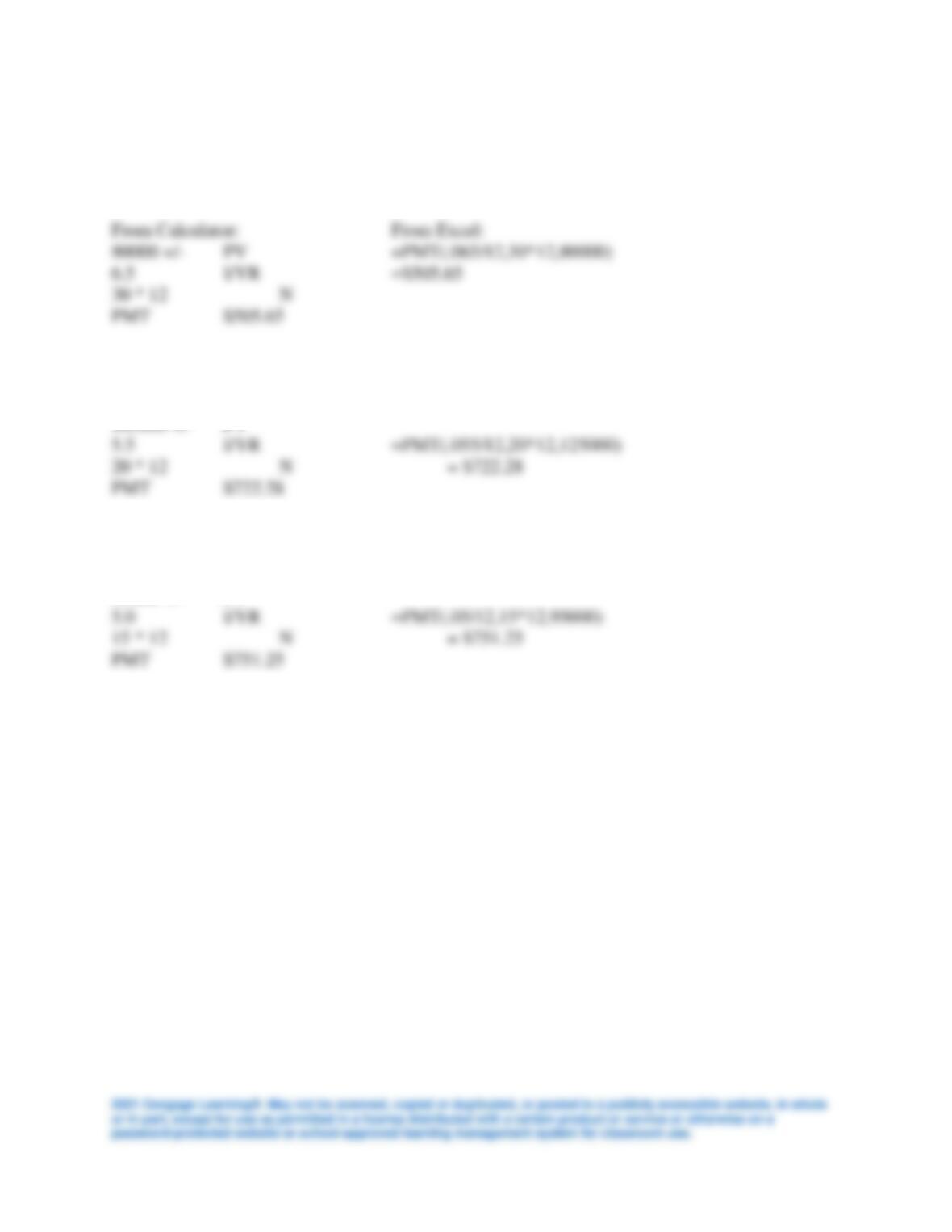
a. $80,000 at 6.5 percent for 30 years
b. $105,000 at 5.5 percent for 20 years
From Calculator: From Excel:
c. $95,000 at 5 percent for 15 years
From Calculator: From Excel:
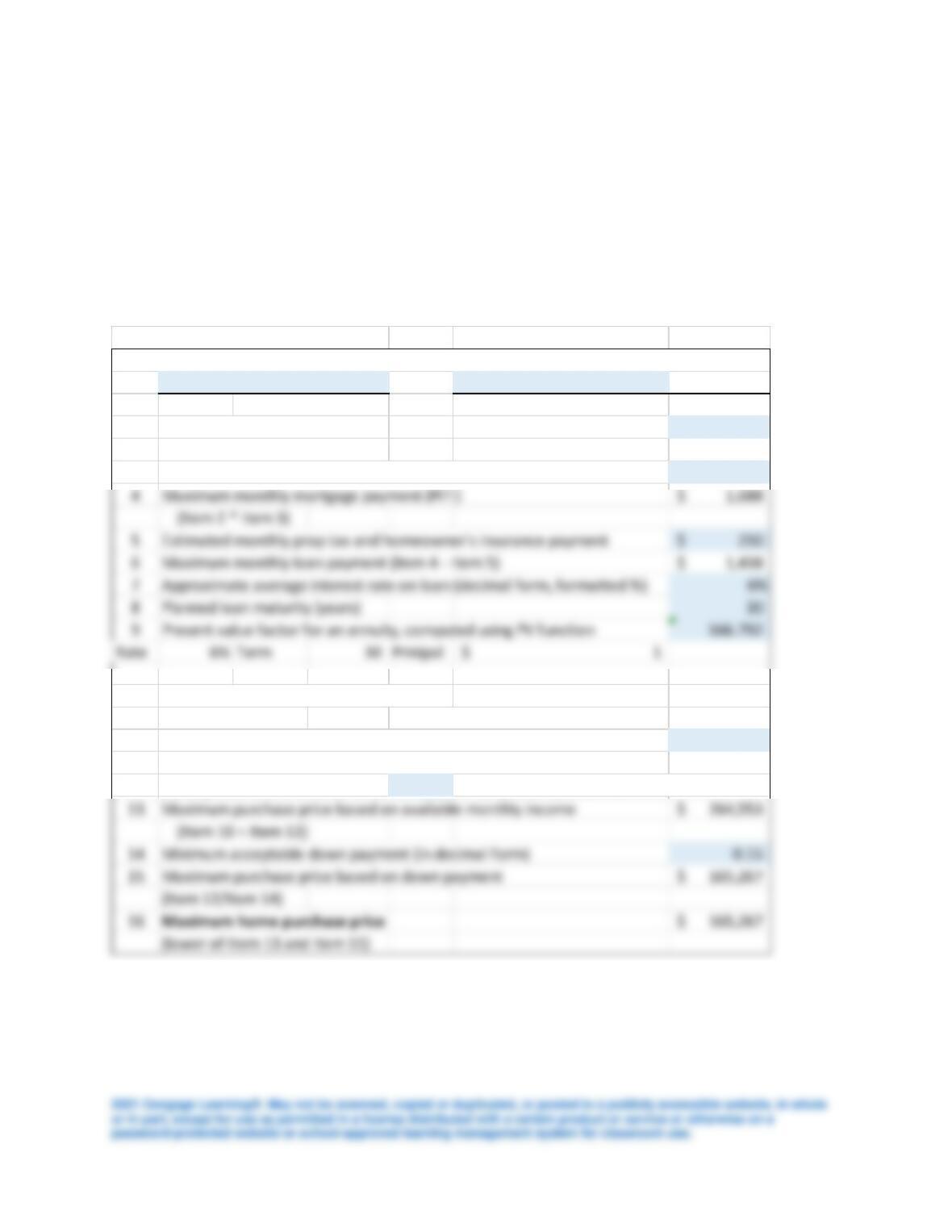
8. Home affordability analysis. Use Worksheet 5.3. Rachel and Alexander Harrison need to
calculate the amount that they can afford to spend on their first home. They have a
combined annual income of $67,500 and have $37,000 available for a down payment and
closing costs. The Harrisons estimate that homeowner’s insurance and property taxes will
be $250 per month. They expect the mortgage lender to use a 30 percent (of monthly gross
income) mortgage payment affordability ratio, to lend at an interest rate of 6 percent on a
30-year mortgage, and to require a 15 percent down payment. Based on this information,
use the home affordability analysis form in Worksheet 5.3 to determine the highest-priced
home that the Harrisons can afford. (Round all dollar amounts up to the nearest dollar.)
Closing costs are typically one-half of the down payment, so down payment plus one-half of the
down payment equals $37,000, then the down payment equals two-thirds of the funds available,
or .67 * $37,000 = $24,790; closing costs are one-third of the funds available, .33*$37,000 =
$12,210.
Worksheet 5.3 Chapter 5, Exercise 8
Name Date
Item Description Amount
1 Amount of annual income 67,500$
2 Monthly income (Item 1/12) 5,625$
3 Lender’s affordability ratio (in decmial form) 0.30
10 Maximum loan based on monthly income 239,763$
Item 6 * Item 9 or pv(.06/12,12*30,1438)
11 Funds available for making a down payment and paying closing costs 37,000$
12 Funds available for making a down payment 24,790$
Closing costs are estimated to be
0.33 of funds available decimal form.
Home Affordability Analysis
Rachel and Alexander Harrison
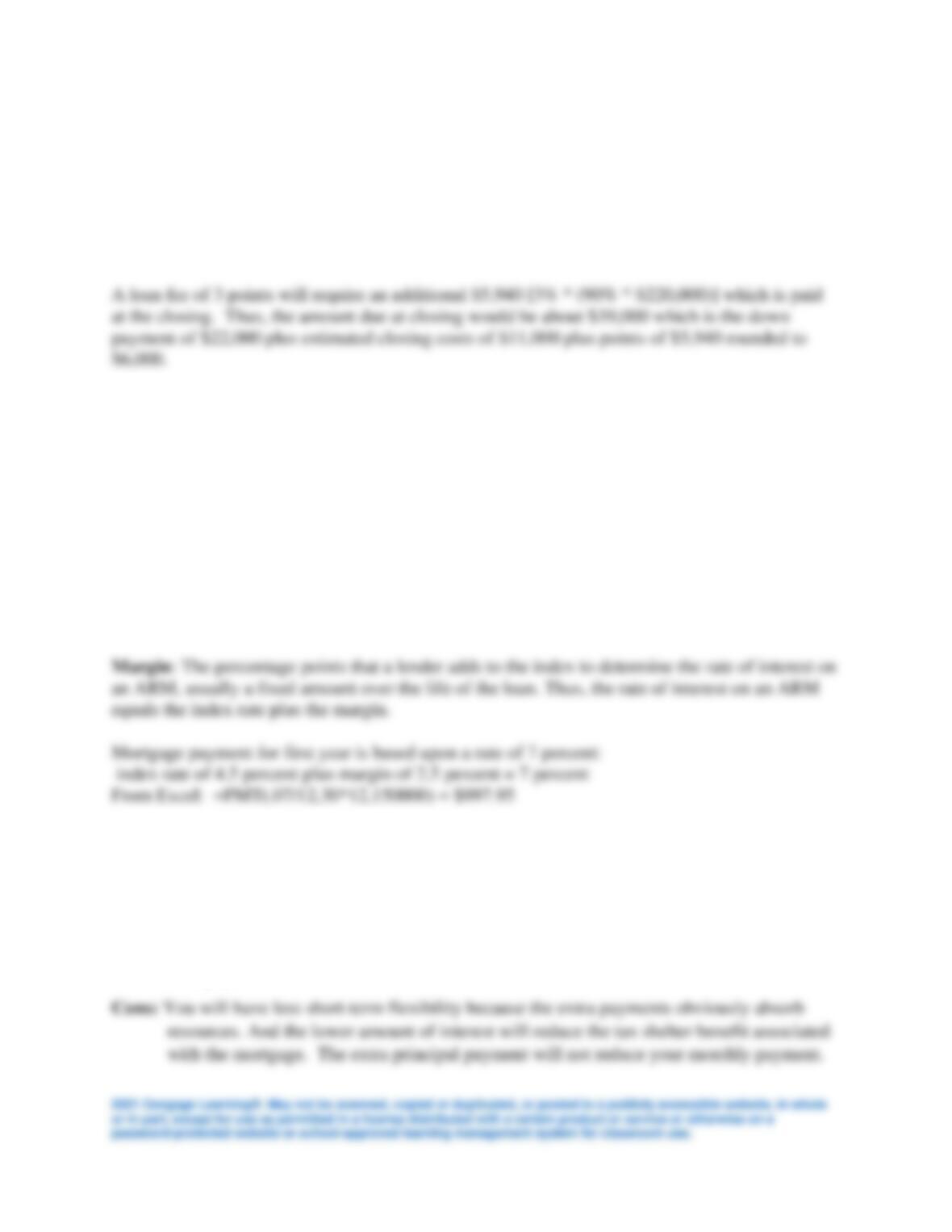
9. Estimating closing costs on home purchase. How much might a home buyer expect to pay
in closing costs on a $220,000 house with a 10 percent down payment? How much would
the home buyer have to pay at the time of closing, taking into account closing costs, down
payment, and a loan fee of 3 points?
Closing costs are about 50 percent of the down payment. For a $220,000 purchase price, with a
10 percent down payment, the closing costs will be about $11,000 (10% * $220,000) * 50%.
10. Conventional vs. ARM mortgage payments. What would the monthly payments be on a
$150,000 loan if the mortgage were set up as:
a. A 15-year, 6 percent fixed-rate loan?
b. A 30-year ARM in which the lender adds a margin of 2.5 to the index rate, which now
stands at 4.5 percent? Find the monthly mortgage payments for the first year only.
a. From Excel: = PMT(.06/12,15*12,150000) = $1,265.79
b. Index Rate: A baseline rate that captures the movement in interest rates, tied to 6-month
U.S. Treasury securities, 6-month CDs, or the average cost of funds to savings institutions as
commonly measured by the 11th Federal Home Loan Bank District Cost of Funds.
11. Adding to monthly mortgage payments. What are the pros and cons of adding $100 a
month to your fixed-rate mortgage payment?
Pros: The higher your extra payment, the sooner you pay off your mortgage. This would provide
extra future flexibility to meet needs like funding a child’s college education or
retirement. Extra payments can also dramatically reduce the total interest paid on a
mortgage.
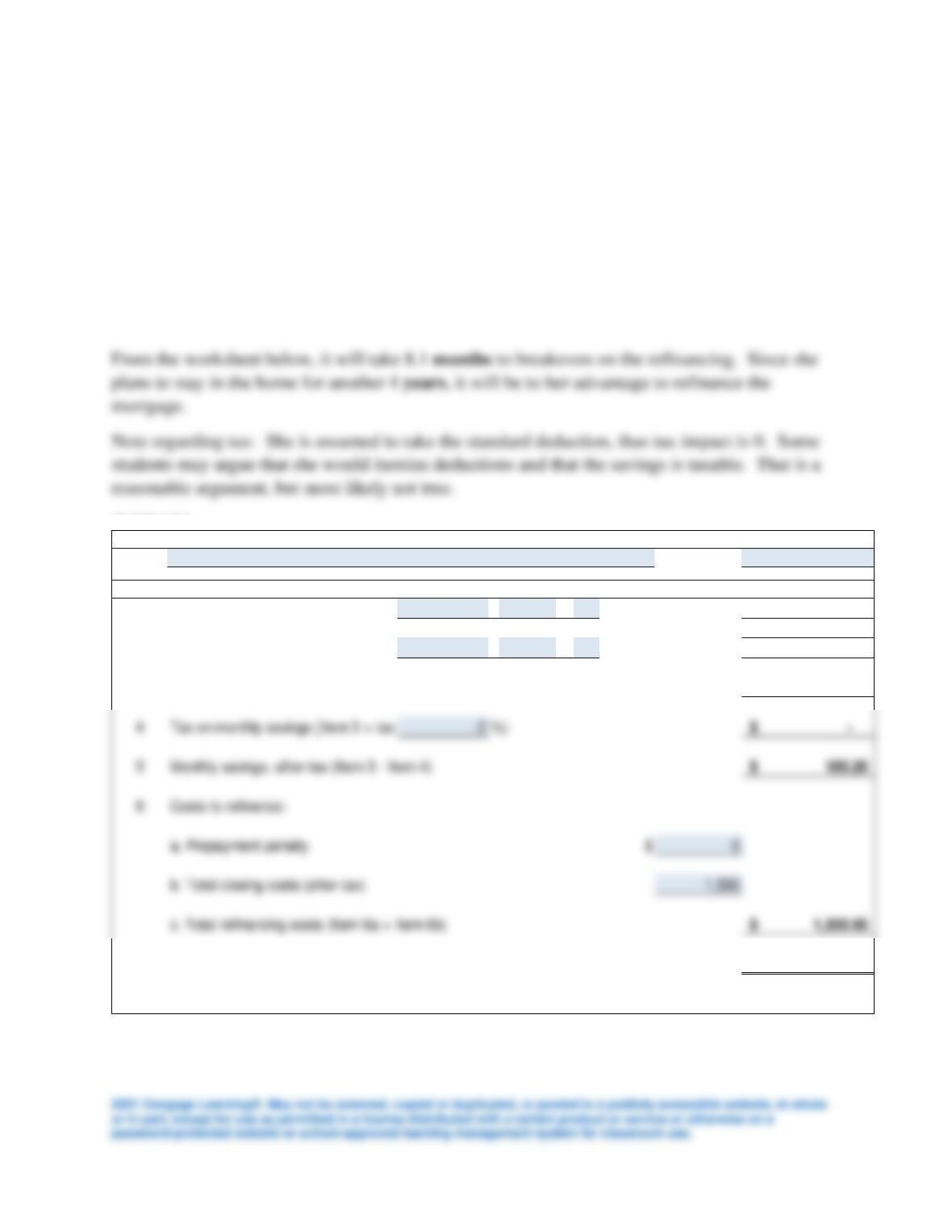
12. Refinancing a mortgage.
Use Worksheet 5.4. Jia Ma purchased a condominium 4 years
ago for $180,000, paying $1,250 per month on her $162,000, 8 percent, 25-year mortgage.
The current loan balance is $152,401. Recently, interest rates have dropped sharply,
causing Jia to consider refinancing her condo at the prevailing rate of 5 percent. She
expects to remain in the condo for at least four more years and has found a lender that will
make a 6 percent, 21-year, $152,401 loan requiring monthly payments of $1,065. Although
there is no prepayment penalty on her current mortgage, Jia will have to pay $1,500 in
closing costs on the new mortgage. She is in the 22 percent tax bracket. Based on this
information, use the mortgage refinancing analysis form in Worksheet 5.4 to determine
whether she should refinance her mortgage under the specified terms.
Worksheet 5.4
Name Date
Item Amount
1 162,000.00 , 8.00
%,
25 years) $1,250.34
2 152,401.00 , 6.00
%,
21 years) $1,065.06
3185.28$
b. Total closing costs (after-tax)
c. Total refinancing costs (Item 6a + Item 6b)
Costs to refinance:
a. Prepayment penalty
7 8.1
Decision: If plan to stay in home longer than months to break even, refinance. Otherwise, do not refinance.
Description
MORTGAGE REFINANCING ANALYSIS
Jia Ma, Chapter 5, Exercise 12
Current monthly payment (Terms:
Months to break even (Item 6c ÷ Item 5)
New monthly payment (Terms:
Monthly savings, pretax (Item 1 – Item 2)

Critical Thinking Problems
5.1 The Hudson’s New Car Decision: Lease versus Purchase
Sarah and Tyler Hudson, a dual-income couple in their late 20s, want to replace their 7-
year-old car, which has 90,000 miles on it and needs some expensive repairs. After
reviewing their budget, the Hudson’s conclude that they can afford auto payments of not
more than $450 per month and a down payment of $2,000. They enthusiastically decide to
visit a local dealer after reading its newspaper ad offering a closed-end lease on a new car
for a monthly payment of $345. After visiting with the dealer, test-driving the car, and
discussing the lease terms with the salesperson, they remain excited about leasing the car
but decide to wait until the following day to finalize the deal. Later that day, the Hudson’s
begin to question their approach to the new car acquisition process and decide to
reevaluate their decision carefully.
Critical Thinking Questions
1. What are some basic purchasing guidelines that the Hudson’s should consider when
choosing which new car to buy or lease? How can they find the information they need?
Exhibit 5.1 lists key strategies in buying a new car whether you purchase or lease the car. There
2. How would you advise the Hudson’s to research the lease-versus-purchase decision
before visiting the dealer? What are the advantages and disadvantages of each alternative?
Until you understand how leasing works and compare lease terms with bank financing, you
won’t know if leasing is the right choice for you. Thus, you need to understand the leasing
process before you get to the dealer and learn the specific terms of the lease.

3. Assume that the Hudson’s can get the following terms on a lease or a bank loan for the
car, which they could buy for $17,000.
• Lease: 48 months, $245 monthly payment, 1 month’s payment required as a security
deposit, $350 end-of-lease charges; a residual value of $6,775 is the purchase option price at
the end of the lease.
• Loan: $2,000 down payment, $15,000, 48-month loan at 5 percent interest requiring a
monthly payment of $345.44; assume that the car’s value at the end of 48 months will be
the same as the residual value and that sales tax is 6 percent.
The Hudson’s can currently earn interest of 3 percent annually on their savings. They
expect to drive about the same number of miles per year as they do now.
a. Use the format given in Worksheet 5.1 to determine which deal is best for the Hudson’s.
b. What other costs and terms of the lease option might affect their decision?
c. Based on the available information, should the Hudson’s lease or purchase the car?
Why?
The worksheet is below. Based on the worksheet, there is an advantage to leasing of $927
[13,066 – 12,139 = $927]. Thus, if you have faith in all of the estimates in the worksheet,