Answers and Solutions: 5 – 1
Chapter 5
Bond Valuation
ANSWERS TO END-OF-CHAPTER QUESTIONS
5-1 a. A bond is a promissory note issued by a business or a governmental unit. Treasury
bonds, sometimes referred to as government bonds, are issued by the Federal
government and are not exposed to default risk. Corporate bonds are issued by
corporations and are exposed to default risk. Different corporate bonds have different
b. The par value is the nominal or face value of a stock or bond. The par value of a bond
generally represents the amount of money that the firm borrows and promises to repay
at some future date. The par value of a bond is often $1,000, but can be $5,000 or more.
The maturity date is the date when the bond’s par value is repaid to the bondholder.
Maturity dates generally range from 10 to 40 years from the time of issue. A call
provision may be written into a bond contract, giving the issuer the right to redeem the
bonds under specific conditions prior to the normal maturity date. A bond’s coupon, or
coupon payment, is the dollar amount of interest paid to each bondholder on the interest
payment dates. The coupon is so named because bonds used to have dated coupons
attached to them which investors could tear off and redeem on the interest payment
dates. The coupon interest rate is the stated rate of interest on a bond.
Answers and Solutions: 5 – 2
d. Most bonds contain a call provision, which gives the issuing corporation the right to
call the bonds for redemption. The call provision generally states that if the bonds are
called, the company must pay the bondholders an amount greater than the par value, a
call premium. Redeemable bonds give investors the right to sell the bonds back to the
corporation at a price that is usually close to the par value. If interest rates rise,
investors can redeem the bonds and reinvest at the higher rates. A sinking fund
provision facilitates the orderly retirement of a bond issue. This can be achieved in one
of two ways: The company can call in for redemption (at par value) a certain percentage
of bonds each year. The company may buy the required amount of bonds on the open
market.
f. Bond prices and interest rates are inversely related; that is, they tend to move in the
opposite direction from one another. A fixed-rate bond will sell at par when its coupon
interest rate is equal to the going rate of interest, rd. When the going rate of interest is
above the coupon rate, a fixed-rate bond will sell at a “discount” below its par value. If
current interest rates are below the coupon rate, a fixed-rate bond will sell at a
“premium” above its par value.
Answers and Solutions: 5 – 3
i. A development bond is a tax-exempt bond sold by state and local governments whose
proceeds are made available to corporations for specific uses deemed (by Congress) to
be in the public interest. Municipalities can insure their bonds, in which an insurance
company guarantees to pay the coupon and principal payments should the issuer
default. This reduces the risk to investors who are willing to accept a lower coupon
rate for an insured bond issue vis-a-vis an uninsured issue. Bond issues are normally
assigned quality ratings by major rating agencies, such as Moody’s Investors Service
and Standard & Poor’s Corporation. These ratings reflect the probability that a bond
will go into default. Aaa (Moody’s) and AAA (S&P) are the highest ratings. Rating
assignments are based on qualitative and quantitative factors including the firm’s
debt/assets ratio, current ratio, and coverage ratios. Because a bond’s rating is an
indicator of its default risk, the rating has a direct, measurable influence on the bond’s
interest rate and the firm’s cost of debt capital. Junk bonds are high-risk, high-yield
bonds issued to finance leveraged buyouts, mergers, or troubled companies. Most
bonds are purchased by institutional investors rather than individuals, and many
institutions are restricted to investment grade bonds, securities with ratings of Baa/BBB
or above.
Answers and Solutions: 5 – 4
l. Interest rate risk arises from the fact that bond prices decline when interest rates rise.
Under these circumstances, selling a bond prior to maturity will result in a capital loss,
and the longer the term to maturity, the larger the loss. Thus, a maturity risk premium
must be added to the real risk-free rate of interest to compensate for interest rate risk.
Reinvestment rate risk occurs when a short-term debt security must be “rolled over.”
If interest rates have fallen, the reinvestment of principal will be at a lower rate, with
correspondingly lower interest payments and ending value. Note that long-term debt
securities also have some reinvestment rate risk because their interest payments have
to be reinvested at prevailing rates.
n. When the yield curve slopes upward, it is said to be “normal,” because it is like this
most of the time. Conversely, a downward-sloping yield curve is termed “abnormal”
or “inverted.”
5-2 False. Short-term bond prices are less sensitive than long-term bond prices to interest rate
changes because funds invested in short-term bonds can be reinvested at the new interest
rate sooner than funds tied up in long-term bonds.
Answers and Solutions: 5 – 5
5-5 From the corporation’s viewpoint, one important factor in establishing a sinking fund is
that its own bonds generally have a higher yield than do government bonds; hence, the
company saves more interest by retiring its own bonds than it could earn by buying
government bonds. This factor causes firms to favor the second procedure. Investors also
would prefer the annual retirement procedure if they thought that interest rates were more
likely to rise than to fall, but they would prefer the government bond purchases program
if they thought rates were likely to fall. In addition, bondholders recognize that, under the
government bond purchase scheme, each bondholder would be entitled to a given amount
of cash from the liquidation of the sinking fund if the firm should go into default, whereas
under the annual retirement plan, some of the holders would receive a cash benefit while
Answers and Solutions: 5 – 6
SOLUTIONS TO END–OF-CHAPTER PROBLEMS
5-1 With your financial calculator, enter the following:
N = 12; I/YR = YTM = 9%; PMT = 0.08 1,000 = 80; FV = 1000; PV = VB = ?
PV = $928.39.
Alternatively,
VB = $80((1- 1/1.0912)/0.09) + $1,000(1/1.0912)
= $928.39
5-3 With your financial calculator, enter the following to find the current value of the bonds,
so you can then calculate their current yield:
N = 7; I/YR = YTM = 8; PMT = 0.09 1,000 = 90; FV = 1000; PV = VB = ?
PV = $1,052.06. Current yield = $90/$1,052.06 = 8.55%.
Alternatively,
Answers and Solutions: 5 – 7
5-5 rT-10 = 6%; rC-10 = 9%; LP = 0.5%; DRP = ?
r = r* + IP + DRP + LP + MRP.
rT-10 = 6% = r* + IP + MRP; DRP = LP = 0.
rC-10 = 8% = r* + IP + DRP + 0.5% + MRP.
Because both bonds are 10-year bonds the inflation premium and maturity risk premium
on both bonds are equal. The only difference between them is the liquidity and default risk
premiums.
rC-10 = 9% = r* + IP + MRP + 0.5% + DRP. But we know from above that r* + IP + MRP
= 6%; therefore,
rC-10 = 9% = 6% + 0.5% + DRP
2.5% = DRP.
Answers and Solutions: 5 – 8
5-8 With your financial calculator, enter the following to find YTM:
N = 10 2 = 20; PV = -1100; PMT = 0.08/2 1,000 = 40; FV = 1000; I/YR = YTM = ?
YTM = 3.31% 2 = 6.62%.
With your financial calculator, enter the following to find YTC:
N = 5 2 = 10; PV = -1100; PMT = 0.08/2 1,000 = 40; FV = 1050; I/YR = YTC = ?
YTC = 3.24% 2 = 6.49%.
5-9 a.
1. 5%: Bond L: Input N = 15, I/YR = 5, PMT = 100, FV = 1000, PV = ?, PV =
$1,518.98.
Bond S: Change N = 1, PV = ? PV = $1,047.62.
3. 12%: Bond L: From Bond S inputs, change N = 15 and I/YR = 12, PV = ? PV
= $863.78.
Bond S: Change N = 1, PV = ? PV = $982.14.
b. Think about a bond that matures in one month. Its present value is influenced primarily
by the maturity value, which will be received in only one month. Even if interest rates
Answers and Solutions: 5 – 9
5-10 a. Calculator solution:
1. Input N = 5, PV = -829, PMT = 90, FV = 1000, I/YR = ? I/YR = 13.98%.
2. Change PV = -1104, I/YR = ? I/YR = 6.50%.
5-11 N = 7; PV = −1000; PMT = 14%(1,000) =140; FV = (1 + 0.09)(1,000) = 1090; I/YR = ?
Solve for I/YR = 14.82%.
5-12 a. Using a financial calculator, input the following:
N = 20, PV = -1100, PMT = 60, FV = 1000, and solve for I/YR = 5.1849%.
However, this is a periodic rate. The nominal annual rate = 5.1849%(2) = 10.3699% ≈
10.37%.
b. The current yield = $120/$1,100 = 10.91%.
Answers and Solutions: 5 – 10
5-13 The problem asks you to solve for the YTM, given the following facts:
N = 5, PMT = 80, and FV = 1000. In order to solve for I/YR we need PV.
5-14 The problem asks you to solve for the current yield, given the following facts: N = 14,
I/YR = 10.5883/2 = 5.2942, PV = −1020, and FV = 1000. In order to solve for the current
yield we need to find PMT. With a financial calculator, we find PMT = $55.00. However,
because the bond is a semiannual coupon bond this amount needs to be multiplied by 2 to
obtain the annual interest payment: $55.00(2) = $110.00. Finally, find the current yield as
follows:
Current yield = Annual interest/Current Price = $110/$1,020 = 10.78%.
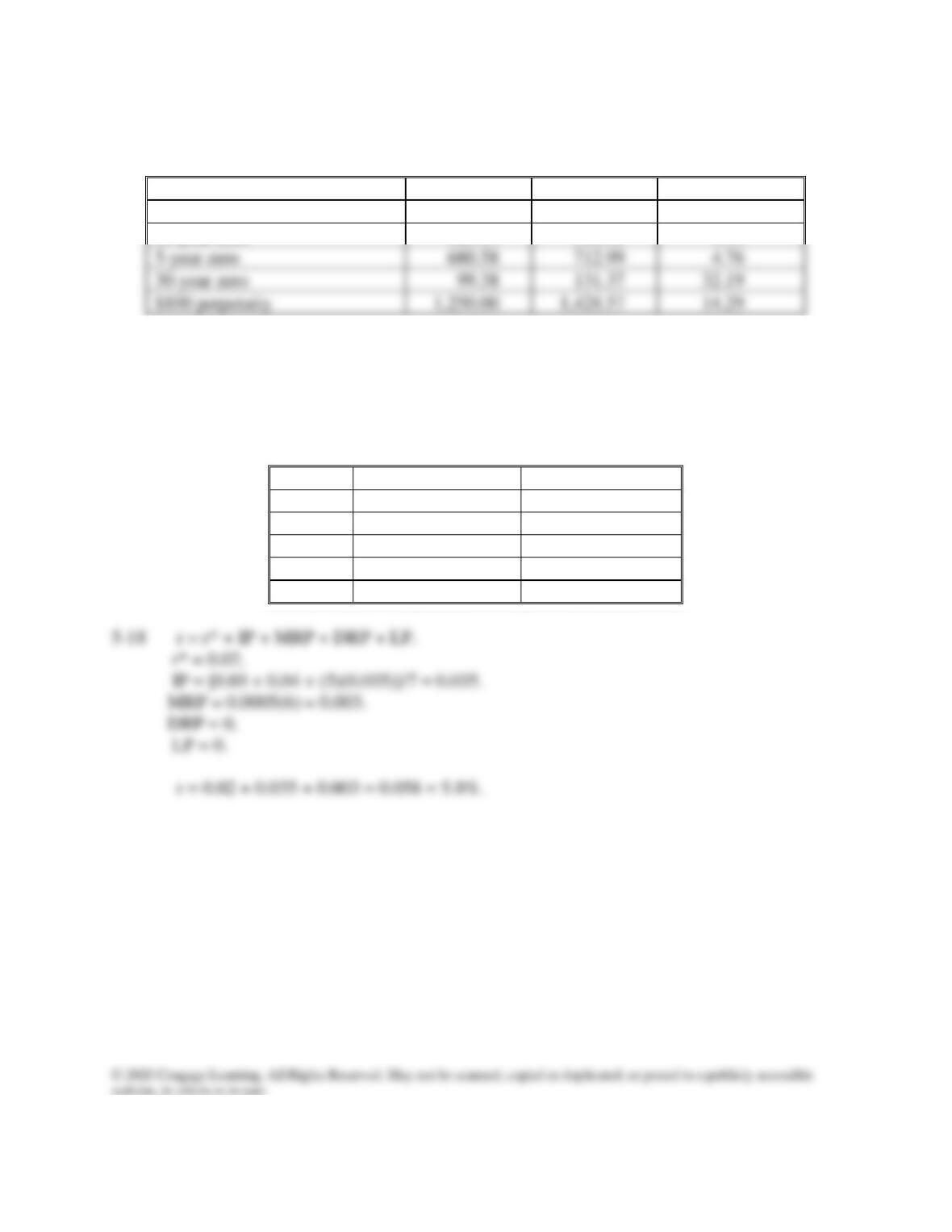
5-16 The price of a perpetuity is: Price = (Annual payment)/(Interest rate). For example, the
price of a $100 perpetuity at an 8% interest rate is: $100/0.08 = $1,250.
The prices for the other cases are found with a financial calculator. For example, the price
of a 10-year, 10% bond is found using these inputs: N = 10, I/YR = 10, PV = ?, PMT =
−(0.10 x 1000) = −100, FV = −1000; solve for PV = 1,134.20. The same approach can be
Answers and Solutions: 5 – 11
used for the zero coupon bonds by substituting zero for the payment.
Price at 8%
Price at 7%
Pctge. change
10-year, 10% annual coupon
$1,134.20
$1,210.71
6.75%
10-year zero
9.75
5-year zero
4.76
30-year zero
32.19
$100 perpetuity
14.29
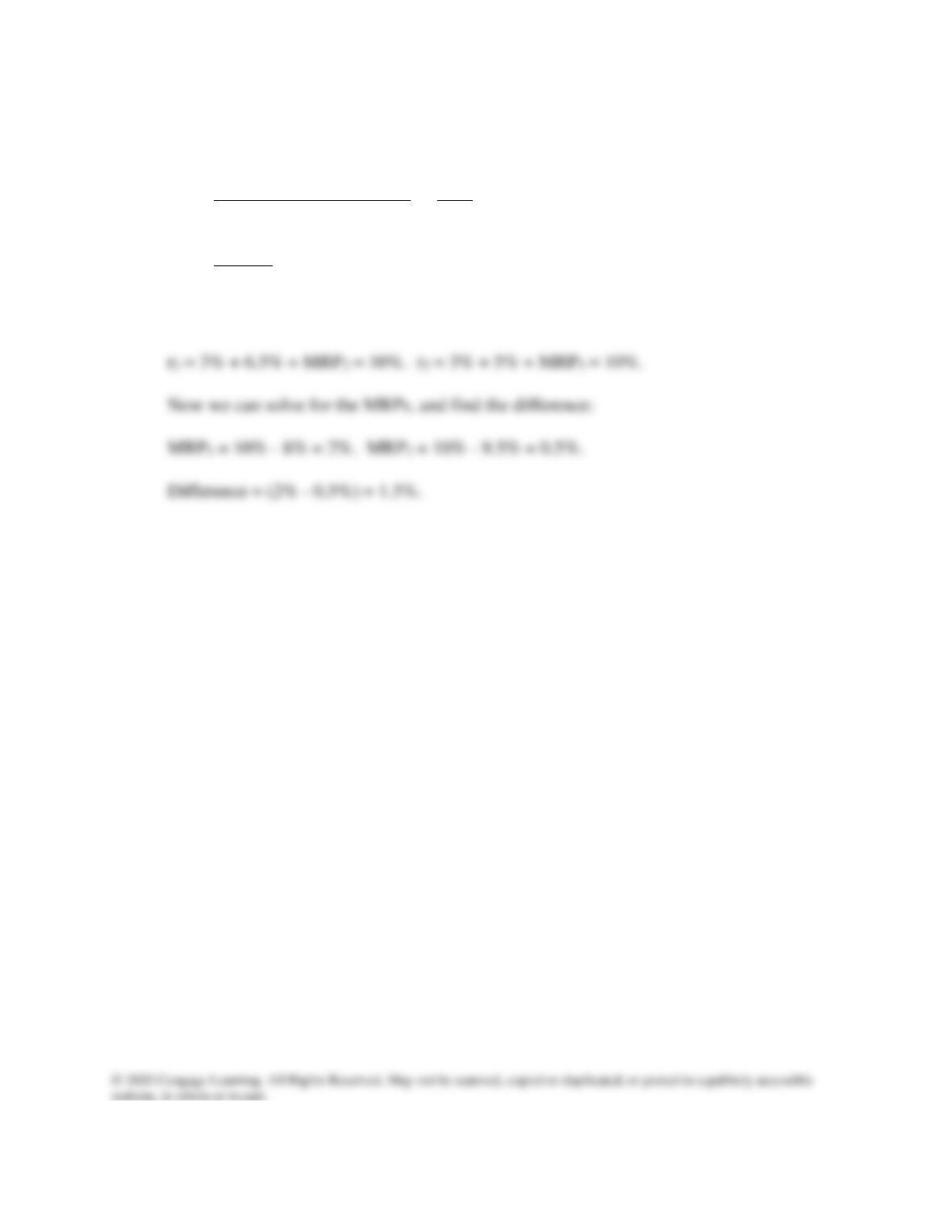
5-17 Using a financial calculator, the price of Bond C is found using these inputs: N = 4 − Yeart,
I/YR = 9.6, PV = ?, PMT = −(0.10 x 1000) = −100, FV = −1000; solve for PV. For example, the
price of Bond C at Year0 is: N = 4, I/YR = 9.6, PV = ?, PMT = −(0.10 x 1000) = −100, FV =
−1000; solve for PV = 1,012.79. The same approach can be used for the zero coupon bonds by
substituting zero for the payment.
t
Price of Bond C
Price of Bond Z
0
$1,012.79
$ 693.04
1
1,010.02
759.57
2
1,006.98
832.49
3
1,003.65
912.41
4
1,000.00
1,000.00
Answers and Solutions: 5 – 12
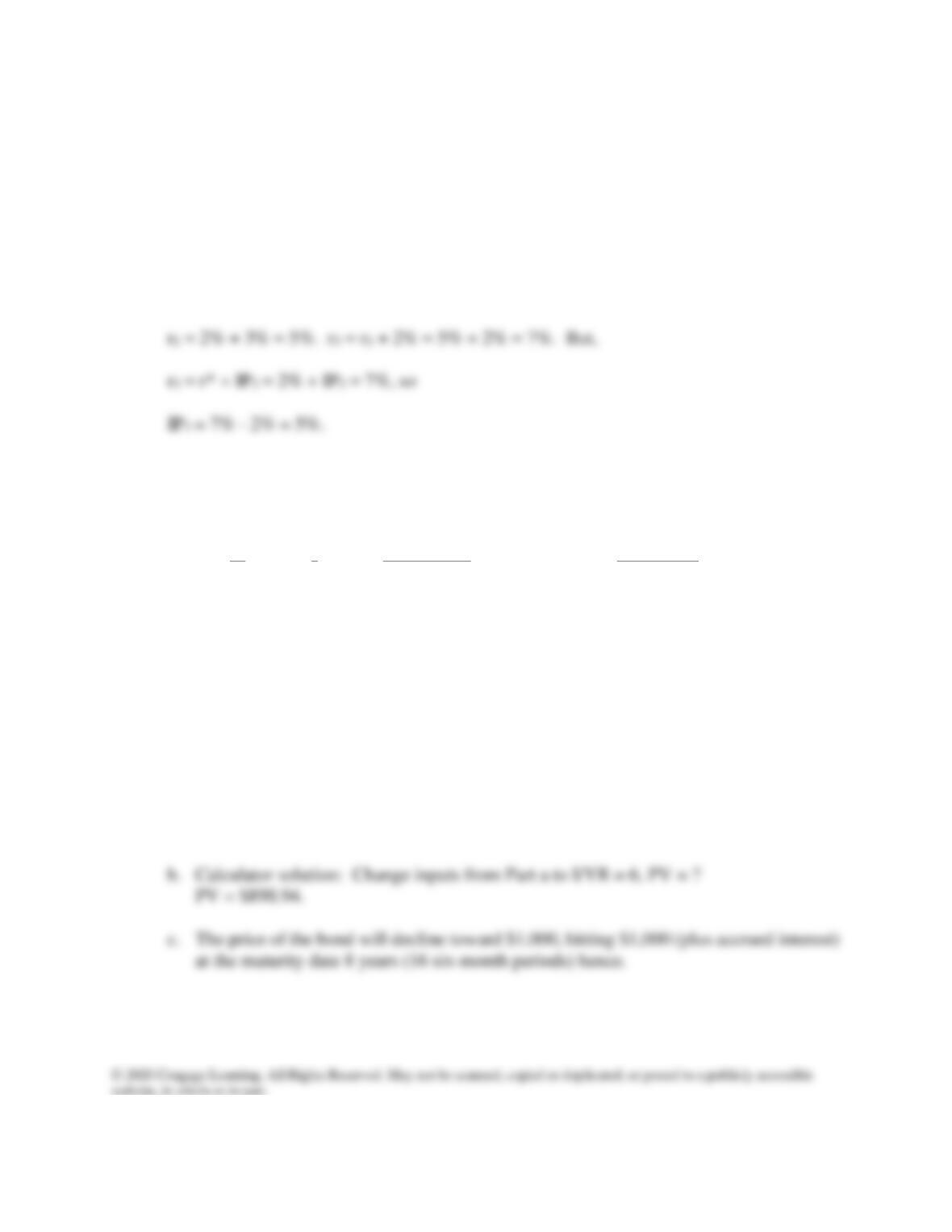
5-19 First, note that we will use the equation rt = 3% + IPt + MRPt. We have the data needed to
find the IPs:
IP5 =
5
4% + 4% + 4% + 5% + 8%
=
5
25%
= 5%.
IP2 =
2
5% + 8%
= 6.5%.
Now we can substitute into the equation:
Answers and Solutions: 5 – 13
5-20 Basic relevant equations:
rt = r* + IPt + DRPt + MRPt + LPt.
But here IP is the only premium, so rt = r* + IPt.
IPt = Avg. inflation = (I1 + I2 + …)/N.
We know that I1 = IP1 = 3% and r* = 2%. Therefore,
We also know that It = Constant after t = 1.
We can set up this table:
r* I Avg. I = IPt r = r* + IPt
1 2 3 3%/1 = 3% 5%
2 2 I (3% + I)/2 = IP2
3 2 I (3% + I + I)/3 = IP3 r3 = 7%, so IP3 = 7% – 2% = 5%.
Avg. I = IP3 = (3% + 2I)/3 = 5%
2I = 12%
I = 6%.
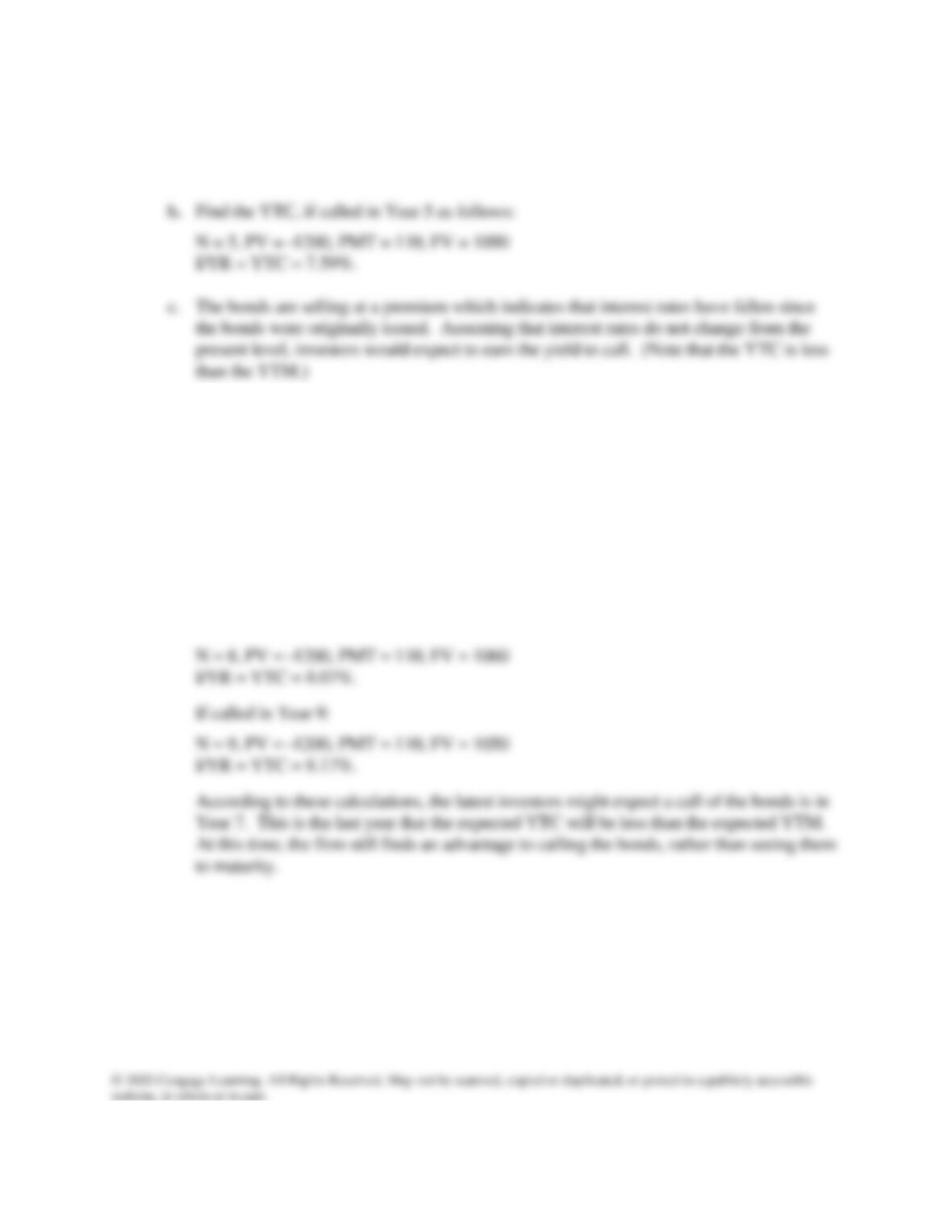
5-21 a. The bonds now have an 8-year, or a 16-semiannual period, maturity, and their value is
calculated as follows:
Calculator solution: Input N = 16, I/YR = 3, PMT = 50, FV = 1000,
PV = ? PV = $1,251.22.
Answers and Solutions: 5 – 14
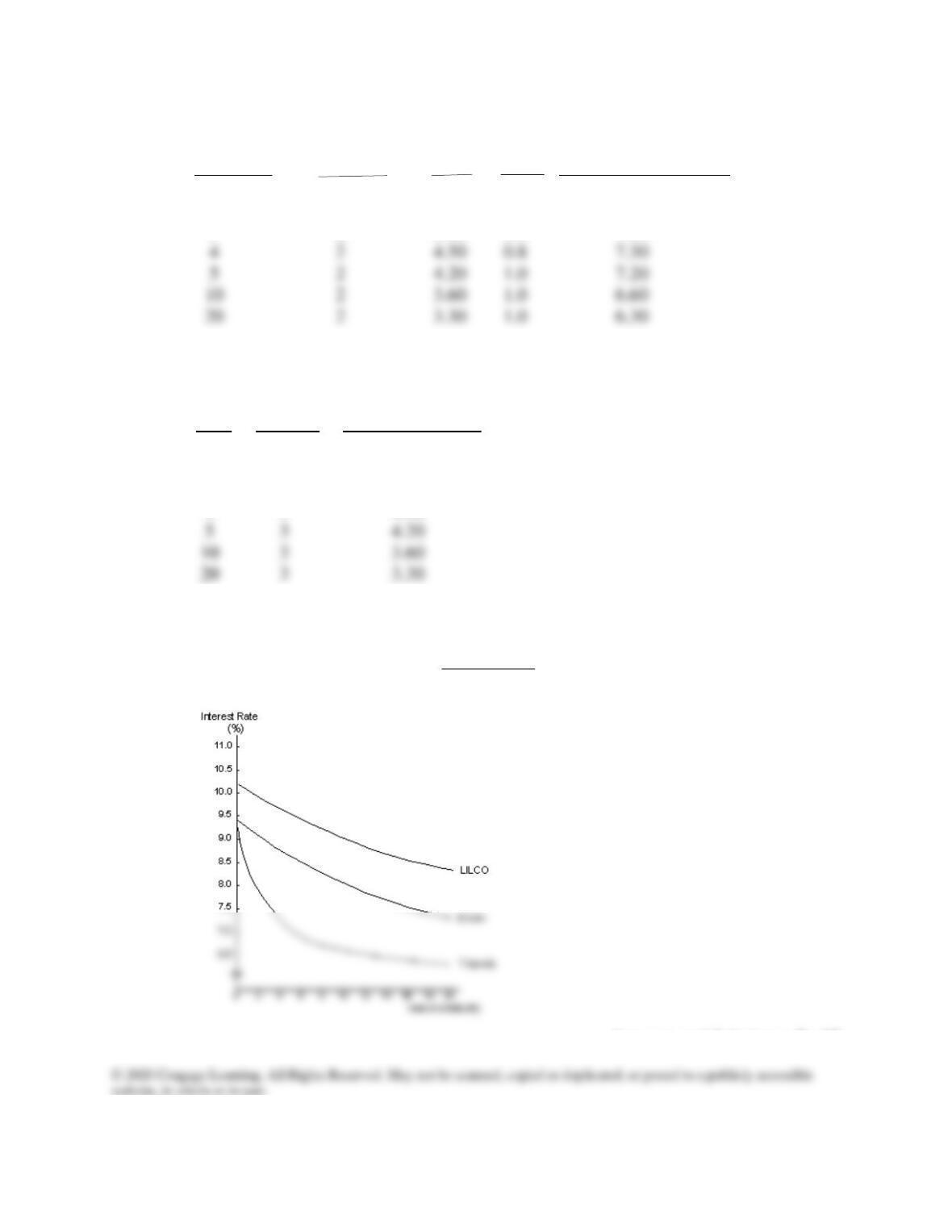
5-22 a. Find the YTM as follows:
N = 10, PV = -1200, PMT = 110, FV = 1000
I/YR = YTM = 8.02%.
d. Similarly from above, YTC can be found, if called in each subsequent year.
If called in Year 6:
N = 6, PV = –1200, PMT = 110, FV = 1080
I/YR = YTC = 7.80%.
If called in Year 7:
N = 7, PV = –1200, PMT = 110, FV = 1070
I/YR = YTC = 7.95%.
If called in Year 8:
Answers and Solutions: 5 – 15
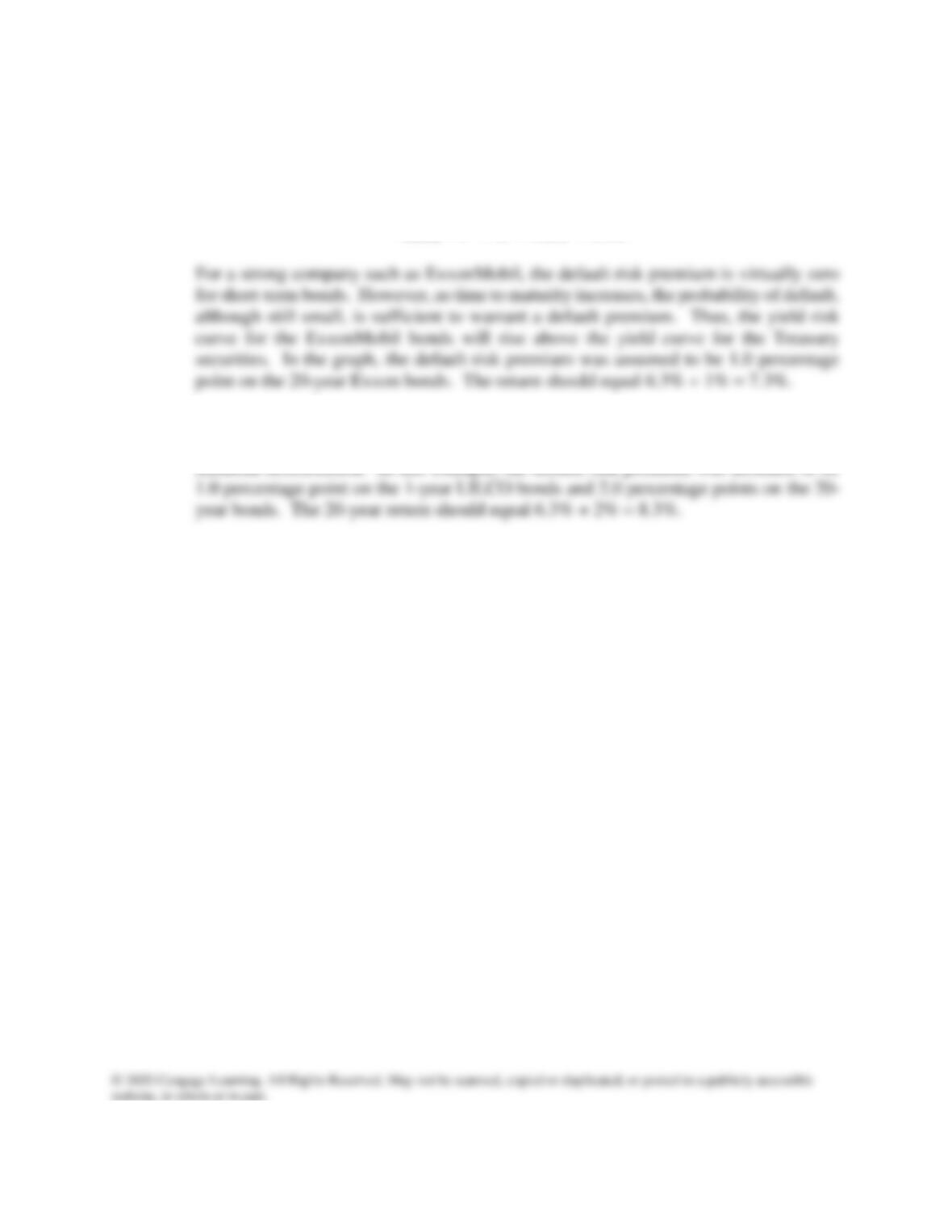
5-23 a. Real
Years to Risk-Free
Maturity Rate (r*) IP** MRP rT = r* + IP + MRP
1 2% 7.00% 0.2% 9.20%
2 2 6.00 0.4 8.40
**The computation of the inflation premium is as follows:
Expected Average
Year Inflation Expected Inflation
1 7% 7.00%
2 5 6.00
3 3 5.00
For example, the calculation for 3 years is as follows:
5.00%. =
3
3% + 5% + 7%
Thus, the yield curve would be as follows:
Answers and Solutions: 5 – 16
b. The interest rate on the ExxonMobil bonds has the same components as the Treasury
securities, except that the ExxonMobil bonds have default risk, so a default risk
premium must be included. Therefore,
rExxon = r* + IP + MRP + DRP.
c. LILCO bonds would have significantly more default risk than either Treasury securities
or Exxon bonds, and the risk of default would increase over time due to possible

Answers and Solutions: 5 – 17
SOLUTION TO SPREADSHEET PROBLEM
5-24 The detailed solution for the problem is in the file Ch05 P24 Build a Model Solution.xlsx
and is available on the instructor’s side of the textbook’s web site.
MINI CASE
Sam Strother and Shawna Tibbs are vice-presidents of Mutual of Seattle Insurance
Company and co-directors of the company’s pension fund management division. A major
new client, the Northwestern Municipal Alliance, has requested that Mutual of Seattle
present an investment seminar to the mayors of the represented cities, and Strother and
Tibbs, who will make the actual presentation, have asked you to help them by answering the
following questions. Because the Boeing Company operates in one of the league’s cities, you
are to work Boeing into the presentation.
a. What are the key features of a bond?
Answer:
1. Par or face value. We generally assume a $1,000 par value, but par can be anything,
and often $5,000 or more is used. With registered bonds, which is what are issued
today, if you bought $50,000 worth, that amount would appear on the certificate.
2. Coupon rate. The dollar coupon is the “rent” on the money borrowed, which is
generally the par value of the bond. The coupon rate is the annual interest payment
divided by the par value, and it is generally set at the value of r on the day the bond
is issued.
b. What are call provisions and sinking fund provisions? Do these provisions make
bonds more or less risky?
Answer: A call provision is a provision in a bond contract that gives the issuing corporation the
right to redeem the bonds under specified terms prior to the normal maturity date. The
call provision generally states that the company must pay the bondholders an amount
greater than the par value if they are called. The additional sum, which is called a call
premium, is typically set equal to one year’s interest if the bonds are called during the
c. How is the value of any asset whose value is based on expected future cash flows
determined?
Answer: 0 1 2 3 n
| | | | • • • |
CF1 CF2 CF3 CFN
PV CF1
PV CF2
The value of an asset is merely the present value of its expected future cash flows: