Chapter 5 CFIN6
Chapter 5 Solutions
5-1
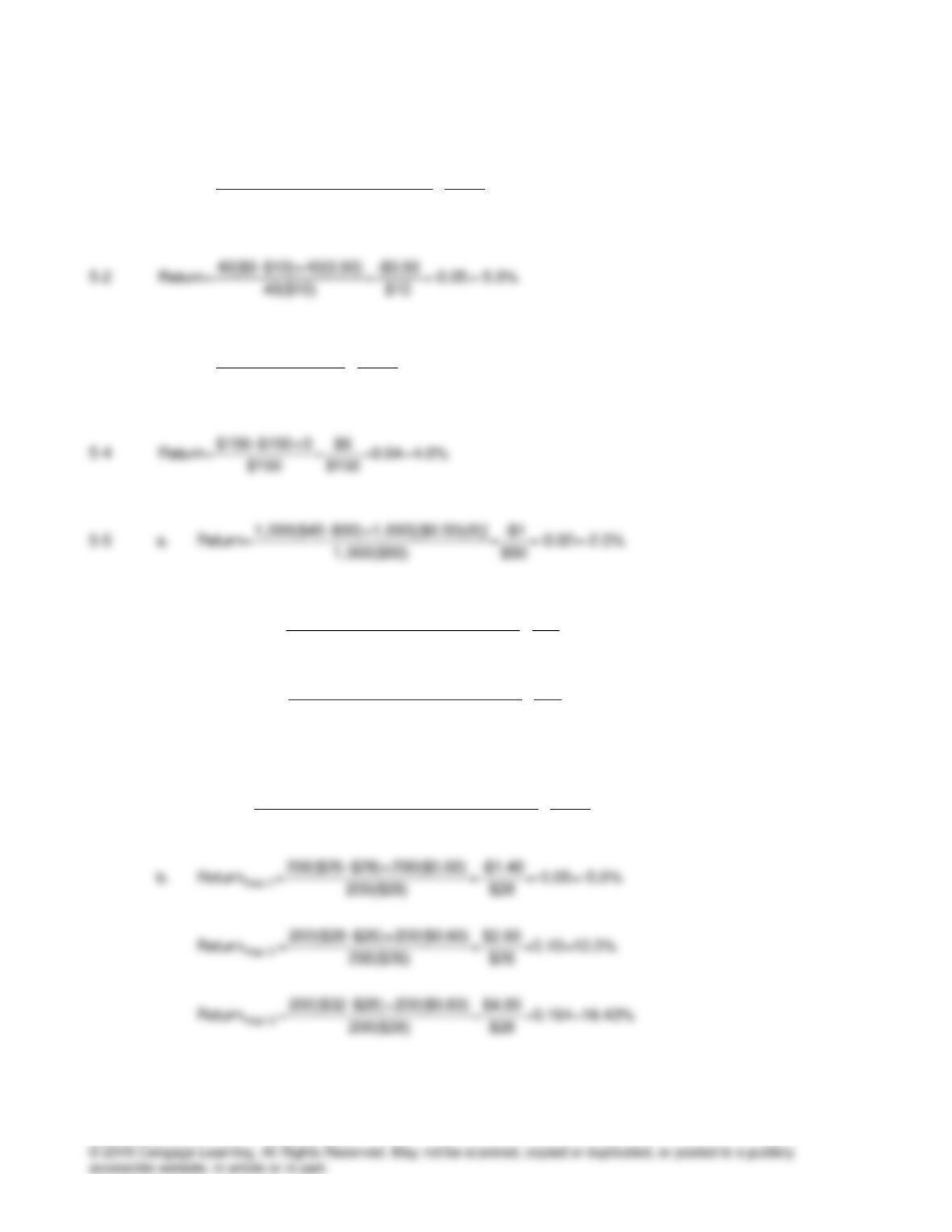
1,000($29–$28)+1,000(4 0.10) $1.40
Return= = =0.05=5.0%
1,000($28) $28
5-3
($44–$42)+2(0.05) $2.10
Return= = =0.05=5.0%
$42 $42
b.
Year 1 1,000($45–$50)+1,000[($0.50)(4)] –$3
Return = = =-0.06=-6.0%
1,000($50) $50
Year 2 1,000($45–$45)+1,000[($0.50)(4)] $2
Return = = =0.044=4.4%
1,000($45) $45
5-6 a.
200($32–$28)+200[($0.60+$0.60+$0.60] $5.80
Return= = =0.207=20.7%
200($28) $28
5-7 Remember that the bonds’ yields represent the averages of the expected one–year interest rates for the
remaining lives of the bonds. Thus, the one-year interest rates for Year 2 and Year 3 can be computed as
follows:
Chapter 5 CFIN6
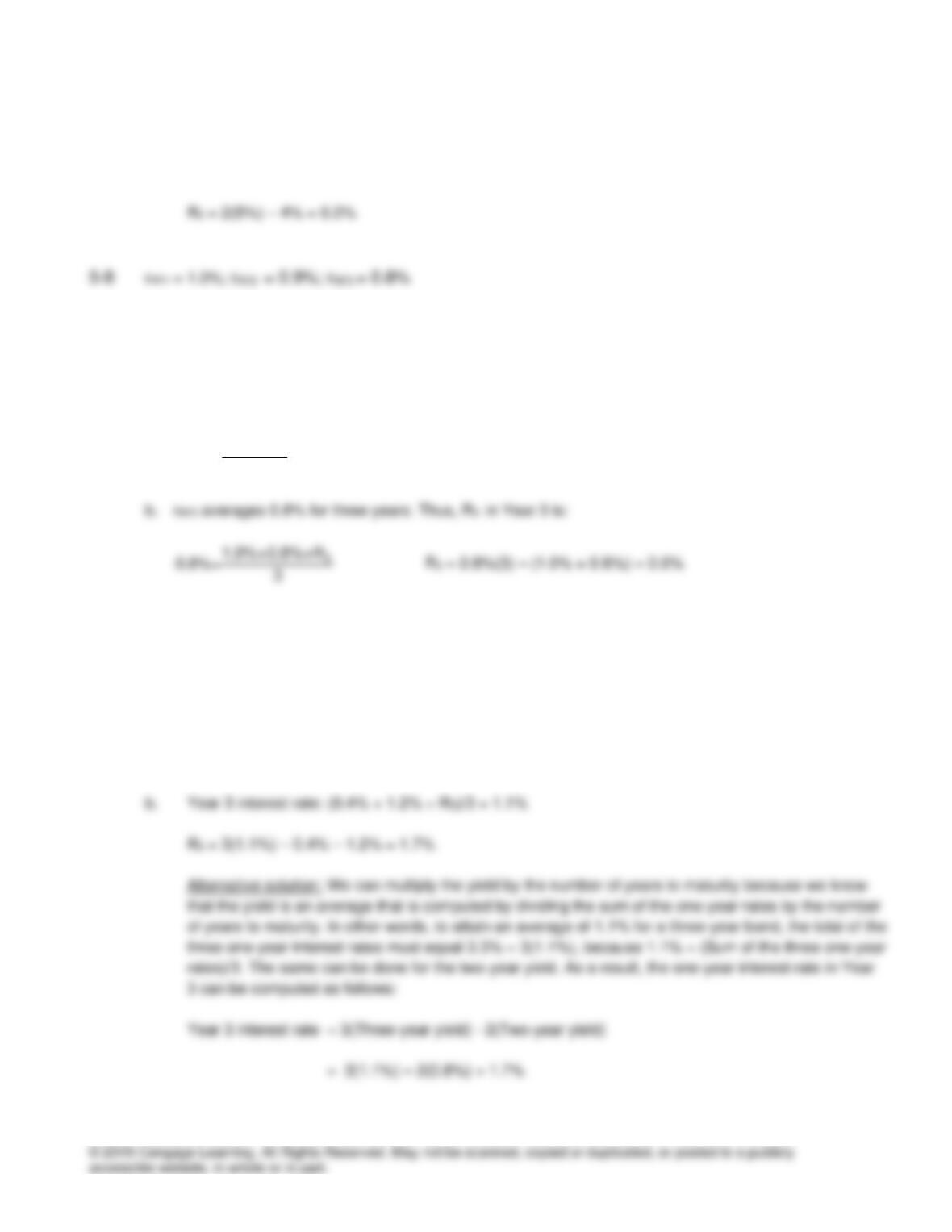
Yield on 2-Year bond: (R1 + R2)/2
(4.0% + R2)/2 = 5.0%
Remember that the bonds’ yields represent the averages of the expected one-year interest rates for the
remaining lives of the bonds. Thus, the one-year interest rates for Year 2 and Year 3 can be computed
as follows:
a. rRF2 averages 0.9% for two years. Thus, R2 in Year 2 is:
2
1.0%+R
0.9%= 2
R2 = 0.9%(2) – 1.0% = 0.8%
5-9 Remember that the bonds’ yields represent the averages of the expected one–year interest rates for the
remaining lives of the bonds. Thus, the one-year interest rates for Year 2 and Year 3 can be computed as
follows:
a. Year 2 interest rate: (0.4% + R2)/2 = 0.8%
R2 = 2(0.8%) – 0.4% = 1.2%
Chapter 5 CFIN6
5-10 Because the bonds’ yields represent the averages of the expected one–year interest rates for the remaining
lives of the bonds, the one-year interest rates for Year 6 and Year 7 can be computed as follows:
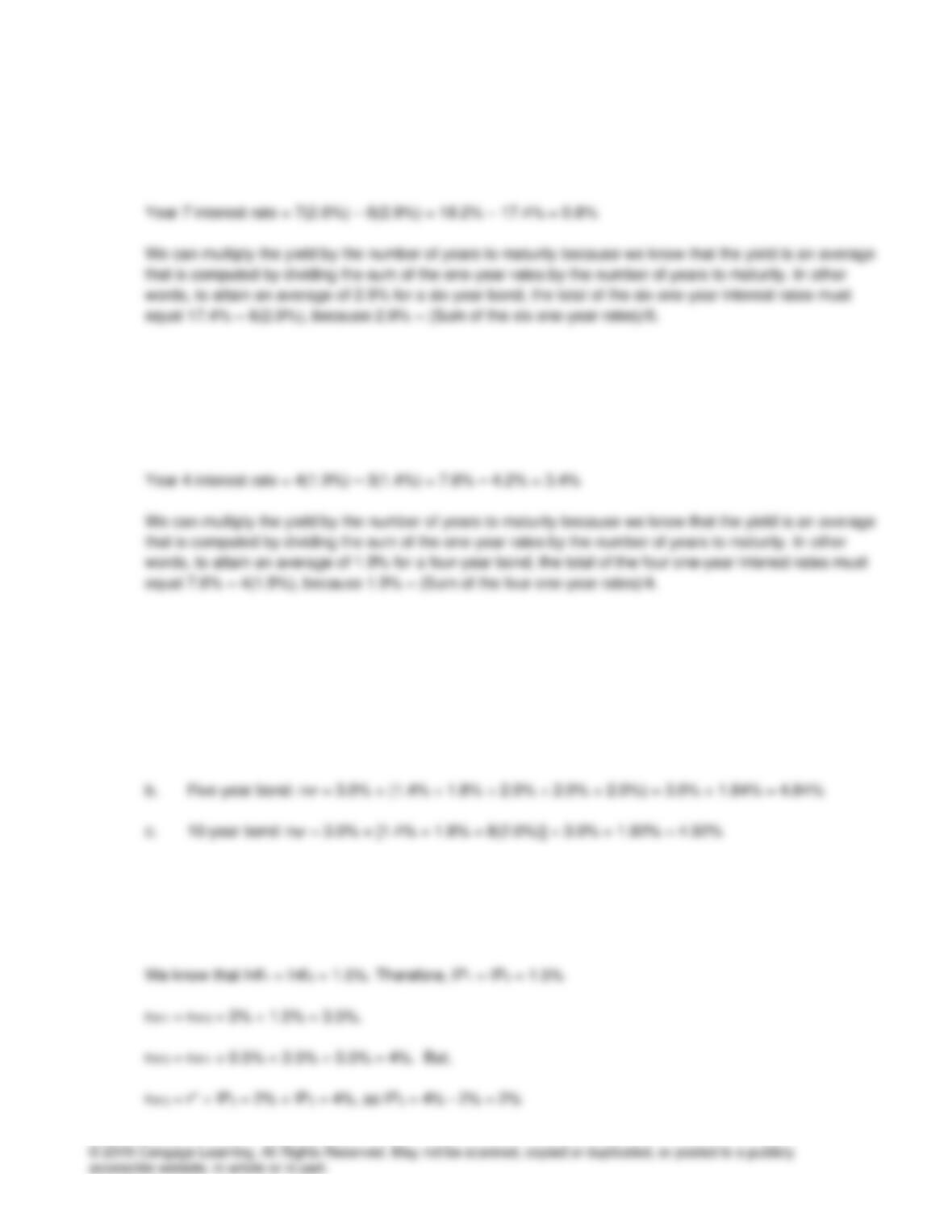
Year 6 interest rate = 6(2.9%) – 5(3.1%) = 17.4% – 15.5% = 1.9%
5-11 Because the bonds’ yields represent the averages of the expected one-year interest rates for the remaining
lives of the bonds, the one-year interest rates for Year 3 and Year 4 can be computed as follows:
Year 3 interest rate = 3(1.4%) – 2(1.2%) = 4.2% – 2.4% = 1.8%
5-12 rRF = r* + IPn = 3% + IPn, where IPn is the average annual inflation rate over n years.
Given: r* = 3.0%; Year 1 Inflation = 1.4%; Year 2 Inflation = 1.8%; Year 3 Inflation = … = Year
Inflation = 2.0%
a. One-year bond: rRF = 3.0% + 1.4% = 4.4%
5-13 rRF = r* + IPn = 2% + IPn, where IPn is the average annual inflation rate over n years.
IPn = Avg. inflation = (Infl1 + Infl2 + … + Infln)/n
Chapter 5 CFIN6
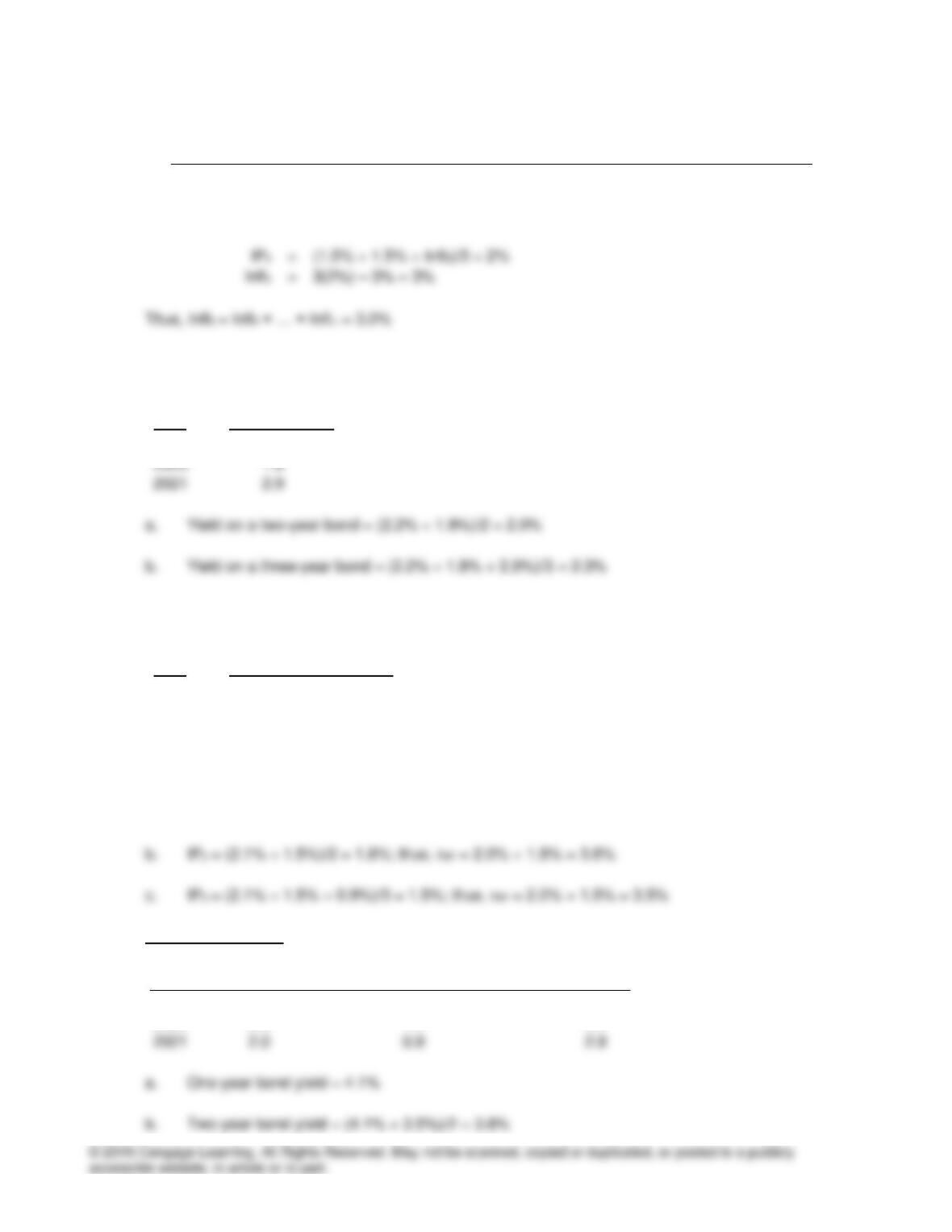
We also know that inflation is constant after Year 2. Thus, we can set up this table:
Year r* Inflation Average inflation = IPn rRF = r* + IPt
1 2% 1.5% 1.5%/1 = 1.5% 3.5%
2 2 1.5 (1.5% + 1.5)/2 = 1.5 3.5
3 2 IP3 (1.5% + 1.5% + Infl3)/3 = IP3 4.0%, so IP3 = 4% – 2% = 2%
5-14 We know the following:
Year One-Year Rate
2019 2.2%
5-15 We know the following:
Year One-Year Inflation Rate
2019 2.1%
2020 1.5
2021 0.9
rRF = r* + IPn = 2% + IPn, where IPn is the average annual inflation rate over n years.
a. IP1 = (2.1%)/1 = 2.1%; thus, rRF = 2.0% + 2.1% = 4.1%
Alternative Solution:
Year r* One-Year Inflation Rate rRF
2019 2.0% 2.1% 4.1%
2020 2.0 1.5 3.5
Chapter 5 CFIN6
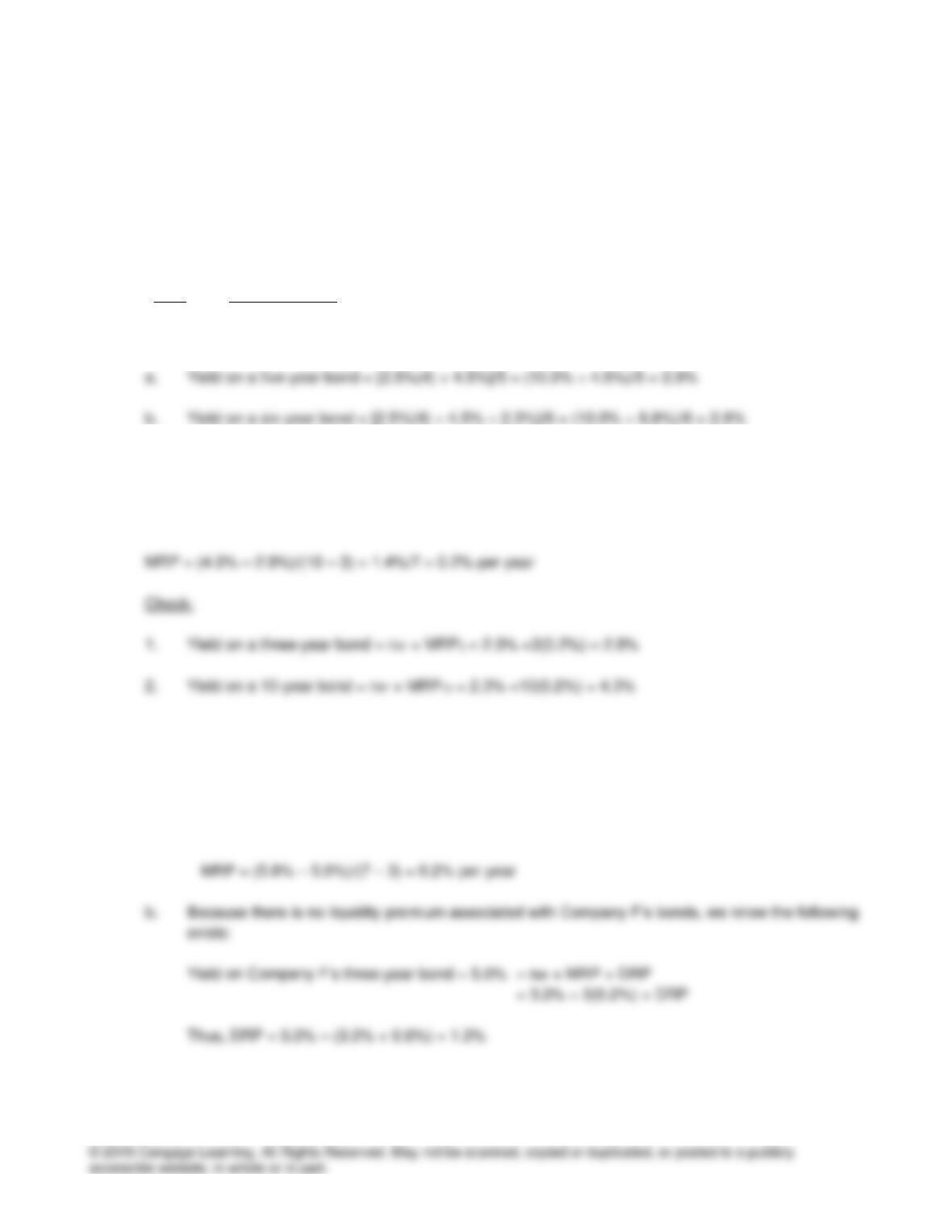
c. Three-year bond yield = (4.1% + 3.5% + 2.9%)/3 = 3.5%
5-16 We know the following:
Yield on a four-year bond = 2.5%; thus, the sum of the returns for the four-year period must equal 10.0%
= 2.5% x 4 = R1 + R2 + R3 + R4.
Year One-Yearl Rate
2023 4.5%
2024 2.3
5-17 Other than their yields, the only difference among the bonds is their terms to maturity. As a result, the
difference in the yields of these bonds must be the result of their MRPs. The nine-month bond does not
have an MRP, which means rRF = 2.3%. Thus,
5-18 rRF = 3.2%
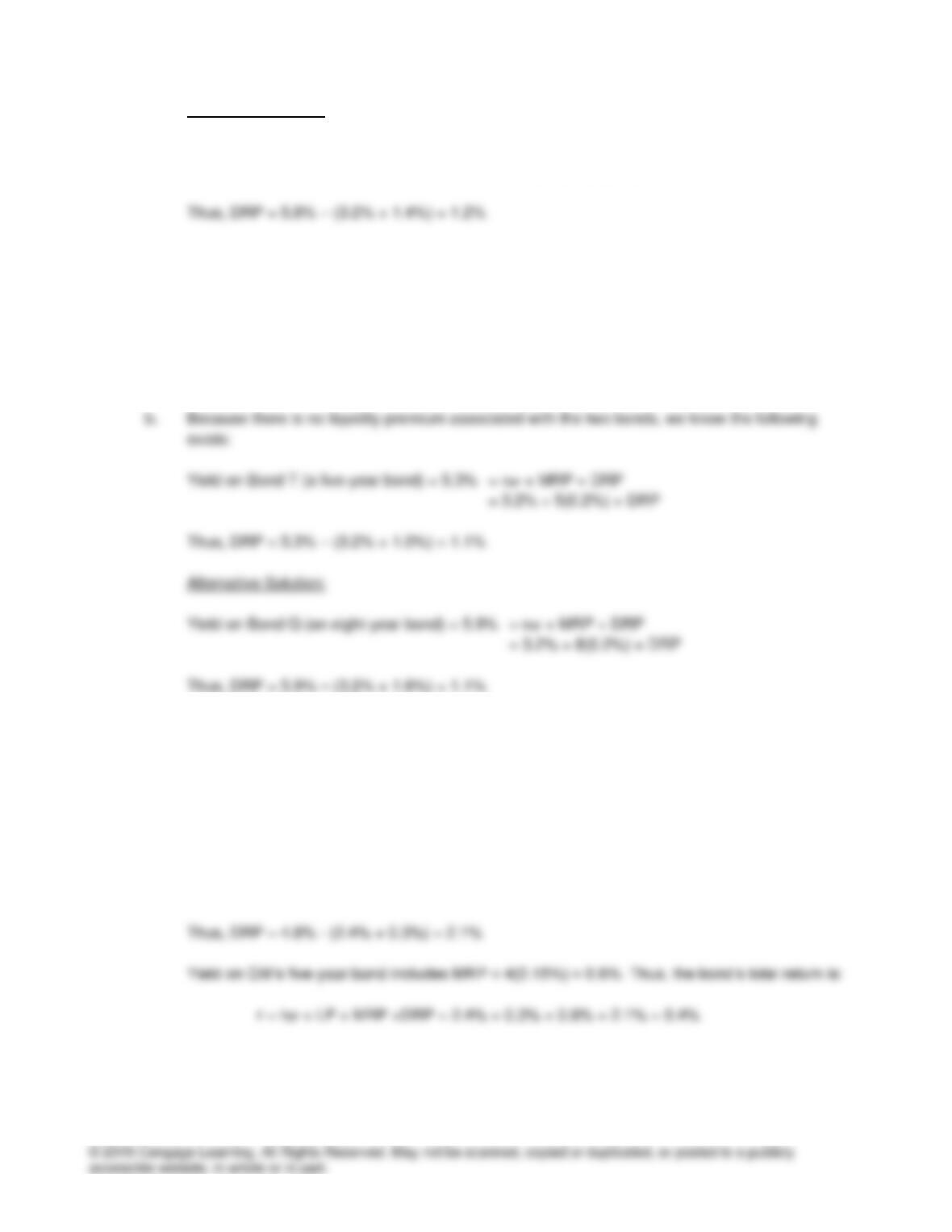
a. Because the only difference between Company F’s three-year bond and its seven-year bond is
the term to maturity, the difference in the yields of these two bonds must be the result of their
MRPs. Thus,
Chapter 5 CFIN6
Alternative Solution:
Yield on Company F’s seven-year bond = 5.8% = rRF + MRP + DRP
= 3.2% + 7(0.2%) + DRP
5-19 rRF = 3.2%
a. Because the only difference between Bond T and Bond Q is their terms to maturity, the
difference in the yields of these two bonds must be the result of their MRPs. Thus,
MRP = (5.9% – 5.3%)/(8 – 5) = 0.2% per year
5-20 Based on the information that is given, we know the following relationships exist:
Bond yield = rRF + LP + DRP + MRP
Yield on one-year T-bond = 2.4% = rRF
Yield on GM’s one-year bond = 4.8% = rRF + LP + MRP +DRP
= 2.4% + 0.3% + 0.0% + DRP