Chapter 5
Interest Rates
I. Chapter Outline
The following chapter outline is correlated to the PowerPoint Lecture Slides. The PowerPoint slides
are referenced in bold. Alternative Examples to selected textbook examples are also available in the
PowerPoint Lecture Slides and are also referenced in bold.
5.1 Interest Rate Quotes and Adjustments (Slides 6–7)
• The Effective Annual Rate (Slide 6)
– Adjusting the Discount Rate to Different Time Periods (Slide 7)
• Table 5.1 Effective Annual Rates for a 6% APR with Different Compounding Periods
• Example 5.2 Converting the APR to a Discount Rate (Slides 16–17)
• PowerPoint Alternative Example 5.2 (Slides 18–20)
5.2 Application: Discount Rates and Loans (Slides 21–24)
5.3 The Determinants of Interest Rates (Slide 27–28)
• Global Financial Crisis: Teaser Rates and Subprime Loans
• Inflation and Real Versus Nominal Rates (Slide 27)
• Example 5.4 Calculating the Real Interest Rate (Slides 29–30)
– Interest Rate Determination
Berk/DeMarzo • Corporate Finance, Fourth Edition 19
5.4 Risk and Taxes (Slide 53)
54)
• Example 5.7 Discounting Risky Cash Flows (Slides 55–56)
5.5 The Opportunity Cost of Capital (Slide 62)
• Common Mistake: States Dig a $3 Trillion Hold by Discounting at the Wrong Rate
Chapter 5 Appendix Continuous Rates and Cash Flows (Slides 65–70)
II. Learning Objectives
5-2 Given an effective annual rate, compute the n-period effective annual rate.
5-4 Describe the relation between nominal and real rates of interest.
5-6 Describe the effect of higher interest rates on net present values in the economy.
5-8 Discuss the determinants of the shape of the yield curve.
5-10 Given the other two, compute the third: after-tax interest rate, tax rate, and before-tax interest
rate.
20 Berk/DeMarzo • Corporate Finance, Fourth Edition
III. Chapter Overview
Chapter 4 introduced the time value of money using risk-free rates of interest. Chapter 5 begins the
5.1 Interest Rate Quotes and Adjustments
This section discusses effective annual rate, annual percentage rate, and the rate per compounding
5.2 Application: Discount Rates and Loans
5.3 The Determinants of Interest Rates
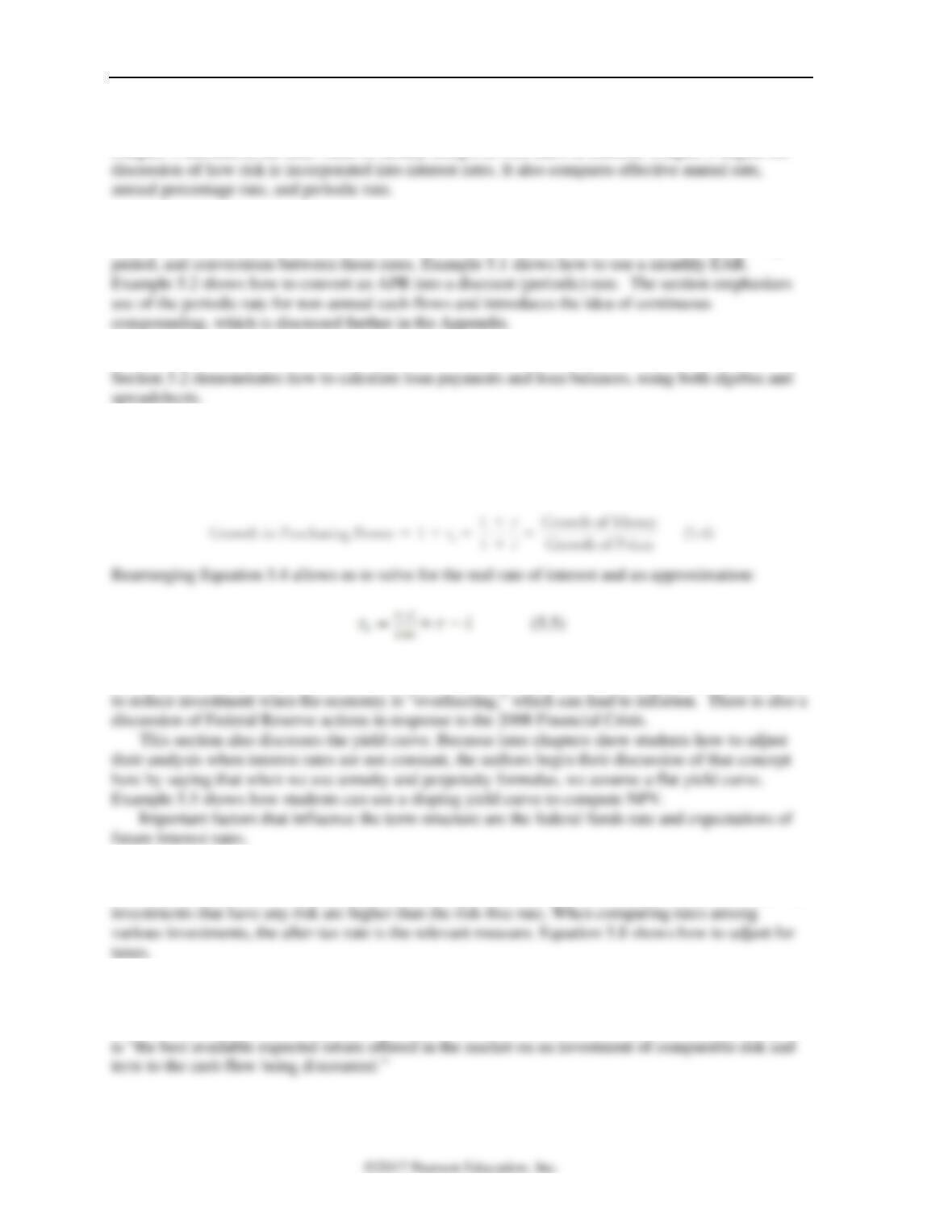
Factors that may influence the willingness of individuals to borrow and lend are inflation, government
policy, and expectations of future growth. The text uses the multiplicative form of the Fisher
equation:
The text also emphasizes that when interest rates are low, more positive NPV projects are in the
economy. The Federal Reserve and other central banks use this information to stimulate investment or
5.4 Risk and Taxes
Two additional factors are important in determining interest rates: risk and taxes. All interest rates on
5.5 The Opportunity Cost of Capital
In summary, interest rates vary based on quoting conventions, the term of the investment, and risk.
The actual return investors keep depends on how the interest is taxed. The opportunity cost of capital

Berk/DeMarzo • Corporate Finance, Fourth Edition 21
IV. Spreadsheet Solutions in Excel
The following Problems for Chapter 5 have spreadsheet versions of the problems available: 2, 3, 10,