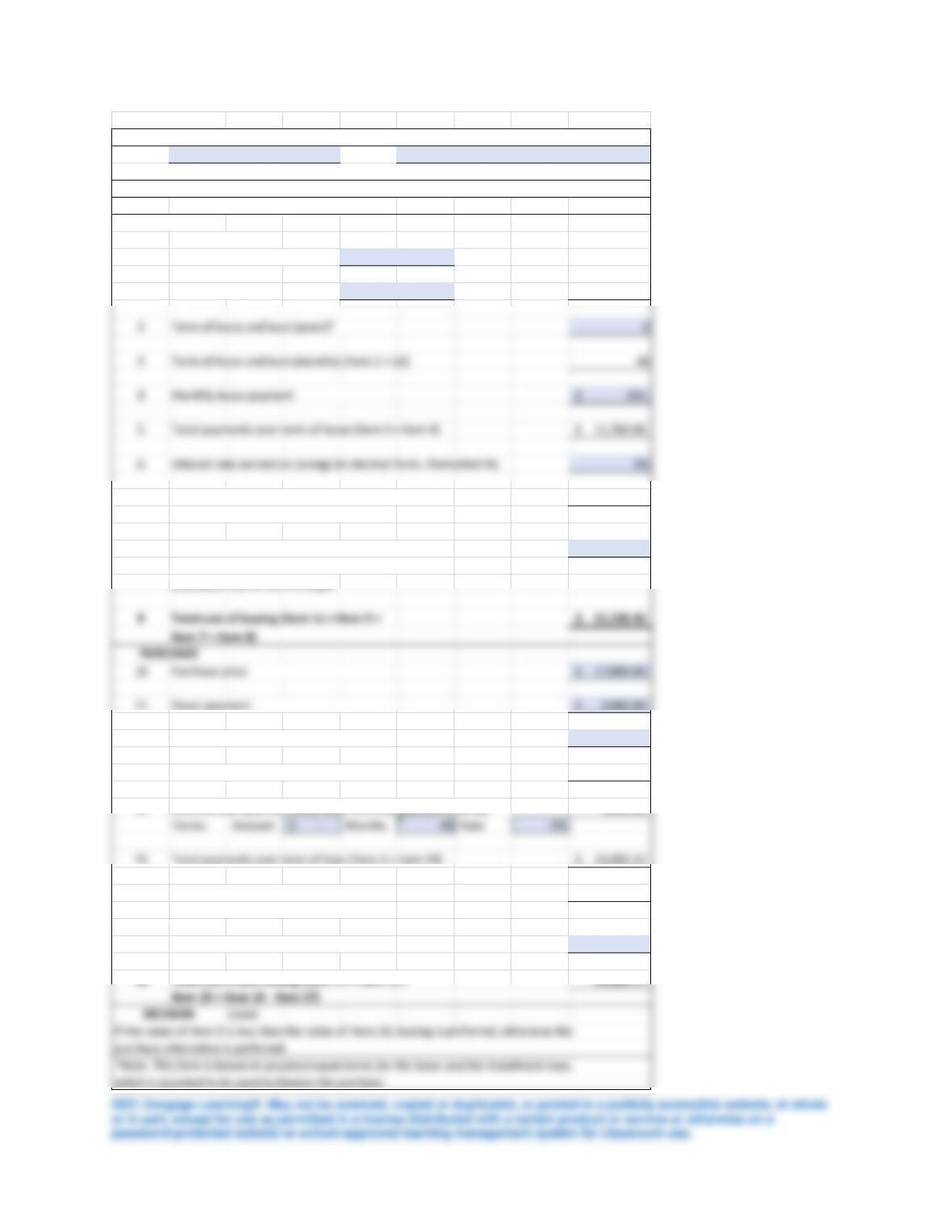
Worksheet 5.1
Name Date
Item Amount
1
a. Down payment (capital
245$
Monthly lease payment
Total payments over term of lease (Item 3 × Item 4)
7 29.40$
8 Payment/refund for market value adjustment 350.00$
at end of lease ($0 for closed-end leases) and/or
Purchase price
Down payment
12 0.060
13 1,020.00$
16 240.00$
17 6,775.00$
If the value of Item 9 is less than the value of Item 18, leasing is preferred; otherwise the
purchase alternative is preferred.
Opportunity cost of down payment (Item 2
Item 6 × Item 11)
Estimated value of car at end of loan
Sales tax rate (in decimal form)
Sales tax (Item 10 × Item 12)
Item 6)
Opportunity cost of initial payment (Item 1 × Item 2 ×
LEASE
Initial payment:
cost reduction):
b. Security deposit:
245.00
Description
AUTOMOBILE LEASE VERSUS PURCHASE ANALYSIS*
Sarah and Tyler Hudson
Enter data in blue areas only.
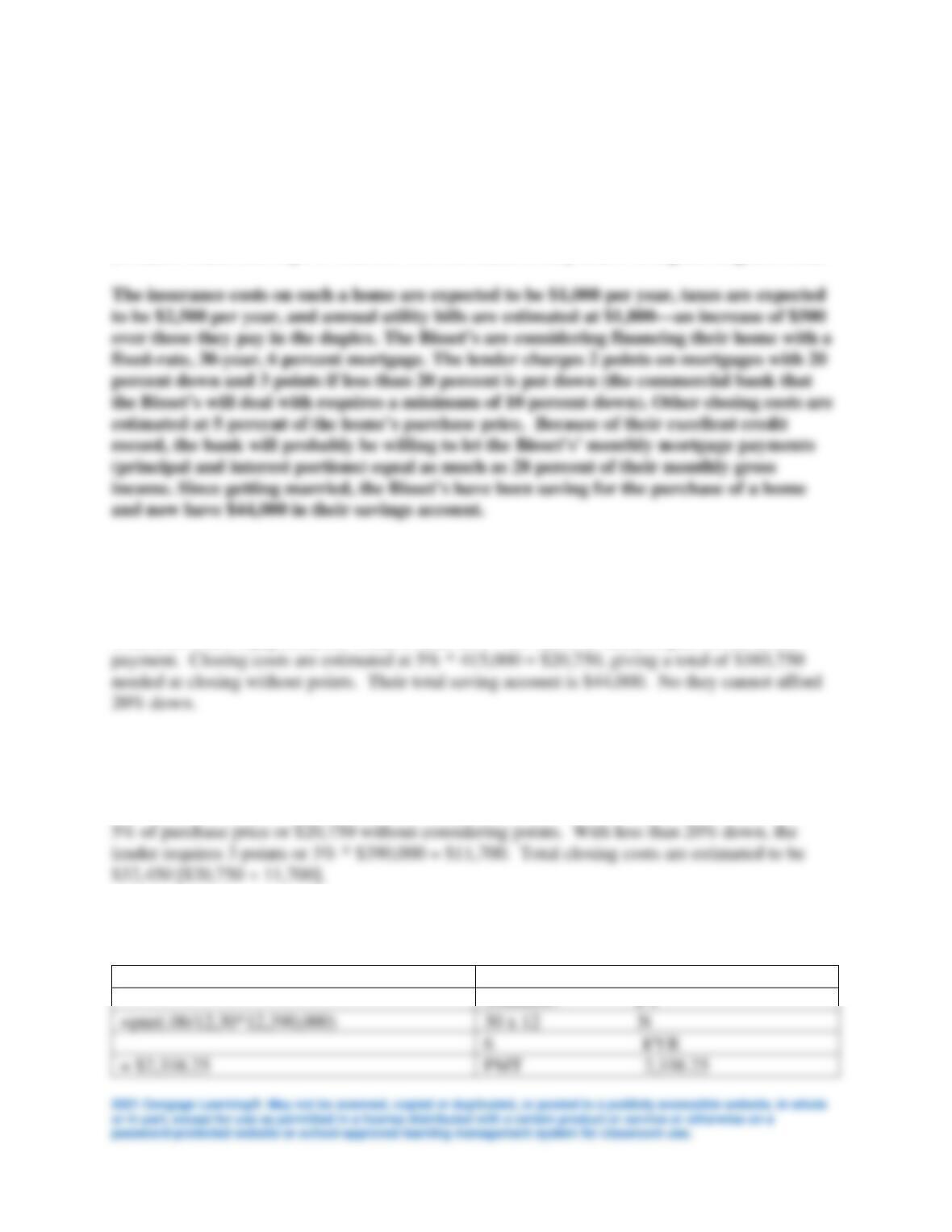
5.2 Evaluating a Mortgage Loan for the Bisset’s
Aramis and Danielle Bisset, both in their mid-20s, have been married for 4 years and have
two preschool-age children. Ben has an accounting degree and is employed as a cost
accountant at an annual salary of $62,000. They’re now renting a duplex but wish to buy a
home in the suburbs of their rapidly developing city. They’ve decided they can afford a
$415,000 house and hope to find one with the features they desire in a good neighborhood.
Critical Thinking Questions
1. How much would the Bisset’s have to put down if the lender required a minimum 20
percent down payment? Could they afford it?
With a 20% down payment, the Bisset’s need 20% * $415,000 or $83,000 just for the down
2. Given that the Bisset’s want to put only $25,000 down, how much would their closing
costs be?
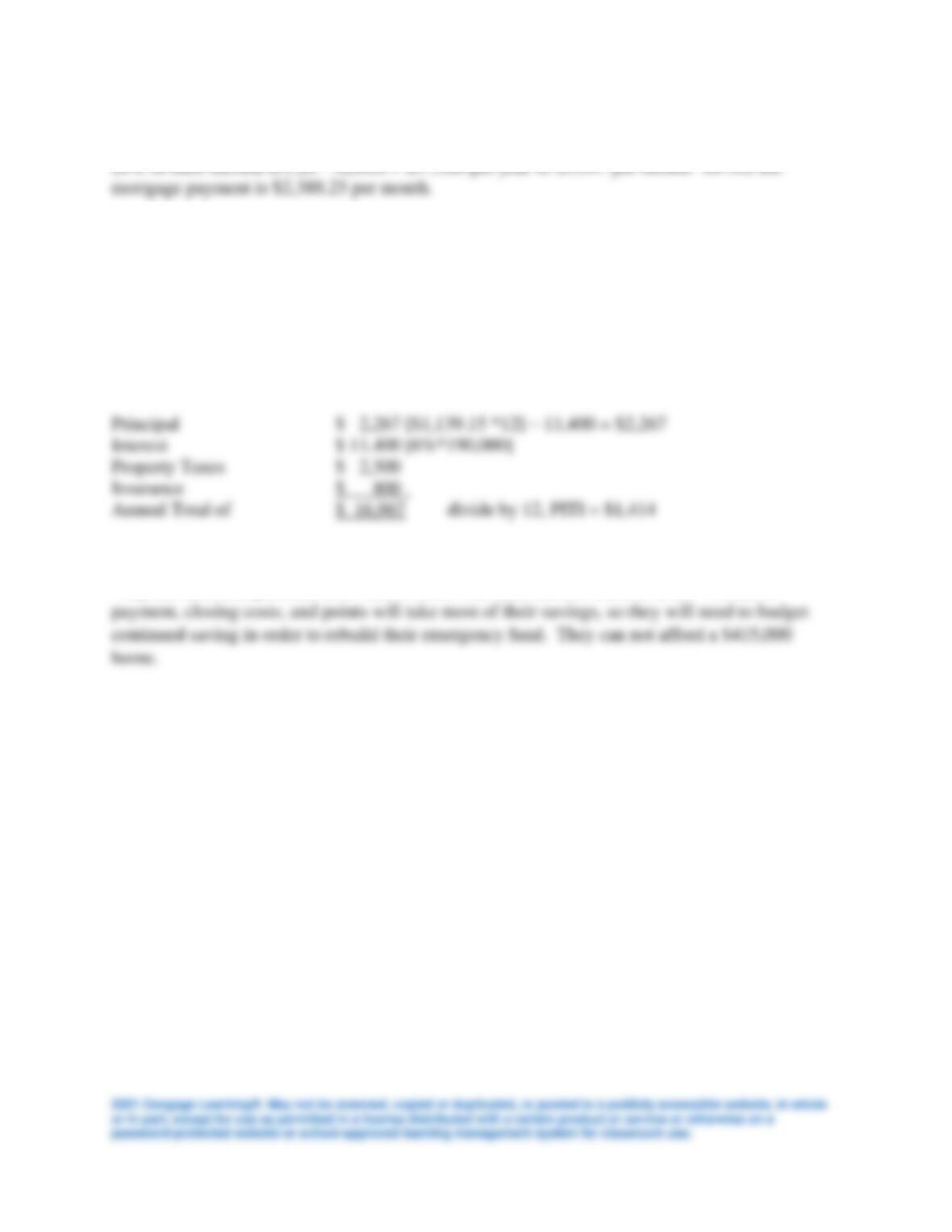
With $25,000 down, the principal on the loan will be $390,000. Closing costs are estimated at
Considering only principal and interest, how much would their monthly mortgage
payments be? Loan of $390,000, 30-year, 6% will require a payment of $2,338.25
Excel:
Calculator:
390000+/- PV
=pmt(.06/12,30*12,390,000)
30 x 12 N
6 I/YR
= $2,338.25
PMT 2,338.25
Would they qualify for a loan using a 28 percent affordability ratio?
3. Using a $25,000 down payment on a $215,000 home, what would the Bisset’s loan-to–
value ratio be? Assuming property taxes are $2,500 and insurance is $800, calculate the
monthly mortgage payments on a PITI basis.
Loan-to-value ratio would be 190,000/215,000 or 88.4%. As a rule, lenders prefer no more than
80%. The payment on a PITI basis includes principal, interest, property taxes and insurance.
For this loan, monthly payment is pmt=(.06/12.30*12.190000) = $1,139.15.
4. What recommendations would you make to the Bisset’s? Explain.
They can afford to purchase a $215,000 home with their current income level. The down
5.3 Natalie’s Rent-or-Buy Decision
Natalie Warren is in her late 20s. She is renting an apartment in the fashionable part of
town for $1,500 a month. After much thought, she’s seriously considering buying a
condominium for $325,000. She intends to put 20 percent down and expects that closing
costs will amount to another $6,500; a commercial bank has agreed to lend her money at
the fixed rate of 6 percent on a 15-year mortgage. Natalie would have to pay an annual
condominium owner’s insurance premium of $800 and property taxes of $1,200 a year
(she’s now paying renter’s insurance of $550 per year). In addition, she estimates that
annual maintenance expenses will be about 0.5 percent of the price of the condo (which
includes a $30 monthly fee to the property owners’ association). Natalie’s income puts her
in the 24 percent tax bracket (she does not itemize her deductions on her tax returns), and
she earns an after-tax rate of return on her investments of around 4 percent.
Critical Thinking Questions
1. Given the information provided, use Worksheet 5.2 to evaluate and compare Natalie’s
alternatives of remaining in the apartment or purchasing the condo.
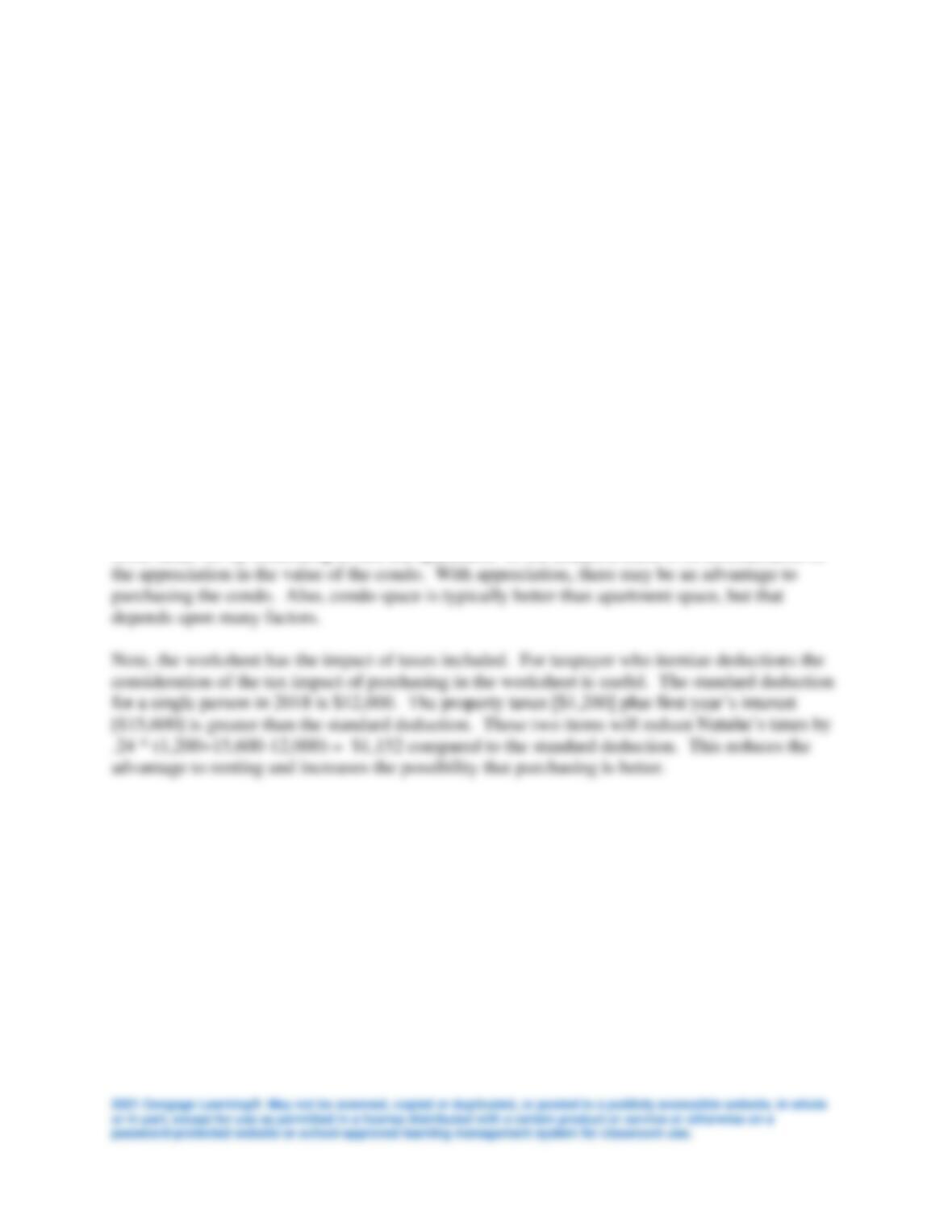
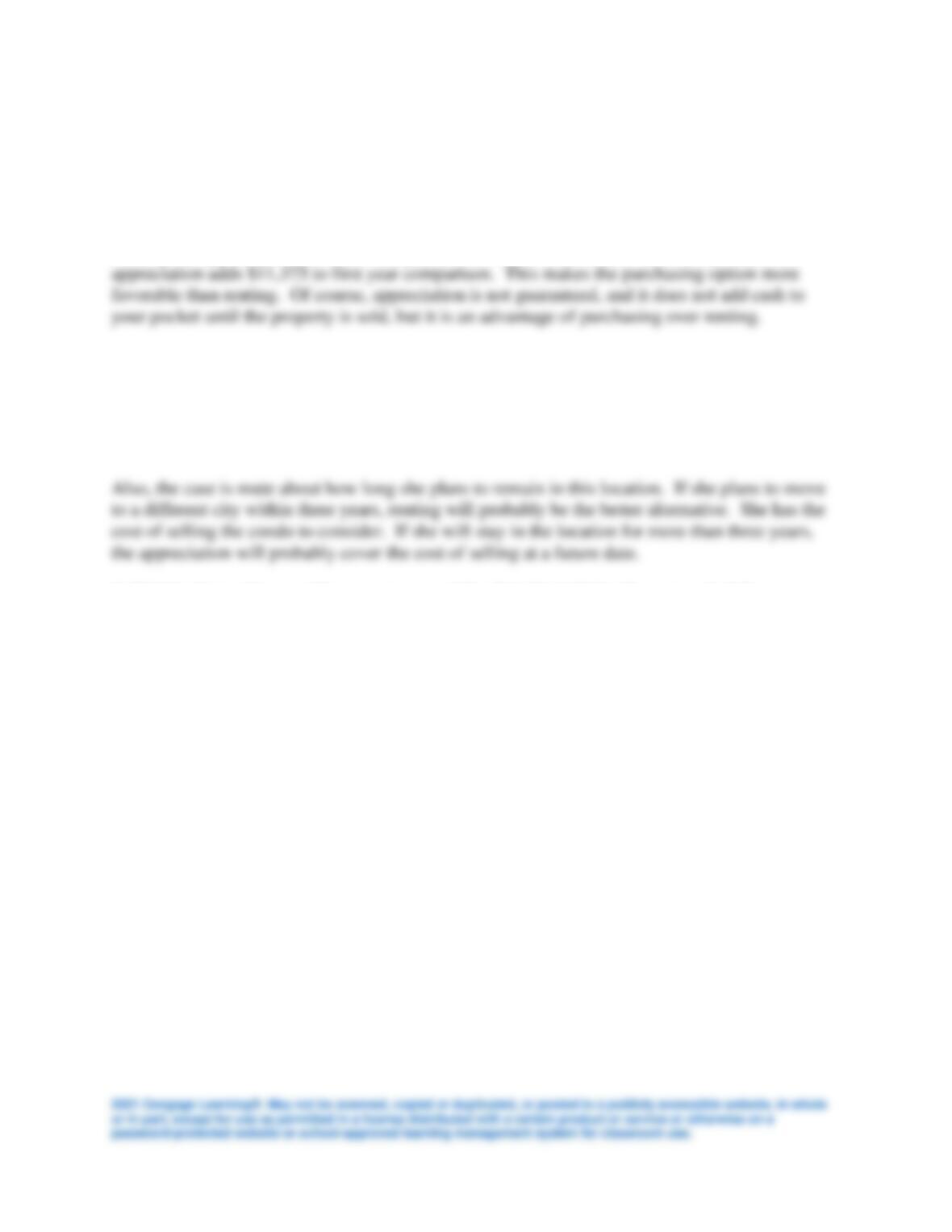
From the worksheet below, there is an advantage to renting of [21,025 – 18,550] = $2,475.
Assuming that the location and quality of the condo space is equal to the rental space, Natalie is
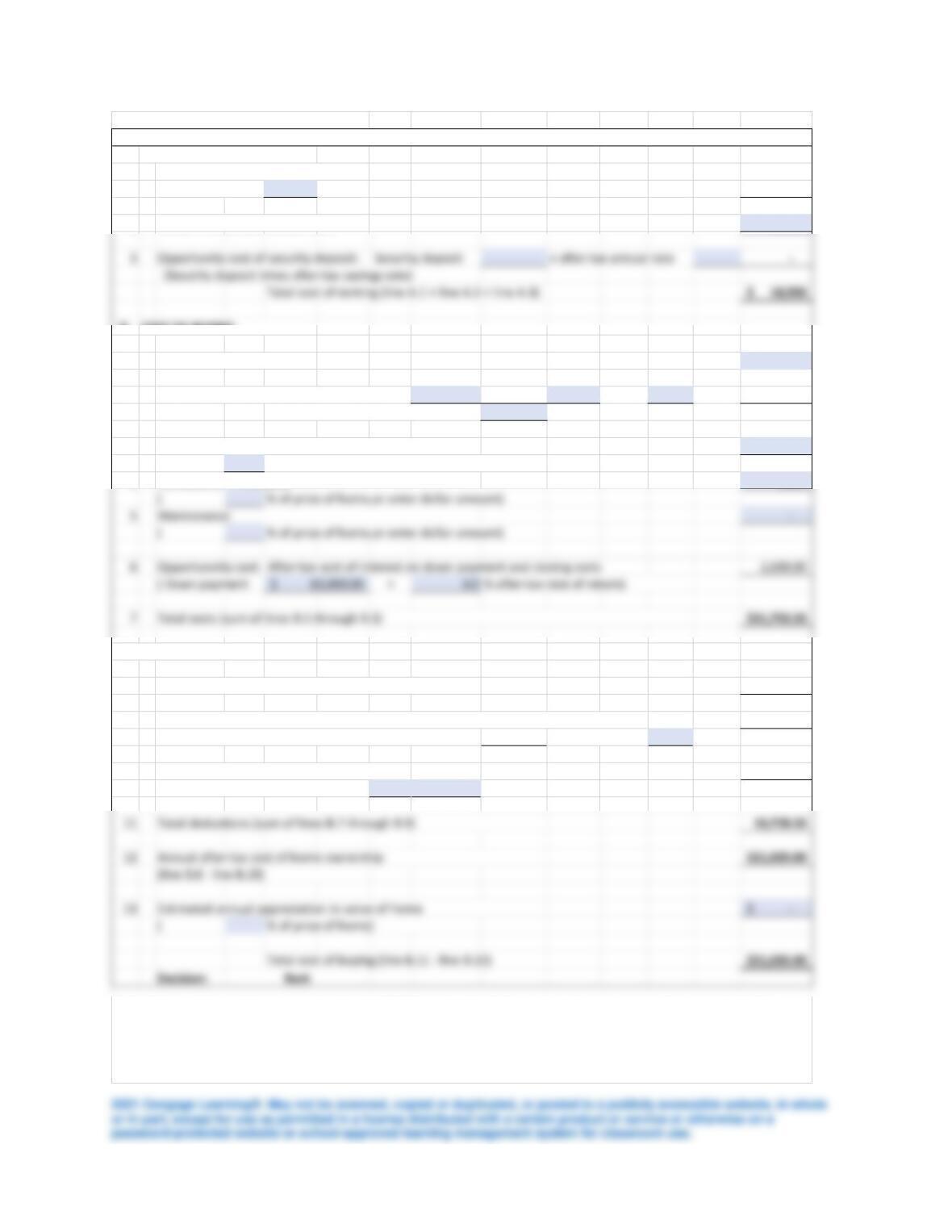
Worksheet 5.2, Critical Thinking Problem 5.3
A.
1
Monthly Rent 1,500$ 18,000$
2 550.00
Opportunity cost of security deposit:
B.
1 Purchase Price of the Home 325,000$
2
Annual mortgage payments (Terms:
260,000$ , 180 months, 6 %) 26,328.33$
(12 $2,194.03 )
3 1,200
( % of price of home,or enter dollar amount)
Total costs (sum of lines B.1 through B.5)
Homeowner’s insurance
% after-tax rate of return)
8 Principal reduction in loan balance (see note below) 10,728.33$
9 –
15,600$ × tax rate of 0%)
10 Tax savings due to property tax deductions* –
%)
Total deductions (sum of lines B.7 through B.9)
Annual after-tax cost of home ownership
(line B.6 – line B.10)
Estimated annual appreciation in value of home
% of price of home)
Annual rental costs, 12 times monthly
Renter’s insurance, Annual Cost
COST OF BUYING
× monthly mortgage payment of
Property taxes
RENT-OR-BUY of HOME ANALYSIS
Note: Find monthly mortgage payments from the Exhibit in chapter 5 of your textbook. An easy way to approximate the
portion of the annual loan payment that goes to interest (line B.8) is to multiply the interest rate by the size of the loan.
To find the principal reduction in the loan balance (line B.7), simply subtract the amount that goes to
interest from total annual mortgage payments.
*Tax-shelter items. Note due to the large standard deduction and the limit on state taxes, the appropriate rate may be zero.
Less:
Tax savings due to interest deductions*
(Interest portion of mortgage payments
(line B.2 × tax rate of
0
COST OF RENTING
2. Working with a friend who is a realtor, Natalie has learned that condos like the one that
she’s thinking of buying are appreciating in value at the rate of 3.5 percent a year and are
expected to continue doing so. Would such information affect the rent-or-buy decision
made in Question 1?
Explain.
Adding the appreciation will make the purchase alternative more favorable. 3.5 percent
3. Discuss any other factors that should be considered when making a rent-or-buy decision.
Location is important and must be considered. For example, the rental unit may be on a public
transportation route that makes it convenient to get to work and other places. If the purchase unit
is not near public transportation, there may be additional transportation costs to consider.
4. Which alternative would you recommend for Natalie in light of your analysis?
I suggest she purchase the condo assuming she will stay in town for more than three more years.
Test Yourself
These questions may be used as quizzes, homework assignments, or class discussion. One
use is to require the students to answer all the questions as a homework/project. They
could do this for all chapters and maintain a notebook which they would submit prior to
each major exam. Someone would have to “grade” the submission to ensure that the
submission is taken seriously.
5-1 Briefly discuss how each of these purchase considerations would affect your choice of a
car:
a. Affordability
This is your first step. You’ll need to calculate two numbers unless you can pay cash for the
entire cost of the car.
• Amount of down payment: This money will come from savings, so be sure not to deplete
your emergency fund.
b. Operating costs
The out-of-pocket cost of operating an automobile includes not only car payments but also
insurance, license, fuel, oil, tires, and other operating and maintenance outlays. Also, consider
how quickly the car will decline in value or depreciate. While, this is not an out-of-pocket or
cash cost, it will impact the future value of the car.
c. Gas, diesel, hybrid, or electric?
Each of these options will impact the annual operating costs and the initial purchase cost. If you
d. New, used, or “nearly new”?
Exhibit 5.2 list steps to consider in finding the care for you. You may be able to afford a
e. Size, body style, and features
Your personal choices and family status will control these features. The options that add to the
cost of a new car, will have little impact on the price of a used car. While most people need a car
for transportation and therefore the style may not matter, some need a car that will enhance their
status either for business or personal purposes.
5-2 Describe the purchase transaction process, including shopping, negotiating price, and
closing the deal on a car.
Shopping is all about finding the best car for you. Exhibit 5.2 lists some steps to take. The key
is to compare cars and dealers. In addition to assessing reliability, talking with friends who own
similar cars and reading objective assessments published by consumer magazines and buying
guides such as Consumer Reports gives you great information that helps you hone in on the car
for you.
stick to the purchase of the car and not the other services.
5-3 What are the advantages and disadvantages of leasing a car?
Leasing is another way to pay for a car. You need to first look at the cost of leasing versus
buying. Note the Financial Road sign in the chapter, “When Does it make Sense to Lease a
5-4 Given your personal financial circumstances, if you were buying a car today, would you
probably pay cash, lease, or finance it, and why? Which factors are most important to you
in making this decision?
The factors referred to in 5-3 answer will apply here. Most students are concerned with down
5-5 In addition to single-family homes, what other forms of housing are available in the
United States? Briefly describe each of them.
Single-family homes: They can be stand-alone homes on their own legally defined lots or row
houses or townhouses that share a common wall. As a rule, single-family homes offer buyers
privacy, prestige, pride of ownership, and maximum property control.
5-6 What type of housing would you choose for yourself now, and why? Why might you
choose to rent instead of buy?
Worksheet 5.2 gives a format for analyzing the rent versus buy cost comparison. A major factor
5-7 Why is it important to have a written lease? What should a rental contract include?
Oral agreements may be binding as to the additional services that are offered by the lessor.
5-8 Briefly describe the various benefits of owning a home. Which one is most important to
you? Which is least important?
Major benefits of owning versus renting are:
Tax shelter, that is, property taxes and mortgage interest are deductible for federal and state
income tax, thus, these costs of ownership will reduce or “shelter” taxes on other income such as
5-9 What does the loan-to-value ratio on a home represent? Is the down payment on a home
related to its loan-to-value ratio? Explain.
The loan-to-value ratio specifies the maximum percentage of the value of a property that the
5-10 What are mortgage points? How much would a home buyer have to pay if the lender
wanted to charge 2.5 points on a $250,000 mortgage? When would this amount have to be
paid? What effect do points have on the mortgage’s rate of interest?
Mortgage points are fees charged by lenders at the time that they grant a mortgage loan. In
appearance, points are like interest in that they are a charge for borrowing money. In fact for
interest rate”.
5-11 What are closing costs, and what items do they include? Who pays these costs, and
when?
Closing costs are all other expenses besides the down payment that borrowers ordinarily pay at
the time a mortgage loan is closed and title to the purchased property is conveyed to them. The
buyer typically pays the majority of the closing costs, although the seller may, by custom or
contract, pay some of the costs. Closing costs are made up of such items as: (1) loan application
5-12 What are the most common guidelines used to determine the monthly mortgage
payment one can afford?
The most common guidelines used to determine the amount of monthly mortgage
payments one can afford are the affordability ratios that stipulate:
5-13 Why is it advisable for the prospective home buyer to investigate property taxes?
Because they’re local taxes levied to fund schools, law enforcement, and other local services, the
level of property taxes differs from one community to another. In addition, within a given
5-14 Describe some of the steps home buyers can take to improve the home-buying process
and increase their overall satisfaction with their purchases.
Gather all the information available about the location of the home. The standing joke: What are
the three most important factors in buying a home? Answer, location, location, and location.
5-15 What role does a real estate agent play in the purchase of a house? What is the benefit
of the MLS? How is the real estate agent compensated, and by whom?
Most home buyers rely on real estate agents because they’re professionals who are in daily
contact with the housing market. Once you describe your needs to an agent, he or she can begin
5-16 Describe a real estate short sales transaction. What are the potential benefits and costs
from the perspective of the homeowner?
A real estate short sale is the sale of property in which the proceeds are less than the balance
owed on a loan secured by the property sold. This procedure is an effort by mortgage lenders to
5-17 Why should you investigate mortgage loans and prequalify for a mortgage early in the
home-buying process?
Prequalification can work to your advantage in several ways. You’ll know ahead of time the
specific mortgage amount that you qualify for—subject, of course, to changes in rates and
terms—and can focus your search on homes within an affordable price range. Prequalification
5-18 What information is normally included in a real estate sales contract? What is an
earnest money deposit? What is a contingency clause?
State laws generally specify that, to be enforceable in court, real estate buy–sell agreements must
be in writing and contain certain information, including: (1) the names of buyers and sellers,
(2) a description of the property sufficient for positive identification, (3) specific price and other
5-19 Describe the steps involved in closing the purchase of a home.
An overview of these closing requirements may be found on HUD’s Web site (go to the
5-20 Describe the various sources of mortgage loans. What role might a mortgage broker
play in obtaining mortgage financing?
The major sources of home mortgages today are commercial banks, thrift institutions, and
mortgage bankers or brokers; also, some credit unions make mortgage loans available to their
5-21 Briefly describe the two basic types of mortgage loans. Which has the lowest initial
rate of interest? What is negative amortization, and which type of mortgage can experience
it? Discuss the advantages and disadvantages of each mortgage type.
The fixed-rate mortgage still accounts for a large portion of all home mortgages. Both the rate
of interest and the monthly mortgage payment are fixed over the full term of the loan. The
charged. In other words, you could end up with a larger mortgage balance on the next
anniversary of your loan than on the previous one.
5-22 Differentiate among conventional, insured, and guaranteed mortgage loans.
A conventional mortgage is a mortgage offered by a lender who assumes all the risk of loss. To
protect themselves, lenders usually require a down payment of at least 20 percent of the value of
the mortgaged property.
Key Terms
adjustable-rate
mortgage (ARM)
A mortgage on which the rate of interest, and therefore the size of the
monthly payment, is adjusted based on market interest rate
movements.
adjustment period
On an adjustable-rate mortgage, the period of time between rate or
payment changes.
anchoring
A behavioral bias in which an individual tends to allow an initial
balloon-payment
mortgage
A mortgage with a single large principal payment due at a specified
future date
biweekly mortgage
A loan on which payments equal to half the regular monthly payment
are made every two weeks.
buydown
Financing made available by a builder or seller to a potential new-
home buyer at well below market interest rates, often only for a short
period.
capitalized cost
The price of a car that is being leased.
closed-end lease
The most popular form of automobile lease; often called a walk-away
lease, because at the end of its term, the lessee simply turns in the car
(assuming the preset mileage limit has not been exceeded and the car
hasn’t been abused).
closing costs
All expenses (including mortgage points) that borrowers ordinarily
pay when a mortgage loan is closed and they receive title to the
purchased property.
condominium
(condo)
A form of direct ownership of an individual unit in a multiunit project
in which lobbies, swimming pools, and other common areas and
facilities are jointly owned by all property owners in the project.
contingency clause
A clause in a real estate sales contract that makes the agreement
conditional on such factors as the availability of financing, property
inspections, or obtaining expert advice.
convertible ARM
An adjustable-rate mortgage loan that allows borrowers to convert
from an adjustable-rate to a fixed rate loan, usually at any time
between the 13th and the 60th month.
cooperative
apartment (co-op)
An apartment in a building in which each tenant owns a share of the
nonprofit corporation that owns the building.
depreciation
The loss in the value of an asset, such as an automobile, that occurs
over its period of ownership; calculated as the difference between the
price initially paid and the subsequent sale price.
down payment
A portion of the full purchase price provided by the purchaser when a
house or other major asset is purchased; often called equity.
earnest money
deposit
Money pledged by a buyer to show good faith when making an offer
to buy a home.
fixed-rate mortgage
The traditional type of mortgage, in which both the rate of interest and
the monthly mortgage payment are fixed over the full term of the loan.
home pledged as collateral. A borrower typically cannot make
scheduled mortgage payments and the lender repossesses the property
in an effort to recover the loan balance owed.
graduated-payment
mortgage
A mortgage that starts with unusually low payments that rise over
several years to a fixed payment.
growing-equity
mortgage
Fixed-rate mortgage with payments that increase over a specific
period. Extra funds are applied
to the principal so that the loan is paid off more quickly.
homeowner’s
insurance
Insurance that is required by mortgage lenders and covers the
replacement value of a home and its contents.
interest-only
mortgage
.
A mortgage that requires the borrower to pay only interest; typically
used to finance the purchase of more expensive properties
index rate
interest rate movements.
interest rate cap
On an adjustable-rate mortgage, the limit on the amount that the
interest rate can increase each adjustment period and over the life of
the loan.
The maximum percentage of the value of a property that the lender is
willing to loan.
margin
On an adjustable-rate mortgage, the percentage points a lender adds to
the index rate to determine the rate of interest.
On an adjustable-rate mortgage, the baseline index rate that captures
mortgage banker
A firm that solicits borrowers, originates primarily government-
insured and government- guaranteed loans, and places them with
mortgage lenders; often uses its own money to initially fund
and places them with mortgage lenders; the broker merely takes loan
applications and then finds lenders willing to grant the mortgage loans
under the desired terms.
mortgage loan
A loan secured by the property: If the borrower defaults, the lender
has the legal right to liquidate the property to recover the funds it is
Service (MLS)
given community or metropolitan area; includes a brief description of
each property with a photo and its asking price but can be accessed
only by realtors who work for an MLS member.
negative
amortization
When the principal balance on a mortgage loan increases because the
monthly loan payment is lower than the amount of monthly interest
being charged; some ARMs are subject to this undesirable condition.
open-end (finance)
lease
An automobile lease under which the estimated residual value of the
car is used to determine lease payments; if the car is actually worth
less than this value at the end of the lease, the lessee must pay the
difference.
payment cap
On an adjustable-rate mortgage, the limit on the monthly payment
increase that may result from a rate adjustment.
PITI
Acronym that refers to a mortgage payment including stipulated
portions of principal, interest, property taxes, and homeowner’s
insurance.
prequalification
The process of arranging with a mortgage lender, in advance of
buying a home, to obtain the amount of mortgage financing the
lender deems affordable to the home buyer.
property taxes
Taxes levied by local governments on the assessed value of real estate
for the purpose of funding schools, law enforcement, and other local
services.
purchase option
A price specified in a lease at which the lessee can buy the car at the
end of the lease term.
Real Estate
Settlement
Procedures Act
real estate short
sale
Sale of real estate property in which the proceeds are less than the
balance owed on a loan secured by the property sold.
rent ratio
The ratio of the average house price to the average annual rent, which
provides insight into the relative attractiveness of buying a house
versus renting in a given area of potential interest.
A federal law requiring mortgage lenders to give potential borrowers a
government publication describing the closing process and providing
clear, advance disclosure of all closing costs to home buyers.
residual value
The remaining value of a leased car at the end of the lease term.
sales contract
An agreement to purchase an automobile that states the offering price
and all conditions of the offer; when signed by the buyer and seller,
the contract legally binds them to its terms.
shared-appreciation
mortgage
A loan that allows a lender or other party to share in the appreciated
value when the home is sold.
title check
The research of legal documents and courthouse records to verify that
the seller conveying title actually has the legal interest he or she
two-step ARM
.
An adjustable-rate mortgage with just two interest rates: one for the
first five to seven years of the loan, and a higher one for the
remaining term of the loan
VA loan guarantee
A guarantee offered by the U.S. Veterans Administration to lenders
who make qualified mortgage loans to eligible veterans of the U.S.
Armed Forces and their unmarried surviving spouses.
Chapter Outline
How Will This Affect Me?
I. Buying an Automobile
A. Choosing a Car
B. Affordability
II. The Purchase Transaction
A. Negotiating Price
B. Closing the Deal
III. Leasing Your Car
A. The Leasing Process
IV. Meeting Housing Needs: Buy or Rent?
A. Housing Prices and the Financial Crisis 2008-2009
V. How Much Housing Can You Afford?
A. Benefits of Owning a Home
B. The Cost of Homeownership
C. The Down Payment
VI. The Home-Buying Process
A. Shop the Market First
B. Real Estate Short Sales
VI. Financing the Transaction
A. Sources of Mortgage Loans
B. Types of Mortgage Loans
C. Fixed-Rate Mortgages
D. Adjustable-Rate Mortgages (ARMs)