d. How is the value of a bond determined? What is the value of a 10-year, $1,000
par value bond with a 10 percent annual coupon if its required rate of return is
10 percent?
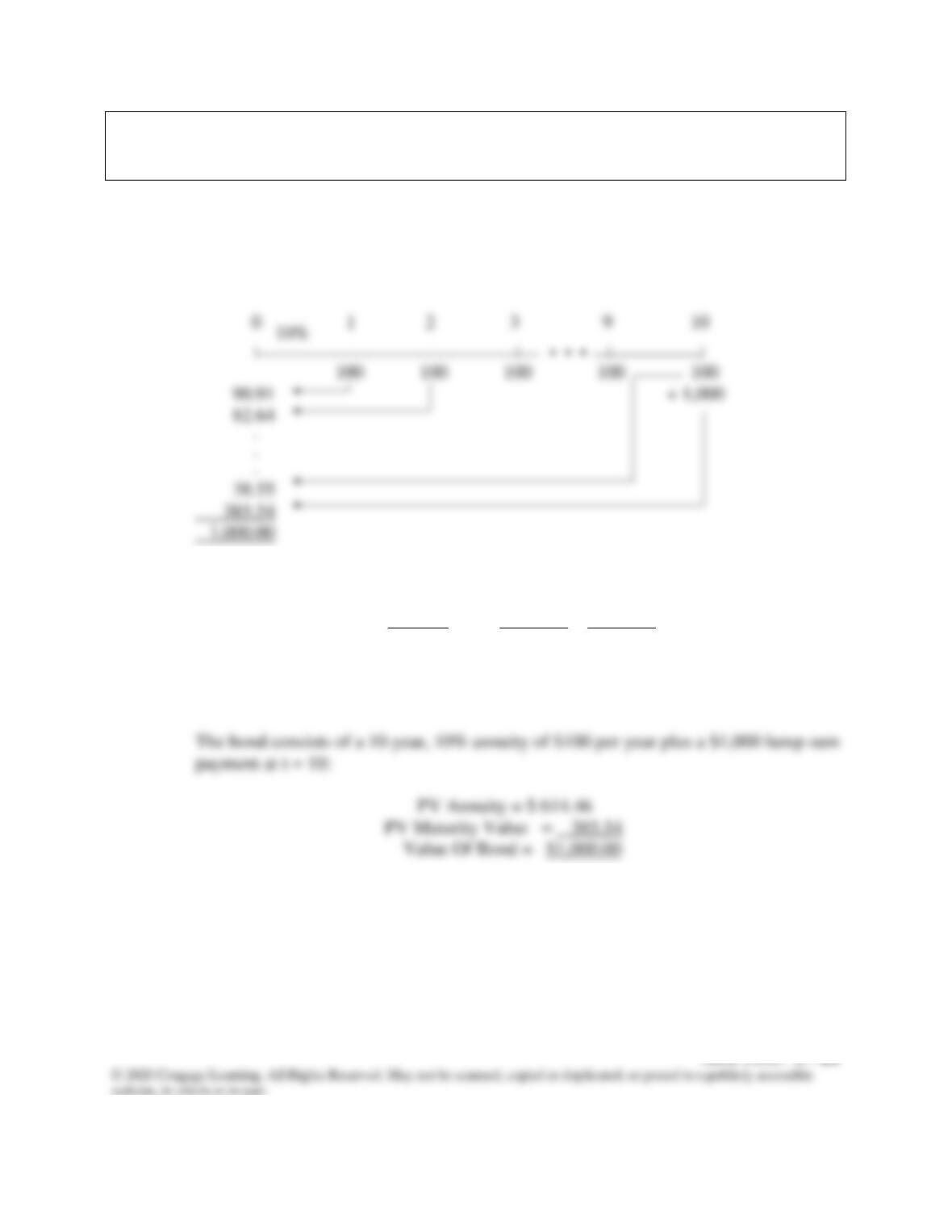
Answer: A bond has a specific cash flow pattern consisting of a stream of constant interest
payments plus the return of par at maturity. The annual coupon payment is the cash
flow: pmt = (coupon rate) (par value) = 0.1($1,000) = $100.
For a 10-year, 10 percent annual coupon bond, the bond’s value is found as follows:
Expressed as an equation, we have:
$1,000. = $385.54 + $38.55 + . . . + $90.91 =
)r + (1
$1,000
+
)r + (1
$100
+ . . . +
)r + (1
$100
=
V
d
10
d
10
d
1
B
The mathematics of bond valuation is programmed into financial calculators which do
the operation in one step, so the easy way to solve bond valuation problems is with a
financial calculator. Input n = 10, rd = I/YR = 10, PMT = 100, and FV = 1000, and
then press PV to find the bond’s value, $1,000. Then change n from 10 to 1 and press
PV to get the value of the 1-year bond, which is also $1,000.
e. 1. What would be the value of the bond described in part d if, just after it had been
issued, the expected inflation rate rose by 3 percentage points, causing investors
to require a 13 percent return? Would we now have a discount or a premium
bond?
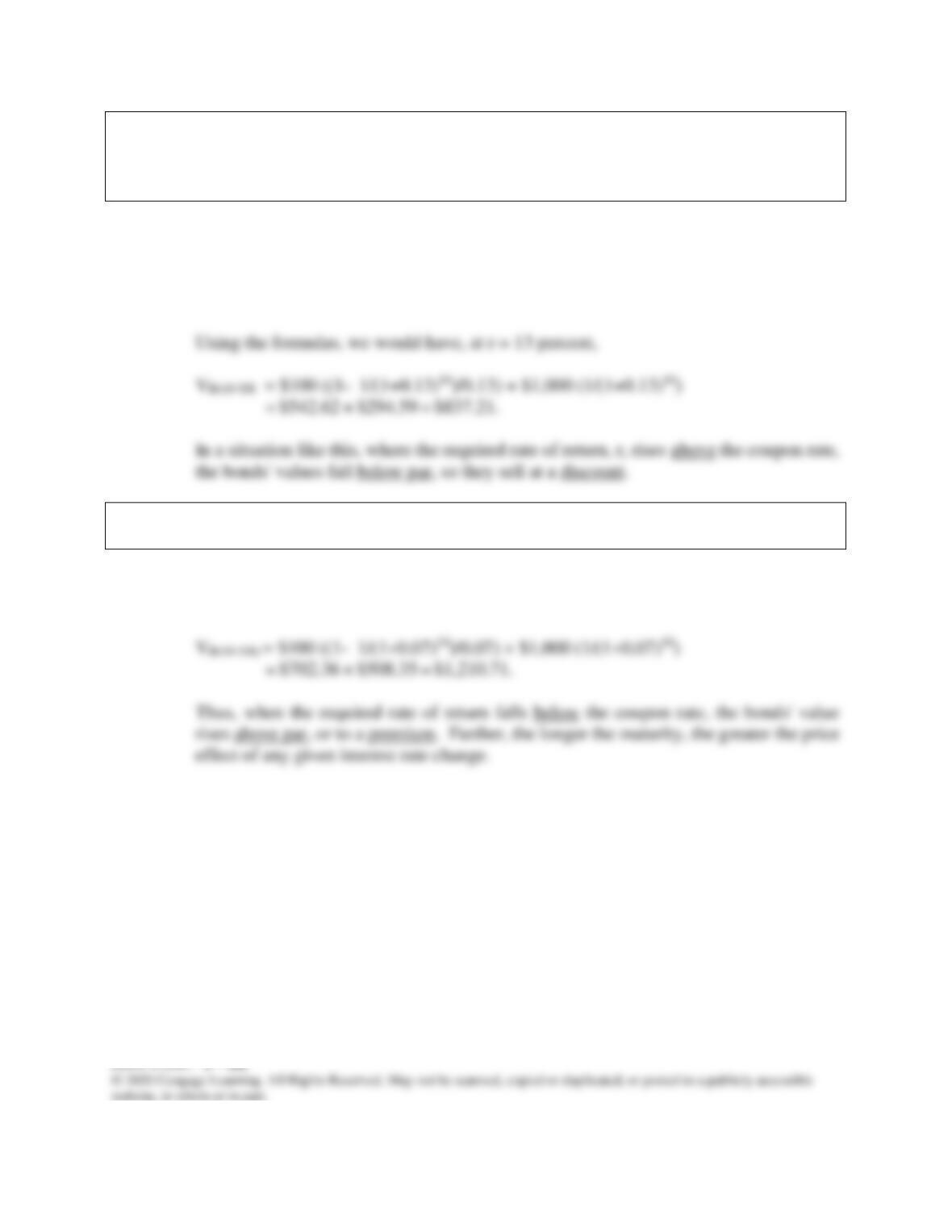
Answer: With a financial calculator, just change the value of rd = I/YR from 10% to 13%, and
press the PV button to determine the value of the bond:
10-year = $837.21.
e. 2. What would happen to the bonds’ value if inflation fell, and rd declined to 7
percent? Would we now have a premium or a discount bond?
Answer: In the second situation, where rd falls to 7 percent, the price of the bond rises above par.
Just change rd from 13% to 7%. We see that the 10-year bond’s value rises to $1,210.71.
e. 3. What would happen to the value of the 10-year bond over time if the required rate
of return remained at 13 percent, or if it remained at
7 percent? (Hint: with a financial calculator, enter PMT, I/YR, FV, and N, and
then change (override) n to see what happens to the PV as the bond approaches
maturity.)
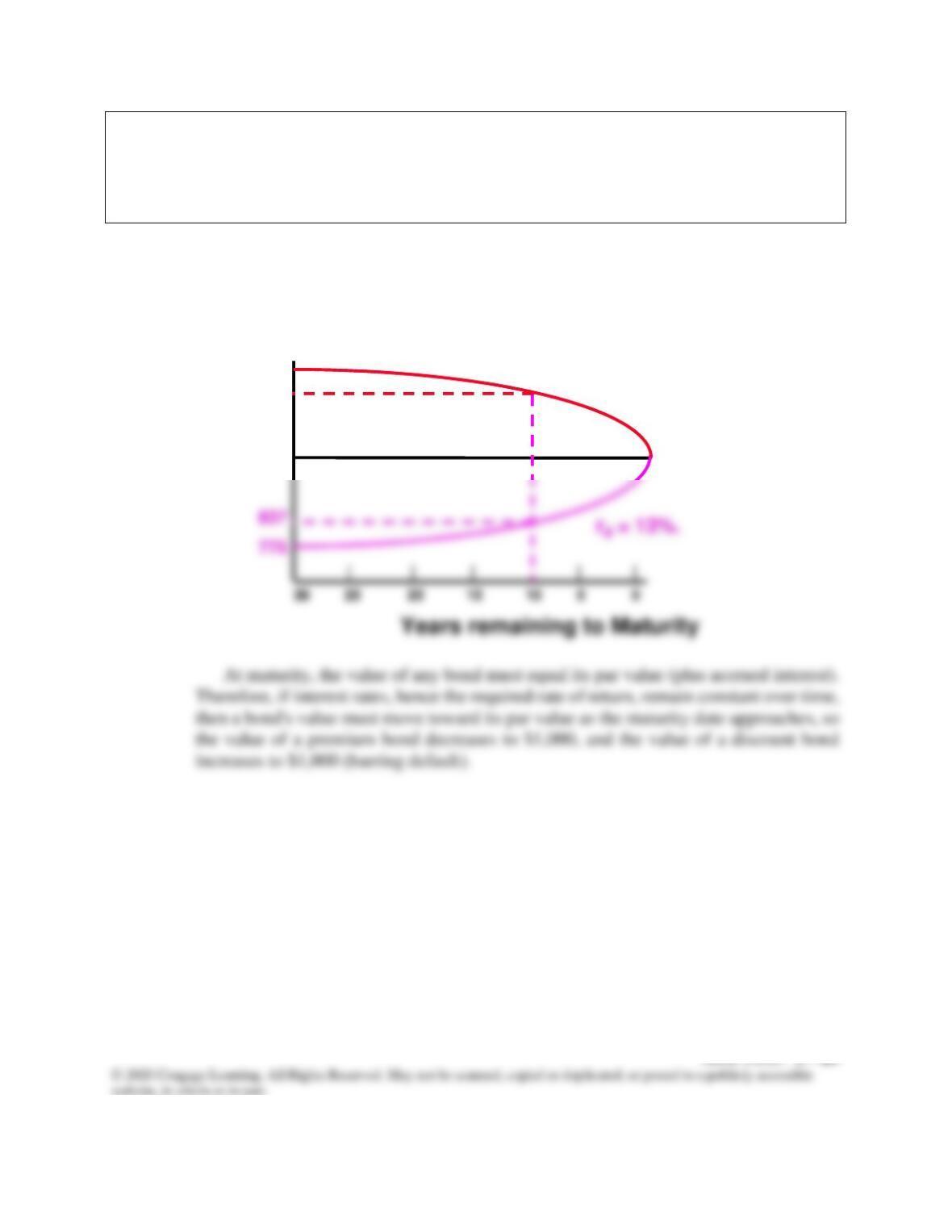
Answer: Assuming that interest rates remain at the new levels (either 7% or 13%), we could find
the bond’s value as time passes, and as the maturity date approaches. If we then plotted
the data, we would find the situation shown below:
M
Bond Value ($)
rd= 7%.
rd = 10%. M
Bond Value ($)
rd= 7%.
rd = 10%.
f. 1. What is the yield to maturity on a 10-year, 9 percent annual coupon, $1,000 par
value bond that sells for $887.00? That sells for $1,134.20? What does the fact that
a bond sells at a discount or at a premium tell you about the relationship between
rd and the bond’s coupon rate?
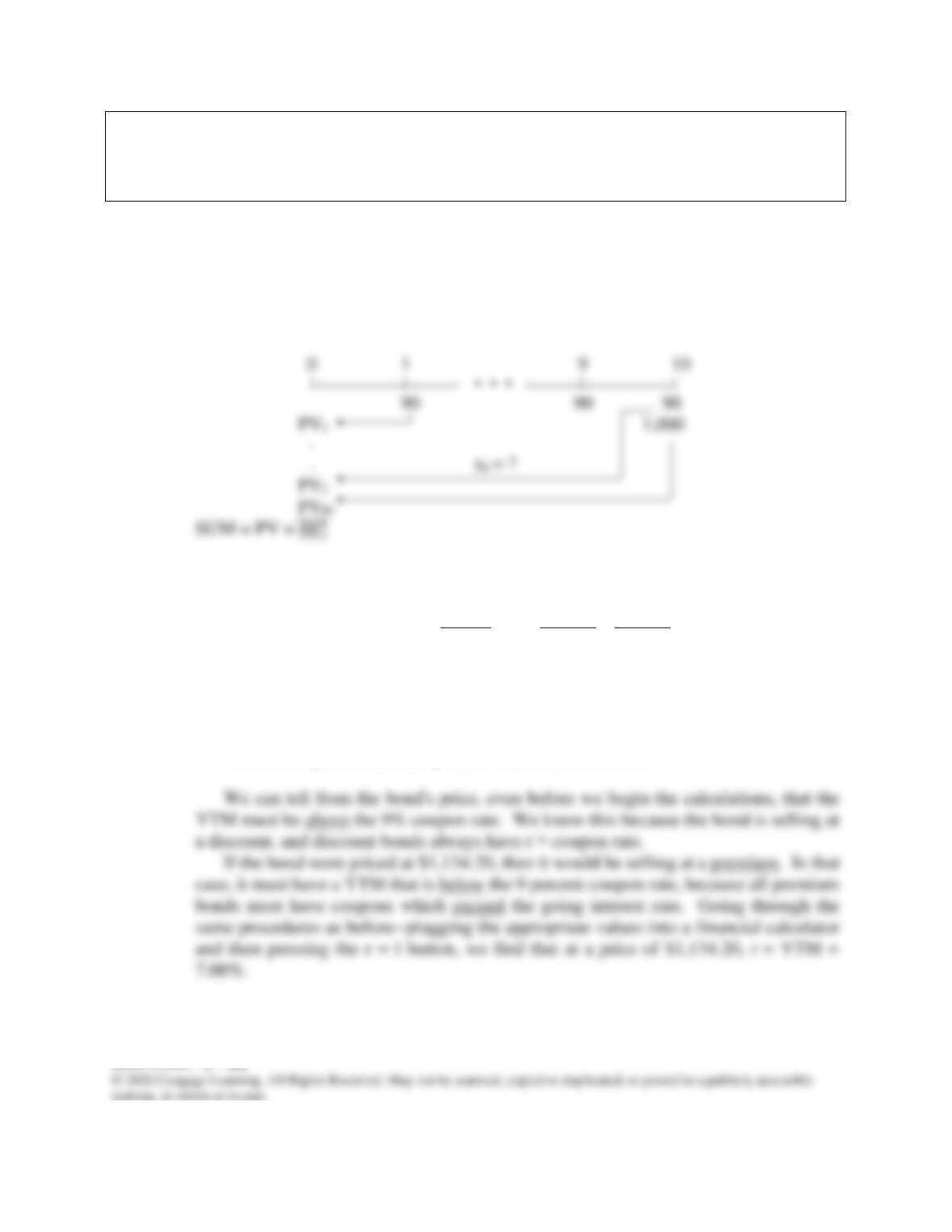
Answer: The yield to maturity (YTM) is that discount rate which equates the present value of a
bond’s cash flows to its price. In other words, it is the promised rate of return on the
bond. (Note that the expected rate of return is less than the YTM if some probability
of default exists.) On a time line, we have the following situation when the bond sells
for $887:
We want to find r in this equation:
.
)r + (1
M
+
)r + (1
INT
+ … +
)r + (1
INT
= PV =
VNN1
B
We know n = 10, PV = -887, PMT = 90, and FV = 1000, so we have an equation with
one unknown, rd. We can solve for rd by entering the known data into a financial
calculator and then pressing the I/YR = rd button. The YTM is found to be 10.91%.
Alternatively, we could use present value interest factors:
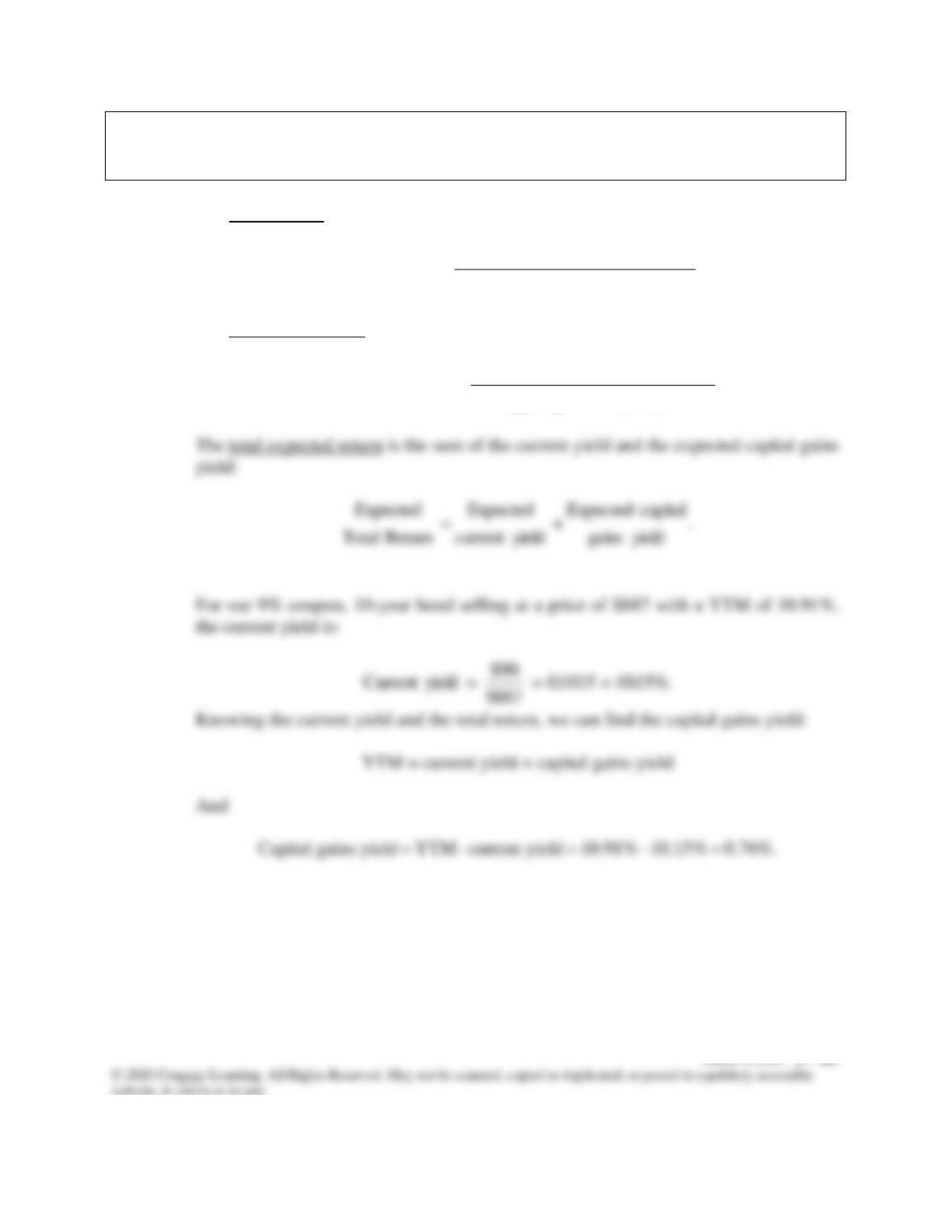
f. 2. What are the total return, the current yield, and the capital gains yield for the
discount bond? (Assume the bond is held to maturity and the company does not
default on the bond.)
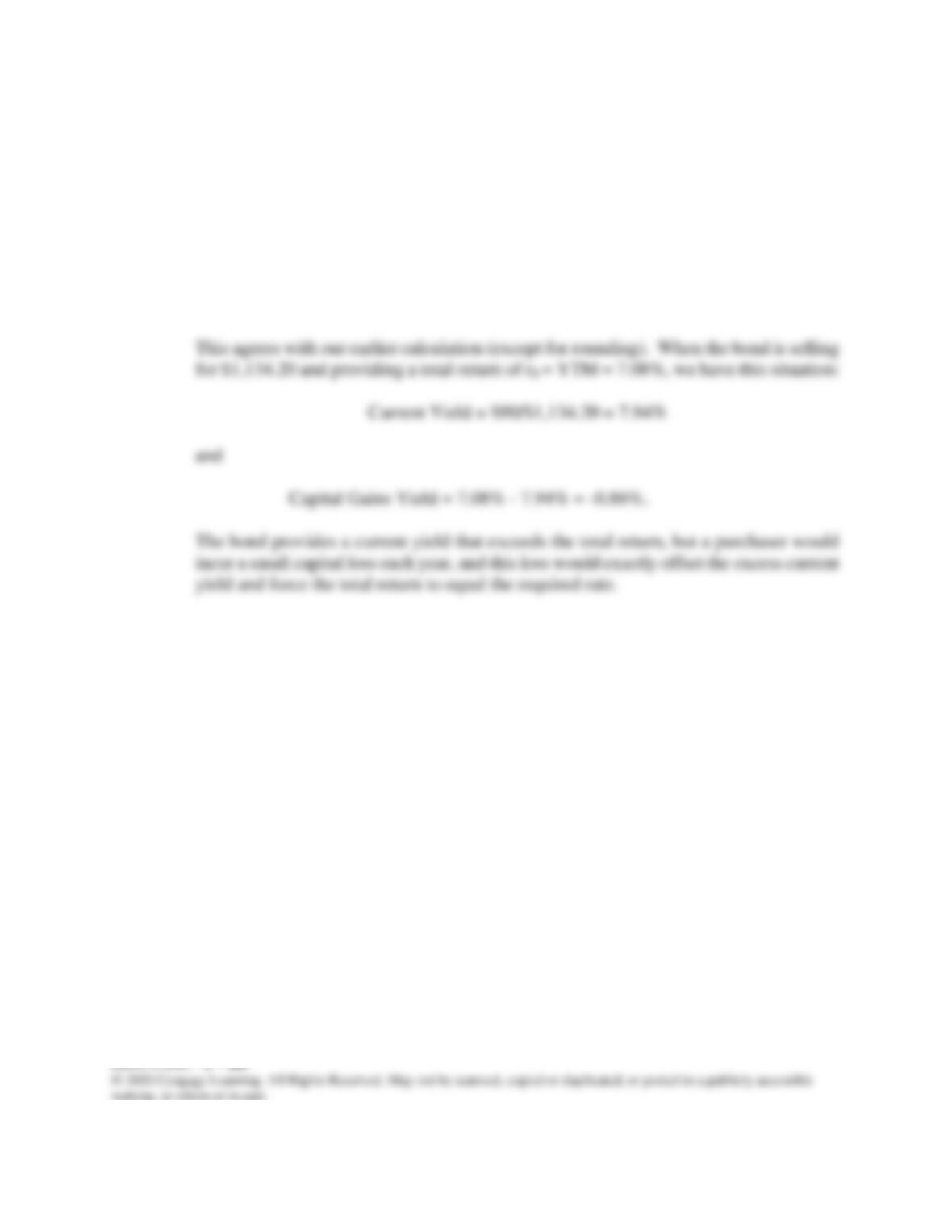
Answer: The current yield is defined as follows:
.
bond theof priceCurrent
paymentinterest coupon Annual
= YieldCurrent
The capital gains yield is defined as follows:
.
priceyear –of–Beginning
price sbond’in Change Expected
= yield gains Capital
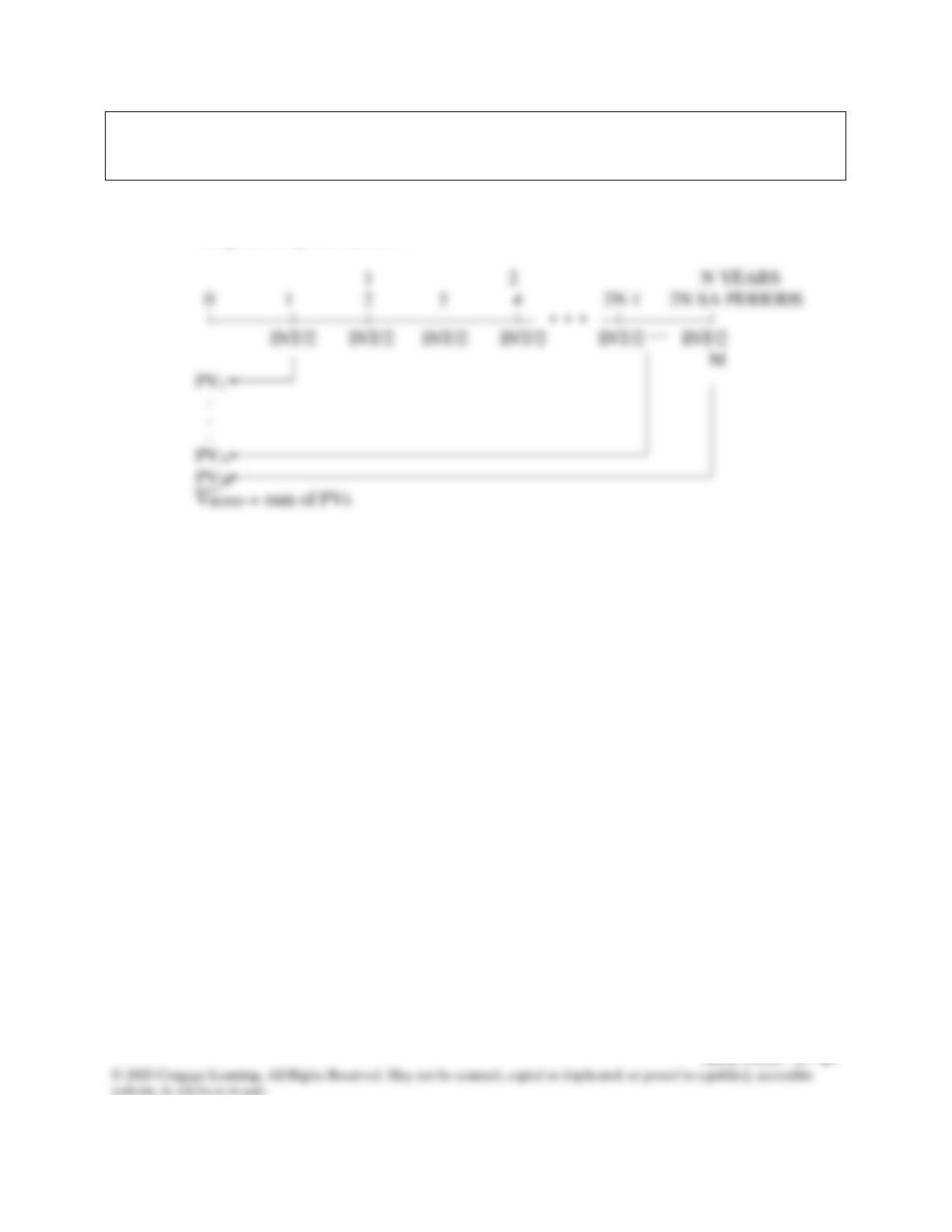
The capital gains yield calculation can be checked by asking this question: “What is
the expected value of the bond 1 year from now, assuming that interest rates remain at
current levels?” This is the same as asking, “What is the value of a 9-year, 9 percent
annual coupon bond if its YTM (its required rate of return) is 10.91 percent?” The
answer, using the bond valuation function of a calculator, is $893.87. With this data,
we can now calculate the bond’s capital gains yield as follows:
Capital Gains Yield =
V
)/
V
–
V
(BBB 001
= ($893.87 – $887)/$887 = 0.0077 = 0.77%,
g. How does the equation for valuing a bond change if semiannual payments are
made? Find the value of a 10-year, semiannual payment, 10 percent coupon bond
if nominal rd = 13%.
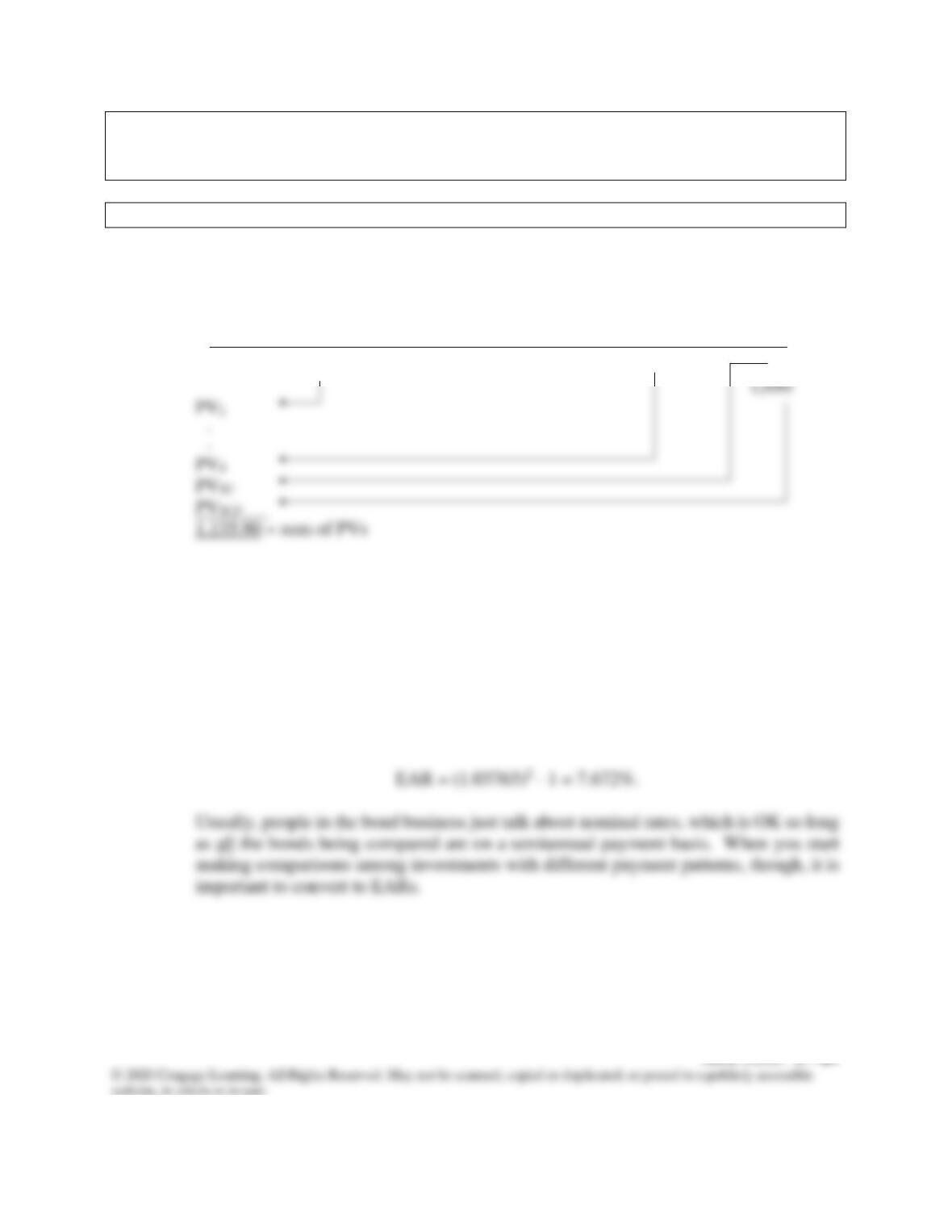
Answer: In reality, virtually all bonds issued in the U.S. have semiannual coupons and are valued
using the setup shown below:
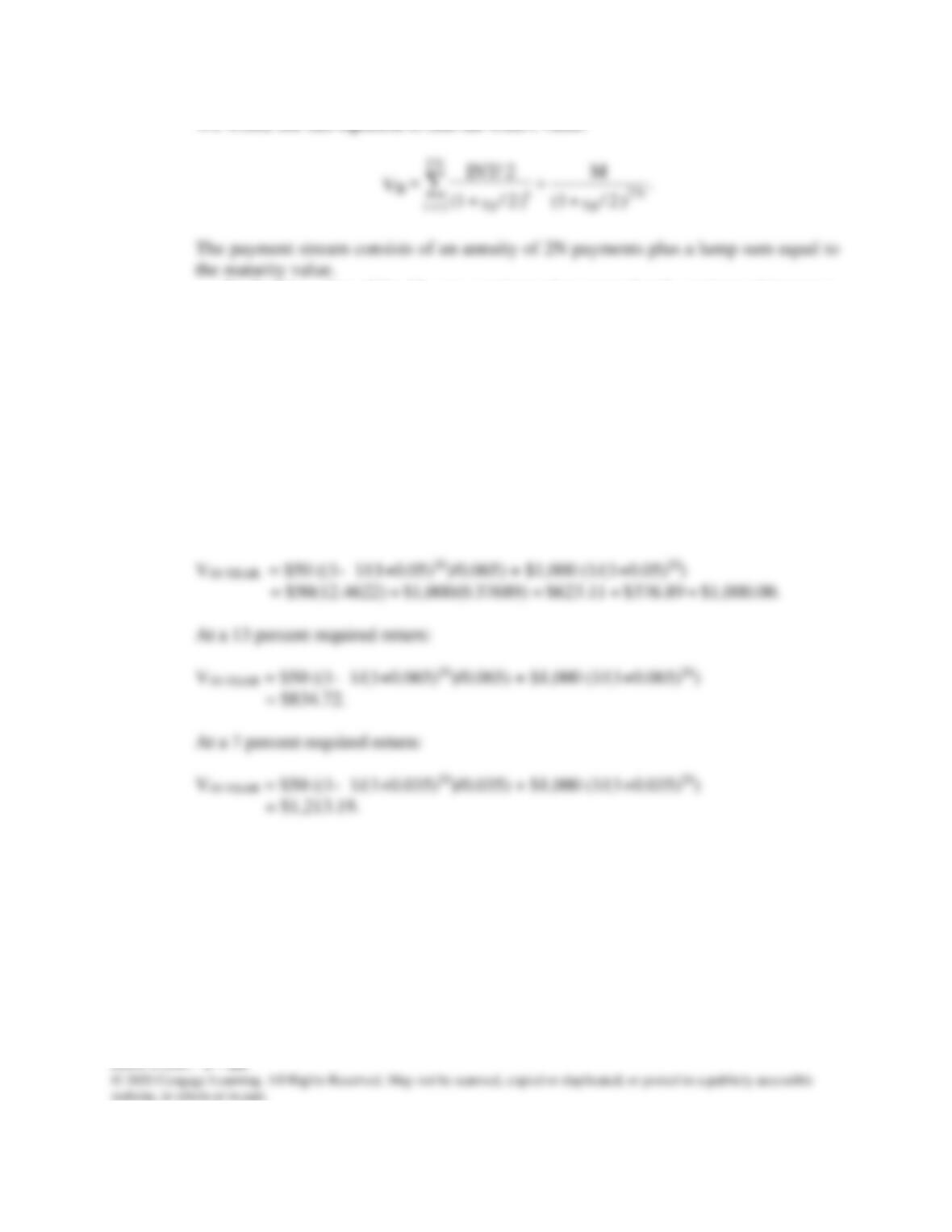
To find the value of the 10-year, semiannual payment bond, semiannual interest =
annual coupon/2 = $100/2 = $50 and N = 2 (years to maturity) = 2(10) = 20. To find
the value of the bond with a financial calculator, enter n = 20, rd/2 = I/YR = 5, PMT =
50, FV = 1000, and then press PV to determine the value of the bond. Its value is
$1,000.
You could then change rd = I/YR to see what happens to the bond’s value as r
changes, and plot the values—the graph would look like the one we developed earlier.
For example, if rd rose to 13%, we would input I/YR= 6.5 rather than 5%, and find
the 10-year bond’s value to be $834.72. If rd fell to 7%, then input I/YR = 3.5 and press
PV to find the bond’s new value, $1,213.19.
We would find the values with a financial calculator, but they could also be found
with formulas. Thus:
h. Suppose a 10-year, 10 percent, semiannual coupon bond with a par value of $1,000
is currently selling for $1,135.90, producing a nominal yield to maturity of 8
percent. However, the bond can be called after 5 years for a price of $1,050.
h. 1. What is the bond’s nominal yield to call (YTC)?
Answer: If the bond were called, bondholders would receive $1,050 at the end of year 5. Thus,
the time line would look like this:
0 1 2 3 4 5
| | | | | |
50 50 50 50 50 50 50 50 50 50
The easiest way to find the YTC on this bond is to input values into your calculator: n
= 10; PV = -1135.90; PMT = 50; and FV = 1050, which is the par value plus a call
premium of $50; and then press the rd = I/YR button to find I/YR = 3.765%. However,
this is the 6-month rate, so we would find the nominal rate on the bond as follows:
rNOM = 2(3.765%) = 7.5301% ≈ 7.5%.
This 7.5% is the rate brokers would quote if you asked about buying the bond.
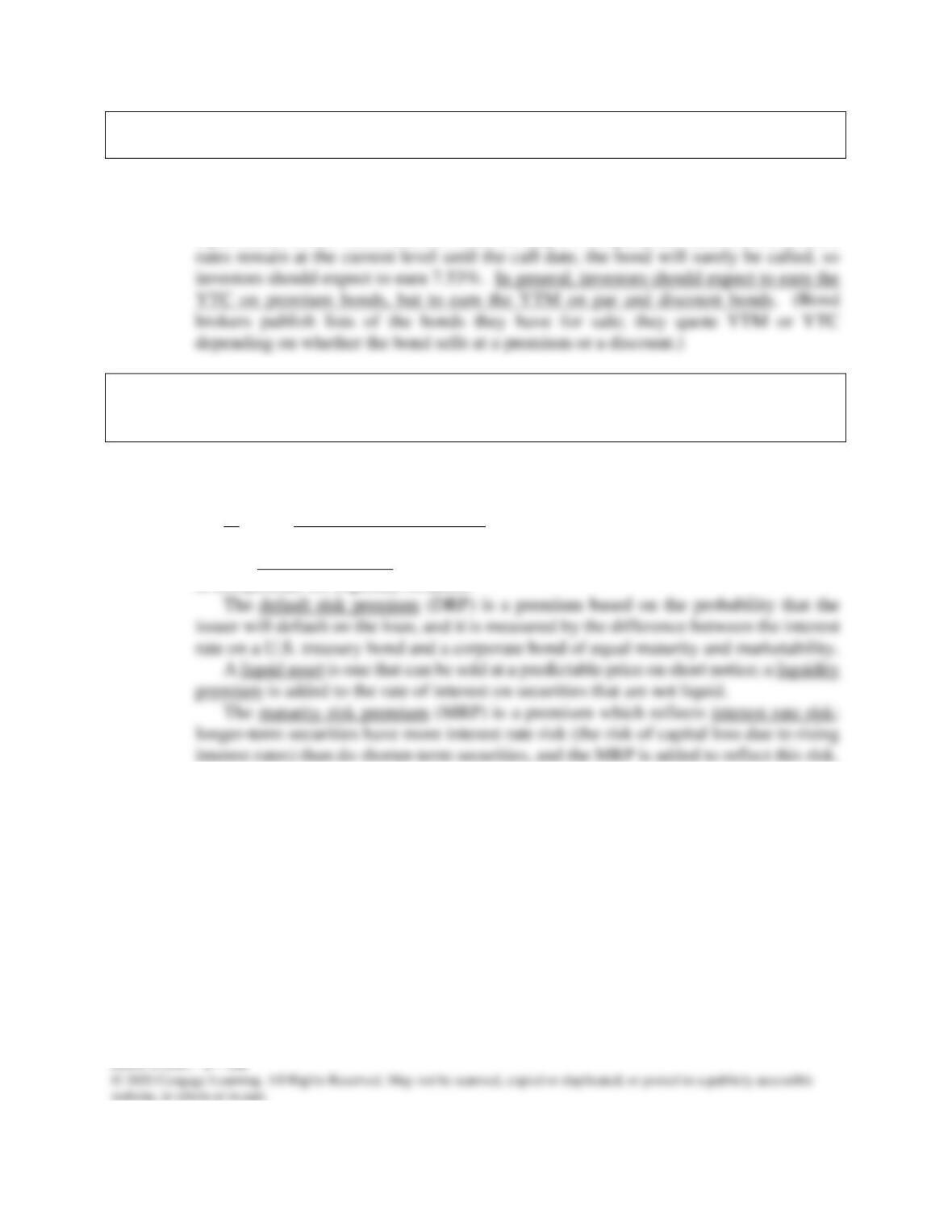
You could also calculate the EAR on the bond:
h. 2. If you bought this bond, do you think you would be more likely to earn the YTM
or the YTC? Why?
Answer: Since the coupon rate is 10% versus YTC = rd = 7.53%, it would pay the company to
call the bond, get rid of the obligation to pay $100 per year in interest, and sell
replacement bonds whose interest would be only $75.30 per year. Therefore, if interest
i. Write a general expression for the yield on any debt security (rd) and define these
terms: real risk-free rate of interest (r*), inflation premium (IP), default risk
premium (DRP), liquidity premium (LP), and maturity risk premium (MRP).
Answer: rd = r* + IP + DRP + LP + MRP.
r* is the real risk-free interest rate. It is the rate you see on a riskless security if
there were no inflation.
The inflation premium (IP) is a premium added to the real risk-free rate of interest
j. Define the real risk-free rate (r*). What security can be used as an estimate of r*?
What is the nominal risk-free rate (rRF)? What securities can be used as estimates
of rRF?
Answer: The real risk-free rate, r*, is the rate that a hypothetical riskless security pays each
moment if zero inflation were expected. The real risk-free rate is not constant—r*
changes over time depending on economic conditions. The best approximation for r*
k. Describe a way to estimate the inflation premium (IP) for a T-Year bond.
Answer: Treasury Inflation-Protected Securities (TIPS) are indexed to inflation. The IP for a