Chapter 5
Financial Options
ANSWERS TO BEGINNING-OF–CHAPTER QUESTIONS
5-1 See the BOC model. Based on the Black–Scholes model, we see that the value of the
5-2 As discussed in the chapter, options are compensation, compensation is an expense, and
expenses should be deducted from revenues when calculating income. Therefore, options
should be deducted on the income statement. However, if options are to be expensed,
their values must be estimated. Although it may not provide an exactly precise estimate
High tech companies have made the greatest use of options. The companies benefited
from reduced cash requirements during their rapid growth phase, and many employees of
successful companies became millionaires. However, options produced problems in the
period 2000–2002, when stock prices fell sharply, driving down the values of options
awarded in earlier years. The stock collapses were due primarily to a general decline in
the market from its “bubble” high, not by poor employee performance. If an employee
had received options whose value was based on an unrealistically high stock price, and if
Answers and Solutions: 5 – 1
5-3 In the past, managers and boards of directors have viewed stock options and stock grants
as almost “free” in the sense that they required no cash outlay, and they didn’t appear as
expenses (albeit non–cash) on the income statement. This view was common even
though it is abundantly clear from a finance perspective that such compensation is
costly—it dilutes the existing shareholders’ ownership and so the existing stockholders
However, stock options and the stock itself don’t have the same payoffs. If the
company does badly, and the stock declines to $30, then the stock option simply doesn’t
pay off and the employee receives nothing—stock options are designed to only pay off
when the company does better. However the stock itself will still be worth $30 and so
the employee will still have some “value” in the incentive package. And if the stock
declines further, this value will decline as well. So if management wants to make
Answers and Solutions: 5 – 2
5-4 If managers or stockholders view their stakes as option–like, then they have some very
clear incentives. You know from problem 1 above that options are worth more the higher
the value of the underlying asset, the more volatile the underlying asset and the longer the
time to expiration. Thus managers will have incentives to 1) increase the value of the
ANSWERS TO END-OF-CHAPTER QUESTIONS
5-1 a. An option is a contract which gives its holder the right to buy or sell an asset at some
predetermined price within a specified period of time. A call option allows the holder
to buy the asset, while a put option allows the holder to sell the asset.
b. A simple measure of an option’s value is its exercise value. The exercise value is
equal to the current price of the stock (underlying the option) less the striking price of
5-2 The market value of an option is typically higher than its exercise value due to the
speculative nature of the investment. Options allow investors to gain a high degree of
5-3 (1) An increase in stock price causes an increase in the value of a call option. (2) An
increase in strike price causes a decrease in the value of a call option. (3) An increase in
SOLUTIONS TO END-OF-CHAPTER PROBLEMS
5-1 Exercise value = Current stock price – strike price
5-2 Option’s strike price = $15; Exercise value = $22; Time value = $5;
V = ? P0 = ?
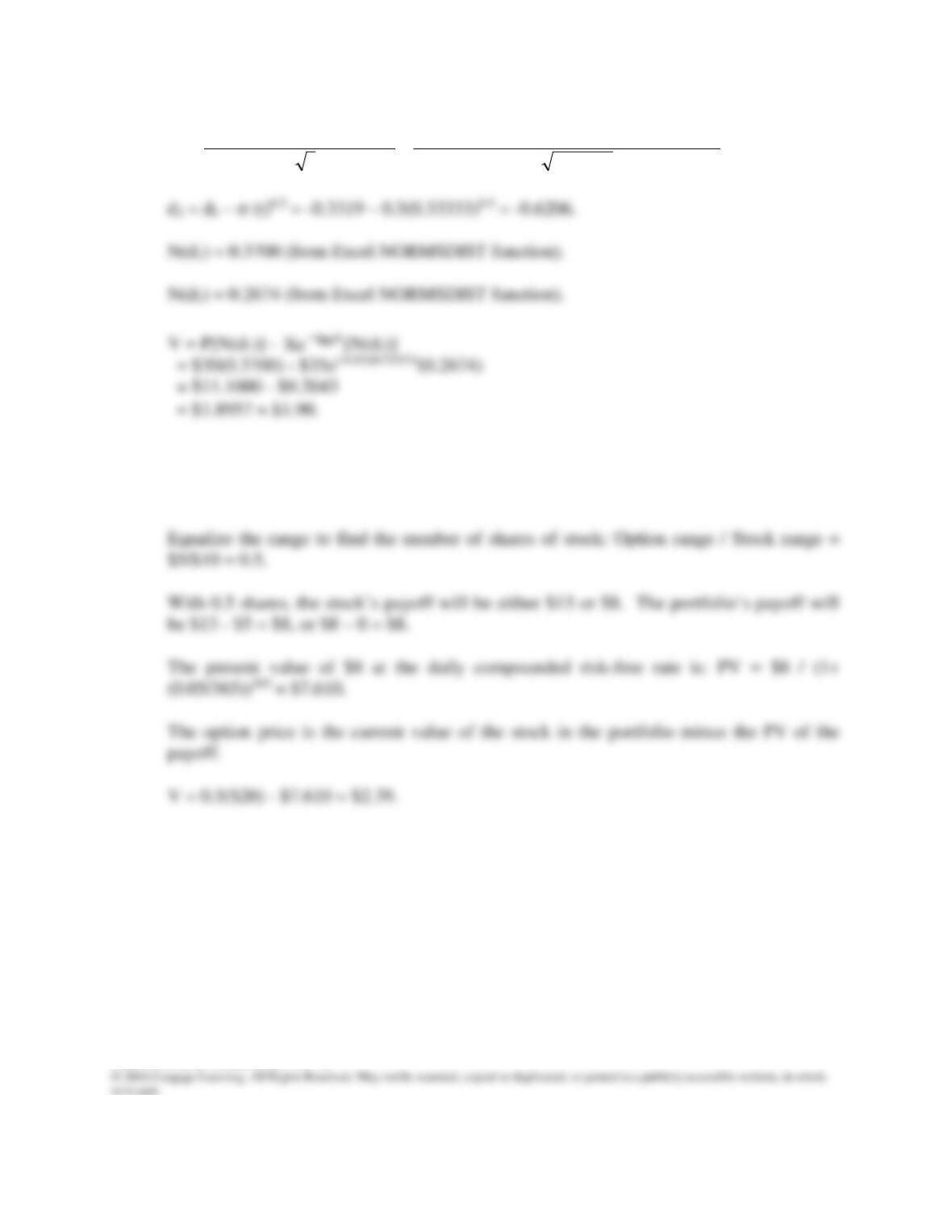
5-3 P = $15; X = $15; t = 0.5; rRF = 0.06; σ2 = 0.12; d1 = 0.24495;
d2 = 0.0000; N(d1) = 0.59675; N(d2) = 0.500000; V = ?
Using the Black-Scholes Option Pricing Model, you calculate the option’s value as:
Answers and Solutions: 5 – 5
5-5
.3319.0
33333.05.0
)333333.0)](2/25.0(05.0[)35/$30($ln
tσ
)]t2/
2
(σ
RF
[r(P/X)ln
1
d−=
++
=
++
=
5-6 The stock’s range of payoffs in one year is $26 – $16 = $10. At expiration, the option
will be worth $26 – $21 = $5 if the stock price is $26, and zero if the stock price $16. The
range of payoffs for the stock option is $5 – 0 = $5.
Answers and Solutions: 5 – 6
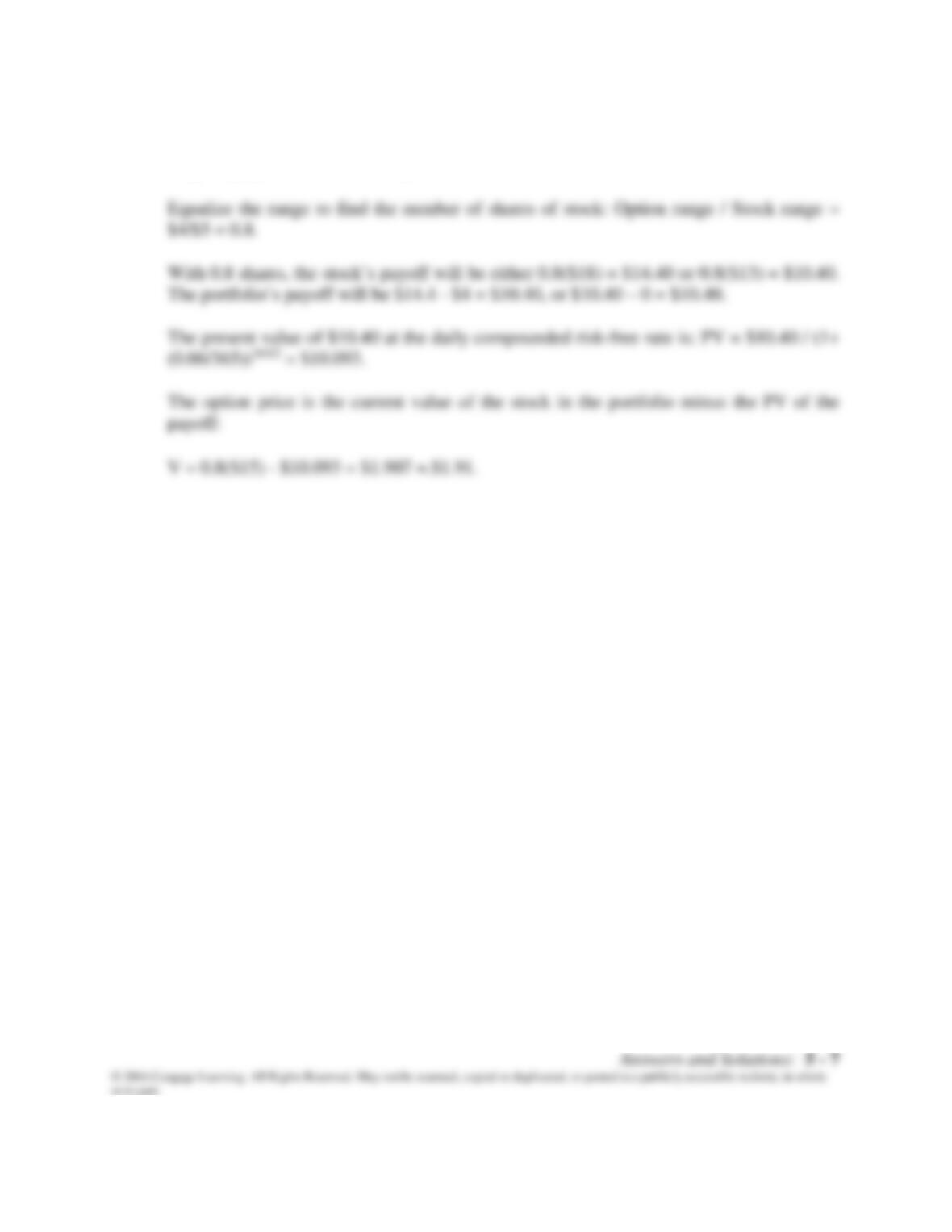
5-7 The stock’s range of payoffs in six months is $18 – $13 = $5. At expiration, the option
will be worth $18 – $14 = $4 if the stock price is $18, and zero if the stock price $13. The
range of payoffs for the stock option is $4 – 0 = $5.

SOLUTION TO SPREADSHEET PROBLEMS
5-8 The detailed solution for the problem is available in the file Ch05 P08 Build a Model
Solution.xls at the textbook’s web site.
Answers and Solutions: 5 – 8
MINI CASE
Assume that you have just been hired as a financial analyst by Triple Play Inc., a mid–sized
California company that specializes in creating high–fashion clothing. Since no one at
Triple Play is familiar with the basics of financial options, you have been asked to prepare
a brief report that the firm’s executives could use to gain at least a cursory understanding
of the topic.
To begin, you gathered some outside materials the subject and used these materials to
draft a list of pertinent questions that need to be answered. In fact, one possible approach
to the paper is to use a question-and-answer format. Now that the questions have been
drafted, you have to develop the answers.
a. What is a financial option? What is the single most important characteristic of
an option?
Answer: A financial option is a contract which gives its holder the right to buy (or sell) an
b. Options have a unique set of terminology. Define the following terms: (1) call
option; (2) put option; (3) strike price; (4) expiration date; (5) exercise value (6)
option price; (7) time value; (8) covered option; (9) naked option; (10) in–the–
money call; (11) out-of-the-money call; and (12) LEAPS.
Answer: 1. A call option is an option to buy a specified number of shares of a security
within some future period.
Mini Case: 5 – 9
6. The option price is the market price of the option contract.
7. The time value is the difference between the option price and the exercise value.
12. An out-of-the-money call is a call option whose strike price exceeds the current
stock price.
Mini Case: 5 – 10
c. Consider Triple Play’s call option with a $25 strike price. The following table
contains historical values for this option at different stock prices:
Stock Price Call Option Price
$25 $ 3.00
30 7.50
35 12.00
40 16.50
45 21.00
50 25.50
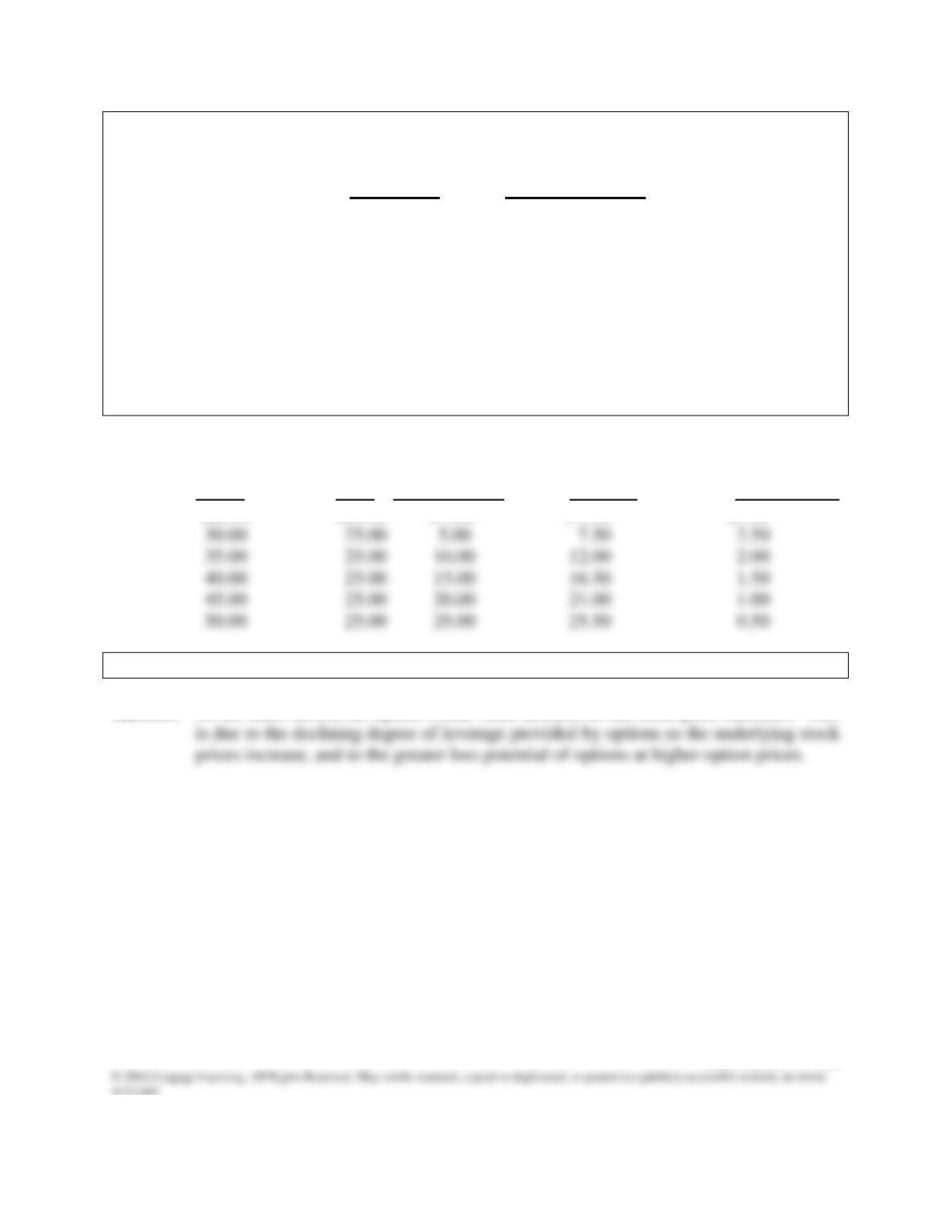
1. Create a table which shows (a) stock price, (b) strike price, (c) exercise value, (d)
option price, and (e) the time value, which is the option’s price less its exercise
value.
Answer: Price Of Strike Exercise Value Market Price Time Value
Stock Price Of Option Of Option (D) – (C) =
(A) (B) (A) – (B) = (C) (D) (E)
$25.00 $25.00 $ 0.00 $ 3.00 $3.00
c. 2. What happens to the option’s time value as the stock price rises? Why?
Answer: As the table shows, the option’s time value declines as the stock price increases. This
Mini Case: 5 – 11
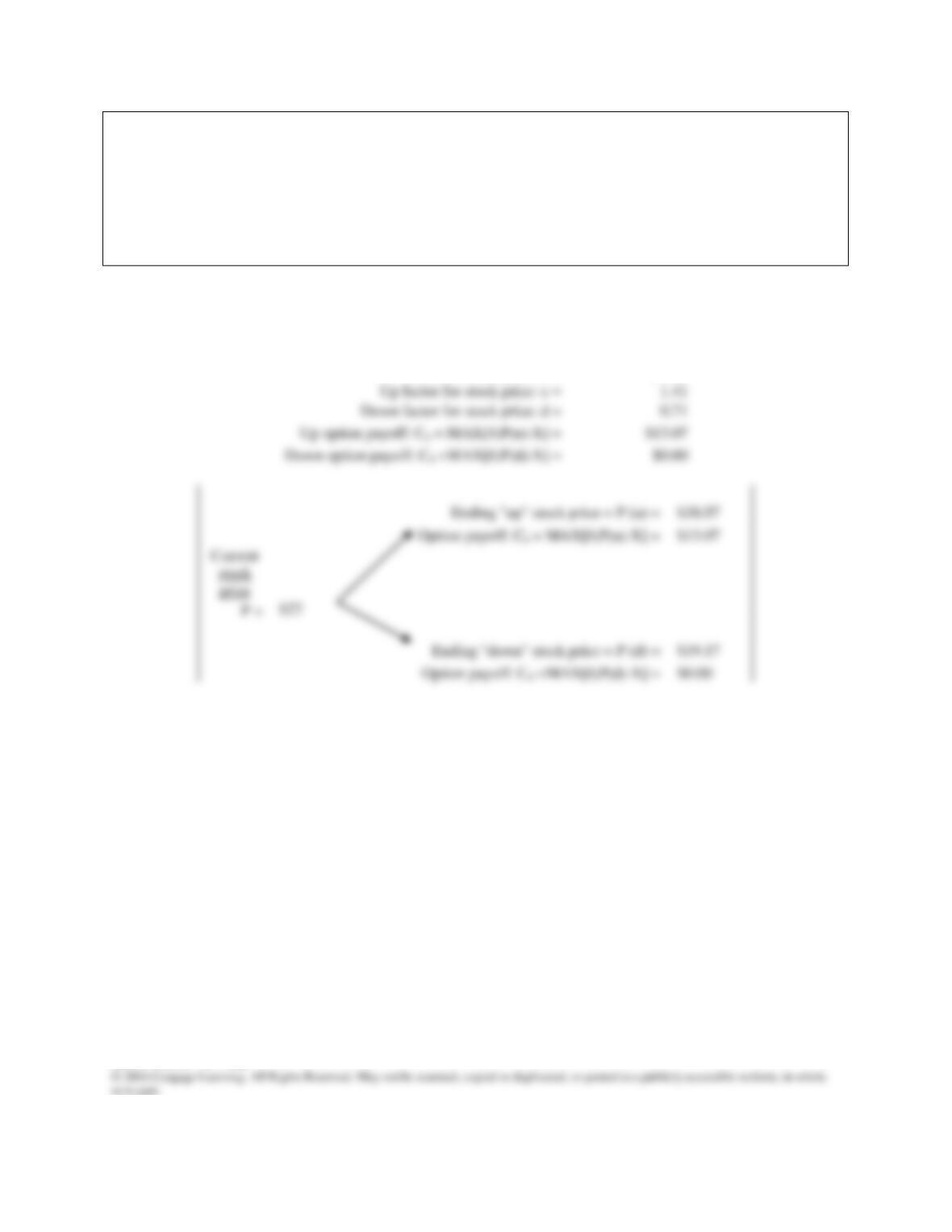
d. Consider a stock with a current price of P = $27. Suppose that over the next 6
months the stock price will either go up by a factor of 1.41 or down by a factor of
0.71. Consider a call option on the stock with a strike price of $25 which expires
in 6 months. The risk–free rate is 6%.
1. Using the binomial model, what are the ending values of the stock price? What
are the payoffs of the call option?
Answer: The assumptions which underlie the OPM are as follows:
Strike price: X =
$25.00
Current stock price: P =
$27.00
Mini Case: 5 – 12
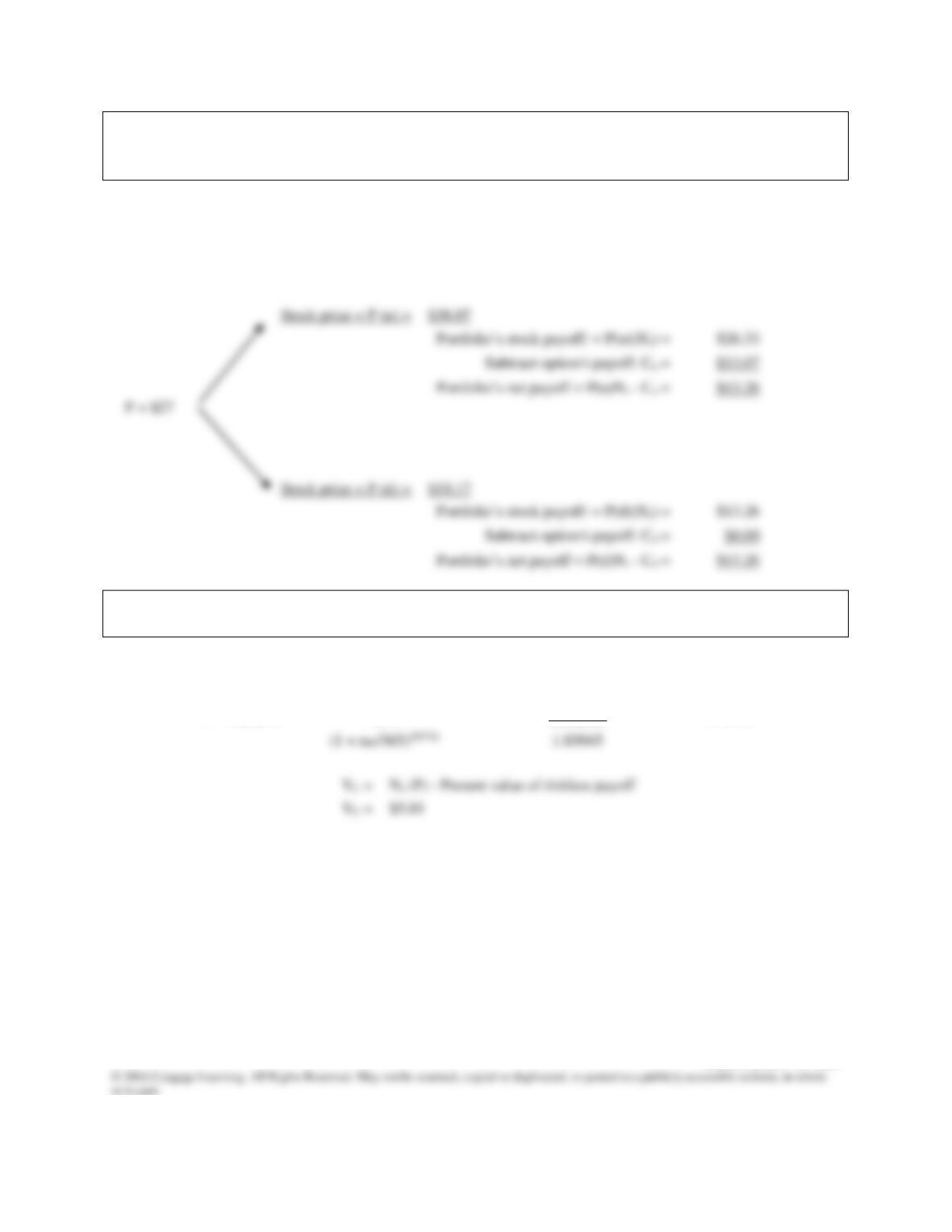
d. 2. Suppose you write 1 call option and buy Ns shares of stock. How many shares
must you buy to create a portfolio with a riskless payoff (which is called a hedge
portfolio)? What is the payoff of the portfolio?
Answer:
Ns =
Cu – Cd
=
0.69153
P(u – d)
:
d. 3. What is the present value of the hedge portfolio’s riskless payoff? What is the
value of the call option?
Answer:
PV of payoff =
Payoff
=
$13.2567
=
$12.865
1.03045
Mini Case: 5 – 13
d. 4. What is a replicating portfolio? What is arbitrage?
Answer: If you borrow an amount equal to the present value of the hedge portfolio’s
riskless payoff and purchase Ns shares of stock, the portfolio’s payoff’s will
e. In 1973, Fischer Black and Myron Scholes developed the Black–Scholes Option
Pricing Model (OPM).
1. What assumptions underlie the OPM?
Answer: The assumptions which underlie the OPM are as follows:
• The stock underlying the call option provides no dividends during the life of the
option.
Mini Case: 5 – 14
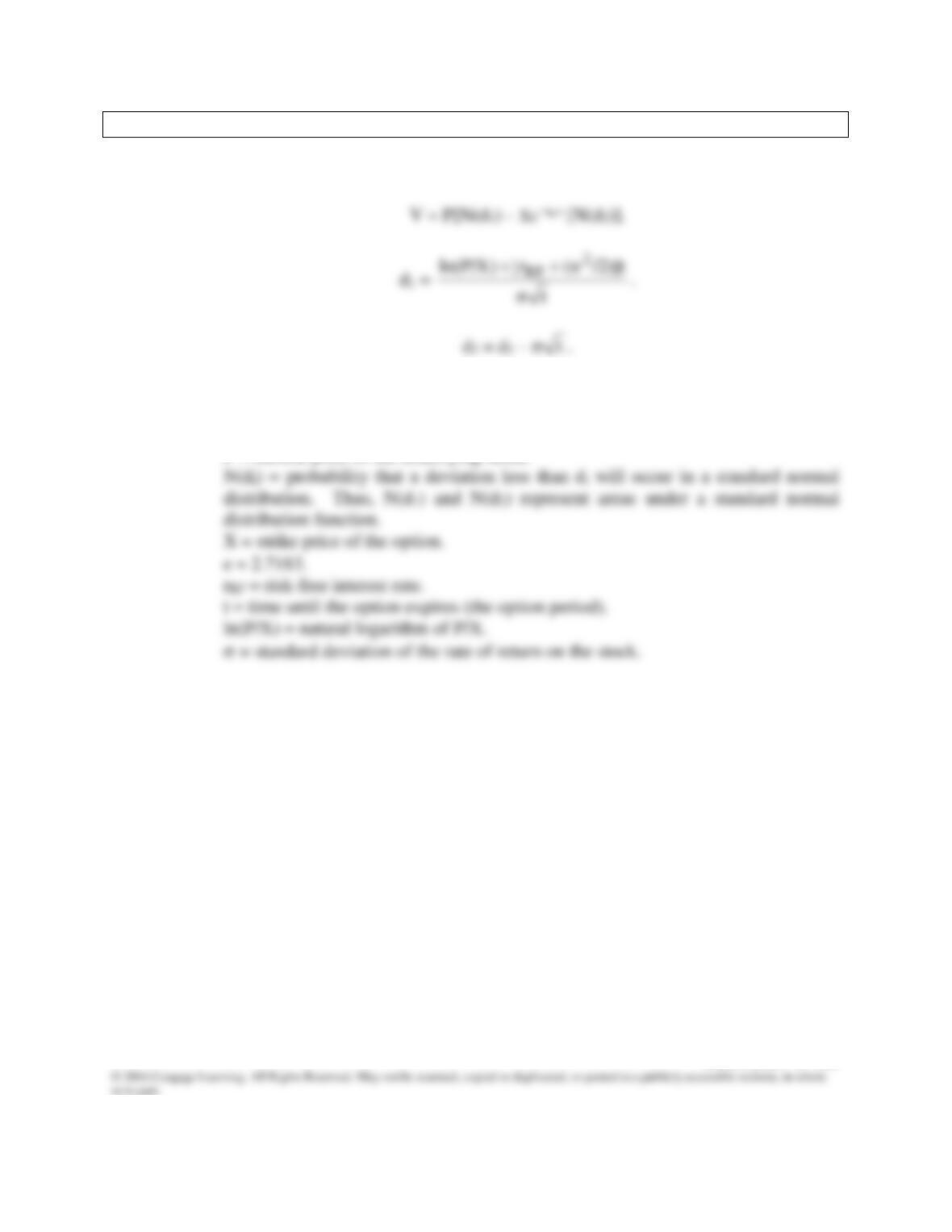
e. 2. Write out the three equations that constitute the model.
Answer: The OPM consists of the following three equations:
Here,
V = current value of a call option with time t until expiration.
P = current price of the underlying stock.
Mini Case: 5 – 15
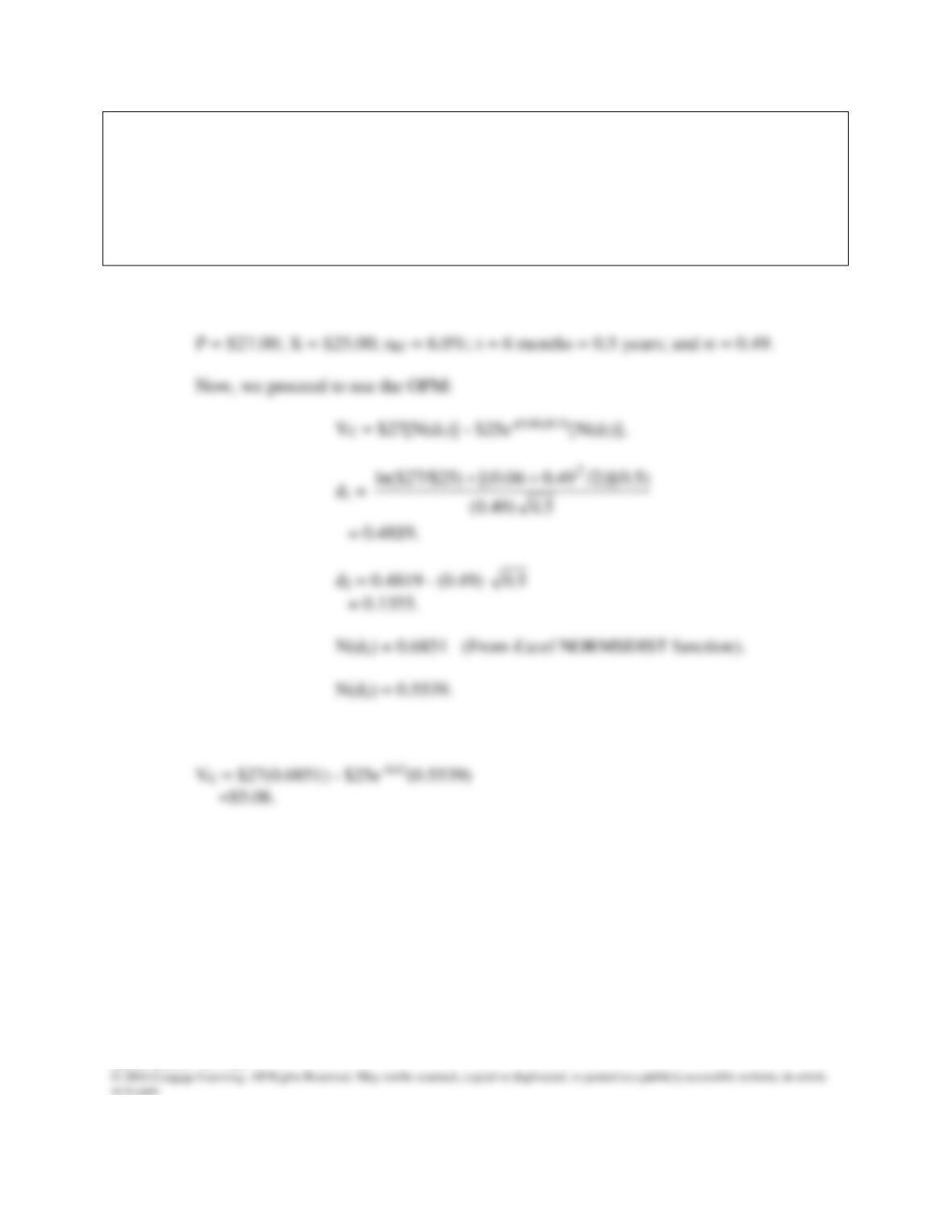
e. 3. What is the value of the following call option according to the OPM?
Stock Price = $27.00.
Strike Price = $25.00
Time To Expiration = 6 Months = 0.5 years.
Risk-Free Rate = 6.0%.
Stock Return Standard Deviation = 0.49.
Answer: The input variables are:
Therefore,
Mini Case: 5 – 16
f. What impact does each of the following call option parameters have on the value
of a call option?
1. Current Stock Price
2. Strike Price
3. Option’s Term To Maturity
4. Risk–Free Rate
5. Variability Of The Stock Price
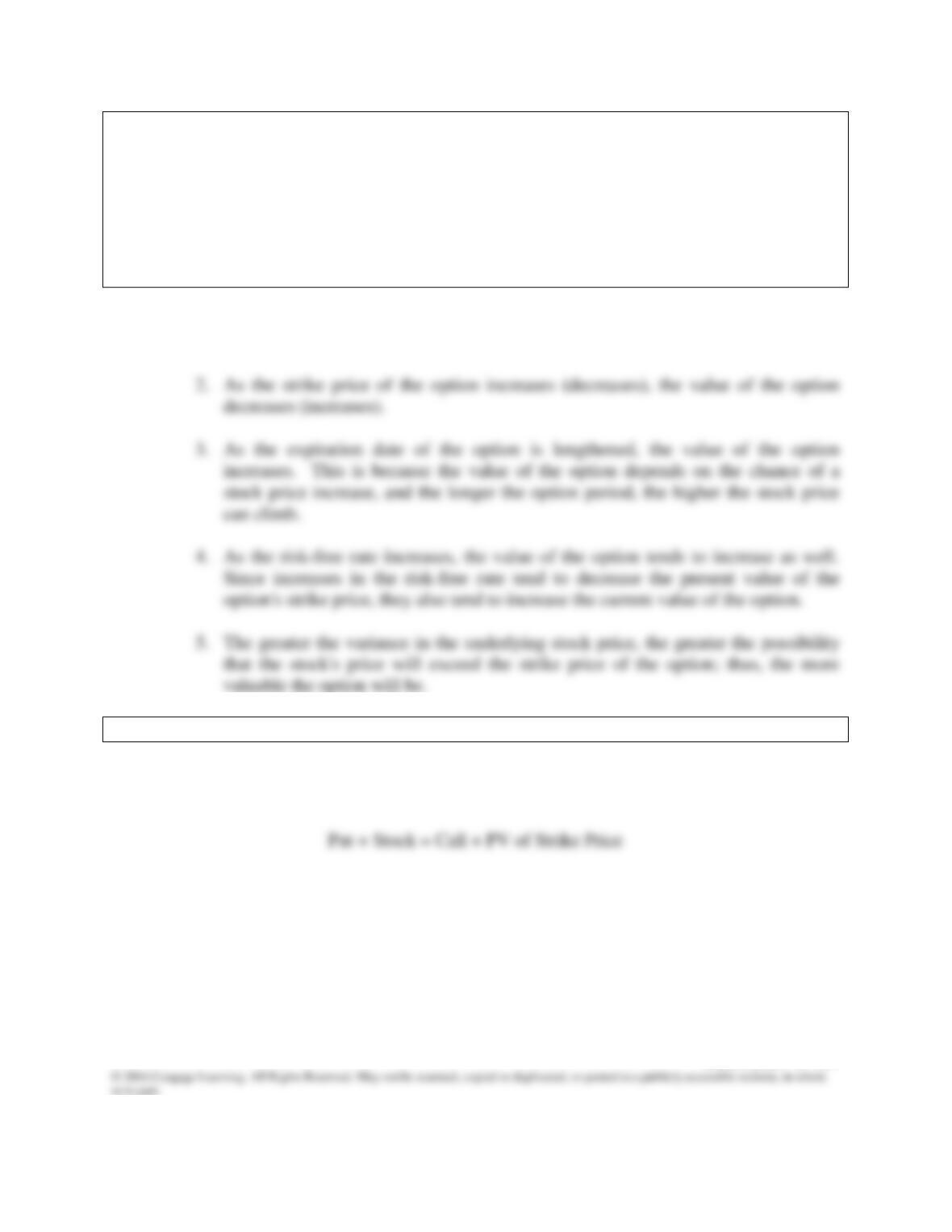
Answer: 1. The value of a call option increases (decreases) as the current stock price
increases (decreases).
2. As the strike price of the option increases (decreases), the value of the option
g. What is put-call parity?
Answer: Put-call parity specifies the relationship between puts, calls, and the underlying stock
price that must hold to prevent arbitrage:
Mini Case: 5 – 17